Texte Intégral du Document
Texte extrait du document original pour l'indexation.
S/2026/732
United Nations
Security Council
Distr.: General
10 September 2026
English
Original: French
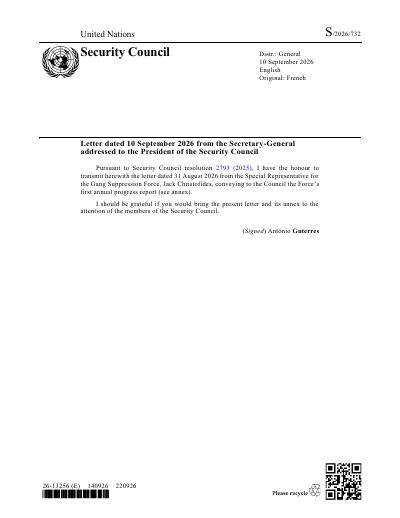
Letter dated 10 September 2026 from the Secretary-General
addressed to the President of the Security Council
Pursuant to Security Council resolution 2793 (2025), I have the honour to
transmit herewith the letter dated 31 August 2026 from the Special Representative for
the Gang Suppression Force, Jack Christofides, conveying to the Council the Force ’s
first annual progress report (see annex).
I should be grateful if you would bring the present letter and its annex to the
attention of the members of the Security Council.
(Signed) António Guterres
26-13256 (E)
140926
*2613256*
220926
�S/2026/732
Annex
[Original: English]
Pursuant to Security Council resolution 2793 (2025), in which the Council
requested that I keep it informed of developments relating to the security and
stabilization situation in Haiti, I have the honour to transmit the first progress report
of the Gang Suppression Force, covering the period from the establishment of the
Force until 31 August 2026 (see enclosure).*
Since its authorization, the Force has progressed from the force -generation and
initial deployment phase to the conduct of sustained operational activities. As at
31 August, 1,166 uniformed personnel from six troop-contributing countries had been
deployed, representing 73% of the Force’s initial operational capability. Four bases
had been established, including in Gonaïves, marking the Force’s first deployment
outside Port-au-Prince.
The Force is conducting intelligence-led patrols and joint operations with the
Haitian National Police and has concluded key institutional agreements with the
Government of Haiti, including the status agreement signed on 27 July and the
detainee handover agreement. While continuing to expand its operational presence,
the Force remains focused on completing force generation and further strengthening
its human rights, protection and prevention of sexual exploitation and abuse
frameworks, as detailed in the report.
I would be grateful if you would arrange for the present letter and the report to
be circulated as a document of the Security Council.
(Signed) Jack Christofides
Special Representative
* The enclosure is being issued without formal editing.
2/12
26-13256
�S/2026/732
Enclosure
GANG SUPPRESSION FORCE IN HAITI
ANNUAL PROGRESS REPORT
Submitted pursuant to Security Council resolution 2793 (2025)
Reporting period
1 April through 31 August 2026
26-13256
3/12
�S/2026/732
Executive Summary
Since the adoption of Security Council resolution 2793 (2025), the Gang Suppression
Force (GSF) has focused on force generation, initial deployments, operation al startup, and the establishment of its legal, administrative and accountability frameworks.
This report covers GSF activities from 1 April to 31 August 2026.
During the reporting period, the GSF continued to implement its operating model
through intelligence-led operations, the establishment of forward operating bases
(FOBs), including outside Port-au-Prince, and coordination with the Haitian National
Police (HNP) and other Haitian authorities. These efforts contributed to localized
security gains in some areas, including temporary reductions in gang activity and
improved conditions for civilian movement. However, the sustainability and
scalability of these gains remain constrained by persistent operational challenges,
including limitations in force generation, mobility, intelligence, logistics, and other
enabling capabilities. Addressing these constraints will be critical to maintaining
operational momentum and achieving broader and more durable security effects. On
29 June 2026, the GSF submitted its strategy and metrics, providing the Security
Council with benchmarks to assess progress, identify gaps, and strengthen
accountability.
Despite these achievements, mandate implementation continues to be constrained by
insufficient uniformed personnel and outstanding institutional arrangements,
including agreements on privileges and immunities and provisions for death and
disability benefits for deployed personnel.
The GSF has also strengthened partnerships with the HNP, United Nations entities,
civil society organizations, humanitarian actors, and the diplomatic community.
Looking ahead, the GSF will focus on transitioning from initial operations to the
sustained expansion of its operating model. Priority efforts will include completing
force generation, consolidating and extending forward operating bases, expanding
joint operations with the HNP and coordination with the Haitian Armed Forces,
protecting critical infrastructure, and addressing remaining capability and
sustainment gaps.
4/12
26-13256
�S/2026/732
I. Security Environment
1.
Haiti’s gangs control or exert significant influence over the country ’s main roads
into and out of Port-au-Prince, using illegal checkpoints, extortion, and other coercive
practices to generate revenue. This includes National Roads 3 and 8 towards the
principal border crossings with the Dominican Republic at Belladère and Ma lpasse,
National Road 1 to the north, and National Road 2 to the south. In the capital, gangs
also influence access to critical economic infrastructure, including the main container
port, fuel terminal, and bulk goods port, often imposing transit fees on t ransport
operators. Kidnapping, racketeering and trafficking remain major sources of income.
2.
The security crisis is concentrated in the Ouest, Artibonite, and Centre
Departments. The Ouest Department, particularly the Port-au-Prince metropolitan
area, remains the epicenter of gang activity. The Artibonite Department continues to
be the main contested rural area, while growing gang activity in the Centre
Department has increasingly affected local communities and transport routes to the
Dominican Republic.
3.
Gang territorial control is well established, although uneven across different
areas. Control of major trade, distribution, and transport routes continues to provide
gangs with significant financial resources and access to weapons and ammunition. In
the north and east of the Port-au-Prince metropolitan area, the Canaan and 400
Mawozo gangs maintained influence over key road networks. In the south, an alliance
of gangs centred around 5 Segond dominated access routes to the southern
departments. In Artibonite, Gran Grif and Kokorat San Ras remained the principal
gangs, retaining the ability to disrupt freedom of movement and state authority across
a wide area.
4.
The reporting period saw indications of reduced visibility and influence among
some prominent gang leaders. The operational profile and public prominence of
Jimmy Chérizier (“Barbecue”), associated with the Delmas 6 gang and the G9 and
Viv Ansanm gang coalitions, appeared to decline. Similar trends were observed
regarding Vitelhomme Innocent of the Kraze Baryè gang in the Tabarre neighborhood
of Port-au-Prince. These developments coincided with the establishment of a GSF
presence in Tabarre and Bas Delmas, although a direct link is difficult to establish.
5.
Some gangs continued to demonstrate increasing levels of militarization and
tactical adaptation. They constructed fortified positions and physical barriers along
strategic routes and adopted their tactics to counter security-force operations,
including through the use of improvised incendiary devices against police stations
and public institutions, and were accompanied by kidnapping, child recruitment,
sexual violence, arson, intimidation of communities, destruction of residential areas,
and forced displacement.
6.
While security operations have disrupted gang activities and inflicted losses,
gangs retain the ability to recruit, adapt, and re-establish positions in contested areas.
Sustained operations by the HNP and other security forces weakened gang presence
in areas such as Kenscoff, Village de Dieu, Gressier, and Artibonite. However, these
gains have not fundamentally changed the broader pattern of territorial control, and
gangs have continued to demonstrate the capacity to retaliate against communities
following security operations.
7.
The persistent threat of retaliation was starkly illustrated by a coordinated attack
in Kenscoff and surrounding localities on 23 and 24 August 2026. Members of the 5
Segond gang and the broader Viv Ansanm coalition targeted displaced civilians
sheltering in a local church, executing residents, burning down over 25 homes, a
church, and a public school, and displacing populations toward Pétion -Ville. The
26-13256
5/12
�S/2026/732
United Nations estimates at least 47 people were killed, including five children, 22
injured, and more than 50 abducted. During the response, HNP units halted the gang ’s
advance using explosive drones, loitering munitions, leaving at least two officers
wounded. In response, gang leadership released video threats to execute the hostages
if security forces continue using explosive drones or launch further counteroperations .
This assault highlights the expansion of gang operations into previously quieter
agricultural areas as groups adopt to security pressures elsewhere in the capital.
II. GSF operational activities
8.
The GSF is authorized to deploy up to 5,500 uniformed personnel and 50
civilians, with an initial operational capability requirement of 1,500 uniformed
personnel. The Special Representative arrived in Port-au-Prince on 1 April 2026, and
the Force Commander and the first elements of the GSF Force Headquarters arrived
on 15 May. The first contingent from Chad arrived on 1 April.
9.
As of 31 August 2026, 1,213 uniformed personnel were deployed, representing
22 per cent of the uniformed personnel ceiling and 78.5 per cent of initial operational
capability. This includes 36 female uniformed personnel, a proportion of 2.9 per cent.
Six countries have uniformed personnel in theatre, contributing infantry, engineering,
aviation, military police, training, force protection and headquarters elements.
Twenty-nine civilians have been recruited with 22 having deployed, of which 45 per
cent are female staff.
Force composition by contributing country as of 31 August 2026
Contributing country
Capability
Strength
Chad
Infantry battalion
397
Sri Lanka
Main body
349
Guatemala
Military police company
150
El Salvador
Aviation unit (4 medium utility helicopters)
125
Mongolia
Force Commander, Headquarters staff, and base defence
company
172
Jamaica
DFC, Headquarters staff, and military training team
20
Total
Six contributing countries
1,213
10. Additional deployments are planned for the fourth quarter of 2026, including
formed police units, special weapons and tactics and enabling elements, and further
force headquarters personnel. In accordance with the deployment plan, over 5,000
uniformed personnel should be in the country by mid-January 2027.
11. The GSF has established four bases, three in Port-au-Prince, including one
adjacent to the Toussaint Louverture International Airport, and one in Gona їves in the
Artibonite Department. The deployment to Gonaїves was the first outside the capital
and a test of the GSF’s and the United Nations Support Office in Haiti (UNSOH) ’s
logistical capabilities. The FOB in the Bas Delmas neighborhood of Port -au-Prince
allowed the GSF to maintain a continuous presence in a key area of the city.
12. The GSF air component maintains four medium utility helicopters with military
crews, operating from Toussaint Louverture International Airport. GSF air assets face
regular threats from small arms fire. During the reporting period, GSF helicopters
came under attack on four occasions, resulting in two bullet impacts.
6/12
26-13256
�S/2026/732
13. Medical support for GSF personnel includes one Level 2 hospital and three
Level 1 facilities, with referral arrangements to specialist hospitals in the Dominican
Republic. The GSF has ground and air (civilian and military) casualty evacuation
assets as well as casualty evacuation is coordinated with UNSOH through by military
air is executed under an agreed clinical timeline with the evacuation coordination cell
embedded in the joint operations center, an arrangement first exercised during the
Gonaїves deployment. Preventive measures have included cholera vaccination and
health surveillance, and no significant disease outbreak affected operational
readiness.
Security Operations
14. The GSF conducted independent and joint operations with Haitian security
institutions, including 441 patrols (398 independent and 52 joint), six cordon and
search operations, three clearing operations, and 18 intelligence surveillance and
reconnaissance missions. It removed 40 barricades, and dismantled two illegal
checkpoints, denying gangs road control and the illicit taxation opportunities, seizing
nine weapons and hundreds of incendiary materials. During the reporting period, 16
suspected gang members were detained and three were neutralized. Of those detained,
13 were subsequently released. GSF patrols, static positions and operations also
served to protect critical infrastructure and key roads. In addition, the GSF maintained
daily perimeter and site security along the airport corridor.
15. Seventeen air reconnaissance missions were flown to conduct route and area
assessments across the overall area of responsibility, while six joint reconnaissance
missions with UNSOH supported planned expansion of the GSF.
16. GSF unmanned aerial systems provided intelligence, surveillance, and
reconnaissance in direct support of operations, which improved objective
identification, enhanced the security of assaulting elements, and better equipped
operations to achieve their intended effect.
17. Joint planning, combined patrolling, and shared operational reporting improved
interoperability with the HNP and Armed Forces of Haiti, and reinforced Haitian
ownership of the security effort. In areas where the GSF established a sustained
presence, including in Tabarre and Bas Delmas, there were indications of increased
commercial activity and a gradual return of some residents. These localized
developments nevertheless remain dependent on the continued provision of security
and basic services by the Haitian government.
Assessed effect in Tabarre and Delmas
18. Qualitative indicators from operational reporting and post-operational
assessments, including observations of residents and small businesses returning to
previously affected areas, suggest an improvement in the security situation. The GSF
has assessed a reduction in gang activity and territorial control across the two
municipalities where it has maintained a continuous presence. However, it is not yet
able to quantify these changes, as it is still refining its assessment methodology and
developing the metrics required to produce reliable and evidence-based analyses.
19. In Tabarre, continuous patrolling dismantled gang positions, cleared barricades,
and yielded weapons and incendiary materials. Consequently, residual gang elements
now operate in smaller groups and avoid direct confrontation with the GSF. Their
capacity to control roads and levy illegal taxation has been substantially reduced,
while civilian freedom of movement has increased and some small businesses have
reopened at previously abandoned intersections. In Delmas, regular patrols from the
GSF FOB have reduced gang influence along major roads and resulted in the seizure
26-13256
7/12
�S/2026/732
of more incendiary materials. This assessment is corroborated by two independent
streams of evidence: the return of residents and an increase in commercial activity,
indicating that the population assesses the risk of return to be acceptable. There has
also been a marked decline in the reported activity and public profile of gang
leadership in both municipalities. Information gathered from community engagement,
humanitarian coordination and interaction with local stakeholders indicated improved
civilian movement and confidence in areas where the GSF established a sustained
presence, while access remained highly constrained in areas affected by continuing
gang activity.
20. This progress, notwithstanding several sectors of these areas, remains contested
and gangs continue to exploit gaps during periods of reduced patrol and at night.
Several humanitarian organizations suspended operations across five neighborhoods
following the Cité Soleil crisis, more than 18,000 people were newly displaced, and
informal encampments consolidated along the airport road, placing a growing
displaced population astride a critical movement corridor.
21. Conditions for humanitarian access remained closely linked to local security
environments. The expanding GSF presence therefore improved the security
environment in some areas but did not by itself resolve the wider structural
constraints on humanitarian access.
III. Partnerships and Community Engagement
22. Cooperation with the Government of Haiti remains essential to implementation
of the GSF mandate. Cooperation with the HNP has intensified during the reporting
period through weekly senior-level meetings, combined planning, joint patrolling,
and operational information-sharing. The GSF also continued engagement with the
Haitian Armed Forces, with whom it shares a base in Port -au-Prince, as well as key
government institutions, including the Ministry of Justice and Public Security, the
Ministry of the Interior, the Ministry of Foreign Affairs, and the Office of the Prime
Minister.
23. The GSF maintained regular engagement with humanitarian partners, including
the Office for the Coordination of Humanitarian Affairs, the International Committee
of the Red Cross, Médecins Sans Frontières, other United Nations entities and other
humanitarian actors. These engagements focused on security developments,
operational constraints and humanitarian priorities. As the GSF expanded its
operational footprint, civil-military coordination became the primary mechanism for
dialogue with the humanitarian community. This engagement informed the
development of guidance on humanitarian notification, information -sharing and
operational coordination, helping to balance security requirements with humanitarian
principles. Civil environment assessments, supported by ongoing monitoring of open
sources and local media, further informed operational planning and humanitarian
coordination.
24. Coordination efforts also increasingly encompassed strategic communications
and community engagement. The Haiti Communications Group, as a sub -group of the
Standing Group of Partners, served as a regular platform for aligning communication
priorities among contributing partners. The GSF also worked with partners and
specialized organizations to better understand community perceptions and public
sentiment, informing its community engagement and strategic communications
activities. These mechanisms helped promote consistent messaging while respecting
the distinct mandates and responsibilities of the GSF, the United Nations and Haitian
authorities.
8/12
26-13256
�S/2026/732
25. Engagement with local authorities, community representatives, and other key
stakeholders across seven municipalities provided the GSF with valuable insights into
local security conditions, humanitarian needs, access challenges, and public
perceptions. Consultations with mayors and other authorities in gang -affected areas,
including those convened by the Ministry of the Interior, strengthened understanding
of local priorities and concerns, informing environment assessments and operational
planning. These engagements established direct channels of communication between
the GSF, local authorities and humanitarian actors, helping to reduce
misunderstanding and support a more coordinated approach among security,
humanitarian and community actors.
26. The GSF also extended its engagement with other Government institutions,
including the National Commission for Disarmament, Dismantlement and
Reintegration (CNDDR), as well as development partners and civil society
organizations. These engagements supported dialogue on stabilization, DDR and
community violence reduction, and on the restoration of State presence, services and
conditions necessary to sustain security gains.
27. The GSF does not seek to replace the roles of humanitarian organizations,
development partners, or Haitian state institutions. However, the sustainability of
security gains depends on the ability of Haitian institutions and civilian partners to
rapidly restore basic services, support the return of displaced populations, and
reestablish state presence in areas where security conditions have improved, thus
affording space and time to address the underlying conditions that empower armed
gangs.
IV. Institutional developments
28. Since 1 April 2026, the GSF has established key institutional and administrative
frameworks to support mandate implementation and operational effectiveness.
During the reporting period, it issued its Concept of Operations, Operations Order,
Rules of Engagement, Directive on Detention, Searches and Use of Force, Command
and Control Policy, and Directive on Disciplinary Matters.
29. The GSF also concluded several key agreements with the Government of Haiti.
These included the Status Agreement of 27 July 2026, which defines the GSF ’s legal
status, privileges and immunities in Haiti, and the Detainee Handover Agreement,
which sets out procedures for the transfer, treatment and monitoring of individuals
apprehended by the GSF. In addition, arrangements governing the privileges and
immunities of the Office of the Special Representative were agreed between the
Standing Group of Partners and the Organization of American States (OAS). The OAS
also administers a Global Affairs Canada-funded project in support of the Office of
the Special Representative.
30. The GSF continued to strengthen the institutional and administrative
foundations necessary to support its operations. While several participating States
concluded Status Protection Agreements with the Government of Haiti and
Memoranda of Understanding with Government of the Dominican Republic on
medical evacuation arrangements, others remain outstanding. The GSF also finalized
casualty evacuation procedures with UNSOH.
31. Civilian protection remains as integral component of GSF operations.
Operational planning incorporates assessment of civilian presence, critical
infrastructure, patterns of life, and humanitarian considerations through community
engagement and, where available, the use of unarmed aerial surveillance and
26-13256
9/12
�S/2026/732
helicopters. Protection considerations are embedded throughout all operational
planning and training.
32. The GSF and UNSOH strengthened cooperation on human rights compliance.
They established a dialogue forum, a dedicated working group, and a risk mitigation
framework to support implementation of the United Nations Human Rights Due
Diligence Policy. Human rights considerations were further integrated into the GSF
training through United Nations-supported pre-deployment, mission induction and
validation programmes.
33. Consultations with United Nations entities, civil society organizations and other
stakeholders continued to inform the development of a Human Rights Compliance
and Oversight Mechanism, aimed at providing a robust framework for monitoring and
ensuring GSF compliance with international human rights standards. In addition, the
Senior Leadership Coordination Forum was established to bring together United
Nations and GSF leaders on a regular basis to align priorities, deconflict activities,
and strengthen information-sharing.
34. The GSF established the foundations of a mission-wide framework for the
prevention of sexual exploitation and abuse (PSEA) through policy development,
training, operational planning, and partnerships. The Force Commander approved a
PSEA Directive setting out standards of conduct, prevention measures, and reporting
responsibilities. PSEA was incorporated into pre-deployment, induction, and
validation training. An initial joint civilian-military PSEA risk assessment was
conducted for the first FOB, creating a model for future deployments. Cooperation
with the Office of the Special Coordinator on Improving the United Nations Response
to Sexual Exploitation and Abuse was formalized through terms of reference for
technical support to develop the mission-wide framework. Engagement with Haitian
women’s organizations and United Nations entities also strengthened survivorcentred approaches, confidential reporting and referral arrangements.
35. The GSF continued to engage with Haitian authorities on post-handover
monitoring arrangements to promote the humane treatment of detainees and mitigate
risks of ill-treatment. The Detainee Handover Agreement requires all individuals
transferred by the GSF to be treated in full accordance with applicable international
human rights standards. to ensure humane treatment of detainees and address risks
of ill treatment. The Handover Agreement includes specific obligations on the
Government to treat all detainees handed over by the GSF in full compliance with
applicable international human rights standards.
V. Resource and Financial Overview
36. The GSF is supported through United Nations assessed contributions via
UNSOH and a trust fund established by the Secretary -General pursuant to Security
Council resolution 2699 (2023) administered by the United Nations Department of
Operational Support. As of 31 July 2026, the trust fund had received pledges of USD
223.9 million from 15 Member States; USD 184.2 million has been received in cash
of which USD 70.4 million has been disbursed.
37. The trust fund finances personnel reimbursements, the acquisition of equipment
for contingents, supports requirements provided by offices and departments of the
United Nations Secretariat to ensure the provision of logistical or other support,
training and technical assistance. UNSOH’s support to the GSF is detailed in
operative paragraph 10 (a) to (d) of Security Council resolution 2793 (2025).
10/12
26-13256
�S/2026/732
VI. Observations
38. The pace of deployment remains the most significant constraint on GSF
effectiveness. With fewer than 1,500 uniformed personnel deployed, the GSF lacks
the capacity to maintain a persistent presence across key areas or consistently deny
gangs freedom of movement. This limits its ability to consolidate gains following
operations. Shortfalls in combat engineering, protected mobility, and aerial
surveillance capabilities further limits its ability to dismantle fortified gang positions,
gather intelligence, protect personnel, and mitigate harm to civilians.
39. The GSF’s experience to date has demonstrated that persistent, intelligence -led
operations conducted in coordination with Haitian security institutions are more
likely to produce sustained security effects than episodic operations alone.
Intensifying cooperation between the GSF, HNP and the Haitian Armed Forces is
intended to address some of these shortcomings. The GSF expresses its appreciation
to the leadership of Haitian security institutions for their partnership, which will allow
us to fulfill our respective mandates.
40. The establishment of FOBs and persistent security presence has improved the
ability to consolidate gains. However, long-term success depends on the timely
restoration of state authority, public services, reintegration efforts, and the safe return
of displaced civilian populations in secured areas. The impact of the GSF is therefore
closely linked to the capacity of Haitian authorities, with the support of relevant
international partners, to effectively leverage the security space created by its
operations and prevent the reestablishment of gang influence or control.
41. Operational activity alone is not a sufficient measure of success. Progress must
be assessed against clear objectives and measurable indicators. As outlined in the GSF
strategy and metrics report of 29 June (S/2026/554), the mission’s objectives are to:
i) eliminate gang control over territory; ii) secure critical infrastructure through GSF led or joint operations; and iii) strengthen the capacity of Haitian authorities to
contain and prevent gang violence as part of broader stabilization efforts.
42. The GSF is working with key partners, including the Haitian Government and
United Nations entities, to further refine indicators and our metrics to better measure
operational impact and progress toward these objectives.
43. With the first round of elections scheduled for 13 December 2026, the GSF will
support the HNP, Haitian Armed Force, and Haitian institution in creating security
conditions conducive to holding elections. This support will be guided by
consultations with relevant partners, realistic assessments of available capabilities,
and the prioritization of mandated tasks.
44. Managing public expectations remains both an operational and strategic
challenge. To address this, the GSF is developing a comprehensive information
operations framework to communicate its activities and impact effectively, while
countering disinformation and other hostile narratives intended to undermine
confidence in its mandate and operations.
45. The GSF has identified four immediate operational priorities: completing force
generation; consolidating and expanding FOBs to sustain presence in key areas;
expanding joint operations with the HNP and strengthening coordination with the
Haitian Armed Forces; and enhancing the protection of critical infrastructure.
46. The GSF acknowledges the important support provided by UNSOH and
underscores the need to finalize the compact governing service delivery, performance
standards, change management, and dispute resolution. The GSF also highlights the
importance of establishing adequate arrangements for the safety and security of
26-13256
11/12
�S/2026/732
deployed personnel, including death and disability benefits for GSF uniformed
personnel, noting that the absence of such arrangements has negatively affected
personnel morale and the sustainability of contributions.
47. Participating States are encouraged to conclude outstanding Status Protection
Agreements with Haiti and medical evacuation arrangements with the Dominican
Republic. These agreements, together with other applicable personnel protection
measures, are essential to ensure the protection and welfare of deployed personnel.
48. The continued effectiveness and independence of the GSF requires clear legal
status, privileges, and immunities for the mission and its personnel, including its
uniformed personnel. Building on the Status Agreement concluded with Haiti on
27 July 2026, the GSF encourages the Council to take appropriate action, building on
the Status Agreement of 27 July 2026 agreed with the Government of Haiti, to include
language in its forthcoming resolution that will achieve that objective, and ensure that
all Member States accord to the GSF and its personnel such status, privileges and
immunities, as are necessary for the independent and effective exercise of their
functions.
49. The GSF expresses its appreciation to its uniformed and civilian personnel, the
Standing Group of Partners, and the Security Council for their continued commitment
and support in advancing the mission’s mandate.
12/12
26-13256
�