
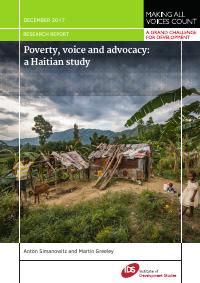
Pauvreté, parole et plaidoyer: une étude haïtienne
Résumé — Produit d'un projet de recherche-action de douze mois mené par Fonkoze avec l'Institute of Development Studies, sur la manière dont la parole des personnes en extrême pauvreté atteint le débat national de politique publique en Haïti.
Constats Clés
- Un projet de recherche-action de douze mois : il documente la pratique du plaidoyer de l'intérieur plutôt que de l'évaluer de l'extérieur.
- Traite la redevabilité envers les membres de Chemen Lavi Miyò comme partie intégrante de la question du plaidoyer et non comme un sujet de gouvernance distinct.
- Utilise la cartographie des résultats comme cadre de stratégie et d'analyse.
Description Complète
Produit d'un projet de recherche-action de douze mois mené par Fonkoze avec l'Institute of Development Studies, sur la manière dont la parole des personnes en extrême pauvreté atteint le débat national de politique publique en Haïti. Il est écrit depuis l'intérieur de la pratique de plaidoyer d'une organisation haïtienne, y compris sa redevabilité envers les membres de Chemen Lavi Miyò, et non comme une évaluation externe de celle-ci.
Texte Intégral du Document
Texte extrait du document original pour l'indexation.
DECEMBER 2017
RESEARCH REPORT
Poverty, voice and advocacy:
a Haitian study
IDS_Master Logo
Anton Simanowitz and Martin Greeley
RESEARCH Poverty, voice and advocacy: a Haitian study
REPORT
Authors
Anton Simanowitz is a socio-economist with 25 years’ experience as a practitioner, researcher,
trainer and advisor. He is a specialist in impact management and works globally to improve the
effectiveness of charities, social enterprises and purpose-driven businesses in delivering positive
social outcomes. Anton has worked for many years in the field of microfinance, supporting
organisations to be more poverty-focused. This includes developing poverty targeting tools, the
pro-poor guidance and assessment framework Truelift, and the Universal Standards for Social
Performance Management now widely adopted by financial service providers internationally. He is
co-author of The Business of Doing Good: Insights from one social enterprise’s journey to deliver on
good intentions.
Dr Martin Greeley is a development economist with more than 40 years’ professional experience.
Martin has directed several major research projects, focusing primarily on poverty reduction and has
led major studies on the evaluation of aid. He spent ten years working on research projects in South
Asia, (India, Sri Lanka and Bangladesh). Over 2017 and 2018 he is working on two major research
projects related to extreme poverty.
He has worked with the World Bank, European Investment Bank, European Bank for Reconstruction
and Development, African Development Bank and Asian Development Bank as well as several UN
agencies and many bilateral donors.
Martin teaches Development Economics at the University of Sussex.
Main areas of research are: poverty reduction; aid and public policy; agricultural development; fragile
states; impact assessment; and microfinance.
Acknowledgements
This paper arises from a partnership between Fonkoze, a Haitian non-profit organisation and pioneer
in programming for ultra-poor households in Haiti, and the Institute of Development Studies (IDS), a
UK-based development research institute. The authors gratefully acknowledge their total dependence
on the staff of Fonkoze for the results reported here and, through sharing their views and experiences,
the critical role of participants in Fonkoze’s ultra-poor programme. We are especially grateful to
Carine Roenen, head of Fonkoze, for her leadership in establishing this action research partnership
and to Gauthier Dieudonné and Steven Werlin, Fonkoze senior staff, for their enthusiastic and
thoughtful engagement. Together with their colleagues, these were the people who ‘made it happen’
in terms of organising the Fonkoze advocacy initiative and undertaking the actions reported on here.
We would like to warmly thank Hannah Hudson, Programme Officer at IDS, for supporting us in the UK
and managing the project, and Rosemary McGee, Programme Manager and IDS Fellow, for providing
guidance throughout the research. Most of all, we owe a substantial intellectual debt to Nathalie
Lamaute-Brisson, social protection specialist and consultant to Fonkoze, who kindly shared her deep
knowledge of social protection in Haiti while working on the research and provided detail and insights
that were essential to our understanding. Without her inputs this paper would not have been possible
and we are very grateful for all her support throughout the process.
FRONT COVER IMAGE: FONKOZE/MAXENCE BRADLEY
Reference and copyright
IDS requests due acknowledgement and quotes from this publication to be referenced as:
Simanowitz, A. and Greeley, M. (2017) Poverty, voice and advocacy: a Haitian study, Making All
Voices Count Research Report, Brighton: IDS
© The Institute of Development Studies 2017
2
RESEARCH Poverty, voice and advocacy: a Haitian study
REPORT
Contents
Summary 4
Introduction: poverty, voice and advocacy 5
1. Contextualising the advocacy challenge 7
1.1 Fonkoze’s ‘graduation’ programme 7
1.2 The graduation model 7
1.3 Gaining exposure on the national stage 10
1.4 Advocating for a focus on ultra-poverty: the strategy workshop 11
1.5 Giving voice to people with experience of extreme poverty in the national policy
process 12
1.6 State voice and international agendas 13
1.7 The emergence of the social protection agenda in Haiti 13
2. The advocacy process 16
2.1 Outcomes mapping as a framework for strategy development and analysis 16
2.2 Downward accountability and getting the voice of CLM members heard 24
3. What are the lessons? 27
3.1 Usefulness of outcome mapping to shape an advocacy strategy 27
3.2 Voice and downward accountability 28
Bibliography 30
3
RESEARCH Poverty, voice and advocacy: a Haitian study
REPORT
Summary
Over the past ten years, Fonkoze (a non-profit organisation in Haiti) has
adapted the ‘graduation’ model of lifting families out of extreme poverty
through its Chemen Lavi Miyò (CLM) or ‘pathway to a better life’ programme.
Yet despite international recognition for this approach, Fonkoze’s work is little
known within Haitian policy circles on social protection and poverty.
This paper is the product of a 12-month action research project by Fonkoze
with support from the Institute of Development Studies (IDS). It used a rapid
outcome mapping approach (ROMA) as a framework for creating an advocacy
strategy through which Fonkoze could influence the development of Haiti’s
social protection policy. It also aimed to give voice and promote downwards
accountability to people who have lived experience of ultra-poverty by enabling
them to articulate their views within the policy process.
For Fonkoze, this was a first attempt to move into activities other than
programme implementation, and to leverage its impact by influencing other
development actors to engage with the ultra-poor as a group with specific
vulnerabilities and needs. It achieved some successes, despite the very limited
time scale, weak voice of local institutions in policy processes and challenging
external conditions. Giving voice and downward accountability to ultra-poor
women (former CLM members) proved somewhat problematic though. These
women, enmeshed in the structures that impoverish and marginalise them,
cannot easily step outside of those structures to articulate their voice.
The report concludes by highlighting the problem that donors tend to channel
their resources through separate government ministries or departments.
Though inevitable (to some extent) given the context, this is also unhelpful in
terms of promoting a coordinated social protection policy.
Key themes in this paper
• Policy processes are complex and rarely linear or logical.
• Successful advocacy work requires a nuanced understanding of the
agendas of all stakeholders (national and international).
• Communication and networking are essential parts of influencing policy.
• Efforts to give voice to ultra-poor people need to be planned and
implemented carefully to avoid inadvertently disempowering them.
4
RESEARCH Poverty, voice and advocacy: a Haitian study
REPORT
What channels are available for the policy process to be
responsive to citizens, and what is needed to give voice to
those with experience to share?
Introduction: poverty, voice
and advocacy
This paper examines voice at two levels: national contested and the efficacy of the graduation model
voice in an international policy agenda, and citizen has become a core part of international debate on
voice in the national policy process. The context is social protection. It is in this context that Fonkoze
an action research project around the development is seeking to expand from its service delivery focus
of a national social protection strategy in Haiti, to informing the national policy process through
and the desire of a local non-profit organisation, its experience in designing and implementing the
Fonkoze, to have its successful social innovation – graduation approach in Haiti. Fonkoze seeks to
a ‘graduation’ approach to addressing extreme and influence national discourse and practice in relation
ultra-poverty – recognised as part of this policy to programming to address ultra-poverty. This is
process. Fonkoze also wanted to create space for challenging in Haiti where there are many NGOs
the voice of women living in extreme poverty to be which are often criticised for their ineffectiveness
heard and to influence this process in some way. and inefficiency and which are not generally part of
the policy process. Fonkoze made a very deliberate
The international policy debate on the social attempt to inform its approach to the policy process
protection agenda, reflected in the positions of by bringing to bear the voice of people with direct
key international agencies, is played out in the experience of extreme poverty. What channels are
development of a national social protection strategy available for the policy process to be responsive to
in Haiti. The processes are complex and layered with citizens, and what is needed to give voice to those
different international actors seemingly competing with experience to share?
and channelling resources through different national
actors. Inevitably, the normative policy process for This research report is the product of a 12-month
these national actors is at least partially shaped by process of action research. Staff from the Institute
the international agencies. This is not uncommon, of Development Studies (IDS), UK, worked with
and indeed may be a ‘norm’ in fragile state contexts Fonkoze to define a strategy for engaging with
and can even be a force for progressive change. government, donors and non-governmental
But the current Haitian context of political fragility, organisations (NGOs) to:
weak institutions and infrastructure, and severe lack
of resources, creates a lop-sided process in which
1. share the evidence for its approach to ultra-
state voice is often weak since it is beholden to
poverty
international actors for resources.
2. engage in discussions about extreme and
Fonkoze’s experience with the graduation approach ultra-poverty in Haiti
to addressing ultra-poverty in Haiti is very positive 3. influence, in the longer term, attitudes and
and has generated good ideas on the evolution practice in line with the experience of its
of policy to address ultra-poverty. Its experience programme targeting the ultra-poor – the
mirrors success with the graduation approach in Chemen Lavi Miyò (CLM) or ‘pathway to a
several other countries, evidenced by rigorous better life’.
evaluation studies. Nevertheless, the approach is
5
RESEARCH Poverty, voice and advocacy: a Haitian study
REPORT
Competition for limited resources, institutional weaknesses and
political and policy uncertainties weaken the ability of Haiti’s
government to be either responsive or accountable
The strategy sought first to gain ‘a place at the While the scope of the advocacy activities addressed
table’,1 to build awareness of the graduation through this paper is narrow, nevertheless we
approach and Fonkoze’s experience, and of what hope that it brings some insights around two key
this could offer to the national social protection questions: how do successful innovations get taken
strategy. It also sought to create a channel through up by policy processes? And how to give voice to
which women2 who have experienced living in
those with direct experience or connection to the
extreme poverty could contribute to the process.
issues at hand in the process?
This was the first time that Fonkoze had sought to
engage with and influence the wider development This research contributes to the evidence base
community in this way. The process was thus a built up by the research component of the Making
learning experience for Fonkoze in terms of how to All Voices Count programme, which seeks to
approach this sort of engagement, as well as a wider understand strategies to make government more
exploration of how to influence policy processes in accountable and responsive to citizen voice. Haiti
a fragile state with few resources, dominated by the is clearly a different case from the Making All
agendas of international donors and agencies. Voices Count priority countries,3 where government
institutions are much stronger. Haiti presents a
The policy processes to develop the national social
complex scenario for citizen voice and government
protection strategy and Fonkoze’s efforts to engage
accountability, and does not have the accountable
with it are ongoing and evolving. The research
for this paper covered a short period during this and responsive government that the programme’s
process, and therefore can only present a snapshot. theory of change envisages. In this paper, the
Furthermore, the 12-month project (June 2016 – question of accountable government is examined in
June 2017) coincided with external factors typical a context in which much policy direction is shaped
of the practical challenges that tend to delay and by international donors, working through local
frustrate development in Haiti. Coinciding with the institutions vying for power and patronage and
launch of the project in June 2016, the presidential where the voices of the most marginalised people
elections were annulled, leading to an eight-month are excluded from policy processes. Competition
political vacuum until the new president was sworn for limited resources, institutional weaknesses,
in during February 2017; this made conversations
and political and policy uncertainties weaken the
about future government strategy difficult. In
ability of government to be either responsive or
addition to this, a major hurricane devastated
the south of the country in October 2016, killing accountable. These features, together with the
more than 550 people, leaving 1.4 million people national development budget’s strong dependence
in need of humanitarian aid, and diverting time on foreign aid, in effect cede a high degree of policy
and resources within many organisations (United influence to international organisations whose lines
Nations 2017). of accountability lie outside of the country.
1 We use this phrase in a figurative sense to imply active participation in policy processes around the emergent social protection
agenda, but also in a literal sense since the government-initiated social protection policy development group is known as the
‘sectoral table’.
2 The Fonkoze graduation programme always works with women from ultra-poor households both because of a recognised need
to seek to empower women within the household and community, and because children’s welfare is likely to be best served
through this targeting strategy.
3 Ghana, Indonesia, Kenya, the Philippines, South Africa and Tanzania.
6
RESEARCH Poverty, voice and advocacy: a Haitian study
REPORT
1. Contextualising the advocacy
challenge
would be able to use the programme support
1.1 Fonkoze’s ‘graduation’ to develop a small enterprise, often based on
programme livestock or trade. While the programme has
In Haiti, 59% of the population live in poverty other selection criteria – confirmation of their
and 24% in extreme poverty (World Bank 2017).4 ultra-poverty status by both the community
and programme management, and the presence
Poverty rates are much higher in rural areas, at
of children – the capacity of a woman in the
more than 75%. The vast majority of the extreme
household to work was key to the programme’s
poor (80%) live in rural areas and comprise 38%
logic (see Figure 1 for the CLM theory of change).
of the rural population.5 Multidimensional poverty
measures (the Multidimensional Poverty Index
(MPI) and the Human Development Index (HDI)) 1.2 The graduation model
confirm the severity of poverty in Haiti, and there Over the past ten years, Fonkoze has successfully
is policy recognition (see section 1.7) of the need ‘graduated’ more than 5,000 women and their
to target support to the extreme poor, especially families into sustainable livelihoods, with a 96%
rural households. success rate.6 Developed from a proven
‘graduation’ model7 (see Figure 2), the CLM
Given these high levels of need, beginning in programme targets the poorest women in rural
2007, Fonkoze’s approach through the CLM Haiti with an 18-month support package
programme was to distinguish a sub-group, the including assets, a cash stipend, weekly
‘ultra-poor’, and focus on one geographical area mentoring visits, skills training and savings
(the Central Plateau). This was an effective use facilities. As there are few basic services
of scarce resources in a country with so much available to people living in poverty in Haiti,
need, but the CLM approach also had a more Fonkoze has included several additional elements
pragmatic basis, reflecting Fonkoze’s practical in the programme, such as support to improve
experience of working with thousands of poor housing, sanitation and a water filter, as well as a
women through its microfinance institution. A key partnership arrangement with a local health
lesson from its microfinance programme was that charity, Zanmi Lasante,8 which provides free
many of the poorest households were unable to health care for programme participants.
utilise microfinance because of constraints linked
to confidence, capacity and access, reflecting The graduation model has gained prominence
the multiple poverty traps they faced daily. CLM particularly in response to the first Sustainable
was developed to address the needs of these Development Goal (SDG), ending extreme poverty.
households and it adopted a specific targeting It aims to support recipients to reach a stage
strategy to identify them. A core element in where they are able to maintain (and, in many
this ultra-poor targeting strategy was to select cases, improve) their livelihoods at a level that,
households with active female members who while remaining poor, lifts them out of extreme
4 See www.worldbank.org/en/country/haiti/overview - updated April 2017 but poverty data is based on the most recent (2012)
household survey, ‘Enquête sur les Conditions de Vie des Ménages après le Séisme’ (Post-earthquake household living conditions
survey), ECVMAS 2012, produced by Institut Haïtien de Statistique et d’Informatique (IHSI).
5 The extreme poor are those living under the national extreme poverty line. This line is well below the new $1.90 purchasing
power parity (PPP) line, which estimates national extreme poverty at 53.9% according to data published by the World Bank.
6 This rate is based on internal monitoring data assessing ‘graduation’ status of participants who have completed the CLM
programme.
7 The model was first developed and used by BRAC in Bangladesh in 2002.
8 Haitian partner of Partners in Health.
7
RESEARCH Poverty, voice and advocacy: a Haitian study
REPORT
Figure 1. The CLM theory of change
Impact
Eliminate extreme poverty from the Central Plateau
With these tools and personal guidance, CLM can
Savings Protection
Increased Higher Capacity and
Sustainable productivity quality of life empowerment
income Basic needs
Long-term outcomes
Graduation
96% success rate!
Case manager support
Skills and Confidence
Income Better health Safe shelter
knowledge and respect
Short-term outcomes
Social
Assets Education Health care development Housing
Inputs
Chemen Lavi Miyò
Pathway to a Better Life
Theory of change
8
RESEARCH Poverty, voice and advocacy: a Haitian study
REPORT
Figure 2. The ‘graduation’ model
Extreme Sustainable
poverty livelihoods
Coaching
Asset transfer
Skills training
Savings
Consumption support
Market analysis
Targeting
Start Month 3 Month 6 Month 24 Month 36
Source: Presentation by Syed Hashemi to IDS/Fonkoze
graduation workshop, IDS, University of Sussex, October 2015
poverty (Bandiera, Burgess, Das, Gulesci, Rasul strategy that is strongly identified with the
and Sulaiman 2016, cited in CGAP 2016). The inclusive growth agenda. But it is also a
graduation approach is now being applied in 37 sophisticated social transfer programme targeting
countries – 20 through government programmes. the extreme poor. The model operates with a more
It recognises a unique set of characteristics and nuanced understanding of constraints to
needs of people living in extreme poverty and household livelihoods than is usually seen in
presents a carefully sequenced combination of
other development approaches such as cash
inputs developed through years of evidence-
transfers and agricultural development
based testing, and adaptation to a number of
programmes. The breadth and depth of evidence
different country contexts. Rigorous research
testifying to the positive outcomes of the model
using randomised control trials (RCTs) has
demonstrated the effectiveness of the model in has led to significant international support for the
reducing poverty in different contexts (Banerjee, approach and an advocacy programme from
Duflo, Goldberg, Karlan, Osei, Parienté, Shapiro, several agencies championing it. The logic
Thuysbaert and Udry 2015). The graduation informing this enthusiasm of development
approach, through its focus on sustainable agencies and their ‘pitch’ to the international
livelihoods, is a market-based development development community is summarised in Box 1.
9
RESEARCH Poverty, voice and advocacy: a Haitian study
REPORT
Box 1. The business case for graduation
Excerpt from The Business Case for Investing in those headed by women; it is holistic in that it
Graduation: combines social assistance, health care, livelihood
training, and financial services; it provides the
Graduation targets people who are well below the
family with an initial economic ‘push’ through a
US$1.90 / day threshold for extreme poverty – a
single, significant investment; it includes forms
cohort described as the ‘ultra-poor’, ‘poorest
of coaching or mentoring to overcome economic
of the poor’, ‘chronic poor’, ‘invisible poor’ and
and social barriers; and it is time bound, with
‘destitute’. Their lives are characterized by food
a clear schedule for graduating the household
insecurity, poor health, minimal education,
into larger social protection systems or access
unreliable incomes, low social capital, and a lack
to microfinance. To be sure, Graduation is not
of assets and land ownership. Daily, they face the
appropriate for every person living in conditions
risks of health crises, climate change, and other
of extreme poverty but a reasonable estimate
shocks and stresses. They often live ‘off the grid’;
is that it could benefit some 200-250 million
in remote rural areas, lacking access to banks and
people. Graduation builds individual autonomy
other financial systems, and often excluded from
and agency, reduces the risk of long-term
poverty programs through governments or non-
dependency on government programs, and can
governmental organizations (NGOs). The number
prevent downstream social problems exacerbated
of people living in these unacceptable conditions
by poverty. Graduation connects marginalized
of poverty is estimated to be in the range of 400-
citizens with the market and with other financial,
500 million (80-100 million families).
social, and political systems that can accelerate
This is the moment to invest in Graduation. It their progress. A growing body of evidence shows
provides a proven means of reducing extreme that Graduation can yield a very positive long-term
poverty and can increase the effectiveness of return on an initial, time-bound investment.
government social protection programs for the
Source: Abrams, Goldstein, Reed, Roenen and
poorest and most vulnerable populations.
Tardif (2017) ‘The Business Case for Investing
Graduation is defined by its five core in Graduation’, Consultative Group to Assist the
characteristics: it targets the household, often Poor (CGAP).
During its years implementing one of the most
1.3 Gaining exposure on the significant poverty reduction programmes in Haiti,
national stage Fonkoze has had very little contact with key
Fonkoze’s experience of using the approach in actors in the sector. Like most national NGOs in
Haiti (and, indeed, international experience) the country, Fonkoze has not been substantively
highlights the potential positive impact of a engaged in strategic discussions or coordination
programme that is effectively targeted towards meetings with government and international
donors in the development of poverty reduction
ultra-poor people and designed with their specific
and social protection strategy and programmes.
characteristics and needs in mind. Fonkoze’s
However, shortly before the launch of the
experience with the CLM has demonstrated the
advocacy process, a ‘policy advisory’ sectoral
efficacy of the approach for a significant group of
table on social protection had been formed
the poorest households in Haiti who had
involving ministries across government and
strengthened their livelihoods and achieved a
donors (as well as the international NGO CARE
sustainable reduction in poverty. However, in
through its role in the consortium leading a major
Haiti, Fonkoze’s CLM programme is little known;
social protection project, Kore Lavi). This table
and the organisation lacks the resources that
provided an opportunity for Fonkoze to use its
would be needed to address ultra-poverty at
experience and expertise to influence thinking,
scale. The decision to instigate an advocacy
policy and practice on national strategy for the
strategy came from the recognition that to
extreme poor.
maximise the value of its experience and
expertise, Fonkoze would have to influence
other development actors in Haiti.
10
RESEARCH Poverty, voice and advocacy: a Haitian study
REPORT
some focus on the extreme poor through social
1.4 Advocating for a focus protection programmes such as Kore Lavi9 and
on ultra-poverty: the strategy Kore Fanmi,10 the ultra-poor are not identified in
national statistics. Sometimes this ambiguity
workshop results in NGOs claiming to work with the poor
A core challenge identified by Fonkoze was the when in fact they do not. Moreover, with the high
invisibility of people living in ultra-poverty in Haiti. vulnerability of poor households to natural
It was not simply a matter of highlighting the disasters and their frequent recurrence, extreme
success of the graduation approach, but of raising poverty is often regarded as a humanitarian
awareness of the need to see the ultra-poor as a rather than a development issue. For others,
group needing particular policy attention. As a addressing the needs of the ultra-poor is simply a
sub-group of the extreme poor, the specific poor fit with the government’s need for visible
characteristics of the ultra-poor define them; it is and quick results, and does not resonate with
these same characteristics, described in Box 1, those who are politically strong and organised.
which informed the design of the graduation
approach and made it effective in supporting The experience of Fonkoze can address some (but
women in ultra-poor households to improve their not all) of these challenges. It highlights the need
living conditions. While academic writing on the to differentiate between different levels of poverty
Kenya
concept of multidimensional poverty traps (e.g. and provides evidence that graduation out of
Carter and Barrett 2006) has contributed to a extreme poverty is possible; moreover, it
greater understanding of the ultra-poor, they are demonstrates that such graduation can be an
not a well-defined target group within the extreme important contributory element of a national
poor. Addressing this issue, the strategy workshop social protection programme, providing visible
held by IDS and Fonkoze sought to define needs, results and reducing the numbers of people
challenges and opportunities by bringing together requiring ongoing social assistance.
a number of actors from government, local NGOs
and civil society. Specifically, in terms of advocating for a focus on
ultra-poverty in Haiti, Fonkoze identified a number
A focus on extreme poverty and ultra-poverty was of key lessons learned that formed the core
seen to be challenging for a number of reasons. objectives of the advocacy strategy (Table 1). This
Firstly, in a country with high levels of poverty, highlighted the need to bring a focus on ultra-poor
there is a sense that there are so many people in women and their families to the national agenda.
need and that the extreme poor should not be Given that this was Fonkoze’s first deliberate
favoured. Moreover, policy-makers and decision- attempt to engage with national policy processes,
makers often do not have experience of the reality discussion at the strategy workshop (the first
of people living in extreme poverty. While there is activity in the advocacy programme) also
9 The Kore Lavi programme is implemented by a consortium of CARE, Action Contre la Faim (ACF) and the World Food
Programme (WFP), with funding from the United States Agency for International Development (USAID) and implemented in
partnership with the Haitian Ministry of Social Affairs and Labour to establish a sustainable system of social protection for
households experiencing chronic food insecurity. Kore Lavi is implementing a safety net programme (food voucher) that
improves access to locally produced foods among vulnerable households. The programme also implements maternal and child
health and nutrition interventions for pregnant and lactating women and children under two years of age. Initially lasting four
years and extended by two years in 2017, Kore Lavi has had a direct impact on more than 18,000 households (the monthly food
voucher) and 205,000 people (maternal and child health and nutrition components) in 16 food-insecure communes,
distributed across five departments.
10 The Community Social Worker Initiative Kore Fanmi, was a pilot programme (now discontinued) implemented by the Haitian
Government’s Economic and Social Assistance Fund (FAES), based on an agreement between the Ministry of Public Health and
Population (MSPP) and the World Bank. The programme sought to harmonise and improve the provision of basic services to
poor and vulnerable families, such as access to education, vaccines and latrines, with a view to moving away from a national
fragmented and unequal system to one of systematic coverage focusing on the rights and needs of families. Families are
classified based on their level of vulnerability, and the activities, medicines or food provisions provided are tailored to meet
their needs. Each worker was responsible for about 100 families for which he or she must prepare a plan covering a specific
period. The plan focuses on 28 life goals, such as, “the family must use latrines”. Each family has a certain number of goals,
based on its own specific needs. The activities of FAES in the Kore Fanmi project are now restricted to the building of a social
registry. UNICEF used the Kore Fanmi approach in three communes in the Southeast department, since 2014 and will close this
specific project in October 2017.
11
RESEARCH Poverty, voice and advocacy: a Haitian study
REPORT
Table 1. Applying Fonkoze’s lessons learned to the advocacy strategy
Lessons learned Advocacy strategy aim
1. Raise awareness of the existence of the ultra-
1. Ultra-poor women and families are invisible
poor and how to reach them
2. Raise awareness of the capacity of ultra-
2. Ultra-poor families can develop sustainable
poor women / families to effectively develop
livelihoods
sustainable livelihoods
3. They need a well-adapted package of 3. Share evidence on the need for an integrated
interventions to make it work package of services
4. Develop collaborative activities with key
4. Fonkoze cannot do this on its own stakeholders (government and civil society) to
move the agenda forward
reflected on the specific actions that Fonkoze An alternative approach, or family of approaches,
should take. This included discussion on emphasises the demand side and the
experience of Haitian policy processes and empowerment of citizens to be able to hold
successful advocacy efforts. For example, there government to account. These social
was active participation from a former secretary accountability approaches focus on strengthening
of state who was living with a disability and had transparency in service delivery and access to
led a very successful campaign to increase information about services as well as seeking to
recognition and rights for disabled people in Haiti. hold government accountable to citizens (Gaventa
Using an outcome mapping approach (see below), and McGee 2013). In reviewing transparency and
the workshop developed desired outcomes for key accountability initiatives, Gaventa and McGee
stakeholders and a plan of activities. (2013: 517–19) acknowledge the limitations of
the evidence base but, gleaning insights from the
available studies, underline the importance of
1.5 Giving voice to people with political will and legal frameworks as core
experience of extreme poverty conditions providing the platform on which
successful transparency and accountability
in the national policy process initiatives depend.
One of the most significant evolutions in
development practice has been the emergence of Neither of these are conditions which characterise
attempts to create and amplify citizen ‘voice’ in opportunity for social accountability approaches
relation to the delivery of public services. Political in Haiti. Notably, an important voice that is absent
democracy has proved a weak tool in many in the policy processes around social protection in
development contexts to ensure meaningful Haiti is that of people with direct experience of
accountability of the state to its citizens. Early living in extreme poverty. The advocacy project
attempts to address this democratic deficit therefore sought to address this in a small way
focused on supply-side initiatives, particularly the through working with former CLM members, and
ideas emerging from new public management supporting them to define an agenda and engage
(NPM). As Joshi (2008: 11) discussed, initiatives with government and other national institutions.
based on NPM, borrowing from the private sector, As part of this process to make the ultra-poor
attempted to improve bureaucratic performance visible, the need to give voice to ultra-poor people
by separating policy design from implementation, themselves in this process was highlighted –
and through arrangements such as performance- borrowing from a popular campaign slogan used
based contracts, contracting out services and in campaigns for disabled people “nothing about
creating competition. These reforms have had us without us”. The hope was that CLM members
mixed results (World Bank 2008) but, critically, would convey their own experiences and priorities
have done little to promote accountability to and potentially influence the attitudes and
citizens or to strengthen inclusion of the poor in practices of people devising the national social
access to services. protection strategy. Only very tentative steps were
12
RESEARCH Poverty, voice and advocacy: a Haitian study
REPORT
taken in this direction during the project, but the unemployment and inability to engage in the
experience throws up some interesting questions labour market are events, or conditions, termed
that are relevant for a process to strengthen ‘social risk’. Social risk is a construct of
downward accountability (of the state to its idiosyncratic (e.g. unemployment or sickness) and
citizens), as well as the role of a development co-variant (e.g. economic shocks) conditions
actor such as Fonkoze in facilitating this process. adversely affecting the individual and their
household but, at its core, it is understood as
market failure in the broad sense – people not
1.6 State voice and being able to work, for whatever reason.
international agendas
The graduation approach is fundamentally about
Graduation as part of the international social
engaging the ultra-poor with the market (at least
protection agenda
in terms of the commonest approach to material
Fonkoze’s advocacy work coincided (fortuitously) improvement) and, as such, is quite consistent
with efforts by the Haitian government and with the broader market-oriented philosophy of
international donors to develop a national social the World Bank. But the Bank’s core approach to
protection strategy. This created a window of social protection also involves the recognition of
opportunity where different approaches were resource scarcity – consumption transfers are
examined and discussed. However, openness to equated with reductions in public investment –
new ideas needs to be understood in the context and therefore involves rationing through a
of the evolution of social protection in Haiti, and targeted approach. In sharp contrast, the broader
particularly in relation to the agendas of key global debate around social protection includes
international players such as the World Bank and the idea of a social protection floor, advocated by
the United States Agency for International the International Labour Organization (ILO),
Development (USAID). which ultimately seeks to promote a rights-based
approach to universal provision of a basic income
The World Bank is a foremost actor in supporting to all citizens. While in practice this approach also
the development of social protection strategies in involves some form of targeting based on income
developing countries. The Bank’s usual approach needs, it is politically quite distinct, as it is based
is to advocate, and financially support, the on the notion of citizenship and legal rights.
development of a universal household socio-
These debates have only been weakly rehearsed
economic survey to assess household needs. The
in Haiti (e.g. through the emergence of the
survey is used to score households using a proxy
means test to inform estimates of economic National Social Assistance Strategy, discussed
wellbeing. According to resource availability, below). However, the absolute scarcity of
households are then targeted through social resources and the weak capacity of the state
protection programmes to receive cash transfers mean that agencies bringing money have
and sometimes other forms of support. USAID has considerable leeway to influence the social
a more nuanced approach using its own targeting protection policy process now under way.
methods, with a strong focus on food security,
mother and child health and supporting market-
based approaches, especially in agriculture, to 1.7 The emergence of the social
reduce vulnerability. These are the two agencies protection agenda in Haiti
that have, to date, been most involved in
supporting the social protection sector in Haiti. Haiti has never had a social movement (either
(The United Nations Development Programme trade unions or other socio-political movements)
(UNDP) and European Union (EU) have also been to significantly question the predatory state on
engaged with the social protection agenda in Haiti.) the specific issue of social protection. However, in
the context of a growing wage economy and the
In neither case do these agencies have a history emergence of a middle class, the first steps
of supporting ‘graduation’ as an element of social towards creating social assistance mechanisms
protection. However, the World Bank is now were taken in the 1940s (Farman 1947;
actively engaged with this agenda, including Department of Labour and Welfare of Haiti 1967),
through the establishment of a learning platform after more than half a century of social care
on graduation. The Bank’s commitment to social through charity work by religious orders and
protection is also informed by market principles; upper-class or middle-class women (Mérat 2011).
the labour market is people’s income source but By the late 1960s, public social security
13
RESEARCH Poverty, voice and advocacy: a Haitian study
REPORT
organisations (insurance and social assistance11) mechanisms. From 2012, a large part of the effort
had been developed but were weak institutions was made through the formulation of a National
and under-funded. After the dictatorship period Social Assistance Strategy (SNAS). This was
(post-1986), new institutions and programmes comprehensive in ambition,13 ranging from social
were created. The creation of the social assistance to social security, capacity
investment fund, an independent, public, financial development and economic inclusion. The
institution called the Economic and Social implementation of the SNAS was entrusted mainly
Assistance Fund (Fonds d’Assistance Economique to FAES.
et Social (FAES)) in 1990 stands out. From that
time, there was an extension and diversification of The SNAS had a strong vision of comprehensive
social protection mechanisms, with social social protection provision and explicitly identified
promotion policies in education, health, food the extreme poor as a target group and also the
security, housing and employment (Lamaute- need to target poor rural women, through its
Brisson 2013). Kredi Fanm Lokal component. However, the
ambition was not matched by resources or
From the 1990s the integration of new social implementation capacity. With the change of
protection functions by the Haitian state was government following the forced resignation of
increasingly influenced by donors. The need to Prime Minister Lamothe in December 2014, the
address the costs of adjustment and, SNAS lost favour; it would, in any event, have
subsequently, the imperative of the Millennium struggled for resources in the difficult fiscal
Development Goals (MDGs) led to the environment (Lamaute-Brisson 2015).
incorporation of vulnerable populations as objects
of attention and enhanced the effective roles of Governance failure
the state in social areas. Major non-contributory
innovations included school canteens, free Haiti has a proud history having won its
obstetric care, free schooling, conditional cash independence in 1804 but has an unenviable
transfers and support to families. Social reputation for poor governance seen most
promotion was expanded through investment in vividly in the despotic leadership of the
social infrastructure, temporary job creation Duvaliers, who used the institution of the state
projects and support for micro-enterprises. to terrorise and steal for 30 years. Little
Significantly, progress was made in supporting immediate progress was seen upon the fleeing of
the often neglected rural areas, especially Baby Doc in 1986 and successive governments
through the FAES and Bureau de Monétisation des have continued to use the office of the state for
Programmes d’Aide au Développement (BMPAD).12 appropriating resources. Given the long-
Nevertheless, the predatory logic of the state – standing and persistent weaknesses of the
infamous during the long kleptocratic regime of Haitian state, international agencies play an
the Duvaliers (1957–1986) – remained strongly in influential role. Aid figures fluctuate largely
evidence (Lundahl and Silié 1998). because of humanitarian crises, but donors
currently supply aid to Haiti that is equal to
nearly 60% of total government expenditure.
The National Social Assistance Strategy (SNAS)
2012–2014 The aid effectiveness agenda seeks to support
As of 2011, new public initiatives emerged, weak institutions to be more effective, and is
inspired by several experiences from Latin particularly pertinent in a fragile state context
America and the Caribbean. There was intent both such as Haiti. But despite the commitment to
to broaden the scope of state intervention by build capacity, which all donors subscribe to, the
introducing innovative mechanisms, and to extend current limited state capacity leaves international
or reactivate previously implemented or proposed agencies in a powerful position to set the agenda.
11 The ‘Office d’Assurance Accidents du Travail, Maladie, Maternité’, or the Office for Work Accidents, Health and Maternity
Insurance. But only the work accidents policy was initially implemented; the health and maternity insurance did not begin
until 2014. And the ‘Office National d´Assurance Vieillesse’, or the National Pensions Office. Both organisations were created
by law in 1967.
12 BMPAD is the ‘Monetisation Office for Development Assistance Programmes’.
13 See www.slideshare.net/FAESHAITI/presentation-ede-pep
14
RESEARCH Poverty, voice and advocacy: a Haitian study
REPORT
While external agencies aim to build sustainable provide analytic capacity. While the Kore Fanmi
local institutions and enable government to take funding was stopped because of service capacity
over the resourcing of ongoing programmes such constraints, the Bank continues to have a strong
as social protection, competition between donors influence on the evolution of the social
and agencies only serves to reinforce some of the protection agenda in Haiti, and there is clear
dysfunctional organisational behaviour such as direction from Washington to apply the global
rent-seeking, which undermines sustainability. model using a proxy means test to identify
Moreover, while poverty is recognised to be households in need. Current plans extend to
multidimensional, most donors take an approach support for the establishment of a national
that focuses on one issue only. More complex social register in order to eventually identify all
approaches that connect mechanisms like social households eligible for social protection. Kore
assistance, asset transfers and support to Lavi also uses a poverty targeting tool to
businesses / business activities have generally channel resources to the extreme poor;
not been pursued. recognition of the need to avoid competition has
led to the World Bank proposing to develop a
The strategy differences at an international level version of the Kore Lavi survey as the basis of
are reflected in the strategies of these the social register. It was also agreed to
institutions’ local Haitian offices. Beyond the establish coordination mechanisms between
different strategies to address poverty and deliver Kore Lavi and other stakeholders or projects,
social protection are differences in alliances and, including the collection and exchange of
in effect, in the patronage given by international information on vulnerable populations and, in
agencies to local government institutions. Two some cases, sharing of project costs. Kore Lavi
main groups exist: the World Bank and UNICEF can use information already collected by Kore
(until very recently) are providing financial and Fanmi to classify and select vulnerable
technical support to the FAES through Kore households (Lamaute-Brisson 2015).
Fanmi; and USAID and the World Food Programme
(WFP) are supporting the Ministry of Social Affairs The advocacy approach adopted by Fonkoze did
and Labour through Kore Lavi. not seek to promote the CLM approach or the
work of Fonkoze per se. Rather, the ambition was
The World Bank, observing lack of capacity in to bring in an ‘ultra-poor perspective’ to the table
Haiti, supported and invested in the capacity of to influence attitudes, practices and policy.
FAES – not a regular ministry, but a specialist Recognising the importance of both state and
unit with technical capacity, which the Bank has international actors in forming the strategy,
used to oversee project implementation and Fonkoze sought to engage with both.
15
RESEARCH Poverty, voice and advocacy: a Haitian study
REPORT
2. The advocacy process
processes, institutions) and type, quality,
2.1 Outcomes mapping as a contestability of research and how this is
framework for strategy communicated, as well as linkages with
other actors
development and analysis
• communication and networking are essential
As already discussed, the Haitian context parts of influencing policy, implying the need
is characterised by complexity, competitive to engage with key players based on an
relationships and uncertainty. Fonkoze, as a local understanding of politics and interests through
institution with a proven approach to working with different channels and media
‘the ultra-poor’ (a group often invisible to policy-
• there needs to be a deliberate focus and
makers), sought to raise the profile of this group
commitment to influencing (Young and
and to share experience on how to work with them
Mendizabal 2009).
effectively. As an operational organisation, this
was Fonkoze’s first venture into advocacy. Given ROMA consists of three main activities, each of
the complexity of agendas, relationships between which is broken down into a series of steps (see
actors, and external factors, an advocacy strategy Figure 3).
that sought to achieve specific changes through
a pre-defined theory of change would have been The first step was a mapping process that
at best challenging. The team recognised that identified stakeholders (defined in outcome
the strategy needed to be iterative, based on an mapping as ‘boundary partners’) – that is, the
evolving understanding of the context and agenda people and organisations that Fonkoze sought
of different stakeholders. to influence. A series of key informant interviews
were then conducted to build an understanding of
To fit with this, they used the rapid outcome the state of attitudes, knowledge and practice of
mapping approach (ROMA) methodology (Young, stakeholders. A strategy workshop then brought
Shaxson, Jones, Hearn, Datta and Cassidy 2014). together key actors – both ‘allies’, where it was
This provides both a framework for analysis, thought that there would be an alignment of
mapping and evaluating the process towards agendas and other actors that Fonkoze sought to
outcomes, and a process for designing an better understand and potentially influence. The
advocacy strategy. workshop deepened Fonkoze’s understanding of
stakeholders, their interests and agendas, and
An important part of the framing of ROMA is an helped define the objectives and process for the
analysis of ‘real-world’ policy processes and the advocacy strategy. Recognising the complexity
implications of this for how advocacy is designed of policy processes (especially in Haiti), the
and understood. Key points highlighted include that: workshop also sought to unpack which kinds of
processes are seen to be effective and how tools
• policy processes are complex and rarely linear
to influence policy and for research would need to
or logical and therefore advocacy needs to be
be adapted.
reflective and adaptive
• policy processes are only weakly informed by Using the ROMA methodology, the baseline and
research-based evidence and policy-makers desired outcomes were mapped out for each
have different concepts of ‘good evidence’ stakeholder. The theory of change that was
• there is a range of other political and resource adopted stipulated that changing knowledge
factors which affect decisions – including the and awareness leads to changing attitudes
need to make a ‘reasonable’ decision (quickly) and discourse, which in turn leads to changing
• there is a need for a holistic understanding practice in terms of procedures, content and
of context including external influences such behaviour (see Figure 4). Specific activities were
as donor policies, political context (people, then developed based on identified opportunities.
16
RESEARCH Poverty, voice and advocacy: a Haitian study
REPORT
Figure 3. The rapid outcome mapping approach (ROMA)
Diag Id
en
nos tif
ec ys
om t
pl
ex
rs
Dia
ty
ain
gn
de
an os
ert
ity
pl
ol
e
req
Unde
ng t
nc
eh
rst
uir
an
du
l ea he
d
em ak
e Pinp
ov
rn w
Collect and m
oin ob
an
i
pr
en
tr
ke sense of data
ists
ana
and ers
ts
it p lem
Ma
Defi ne information
ge to
hy es
au s
da onitoring im
tc
oo
ta pr
decision-ma
kin
am g
lop es
om es
e tc
ev Id u
ti v
ent ic o j
ec
ify r e alist
D
Id ob
en g
t if y c in
yo u r i n fl u e n
y
at eg
Develop a s tr
e
a ng
o f ch eg
y
ry t
D e velo p a th e o t ra
ns es
nic at io u rc
D e ve l o p a co m m u es
o
dr s
c i t y a n
i v itie
A s s e s s yo u r c a p a c t
sa
c a t ion
ni
Choose com mu eg y
r s t r at
yo u
Finalise
Source: Young et al. 2014
Advocacy strategy
Fonkoze’s experiences with the CLM programme
Actions were defined in three dimensions: and evidence generated by the complementary
• Engaging with graduated CLM members to research activities were designed to form
understand and define their own priorities in the basis for this engagement. The two key
terms of raising the voice of ‘ultra-poverty’ in parts of the process by which CLM seeks to
the Haitian policy and development context, influence policy and practice are empowering
and then to engage with stakeholders that they voice for ultra-poor citizens and building and
identify. strengthening relationships with identified
stakeholders. Together, these shaped actions,
• Working with allies to leverage their existing
discussions and messaging.
relationships, networks and channels to the
‘ultra-poor agenda’.
The strategy was stepped; ultimately, Fonkoze’s
• Facilitating engagement activities involving agenda is to shift thinking and practice in relation
a range of stakeholders to discuss technical, to the ultra-poor. The first step to achieving this
programmatic and policy issues, in which the was to get Fonkoze to the table and to engage in
perspectives of CLM members can be included. existing processes in relation to the extreme poor.
17
RESEARCH Poverty, voice and advocacy: a Haitian study
REPORT
By doing this, Fonkoze sought to expose other longer term, it was hoped that this would create
actors to its approach of working with a sub- space for more explicit discussions and ultimately
set of the extreme poor – the ultra-poor. In the actions focused on the ultra-poor.
Figure 4. Fonkoze’s advocacy strategy – intended outcomes
Attitudinal changes
• Recognition that extreme poverty can and should be eliminated.
• Recognition that people living in extreme poverty have the capacity to move to a more sustainable
livelihood; this requires a developmental not humanitarian approach.
• Recognition that to work effectively with people living in extreme poverty, organisations need to
actively identify this target group, and demonstrate that they are reaching these people.
• Gaining collective buy-in for the extreme poverty agenda.
• Building the idea that working on extreme poverty is a win-win strategy for everyone.
Discursive changes
• Bringing a focus on extreme poverty into policy discussion on social protection. Also making
connections for discussions on the SDGs, climate change / risk resilience, inclusive growth, gender /
empowerment and national development.
• Recognising differentiation of different levels of extreme poor, and that there is a group of ultra-poor
that needs to be specifically identified.
• Distinctiveness of rural vs urban extreme poor.
Procedural and content changes
• Clear understanding of characteristics of extreme poor demonstrated in documents, strategy and
other communication by key stakeholders in Haiti.
• Process to identify / target poverty level is defined by key actors.
Behavioural changes
• Decision-makers connect with extreme poor (so understand their reality).
• Practitioners apply methods that enable the extreme poor to sustainably move out of poverty.
• Actors at the community, local, national organisation, international organisation and government
levels collaborate on activities to promote the extreme poverty agenda.
By drawing on these interpretations of power as an In relation to the national social protection
analytical framework, this research explores the agenda, Fonkoze’s strategy sought to engage with
different legal empowerment approaches used for key actors at a technical level (hosting a technical
obtaining more equal access to basic services. meeting on poverty targeting) and at a strategic
The advocacy activities described in this report are level (presenting to the social protection table).
used to discuss the links between empowerment Table 2 summarises the activities it undertook.
and accountability, and the role of legal frameworks
and rights-based action for strengthening both.
18
RESEARCH Poverty, voice and advocacy: a Haitian study
REPORT
Table 2. Timeline of key activities undertaken as part of advocacy strategy
Date External factors Engagement with Engagement with CLM
stakeholders members
March 2016 Agreement of funding for Sectoral table on social
advocacy research protection revived
May 2016 Strategy workshop
June 2016 Decision to re-run Invitation to participate in
presidential elections national social protection
table
July to Recruitment of consultant Follow-up discussions
September who had major role in
2016 development of national
social protection strategy
October 2016 Hurricane Matthew
December 2016 New president elected
January 2017 Open-space meeting with
graduated CLM members
February 2017 New President Jovenel
Moïse sworn in
March 2017 Follow-up meeting
of graduated CLM
members with women’s
organisations
April 2017 Technical (Poverty
Monitoring and Social
Exclusion Unit (UOPES))
and high-level seminars
(donors)
Presentation to the social
protection table
April-June 2017 Evolving partnership with Planning training for CLM
Kore Lavi, engagement staff
with national social
protection strategy and
end-line stakeholder
interviews
July 2017 Exposure visit to Rwanda
of CLM staff – discussed
with key government
officials who were invited
but did not take part
19
RESEARCH Poverty, voice and advocacy: a Haitian study
REPORT
These events were seen as significant progress in terms of attitude
and inclusion – although being at the table is only a first step
towards being heard and understood
Bringing Fonkoze to the table exposure visit to Rwanda to look at the successful
integration of a graduation component into
As outlined above, over the past ten years
national social protection provisions there.15
Fonkoze has adapted the ‘graduation’ model and
implemented a highly successful approach to
Given Fonkoze’s invisibility at the start of the
sustainably moving women and their families out of
advocacy process, these events were seen as
extreme poverty. Despite international recognition significant progress in terms of attitude and the
for the approach, Fonkoze’s focus locally was practice of inclusion. Of course, being at the
implementation, and although their microfinance table is only a first step towards being heard and
bank was well-known, the organisation had no understood, and to lobbying for changes in social
visibility on the social protection and poverty protection provision.
agenda. Nationally, one of the challenges is to
make people understand that the graduation A number of factors may have contributed
package is a mix of social assistance and social towards this success. Luck is one such factor; the
promotion (promoting livelihoods), and individual decision to start a process to design a national
empowerment. The other challenge is to convince social protection strategy created a window of
people that graduation is not an exit strategy from opportunity in which issues can be discussed and
social protection. new perspectives can be included. Getting the right
local guidance as to who to talk to and guidance
A key achievement of the advocacy project was on messaging was also important. It may also have
to get Fonkoze engaged in the national policy been that Fonkoze’s alliance with an internationally
process, in that Fonkoze has been invited to respected development research institute gave
present to the sectoral table on social protection. some credibility to Fonkoze and ‘opened doors’;
This was evidenced in a number of ways, including so, for example, an early visit to the WFP by IDS
an invitation for Fonkoze representatives to academics led to an animated conversation about
attend one meeting of the sectoral table.14 Further possibilities for collaboration and a commitment to
evidence was a good turnout of 40 participants, involve Fonkoze in future discussions. It may also
including Ministry of Planning officials, and most of partly be due to strategic decisions by stakeholders
the significant stakeholders, at a technical meeting who sensed a possibility for access to resources or
organised by Fonkoze and the Poverty Monitoring gain for their institution by opening up to Fonkoze.
and Social Exclusion Unit (L’Unité d’Observation
de la Pauvreté et de l’Exclusion Sociale, UOPES). The technical and donor meetings in particular
UOPES was a key ally that emerged from the initial undoubtedly made Fonkoze and the CLM
strategy workshop and demonstrated keen interest programme more visible within policy circles.
in the issues that Fonkoze was presenting. Indeed, It opened the door and gave credibility for
in subsequent sectoral table meetings, there were ongoing engagement, although follow-through
positive references to Fonkoze’s work. Importantly, – particularly around findings from Fonkoze’s
Fonkoze also started dialogue with the Director research agenda – will be important. So through
General of the Ministry of Social Affairs and Labour, design or intent, Fonkoze is now well-connected to
including inviting a senior staff member on an the key stakeholders working on poverty and social
14 The members of the sectoral table are public / state institutions, bilateral and multilateral cooperation agencies / donors /
embassies and CARE as a leading member of the Kore Lavi project.
15 The visit took place in July 2017, but unfortunately the Haitian official had to pull out at the last moment. Fonkoze staff who
did travel to Rwanda will make a presentation to the sectoral table.
20
RESEARCH Poverty, voice and advocacy: a Haitian study
REPORT
protection nationally, and there is now widespread uses a household survey implemented through
awareness of Fonkoze’s CLM programme and its a census of all households in an area, with an
focus on the ultra-poor. algorithm for calculating an index of vulnerability
and a classification of the households according
Building new alliances to their level of vulnerability. This is the Haitian
Deprivation and Vulnerability Index (HDVI) and
Collaborating with Kore Lavi. Fonkoze aimed to
is used to identify the 10% most vulnerable
better understand the perspectives of different
households, which are then targeted by the
stakeholders and to engage in a way that was
programme. However, this approach is costly,
supportive (rather than pushing a ‘graduation
and there are concerns about the sustainability
agenda’). This approach has opened up space
of the approach at scale, given the context of
for new alliances. Evolving collaboration with
resource scarcity in Haiti (funding for social
Kore Lavi (and its component organisations
protection mostly comes from donors, except
CARE, WFP and the Ministry of Social Affairs
in the education sector, and the rationalisation
and Labour) is regarded as a significant
of costs could release resources to reach more
breakthrough, as it has given Fonkoze a way to
people who are impoverished or vulnerable). A
interact directly with major stakeholders, and
second and continuing concern for Kore Lavi is
paves the way for future opportunities to engage that it does not have an exit strategy as such,
on the ultra-poverty agenda. The example also unlike the graduation model of CLM. It is these
clearly demonstrates outcomes at each level two interrelated issues (lower cost targeting and
of the theory of change on which the advocacy exit from the social safety net) that open the door
strategy is based – attitudinal, discursive, to Fonkoze’s discussion of the respective targets
procedural and behavioural. of Kore Lavi and CLM.
Kore Lavi is a multi-organisation partnership. Initial conversations were with the IDS team
It falls under the auspices of the Ministry and and the WFP representative. However, within
is implemented through a partnership with the the partnership, CARE has taken the lead with
international NGO, CARE (the main implementing Fonkoze, and it was through the advocacy efforts
organisation alongside WFP). Funding comes from that the Kore Lavi Chief of Staff became more
USAID. Engagement therefore took the form of engaged in dialogue with Fonkoze. There were
bilateral discussions with each partner as well as several meetings between the CARE / Kore Lavi
with Kore Lavi itself. leadership team and the Fonkoze team, including
a field visit by the Kore Lavi team. Discussions
CARE has worked with Fonkoze for several evolved and led to an agreement to collaborate on
years, but not in relation to the CLM programme. comparative research between the CLM programme
Despite attempts for dialogue there had been and Kore Lavi on targeting methods to understand
no contact with WFP prior to the meeting of IDS the differences between which people were being
academics at the start of the advocacy process. targeted by the two programmes. This was done
USAID works with the Fonkoze Foundation but not by collecting data from households in a new CLM
on the CLM programme. Presentations on CLM area using both the CLM targeting approach
have been made to USAID prior to the advocacy and the Kore Lavi questionnaire, and the Kore
programme, with no obvious effect, but USAID is Lavi algorithm (implemented by the Kore Lavi
now committed to funding the expansion of Kore team). The results highlighted a strong degree
Lavi and is interested in the agenda. So far as the of correlation in that most CLM members were
USAID position on social protection is effectively identified as qualifying for Kore Lavi, confirming
the Kore Lavi position, there may have been some the effectiveness of both Kore Lavi and CLM
changes, but there was no direct contact with in targeting the extreme poor. In addition, a
USAID representatives on the subject during the substantial number of households (372, or 28%)
advocacy project. qualified for Kore Lavi but were excluded by CLM
targeting.16 This affirmed the notion that CLM
Fonkoze found a natural ally in Kore Lavi in reaches a sub-group of the extreme poor. Kore Lavi
terms of a focus on extreme poverty. A number recognises that its targeting is less specific than
of elements in the CLM approach resonated the CLM approach but is comfortable with that.
with challenges being faced by Kore Lavi. The The second area of interest was comparing and
first was the cost of poverty targeting. Kore Lavi refining the programmatic elements of Kore Lavi.
21
RESEARCH Poverty, voice and advocacy: a Haitian study
REPORT
Given the lack of resources for social protection in Ministry – not just a UOPES initiative. The reaction
Haiti, and the relatively high cost of Kore Lavi and of these persons showed that CLM strikes a
CLM, there was particular interest to understand chord with Haitian intellectuals and middle-class
the relative benefits of the two approaches. The public servants: the idea of social promotion –
successful research on targeting led to an interest of a push to help people improve their lives – is
in deeper comparative research and agreement very attractive to them, as opposed to the idea of
to a joint Kore Lavi–Fonkoze application17 to continuous handouts.
fund a research project to look at overlap and
complementarity where CLM and Kore Lavi work Fonkoze’s developing collaboration with Kore Lavi
in the same community. A Kore Lavi representative (which is also led by the Ministry of Social Affairs
observed that this development signified “our and Labour), led to an opportunity to engage with
strategic interest in starting a collaborative the Ministry, through a consultant contracted to it.
and structured research effort on the different The consultant was influential, having been involved
protection and poverty models for the poorest in in the previous task force on social protection linked
Haiti”. The study proposed a mixed methodology, to the national presidency. He attended a half-day
combining a quantitative baseline and end- meeting with Kore Lavi and Fonkoze to review the
line household survey with qualitative case findings from the research comparing the poverty
studies, to understand the differences between targeting of Kore Lavi and CLM.
households served by the two programmes, the
results achieved, and how households had utilised The collaboration with Kore Lavi also led to an
programme resources to achieve results. The invitation to present to the sectoral table and later
research findings would further support and shape to participate in subsequent meetings. This link
engagement with the national social protection in turn allowed Fonkoze to invite a representative
policy process. from the Ministry to participate in an exposure
visit to Rwanda to learn about the integration of
Engaging with the state and relevant ministries. the graduation approach into its national social
The sectoral table on social protection was initially protection programme.
announced in 2014, and following a number of
workshops, it was formally launched in April 2016, Engaging with donors. While the connection to
coordinated by the Ministry of Social Affairs and the Ministry and the invitation to the sectoral
Labour. The Ministry is also taking the lead in the table are certainly very positive developments, the
development of the new social protection strategy, policy process is complex since the policy space
announced after the new president had taken is congested with donor agencies and ministries
office. Through the advocacy initiative, Fonkoze offering alternative perspectives; local agencies –
has engaged with most of the key players in the local NGOs and grassroots organisations – are not
strategy: government ministries (Ministry of usually present and their voices remain unheard.
Social Affairs and Labour, Ministry of Planning and
External Cooperation); NGOs (CARE / Kore Lavi); While the strategy is formally being led by the
and donors (WFP, USAID, EU, UNDP). state, in practice, it is donors that are controlling
the process through their money, capacity and
The technical meeting on poverty targeting, knowledge – though, of course, they have to
attended by most key stakeholders (except UNDP), operate through the different state functionaries
was an important step for Fonkoze in engaging as discussed. The policy process for the national
with key state players in the policy process. In social protection policy has been slow because of
addition, UOPES, which hosted the meeting, the changes in state leadership, which resulted
included many staff from their home ministry, the in a restarting of key processes and only partial
Ministry of Planning and External Cooperation. The opportunity to build on earlier work. The current
UOPES Director invited them because he wanted process now has a clear timetable leading to
to use that opportunity to make the discussion the development of the strategic framework for
around social protection more mainstream in the social protection but has not yet reached a stage
16 It is not necessarily the case that all these were excluded categorically as in some cases geographic overlap of the surveys was
incomplete. Also, there were a very small number of CLM households not in the HDVI target scores. These were investigated
and it was found that, despite the apparent anomaly, CLM management was content that the households selected and the
households in question had social and economic circumstances that belied their HDVI scores.
17 Unfortunately, the first application was unsuccessful.
22
RESEARCH Poverty, voice and advocacy: a Haitian study
REPORT
where even the positions of donors and national Recognising the ultra-poor as a separate group
actors are clear. While the advocacy process was that needs a package of actions to address
an opportunity in terms of timing, and potential multidimensional poverty
openness to new ideas, the ‘political chessboard’
that is the social protection agenda will become Extreme poverty has been recognised as a focus in
more visible in the coming months. Haiti for some time, with (for example) the creation
of a Ministry of Extreme Poverty and Human
The World Bank is promoting the idea of a ‘social Rights in 2012. But there has been no attempt
registry’ based on a household survey (census) to segment the extreme poor by poverty level;
and using the Bank’s favoured proxy means rather, a focus on different life-cycle positions or
test approach – surveying largely observable those with special needs. The analysis of poverty
characteristics of a household to estimate their made by OPES18 and the World Bank (published in
incomes or consumption. As discussed below, 2014) was a parallel process19 with information
and confirmed through meetings with World Bank on extreme poverty and moderate poverty, which
staff, there has been some sign of adaptability, provides the technical means for the World Bank’s
with an agreement to include Kore Lavi’s application of a proxy means test but does not seek
vulnerability survey (HDVI) as the basis, with to distinguish sub-groups of the extreme poor.
some amendments, for the survey for the registry.
From Fonkoze’s perspective, this is an important Given the discussions about the costs of the
step, as the HDVI allows for identification of the social registry and of poverty targeting, there is
ultra-poor, and creates space to focus on this particular interest in Fonkoze’s poverty targeting
group. The data from the social registry will be approach. The strategy workshop also highlighted
available to any organisation that wants to target that there is awareness of differences between
poor people, and will be updated with information poor people, with a Haitian proverb talking about
from those using it. the difference between being ‘wet’ and ‘soaked’
in relation to levels of poverty. The advocacy
Beyond the debates on the social registry and strategy sought to build on this engagement
resolving potential tensions between the World and deepen understanding of the ultra-poor as
Bank and USAID, there are a number of other a distinct category to focus on. The core idea
donors interested in social protection, looking was to demonstrate that the ultra-poor can be
to define their own niche. Through its long- cost-effectively targeted and that a package of
standing relationship with the Swiss Development interventions can lead to sustainable movement
Corporation (SDC), Fonkoze was invited to present out of ultra-poverty. This then makes the case
to the Haitian donor group (of which the SDC held for channelling resources to the ultra-poor as a
the presidency). While this was a short meeting, pragmatic response to the huge levels of poverty in
it did create visibility for Fonkoze with heads of Haiti – i.e. to focus the limited resources available
mission and ambassadors of key donors, and has on those most in need.
led to some interesting follow-up with the EU,
UNICEF and SDC. While there had been no prior This analysis comes just six months into the
contact with the EU, after the donor meeting process, so it is very early to ask about success in
Fonkoze exchanged documents with an EU terms of building recognition of the ultra-poor as
representative, who has communicated that they a distinct sub-group of the extreme poor. However,
are ‘on board’ with the idea that there are ultra- there are some early indications that Fonkoze will
poor people who have to be targeted specifically, be able to stay usefully engaged on the social
noting that “these people are difficult to reach and protection agenda. There was a positive reaction
it looks like Fonkoze has a way to reach them and to the sense that the graduation approach fosters
work with them”. The EU is interested in including autonomy rather than ongoing dependency on
a social safety net into a programme that would handouts. While the consultant to the Ministry of
include nutrition / agriculture / food security, and is Social Affairs and Labour communicated that he
exploring the relevance of the CLM approach to this. was convinced that Haiti’s national social protection
strategy should include a graduation component,
18 Observatoire National de la Pauvreté et de l’Exclusion Sociale (ONPES but now known as UOPES).
19 This analysis was based on the 2012 living conditions survey after the 2010 earthquake.
23
RESEARCH Poverty, voice and advocacy: a Haitian study
REPORT
A second aim of the advocacy initiative was to facilitate
the voice of people living in ultra-poverty to define and
communicate their own agendas
it is too early to say whether this will lead to
changes in practice. There is recognition that the
2.2 Downward accountability
extreme poor as a group are too large to target in and getting the voice of CLM
a cost-effective way, but, despite good evidence,
members heard
Fonkoze’s approach has not yet been widely
endorsed by key stakeholders as an effective way A second aim of the advocacy initiative was to
to reach the ultra-poor. Most of the people Fonkoze facilitate the voice of people living in ultra-poverty
engaged with while developing the advocacy to define and communicate their own agendas. This
strategy felt that the CLM’s targeting methodology was envisaged as occurring through working with
was difficult if not impossible to replicate. This is an former CLM members who have experience of living
important focus for future discussions. in ultra-poverty. Two activities were articulated
as part of this process. The first step was to help
Within Kore Lavi, WFP’s position is very women who were former CLM members to articulate
sympathetic. There is recognition that the Kore Lavi their own messages through an ‘open space’
programme is costly in that it is not possible to event, exploring issues around the ‘invisibility’ of
the ultra-poor and their capacity to move out of
provide food vouchers to populations indefinitely.
poverty. The women defined messages they wished
The concept of graduation is therefore attractive.
to communicate, and identified who to target
Similarly, CARE is open to exploring alternatives,
these messages to. Next, Fonkoze was to set up an
including community-based targeting and thinking
advocacy meeting with the identified organisations
about the package of activities.
and work with the women to prepare the event.
By contrast, the World Bank’s position has always
Open space meeting
been that graduation is too complicated to do
in Haiti. While Paris-based staff members wrote The meeting included 27 women who had
several times that the inclusion of graduation-type graduated from the CLM programme. There was
activity packages made sense for social protection strong recognition of continuing need so that
in Haiti, the local representative commented that others could take part in the CLM and a feeling
there is “no counterfactual proof that graduation that more should be done to support the many
works in Haiti”. The carefully tailored package of ultra-poor not served by CLM. As one participant
CLM does not seem to fit with the Bank’s move observed, “there are still people who find
to greater simplicity, scaling back the complex themselves in situations worse than ours today,
design of Kore Fanmi, towards conditional cash or as difficult as ours was when CLM first reached
us. Their children do not go to school; they have
transfers targeted through a single social registry,
passed the compulsory school-leaving age. The
which can also be used by other actors to channel
land is not used. We must help the needy, show
complementary resources or services.
them how they must work, and help them when
they do not have the resources to work.”20
The concept of advocacy, and taking this message
to government and other actors who were in a
20 It was noteworthy that the translation of concepts into Creole proved difficult - the participants did not use the equivalent of
“ultra-poor” in Creole. The wealth ranking used by CLM leads to participants defining several loose categories of poverty: a
little needy (ti malere), needy (malere), poor (pòv), and misery (nan lamizè); but during the open space the women essentially
referred to “people who are where I was”.
24
RESEARCH Poverty, voice and advocacy: a Haitian study
REPORT
position to take action to change things, was more they took advantage of the tools provided by
difficult to understand. The women found it easier CLM (not without professing repeatedly their
to talk about their own experience in the CLM gratitude towards CLM)”. The four women
programme, and how it had helped them. It was selected were able to talk about their own
harder to identify more generalisable messages experience, to connect their experiences to the
such as what support the ultra-poor need or the need for interventions to mitigate the impact of
value of a holistic approach. The conversation catastrophic events on people’s livelihoods, and
also included requests for CLM to return to their to tell others about the strategies they conceived
neighbourhoods, which was perhaps inevitable and implemented during the CLM programme
given the previous support they had received from (comparing the survival strategies prior to their
the programme and the absence of any other type entry into the CLM programme and their new
of intervention. strategies building on learning from their past
CLM membership).
One question that came up was around identifying
the recipient of the advocacy.21 There was an Advocacy meeting with feminist organisations
understanding of the need for those in authority
to listen to people without power – that the An advocacy meeting was held, at which the four
state has rights as well as responsibilities – so selected former CLM members were to present. It
that it is not just about asking for help from was attended by women’s organisations, plus staff
CLM but calling on the state to fulfil its remit. and students from the University of Quisqueya (a
While there was recognition that “we are proof local private university), including the rector, who
that the help we were given brings results; we opened the meeting. Prior to the meeting, Fonkoze
can advocate ...” and that to “speak on behalf of worked with the four former CLM members to
others, we must organise ourselves”, there was a help clarify the issues they wanted to present and
concern about their capacity to do this: “CLM is discuss the likely questions they would be asked.
more familiar, CLM has genuinely helped, and we
don’t know how to go about talking to the state”. Following the opening of the meeting, the four
For most women, immersed in survival in a risky CLM members each spoke in turn highlighting
environment where solidarity comes primarily their experiences of ultra-poverty: the key words
through family or community, advocacy was an and expressions they used were humiliation
alien concept. and fear (“since they see you are poor, you are
afraid”), and dependency (“women depend
This sense of disempowerment among former on men”). They also talked about the support
CLM members with respect to the advocacy provided by CLM.
process, and looking to CLM for answers, was
deep, even extending to their engagement The discussion in the meeting did not engage
with the external facilitator, who was felt to be extensively with the experiences articulated by
“paternalistic” and “patronising”. As we shall the women, other than participants expressing a
discuss, this theme continues throughout this sense of being moved by their testimony. Rather,
strand of the advocacy activities. participants discussed various aspects of the CLM
programme, including the training given to case
One of the objectives of the open space meeting managers, the targeting process, opportunities for
was to select former members of CLM who integrating people with disabilities, gender issues
were willing and able to advocate for the ultra- (such as the extent to which members control the
poor with government ministries, civil society resources given to them, and domestic violence)
organisations and others engaged in social and the potential for links between CLM and the
protection in Haiti. Stepping into the paternalistic Ministry of Women’s Affairs and Women’s Rights.
role again, it was Fonkoze staff who selected four Certainly, the environment was challenging for
former members who “had shown capacity to the former CLM women, in that it was a large
speak in public, speak in a clear and structured group (25 people from women’s organisations, ten
manner, and had some interesting ideas about students, plus four CLM staff) and the discussion
their experience with CLM and the way in which focused on technical aspects of the programme,
21 There was some confusion around the recipients of messages and the location of advocacy. Some could only imagine advocacy
in their own area of residence.
25
RESEARCH Poverty, voice and advocacy: a Haitian study
REPORT
While the aim of enabling ultra-poor women to communicate
their experiences directly is valid, the process of supporting
them to engage more effectively would need to be much longer
and more considered
rather than their lived experience of poverty and you have to be citizens). CLM members responded
how government and civil society actors could in a patronising way – “I help my neighbours when
engage with this. During the open space meeting they are sick and children can’t go to school,
the women had been very engaged, but their etc.” – ie, traditional solidarity expressed in such
demeanour was very different in the advocacy a way that reflected that these individuals now
meeting, becoming much more closed, quiet and had more power than their neighbours. Their
fitting into the norms of social stratification in Haiti, enhanced material status was not reflected in a
understood as a “mental structure where you say shift in their attitudes, highlighting the focus of
very little and don’t expose yourself to anything”. CLM on material rather than cognitive or relational
(transformative) changes.
It is important to emphasise that the position of
certain key stakeholders (such as the feminist This experience has been replicated in other
organisations represented at the meeting) was contexts. Sardenberg (2008: 18) has observed, in
that the testimony of CLM members did not relation to Latin America, that “feminist thinking
come across as transformative. Rather, the CLM in the region still lacks concerted analysis
case manager observed that they developed the of the linkages and discontinuities between
relationship with the members in a paternalistic individual agency, collective action and structural
way, and the former members talked about their transformation …”. Haiti, with all its attendant
case managers being like their father and mother. disadvantages through its polity, poverty and
This highlighted the lack of reflection within CLM frequent natural disasters, sorely lacks the capacity
on the social structures they are engaging in to make such linkages. While there is a peasant
and the extent to which the intervention might movement (the Papaye Peasant Movement (MPP),
reinforce rather than challenge the status quo. set up in 1973 and now with more than 50,000
CLM focuses on addressing the material aspects farmer groups operating in the same areas as CLM,
of extreme poverty, and the process does support in the Central Plateau), it does not address ultra-
self-reflection and provides the tools for members poverty. It has support from international NGOs, a
to empower themselves. However, the critique seemingly radical agenda, and includes a women’s
from a rights-based approach is that CLM does movement, but its 44-year history shows it is
not seek to explicitly empower women in terms primarily a farmers’ organisation.
of challenging the social structures that surround
CLM members and that inform the paternalistic While some participants at the meeting were
approach of the case managers. moved by CLM members’ testimony, the meeting
was not effective in terms of connecting the
Some feminists at the meeting observed these individuals with organisations that could be
gaps. CLM members talked about their lived allies. However, it was useful to CLM in terms
experience and about becoming empowered, but of raising issues that the programme needs
this was not convincing for some of the women’s to address, including paternalism, gender
organisations present, who criticised both the relations and empowerment, and some of the
paternalism of CLM and the lack of solidarity of organisations that were represented at the
former CLM members with other women. They meeting have expressed interest in working with
criticised CLM women members for not doing CLM to do so. CLM plans to organise training for
more to empower other extremely poor women staff and internal discussion on these issues. It
(i.e. you were ultra-poor, now you’re not, so now also opened some space for creating links with
26
RESEARCH Poverty, voice and advocacy: a Haitian study
REPORT
feminist organisations or individuals regarding during this advocacy process. While the aim of
the incorporation of a rights-based approach. enabling ultra-poor women to communicate their
It is perhaps always going to be awkward, experiences directly is certainly valid, the process
however, for Fonkoze to be both a facilitator of supporting those women to engage more
and a spokesperson on behalf of CLM members, effectively would need to be a much longer and
compared to the political power that potentially more considered one. For now, the next step for
comes through a member-based organisation CLM is introspection on the empowerment agenda
established to focus only on representing its rather than further advocacy meetings with former
members’ interests. CLM members. Another idea that came from this
reflection was that it is also possible to help (former)
Finally, the meeting highlighted the challenge CLM members find their voice by using short videos
of downward accountability, with an external or written words instead of having them talk directly
organisation seeking to ‘give voice’ to others to what may be perceived as intimidating audiences.
3. What are the lessons?
the agendas of different stakeholders and the
3.1 Usefulness of outcome relationships between them proved invaluable for
mapping to shape an understanding where Fonkoze could contribute to
the process. For example, the strategy workshop
advocacy strategy identified the value of focusing on poverty
Fonkoze’s advocacy initiative was a first attempt targeting, which proved right given the World
by the organisation to do more than implement Bank’s agenda to develop a national social registry
programmes and to leverage its impact through and the concerns of Kore Lavi over the costs of a
wider connections. Given the very limited time census-based approach. Seeing how debates and
scale, the challenging external conditions and the agendas evolve has allowed Fonkoze to position
fact that the national social protection strategy itself where it has something to contribute.
is still under development, Fonkoze has achieved
a lot. The ROMA process proved to be a useful Policy processes are only weakly informed by
framework, encouraging an iterative, flexible research-based evidence. Policy-makers have
approach and focusing on building connections different concepts of what constitutes ‘good
and relationships with stakeholders based on an evidence’ and a range of other factors affect
understanding of their perspectives and priorities. decisions; they often need to make a ‘reasonable’
Fonkoze rightly did not try to push the graduation decision (quickly). This is partly the case in Haiti,
approach as a solution; rather, it engaged in given the vying for position and competition
discussion, it shared information and looked for for resources among national and international
opportunities to collaborate. Lessons from using institutions alike. As one person put it: “There are
the ROMA process with Fonkoze resonated with two things that make people move: discussions
those coming out of previous research seeking to and exchange but also resources. And the latter
understand how policy processes operate in the comes only from donors who don’t make decisions
real world (Young and Mendizabal 2009). based on these meetings”.
Policy processes are complex and rarely linear But this is not entirely the case; having solid
or logical. This highlights the need for advocacy evidence to compare the targeting methodology
strategies to be reflective and adaptive. Rather of Kore Lavi and CLM was an important factor
than setting out clear advocacy messages, actions in building collaboration with Kore Lavi, in the
and targets at the outset, Fonkoze sought to success of the technical meeting, and more
engage in the policy process and look for ways to broadly in Fonkoze being taken seriously and
contribute with broad objectives in mind. being ‘invited to the table’.
Advocacy actors need a holistic understanding However, it also seems apparent that not having
of context. Understanding the nuances of strong enough evidence-based research was a
27
RESEARCH Poverty, voice and advocacy: a Haitian study
REPORT
weakness of Fonkoze’s advocacy activity. For in the context of a weak state with a poor track
example, the head of the World Bank in Haiti record and few resources, there is limited power to
highlighted the lack of evidence demonstrating demand anything from international institutions.
the impact of the graduation model in the Haitian Real downward accountability of donors to the
context.22 Similarly, the Ministry of Planning and state would mean promoting local ownership of
UOPES were somewhat sceptical due to a lack policy processes and not starting with ‘blueprint’
of evidence on the impact of CLM with a solid head office solutions. Nor should the promise of
counterfactual. Current research being undertaken resources shape and manipulate the position of
by Fonkoze in collaboration with IDS will provide a local institutions that are expected to take control
better evidence base to inform future engagement. and lead implementation in due course.
At this stage in the country’s development of
a national social protection strategy, it is too Significant amounts of time and resources are
early to identify new policies, and indeed the being spent in developing Haiti’s social protection
presence of a policy in itself does not lead to policy. But how can a policy be effective if
change. However, providing such evidence has the there are no domestic resources to put it into
potential to make a significant impact, should the practice? In Haiti, many policies that have been
idea of social promotion to support sustainable elaborated gather dust on shelves, particularly
livelihoods gain prominence in the development as governments fall and new priorities are
of the social protection strategy, and if resources identified. Perhaps one clue to the ultimate value
become available for its implementation. of developing the social protection policy comes
from a question raised in the SDC-hosted donor
Communication and networking are essential meeting: “What is it that government wants?”
parts of influencing policy. Engaging with key The policy is being driven by the agendas of
players based on an understanding of agendas international agencies, and written for government
and politics has certainly been core to Fonkoze’s by consultants paid for by these same agencies,
advocacy efforts to date, and affirms the which provides a sort of legitimacy to their
importance of this principle. actions in seeking to ‘support’ the state to put
the policy into practice. But the extent to which
3.2 Voice and downward the state has effective voice in this process is
unclear, particularly as donor financing patterns
accountability encourage fragmentation within government.
So what has been learned about giving voice at The channelling of resources by donors through
different levels to create policy processes that particular government ministries or departments
are accountable to those affected? These levels is characteristic of donor engagement in social
include the accountability of civil society and protection in Haiti. It is therefore questionable
government institutions to the most marginalised (as the FAES example below makes clear) as
and disempowered citizens, and accountability to whether there has been coordination across
of international institutions to the states they donors and the promotion of a common vision for
seek to support. On one level, the complexity the development of the social protection sector.
of the Haitian context invites a conclusion that
everything is context-specific and that nothing To give an example, the World Bank supported
can be generalised. At another level, things are FAES to carry out the Kore Fanmi programme.
perhaps more simple. The former CLM women, At that time, donors regarded FAES as both
enmeshed in the structures that impoverish and functional and credible. FAES planned to develop
marginalise them, cannot easily step outside the Unified Register of Beneficiaries (RUB) – a
of those structures and engage in a way that precursor to the more recently proposed Unified
gives voice to their needs, other than in terms Social Register, which would have taken some time
of those structures. It cannot be their job to to develop. But because donors tend to adopt
better articulate their needs; rather, it is the job a ‘project’ approach, support is short-term and
of those who seek to catalyse change to listen institutional capacity-building goals are often
and seek to understand their views. Similarly, unrealistic, leaving government departments
22 See Huda and Simanowitz (2010) and Pain et al. (2015).
28
RESEARCH Poverty, voice and advocacy: a Haitian study
REPORT
competing for short-term project funding. The ownership is sorely lacking. It is evident from this
operations of FAES have been largely project- experience how donor practice can exacerbate
based and as projects have completed without divisions rather than foster coordination, by
sufficient replacements in 2017, FAES has had to encouraging competition and vying for position
scale back. At the same time, since 2013, USAID among local institutions.
has put substantial resources into the sector It is therefore questionable as to whether the
through the Kore Lavi programme, which operates strategy of engaging with secondary channels
through the Ministry of Social Affairs and Labour (through donors and, to a lesser extent, through
and includes a capacity-building component. With the sectoral social protection table) has been
the scaling back of Kore Fanmi, the plan for the sufficient to persuade the Haitian government
social register is now likely to involve the use of to consider integrating the CLM approach
the Kore Lavi questionnaire and will thus require into its poverty reduction policies. Moreover,
coordination, as both FAES and the Ministry may the members and representatives of the state
have a role. did not really engage in the discussions until
about May 2017, after the major stages of the
Institutional survival often means that funding advocacy process had been completed. While
is more important than choosing the model or there have been some very positive signs, with
the social policy instrument. This approach, and senior government officials involved in the social
the resistance to institutional change (which protection table talking through the graduation
is very real), ends up producing institutional approach, it will only be possible to ascertain
configurations that are far from an accountable how far the CLM approach has been understood
and responsive governance model. Aid and integrated when the national policy paper on
effectiveness – informed by the idea that aid social protection and promotion is launched. The
is only effective if good policies are in place – national social protection strategy remains under
presumes an effective voice of government in development, so there remain opportunities for
policy processes, but in Haiti, this domestic Fonkoze to influence it going forward.
29
RESEARCH Poverty, voice and advocacy: a Haitian study
REPORT
Bibliography
Abrams, W.; Goldstein, J.; Reed, L.; Roenen, C. Lamaute-Brisson, N. (2013) Social Protection
and Tardif, J.F. (2017) ‘The Business Case for Systems in Latin America and the Caribbean: Haiti,
Investing in Graduation’, CGAP, www.fonkoze.org/ Economic Commission for Latin America and
assets/technical-report_final-graduation-business- the Caribbean (ECLAC), Study Series on Social
case-5-30-17.pdf (accessed 11 October 2017) Protection Systems in Latin America and the
Caribbean, http://archivo.cepal.org/pdfs/2013/
Banerjee, A.; Duflo, E.; Goldberg, N.; Karlan, D.; S2013068.pdf (accessed 12 October 2017)
Osei, R.; Parienté, W.; Shapiro, J.; Thuysbaert, B.
and Udry, C. (2015) ‘A Multi-faceted Program Lamaute-Brisson, N. (2015) ‘Protection et
Causes Lasting Progress for the Very Poor: promotion sociales en Haïti: La stratégie nationale
Evidence from Six Countries’, Science 348 d’assistance sociale (SNAS/EDE PEP), enjeux
stratégiques et institutionnels’, Final Report for the
Carter, M.R. and Barrett, C.B. (2006) ‘The Commission Économique pour l’Amérique Latine
Economics of Poverty Traps and Persistent et les Caraïbes (CEPALC), http://repositorio.cepal.
Poverty: An Asset-based Approach’, The Journal of org/handle/11362/38232 (accessed 12 October
Development Studies 42.2: 178–99 2017)
Consultative Group to Assist the Poor (CGAP) Lundahl, M. and Silié, R. (1998) ‘Economic Reform
(2016) ‘Graduation Pathways: Increasing Income in Haiti: Past Failures and Future Success?’
and Resilience for the Extreme Poor’, CGAP, www. Comparative Economic Studies 40.1: 43–71
cgap.org/sites/default/files/Brief-Graduation-
Pathways-Dec-2016.pdf (accessed 9 October Mérat, P.J. (2011) ‘Protection sociale en Haïti’,
2017) unpublished
Department of Labour and Welfare of Haiti (1967) Outcome Mapping Learning Community website,
‘Social Security Law in Haiti’, International Social Outcome Mapping Practitioner Guide, www.
Security Review 20.4: 453–62 outcomemapping.ca/outcome-mapping-
practitioner-guide (accessed 12 October 2017)
Farman, C.H. (1947) ‘Social Security in Colombia,
Costa Rica, the Dominican Republic, Guatemala, Pain, C.; Vautravers, E. and Descieux, A. (2015)
and Haiti’, Social Security Bulletin 10.6: 13–19 ‘Sustaining Graduation: A Review of the CLM
Programme in Haiti’, IDS Bulletin 46.2: 74–82
Gaventa, J. and McGee, R. (2013) ‘The Impact
of Transparency and Accountability Initiatives’, Sardenberg, C.M.B. (2008) ‘Liberal vs. Liberating
Development Policy Review 31.S1: s3–s28 Empowerment: A Latin American Feminist
Perspective on Conceptualising Women’s
Huda, K. and Simanowitz, A. (2010) ‘Chemen Levi Empowerment’, IDS Bulletin 39.6: 18–27
Miyo – Final Evaluation (24 Months)’, on behalf of:
Concern Worldwide and the Consultative Group to United Nations (2017) Haiti Humanitarian Needs
Assist the Poor (CGAP), www.fonkoze.org/assets/ Overview, www.humanitarianresponse.info/en/
tech_clm-24-month-evaluation.pdf (accessed 12 operations/haiti/document/humanitarian-needs-
October 2017) overview-2017 (accessed 12 October 2017)
Institut Haïtien de Statistique et d’Informatique World Bank and Observatoire National de la
(IHSI) (2012) ‘Enquête sur les Conditions de Vie Pauvrete et de l’Exclusion Sociale (ONPES). 2014.
des Ménages après le Séisme’ (Post-earthquake Investing in People to Fight Poverty in Haiti,
household living conditions survey), ECVMAS Reflections for Evidence-based Policy Making.
Washington, DC: World Bank. License: Creative
Joshi, A. (2008) ‘Producing Social Accountability? Commons Attribution CC BY 3.0 IGO
The Impact of Service Delivery Reforms’, IDS
Bulletin 38.6: 10–16
30
RESEARCH Poverty, voice and advocacy: a Haitian study
REPORT
World Bank (2017) ‘The World Bank in Haiti: Young, J.; Shaxson, L.; Jones, H.; Hearn, S.; Datta,
Overview’, www.worldbank.org/en/country/haiti/ A. and Cassidy, C. (2014) Rapid Outcome Mapping
overview (accessed 11 October 2017) Approach: A Guide to Policy Engagement and
Influence, London: Overseas Development Institute,
World Bank (2008) The Political Economy of Policy www.odi.org/sites/odi.org.uk/files/odi-assets/
Reform: Issues and Implications for Policy Dialogue publications-opinion-files/9011.pdf (accessed 12
and Development Operations, Washington DC: October 2017)
The International Bank for Reconstruction and
Development / The World Bank
Young, J. and Mendizabal, E. (2009) ‘Helping
Researchers Become Policy Entrepreneurs: How to
Develop Engagement Strategies for Evidence-based
Policy-making’, ODI Briefing, London: Overseas
Development Institute, www.odi.org/sites/odi.
org.uk/files/odi-assets/publications-opinion-
files/1730.pdf (accessed 12 October 2017)
31
RESEARCH Poverty, voice and advocacy: a Haitian study
REPORT
About Making All Voices Count
Making All Voices Count is a programme working towards a world in which open, effective and participatory
governance is the norm and not the exception. It focuses global attention on creative and cutting-edge
solutions to transform the relationship between citizens and their governments. The programme is inspired
by and supports the goals of the Open Government Partnership.
Making All Voices Count is supported by the UK Department for International Development (DFID), the US
Agency for International Development (USAID), the Swedish International Development Cooperation Agency
(SIDA) and the Omidyar Network, and is implemented by a consortium consisting of Hivos, IDS and Ushahidi.
Research, Evidence and Learning component
The programme’s Research, Evidence and Learning component, managed by IDS, contributes to improving
performance and practice, and builds an evidence base in the field of citizen voice, government
responsiveness, transparency and accountability (T&A) and technology for T&A (Tech4T&A).
Web www.makingallvoicescount.org
Email info@makingallvoicescount.org
Twitter @allvoicescount
Disclaimer: This document has been produced with the financial support of the Omidyar Network, SIDA, UK
aid from the UK Government, and USAID. The views expressed in this publication do not necessarily reflect
the official policies of our funders.
This work is distributed under the terms of the Creative Commons Attribution 4.0 International
licence, which permits unrestricted use, distribution and reproduction in any medium, provided
the original authors and source are credited. http://creativecommons.org/licenses/by/4.0/legalcode
EDITING: KATHRYN O’NEILL (KATHRYNONE@YAHOO.CO.UK) LAYOUT: PETE WHITE (PETEWHITE333@GMAIL.COM)
IDS_Master Logo
Implemented by:
32
Comment citer
Fondasyon Kole Zepòl (Fonkoze); Institute of Development Studies (IDS), 2017, Pauvreté, parole et plaidoyer: une étude haïtienne, consulté via HaitiDocs, https://www.haitidocs.org/doc/fonkoze-ids-2017-poverty-voice-advocacy