Description Complète
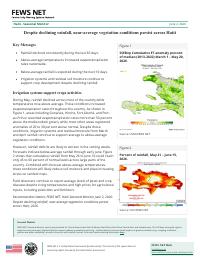
Moniteur saisonnier de FEWS NET pour Haïti, mai 2026, daté du June 2, 2026. Les pluies ont diminué de façon constante sur les 30 derniers jours, tandis que des températures supérieures à la moyenne ont augmenté les taux d'évapotranspiration dans tout le pays. Les systèmes d'irrigation et l'humidité résiduelle du sol ont continué de soutenir le développement des cultures malgré cette baisse, les conditions de végétation sont restées proches de la moyenne, et des pluies inférieures à la moyenne étaient attendues sur les 10 jours suivants. Le moniteur suit la saison en cours : cumuls pluviométriques rapportés à la moyenne de long terme, état de la végétation à partir du NDVI satellitaire, et ce que les deux impliquent pour les semis, le développement des cultures et la récolte. La date de couverture clôt la fenêtre de 30 jours couverte.
Texte Intégral du Document
Texte extrait du document original pour l'indexation.
Haiti - Seasonal Monitor
June 2, 2026
Despite declining rainfall, near-average vegetation conditions persist across Haiti
Key Messages
Figure 1
Rainfall declined consistently during the last 30 days.
Above-average temperatures increased evapotranspiration
rates nationwide.
SSEBop Cumulative ET anomaly percent
of median (2013–2022) March 1 – May 20,
2026.
Below-average rainfall is expected during the next 10 days.
Irrigation systems and residual soil moisture continue to
support crop development despite declining rainfall.
Irrigation systems support crops activities
During May, rainfall declined across most of the country while
temperatures rose above average. These conditions increased
evapotranspiration rates throughout the country. As shown in
Figure 1, areas including Gonaïves, Hinche, Fort-Liberté, and Portau-Prince recorded evapotranspiration rates more than 50 percent
above the median (dark green), while most other areas registered
anomalies of 20 to 30 percent above normal. Despite these
conditions, irrigation systems and residual moisture from March
and April rainfall continue to support average to above-average
vegetation conditions.
However, rainfall deficits are likely to worsen in the coming weeks.
Forecasts indicate below-average rainfall through early June. Figure
2 shows that cumulative rainfall from May 26 to June 10 could reach
only 45 to 60 percent of normal levels across large parts of the
country. Combined with forecast above-average temperatures,
these conditions will likely reduce soil moisture and place increasing
stress on rainfed crops.
Source: USGS/FEWS NET
Figure 2
Percent of rainfall, May 21 – June 15,
2026.
Field observers continue to report average levels of pests and crop
diseases despite rising temperatures and high prices for agricultural
inputs, including pesticides and fertilizers.
Recommended citation: FEWS NET. Haiti Seasonal Monitor June 2, 2026:
Despite declining rainfall, near-average vegetation conditions persist
across Haiti, 2026.
Source: CHC/FEWS NET
Seasonal Monitor
FEWS NET’s Seasonal Monitor reports are produced for Central America and the Caribbean, West Africa, East Africa, Central Asia, and Somalia every 10-to-30 days during the region’s
respective rainy season(s). Seasonal Monitors report updates on weather events (e.g., rainfall patterns) and associated impacts on ground conditions (e.g., cropping conditions,
pasture and water availability), as well as the short-term rainfall forecast. Find more remote sensing information here.
FEWS NET is a United States Government-funded activity. The content of this report does not
necessarily reflect the view of the United States Government.
FEWS NET Haiti
haiti@fews.net
fews.net/latin-america-and-caribbean/haiti