Deskripsyon Konple
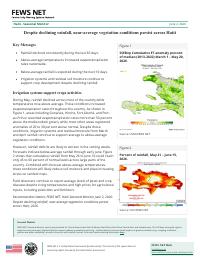
Monitè sezonye FEWS NET pou Ayiti, me 2026, ki gen dat June 2, 2026. Lapli te bese san rete pandan 30 dènye jou yo, pandan tanperati pi wo pase mwayèn te ogmante to evapotranspirasyon nan tout peyi a. Sistèm irigasyon ak imidite tè ki rete te kontinye sipòte devlopman rekòt yo malgre bès la, kondisyon vejetasyon yo te rete pre mwayèn, epi yo te atann lapli pi ba pase mwayèn pandan 10 jou ki vin apre yo. Monitè a swiv sezon k ap dewoule a: total lapli konpare ak mwayèn long tèm nan, kondisyon vejetasyon dapre NDVI satelit, ak sa toude vle di pou plantasyon, devlopman rekòt ak rekòt la. Dat kouvèti a fèmen fenèt 30 jou li kouvri a.
Teks Konple Dokiman an
Teks ki soti nan dokiman orijinal la pou endeksasyon.
Haiti - Seasonal Monitor
June 2, 2026
Despite declining rainfall, near-average vegetation conditions persist across Haiti
Key Messages
Figure 1
Rainfall declined consistently during the last 30 days.
Above-average temperatures increased evapotranspiration
rates nationwide.
SSEBop Cumulative ET anomaly percent
of median (2013–2022) March 1 – May 20,
2026.
Below-average rainfall is expected during the next 10 days.
Irrigation systems and residual soil moisture continue to
support crop development despite declining rainfall.
Irrigation systems support crops activities
During May, rainfall declined across most of the country while
temperatures rose above average. These conditions increased
evapotranspiration rates throughout the country. As shown in
Figure 1, areas including Gonaïves, Hinche, Fort-Liberté, and Portau-Prince recorded evapotranspiration rates more than 50 percent
above the median (dark green), while most other areas registered
anomalies of 20 to 30 percent above normal. Despite these
conditions, irrigation systems and residual moisture from March
and April rainfall continue to support average to above-average
vegetation conditions.
However, rainfall deficits are likely to worsen in the coming weeks.
Forecasts indicate below-average rainfall through early June. Figure
2 shows that cumulative rainfall from May 26 to June 10 could reach
only 45 to 60 percent of normal levels across large parts of the
country. Combined with forecast above-average temperatures,
these conditions will likely reduce soil moisture and place increasing
stress on rainfed crops.
Source: USGS/FEWS NET
Figure 2
Percent of rainfall, May 21 – June 15,
2026.
Field observers continue to report average levels of pests and crop
diseases despite rising temperatures and high prices for agricultural
inputs, including pesticides and fertilizers.
Recommended citation: FEWS NET. Haiti Seasonal Monitor June 2, 2026:
Despite declining rainfall, near-average vegetation conditions persist
across Haiti, 2026.
Source: CHC/FEWS NET
Seasonal Monitor
FEWS NET’s Seasonal Monitor reports are produced for Central America and the Caribbean, West Africa, East Africa, Central Asia, and Somalia every 10-to-30 days during the region’s
respective rainy season(s). Seasonal Monitors report updates on weather events (e.g., rainfall patterns) and associated impacts on ground conditions (e.g., cropping conditions,
pasture and water availability), as well as the short-term rainfall forecast. Find more remote sensing information here.
FEWS NET is a United States Government-funded activity. The content of this report does not
necessarily reflect the view of the United States Government.
FEWS NET Haiti
haiti@fews.net
fews.net/latin-america-and-caribbean/haiti