Description Complète
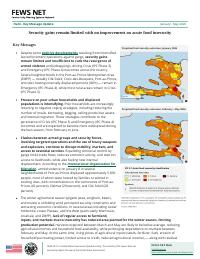
FEWS NET indique que, malgré certaines évolutions positives liées à l'intensification des opérations des forces de l'ordre contre les gangs (un début rapporté de reconquête de territoires), les gains sécuritaires restent limités et insuffisants pour freiner la recrudescence de la violence armée et des enlèvements, entraînant des résultats de Crise (Phase 3 de l'IPC) et d'Urgence (Phase 4 de l'IPC) à travers le pays. Plusieurs quartiers de la ZMPP - Cité Soleil, Croix-des-Bouquets, Port-au-Prince et sites de déplacés - restent en Urgence (Phase 4 de l'IPC), tandis que la plupart des zones rurales restent en Crise (Phase 3 de l'IPC).
La pression sur les ménages urbains pauvres et les populations déplacées s'intensifie, avec des stratégies négatives (moins de repas, endettement, mendicité, vente d'actifs productifs, migration interne) qui devraient se généraliser pendant la soudure de février-juin. Les affrontements impliquant armes lourdes et explosifs continuent de perturber la mobilité, les marchés et les services essentiels, et l'extension du contrôle territorial des gangs limite les flux commerciaux, réduit l'activité économique et alimente de nouveaux déplacements ; selon l'OIM, la violence armée du 8 janvier a déplacé environ 5 836 personnes, concentrées à Port-au-Prince (42%), Delmas (29%) et Cité Soleil (28%).
La campagne d'hiver (pois Congo, sorgho, haricot, maïs) se déroule dans un contexte d'insécurité qui a réduit les superficies emblavées (Bas Artibonite, Bas Plateau, communes de l'Ouest dont Montrouis, Arcahaie), de sorte que les récoltes de mars-mai seront probablement inférieures à la moyenne, prolongeant la dépendance aux marchés et réduisant les revenus agricoles. Les prix des produits de base restent atypiquement élevés - jusqu'à 130% au-dessus de la moyenne quinquennale - et malgré un taux de change stable autour de 130 HTG/USD, cette stabilité n'a pas amélioré l'accès alimentaire, le pouvoir d'achat des ménages pauvres restant sévèrement érodé.
Texte Intégral du Document
Texte extrait du document original pour l'indexation.
Security gains remain limited with no improvement on acute food insecurity
Key Messages
Haiti - Key Message Update January - May 2026
Despite some positive developments resulting from intensified
law enforcement operations against gangs, security gains
remain limited and insufficient to curb the resurgence of
armed violence and kidnappings, driving Crisis (IPC Phase 3)
and Emergency (IPC Phase 4) outcomes across the country.
Several neighborhoods in the Port-au-Prince Metropolitan Area
(ZMPP) — notably Cité Soleil, Croix-des-Bouquets, Port-au-Prince,
and sites hosting internally displaced persons (IDPs) — remain in
Emergency (IPC Phase 4), while most rural areas remain in Crisis
(IPC Phase 3).
Pressure on poor urban households and displaced
populations is intensifying. Poor households are increasingly
resorting to negative coping strategies, including reducing the
number of meals, borrowing, begging, selling productive assets,
and internal migration. These strategies contribute to the
persistence of Crisis (IPC Phase 3) and Emergency (IPC Phase 4)
outcomes and are expected to become more widespread during
the lean season, from February to June.
Clashes between armed groups and security forces,
involving targeted operations and the use of heavy weapons
and explosives, continue to disrupt mobility, markets, and
access to essential services. Expanding territorial control by
gangs limits trade flows, reduces economic activity, and restricts
access to livelihoods, while also fueling new internal
displacement. According to the International Organization for
Migration, armed violence on January 8 in several
neighborhoods of Port-au-Prince displaced approximately 5,836
people, most of whom were hosted by families or settled in
existing sites, with concentrations in the communes of Port-au-
Prince (42 percent), Delmas (29 percent), and Cité Soleil (28
percent).
The winter agricultural season (pigeon peas, sorghum, beans,
and maize) is unfolding amid persistent security constraints and
worsening economic conditions. In several areas including Lower
Artibonite, Lower Plateau, and the West (particularly Montrouis,
Arcahaie, and ZMPP), lack of regular access to farmland,
inputs, and markets due to insecurity has reduced area planted for the winter season, limiting
production potential. Harvests expected between March and May are likely to be below average, reducing
agricultural incomes and household food availability, while prolonging dependence on markets between
February and May. At the same time, rising prices of agricultural inputs (seeds, fertilizer, fuel), erosion of
household purchasing power, limited access to credit, reduced agricultural incomes — along with residual
FEWS NET is a United States Government-funded activity. The content of this report does not
necessarily reflect the view of the United States Government.
FEWS NET Haiti
haiti@fews.net
fews.net/latin-america-and-caribbean/haiti
Recommended citation: FEWS NET. Haiti Key Message Update January - May 2026: Security gains remain limited with no
improvement on acute food insecurity, 2026.
Key Message Update
This Key Message Update provides a high-level analysis of current acute food insecurity conditions and any changes to FEWS NET's latest projection of acute food insecurity outcomes
in the specified geography. Learn more here.
impacts of Hurricane Melissa, particularly in the Grand Sud — are constraining agricultural households’ capacity
to invest and to rebuild their productive assets.
Prices of staple foods remain atypically high and continue to severely limit economic access to food for
poor households. In December 2025, despite relative month-on-month economic stability in most markets,
prices of both local and imported food commodities remained well above the five-year average, with
fluctuations reaching up to 130 percent above the five-year average, depending on the product and market. This
price stability, supported by a relatively stable exchange rate of around 130 HTG/USD, has not translated into
improved food access. The purchasing power of poor households remains severely eroded, contributing to the
persistence of Crisis (IPC Phase 3) and Emergency (IPC Phase 4) outcomes.
*
FEWS NET's classifications are IPC-compatible. IPC-compatible analysis follows key IPC protocols but does not necessarily reflect the consensus of national food security partners. As of IPC
3.0, the IPC no longer assesses the impact of food assistance on classification and thus no longer maps the (!). However, FEWS NET continues to produce food security maps inclusive of the
(!) as well as maps compatible with IPC 3.0/3.1, which include the mapping of food security assistance bags. FEWS NET and the IPC use different methods to estimate the total Population in
Need of humanitarian food assistance and assess the risk of Famine. Learn more at www.fews.net/about.
Key Message Update January - May 2026
Famine Early Warning Systems Network
2