Texte Intégral du Document
Texte extrait du document original pour l'indexation.
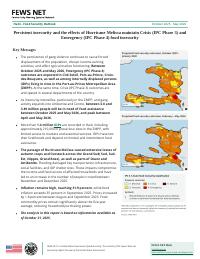
Persistent insecurity and the effects of Hurricane Melissa maintain Crisis (IPC Phase 3) and
Emergency (IPC Phase 4) food insecurity
Key Messages
Haiti - Food Security Outlook October 2025 - May 2026
The persistence of gang violence continues to cause forced
displacement of the population, disrupt income-earning
activities, and affect typical market functioning. Between
October 2025 and May 2026, Emergency (IPC Phase 4)
outcomes are expected in Cité Soleil, Port-au-Prince, Croix-
des-Bouquets, as well as among internally displaced persons
(IDPs) living in sites in the Port-au-Prince Metropolitan Area
(ZMPP). At the same time, Crisis (IPC Phase 3) outcomes are
anticipated in several departments of the country.
As insecurity intensifies, particularly in the ZMPP, and gang
activity expands into Artibonite and Centre, between 3.0 and
3.49 million people will be in need of food assistance
between October 2025 and May 2026, and peak between
April and May 2026.
More than 1.4 million IDPs are recorded in Haiti, including
approximately 210,000 in precarious sites in the ZMPP, with
limited access to markets and essential services. IDPs have lost
their livelihoods and depend on limited and intermittent food
assistance.
The passage of Hurricane Melissa caused extensive losses of
autumn crops and livestock across the Grand Sud( Sud, Sud-
Est, Nippes, Grand'Anse), as well as parts of Ouest and
Artibonite. Flooding damaged key transportation infrastructure,
social facilities, and IDP shelter sites. These impacts compromise
the income and food access of affected households and have
led to an increase in the number of people in need between
November and December 2025.
Inflation remains high, reaching 31.9 percent, while food
inflation exceeds 35 percent in September 2025. Prices increased
by 1.8 percent between August and September 2025. Food
commodity prices remain significantly above the five-year
average, reducing household purchasing power.
The analysis in this report is based on information available as
of October 31, 2025.
FEWS NET is a United States Government-funded activity. The content of this report does not
necessarily reflect the view of the United States Government.
FEWS NET Haiti
haiti@fews.net
fews.net/latin-america-and-caribbean/haiti
Food security context
Persistent insecurity remains one of the main determining factors of food insecurity in Haiti. Armed gang
activities have intensified in Port-au-Prince since the 2000s, despite a period of calm between 2006 and 2011. Since
2019, the resurgence of armed gang-related violence, particularly in the Port-au-Prince Metropolitan Area (ZMPP),
has profoundly disrupted household livelihoods. This violence has led to the displacement of more than 1.4 million
people, hindered the functioning of markets, limited humanitarian access, and compromised essential economic
activities.
The ZMPP, which has a population of nearly 3 million, constitutes the epicenter of violence and
approximately 90 percent is now controlled by armed groups. This situation has paralyzed income-generating
activities, particularly informal trade, street vending, and casual labor, which represent more than 90 percent of poor
urban households' income. Gang violence, in their effort to expand their territory of control, now extends beyond the
metropolitan area, particularly affecting the departments of Artibonite and Centre. Furthermore, gangs have
established checkpoints on major roads, notably the national highways connecting the capital to the north, center,
and south of the country, where they impose illegal taxes, thus hindering freedom of movement and the supply
chain. The markets of Croix-des-Bossales and Croix-des-Bouquets are more than 80 percent non-functional due to
violence and looting. Insecurity has led to a sharp decline in income for most households, both displaced and non-
displaced, affecting both formal and informal activities.
Macroeconomic conditions have severely deteriorated. The country has experienced seven consecutive years of
economic contraction between 2019 and 2025. The GDP, having already recorded a decline of more than 4 percent
during fiscal year 2023/24, is contracting further in 2024/25, given the current context of sociopolitical and security
crisis, as well as the slowdown in various economic sectors. The general price level remains high, reaching an average
of nearly 32 percent year-on-year, with food inflation exceeding 35 percent in September 2025. Moreover, although
prices of imported products have been relatively stable for three years, they remain above the five-year average,
which reduces household purchasing power and their access to markets, the main source of food.
National agricultural production is also affected by insecurity and a lack of public investment. Agriculture,
although secondary to imports, remains an essential source of income and food for rural households. However,
insecurity has led to the abandonment of arable land, particularly in the departments of Artibonite, Centre, and
Ouest. The persistence of insecurity and the deterioration of the economic context limit the government's capacity to
invest in the improvement and maintenance of agricultural infrastructure. In certain key areas, such as Liancourt,
Verrettes, and Petite Rivière de l'Artibonite, gangs control irrigation systems and impose illegal payments for access
to water. Although the country has three agricultural production seasons — spring, fall, and winter — spring
constitutes the main season and contributes 60 percent of the national production. However, the abandonment of
fields and below-average rainfall recorded during the first half of 2025 have contributed to a below-average spring
harvest.
Learn more
The following links provide additional information:
Latest Haiti Food Security Outlook Report: October 2024-May 2025
Latest Haiti Key Message Update: July-September 2025
Overview of FEWS NET’s scenario development methodology
FEWS NET’s approach to estimating the population in need
Overview of the IPC and IPC-compatible analysis
FEWS NET’s approach to humanitarian food assistance analysis
Food Security Outlook October 2025 - May 2026
Famine Early Warning Systems Network
2
Current anomalies in food security conditions as of October 2025
Insecurity has deteriorated in the Port-au-Prince metropolitan
area and is extending toward Lower-Artibonite and Centre.
Armed violence remains concentrated in the ZMPP, where gangs
control nearly 90 percent of the territory. Gang violence incidents
have multiplied, with 70 percent concentrated in Ouest, and an
increase in attacks in Bas-Artibonite, Centre, and certain areas of
Sud, according to Armed Conflict Location and Event Data (ACLED)
and Partner Liaison Security Office (PLSO). These attacks have
resulted in more than 1.4 million IDPs, 210,000 of which are
located in sites with precarious living conditions. The majority of
IDPs (85 percent) are hosted by rural families, further straining
already limited resources. These massive displacements disrupt
agricultural and non-agricultural livelihoods and exacerbate the
vulnerability of host households. Recurrent violence has also
slowed trade and investment, blocked the delivery of agricultural
inputs, and gangs have imposed passage fees on main routes (RN1,
RN2, RN3). Humanitarian access remains restricted, particularly in
the ZMPP, where distributions are often interrupted.
Although Hurricane Melissa did not make landfall in Haiti, it
caused flooding and landslides that resulted in loss of life (43 deaths, including 25 in Petit-Goâve), the
destruction of roads and infrastructure, as well as significant losses in the agricultural, livestock and
fisheries sectors. Satellite analysis conducted by REACH assessed the extent of flooded areas (Figure 1). The most
affected departments are Sud, Sud-Est, Nippes, Grand'Anse, Ouest (Leogane and Petit-Goâve), and Artibonite. More
than 15,861 people were affected and housed in temporary shelters, mainly in Grand Sud. In addition, several IDP
sites in the ZMPP were flooded, worsening the already precarious living conditions of these households. Banana,
sorghum, pigeon pea, maize, fruit tree, root, and tuber crops were damaged. In Sud-Est, damage to road
infrastructure affected the route connecting Jacmel to Port-au-Prince as well as local roads in Belle-Anse and Marigot.
The destroyed roads disrupted supply chains, market access, and the delivery of emergency humanitarian assistance.
The damage caused by Hurricane Melissa negatively impacted livelihoods, income and market access, as well as food
access for affected households. Although comprehensive assessments of the hurricane's impacts on food security
conditions are ongoing, an update will be provided in the next report.
Agricultural production for 2024/25, particularly spring harvests in June-July, temporarily improved local food
availability and reduced household dependence on market purchases; however, low yields due to lack of
inputs and insecurity prevented meaningful improvements to household consumption . Cereal production
(maize, rice, sorghum) in particular fell by 12 percent compared to 2023/24 and by 24 percent compared to the five-
year average. Local products (mangoes, avocados, bananas, tubers) only cover one to two months of consumption
stocks for poor households. In several areas of Nord-Ouest and Artibonite, households have already exhausted their
reserves and depend almost exclusively on the market.
The Haitian economy is recording a seventh consecutive year of recession, with GDP decline estimated at 1
percent in 2025. General inflation reached 31 percent in August 2025 and 34 percent for food products. Although
the exchange rate has stabilized around 130–131 HTG/USD since early 2024, purchasing power remains severely
eroded. Structural dependence on imports, combined with high transportation and energy costs, continues to restrict
food access for poor and very poor households.
Figure 1
Flooded areas by department, October
29-30, 2025
Source: REACH
Food Security Outlook October 2025 - May 2026
Famine Early Warning Systems Network
3
Various sources of income are declining for poor and very poor households. Decreased income from the sale of
agricultural products in 2025 is due to limited market access and input costs. Agricultural labor is contracting, and
below-average demand is resulting in wage stagnation. Non-agricultural activities are declining under the impacts of
insecurity and weak demand. Off-own-farm income is falling, pushing households to adopt negative coping strategies
such as the sale of productive assets, reducing meal size and quantity, and internal migration.
In the ZMPP, market functioning and supply remain disrupted by insecurity, leading to price increases for
basic commodities. Security disruptions continue to hinder access to the Port-au-Prince port, forcing importers to
favor the Cap-Haïtien port. This logistical reorganization has reduced imported volume and increased transportation
costs. According to the U.S. Department of Agriculture (USDA), a significant portion of rice shipments has been
redirected to Nord, a flow anomaly causing delays and additional costs.
Regional markets (Grand Nord, Artibonite, Centre, Grand Sud) remain supplied, but prices are high due to
transportation costs and fuel scarcity. In August 2025, continued increases in basic commodity prices were observed,
including more than 13 percent for wheat flour, more than 18 percent for vegetable oil, and more than 9 percent for
imported rice. Local products (roots, tubers, green maize) remain available, but at prices far exceeding the five-year
average, limiting food accessibility for poor households — a persistent anomaly linked to logistical shocks, input
inflation, and market fragmentation.
Humanitarian food assistance
In October 2025, assistance remains far below the level of need and faces severe operational and financial
constraints. WFP has suspended hot meals for newly displaced persons and reduced general rations by 50 percent
since June 2025 due to funding challenges, and has been unable to preposition food supplies for the cyclone season.
Partners report intermittent coverage in the ZMPP and around displacement sites, with access interruptions due to
violence and high logistical costs. Furthermore, the impacts of Hurricane Melissa have further increased the
immediate need for emergency food assistance. Despite this, food assistance volumes remain insufficient in
relation to sharply rising demand, while the 2025 Humanitarian Response Plan (HRP) remains underfunded .
As a result, the impact of assistance on consumption deficits is limited and highly heterogeneous depending on
humanitarian access.
Food Security Outlook October 2025 - May 2026
Famine Early Warning Systems Network
4
Current acute food insecurity outcomes as of October 2025
IDP households living in host sites in Port-au-Prince remain in
Emergency (Phase 4), primarily due to insecurity that has forced
them to abandon their homes and is resulting in the loss of their
livelihoods. These households face a severe lack of employment
opportunities, which severely limits their ability to earn income.
Humanitarian assistance, although present intermittently in these
host sites, does not even cover 25 percent of their essential needs.
Consequently, the majority of these households continue to resort to
extreme survival strategies, such as begging, child labor, sale of
household goods, and even petty urban crime.
In the ZMPP, the communes of Port-au-Prince, Cité Soleil, and
Cornillon and Ganthier in Croix-des-Bouquets, are in Emergency
(IPC Phase 4). These areas are marked by an intensification of armed
violence, prolonged disruptions of the food supply chain, a sharp
decline in income, and high prices. These combined factors severely
affect household access to food and livelihoods, resulting in significant
food consumption deficits. According to the 2025 Multi-Sector Needs
Assessment (MSNA) survey, 37, 25, and 16 percent of surveyed
households in Cité Soleil, Cornillon, and Croix-des-Bouquets,
respectively, reported not having food often. However, the other
communes constituting the ZMPP are in Crisis (IPC Phase 3) due to
the impacts of insecurity on their livelihoods, particularly income-
generating activities and access to markets, which are limiting their
access to food.
Other regions of the country remain in Crisis (IPC Phase 3) due to gang violence, declining purchasing power, as
well as disruptions to transportation and market supply due to illegal roadblocks. Households are resorting to
negative coping strategies to meet their food needs, including sales of animals, intensification of charcoal production,
and taking on debts to purchase food.
In the Nord-Ouest, late spring rains caused below-average harvests and reduced demand for agricultural labor.
Seasonal incomes for poor households are therefore atypically low, while prices of basic commodities (rice, oil, flour)
remain high. Pockets of households in Emergency (IPC Phase 4) are observed in the communes of Baie-de-Henne,
Bombardopolis, La Tortue, Môle-Saint-Nicolas, and Jean-Rabel.
In the Grand Sud (Sud, Sud-Est, Grand'Anse, Nippes), despite near-average spring harvests in some areas, the influx
of IDPs from Port-au-Prince increases pressure on host households and local resources, exacerbating their
vulnerability. High transportation prices due to illegal roadblocks on RN2 continue to impact markets. Poor
households are engaging in coping strategies such as selling their animals, intensifying charcoal production, and
taking on debts to maintain food consumption. Furthermore, the floods of late September 2025 and the passage of
Hurricane Melissa, affecting Sud, Nippes, and Grand'Anse, destroyed autumn crops and damaged secondary roads,
hindering the transport of agricultural products to trading locations. This resulted in income losses for farmers and
indirectly for agricultural workers, significantly reducing food access for affected poor households and increasing the
number of people in need emergency food assistance.
In Artibonite and Centre, a rapid deterioration of access and availability conditions linked to the expansion of armed
groups is observed, disrupting livelihoods, household food sources, inter-urban trade and access to rural markets.
Food prices remain high in the major markets of Gonaïves, Saint-Marc, and Mirebalais where supply disruptions are
frequent. Due to the negative impacts of the resurgence of violence on food access, resulting in more pronounced
food consumption deficits, pockets of households in Emergency (IPC Phase 4) are observed in the communes of La
Chapelle, Petite Rivière de l'Artibonite, Liancourt, Mirebalais, Saut d'Eau, Lascahobas (Centre).
Food Security Outlook October 2025 - May 2026
Famine Early Warning Systems Network
5
The Nord and Nord-Est departments present a relatively stable but fragile situation, with constraints related to fuel
and weak demand for non-agricultural work. This results in difficult and limited access to basic food products given
the high prices that poor and very poor households face. Additionally, the nutritional situation of children under five
is at the Alert threshold, particularly for the Nord-Est, with a GAM rate near 10 percent according to MSPP.
UNICEF, at the beginning of October 2025, estimates that approximately 288,500 children under five are
suffering from acute malnutrition in the context of massive displacement and collapse of health services. In June
2025, 30,376 children were screened countrywide and more than 9,600 cases of severe acute malnutrition (SAM)
were admitted for treatment, nearly triple the number recorded in May. This increase reflects strong pressure on
nutritional care capacities. The aggravating factors of this deterioration are primarily insecurity disrupting access to
care, food inflation reducing diet quality, waterborne disease (cholera/diarrhea), and limited access to safe water and
sanitation. High-risk areas include the ZMPP, displacement camps, and pockets of households in Artibonite and the
Central Plateau, where humanitarian access is restricted and child morbidity is high.
Key assumptions about atypical food security conditions underpinning the most likely scenario through
May 2026
In Haiti, gang-fueled violence has intensified in the ZMPP, nearly 90 percent of which is now under gang control.
Homicides and attacks against civilians and security forces are expected to remain at their current level in the
very short term, before experiencing an increase by February 2026 and likely beyond.
Gangs are expected to extend their grip toward Centre and Artibonite, causing violence, forced displacement,
and disruptions to livelihoods, markets, and trade. Persistent restrictions on major routes around the capital
(Port-au-Prince) will continue to hinder trade between the capital and the rest of the country.
Gang-related insecurity, which impacts the main national roads (RN1, RN2, and RN3), will likely continue to
disrupt the supply of urban markets, particularly those in the ZMPP, and limit movement between major cities.
Due to the persistence of violence, population displacement is likely to continue in Artibonite, Centre, and the
ZMPP. This dynamic is expected to continue from October 2025 to May 2026, given the weakness of the state
response to armed gangs. Meanwhile, nearly 227,000 Haitians have been repatriated from January to
November 2, 2025, the vast majority (98 percent) from the Dominican Republic. Expulsions are expected to
continue over the outlook period.
Apart from the passage of Hurricane Melissa, which caused above-average rainfall, the combination of near-
average precipitation and above-average temperatures could reduce soil moisture, increase evapotranspiration,
and consequently limit growth and decrease yields of fall and winter crops such as maize, beans, roots, and
tubers.
The reference exchange rate of the Banque de la République d'Haïti (BRH) will likely remain stable around 130
HTG/USD during the projection period. The requirement to receive remittances from the diaspora only in HTG
and banking restrictions limiting daily cash withdrawals and foreign currency acquisitions (daily caps) reduce
immediate pressure on the market. Moreover, weak demand for foreign currency, linked to the contraction of
economic activities and the decline in imports, would contribute to limiting pressure on the dollar.
Relative price stability for imported rice varieties is expected in the Haitian market, particularly at Croix-des-
Bossales. Near-record production and substantial rice stocks (USDA) are expected to lead to a decline in global
prices, while sustained record supply in Asian countries should maintain low prices throughout the forecast
period. Prices for products such as wheat (for flour) and edible oil are expected to be similarly stable.
Local prices for yellow maize, black beans, and local rice are expected to remain above average and likely to
increase seasonally during the February to May lean season.
Annual food inflation is expected to remain above 30 percent, with seasonal increases anticipated toward the
end of the year. Overall inflationary pressures are expected to intensify, driven by rising costs of transportation,
Food Security Outlook October 2025 - May 2026
Famine Early Warning Systems Network
6
Humanitarian food assistance
Projected acute food insecurity outcomes through May 2026
From October 2025 to May 2026, Cité Soleil, Port-au-Prince, Croix-des-Bouquets, as well as IDPs in sites in the
ZMPP, will remain in Emergency (IPC Phase 4). The resurgence of clashes between gangs and security forces
severely restricts mobility and access to local markets, while the main supply routes (RN1, RN2, RN3) remain under
the influence or intermittent control of armed groups. This gang violence causes prolonged disruptions to markets
and logistical flows. The closure or irregular operation of the Croix-des-Bossales, Croix-des-Bouquets, and Cité Soleil
markets continues to disrupt the supply of basic commodities, leading to increased prices and limiting local
availability. Moreover, the livelihoods of the majority of poor households have deteriorated (informal trade,
transport, domestic services), resulting in declining income and weak purchasing power. Some households will
continue to resort to coping strategies such as begging, selling productive assets, skipping meals, and withdrawing
children from school, and food assistance is insufficient to cover the population in need. In addition, IDPs live in
overcrowded conditions marked by insecurity, malnutrition, and cases of acute diarrhea, with very limited access to
water and healthcare further aggravating food insecurity.
The majority of the country's departments will remain in Crisis (IPC Phase 3) from October 2025 to May 2026,
with pockets of households in Emergency (IPC Phase 4) persisting in the Nord-Ouest (HT01–HT02), the Bas Plateau
Central, and certain areas of Artibonite (notably Petite-Rivière, Verrettes, and L'Estère). In the ZMPP, the communes
of Carrefour, Delmas, Pétion-Ville, and Tabarre will maintain slightly less degraded conditions due to a partial
recovery of urban service and trade activities. However, security volatility, high transportation costs, and the
contraction of small-scale trade income will continue to restrict access to food.
In rural areas — notably in the Nord, Nord-Est, Centre, and areas affected by Hurricane Melissa including Sud-Est,
Sud, Ouest (notably Petit Goave, Leogane), Nippes, Artibonite and Grand'Anse — the persistent decline in cereal
production (rice, maize, sorghum), lack of inputs, above-average prices, and heavy market dependence will prevent
households from meeting their minimum food needs. Households in the south will continue to suffer the residual
effects of the hurricane until the end of the year, experiencing negative impacts to the winter season (starting in
December), and possibly even the start of the spring season. This will limit the ability of farmers to hire workers or
purchase seeds. In addition, mass repatriations from the Dominican Republic and internal displacements will
increase pressure on already vulnerable host communities.
food, and utilities.
Fuel supply is expected to remain limited by insecurity and disruptions to distribution routes and storage sites.
Despite international stability, local prices are anticipated to remain above the five-year average due to
transportation costs and logistical constraints.
Remittances are expected to remain significant, exceeding the average and 2024 levels, and support household
consumption throughout 2025 and 2026. In 2026, remittances are expected to decrease compared to 2025 but
remain above average. The tightening of migration policies and new taxes on money transfers from the United
States are expected to discourage remittances.
The income of poor households, both in rural and urban areas, will likely be below the five-year average due to
the continued decline of key economic activities. In rural areas, the decrease in income will result primarily from
reduced profits from the sale of agricultural labor due to high input costs, the scarcity and high cost of
agricultural labor, as well as persistent disruptions in the distribution chain due to insecurity. In urban areas,
small-scale trade, a key source of income, would also experience a notable decline.
For the projection period (October 2025-May 2026), food assistance coverage is expected to be low.
Furthermore, given the significant reduction in rations since June, funding challenges and logistical and security
constraints, it is likely that the level of assistance will decrease further during the projection period.
Food Security Outlook October 2025 - May 2026
Famine Early Warning Systems Network
7
In the Nord-Ouest, the series of failed agricultural seasons due to drought, lack of inputs, and environmental
degradation has reduced local availability to a historic low level. In the Plateau Central and Bas Artibonite, armed
gang violence disrupts trade along RN1, RN2 and with the Dominican Republic, affecting the flow of products and
agricultural income. These areas therefore combine low food availability, limited access, and severely eroded income.
Annex 1: Key sources of evidence used in this analysis
Livelihoods profiles FEWS NET Qualitative Typical sources of food and income by livelihood
zone
Outlook on cereal supply
and markets in Haiti
FEWS NET Qualitative/
Quantitative
Analysis of national and regional cereal supply
and demand trends; monitoring of imports,
internal flows, stock levels, and price
movements in major markets
Annual grain report
produced by the U.S.
Department of Agriculture
(USDA)
USDA Qualitative/
Quantitative
Global and regional cereal production trends;
impact on international prices and availability in
Haitian markets
Monetary Policy Note,
April–June 2025
BRH Qualitative/
Quantitative
Inflation, exchange rates, money supply, and
their impacts on purchasing power and food
prices
Food Security Cluster
distribution plans, including
historical trend analysis
FSC Qualitative/
Quantitative
Geographic and temporal coverage of food
assistance, number of beneficiaries, and trends
in humanitarian coverage
Haiti – Internal Displacement
Situation Report – Round 10
(June 2025)
International
Organization
for Migration
(IOM)
Qualitative/
Quantitative
Number of IDPs, causes of displacement, areas
of concentration, and impacts on livelihoods
and food access
Conflict analyses ACLED, PLSO Qualitative/
Quantitative
Number of violent incidents, affected areas,
conflict trends, and impacts on market access,
production, and population movements
Key informant interviews,
including FEWS NET price
enumerators, community
leaders, and others
FEWS NET Qualitative/
Quantitative
Field information on prices, food availability,
survival strategies, local perceptions, and
market trends
Food Security Survey REACH/MSNA Qualitative/
Quantitative
Field data collected by REACH on food security
conditions, including consumption, livelihoods,
and coping strategies by region
CPI Haitian
Institute for
Statistics and
Informatics
(IHSI)
Quantitative Information used to measure inflation rates for
food and non-food items, including local and
imported products
Reports OCHA Qualitative/
Quantitative
Monitoring of the humanitarian situation,
sectoral coverage, aid financing, priority
intervention areas, and intersectoral
coordination
Evidence Source
Data
format Food security element of analysis
Food Security Outlook October 2025 - May 2026
Famine Early Warning Systems Network
8
Haitian Market Monitoring –
August 2025
WFP Market
analysis and
monitoring
Food security analysis report
Analytical Report WFP Qualitative Analysis of the impact of violence on food
security in the Haitian capital amid declining
food assistance
News Article Miami Herald,
Haitian Times
Qualitative/
quantitative
Article on the impact of Hurricane Melissa
Emergency Response
Update
World Vision Qualitative
situation
report
Rapid assessment of the impact of Hurricane
Melissa
Annex 2: FEWS NET’s analytical approach explained
Early warning of acute food insecurity outcomes requires forecasting months in advance to provide decision makers with
sufficient time to budget, plan, and respond to expected humanitarian crises. However, due to the complex and variable
factors that influence acute food insecurity, definitive predictions are impossible. Scenario Development is a methodology
that allows FEWS NET to meet decision makers’ needs by developing a “most likely” scenario of the future.
FEWS NET’s scenario development process applies the Disaster Risk Reduction framework and a livelihoods-based lens to
assess acute food insecurity outcomes. A household’s risk of acute food insecurity depends not only on hazards (such as
drought) but also the household’s vulnerability to these hazards (e.g., the level of dependence on rainfed crop production
for food and income) and coping capacity (which considers both the household’s ability to cope with a given hazard and the
use of negative coping strategies that harm future capacity). To evaluate these factors, FEWS NET bases this analysis on a
strong foundational understanding of local livelihoods. FEWS NET’s scenario development process also accounts for the
Sustainable Livelihoods Framework; the Four Dimensions of Food Security; and UNICEF’s Nutrition Conceptual Framework,
and is closely aligned with the Integrated Food Security Phase Classification (IPC) analytical framework.
Evidence Source
Data
format Food security element of analysis
How does FEWS NET analyze current acute food insecurity outcomes? FEWS NET assesses the extent to which
households can meet their minimum caloric needs. This analysis converges evidence of current food security
conditions with available direct evidence of household-level food consumption and livelihood change. FEWS NET also
considers available area-level evidence of nutritional status and mortality, focusing on whether these reflect the
physiological impacts of acute food insecurity. FEWS NET uses the globally recognized five-phase Integrated Food
Security Phase Classification (IPC) scale to classify current acute food insecurity outcomes, and the analysis is IPC-
compatible. In addition, FEWS NET applies the “!” symbol to designate areas where the mapped IPC Phase would
likely be at least one IPC Phase worse without the effects of ongoing humanitarian food assistance.
How does FEWS NET develop key assumptions underpinning the most likely scenario? A key step in FEWS NET’s
scenario development process is the development of evidence-based assumptions about factors that affect food
security. These include hazards and anomalies in food security conditions that will impact the evolution of household
food and income during the projection period, as well as factors that may affect nutritional status. FEWS NET also
develops assumptions about factors expected to behave normally. Together, these assumptions form the foundation
of the “most likely” scenario.
How does FEWS NET analyze projected acute food insecurity outcomes? Using the key assumptions that underpin
the “most likely” scenario, FEWS NET projects acute food insecurity outcomes by assessing the evolution of households’
ability to meet their minimum caloric needs over time. FEWS NET converges expectations of the likely trajectory of
household-level food consumption and livelihood change with area-level nutritional status and mortality. FEWS NET
then classifies acute food insecurity outcomes using the IPC scale. Lastly, FEWS NET applies the “!” symbol to designate
any areas where the mapped IPC Phase would likely be at least one IPC Phase worse without the effects of planned –
Food Security Outlook October 2025 - May 2026
Famine Early Warning Systems Network
9
Annex 3: Seasonal calendar
Annex 4: Events that would likely change projected acute food insecurity outcomes
While FEWS NET’s projections are considered the “most likely” scenario, there is always a degree of uncertainty in the
assumptions that underpin the scenario. This means food security conditions and their impacts on acute food security may
evolve differently than projected. FEWS NET issues monthly updates to its projections, but decision makers need advance
information about this uncertainty and an explanation of why things may turn out differently than projected. As such, the
final step in FEWS NET’s scenario development process is to briefly identify key events that would result in a credible
alternative scenario and significantly change the projected outcomes. FEWS NET only considers scenarios that have a
reasonable chance of occurrence.
National
A delay or poor distribution of rainfall in agricultural production areas: Sud, Sud-Est, Nippes, Grand'Anse, Ouest,
Artibonite, Grand Nord.
Likely impact on acute food insecurity outcomes: A delayed or poor distribution of rainfall between February and
May 2026 would compromise the timely launch of the spring agricultural season and jeopardize crop performance.
These consequences would result in considerable economic losses for farmers and create food shortages within
affected communities. The livelihoods of the poorest households would likely be most severely affected, particularly
those dependent on the sale of labor and agricultural products to access income. This would lead to an increase in
the number of households in Crisis (IPC Phase 3) or Emergency (IPC Phase 4) in areas vulnerable to natural disasters
such as the southern peninsula, the Ouest, and to food insecurity such as the Nord Ouest.
and likely to be funded and delivered – food assistance.
How does FEWS NET analyze humanitarian food assistance? Humanitarian food assistance – defined as
emergency food assistance (in-kind, cash, or voucher) – may play a key role in mitigating the severity of acute food
insecurity outcomes. FEWS NET analysts always incorporate available information on food assistance, with the caveat
that such information can vary significantly across geographies and over time. In line with IPC protocols, FEWS NET
uses the best available information to assess where food assistance is “significant” (defined by at least 25 percent of
households in a given area receiving at least 25 percent of their caloric requirements through food assistance). In
addition, FEWS NET conducts deeper analysis of the likely impacts of food assistance on the severity of outcomes, as
detailed in FEWS NET’s guidance on Integrating Humanitarian Food Assistance into Scenario Development.
Source: FEWS NET
Food Security Outlook October 2025 - May 2026
Famine Early Warning Systems Network
10
Annex 5: A closer look at conflict and its impacts on food security outcomes
Armed conflict in Haiti, particularly in Port-au-Prince, Artibonite, and
Centre, has severe impacts on food security. This violence consists
of gang attacks against civilians, security forces, commercial
establishments, markets, and public and private institutions. Waves
of violence have resulted in the complete devastation of downtown
Port-au-Prince. The majority of commercial infrastructure has been
destroyed and looted and inhabitants have fled, relocating to other
locations such as Pétion-Ville, Delmas, and the airport, which are
not yet directly under gang control. In Artibonite, gangs are not only
forcing agricultural populations to flee their production areas, but
also burning or destroying rice plantations during the growing
season, thus jeopardizing winter rice production.
Since 2019, the rise of armed violence in Haiti has transformed into
a prolonged conflict, pitting state forces against organized armed
groups, the best known of which is the organization called "Viv
ansanm." This grouping of gangs, once rivals, now agrees to
exercise almost total control over the ZMPP (90 percent). In
2025, their presence has consolidated in the Ouest, Artibonite (Saint-Marc, Petite-Rivière-de-l'Artibonite, Verrettes,
L'Estère, Gros-Morne, Marchand-Dessalines, Liancourt), Centre, and in communes of the Nord-Ouest, such as Bassin
Bleu, Chansolme, and others (Figure 2).
Approximately 200 gangs are armed in Haiti, with varied claims and objectives. These groups find their origin in
the Haitian political landscape. Today, gangs use their illicit activities and political connections to accumulate power,
control territories, and respond to political and economic grievances.
IOM estimates more than 1.4 million people have been internally displaced due to gang violence, an increase of
31 percent compared to the end of 2024. These people have lost their essential livelihoods and are living on the edge
of survival. Gangs have extended their grip toward Centre and Artibonite, causing violence, forced displacement, and
disruptions to livelihoods, markets, and trade in these regions. In addition to population movements and their direct
impact on food security conditions, the effects of conflict are manifested on agricultural production and economic
access. The spring 2025 agricultural season recorded yields below the five-year average, particularly in the Artibonite
valley and the southern peninsula, where violence and limited access to inputs reduced cultivated areas, according to
a FEWS NET Markets and Trade analysis.
Insecurity on commercial routes prevents the typical movement of people and goods. Transporters who use national
roads despite the insecurity risks must pay illegal taxes at variable rates to gang members, increasing their
operational costs. Other traders and individuals are forced to resort to maritime transport to avoid armed gang
attacks. As a result, public transport costs for individuals and traders are increasing, and by extension, the prices of
basic commodities. This is particularly evident in the Ouest department and the ZMPP, where main access routes are
under the control of armed gangs, preventing local and imported products from supplying major urban markets and
households from carrying out their income-earning activities related to petty trade and daily/casual labor. This
reduces the economic and physical access of poor households who, to cope with this situation, must resort to
negative consumption and livelihood coping strategies.
Persistent restrictions on the main routes around Port-au-Prince will continue to hinder trade between the capital
and the rest of the country. Population displacements will likely continue in Artibonite, Centre, and the ZMPP. This
dynamic is expected to continue from October 2025 to May 2026, given the weakness of the state response to armed
gangs. Thus, armed conflict and security deterioration will continue to be the main drivers of food insecurity in Haiti.
Their cumulative effects on production, markets, and humanitarian access are maintaining Crisis (IPC Phase 3) and
Emergency (IPC Phase 4) outcomes for millions of people. Without security improvements or increased humanitarian
support, this situation is at risk of extending beyond May 2026.
Figure 2
Heat map of violent incidents in Haiti
Source: ACLED
Food Security Outlook October 2025 - May 2026
Famine Early Warning Systems Network
11
Recommended citation: FEWS NET. Haiti Food Security Outlook October 2025 - May 2026: Persistent insecurity and the
effects of Hurricane Melissa maintain Crisis (IPC Phase 3) and Emergency (IPC Phase 4) food insecurity, 2025.
Food Security Outlook
To project food security outcomes, FEWS NET develops a set of assumptions about likely events, their effects, and the probable responses of various actors. FEWS NET analyzes these
assumptions in the context of current conditions and local livelihoods to arrive at a most likely scenario for the coming eight months. Learn more here.
*
FEWS NET's classifications are IPC-compatible. IPC-compatible analysis follows key IPC protocols but does not necessarily reflect the consensus of national food security partners. As of IPC
3.0, the IPC no longer assesses the impact of food assistance on classification and thus no longer maps the (!). However, FEWS NET continues to produce food security maps inclusive of the
(!) as well as maps compatible with IPC 3.0/3.1, which include the mapping of food security assistance bags. FEWS NET and the IPC use different methods to estimate the total Population in
Need of humanitarian food assistance and assess the risk of Famine. Learn more at www.fews.net/about.
Food Security Outlook October 2025 - May 2026
Famine Early Warning Systems Network
12