Texte Intégral du Document
Texte extrait du document original pour l'indexation.
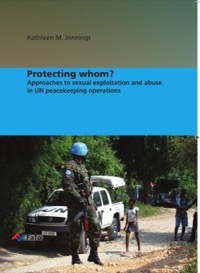
Protecting whom? Kathleen M. Jennings
Kathleen M. Jennings
This policy report critically examines the preliminary impact and
implications of the zero-tolerance policy towards sexual exploitation Protecting whom?
and abuse in two UN peacekeeping missions – the UN Stabilization Approaches to sexual exploitation and abuse
Mission in Haiti and the UN Mission in Liberia – using the organizing
in UN peacekeeping operations
Protecting whom?
principle of protection. It argues that the missions have taken different
approaches to implementing the zero-tolerance policy according
to different primary referents of protection: in Haiti, the UN image
was the primary referent, resulting in a minimalist approach to
implementation of the zero-tolerance policy; while in Liberia, the local
population was the primary referent, resulting in a more maximalist
approach. The report also lays out findings of particular relevance for
policymakers and practitioners.
Protecting Whom has been made possible by the generous support of
the Norwegian Ministry of Foreign Affairs.
Fafo
P.O.Box 2947 Tøyen Fafo-report 2008:36
N-0608 Oslo ISBN 978-82-7422-646-3
www.fafo.no/english/ ISSN 0801-6143
Order no. 20078
20078-omslag.indd 1 14.11.2008 14:12:59
��Kathleen M. Jennings
Protecting Whom?
Approaches to sexual exploitation and abuse
in UN peacekeeping operations
Fafo-report 2008:36
�© Fafo 2008
ISBN 978-82-7422-646-3
ISSN 0801-6143
Cover photo: Henriette Lunde
Cover design: Fafo Information office
Printed in Norway by: Allkopi AS
�Contents
Acronyms���������������������������������������������������������������������������������������������������������� 5
Acknowledgements����������������������������������������������������������������������������������������� 6
Executive summary�������������������������������������������������������������������������������������������7
1. Introduction��������������������������������������������������������������������������������������� 9
Methodology and ethical considerations������������������������������������������������������11
2. Setting the context: zero-tolerance policy overview
and application����������������������������������������������������������������������������������� 15
A difficult problem to measure��������������������������������������������������������������������� 18
A clarification on application and sanctions������������������������������������������������ 20
What “really” counts as SEA?����������������������������������������������������������������������� 22
3. Can zero-tolerance be enforced? –
Limitations in Haiti and Liberia��������������������������������������������������������� 25
4. Protection as the organizing principle������������������������������������������ 35
The minimalist approach: protection of the UN image������������������������������� 36
Haiti: minimalism in practice��������������������������������������������������������������������� 39
The maximalist approach: protection of the local population�������������������� 45
Liberia: maximalism in practice����������������������������������������������������������������� 48
Mission context and the different approaches to prevention�������������������� 53
5. Initial impact and unintended consequences of
the zero-tolerance policy������������������������������������������������������������������� 55
6. Conclusion��������������������������������������������������������������������������������������� 65
Organizational issues: Improving the OIOS-mission relationship��������������� 69
Dealing with stereotypes and improving enforcement�������������������������������71
7. References��������������������������������������������������������������������������������������������������� 73
3
�4
�Acronyms
CDU Conflict and Discipline Unit
DPKO Department of Peacekeeping Operations
DRC Democratic Republic of the Congo
FCD Force Commander’s Directive
FPU Formed Police Unit
OIOS Office of Internal Oversight Services
MINUSTAH United Nations Stabilization Mission in Haiti
MOU Memorandum of Understanding
NGO Non-governmental organization
SEA Sexual exploitation and abuse
SGB Secretary-General’s Bulletin
SRSG Special Representative of the Secretary-General
TCC Troop-contributing country
UN United Nations
UNICEF United Nations Children’s Fund
UNIFEM United Nations Development Fund for Women
UNMIL United Nations Mission in Liberia
UNPOL United Nations Police
5
�Acknowledgements
Much appreciation and sincere thanks are owed to all of the informants who were so
generous with their time, insights, and trust in Haiti and Liberia; as well as to the respec-
tive missions, for tolerating the incursion of curious and critical researchers working on
such a delicate subject. In particular, the office of the Force Commander in Haiti and
the office of the Gender Advisor in Liberia were of invaluable assistance in providing
logistical support and facilitating temporary passes. The author is also enormously
grateful to the hard work and dedication of Henriette Lunde and Ingunn Bjørkhaug,
who conducted the fieldwork with her in Haiti and Liberia, respectively. Thanks are
also owed to Fafo colleagues May-Len Skilbrei, Jon Pedersen, and Mark Taylor, for
commenting readily and intelligently on early drafts. It goes without saying that any
errors in the final report are the author’s own. Finally, the author wishes to thank the
Norwegian Ministry of Foreign Affairs for generously funding this project.
6
�Executive summary
In order to combat the problem of sexually exploitative or abusive behavior by UN
peacekeepers towards local citizens, the United Nations has instituted a “zero-tolerance
policy” that a) prohibits the exchange of money, employment, goods, services, and
other assistance for sex, b) prohibits UN personnel from having sexual relations with
persons under the age of 18, and c) strongly discourages sexual relationships between
UN personnel and adult beneficiaries of assistance. The promulgation of the policy in
2003 was followed by a series of institutional reforms, most notably the formation of
Conduct and Discipline units in New York and within peacekeeping operations, and
the expansion of the Office of Internal Oversight Service’s (OIOS) mandate to include
investigations of SEA allegations. Peacekeepers found in violation of the zero-tolerance
policy can be dismissed from UN service and/or repatriated, and may be subject to
prosecution in their home country or military for criminal violations.
This policy report examines the institutional ramifications and manifold pre-
liminary impacts of the zero-tolerance policy towards sexual exploitation and abuse
(SEA) in two UN peacekeeping missions: the UN Stabilization Mission in Haiti
(MINUSTAH) and the UN Mission in Liberia (UNMIL). It identifies enforcement
problems that undermine the effectiveness of the zero-tolerance policy – problems
that are unsurprising in an attempt to impose a particular normative standard on a
large, culturally and socio-economically diverse peacekeeping mission population, in
the context of a host society afflicted by widespread poverty, joblessness, and extremely
distorted economies. It further argues that the two missions have taken different
approaches to implementing the zero-tolerance policy according to different primary
referents of protection – that is, differences in whether the primary task is protecting
the local population from SEA or protecting the UN’s image from disrepute. In Haiti,
the UN image was the primary referent, resulting in a minimalist, internally-oriented
approach to implementation of SGB; while in Liberia, the local population was the
primary referent, resulting in a more maximalist, externally-focused approach. Differ-
entiating the two ideal types of minimalist and maximalist approaches does not imply
a moralistic argument for one over the other. Rather, it provides some clarity going
forward in terms of which actions and desired outcomes may be prioritized, possible,
or unrealistic in different mission contexts employing the different approaches, as well
as what the tradeoffs of different implementation modalities may be.
7
�The report focuses in particular on the ways in which the zero-tolerance policy is
interpreted and perceived by personnel serving in UN missions, whether as military,
police or civilians, and whether as part of the Department of Peacekeeping Operations
(DPKO) mission or as UN agency staff. Is the zero-tolerance policy being effectively
communicated, and how do personnel’s understanding and perceptions of the policy
seem to relate to their expressed attitudes and observable behavior? The report also
identifies the paradox that the zero-tolerance policy – which attempts to reinforce
protections against exploitative and abusive behavior – seems to have unfortunately
encouraged the persistence among a multitude of informants of racial and gender-
based stereotypes about the local population, and occasionally of their fellow UN
colleagues.
Key findings from the report include:
• The importance of context in the approach to implementing the zero-tolerance
policy, taking into account the mission’s capacity, resources, and previous behavior
or history of misconduct, as well as whether there is local interest, capacity and
national lead on SEA issues.
• The need to improve communication, cooperation, and limited information-sharing
between the Office for Internal Oversight Services, the mission Conduct and Discip
line Unit, and mission leadership, in a way that protects OIOS’s independence and
integrity while enabling mission leadership and CDU to more effectively and pro-
actively manage problem individuals or groups on the basis of accurate information.
• The importance of moving SEA enforcement beyond its dependence on individual
reporting by systematically integrating, prioritizing, and providing clear guidance
on conducting SEA prevention and enforcement within existing activities being
conducted by missions, including: night patrols by the mission’s security unit,
military police, and UN Police; investigations into curfew violations; listing and
sporadically checking in on “out-of-bounds” establishments prohibited to mission
personnel; and road checkpoints.
• In presenting and explaining the SEA policy, mission personnel must take care to
avoid perpetuating, reinforcing, or introducing new stereotypes about the local
population or fellow UN colleagues, via the zero-tolerance strictures – for example,
by not over-exaggerating the risk of false allegations, indulging in scare tactics about
HIV prevalence rate, or generalizing about the local culture and/or perceived sexual
norms of certain groups of people.
• Either more guidance is needed on how to appropriately deal with the “strongly
discouraged” standard for relationships with local residents, or the clause should
be discarded – as it stands, the “strongly discouraged” standard merely complicates
attempts to explain and fairly enforce the zero-tolerance policy and substantiate
allegations, and also undercuts the policy’s legitimacy among personnel.
8
�1. Introduction
The problem of peacekeeper involvement in sexual exploitation and abuse against the
local population first surfaced publicly in the 1990s with the UN peacekeeping mis-
sions in Cambodia, Bosnia and Herzegovina, Timor-Leste, and Kosovo (UN 2005a).
However, it was not until 2002 – when allegations of widespread abuses by military
and civilian personnel in West Africa and, later, the Democratic Republic of the
Congo prompted outrage – that the issue of SEA and peacekeeping operations re-
ceived concerted attention within the UN system. The United Nations subsequently
formulated strategies to combat SEA by UN personnel in peacekeeping operations.
Most important is the “zero-tolerance” policy towards sexual exploitation and abuse
outlined in the Secretary-General’s Bulletin (SGB) of 2003 (UN 2003).
The SGB defines sexual exploitation as “any actual or attempted abuse of a position
of vulnerability, differential power, or trust, for sexual purposes, including, but not
limited to, profiting monetarily, socially, or politically from the sexual exploitation of
another”; sexual abuse is “the actual or threatened physical intrusion of a sexual nature
whether by force or under unequal or coercive conditions”. The zero-tolerance policy
prohibits the exchange of money, employment, goods, services, and other assistance
for sex. The policy further prohibits UN staff from having any sexual relations with
persons under the age of 18, regardless of the local age of consent or mistaken belief
in the person’s age. In other words, sexual relations with persons under the age of 18
are de facto exploitative and/or abusive, and cannot be mitigated by other factors.
Furthermore, all UN staff are obligated to report “concerns or suspicions regarding
sexual exploitation or sexual abuse by a fellow worker, whether in the same agency or
not and whether or not within the United Nations system (UN 2003: 2)”. Violations
of the policy can constitute grounds for summary dismissal of UN staff.1 Notably,
however, the SGB does not prohibit non-transactional sexual relationships between
UN staff and adult beneficiaries of assistance, although it does “strongly discourage”
such relationships, citing the “inherently unequal power dynamics” upon which they
1
Applicable punishments for violations of the zero-tolerance policy vary depending on whether the
perpetrator is a UN staff member, an expert on mission (e.g. a member of the civilian police, UNPOL),
or a member of a military contingent. This inconsistency will be explained in further detail in chapter
2, below.
9
�are generally based.2 The zero-tolerance policy is now typically amended or integrated
into the codes of conduct that peacekeeping mission personnel pledge to uphold.
This policy report will critically examine the preliminary impact and implications of
the zero-tolerance policy towards sexual exploitation and abuse in two UN peacekeep-
ing missions: the UN Stabilization Mission in Haiti and the UN Mission in Liberia.
It argues that the two missions have taken different approaches to implementing the
zero-tolerance policy according to different primary referents of protection: in Haiti,
the UN image was the primary referent, resulting in a minimalist approach to imple-
mentation of SGB; while in Liberia, the local population was the primary referent,
resulting in a more maximalist approach. The report particularly focuses on the ways
in which the zero-tolerance policy is interpreted and perceived by personnel serving
in UN missions, whether as military, police or civilians, and whether as part of the
DPKO mission or as UN agency staff.3 Is the zero-tolerance policy being effectively
communicated, and how do personnel’s understanding and perceptions of the policy
seem to relate to their expressed attitudes and observable behavior? The report also
identifies the paradox that the zero-tolerance policy – which attempts to reinforce
protections against exploitative and abusive behavior – seems to have unfortunately
encouraged the persistence among a multitude of informants of racial and gender-based
stereotypes about the local population, and occasionally of their fellow UN colleagues.
The report does not focus on relating the experiences of victims of sexual exploitation
and abuse. While these are valuable testimonies, which have received attention from
media, nongovernmental, and UN sources (BBC 2006a, 2006b, 2006c; Eide Andersen
2008; Save the Children 2006, 2008; Martin 2005; Rehn and Johnson Sirleaf 2002;
UN 2005a), the purpose of this report is to examine the institutional ramifications
and multi-faceted impacts of the zero-tolerance policy.
The report begins with a brief discussion of the zero-tolerance policy – including
some of the difficulties inherent in attempting to assess the policy’s impact – and
outlines the various SEA-related reforms and activities that have been implemented
throughout the UN system in order to improve the institution’s response to the prob-
2
National staff of peacekeeping missions are not necessarily bound to the same prohibitions as international
staff. For example, the UN Mission in Liberia code of conduct excuses national staff from the provision
barring sexual activity with persons under the age of 18, noting instead that “This provision shall not
apply to national staff of UNMIL involved in a bona fide relationship in respect of Liberian national
law and customs . . .”. According to informants, the age of consent in Liberia has long been 16, but the
rape law passed in 2006 seems to have raised it to 18, although this was unclear among most local and
international informants.
3
UN agency staff are distinct from UN mission personnel. The former are usually referred to as the
Country Team. This report uses “agency staff ” and “country team” interchangeably. It also uses the
acronym DPKO to refer to both the Department of Peacekeeping Operations and the Department of
Field Support.
10
�lem. Chapter 3 examines some of the challenges to enforcing the zero-tolerance policy,
illustrating these with specific reference to the Haiti and Liberia cases. In chapter 4, I
outline the two ideal types of protection mentioned above – protection of the local
population and protection of the UN image – and analyze the impact that these ideal
types have on the interpretation, implementation, and enforcement of the SEA policy.
Chapter 5 returns to the issue of determining the zero-tolerance policy’s impact, and
examines some of its unintended consequences. The concluding chapter lays out find-
ings of particular relevance for policymakers and practitioners.
Methodology and ethical considerations
The research for this project was primarily conducted on two field visits, one to Haiti
(7-26 October 2007) and the other to Liberia (14 November-2 December 2007), as
well as during a period of desk research. In both Haiti and Liberia, the majority of the
fieldwork was conducted in the capitals (Port-au-Prince and Monrovia, respectively),
with short trips to towns also hosting a UN contingent and staff presence (Cap Haïti
en and Harper). In Haiti, the field team comprised Kathleen Jennings and Henriette
Lunde; in Liberia, it consisted of Kathleen Jennings and Ingunn Bjørkhaug. In both
sites, the research teams were given temporary ID cards from the respective missions
in order to improve access to UN sites and enable transport by UN vehicles and
helicopters. However, interviewees were always informed that neither researcher was
at all affiliated with, or paid by, the United Nations, and that the research was being
conducted independently on behalf of a project funded by the Norwegian government.
Translation was used in Haiti and, to a lesser degree, Liberia.4
In both field sites, informants included military, civilian, and civilian police person-
nel working for the peacekeeping mission; local and international NGO representatives;
UN agency staff; and local residents (male and female) covering a range of age groups
and socioeconomic and political backgrounds. Among military personnel, informants
were contingent personnel (primarily in focus groups) as well as staff officers in the
mission headquarters; high-ranking officers as well as soldiers; and male and female
soldiers. Only qualitative methods were used, including in-depth, sometimes repeated
interviews; focus groups; participation in a UN-sponsored anti-prostitution workshop;
observation in nightlife settings; accompanying daytime foot patrols and a nighttime
vehicular security patrol; and many informal conversations with informants (used
4
In Haiti we relied on French/ Creole translation with many of our local informants, while using English
with most UN staff and higher-ranking military officers. In interviewing lower-ranking military person-
nel in Haiti, we relied on translation into Portugese, Spanish, and Sinhala. In Liberia, we depended on
translation to interview lower-ranking military contingent personnel from Senegal and Pakistan.
11
�on background). In all, a total of 49 interviews and 12 focus groups were conducted.
On average the interviews lasted over one hour, with many taking up to or over two
hours; while the focus group discussions ranged in duration from approximately 20
minutes to over two hours. Interviews were considered off-the-record, meaning that
the information could be used but not attributed unless permission was explicitly
granted. Due to the sensitivity of the subjects discussed, we did not record interviews,
but took extensive notes during and immediately afterwards. Throughout this policy
report, I occasionally omit the mission or agency name in connection with certain
informants, where including details of the mission or agency would comprise identi-
fying information.
Going into the fieldwork, we did not expect informants to confess their own
participation in sexually exploitative or abusive acts, although we discussed what our
response should be were that to occur.5 In the end it did not, although informants
did tell stories about friends or colleagues and pass on rumors about various types of
activities, sites for SEA, or specific groups within the mission considered the worst of-
fenders. In Haiti in particular, we heard many rumors from non-mission sources about
a particular contingent’s activities in a certain section of Port-au-Prince. These rumors
were later borne out with the repatriation, shortly after we left the field, of over 100
Sri Lankan soldiers and three officers after allegations of transactional sex, including
with minors – a move that surprised us only because of the numbers repatriated (an
entire company). The investigation conducted by the UN’s Office of Internal Oversight
Services into the allegations against the Sri Lankans is not publicly available.
On multiple occasions in both Haiti and Liberia, we personally witnessed situa-
tions that suggested that prohibited SEA activities could or would subsequently occur.
Some of these situations were more blatant than others, but in no case did we actually
witness acts that were in violation of the zero-tolerance policy. While as independent
researchers we are under no obligation to report SEA violations (or suspicions of the
same), the experience of witnessing such scenes was important in familiarizing us with
the dilemma faced by many of our informants: when do you act on your suspicions and
report someone (thus possibly jeopardizing their career on the basis of little or no direct
proof ), and when do you quell your suspicions and keep your mouth shut (knowing
that your silence could allow SEA to occur with effective impunity)? As indicated by
the under-reporting and enforcement problems outlined later in this report, many
choose to stay quiet rather than report a friend or colleague.
This approach taken in this policy brief is congruent with critical security studies,
especially the growing body of work on critical approaches to peacekeeping and
5
We concluded that we were under no obligation to report SEA violations that were confessed personally to
us unless they rose to the level of a crime under Norwegian law (which we are bound by) or the applicable
host jurisdiction. We would not report any such information passed on to us secondhand.
12
�peacebuilding. It also draws on insights from feminist scholarship focusing on military
masculinities, prostitution, and sex tourism, as well as feminist critiques of UN peace-
keeping (see especially Whitworth, 2004). This report does not address the specific
problem of human trafficking into or from peacekeeping mission areas – an omission
that simply reflects the researchers’ need to limit the project’s scope, rather than a lack
of awareness of past (and possibly recent) peacekeeper involvement in such practices.6
This report is also very much grounded in the empirical research conducted in Haiti
and Liberia. While some cross-cutting themes, practices, and problems are expanded
upon and generalized in order to form the basis for recommendations, the findings
should not be perceived as universal across the spectrum of peacekeeping operations.
Finally, I use the term “prostitution” rather than “sex work” throughout this policy
brief. Per Brunovskis and Tyldum (2004:19), this is not owing to a particular desire to
place myself on one side of a highly contentious debate or lack of sympathy with the
sex workers’ rights movement, but rather a reflection of dominant usage: UN docu-
ments and policies themselves (at least those relating to the specific problem of SEA
in peacekeeping operations) typically refer to “prostitution” or “prostitutes”.7 While
I attempt to use gender-neutral terms, simplicity sometimes prevails: in those cases I
normally refer to the exploiting or abusing party as male and the exploited or abused
party as female. I also subscribe to the idea that men, women, and children possess
agency, while recognizing the very real constraints that can limit people’s ability to act
according to their own perceptions of their best interests. The analytical construct of
agency invariably gets complicated when applied to life in conflict and post-conflict
areas – as does the concept of exploitation. In general, this tension between ideals,
norms, and practices – life as it could be, life as it should be, life as it is – is a common
theme throughout this paper.
6
For example, UNMIL’s Report on Sexual Exploitation and Abuse for the period January to June 2007 notes:
“A joint team from Save the Children UK and UNMIL visited Bo Waterside and Sanjanama from 19-21
June 2007 to follow-up on a report . . . which indicated that SEA is prevalent in the border areas and
involves UNMIL military personnel, local officials, business people and NGO’s. The joint assessment
confirmed the numerous reports of the trafficking of girls and women for sex from Sierra Leone although
specific cases were not identified (UNMIL 2007: 3-4)”.
See for example the Zeid report (UN 2005a), which refers to the use of adult prostitutes; and the UNMIL
7
Code of Conduct, distributed to all mission personnel, which proclaims that “The presence of UNMIL
personnel in bars, nightclubs or other places where services of prostitutes are available . . . is prohibited”.
See also elsewhere in the main text on the Conduct and Discipline Team’s Campaign to End Transactional
Sex/ Prostitution. By contrast, the UNIFEM-commissioned report Women, War and Peace (Rehn and
Johnson Sirleaf 2002) uses the term “sex workers”.
13
�14
�2. Setting the context: zero-tolerance
policy overview and application
In the wake of the 2003 Secretary-General’s Bulletin prohibiting acts of sexual exploit
ation and abuse by UN staff, an analysis of the problem of SEA by UN peacekeeping
personnel was undertaken. This was led by Prince Zeid of Jordan and released in 2005
as A comprehensive strategy to eliminate future sexual exploitation and abuse in United
Nations peacekeeping operations (UN 2005a, hereafter the Zeid report).
The Zeid report first outlines the difficult contexts in which peacekeeping operations
occur, then identifies and formulates recommendations on four main areas of concern:
the rules governing status and conduct of peacekeeping personnel; the investigative
process for allegations of SEA; organizational, managerial, and command accountabil-
ity; and individual disciplinary, financial and criminal accountability. The Zeid report
identifies as problematic the fact that the SGB does not, of its own force, apply to all
three categories of personnel involved in peacekeeping operations. This is because UN
civilian staff, civilian police (UNPOL), and military personnel each have a distinct
legal status and are therefore governed by different rules and disciplinary procedures.8
As written, the SGB applies only to UN staff – that is, to the civilian (non-police) staff
of the DPKO-led mission and the UN country team.
A key recommendation of the Zeid report is therefore that “rules against sexual
exploitation and abuse must be unified for all categories of peacekeeping personnel
(UN 2005a: 31)”. On the military side, this would imply a) incorporating the stand-
ards set forth in the SGB into the model memorandums of understanding (MOU)
between the UN and troop-contributing countries (TCCs), and b) including in the
model MOU a requirement that TCCs countries issue those standards in a form bind-
ing on their contingent personnel. Subsequently in July 2007, the General Assembly
adopted the recommendation that the UN’s standards of conduct, including on SEA,
be included in the revised model MOU between the UN and TCCs.9 This change is
not retroactive to the MOUs already adopted for pre-existing missions.
Other key recommendations from the Zeid report include:
• Establish a professional investigative capacity independent of the missions.
8
Civilian police are considered experts on mission.
9
See: http://www.un.org/News/Press/docs/2007/ga10605.doc.htm (accessed 7 July 2008).
15
�• Improve peacekeeper training and living conditions, and implement more effective
mission outreach to local communities around the issue of SEA and peacekeeping
codes of conducts.
• Provide/improve complaint mechanisms for victims, data collection and manage-
ment systems, and feedback and assistance programs to victims.
• Make managers’ (whether civilian, civilian police, or military) performance assess-
ments based at least in part on how well they implement policies and programs
against SEA.
• Create a dedicated capacity at Headquarters and in missions to facilitate the devel-
opment and implementation of measures against SEA; and a dedicated capacity
at Headquarters to address cases of misconduct and ensure that disciplinary pro-
cedures are applied consistently throughout and within missions and categories of
personnel.
• Hold individuals professionally, financially, and/or criminally accountable for
actions in violation of the SGB.
Since the Zeid report’s release, the Department of Peacekeeping Operations has
implemented some of its recommendations, most notably by establishing a Conduct
and Discipline Team at Headquarters and similar units (CDUs) in missions (includ-
ing Haiti and Liberia).10 These teams are “the primary mechanism to implement the
Department’s comprehensive strategy on sexual exploitation and abuse by United
Nations peacekeeping personnel and to address conduct and discipline issues more
broadly (UN 2006a: 5)”; a key component of their work is developing and providing
training on SEA to incoming mission personnel. On the basis of findings from field
missions in early 2007, the Conduct and Discipline Team in New York devised a
Campaign to End Transactional Sex/Prostitution, in conjunction with mission-level
CDUs. This sits alongside DPKO’s general anti-SEA strategy, which is three-pronged
and comprises measures aimed at prevention of misconduct; enforcement of UN
standards of conduct; and remedial action.
Within the missions, the CDUs can receive allegations of SEA, and are further
responsible for ensuring that all allegations received are followed up – whether they
are reported directly to CDU, via an SEA focal point, or through other staff or offices.
Allegations can be received from either internal sources (UN system) or external
sources (e.g. local residents, local police authorities, and non-UN organizations).
Notably, however, the CDUs at mission level do not have the authority to investigate
Conduct and Discipline Units at headquarters and in missions deal with all conduct and discipline
10
matters involving all categories of personnel in peacekeeping operations, not just SEA issues. See: http://
www.un.org/Depts/dpko/CDT/about.html (accessed 13 February 2008).
16
�SEA allegations, which comprise ‘category one’ (serious) disciplinary offenses; as of
September 2005, these are instead referred to and investigated by the UN’s internal
oversight arm, the OIOS.
Because the OIOS is not a component of peacekeeping missions, but rather an
independent office reporting directly to the Secretary-General, granting it investigating
authority over SEA cases fulfils another of the Zeid report’s main recommendations.11
As an independent office, the reporting line for OIOS’s investigation results initially
bypasses the mission leadership, going from OIOS at mission-level to the OIOS
leadership in New York, then horizontally to DPKO and affected member state per-
manent missions in New York, before filtering back down to DPKO in the field. Yet
the relationship between the OIOS and the mission CDU seems to vary substantially
between missions. Significantly, where there is a lack of mutual horizontal commu-
nication in the field between the OIOS, CDU, and mission leadership, this seems to
be a source of tension and distrust. Indeed, we heard from one well-placed informant
that rivalry and dysfunction between mission-level CDU and OIOS offices is the rule
rather than the exception.
In addition to formulating recommendations, the Zeid report also highlighted
some legal and practical barriers to levying accountability on peacekeeping personnel
for acts committed during peacekeeping operations. These barriers have subsequently
been addressed in two Groups of Legal Experts, which submitted separate reports in
2006 (UN 2006c; UN 2006d). The first Group of Experts report focuses on ensur-
ing accountability of UN staff and experts on mission for criminal acts committed in
peacekeeping operations. It concludes that host state jurisdiction should be prioritized
in such cases. Where the effective exercise of host state jurisdiction is unfeasible, the
Group recommends “the development of a new international convention to address
jurisdiction and related issues (UN 2006c: 2)”. With respect to administrative inves-
tigations of wrongdoing, the report concludes that the role of the OIOS is to some
extent compromised by confusion within the organization over the Office’s role and
purview. The OIOS was also deemed under-resourced (UN 2006a).
The second Group of Experts report focuses on two other aspects of accountability:
applying the SGB to members of military contingents before the MOU or similar
document is signed (thus avoiding a legal “gap period”); and standardizing the norms
of conduct across all categories of peacekeeping personnel. The latter was an attempt
to provide means of operationalizing one of the main recommendations from the Zeid
report. Ultimately, however, the Group concludes only that the possibility of applying
the same norms to all peacekeeping personnel should be kept open, but concedes that:
11
During fieldwork we heard of at least one occasion when the OIOS referred a case back to the mission
CDU for investigation; the CDU then requested the Special Investigations Unit (of the Department
of Safety and Security) to conduct the investigation. Our informant said that this was due to lack of
resources on the part of OIOS.
17
�“[A]s the different categories of peacekeeping personnel serve the United Nations under
different terms and conditions and perform different functions, having a single set of
norms in relations to all conduct and for all categories of peacekeeping personnel is
neither practical nor necessary (UN 2006d: 14)”. In other words, the practical difficul-
ties of standardizing norms of conduct are daunting because of the obstacles posed by
the different legal standings and rules related to the different categories of personnel.
These cannot be easily wiped away, even if they sometimes seem obstructive.
Moreover, where standardizing codes of conduct has been successfully attempted –
as with the revised model MOU mentioned above – there have been trade-offs involved.
For example, the revised model MOU, in addition to integrating UN standards of
conduct, also shifts some of the investigating authority for acts committed by military
personnel to their home militaries. In other words, national militaries now conduct
their own investigation of their own troops (either alongside or in some cases instead
of the OIOS), and have discretion in acting upon those findings – thus proving the
point that standardizing codes of conduct is not a silver bullet in terms of ensuring
equal treatment of different categories of personnel. Indeed, among informants familiar
with the revised model MOU, it was perceived as a mixed blessing for the enforcement
of the SEA policy. It is evident that standardizing codes of conduct does not require
or imply standardizing disciplinary regimes or sanctions.
Since receiving the reports of the Groups of Legal Experts, the UN has more recently
focused attention on improving the assistance given to SEA victims, most notably by
convening an Open-ended Working Group on Assistance and Support to Victims of
Sexual Exploitation and Abuse. The Working Groups has been tasked to prepare a
strategy to provide material, medical, legal, and psycho-social support to SEA victims
and complainants (see UN 2007c).
A difficult problem to measure
The UN system has maintained data on investigations into SEA and related offences
since at least 2003 (see UN 2005b; UN 2006b; UN 2007b; UN 2008). The number of
reported allegations of SEA in 2004 was 121, more than double the figure for 2003; and
this more than doubled again in 2005, totaling 373 allegations. Some of this increase
likely owed to greater awareness about SEA among local populations and UN personnel
and/or better reporting mechanisms, although this is impossible to determine defini-
tively. The number of SEA allegations leveled off in 2006, totaling 371 (UN 2007b);
and in 2007, the number of received allegations dropped dramatically to 159 (UN
2008), although this number may be artificially low (see footnote 12 below). Besides
the rapid increase, and equally rapid decrease, in the number of reported allegations
18
�from 2003-2008, two other points stand out from the UN statistics: first, that the vast
majority of allegations involve DPKO personnel, especially uniformed personnel; and
secondly, that there is not much consistency in the substantiation rate of allegations.
For example, only 21 allegations received in 2006 were determined to be substantiated
by the end of the year, out of 92 completed investigations (UN 2007b) and 371 total
allegations. In 2007, conversely, there were 135 substantiated cases by the end of the
year, out of 164 completed investigations (UN 2008).12
Although the military component of DPKO personnel receives by far the most
allegations – and is also by far the largest category of personnel active in peacekeeping
operations worldwide13 – it is worth stressing that the military is by no means the sole
offending actor with regards to SEA. Anecdotally, several sources in both missions
indicated that UNPOL officers are now perceived as some of the most problematic
actors in terms of SEA violations.14
It is nevertheless crucial to note that, in both Haiti and Liberia, most informants
considered under-reporting of SEA violations to be a serious, albeit necessarily un-
quantifiable, problem: at an anti-SEA workshop in Port-au-Prince, for example, most
participants were openly skeptical, if not outright dismissive, of official UN figures of
only six reported cases of transactional sex in Haiti through the first nine months of
2007. The under-reporting problem will be examined more thoroughly in chapters 3
and 5, below. Additionally, the numbers collected by the UN naturally do not include
allegations against other entities involved in mission areas, such as NGOs, regional
organizations, and private contractors or businessmen. In terms of their ability to shed
light on the totality of the problem of sexual exploitation and abuse in peacekeeping
mission areas, therefore, these statistics should therefore be taken with a hefty grain of
salt. Thus, I generally do not refer to the publicly available statistics in this report.
12
The 2007 statistics are somewhat confusing, given that there were more completed investigations (164)
than reported allegations (159). This is seemingly due to the large repatriation of Sri Lankan peacekeep-
ers from Haiti. 111 Sri Lankan peacekeepers were ultimately repatriated, and these cases constitute the
bulk of the 164 completed investigations. However, there were only 19 total allegations received against
MINUSTAH personnel for the whole of 2007, which indicates that one or more specific allegations
were applied to the entire group, but only counted once. If this explains the discrepancy between received
allegations and completed investigations – which is not detailed in the narrative report accompanying the
statistics – then it would indicate either that the total number of received allegations is artificially low, or
that peacekeepers were being repatriated in the absence of specific allegations against them personally.
As of October 2007, there were approximately 73,300 military personnel in UN service; 9,400 UNPOL
13
personnel; and 5,900 international civilian DPKO staff (Center on International Cooperation 2008).
14
This perception is not borne out by the UN’s statistics, which show significantly more investigations
of military rather than civilian police personnel.
19
�A clarification on application and sanctions
The zero-tolerance policy easily gives rise to confusion on its application and possible
sanctions, thus requiring clarification.
First: as noted above, the SGB only applies of its own force to UN staff, rather than
all three categories of personnel involved in peacekeeping operations. This gap is now
essentially filled by the revised model MOU adopted in 2007. In this respect, it is im-
portant to note that military personnel in Liberia and Haiti – although operating with
older MOUs – are also subject to SEA regulations, through the integration of the SEA
policy into the mission code of conduct and/or the use of Force Commander Directives
to make adherence to the zero-tolerance policy a standing order. Indeed, in Haiti the
Force Commander’s Directive actually overrides the SGB in one area, by prohibiting
any sexual relationship between military contingent personnel/staff officers and locals
– a stricter policy than the standard that applies to relationships between UN staff and
locals. Furthermore, immediately upon rotation into missions, all incoming military
personnel (like their civilian counterparts) now receive SEA-related training.15
A more important manifestation of the difference between the various categories of
personnel is that the sanctions indicated for SEA violations continue to vary according
to category. For example, a civilian UN staffer found to have violated the SEA policy
can be fired and sent home; while a soldier or civilian police officer in similar circum-
stances can be repatriated but not necessarily fired or further punished, the latter actions
being at the discretion of the sending military or police authority.
All the same, the choice between repatriation, dismissal, or less grave punishments
is a reminder that the zero-tolerance policy and related punitive actions are strictly
administrative matters. In UN parlance, SEA is always a considered a category one
offense, placing it among the most serious offenses that can be committed. But the
punishments the UN can levy are, of course, limited. Repatriation and/or dismissal, the
garnishing of wages, and blacklisting (preventing deployment into future peacekeep-
ing missions) are the heaviest possible sanctions that can be levied by the UN; and as
noted immediately above, in the case of the military the fate of repatriated personnel
is the prerogative of the sending force. When soldiers are repatriated, the UN requests
to be informed on any follow-up actions taken by the military (or police authority, in
the case of repatriated civilian police). Yet there may be a disconnect between UN
administrative standards and the legal regimes of the troop-contributing countries/
militaries. Some of the activities covered by the SEA policy are legal in many countries
and their militaries – such as having sex with prostitutes, having sex with a 17 year-old,
or exchanging some form of assistance or favors for sex. For such violations, it is likely
15
Some military personnel also receive pre-deployment training on SEA from their home militaries,
although this practice is not standardized and the quality of training cannot be vouched for.
20
�that a soldier could be punished or discharged for e.g. disobeying a standing order or
conduct unbecoming: charges relating to disciplinary failures rather than the issue of
exploitation and abuse as framed by the UN.16 This is not to say that some national
militaries do not take seriously SEA offenses committed by their soldiers in peacekeep-
ing operations. In the case of the aforementioned Sri Lankans repatriated from Haiti
in 2007, for example, the Sri Lankan military has said it will conduct military legal
proceedings and strongly punish those found guilty.
Yet what is often overlooked is that the disconnect between the UN administrative
rules and home legal regime holds true for civilian staff as well. That a person is fired
from their UN job does not imply further action on the part of his/her home country,
especially where the violation does not rise to a level of a crime in the home jurisdic-
tion. Indeed, because there is no such thing as “conduct unbecoming” or disobeying
an order among civilians, they may be less likely than military personnel to see further
punishment beyond the administrative sanctions meted out by the UN.
Moreover, even where there is an underlying crime (such as rape, attempted rape,
assault, or statutory rape), it is still primarily left to the civil or military justice systems
of the home country to decide whether or not to prosecute. These decisions will likely
be determined on the basis of issues of jurisdiction, ease of evidence gathering, and
prosecutorial will. Prosecuting crimes that occur in a different jurisdiction can be both
difficult and costly. There is no evidence to suggest that civilian staff or experts on
mission that commit SEA-related crimes in-mission are held criminally responsible in
their home jurisdictions, much less that they are generally punished to a greater degree
than their military counterparts. Indeed, the scanty evidence of national follow-up to
SEA cases suggests that the opposite may be true.
As noted above, the first Group of Legal Experts (UN 2006c) recommended that
host country jurisdiction be prioritized in criminal cases involving mission personnel
in mission areas, meaning that prosecutions for SEA-related crimes would not depend
on the initiative of the home prosecution service or military. However, this is probably
unlikely in most cases. First, while the Special Representative of the Secretary-General
(SRSG) can waive the immunity of UN staff in peacekeeping operations, thus theo-
retically allowing for host state prosecution, s/he cannot do so for military personnel.
Furthermore, the issue of whether or not an SRSG would ever waive the immunity
of a UN staffer is one of some debate, considering the dubious state of the legal and
penal systems in most countries hosting peacekeeping operations. It is hard to imagine
that such a step would even be considered unless the crime committed was extremely
16
Our impression from many of our UNPOL informants was that there are even less consequences for
repatriated UNPOL personnel, especially those recruited by and processed through a private contrac-
tor, as is the case with US UNPOL officers. This should not, however, be read to imply that US police
personnel are more (or less) implicated in SEA offenses than other categories or groups of peacekeeping
personnel.
21
�grave, and some sort of safeguards were put in place to ensure a fair trial and sentencing,
presumably including an assurance that capital punishment would not be sought.
Regardless, the crux of the matter is that the UN cannot compel home or host
countries/militaries to launch prosecutions on the basis of even grave violations of
the SEA policy. Perhaps unsurprisingly, most of our informants within the missions
felt that dismissal or repatriation were serious consequences for committing sexual
exploitation and abuse, especially where the offenses committed concerned “only”
prostitution; while many local informants argued that repatriating personnel was more
akin to evading justice by spiriting away the alleged perpetrators.
What “really” counts as SEA?
The SEA policy also contains some ambiguity with regards to its scope: that is, what is
actually prohibited. Although not contained in the text of the SGB, the UN increas-
ingly prefers the term “transactional sex” to describe the types of interaction forbid-
den by the zero-tolerance policy.17 Transactional sex includes, but is not exclusive to,
prostitution. It captures the fact that sexual encounters or relationships that do not
take the form that many associate with prostitution – that is, a time-limited, more-or-
less anonymous encounter – can nevertheless involve an element of exploitation and
exchange banned under the zero-tolerance policy.
Yet this is an ambiguous standard. While prohibiting transactional sexual encoun-
ters is straightforward, the ability to distinguish between “transactional” and “real”
relationships is difficult. This distinction is, however, key to the zero-tolerance policy,
because not all sexual relationships with local partners are off-limits – even though
these are always presumed unequal and therefore “strongly discouraged”.18 Although
not defined by the CDU or UN documents, “transactional” relationships would
seem to refer to relationships where both partners benefit in some way from the ar-
rangement and the main form of exchange is in-kind rather than cash (e.g. mobile
phone top-up cards, clothes, groceries, restaurant meals, entertainment, school fees,
payment of hospital bills or rent, etc). A transactional relationship could be consid-
ered as essentially an open-ended, non-contractual exchange “based on only a very
general, implicit understanding that some form of payment (O’Connell Davidson
17
An example being the Conduct and Discipline Team’s Campaign to Prevent Transactional Sex/ Pro
stitution, launched in 2007.
Again excepting the military personnel in Haiti covered by the stronger standard imposed by the Force
18
Commander’s Directive. Stronger standards have also been imposed in the Democratic Republic of the
Congo, and may be in place in other missions.
22
�1998: 78)”, monetary or otherwise, will be forthcoming.19 Such relationships would
presumably be prohibited by the SGB in the same way that transactional sex is pro-
hibited. Nevertheless, according to the UN’s own definition in the SGB, it is difficult
to say unequivocally whether such a relationship is or is not exploitative. Instead, in
the case of the zero-tolerance policy, the ambiguity between what constitutes a “real”
relationship (strongly discouraged but permitted) and an exploitative transactional
one (prohibited) is an unresolved issue left to be grappled with by mission personnel,
management, and those charged with investigating allegations. This compromises the
policy’s consistency and enforcement.
Indeed, our informants charged with enforcing or investigating the zero-tolerance
policy almost uniformly derided the ambiguity of the zero-tolerance policy with re-
spect to sexual relationships between adults. One investigator confessed that, from a
purely investigative standpoint, the “strongly discouraged” clause is impossible to deal
with; and that, if it were up to them, the zero-tolerance policy would either really be
zero-tolerance (i.e. no sexual relationships of any kind), or else would allow any sexual
relationships that did not involve physical abuse or minors. Attempting to decipher
and enforce the murky in-between was, to this informant, a waste of their time.
Significantly, even where the zero-tolerance policy is unambiguous, there was a
distinction made by many informants between what should (and should not) “really”
be a punishable SEA offense. This distinction recurred often and, while hardly stand-
ardized, seemed to break down along the following lines: “real” SEA offenses consisted
of physically violent or abusive sexual activity (rape, assault) or sex involving minors
(especially “younger” minors, under the age of 16); while sex with a prostitute, sex
with paid house-help or someone in a similarly subservient (but paid) position, or sex
with an “older” minor (over the age of consent locally or in the home state) seemed to
be deemed borderline or less offensive.20 A similar distinction was made, rather sur-
prisingly, in a semi-public (on-the-record) forum by a UN official charged with SEA
policy enforcement: he claimed that the use of the term “victim” was problematic in
19
In this quotation O’Connell Davidson was referring specifically to the phenomenon of sex tourism.
20
Conversely, Higate and Henry’s analysis (2004: 489) pegged the dividing line between “acceptable”
and “unacceptable” sexual behavior as depending on the person being legally an adult: “In the minds of
many of the peacekeepers, 18 seemed to be a crucial age at which to distinguish between consensual and
non-consensual relations. If women having sexual relations with peacekeepers were 18 or older, they were
seen as agents rather than victims”. At the same time, there is evidence that many users of child prostitutes
do so accidentally – that is to say, the clients are not necessarily interested in having sex with children (i.e.
are not pedophiles), but accept the child’s statement of their age without question (O’Connell Davidson
and Sanchez Taylor 1996). They therefore convince themselves that they are having sex with an adult,
notwithstanding the child’s young appearance.
23
� SEA cases because, he explained, not all SEA cases involve non-consensual sex.21 In his
reckoning, people that are raped are “victims”; people that claim sexual exploitation
and abuse in relation to consensual transactional sex are not victims, because they have
an “interest” in this activity. In fact, he claimed, the latter cannot even be considered as
“allies” in the UN’s campaign (see also chapter 3 below). Needless to say, this is not the
way the policy is framed by the SGB. Finally, a number of informants questioned the
premise that consensual sex and/or relationships between adults should be assumed
exploitative by default; and, in the case of ongoing peacekeeper-local relationships,
asked whether it wasn’t the UN employee supporting the local resident that was the
one being exploited.
Noting that informants make distinctions between different types of prohibited
or discouraged activity is not to claim that informants do not understand the terms
of the SGB; informants generally did, but nevertheless judged some types of activity
more severely than others. Nevertheless, it is worth reiterating that the same ultimate
sanction (repatriation, dismissal, blacklisting) applies to the entire spectrum of SEA
violations. This implies equivalence between seemingly “lesser” infractions and grave
abuses, which can plausibly be spun one of two ways: as “getting tough” on SEA; or
as belittling the seriousness of “real” abuses, thus making a mockery of the policy and
potentially diminishing the chances of effective enforcement. It is to the subject of
enforcement that this report now turns.
21
In this case the speaker seemed to have a rather under-developed notion of the idea of consent and ability
to consent. The distinction drawn between victims and non-victims in SEA cases occurred in the context
of a discussion in which the speaker related an SEA case that had occurred in Gonaïves, Haiti in 2005. As
he related the case, it involved three peacekeepers using an intermediary to arrange sex with a 23-year-old
woman, the sex occurring outside of a petrol station. The speaker later revealed that the intermediary was
the woman’s aunt, and that the woman herself suffered from some kind of (unspecified) mental disability.
Yet he persisted on insisting that what occurred was not rape, because the woman consented to the trans-
action; and moreover, that it was her aunt that pimped her, as if to imply that being pimped by a family
member is somehow less problematic (or more indicative of consent) than being pimped by someone
outside the family. The victimhood issue arose when the speaker came perilously close to suggesting that
the peacekeepers were the real victims, by emphasizing the harshness of their punishment (repatriation and,
he said, dismissal from home militaries and short jail sentences in the home country), and contrasting this
using the repeated claim that the “girl was not raped . . . [and] knew what she was doing”. Yet the issue of
mentally disabled people’s ability to consent to sex is extremely contested legally, ethically, and politically;
one British government law commission report frames the dilemma as “the appropriate balance between
paternalism and the right to respect for private life (The Law Commission [UK] 2000: 15)”. Without
fuller knowledge of the nature and severity of the woman’s disability, it is impossible to gauge the extent
to which she was able to consent. It was nevertheless troubling to this observer (and many other forum
participants) that the speaker – who was, after all, occupying a position of authority in relation to the
enforcement of the zero-tolerance policy – seemed unwilling to entertain the notion that the woman’s
ability to consent to sex with multiple unknown partners on her aunt’s behest, may have been affected
by her “mental problems” (his term).
24
�3. Can zero-tolerance be enforced? –
Limitations in Haiti and Liberia
In light of the significant attention being paid to SEA within missions and by UN
headquarters, it is useful to briefly discuss the way in which the zero-tolerance policy
seems to be enforced in Haiti and Liberia. It has already been noted in chapter 2 that
underreporting is considered a serious problem when it comes to SEA. This illustrates
the dilemmas inherent in attempting to enforce – in a limited and somewhat haphazard
way – a particular normative standard on a large, culturally and socio-economically
diverse peacekeeping mission population, in the context of a host society afflicted
by widespread poverty, joblessness, and extremely distorted (and highly gendered)
peacekeeping economies.22
In both Haiti and Liberia, as elsewhere, enforcement of the zero-tolerance policy
depends on reporting. But what is noteworthy is not that reporting factors into enforce-
ment, but that reporting essentially is enforcement. While to some degree enforcement
has been attempted by limiting the extent to which UN personnel and local residents
come into contact with each other – for example, by cordoning off bases and living
areas and closely controlling movement into and out of guarded compounds – this
approach is only feasible for formed police units (FPUs)23 and contingent military
battalions,24 rather than for civilian UN staff or other UNPOL. Overall it remains
the case that, independent of the mechanism of reporting, the ability to enforce the
SEA policy has been extremely constrained.25
22
On the highly gendered and sexualized nature of peacekeeping economies, see Jennings (2008); Rehn
and Johnson Sirleaf (2002). For more on the peacekeeping economy in the context of SEA, see chapter
5 below.
23
Formed police units are essentially paramilitary units that, while a part of UNPOL, deploy together as
a group and live in military-like conditions. They are used for riot control and other specialized tasks.
24
It is worth noting that contingent military units or companies cannot always be isolated inside military
barracks or compounds. Units or companies deployed in urban areas, for example in parts of Monrovia,
can be living in small groups in the middle of tightly packed urban residential areas, making it more dif-
ficult to control movement around and into the compound compared to bases that are large, relatively
set apart from their surroundings, and walled and gated.
25
See also Save the Children (2008) on the problems facing children in particular when it comes to
reporting sexual abuse and exploitation.
25
�For example, in both Haiti and Liberia there were other activities occurring that
could potentially contribute to enforcing the zero-tolerance policy: night patrols by
the mission’s security unit, military police, and UNPOL; the imposition of curfews;
the listing of “out-of-bounds” establishments prohibited to mission personnel;26 the
establishment of nightly checkpoints, whether for general security reasons or as part
of anti-drunk driving campaigns; and of course, the training on SEA provided to all
new personnel. However, the effectiveness of these activities against SEA seemed lim-
ited, with the possible exception of the SEA training.27 This is because the anti-SEA
aspect of these activities is secondary – an add-on to their primary goal of monitor-
ing and improving the security situation for both local residents and UN personnel.
Thus, for instance, with night patrols conducted jointly between the military and/or
UNPOL and the local police (the Haitian National Police or the Liberian National
Police), the main objective is to project a sense of security and deal effectively with
any disturbances that may occur, not to ferret out SEA violations. Similarly with night
patrols by security officers (where they occur), the overarching objective is to keep an
eye on what is going on in the area of operation and watch out for the security of UN
personnel and facilities. Although all personnel are obligated to report any SEA viola-
tions they witness (per the SGB), they are not obligated to be pro-active in uncovering
or preventing violations. Indeed, one well-placed informant confirmed that, in that
particular mission, virtually no SEA-related reports were received from patrolling
operations. Furthermore, some informants – although acting in roles in which they
could potentially be pro-active regarding SEA enforcement – admitted that they are
uncomfortable with being thought of as the “sex police”. This implies that they could
be willing to turn a blind eye to potential violations of the SEA policy.
Thus, even where active patrolling occurs, situations that may be seen as suspicious
with regards to SEA often end up going unreported and unpunished or, if reported,
garnering only a minor punishment. A typical example – and one we witnessed per-
sonally – is when a mission staffer is caught with a local person in the car. Because the
couple (in this case a male UN employee and female local, in a UN vehicle parked
by the side of the road at ten o’clock on a Friday night) was not caught en flagrante
and neither admitted any wrongdoing (indeed, the woman slipped out of the car and
quickly vanished), the end result was that the employee would only be reported as
having an unauthorized personnel in his vehicle. This minor offense, which is dealt
26
Both the Haiti and Liberia missions kept lists of “out of bounds” establishments, which were primarily
determined by the mission’s Department of Safety and Security unit. According to the UN (2008: 7), 11
peacekeeping missions have an “out of bounds” policy that applies to venues where “sexual transactions
are known to take place”.
27
On training, virtually all of our in-mission informants in both Haiti and Liberia knew of the existence
of the SEA policy and could describe its basic prohibitions and the possible sanctions of repatriation or
firing, although knowledge of specific details varied considerably. See also chapters 4 and 5, below.
26
�with internally rather than referred outside the mission to OIOS investigators, usually
results in the temporary loss of one’s driving license; but because the punishment of
minor offenses is left to the discretion of the person’s management, it may result in no
sanction at all. This underlines the point that the consequences for misconduct can
be extremely variable, both in what gets reported (or doesn’t) and how it is reported,
and the way in which that information is acted upon. It also illustrates the fallacy of
assuming that – absent clear guidance and imperatives from mission management on
dealing with SEA violations in the course of mission activities – combating SEA will
be a leading priority among those that can monitor and influence their colleagues’
activities.
A key problem with relying on reporting for enforcement is of course that, in the
absence of victims coming forward, it misses that which is deliberately hidden, includ-
ing “discrete” exchanges with prostitutes, hidden relationships, and cases in which
personnel negotiate deals with local women – whether “girlfriends” or prostitutes – to
prevent them from reporting the situation.28 Moreover, as was often pointed out by
informants (including the UN official referred to in chapter 2 above), many of those
earning a living from transactional sex have no desire to compromise their livelihood
by reporting violations or participating in an investigation that, if successful, will
only drive away their custom. (This argument assumes that the women are aware
that recourse exists.) Furthermore, even women and girls who do not self-identify as
prostitutes, but nevertheless benefit monetarily or materially from transactional sexual
encounters or relationships, are not likely to be willing to report violations or cooperate
with investigations so long as the relationship is ongoing. One must also consider that
women in such situations may find their security threatened by a vengeful pimp or by
the client/“boyfriend” in question, or may otherwise fear that reporting a violation
will lead to some form of retribution.
Moreover, even if reporting does occur by a third party in cases where the local
party does not come forward, it is virtually impossible to substantiate allegations
and therefore to sanction wrongdoing. This is because, in the absence of eyewitness
statements or physical proof, many SEA allegations boil down to the suspicions of the
third party. Yet even when the local party comes forward, many SEA investigations
resemble a case of “he said, she said”, making substantiation extremely difficult; and
erratic or ineffective substantiation reiterates the sense that the zero-tolerance policy
is hollow or arbitrary. Of course, some allegations are undoubtedly false and oppor-
28
In Haiti, an informant pointed out that this practice of “cutting deals” mirrored local ways of resolving
rape or sexual abuse cases without involving the authorities. Another informant noted that authorities
themselves can order negotiations and deal-making between a rapist and his victim/ her family: a judge
can force the two sides to negotiate an arrangement, which typically ends in the accused paying a sum
of money to the victim’s family. This practice is not supposed to continue under Haiti’s 2006 rape law,
although both the knowledge of that law and its implementation currently seem lacking.
27
�tunistic. However, as one informant cautioned, lack of substantiation should not be
considered synonymous with false, as for example in cases where the alleged victim is
unwilling to cooperate with an investigation due to security, financial, or reputational
reasons. Indeed, in a 2007 report detailing OIOS’s investigation into 217 allegations
of SEA in Ituri region (Bunia) in the DRC, it was noted that:
Despite what collectively was a clear pattern of exploitation, it became virtually
impossible to substantiate specific instances of sexual exploitation and abuse by
conclusive evidence. In many of these cases, the accused peacekeeper was no
longer in Bunia. Many complainants became frightened at the prospect of being
confronted with the subjects of investigation, or were pressured or intimidated by
young prostitutes not to cooperate with OIOS. Some complainants lost interest
in further cooperation when they learned that they would not receive financial
compensation for their cooperation. In the end, only one case was fully substanti-
ated and reported by OIOS to the Department of Peacekeeping Operations (UN
2007a: 2).29
The report went on to note that, “Without an in-person identification by a victim of
the peacekeeper with whom she claimed to have had sexual relations, substantiation
of the allegation was not possible (UN 2007a: 4)”.
Where a woman does report an SEA violation, particularly involving a relation-
ship, it tends to be reported only after there is a break in that relationship. This often
occurs after the alleged offender has already left the mission, leaving the woman high
and dry – and occasionally pregnant or infected with a sexually transmitted disease.
As alluded to in the quote above, there is little that investigators can do in such cases,
especially if the alleged perpetrator is from the military or civilian police.30
Relying on reporting as the primary means of enforcing SEA also requires that the
perceived wrongness of the act outweigh the burden of reporting. As regards internal
reporting within the UN system, this echoes the fallacy identified above: the assump-
tion that, as a priority, reporting cases of SEA will trump other priorities – such as
29
The report cited here follows an earlier OIOS report (A/59/661) that summarized the investigation
of 72 allegations of SEA, of which six were eventually substantiated, against peacekeepers serving in the
same region of eastern Congo.
30
The distinction here is that once military and civilian police personnel rotate back to their home coun-
tries, they are out of UN service and no longer covered by UN policies – although it is conceivable that
they could be blacklisted if the allegations were found to be substantiated. Regular UN staff that have
rotated out of the country but are still employed by the UN elsewhere remain bound by UN regulations.
Although we heard of many cases where allegations were received only after the alleged perpetrator left
the country, we did not hear of any cases where personnel were called back to be investigated for those
allegations. Conversely, it has occurred that investigations into SEA misconduct are halted if the accused
voluntary quits or otherwise leaves the mission area.
28
�loyalty to colleagues or a desire not to get involved in someone else’s private life. In
terms of the perceived wrongness of the act, moreover, it was already seen in chapter
2 above that many informants distinguish between what “really” counts and doesn’t
count as SEA. This attitude is both extremely problematic and seemingly common, and
probably represents the single-most resistant factor to effective anti-SEA enforcement.
Informants simply seemed unwilling to report on colleagues engaged in activities that
the informants themselves did not consider especially problematic or harmful to the
other person involved.
With regards to the burden of reporting, this varies according to whether the source
is internal or external and, in the case of the latter, the outreach effort and reporting
mechanisms put in place by the mission. Many of our internal UN informants – a few
of whom claimed to have themselves reported suspicions of SEA – seemed reluctant
to “rat out” colleagues. This feeling is presumably heightened by the cozy, somewhat
cliquish atmosphere prevalent in many missions among the civilian and civilian police
as well as military components – an atmosphere that may be amplified by the fact that
peacekeeping missions tend not to be family missions,31 which can have the effect of
making one’s colleagues a substitute family.
Moreover, not reporting seems to carry few consequences for UN staff. Although
the Zeid report recommended that criteria related to SEA enforcement be included
in the performance reviews of management, it did not extend this recommendation
to non-managerial staff; and in both missions, we heard of no such cases of failure to
report resulting in sanctions to either.32 Indeed, some informants argued that especially
people in management or command positions lack incentives to report, since incidents
happening on their watch could lead to punishment for them, even if they were not
directly involved. Further adding to the perceived burden of internal reporting is that,
although the complainant’s identity is supposed to be protected, the general sense
among informants is that confidentiality cannot be ensured in such a close environ-
ment, especially when investigations are launched and witnesses interviewed (witnesses’
identities are not necessarily kept confidential). This was essentially confirmed by other
informants charged with SEA policy enforcement.
Finally, and related to the point about not wanting to “rat out” colleagues, inform-
ants commonly claimed that the sanctions for SEA were too severe for them to report
only on the basis of a hunch or supposition, and that only “real” proof would compel
them to report. This issue of needing proof is, however, intertwined with the distinction
31
That is, family members are not relocated to the mission area along with the staff member.
32
It is worth noting that most militaries have a long-standing tradition of holding commanding officers
liable for the criminal acts or misconduct of their soldiers. This tradition seems to have been upheld in
the November 2007 repatriation of three Sri Lankan army officers from Haiti on SEA-related allegations.
The officers were repatriated (along with the company they commanded) for failures relating to control
and command, although they were seemingly not directly involved in the alleged acts.
29
�made between what “really” counts as SEA. Specifically, lack of proof seemed to play
a significant role in informants not reporting “lesser” violations of SEA (e.g. transac-
tional sex), but most informants also emphasized that they would report on the basis of
suspicions of “serious” violations, such as assault, abuse, or sex with younger minors.
Relatedly, and significantly, it is worth noting the perception – shared by virtually
all internal informants in both Haiti and Liberia – that being reported for SEA is to
be presumed guilty. This perception persists despite vehement denials from those
involved in investigations, and despite a rather low substantiation rate of reported
allegations in previous years. There are varying reasons for this perception, mostly
circling around arguments that “the powers that be” (in the mission or New York) are
on a moralistic crusade against SEA and need to be seen as “doing something” in order
to counter rumors or bad press when a violation is reported. The sense that accused
personnel must prove their innocence is also likely exacerbated by the secrecy shroud-
ing SEA investigations. The confidentiality and secrecy issues around investigations
are not likely to change – although more systematic and constructive communication
and information-sharing between OIOS and other concerned parties, including the
mission leadership, CDU, and the local community, would be helpful. Regardless,
to a large degree there is little the mission leadership or OIOS can do to change the
perception of automatic guilt, apart from assuring personnel that all administrative
and investigative guidelines are being followed.
Nevertheless, it remains the case that the perceived presumption of guilt seems to
make it less likely that UN personnel will report on each other where they only have
suspicions of misconduct. Moreover, any pre-existing unwillingness to report is likely
to only be reinforced by the claim that the accused do not get a fair shake. Returning
to the fallacy above, this too suggests that – notwithstanding the rights-based and
protection-oriented arguments made against SEA in training sessions – informants’
loyalty to their friends or fellow colleagues may trump their obligations to the local
resident concerned.
Thus, although UN staff members are compelled by the SGB to report even suspi-
cions of SEA violations, the reality seems much less cut-and-dried. Instead we found
that, when asked hypothetically about reporting, our UN informants balanced what
the perceived potential effects might be on their careers, their friendships, and their
work environment against the severity of the (hypothetical) violation, the strength of
their suspicions or proof, and their own moral compass. Of course, this balancing act
will not always fall down on the side of reporting, as evidenced by the consensus in
both missions that the under-reporting of SEA is a problem. And while this under-
reporting seems evidence of the acceptance of a “boys will be boys” attitude among
some UN personnel – in other words, that sexually exploitative behavior is “natural”
or understandable among men, with the accompanying implication that it is all a bit
of juvenile fun; it doesn’t really do anyone any harm – it is worth noting that many of
30
� our female informants exhibited no real differences from our male informants in their
professed willingness to report, the decisionmaking process around reporting, or the
informal distinction made between the severity of different types of SEA offenses. This
seems to indicate that the “boys will be boys” attitude is internalized and accepted by
more than just “the boys”. This is likely to be especially so in the parts of the mission that
remain male-dominated, such as the military or civilian police components. However,
Higate and Henry (2004: 490) relate the case of a female civilian UN worker in the
DRC, who confided that “she preferred to work with a man who had a ‘sexual outlet’,
as he was more likely to be ‘controlled’ in the office environment”.
It is also possible that women’s “acceptance” of their male colleagues’ behavior may
not indicate that they condone that behavior, but rather that they feel pressured – in
a highly gendered way – to be a “team player” or go along with the status quo. Where
women are outnumbered, and possibly taken less seriously than their male colleagues,
the pressure to conform to the majority can be intense. At the least, women may feel
that they should desist from calling attention to their difference by not objecting to
acts of sexual exploitation seen by other colleagues as relatively harmless. Importantly,
this seems to go against the standard rhetoric relating to women’s involvement in peace-
keeping: that having more women peacekeepers will necessarily improve enforcement
and reduce incidence of SEA, presumably because women peacekeepers will be more
likely to turn in violators, less likely to commit violations themselves, and because lo-
cal women will feel more comfortable talking to and confiding in them about abuses.
Again, the issue is whether one can assume that women peacekeepers’ loyalty to locals
– or more particularly, loyalty to one’s gender – will trump their loyalty to colleagues.
Similarly, assuming that local women are more likely to confide in women peacekeepers
assumes that the peacekeepers’ foreignness is less important than their gender. These
assumptions deserve more thorough investigation.
Finally, it is worth noting a striking disparity, namely that sexual harassment (com-
mitted by one or more colleagues against another) is considered a minor, category two
offense, while SEA (committed by UN personnel against a local resident) is always
considered a serious, category one offense. This can easily and understandably be
taken by women in-mission to mean that the institution is less concerned about their
welfare than about the possibility of scandal, which is more probably more likely in
the peacekeeper-local dynamic than in the strictly internal, peacekeeper-peacekeeper
scenario. This perceived lack of concern could make women less willing to rock the
boat, especially where reporting an allegation could facilitate the very outcome – scan-
dal – that the institution is concerned to avoid.
As regards external sources and the burden of reporting, we found dramatic dif-
ferences in the possibilities for reporting between the Haiti and Liberia missions. In
Haiti, where very little public outreach on SEA has been conducted (even including
publicizing the free SEA telephone hotline number to report violations), the reporting
31
�burden placed on the complainant is quite steep: she must first inform herself on the
existence of the policy and then gain access (by herself or through a mediator) to UN
staff capable of passing on the allegation. Conversely in Liberia, the reporting burden
was lower, owing at least in part to a concerted public outreach effort spearheaded by
former SRSG Alan Doss.33 As seen in the next chapter, I argue that these differences
are consistent with the different referents of protection in the two missions’ approaches
toward SEA, with UNMIL taking a more population-oriented maximalist approach,
and MINUSTAH adopting an UN-oriented minimalist approach.
For the moment, however, what all of the above indicates is that there are severe
problems on both sides of the enforcement chain: potentially strong disincentives
against reporting violations for both victims and observers, combined with allegations
that are difficult to substantiate in the absence of other evidence. Indeed, the question
at the heart of this project, one that recurred again and again in the field, is whether it
is ever possible to stamp out sexual exploitation in peacekeeping operations, especially
where there is a perceived or actual benefit accruing to both parties. This question is not
as pertinent to sexual abuse, which – probably because of the component of physical
intrusion involved – was not subject to similar wavering among informants.
One informant involved in enforcing the policy argued that, if the UN “really”
wanted the policy to be enforced, it would provide the resources and the latitude to
do so, while implying that this would entail more coercive and intrusive interventions
into personnel’s private lives. Yet as it now stands, the enforcement of the zero-tolerance
policy depends on many discrete decisions made at various levels and moments – in-
cluding the decision not to report. Indeed, even several CDU staff voiced the view
that, with regards to exploitative behavior such as prostitution, the goal is not to get
to zero violations – which is perceived as infeasible – but rather to get as close to zero
as possible. However, even this seems far-fetched for a policy being enforced primarily
by happenstance: whether or not people choose to report; whether or not a person
is discrete and able to hide their activities; whether or not the other party cooperates
with the investigator; or whether or not a person is “unlucky” enough to be caught in
the act. Cumulatively, the problems of enforcement threaten to undermine the zero-
tolerance policy as a whole. Many of those charged with enforcing it (at both managerial
and investigative levels) feel the policy is necessary but admitted frustration with the
perceived impossibility of the task. At the same time, a sense of impunity still exists –
33
Save the Children (2008: 12-14) has argued that underreporting by victims – especially (although not
exclusively) children – occurs for several reasons: 1) fear of losing material assistance provided by the
exploiter; 2) fear of stigmatization; 3) negative economic impact on the family (specifically related to a
potential decrease in bridewealth and/or decreased marriage possibilities); 4) the threat of retribution or
retaliation; and 5) “cultural” acceptance of, or resignation to, abuse. Save the Children also points out that
many people either do not know how to report a violation, or feel powerless to do so, or feel that there is
no point in doing so – points that coincide with what I refer to as the reporting burden.
32
�perhaps not as strongly as before, but nevertheless tangible. People see that the policy
is very difficult to enforce; they see the gap between the ideal, the rhetoric, and the
reality; some of them exploit that gap; and relatively few seem to get caught.
Yet taking pro-active measures to enforce the zero-tolerance policy also poses cer-
tain problems. Consider, for example, the sight of a UN staffer buying drinks for, or
talking to, or dancing with a local woman or man in a bar. Because there is nothing in
the policy prohibiting socializing with the local population – and indeed, because the
regulation pertaining to non-transactional sexual relationships with locals is at best
ambiguous – there is little one could do to enforce the policy on the spot, even if one
were so inclined. Similarly, reporting that person only on the basis of observed activi-
ties would likely have little impact aside from a note in their file. From an enforcement
perspective, this is problematic, as it dilutes the extent to which SEA can be pre-empted.
It is worth considering, however, that if (hypothetically) a colleague approached that
UN staffer to remind him of the zero-tolerance policy, the colleague would be assum-
ing two things: first, that the UN staffer and his companion were not in a genuine
relationship falling within the guidelines of the SGB; and second, that the inevitable
result of socializing in a public place with a local resident is the subsequent buying of sex
(or exchange of favors, goods, etc for sex). In other words, attempting to pre-emptively
enforce the zero-tolerance policy essentially requires the default assumption that the
local partner is a prostitute and the UN staffer an exploiter. Unsurprisingly, we did
not witness any such attempts at pre-emptive enforcement, nor was there an expressed
willingness on the part of any informant to engage in it.
Pre-emptive enforcement on the basis of observed activity should not be considered
impossible. Realistically, however, guidance on the issue of pre-emptive enforcement
is sorely needed, both so that those charged with enforcement can act on a reasonable
and predictable basis, and that staff themselves can understand the types of behavior
that are and are not likely to be deemed acceptable in social settings with local residents.
Such guidance would similarly be useful for staff members weighing whether or not
to report certain observed activities after-the-fact.
A final aspect worth emphasizing is that the UN can only control, or attempt to
control, its own personnel. Yet areas hosting peace operations are flush with relatively
well-paid internationals representing other international organizations; NGOs and
humanitarian organizations; the international financial institutions; possibly other
military forces (e.g. NATO, national armies operating outside UN command, etc);
business; and private security companies. In many cases, these groups have no applicable
policy akin to zero-tolerance regarding SEA; some are not even bound by a general
code of conduct. Moreover, as seen in the turbulent recent history of private security
companies’ involvement in Iraq and parts of Africa, impunity is the rule rather than
the exception, even for gross violations of human rights (see e.g. Jennings 2006). The
point is simply that – even if the UN was able to enforce the zero-tolerance policy to
33
� the extent of dramatically reducing the incidence of SEA among its own personnel
– they are to some degree a victim of their own visibility and size. Because in peace
operations the UN is typically the largest, most influential individual actor, non-UN
actors tend to get conflated with the UN presence. Once internationals step out of
their organizationally branded SUVs and into the bars and clubs of the capital, it is
extremely difficult, if not impossible, for locals (or other internationals) to distinguish
between them on the basis of appearances or superficial contact.34 To the degree that
the generic foreigner is considered UN, then the idiotic behavior of any international
can hurt the UN’s credibility or contribute to a local perception of the mission as
exploitative or unserious.35 Realistically, this problem cannot be solved by the zero-
tolerance policy. Rather, this points to the limitations of what even a well enforced
zero-tolerance policy can hope to achieve in terms of protection – that is, protecting
the local population from SEA and protecting the UN’s image from disrepute. These
two referents of protection will be the focus of the next chapter.
34
Unless the individual/group are uniformed personnel. In general, the problem described here may
be more of an issue in capitals or larger cities, where there is a large, concentrated and diverse group of
internationals.
35
In Haiti, there is a saying that “MINUSTAH est turista” (MINUSTAH are tourists). One Haitian
informant described this to us as expressing the sentiment that MINUSTAH were only in the country
to catch sun, sleep with “our” women, and drink rum – in other words, they were on holiday.
34
�4. Protection as the organizing principle
The UN’s policy against sexual exploitation and abuse, and its differential application
and various consequences in the missions in Haiti and Liberia, can be fruitfully ana-
lyzed using the organizing principle of protection. In prohibiting sexually exploitative
and abusive behavior by peacekeepers, the zero-tolerance policy is a manifestation of
an impulse to protect. But what is the primary referent of that protection?
As written, of course, the primary referent of protection for the zero-tolerance
policy is the local population. But protection of the UN image is also a point of great
political and operational interest: as noted in the Zeid report (UN 2005a: 6), “Sexual
exploitation and abuse damages the image and credibility of a peacekeeping operation
and damages its impartiality in the eyes of the local population, which in turn may
well impede the implementation of its mandate”. A third referent of protection is UN
personnel – essentially protecting them from themselves.
Protecting one does not mean forsaking the other. If the SEA policy is actually
implemented and enforced, then theoretically all should benefit: local residents will
not be subjected to SEA, the UN image will be safeguarded against sex scandals and
disgrace, and UN staff will not put themselves into positions of potential harm by go-
ing to brothels, using prostitutes that are backed up by pimps, or increasing their risk
of getting a sexually transmitted disease. Protection of the population and protection
of the UN image are thus not mutually exclusive, and protection of UN personnel is
consistent with both. Yet while it is not impossible to be primarily concerned with the
protection of locals and worried about the UN’s image (or vice versa), if you accept the
possibility that protection of locals or the UN’s image can sometimes be contradictory
then it is unlikely that one can be equally concerned about both.
Indeed, our experiences in the two missions indicate that, on the mission level, one
of the referents of protection will be primary. Various parts of the mission or agencies
outside the mission may have other interpretations, but the overall tone and prioritiza-
tion is set at the top levels and propagated by the messages and training provided by the
mission CDU. This is important because the different referents of protection imply
different implementation priorities and imperatives, different enforcement practices
and, arguably, different ways of dealing with actual or potential violations.
In the following section, I will outline two ideal types of protection – protection of
the UN image and protection of the local population – and contemplate the impact
that these ideal types have on the interpretation, implementation, and enforcement
35
�of the SEA policy.36 I argue that taking the UN image as primary referent results in
a minimalist approach on the part of the UN mission and agencies, while taking
the local population as the primary referent for protection requires a maximalist
approach.37 Each ideal type is also considered in light of findings from the Haitian
and Liberian missions, with the Haitian mission hewing to the minimalist approach
and the Liberian mission according more closely to the maximalist approach. This is
not to imply that the Haiti mission is unconcerned about the local population or that
the UN’s image does not factor into UNMIL’s actions; instead, it provides shorthand
to analyze and refer to differences in prioritization and implementation in the two
missions. Accordingly, the findings presented below refer mainly to the specific mis-
sions (MINUSTAH and UNMIL, respectively), but can also be relevant to the range
of UN peace operations.
The minimalist approach: protection of the UN image
If the primary subject of protection is the UN image, then this would imply a strategy
focusing less on lowering reporting barriers and conducting public outreach concerning
the policy against sexual exploitation and abuse, and more on prevention – keeping
personnel from partaking in activities that might provoke a scandal – and damage con-
trol once abuses are reported and/or publicized. Such a minimalist strategy would be
almost entirely aimed at UN staff and personnel rather than local communities. Where
public outreach and information sharing does occur with local governmental and
nongovernmental partners and media, it is likely to be minimal and reactive – perhaps
driven by a specific case and the subsequent need for the institution to demonstrate
to the public that it is taking action.
Although a minimalist approach to SEA does not preclude the existence of good
working relationships between the mission and local governmental and nongovernmen-
tal partners, nor does it suggest that the problems of sexual exploitation and abuse will
be a priority for discussion and action on either side(s). Here the issue of mutuality is
key, as the adoption of a minimalist strategy could be influenced by national partners’
action (or inaction) on these issues, in addition to the mission’s own prerogatives and
36
I am grateful to a MINUSTAH informant for the framing the approach in Haiti as emphasizing “pro-
tection of the UN image”.
37
The terms “minimalist” and “maximalist” are applied here by the author; they were not used by any
informants in the missions to describe their perception of the anti-SEA policy or implementation. On
the broader topic of minimalist and maximalist approaches towards democratisation in peace operations,
see Ammitzbøll and Torjesen (2007).
36
�priorities. In cases where national partners do not themselves consider sexual violence
as a first-order issue, a risk of a UN-driven campaign is that the public begins to asso-
ciate sexual exploitation and abuse primarily or only with the UN presence. Another
possibility is that those within the host society that are invested in maintaining (or
regressing) the status quo as relates to gender equality, will attempt to marginalize is-
sues of sexual exploitation and abuse as “foreign” concerns improperly imposed on, or
irrelevant to, their society. This does not, of course, imply that the mission’s strategy
must be constrained by uncertain fears of a potential backlash. It nevertheless points
to the likelihood that, in the absence of a local lead, an internally focused and relatively
reticent anti-SEA strategy will be the more politically convenient and risk-averse
choice for missions.
Within the minimalist approach, prevention includes training on SEA and can
further encompass such measures as curfews; out-of-bounds areas; other restrictions
on movement (such as “no walking out” rules that keep military personnel in their
compound while off-duty); requirements that uniformed personnel always wear their
uniforms in public, regardless of duty status; night patrols that can play a role in stop-
ping actual or potential SEA violations; provision of supervised entertainment and
recreation facilities for UN personnel; and non-fraternization policies (essentially
prohibiting any non-job-related contact between international staff and local residents,
and previously instituted in the DRC mission). Prevention can also encompass meth-
ods such as emphasizing the risks of HIV and other sexually transmitted infections in
orientation training, possibly using scare tactics focusing on the country’s (presumed)
high HIV prevalence rate.38 It is notable that the kind of prevention facilitated by the
measures above is entirely deterrence- and sanctions-based, in a manner more coer-
cive than persuasive. It is generally oriented towards closing off or clearly delimiting
38
In both Haiti and Liberia, informants mentioned that such tactics were indeed part of the HIV/AIDS
training they received as part of their orientation: the (presumed) high prevalence rate of the local society
was emphasized, despite the fact that such figures can be highly unreliable in post-conflict (data-scarce)
societies. One informant in UNMIL was openly disgusted by this tactic, claiming that the training he
received was distorted and inaccurate, making him doubt the validity of the rest of the information pre-
sented. The emphasis on the estimated prevalence rate in the local population is, of course, important
in bolstering the general argument for safe sex (by making it primarily a matter of self-interest); but
insofar as it sends the message that it is uncommonly unsafe to have sex with locals, it also reinforces the
proscriptions of the zero-tolerance policy. On the principle of better safe than sorry, one might expect
attention to also be paid to the HIV prevalence rates in neighbouring countries where many personnel
go for their rest and recreation periods (in Haiti’s case, the Dominican Republic; in Liberia’s case, Ghana).
None of our informants mentioned receiving any such information, although this does not mean it was
not presented; we did not attend any HIV/AIDS training sessions. Insofar as the case against SEA is
linked to or made on the back of HIV/AIDS prevalence, therefore, this seems to indicate that the UN is
only worried about its personnel’s participation in transactional sex or SEA when in-country, not when
in the neighbouring one.
37
�interaction between mission personnel and the local population, except where such
interaction is required by one’s job.
Implementation of a minimalist strategy would likely limit the incidence of false
allegations of SEA against UN personnel – an issue that was frequently mentioned by
informants in both missions. False allegations are less likely with a minimalist approach
for the simple reason that an absence of public outreach and education about the zero-
tolerance policy would mean that the general public would be less informed about the
policy’s existence, meaning, and the available reporting channels, and thereby less likely
to make a false – or any – report. Indeed, this could be a contributing factor in a mis-
sion’s decision to adopt a minimalist strategy. All the same, assuming that a rise in false
allegations would be the inevitable result of informing the public of the zero-tolerance
policy seems to reflect a particular conception of local citizens as opportunistic, if not
outright deceitful.
The obvious flip side of a policy that curtails false allegations is that it places a
heavier burden on those outside the UN system who wish to report violations. This
is unsurprising: where information (on rights, reporting, and process) is lacking and
reporting systems are opaque or difficult for outsiders to access, there will necessarily
be a high barrier to reporting. Instead, where the UN image is referent, the operating
assumption seems to be that, if a case is “real”, the victim will figure out on her own
how to report it – or if it is especially bad or scandalous (e.g. rape, sex with children),
it will eventually be brought to the mission’s attention through one channel or another.
In fact, this seemed to be what happened in the aforementioned 2007 case in Haiti
involving the Sri Lankan contingent: the case was originally uncovered owing to the
initiative and investigative efforts of a local NGO, which then referred the case to UN
agency contacts, which in turn informed the mission. As will be seen below, however,
this reliance on outside channels and indirect reporting is a clear departure from the
approach governing reporting when the population is the primary referent.
Having the UN’s image as the referent of protection implies that the arguments
used in the internal prevention strategy will be more sanctions-based than moralistic,
and concerned less with attitudinal than behavioral control. This is not to say that
rights-based argumentation will be absent, but rather that – given the priority accorded
to the UN’s image as referent of protection – it makes sense to place SEA violations
within the framework of the UN’s overall posture and standing, with normative rights-
based arguments as complementary instead of stand-alone arguments. Relying on the
threat of sanctions to curtail sexually exploitative or abusive behavior, in turn, seems
to require robust enforcement to make the threat viable. Essentially, this would mean
the allocation by DPKO and OIOS of more human, financial, and technical resources
for patrolling and investigations, possibly with an emphasis on trying to catch people
in the act – such as by conducting sting operations at out-of-bounds bars or suspected
prostitution venues, or otherwise actively seeking out and halting suspicious SEA-type
38
�activities when on patrol (or even off-duty). It could also entail more strict enforcement
of the reporting requirement. This would require, for example, that OIOS investiga-
tions into allegations also encompassed the potential complicity of the colleagues and
friends of the accused and the extent to which they condoned his activity; and that such
complicity be punished by suspensions or other administrative reprimands. However,
such an approach may risk promoting widespread mutual suspicion or paranoia and
defensiveness within the mission, or alternatively may lead to a closing of the ranks
that further complicates investigations.
Yet there is also a converse possibility: specifically, that a primary focus on the UN
image does not lead to more systematic attempts at prevention and enforcement, but
rather to ad hoc and event-driven reactions: for instance, making high-profile examples
of alleged or proven offenders in order to be seen as taking matters seriously. There
is also the chance that prioritizing the institution’s image encourages the covering up
of potential scandals, whether actively or passively (e.g. by letting investigations be
choked by lack of cooperation or thwarted by hasty redeployments of civilian or mili-
tary staff ).39 Meanwhile, “minor” offenses that carry little potential for scandal – like
that detailed in the previous chapter, when a UN staff member was caught in a parked
car with a local woman, but not caught en flagrante – are not vigorously pursued as
potential SEA violations, but rather considered outside the SEA/category one frame-
work and handled with a warning or minor punishment.
Haiti: minimalism in practice
MINUSTAH, the most recent UN mission in Haiti, was deployed in the months
following ex-president Jean-Bertrand Aristide’s forced exile in 2004: a peacekeeping
mission entering the site of a never-declared war, and with little peace to keep in the
armed violence-ridden slums of Port-au-Prince and other urban centers. Beginning in
early 2007, the Brazilian-dominated military component of MINUSTAH began an
aggressive “pacification” campaign – described by one military informant as “urban
warfare” – against groups of gangs in the most notorious of Port-au-Prince’s slums, Cité
Soleil. By the end of 2007, the campaign seemed to have improved security and move-
ment in Cité Soleil and surrounding areas, though the durability of this improvement
is questionable. Indeed, in April 2008, in the wake of riots to protest rising living costs
and lack of food (in which a Nigerian peacekeeper was killed and the prime minister
eventually toppled), SRSG Hedi Annabi described the situation in Haiti as “extremely
fragile, highly reversible, and made even more fragile by the current socio-economic
39
We heard unsubstantiated accounts of such hasty redeployments concerning both civilian employees
and military members in both missions.
39
�environment”,40 and noted that: “There are also recurrent indications that gangs may
be trying to reorganize themselves”.41 Politically, the elected government of René Préval
is both weak and extremely constrained in its ability to act, as a byproduct of the severe
tensions and dysfunction prevailing between the different political actors and branches,
as well as between politicians and their constituencies.42
Given the ongoing insecurity and the turbulent political situation, it is not especially
surprising that the anti-SEA strategy implemented by MINUSTAH is minimalist in
orientation. As of late 2007, the Haitian government had no national anti-SEA strat-
egy, despite staggeringly high estimates of rates of sexual violence;43 and while there
are working relationships between MINUSTAH, the gender ministry, and some local
NGOs and women’s groups, progress on gender and sexual violence issues has been
slow. A further complicating factor is the reluctance or outright refusal by some local
and established women’s NGOs to work with the mission, on the grounds (accord-
ing to one informant) that they are an illegitimate occupying force. This clearly limits
the extent to which cooperation and information sharing on SEA and other issues
is possible, and undercuts the UN’s typical reliance on local NGOs as a conduit of
information and knowledge to and from local women. The gender office also seems
under-resourced; and in a striking (if mostly symbolic) contrast to the Liberian mission,
where the gender office was located in the same suite of offices as the SRSG, the senior
gender advisor’s office is not even located in the main mission headquarters building.
Although it is not primarily the gender office but the CDU’s responsibility to train
staff and lead anti-SEA activity, the inability of the gender office to work with some
key local players – combined with the lack of a national lead to drive sexual violence
issues within Haiti and the country’s overall insecurity – probably only reinforces the
narrowness and internal focus of the anti-SEA strategy. The CDU nevertheless claims
to take an integrated approach to SEA training, although there seemed to be some
tension between various sections as to the extent to which their viewpoints were ac-
counted for in the training curriculum. Regardless, all mission informants were aware
40
Annabi quoted in BBC (2008).
41
See: http://www.un.org/apps/news/story.asp?NewsID=26247&Cr=haiti&Cr1=
42
Emblematic of the volatility of Haitian politics is the April 2008 shooting incident in the Haitian
parliament, when a lawmaker’s pistol discharged and injured a legislative clerk. Although the legislator
claimed the shooting was accidental, other witnesses claimed the shooting was intentional and occurred
after the legislator was accused of corruption. See Associated Press (2008). In the wake of the April 2008
riots, the prime minister was sacked, leading to an intense power struggle among the various parties and
blocs in parliament. A candidate for prime minister was finally agreed at the end of July 2008.
43
A UN report referred to in the Guardian Weekly contends that almost half of the women and girls
in ‘conflict-zone’ slums in Haiti have been raped or experienced other forms of sexual violence (Renton
2008).
40
� of the zero-tolerance policy and most could recite the basic prohibitions and punish-
ments, indicating that the basic message of the zero-tolerance policy is being effectively
communicated. Indeed, one CDU informant claimed that it is clear that personnel
“get it” with respect to the zero-tolerance policy, as evidenced by the fact that they ask
questions during training sessions that attempt to ascertain the loopholes in the rule.
The internal orientation of MINUSTAH’s anti-SEA strategy is evident in the fact
that, as of late 2007, there is almost no public outreach or other mechanisms in place
to enable reporting of violations from outside the UN system.44 There has not been
an observable attempt to systematically or pro-actively communicate to local residents
that sexual exploitation and abuse by peacekeepers is unacceptable and punishable;
one can therefore presume that the level of knowledge on this issue within the wider
community is low. Regarding possibilities for external reporting, the only mechanism
mentioned by mission and other UN informants is the SEA telephone hotline. How-
ever, the number of the hotline has been scarcely publicized: no local informants knew
the number (or even knew of the service), and many UN informants were similarly
uninformed, despite the information being included in the training and accessible from
the mission intranet. Insofar as the hotline is used, it is primarily used by UN staff to
make anonymous reports; we were told that there has been very little, if any, external
use of the hotline. Besides the hotline, the only means of reporting for local residents
is either indirect (via a local NGO or a personal contact in the UN system) or implies
a heavy burden on the reporter – essentially requiring them to present themselves at a
UN facility and convince the security guards to let them inside, without an appoint-
ment or contact person, in order to make their complaint. Security regulations, and
the power differential between security guards and entry-seekers, ensure that this is no
easy task. There is also the possibility that the closest (or only) UN facility accessible
to the complainant, is the one to which the accused is attached. This would likely be
a strong deterrent to reporting, alongside the more general perception (particularly in
areas outside Port-au-Prince) that the UN presence is almost entirely military, making
the prospect of reporting potentially more intimidating.
The internal focus of the MINUSTAH strategy was expected to be maintained in
the design and implementation of a 2007-8 CDU-led campaign against transactional
sex/ prostitution. In a semi-public mission-sponsored forum, two arguments were
put forth to justify the strategy’s internal emphasis. (These arguments were initially
presented by a high-ranking official, and later questioned and critiqued by some of the
participants present.) The first argument was pragmatic: because the UN could only
hope to control the behavior of its own personnel – rather than influence the sexual
44
There was a small-scale, discrete outreach program in the town of Jeremie to try to inform people about
the SEA issue and options for reporting. However, there were no indications that this project would be
continued in Jeremie or repeated elsewhere.
41
� norms or behavior within Haitian society – it makes sense to limit anti-SEA efforts
to within the UN family. The premise here is that the UN’s capacity for effecting
(sexual) behavioral change is limited to UN personnel, the implication of which is
that attempts at change are better directed inward than outward. This seems a sensible
premise. It is nevertheless worth noting that the implication and argument built up
from it is flawed. The zero-tolerance policy was never intended to change the sexual
activities of the local population; insofar as the policy and subsequent reforms relate
to the local population, it is about preventing their exploitation or abuse or (failing
prevention) giving victims some recourse after the fact. The latter in turn depends on
citizens’ awareness that means of recourse exist, which is not a given in areas where
public outreach on the issue has been lacking. In other words, the zero-tolerance policy
places the burden of behavioral change entirely on UN personnel rather than the host
society, thus making problematic the claim that an inability to effect change within
the host society requires a minimalist strategy.
The second argument made in defense of the minimalist strategy centered on the
issue of false allegations, and was specifically based on the unquestioned assumption
that shifting to a more maximalist approach and raising public awareness on SEA
would necessarily lead to a groundswell of baseless accusations. Interestingly, when
the topic of false allegations was raised, UN informants often invoked the case of
eastern Congo, usually referring to a deluge of false allegations and the destructive
impact that this had on the mission (this information being by and large secondhand;
other missions, including the Liberian one, never were mentioned). Among our UN
informants in Haiti, the idea that public outreach on SEA would not lead to a wave of
false allegations was almost uniformly dismissed. However, a few informants also noted
that outreach leading to an increase in false allegations would not be only negative
because, assuming that the overall increase in allegations was not entirely comprised
of false charges, it would facilitate more true allegations being brought to light and
substantiated. Nevertheless, the prevailing argument seemed to be that such an increase
in false allegations would both waste time and resources in investigating claims, while
giving Haitians the impression that the problem was bigger than it “really” was – thus
(in a sense) preemptively tarnishing the UN’s image.
As it was, the issue of false allegations by Haitians did not seem to loom especially
large over our MINUSTAH informants, except as a hypothetical. Interestingly, however,
there was a noticeable sense of mutual suspicion operating internally, if not necessarily
within then between different types of personnel, e.g. non-contingent military and
UNPOL. Some informants, primarily among those based in Port-au-Prince, expressed
wariness regarding the motives of other UN personnel, seemingly worried that “inno-
cent” behavior such as dancing with a Haitian woman in a club would be misinterpreted
and reported. Others claimed that they kept their distance from all Haitians if they
could help it, asserting that it was “better safe than sorry”; their concern stemmed
42
� less from false allegations from Haitians than from being reported on internally. One
(European) informant even expressed doubt that he would feel comfortable going to
dinner with either of us alone if we were black, since others in the restaurant could
get suspicious. This statement was interesting in showing a profound distrust of his
colleagues while simultaneously disallowing the possibility that not all dark-skinned
people are Haitian (and vice versa), and ignoring the overarching fact that there is noth-
ing in the policy prohibiting internationals and locals from dining together. Informants
spoke of a sense that people were being “railroaded” by the policy, and that it was a
“crusade” or “witch hunt” being driven from New York. Indeed, some informants linked
people’s (presumed) willingness to report on colleagues with New York’s prioritization
of the issue, arguing that reporting was a way to curry favor and boost one’s career, even
if doing so made one unpopular among one’s current colleagues.
A racial element was also troublingly evident in the dispersions cast about how the
policy was enforced, as well as the perceived activities and behavior of personnel of
different nationalities. For example, some white personnel felt aggrieved that whites
were being unfairly singled out for suspicion, while (they claimed) their black col-
leagues were less likely to be questioned or confronted, presumably because they could
“blend in” with Haitians.45 This complaint often came in tandem with an inference to
the suspected nocturnal activities of black colleagues, and how they “took advantage”
of this alleged preferential race-based enforcement. Culturally or racially-based stere-
otypes concerning sexual proclivities or attitudes towards gender were also rehashed
by a number of informants: for example, that European, North American or Latin
American men are more likely to have one girlfriend (or have strictly transactional
encounters), whereas African men keep several “concubines” with whom they have
ongoing and overlapping relationships.46 There were also insinuations that one or
another group treats “their women” better than a different group, with strongly racist
and highly gendered overtones. The statement noted above, regarding the informant’s
unwillingness to dine with us (singly) if we were black, also illustrates the unintended
racial dimension of the SEA policy in that particular context. To some degree, the
informant’s statement supports the contention that white-black male-female pair-
ings, even if “innocent”, will be subject to more scrutiny. Yet it also illustrates that the
impact of this scrutiny is not confined to the white person: the black person, by being
assumed to be Haitian, also comes under suspicion, likely in a form that assumes their
complicity in a transactional sex situation. It is a double assumption: black people are
45
This assertion seemed dependent on a purely visual perspective, as not all of the black personnel in
the mission were from Francophone countries, and could thereby be easily identified as foreigners by
anyone within earshot.
46
The word “concubine” was used by one informant in exactly this context.
43
�assumed to be Haitian; and Haitians are assumed to be in the act of selling themselves.47
Tangentially, this dynamic was not as present in the Liberian mission, which has a much
stronger composition of African military and civilian personnel.
It is important not to overstate the sense of mutual suspicion reported here. The
kinds of sentiments reported above are not generalizable to all our UN informants,
and were typically floated in the specific context of a discussion on the zero-tolerance
policy, rather than given as a general description of mission life. Nevertheless, insofar
as the zero-tolerance policy engenders suspicion among UN personnel in Haiti, this
seems to be largely directed inward. As will be seen below, the opposite tendency ap-
plied in Liberia, where suspicions fomented by the zero-tolerance policy were more
inclined to be focused outwards, towards the very local population that was the primary
referent of protection.
Interestingly, however, there was also a contradiction between the expressed sense
of wariness about being (wrongly) reported on by one’s colleagues, and informants’
own sense of the prevalence of SEA. Many informants seemed to believe that SEA was
occurring quite frequently, either in strictly transactional encounters with prostitutes
or in “kept women” relationships with one or more “girlfriends” – some hidden, some
less so. Informants uniformly distanced themselves and their immediate colleagues or
friends from involvement in such activities, but often passed on rumors and second-
hand information about groups of personnel (either specific categories of personnel
or specific country contingents or delegations). Individual informants also related
rumors of past SEA cases, one of which (repeated on multiple occasions) was rather
sensationalistic but for which we could not receive official substantiation. Nevertheless,
the point is that informants did not seem to see that, if internal reporting was as zeal-
ous as the more suspicious informants indicated, then the claimed prevalence of SEA
should be correspondingly lower: such activities would not occur with such impunity.
At the same time, it is important to note that both the sense of mutual suspicion or
mistrust being expressed by informants, as well as their impressions of the frequency
of SEA, seemed sincerely felt.
Because our fieldwork was completed shortly before the Sri Lankan soldiers’ repa-
triation in November 2007, it is difficult to speculate how the repatriation of such a
large group of peacekeepers affected the internal mission dynamics around the SEA
issue. As previously noted, the investigation of the Sri Lankan soldiers was sparked by
the findings of a local NGO, which were passed on to a UN agency and from there
to the mission; it was not a matter of internal reporting. Nevertheless, some of our
47
Women that are (or look) Dominican, or Hispanic in general, could also come under similar suspicion,
owing to the presence of Dominican women in the prostitution market in Port-au-Prince (primarily
catering to the higher end of the market, such as wealthy Haitians or internationals; conversely, the street
prostitution market in Port-au-Prince is predominantly Haitian). According to a knowledgeable inform-
ant, many of these Dominican women are likely to be victims of trafficking.
44
� military sources in the mission subsequently reported a feeling, which they claimed
was shared by other colleagues, that the decision to repatriate so many soldiers was
an over-reaction; they claimed (on the basis of speculation) that the punishment was
collective rather than individual, implying that many of the soldiers may have been
unfairly swept up by the pressure from New York to react strongly. The facts of this
case have not been widely accessible, enabling such claims to be easy to make and hard
to refute. It is nonetheless worth noting that this reaction clearly interrelates with the
witch hunt narrative that some informants invoked during our fieldwork,48 while also
pointing to an aggrieved sense among military sources – also evident during fieldwork
– that the military gets all the blame for a problem that civilians and civilian police are
also implicated in.49 On the other hand, the relatively quick and decisive way in which
the situation was handled could have shaken the sense of impunity noted above, while
giving succor to those that felt the UN was not taking the problem of SEA seriously
enough.
The maximalist approach: protection of
the local population
Taking the local population as the primary referent of protection has multiple practical
implications, going beyond those outlined in the minimalist section above. First, it
entails a concerted and comprehensive public relations and outreach strategy to inform
local residents and authorities of the existence of the SEA policy and the recourse
available. On a basic level, this involves informing people that it is not permissible for
UN personnel to violate their personal autonomy by sexually exploiting or abusing
them: in other words, that whatever impunity prevailed during the conflict period
should not extend to the peace operation or to UN personnel simply because they
are (relatively) rich or powerful or armed. In Haiti and Liberia – both countries in
which laws criminalizing rape are recent – this message should not be taken as a given.
A further element of the message is that the criminal immunity that UN personnel
typically enjoy does not mean that allegations of misconduct cannot be reported or
will not be acted upon. This is an important message, as even very knowledgeable local
informants tended to assume that all UN personnel enjoyed blanket immunity while
in the mission. In this regard, public outreach can have important effects internal to
48
See also chapter 3 above.
49
Indeed, informants from a range of different positions within the UN system implicated UNPOL most
frequently when asked their perception of the extent of SEA in Haiti.
45
�the mission, because the more the public is aware of their rights and recourse, the more
difficult it is for impunity to be maintained for offenses by mission personnel.
In order to give practical meaning to the zero-tolerance message, the public outreach
strategy must focus on disseminating basic information on what constitutes a violation
of the SEA policy; how these can be reported; and what to expect of the process after
reporting. Local political and law enforcement authorities, local NGOs, public health
officials, and media representatives should be included in the formulation and/or dis-
tribution of the strategy and materials, and could also go through the same training on
SEA that the CDU conducts as part of the mission initiation process.
A comprehensive public outreach strategy is not a discrete event. To be effective,
it depends on the implementation of complementary activities: lowering barriers
to reporting; establishing good formal or informal working relationships with the
women’s ministry (where existing) and women’s NGOs, as well as police authorities,
public health officials, and media outlets, so that strategies can be agreed and suspicious
cases reported and handled; supporting existing or establishing new crisis centers and
shelters for victims of domestic and sexual violence; and clearly communicating the
outcomes of investigations to both the complainant and the local community where
the violations occurred, as well as keeping complainants as informed as possible on
the status of ongoing investigations (to avoid perceptions of whitewashing). In terms
of lowering the barriers to reporting, this should go beyond publicizing the number
of the much lauded but seemingly little used SEA hotline. However, it does not need
to be much more advanced than providing a reporting box or free telephone link –
preferably to a live staffer/ SEA focal point at all times, but minimally to a live staffer
during office hours and the SEA hotline after-hours – just inside all UN outposts/
guard houses, so that complainants can report violations without having to actually
get past the gauntlet of security guards. With regards to services (crisis centers and
shelters and other assistance organizations), it is worth noting the potentially harmful
impact of assuring people of their rights and (supposed) protections without the basic
ability to enforce them.
The maximalist approach would also require strong enforcement in order to fulfill
its protection purpose, with an emphasis on prevention, the obligation of UN person-
nel to report violations, and support for victims. Similar to the minimalist approach,
it would entail greater resources being devoted to patrolling, investigations, and vic-
tim protection. Speculatively, the difference between the ideal-type maximalist and
minimalist approaches regarding prevention is that the former would depend more
on persuasion and effective enforcement than on tactics relying on physical separation
and non-fraternization between UN personnel and local residents. This is because
having the local population as referent does not seem entirely reconcilable with poli-
cies aimed at cordoning them off – unless the desultory assumption is that, in matters
46
�concerning sex, the only way to protect the local population is to impose separation
between them and UN personnel.
Going further, the maximalist approach to implementing zero-tolerance could in-
clude elements of the UN working together with local authorities to develop ways of
dealing constructively with the local sex industry, recognizing that the peacekeeping
economy is a major contributing factor to the typical post-peace agreement expansion
of the sex industry in these environments. This would go beyond the current, CDU-
led and internally-oriented campaign to end the use of prostitutes by UN personnel,
instead attempting to deal with the industry irrespective of the employment status of
clients. Such an initiative may be too controversial and too low on the priority list for
a mission to attempt, although certain agencies with a more permanent presence in the
area – UNIFEM and possibly also UNICEF – could potentially engage quite usefully.
Critically, however, UN missions and agencies should not encourage or participate in
strategies predicated on scapegoating or punishing the prostitute. Insofar as criminaliza-
tion or punishment is a component of strategies to regulate the sex industry, the party
punished should be the pimp, trafficker, or client.50 A preferable alternative could be
working with the national women’s ministry, NGOs, and public health officials to
establish or support free clinics catering to the sexual health, security, and other needs
of prostitutes, and/or work to ensure that existing sexual health, domestic violence,
and rape crisis centers do not discriminate against prostitutes. Another alternative is
to provide livelihood alternatives such as grants, access to micro-credit, or vocational
training to prostitutes hurt by loss of custom due to the zero-tolerance policy. However,
this, too, could be politically problematic – leading people to wonder why prostitutes,
typically a stigmatized group, “deserve” such rewards – and difficult to enforce, insofar
as access to assistance is predicated on the recipients stopping selling sex.
Protection of the local population also implies that the internal dimension of the
anti-SEA campaign will reflect and reinforce essentially moralistic, rights-based argu-
ments: a “do no harm”-type campaign, where personnel are supposed to abstain from
sexual activity with local partners on the grounds that such activity likely exploits
and victimizes them, and thus brings harm. This is not to say that sanctions-based
arguments will not also be used to discourage sexually exploitative or abusive activity,
but rather to suggest that – in a mirror image of the ideal-type ‘UN image as referent’
scenario – such arguments are seen as supporting the main rights-based argument
instead of standing alone. In such a campaign, the reporting of violations is framed as
an ethical obligation – a moral imperative reinforced (but not created) by the com-
pulsion to report laid out in the SGB. In practical terms, this policy approach and
rhetoric may be perceived intra-institutionally as shifting the burden of proof from
the accuser to the accused.
50
For an argument against criminalizing the buying of sex (much less the selling of it), see O’Connell
Davidson (2003).
47
�Liberia: maximalism in practice
Under SRSG Alan Doss,51 the prevention of sexual exploitation and abuse became a
leading priority for the UN mission in Liberia. To some degree this manifested itself in
rhetoric: nearly all of Doss’s public speeches included a section denouncing SEA and
mentioning the UN’s efforts against it, while attention has also continually been given
to the issue in internal mission communications and materials (newsletters, etc). The
prioritization of the SEA issue has also manifested in issues of process and institutional
design. For example, the mission has attempted to increase its transparency with the
local media, including by being open about the number of SEA-related repatriations
during Doss’s tenure. Institutionally speaking, under Doss the mission’s gender office
was bolstered by being physically located in the same group of suites as the SRSG’s
office, thus combating – in both a symbolic and tangible way – the perception of the
gender office as an add-on to the “real” work of the mission. As of late 2007, the train-
ing provided by the gender office to all incoming personnel is explicitly rights-based;
and while the gender office no longer has responsibility for conducting SEA training
(which is the CDU’s domain), the two offices have apparently collaborated on an ad
hoc basis in Liberia in order to integrate rights-based arguments into SEA training.
Complementing the internal anti-SEA strategy is an external strategy focusing on
outreach and training to local NGOs, as well as informing the general public about
the SEA policy, the ways of reporting, and the process after reporting. UNMIL also
participates in the Gender Based Violence Task Force, led by the Ministry of Gender
and Development, which is conducting its own national anti-SEA campaign.
Indeed, Liberia is an interesting case because UNMIL’s anti-SEA campaign is some-
what trumped by the national campaign that was implemented (through December
2007) by President Ellen Johnson Sirleaf ’s government and partner organizations. The
national campaign’s catchphrase is “No sex for help, no help for sex”, with the tagline:
“Stop sexual exploitation and abuse”. Campaign material is distributed in the form
of, among other things, posters, t-shirts, decals and bumper stickers, orange rubber
bracelets, roadside billboards, and ads in newspapers; and SEA is talked about on the
UN radio station. The promotional material includes the catchphrase and tagline, and
(space permitting) tends to takes the form of cartoons depicting various scenarios:
a woman refusing a ride from a man when he puts his hand on her backside; a girl
brushing off the embrace of her teacher; a female job-seeker rejecting the advances of
the “Bossman”; a comic strip in which a girl refuses her mother’s attempts to pimp her
to an older, potential patron; and a woman waving off sacks of food offered to her by
the man in charge of the aid warehouse. One cartoon also depicts a woman refusing
cash being offered in exchange for (presumably) sex. All of the cartoons depict male
Doss is now the SRSG of the UN mission in the Democratic Republic of Congo; his successor in the
51
UNMIL SRSG position is Ellen Margrethe Løj.
48
�aggressors – typically smiling and making expansive and harassing gestures – and
offended-looking female “refusers”. Reflecting that this is a nationally driven campaign,
all of the characters have African features: in the collection of material we saw, there
was no attempt to depict a non-African, nor were any of the characters dressed in
uniforms (e.g. depicting the generic peacekeeper as perpetrator). However, some of
the scenarios, like the warehouse cartoon, get across the message that “no sex for help”
extends to aid situations; and the message itself is presented as universal.
The “no sex for help, no help for sex” campaign was not uncontroversial among
our Liberian informants.52 In particular, some local informants noted that the cam-
paign’s content was elitist and judgmental, while the campaign’s distribution strategy
was weighted towards literate, urban (Monrovia-based) English-speakers. In terms of
content, informants claimed it did not take into account the real lives and challenges
that many women and girls face: if they say no to the “Bossman” and lose the job, how
will they feed their kids; or if they say no to the teacher, how will they ever get their
qualifications? Such images also implicitly place on women and girls the responsibility
for the structural and social conditions that facilitate and, to a degree, normalize the
exchange of sex for help or favors.
At the same time, however, anecdotal evidence seems to indicate that the com-
bined anti-SEA campaigns are having an impact in raising public awareness about the
issues of sexual exploitation and abuse, at least in Monrovia.53 External reporting is
encouraged via the SEA hotline – despite the number not being printed on much of
the promotional material, presumably reflecting the national lead – and through the
complaint boxes posted at the guard stations of UN installations, as well as indirectly
via the involvement of local civil society.
The heightened awareness about SEA in Liberia in turn leads to the rather heated
subject of false SEA allegations by local residents against UN personnel. As seen above
52
In the realm of unintended consequences, one informant related that – in response to a march organ-
ized to promote the “no sex for help, no help for sex” campaign – some young men observing the scene
started calling out for free sex: in other words, if they can’t get sex for giving help, then they’ll dispense
with the giving of help and just take the sex instead.
53
One informant working on health issues claimed on the basis of anecdotal evidence that the number
of reported rapes in Monrovia has gone up dramatically in the past two to three years. This could be
attributed to a government-led campaign highlighting the importance of reporting and receiving treatment
in cases of sexual violence – a campaign that to some degree overlaps with and reinforces the anti-SEA
campaign. It could also, or additionally, be the case that the rising number of reported rapes indicates a
rise in the absolute level of rapes, and is not simply attributable to greater rates of reporting; and here it is
worth noting that there are indications from other post-conflict areas that sexual violence against women
persists at the same level, if not increases, after the war ends (see e.g. Pankhurst, 2008; Rehn and Sirleaf,
2002). Assuming that the increase in reported rapes is correct, attempting to determine how much of
the increase in reported rapes is due to better reporting and how much to increased incidence would be
incredibly complex and largely speculatory, and goes far beyond the scope of this policy report.
49
�in the Haiti case, an argument commonly used against comprehensive anti-SEA public
outreach campaigns is that they will result in a flood of false allegations against inno-
cent UN personnel – and subsequently in the waste of human and financial resources
spent investigating these claims, as well as a potential loss of reputation for the accused
and among the UN mission as a whole. Indeed, among many of our UN informants
in Liberia, the prevalence of false allegations was taken as a given and influenced their
thinking around the SEA policy. Contrary to the situation in Haiti – where there was
virtually no public outreach campaign and, probably relatedly, personnel were suspi-
cious that other UN personnel would (falsely) report them – in Liberia the suspicions
were directed outward: among those expressing concern about false allegations, it was
almost always Liberians rather than UN colleagues that they feared.
To some degree this emphasis on false allegations is institutionally encouraged: the
training courses conducted by the UNMIL CDU give examples of past situations
involving false allegations, presumably as means of warning personnel against putting
themselves into situations that can be misconstrued. One such scenario mentioned (in
very similar versions) by several informants involved a UN staffer who, while driving
in the evening in Monrovia, stopped his car to assist two women ostensibly in distress.
Upon his stopping the vehicle, the story goes, the women leapt into his vehicle and
extorted money from him, using the threat of falsely reporting an SEA violation to
convince him to pay them. (Incidentally, it is not always women making SEA allega-
tions: several informants spoke of stories they’d heard of in which a man makes a report
on behalf of a woman, usually represented as his relation.) We found also that some
military contingent personnel were warned on the issue of false allegations in the
pre-deployment training they received from their home militaries. Some soldiers said
they were told to tuck their ID badges under their shirts when out patrolling in order
to prevent the badges from either being visible – so that potential false accusers could
not note down their names and report them54 – or torn off (so that potential accusers
could not use the stolen badge as “proof ” when reporting a false allegation).
Regardless of the institutional role in highlighting this topic, it is worth noting that
the false allegations issue seems to both reflect and reinforce some informants’ percep-
tions of the host culture. In Liberia, a commonly expressed view of the host population
is that they cannot be entirely trusted and must be treated with some skepticism, if
not outright suspicion. This lack of trustworthiness may be attributed to opportun-
ism, desperation, or something more malign. In such an atmosphere, it is unsurpris-
ing that the fear of false allegations is widespread. However, this state of affairs is not
specific to Liberia; as noted above, it was also present in Haiti, where the incidence of
false allegations seems low but where the fear of a wave of future false allegations was
54
This line of reasoning is odd in light of the fact that soldiers typically have their last names sewn onto
their uniform tops.
50
� invoked by many in the mission to justify the current minimalist strategy. That the
CDU includes false allegations on its curriculum can therefore be seen as reifying, and
giving the official seal of approval to, stereotypes about the “crafty” or “devious” local
acting against the (presumed) “innocent” and “good” peacekeeper.55
In light of the above, it is telling that none of our informants claimed to have been
the subject of false allegations themselves, nor did most informants claim to personally
know anyone that had been so accused. This invites speculation that the fear of false
allegations is disproportionate to their frequency. Several knowledgeable informants
confirmed that false allegations do in fact occur in Liberia. Yet as with so many other
aspects of the SEA issue, it is difficult to accurately assess the scope of the problem of
false allegations, in part because the point of false allegations is not necessarily to report
them. The allure of false allegations is primarily extortionary: the accuser’s calculation
is that the threat of being reported will sufficiently frighten the accused into paying
whatever sum (or providing whatever help) is demanded. The prospect for immediate
payoff diminishes once an allegation is actually reported, especially if the case is weak
or transparently false. From another perspective, moreover, it is worth observing that
the issue of false allegations can be a convenient scapegoat: the credibility of virtually
any SEA report can be questioned by raising the bogeyman of false allegations.
The false allegations issue is nevertheless important because, according to some of
our uniformed UNMIL informants, it negatively impacts the way they do their jobs.
In a discussion on the potential contradiction between soldiers’ mandate of protect-
ing the population and soldiers’ fears of that same population (owing to the fear of
being falsely accused), one soldier noted to general approval: We protect the ones in
the homes and avoid the ones in the street. The implication here is clear: those in the
houses at night are “good”, decent, deserving of protection; those on the streets are
“bad”, worthy of suspicion, up to no good. However, this sentiment clearly undercuts
the goal of protection of the population supposedly espoused in both in the SEA policy
and the mission mandate.
Even so, and despite the various issues outlined above, the UN’s own zero-tolerance
campaign seems to be having a generally positive impact in Liberia, with reductions
in both the numbers of overall allegations received and in the incidence of potentially
criminal violations (e.g. rape, assault, statutory rape, child pornography).56 Our local
informants also confirmed that, in their personal opinions, the SEA problem by peace-
keepers had dramatically improved since approximately 2006, following several high
profile and damaging cases in 2005. Although they were not immune to the activity
occurring in Monrovia’s bars and clubs – the typical tableau of young Liberians, espe-
cially women, drinking, dancing, and flirting with foreigners in the hopes of “making
55
See also Whitworth (2004).
56
See also: http://www.peacewomen.org/un/pkwatch/News/08/UNMIL_SEA.html.
51
�a contact” or “hooking up” – our local informants also seconded the mission’s claims
that the reduction in serious violations was real.
It is difficult to ascribe exact reasons for this reduction, but most likely it is a com-
bination of three factors: a decrease in sexually exploitative or abusive activity, likely
owing to better awareness and/or fear of the zero-tolerance policy; ongoing failures
to report violations; and activity being driven underground or more effectively hid-
den. Similar to the situation in Haiti, the SEA training seems effective in increasing
personnel’s familiarity with the zero-tolerance policy. All of our UN informants in
Liberia were aware of the existence of the zero-tolerance policy and could identify its
possible sanctions; and most personnel were at least generally aware that the mission
had experienced several highly publicized and damaging SEA cases in the past. At the
same time, the policy tended to be represented somewhat differently in many inform-
ants’ retelling, typically with a more simplistic view of what was prohibited – often
citing a blanket prohibition against sexual relationships with locals57 – and a focus on
the impact on the accused (repatriation, etc) rather than on the victim. Some of the
interpretations of the zero-tolerance policy were also extremely rude; one informant
summarized it as, “Don’t eat the bushmeat”. Here the positive aspect of knowledge
of the policy is countered by the crude and misogynistic tone of the message being
internalized.
Notably, the seemingly positive impact of the zero-tolerance policy does not
stem from particularly robust enforcement of the type that could be expected from a
maximalist approach; instead, as discussed above in chapter 3, the implementation of
the policy in Liberia is almost entirely dependent upon reporting. The limitations of
reporting as an enforcement mechanism have already been thoroughly aired and do
not need repeating here, except to note a general agreement among interested parties
in Liberia that under-reporting is a problem.
In this respect, a cautionary note is in order. The bulk of our fieldwork took place
in Monrovia, and many of our informants had spent all or most of their time in the
mission in the capital. It is therefore difficult to comment one way or the other on the
many rumors we heard about life in “the bush”. The gist of these rumors was that SEA
occurred much more openly and extensively in the countryside, away from the gossip
and relative scrutiny of the masses in Monrovia. We heard unsubstantiated reports of
the practice of having housegirls and houseboys: children or young adults that cook
and clean and, in some cases, provide sexual services, in exchange for a salary and/or
a place to live. We heard of a particularly problematic military contingent, no longer
57
As noted in chapter 2, there is a blanket prohibition against sexual relationships pertaining to military
personnel in Haiti, as the result of a Force Commander’s directive. No such blanket prohibition exists
in the Liberian mission – although it is possible that individual battalion commanders could order their
soldier and officers to abstain entirely from sex while in the mission, even in the absence of an overarch-
ing FCD.
52
�in the mission, whose various battalions allegedly left behind a raft of “peacekeeping
babies” and also frequented ramshackle video huts that both attracted children and
showed porn; and of civilian middle managers essentially running their own fiefdoms
(including easy access to sexual services) with very little effective oversight or control
from Monrovia. We heard also of questionable practices and activities by representatives
of NGO and humanitarian organizations. None of these rumors are verified, although
we heard several of them from multiple sources with differing degrees of authority.
The point here is merely to convey the impression, strongly expressed by our inform-
ants with experience in rural areas, that impunity is essentially unchecked away from
the relative glare of the capital. It is not unreasonable to suggest that this urban/rural
divide is replicated throughout other UN peacekeeping missions.
Mission context and the different approaches to
prevention
The minimalist and maximalist approaches outlined above illustrate how different
tactics are used in fulfillment of a common strategy, namely the reduction or elimina-
tion of sexually exploitative and abusive behavior by UN personnel in peacekeeping
operations. Different referents of protection are prioritized, and specific decisions and
actions – such as whether or not to conduct a concerted public outreach campaign –
reflect that prioritization. The policy itself is fixed, but its means of implementation
vary in form, ambition, and effectiveness.
Retaining some flexibility in the implementation of the zero-tolerance policy is re-
alistic and, indeed, likely necessary to the policy’s long-term survival once institutional
attention inevitably shifts away from the issue of SEA. Moreover, it does not necessarily
follow that “minimalist” should always be derided and “maximalist” always lauded. The
key issue is instead the extent to which the chosen approach chimes with the capacity
and resources of both UN actors and local and national partners, including the extent
to which the latter have the interest or desire to cooperate with international actors
on highlighting issues of gender and sex. Here one could postulate that, in the early
mission phases at least, the minimalist approach is likely to be the default approach.
The mission is scrambling to start up; establishing and maintaining security is the
dominant priority; local actors are testing the waters of the new political order and
the commitment of the UN mission leadership; and certain programmatic priorities
(such as disarmament, demobilization and reintegration programs) are being launched.
Adding a high-profile public outreach campaign, or robustly enforcing the SEA policy
through dedicated nighttime patrolling, or working with local partners to improve
the services available to prostitutes and other vulnerable women, are not likely to be
53
�high on the priority list – even if the early phases are perhaps the most opportune
time to set the tone for the mission and its relationship to local citizens. Nevertheless,
taking a minimalist approach in the early phases does not preclude shifting into a
more expansive, maximalist approach later on, especially if key national partners are
leading (or are at least receptive to) related campaigns or activities dealing with sexual
and gender-based violence. This seems to have happened in Liberia.
Indeed, in both the Haiti and Liberia cases, the decision to implement a minimalist
or maximalist approach – although of course not framed in those terms – seems to
have more-or-less reflected the contexts in which the missions are working, in balance
with the SEA-related imperatives from New York. In Haiti, the mission is hardly in its
early phases, but it remains bogged down by the country’s volatile security and political
environment and constrained by a limited mission mandate, meaning that the mis-
sion’s priorities remain heavily security-dominated and narrow. The hostility of some
prominent civil society actors towards MINUSTAH, and the lack of a strong national
counterpart, seem to have privileged a more contained and constrained approach to
SEA issues.
The Liberia mission, conversely, has made a concerted effort towards a more
maximalist approach against SEA, in conjunction with other moves such as upping
the status of the mission’s gender office and working closely with the Johnson Sirleaf
government on gender, sexual violence, and other issues. These moves seem to have
been prompted by a combination of UN system-wide reforms brought on by the Zeid
report, and pressure from the local media following the cases reported in 2005. Indeed,
UNMIL’s previous record of misconduct regarding SEA seems to have played at least
some role in heightening the profile of SEA and the zero-tolerance policy within the
mission, as the mission came under internal (UN-directed) and external pressure to
clean up its act. Finally, the calming of the security situation and the mission’s good
relations with, and strong investment in, the Johnson Sirleaf government has also
undoubtedly played important roles in the seeming shift from a more minimalist to
a maximalist approach.
But what of the impact of the zero-tolerance policy, whether interpreted minimally
or maximally? Some of the impact the policy has had within missions has already been
examined above. But the impact question is both multifaceted and difficult to answer
with assurance; and it is thus to a greater discussion of this issue that we now turn.
54
�5. Initial impact and unintended
consequences of the zero-tolerance policy
This report has been primarily interested in examining two aspects of the zero-tolerance
policy’s impact: impact within missions and on mission personnel; and impact on the
incidence of SEA. Neither can be assessed definitively, but some interesting findings
can be highlighted.
As noted above, the UN’s statistics reveal that the number of reported SEA viola-
tions increased dramatically in 2005 and 2006, before decreasing considerably in 2007.
This seems to indicate that the reforms put in place after the Zeid report are beginning
to pay dividends. Yet as outlined in chapters 2 and 3, the SEA-related statistics gathered
by the UN do not capture the problem in its entirety, owing largely to under-reporting
and lax enforcement. The UN (2008) itself cautions against reading too much into
the statistics, noting that:
… reports from other organizations suggest chronic underreporting of allegations of
sexual exploitation and abuse, in particular of minors, against United Nations per-
sonnel, as well as personnel from the international aid community. In addition, the
period during which systematic reporting and specific policies were implemented
remains relatively short (from 2005 to 2007) and it is therefore difficult to make
a conclusive determination and analysis regarding the decrease in the number of
allegations in the reporting period [2007] (UN 2008: 5).
Substantiation of reported violations also remains a time-consuming and problematic
process, which could feasibly have a chilling effect on future reporting: people may be
less willing to report a violation if they feel it is a pointless exercise.
Many of our informants were indeed sceptical of the low incidence of reported SEA
violations, as expressed in the UN’s statistics or as communicated to them by the mis-
sion CDU. Yet anecdotal evidence as to the prevalence of SEA – from local residents
and civil society; UN military, civilian and police personnel; and other (non-UN)
internationals – sometimes markedly diverged, making it difficult to get a sense of the
“real” dimension of the problem and, accordingly, of the effect of the zero-tolerance
policy on the incidence of SEA. This is unsurprising. People are naturally influenced by
their own experiences and immediate environment, as well as what they hear second-
hand through friends, colleagues, etc. Those frequenting clubs and bars popular with
55
� internationals, especially in the capital cities, will likely witness behavior that could be
seen as suspicious with respect to the zero-tolerance policy, and may extrapolate from
this that violations of the policy (at least as regards transactional sex) are commonplace.
International staff working closely with local residents and activists, especially on gender
and child protection issues, will likely be coming from a particular standpoint based in
part on the experiences of and feedback from their sources. Among military personnel,
their perceptions of the scale of the problem will likely be influenced not just by their
own experiences and location,58 but also by their perceptions of the quality of com-
mand and control in their battalion; that is, whether officers and fellow soldiers seem
to turn a blind eye to exploitative or abusive behaviour and condone (or facilitate) a
“boys will be boys” atmosphere (Martin 2005). Military personnel’s perceptions likely
also depend on their rank and relative freedom of movement. For example, in both
the Haiti and Liberia missions, staff officers assigned to the mission headquarters have
far more mobility and freedom than officers and contingent soldiers living in barracks,
which on a practical level means that staff officers can have a relatively unsupervised
social life in their off-hours.
Furthermore, the fungible nature of under-reporting means that all sides’ percep-
tions can be validated. Under-reporting is by nature unquantifiable. It can thus be used
to buttress the arguments both of those that feel that the SEA problem is significantly
worse than the statistics show, as well as those that feel that the SEA problem is blown
out of proportion. To the former, under-reporting is considered to be rife; reporting
violations is the exception rather than the rule. The latter, conversely, agree that under-
reporting is an issue but would not agree that it is rampant. Interestingly, people’s
institutional affiliations are not necessarily predictive of where they stand regarding
the severity of the SEA problem. For example, some informants that might be expected
to have an expansive view of the incidence of SEA – because of their work on human
rights or child protection issues or, in two instances, the fact that they worked for
CDU – claimed instead that the problem was being somewhat overblown. On the
other hand, we also experienced a great degree of frankness and openness from some
uniformed personnel, who might be expected to be more defensive and sceptical about
the issue. Regardless, neither side can prove the other wrong. In the absence of reliable
statistics, therefore, attempting to trace the impact on incidence of the zero-tolerance
58
For example, whether they are based in an urban or rural location. See above, chapter 4, on the alleged
difference between urban and rural locales as relates to SEA prevalence and enforcement.
56
�policy becomes captive to a fundamental disagreement among informants as to the
scale of the SEA problem, both in general and over time.59
In Haiti, for example, street prostitution in certain areas of the capital – particularly
the Petionville district in which many internationals live and work – is highly visible
in the evenings, with women openly soliciting on street corners. White SUVs of the
kind driven by UN and many other international personnel seem particularly targeted
for solicitation, leading several of our informants to conclude that prostitutes are still
finding willing buyers, zero-tolerance policy notwithstanding. At the same time, mis-
sion personnel in Haiti emphasize that they have taken a firm line against SEA, not-
withstanding the lack of public outreach and the minimalist nature of their anti-SEA
campaign. Certainly there seem to be stricter boundaries drawn between international
personnel and local residents now than before: civilian UN personnel with experience
from previous missions in Haiti noted real differences in the interaction between the
mission and locals in MINUSTAH versus past missions, claiming that the mission
personnel today are much more segregated and disconnected from the society around
them. This likely owes to the difference in size and mandate of the missions, as well as
the different security environments they occupy, but it could also be seen as evidence
that the zero-tolerance policy is influencing how mission personnel conceptualize
the “proper” relationship between them and Haitians. Some informants also explicitly
linked the curfew imposed on UN personnel in the summer of 2007 with the SEA
issue – a link that was denied by others involved in the curfew issue, who claimed that
it was primarily targeted at curbing public drunkenness and drunk-driving on the
59
Save the Children’s (2008) report found “significant levels of abuse of boys and girls (p.1)” in Haiti,
South Sudan, and Côte d’Ivoire. Their findings were based on focus group discussions with children
and adults (grouped separately) at various sites in each country/ region. According to Save the Children,
over 50 percent of focus group participants identified coerced sex as a form of abuse that they had “seen,
heard about, or experienced (4)”; furthermore, approximately 30 percent similarly identified forced sex.
These findings received significant media attention when released, although in both the report itself and
in the ensuing media coverage, the statistics mentioned above were either downplayed or unmentioned.
This is wise, as the question being asked – “How many times have you seen, heard about, or experienced
different kinds of sexual exploitation and abuse of children by peacekeepers or aid workers in your com-
munity (4)” – combined with the focus group forum, is bound to lead to inflated results. For example,
if all 10 participants in a focus group discussion “heard about” the same incidence of forced sex in their
community, then the findings from that focus group would show that 100 percent of participants “identi-
fied” that abuse – without clarifying whether it was just a rumor (“heard about”) and without noting that
the same case was being identified by all participants. One might then (wrongly) infer that 100 percent
of participants had themselves experienced that abuse, since there is no accompanying breakdown of
whether identified abuses were seen, heard about, or experienced. Lumping in “heard about” with “seen”
and “experienced” is thus deeply problematic in attempting to delineate the scale of abuse that is actually
ongoing, by giving secondhand evidence the same weight as firsthand experience, and by not factoring
in that 10 “cases” of identified abuse could in fact refer to one case of actual abuse.
57
� part of personnel.60 Military informants also stressed the seriousness with which they
take the zero-tolerance policy, emphasizing that they are prohibited from having any
sexual relationship with a local resident (a stricter policy than the “strongly discouraged”
official stance), and pointing to “no walking out” rules that keep contingent military
personnel on-base – and away from locals – when not on duty.
However, social self-segregation does not necessarily imply the absence of strictly
transactional encounters and, as the Haiti case amply shows, seriousness of purpose
does not inoculate against wrongdoing. For example, the repatriated Sri Lankan soldiers
were (allegedly) able to circumvent the “no walking out” rule by taking advantage of
lax oversight while the soldiers were on duty at off-base guard stations: the soldiers
would allegedly slip away from their post, relying on the other soldier(s) at the post to
cover for them. Here it is worth noting that, like the duelling arguments surrounding
under-reporting, the repatriation of so many military personnel could in this case be
interpreted either positively or negatively: as proof that the policy is working (because
repatriations resulted) or failing (because offenses were committed at all). Meanwhile,
local informants claimed that the Sri Lankan case, if not typical, was hardly surprising;
the accusation has long been made that MINUSTAH are in Haiti only for its beaches
and women. Exaggerated or not, this accusation seems to resonate among Haitians,
and is only likely to be reinforced by the 2007 Sri Lankan case.
All of the above illustrates the complexity of trying to ascertain the scale of the
SEA problem and the impact of the zero-tolerance policy. People’s own experiences,
and the visible evidence of a large street prostitution market, are not definitive – but
they can also be difficult to discount. Noting that official action against SEA seems
ineffective or insufficient does not mean that those involved in enforcing the policy
are not acting in good faith. It simply illustrates how difficult the policy is to enforce,
in an environment that can be hard for outsiders to understand and nearly impossible
to control.
One point worth noting from the Haiti case is that, while local informants tended
to stress the difficulties Haitian women face from their own society – in terms of
sexual and domestic violence, lack of legal protections, lack of respect, and prevalent
insecurity and poverty – they also placed the activities of internationals vis-à-vis Haitian
women on the same spectrum, rather than demarcating peacekeeper-inflicted SEA
as a substantively different or exceptional phenomenon. Their point is that, where
SEA occurs, it simply reifies and reinforces the subservient and exploited position
that (especially poor) women in general face in the wider society, especially in rela-
tion to men. This is interesting because it represents a different approach from the
UN’s, whose zero-tolerance policy posits a duality not between men and women, but
60
Of course, these are not mutually exclusive goals.
58
�between UN personnel and the local population.61 The UN approach treats sexual
exploitation and abuse among its personnel as an especially grievous occurrence, ow-
ing to the fact that “the United Nations [is] mandated to enter into a broken society
to help it, not to breach the trust placed in it by the local population (UN 2005a: 8)”.
A major strand of thinking behind the zero-tolerance policy is thus that the harm
inflicted by sexual exploitation and abuse is somehow multiplied by the employment
status of the exploiter or abuser. Perhaps paradoxically, this view of the amplified
harm caused by UN-associated abuses depends on and reinforces the UN’s own self-
image as a disinterested and essentially benign, even noble actor62 – because betrayal
by someone you trust or admire will be more strongly felt than betrayal by someone
with no such expectations. Removing this special status by placing UN personnel on
the same level as local residents – for example, by asserting that exploitative behavior
by blue helmets is of a piece with exploitative behavior by Haitian men – collapses
the us/them distinction enshrined in the zero-tolerance policy, thus undermining the
UN’s collective self-image of disinterested superiority.
This distinction is also collapsed in the Liberia case. As noted in chapter 4, over the
past two years the Liberian government has itself been driving the anti-SEA message,
focusing specifically on the problem of exploitative behavior by “big men” in positions
of authority (teachers, the “bossman”, etc). While the Liberian government campaign
portrays Liberian men as the perpetrators, it sits alongside UNMIL’s own anti-SEA
outreach and implicates aid givers and others in positions of authority in its overarching
message of “no sex for help, no help for sex”. The implicit portrayal of UN personnel
as no better or worse than other men is likely a more accurate reflection, at least at this
point in UNMIL’s presence, of local residents’ actual expectations and experiences of
mission personnel, even as it deflates the UN’s own self-image.
Informants in Liberia were, however, generally more disposed to speak favorably
of the zero-tolerance policy’s impact than their Haitian counterparts: many local and
international informants claimed that the SEA policy was helping reduce the incidence
of SEA, at least in the capital. Most of the informants who made this claim did so
on the basis of their own observation or impression that less sexually exploitative or
61
Indeed, this makes all the more strange the assumption that increasing the number of women peacekeep-
ers will necessarily improve SEA enforcement, presumably by transcending the dividing line separating
local residents and peacekeepers that is enshrined in the SGB. See also chapter 3 above.
62
This builds on Sandra Whitworth’s (2004) observation that, among certain “peacekeeping nations”
(she emphasizes Canada), participation in peacekeeping operations is part of their “national myth” and a
crucial element in how they represent themselves to themselves and others: “Peacekeeping tells us a great
deal about the self-representations of states that deploy peacekeepers … (p.15)”. The flip side of this, as
Whitworth elaborates, is that peacekeeping also tells us “much of the (re)presentations of those countries
in which missions are deployed (Ibid.)”, as is also the case here: peacekeepers are not expected to exploit
or abuse, implying that no such expectation holds for local men.
59
�abusive activity was occurring; a number of informants nonetheless hedged that the
same level of activity could be occurring, only less openly and visibly. Notably, many
local informants (and longer serving international personnel) explained that part of
the reason that SEA seemed less prevalent in 2007 than before, was simply that the
environment was previously so bad. The fact that some of the country contingents
active in the wartime ECOMOG force continued into (and were simply re-hatted
by) the post-conflict UN force seems to have been a source of particular problems.63
Among these forces, three key transitions occurred in quick succession: from war to
peace; from ECOMOG to UN responsibility; and from the pre-Zeid report UN to the
post-Zeid report UN. Not all of these transitions were handled with particular grace;
indeed, many commanders and soldiers seemed slow to appreciate the differences in
rules and acceptable conduct entailed by the multiple shifts in authority or priority.64
Of course, the latter transition – from the pre-Zeid report UN to the post-Zeid report
UN – is one still being felt by the organization as a whole, as was alluded to by veterans
of previous missions in Haiti comparing the current and past missions.
That brings up the other area of the zero-tolerance policy’s impact, namely its
effect on mission infrastructure, procedures (especially training), and rules and, re-
latedly, the way in which it seems to be perceived among different mission personnel.
The development of the Conflict and Discipline units at headquarters and mission
levels, and the expansion in the mandate of OIOS, are two obvious results of the
zero-tolerance policy. Moreover, because neither the CDU nor OIOS are limited to
SEA-related issues, they could potentially have a wider impact on missions in general,
particularly as regards oversight and institutional enforcement of minimal behavioural
standards.65 The initiation training on SEA – and, in some cases, pre-deployment
training for military personnel – also seems widespread and reasonably effective in
both the Haiti and Liberia missions, insofar as transmitting basic knowledge about
the zero-tolerance policy.
63
This is not, of course, to imply that only those connected with the ECOMOG contributing countries are
implicated in sexual exploitation or abuse in Liberia, nor that only military personnel are so implicated.
64
Of course, militaries tend to operate with a single code of conduct and disciplinary regime that applies
in times of both war and peace, and independent of whether the operation is under UN command or not.
That said, it seems that in many militaries (and other types of organizations), the extent to which these
rules get enforced, and the latitude that both commanders and soldiers have in pushing the boundaries
of acceptable conduct, can vary quite widely according to context. In the Liberian case, the activities and
behavior that some in the ECOMOG forces openly engaged in during wartime would be difficult to
sustain (at least openly) in a UN peace operation, much less under the zero-tolerance policy; commanders
and soldiers must therefore adapt to somewhat more stringent standards.
65
As noted in the citation from the UN (2008) report, it is too early to make any conclusive determina-
tions about the effect of the post-Zeid report institutional reforms.
60
�It is more difficult to determine whether or not personnel internalize or sympathize
with the reasons for the zero-tolerance policy, or the specific meanings of “sexual ex-
ploitation” or “sexual abuse”. From the perspective of stopping sexual exploitation and
abuse, this may seem irrelevant: an advocate for a minimalist approach towards SEA
prevention could argue that, so long as personnel know what is prohibited, it is less
important that they can articulate why. This approach seems to be especially favoured
by military informants, several of whom claimed that, because soldiers are used to fol-
lowing orders without asking why, the attempt to explain or moralize around sexual
exploitation and abuse is preachy, tiresome, unnecessary, and potentially counterpro-
ductive. Yet for those interested in advancing gender equality using a rights-based
approach – in line with the maximalist approach outlined in the previous chapter – it
is not sufficient for personnel to only be aware of the zero-tolerance policy without
taking on-board the larger issue of women’s and children’s protection and rights. This
more robust, normative attempt to fit the SEA policy within a broader framework
of rights is nevertheless more challenging to sustain, especially considering concerns
regarding the limitations of training in conveying complex or multi-faceted informa-
tion to diverse audiences. For example, a Knowledge, Attitudes and Practice survey
concerning HIV training and awareness among MINUSTAH uniformed personnel
noted that “there is not necessarily any relationship between levels of training and levels
of knowledge ... a lot of training does not imply high levels of knowledge (Lothe and
Gurung 2007: 16)”. The difficulty for rights-based advocates is to present progressive
and, for many, challenging material in a way that is both comprehensible and does not
produce a backlash.
Regardless, both rights-based advocates and proponents of the minimalist approach
should be heedful of the disturbing effect outlined in chapter 4 above, concerning the
extent to which the zero-tolerance policy unintentionally reinforces negative stereo
types about the local population and/or fellow UN colleagues. For many informants,
the SEA policy and training essentially boiled down to an official admonition to mini-
mize or eliminate contact with local residents as much as possible. Yet the “othering”
that seems to feature in some of the training – as for example the exaggeration of
the HIV prevalence rate in both Haiti and Liberia, as well as the emphasis on false
allegations by locals – combined with the lack of substantive or meaningful contact
with local residents seems to reinforce various unsavoury stereotypes among some
informants. From mission informants in Haiti, for example, we heard variations of
several themes: that Haitians are lazy, that Haitian girls are promiscuous, that sex (and
the selling of it) is seen differently by the Haitian culture, etc. The function of such
stereotypes, insofar as there is one, is to excuse questionable or exploitative behavior
on the part of the peacekeepers, while casting dispersions on the intentions and worth
of the local population. This “blame the victim” strategy, in which local women and
girls are portrayed as highly sexualized and almost predatory in their advances towards
61
�“innocent” and blameless peacekeepers, recurred in both Haiti and Liberia, and has also
been noted elsewhere (UN 2007a; Higate 2007; Higate and Henry 2004). In these
respects, therefore, the zero-tolerance policy seems to have unfortunately encouraged
the persistence of racial and gender-based stereotypes of local residents. The stereotype
of the rapacious black woman and their construction as “sexual predators (Higate and
Henry 2004, p.491)”; the assumption that local women in the company of international
men are probably prostitutes; the fear that local residents are infected or dirty; the slur
that local residents are lazy – these are all at least tacitly reinforced, if not perpetuated,
by the zero-tolerance policy.66
Purported “cultural” arguments also tend to emerge in the specific context of UN
informants arguing against the zero-tolerance policy, particularly its prohibition
of transactional sex (and to a lesser degree, sex with older teenagers). Particularly
where informants come from different racial or ethnic backgrounds than the local
population, these cultural stereotypes tend to mirror and reify the racial or gender-
based stereotypes.67 A typical form of the culture argument is that transactional or
otherwise exploitative or abusive sexual behavior is “okay in this culture, because here
they’re … (promiscuous, poor, bad morals, treat “their” women badly, different about
sex, enjoy making money this way, enjoy the attention, always start having sex young,
etc)”.68 In other words, the standards imposed by the zero-tolerance policy are deemed
inappropriate to the degraded and/or highly sexualized local context. This enables the
person making the argument to minimize or overlook the issue of harm to the local
partner, by using the presumption that the local partner expects or is accustomed to
much worse. As Farmer (2004: 287) notes, in discussing a pernicious effect of cultural
stereotyping:
. . . cultural difference is one of several forms of essentialism used to explain away
assaults on dignity and suffering in general. Practices, including torture, are said
to be “in their culture” or “in their nature” – “their” designating either the victims
or the perpetrators, or both, as may be expedient.
66
As noted above, where scare tactics are used in HIV/AIDS training – as for example emphasizing the
high HIV prevalence rate in the population (potentially on the basis of poor data) – this feeds into and
reinforces negative stereotypes of locals as diseased, infected or dirty. Insofar as having HIV or AIDS
is still conflated by some with moral failings, this likely increases the negative perception of the local
population.
67
Interestingly, some of our African UN informants in Liberia stressed that the Liberian culture is a hybrid
of both African and American cultures, and emphasized that what they perceived as the degrading aspects
of Liberian culture are attributable to the American inheritance – thus differentiating a wider “African”
culture from the contemporary Liberian experience.
68
Another variant of the cultural argument relates to the informant’s home culture, and goes along the lines
that the prohibited behaviour is “okay in my culture”, which, despite being irrelevant as an excuse for sexual
exploitation and abuse according to the SGB, nevertheless seems persuasive to many of our informants.
62
�A related host-culture-based argument is not explicitly about the society’s presumed
sexual norms and behaviour, but rather concerns the perceived poverty and depriva-
tion of that culture. A standard argument in this line has already been brought up in
relation to the false allegations issue: that is, it is impossible to trust a local or believe
anything they say because they are so poor (or desperate or dishonest or scheming) that
will they say or do anything that will give them an advantage. This argument seeks to
cast doubt on anyone making SEA allegations, on the grounds that they are only mak-
ing up stories to get compensation from the UN. It also runs counter to the notion of
the local population as referent of protection, predicated as it is on the debasement of
the perceived standards and norms of the local population and culture. Significantly,
although we never heard these various strands of arguments presented as justifications
of informants’ own activities, they were floated quite often when informants were
discussing and expressing reservations about the SEA policy in the abstract.
The construction and perpetuation of such stereotypes cannot be seen in isola-
tion from the duality between UN personnel and the local population posited by the
zero-tolerance policy. Such stereotypes may be considered unintended consequences
that run counter to the interests of the mission, but they do not occur in a vacuum.
Indeed, as Whitworth (2004) argues, such a constructed and constantly reinforced
duality between peacekeepers and the local population is an integral component of
the peacekeeping exercise.69 Whitworth is interested in the representational practices
associated with peacekeeping, and argues that this entails two ideal types: nations that
contribute troops to peacekeeping (good, engaged, modern) and nations that receive
peacekeeping (primitive, chaotic, disordered, tribal). Accordingly, “peacekeeping
serves as part of the contemporary colonial encounter, establishing knowledge claims
about both ‘us’ and ‘them,’ knowledge claims that then serve to legitimize the missions
themselves (Whitworth 2004, p.15)”. These knowledge claims are evident in mission
informants’ statements that local residents are dirty, “easy”, highly sexual, lazy, etc.
Interestingly, with respect to SEA, they seem to work in opposing ways. On the one
hand, knowledge claims are used to excuse or justify bad behaviour by peacekeepers, on
the grounds that the local person lives in such a compromised and degraded environ-
ment that the peacekeeper’s action could not possibly have caused harm. Conversely,
some peacekeepers forwarded such knowledge claims in explaining why they would
never commit sexually exploitative or abusive acts – because they were not tempted by
the local women, whose poverty, physical appearance, perceived high risk of disease,
and perceived lack of cleanliness and intelligence were considered turnoffs. However,
Whitworth’s argument does not fully account for the differences within peacekeep-
69
Whitworth does not specifically address the zero-tolerance policy, which was promulgated not long
before her book’s release. She does, however, argue that the UN’s attempts to deal with gender are focused
on “problem-solving” rather than foundational critical questions, such as the imperialist nature of peace-
keeping and the militarized masculinities that it forwards and celebrates.
63
�ing missions, which, as noted in chapter 4, also cropped up as points of contention
concerning the enforcement of the zero-tolerance policy. Insofar as racialized, cultural
and gender-based stereotypes encompass UN colleagues from different nationalities,
races, and gender, these are similarly detrimental to ethics, morale, and functioning
of the mission.
Finally, the zero-tolerance policy can only be a limited attempt to deal with the
highly gendered peacekeeping economy. The term “peacekeeping economy” gener-
ally refers to the industries and services (e.g. hotels, bars, restaurants) that spring up
when a peacekeeping operation comes into an area, and depend on the custom and
cash it provides (Rehn and Johnson Sirleaf, 2002). It can also refer to the skilled or
semi-skilled jobs available to local staff in UN offices or NGOs (usually secretarial
or translation-based); unskilled work such as housecleaning, laundering, running
errands, etc for international staff; and participation in the sex industry, whether in-
dependently or mediated through a third party (e.g. pimp, madam) (see e.g. Jennings
2008). Some women benefit from the peacekeeping economy, whether from getting
professional-level jobs in the UN mission or NGO sector; earning larger salaries for
menial work from international tenants than local residents would pay; or earning a
living through regular or occasional participation in the sex industry, and/or by being
in a relationship with an international. At the same time, the peacekeeping economy’s
contribution to the expansion of the local sex industry can be a source of insecurity to
the women (and children and men) involved in prostitution, as well as in terms of the
organized crime elements that may control and supply at least parts of the industry.
The zero-tolerance policy aims to choke off the demand side of the sex industry – at
least the demand from UN personnel – but is unlikely to change the fundamentals of
the peacekeeping economy, which is characterized by extreme income inequality, an
informal and often highly exploitable labour force, corruption and criminality, and a
lack of accountability or sustained investment on the part of individuals and institu-
tions associated with the post-conflict peacekeeping boom. Indeed, the zero-tolerance
policy may make some people’s lives more precarious, by removing a source of income
upon which they depend. For example, we heard that a group of prostitutes in Liberia
apparently complained to the mission about the policy’s affect on their livelihoods,
prompting the then-gender advisor to suggest that training in alternative livelihoods be
offered to this group. Although above (see chapter 4) such a possibility was mentioned
as a potential activity within a maximalist approach, in this case the idea does not seem
to have been pursued. It nonetheless keeps alive the question as to what extent (if at
all) the UN should recognize a responsibility towards prostitutes whose livelihoods
suffer as a result of the zero-tolerance policy. Thus far there seems to have been little
active consideration of this issue within the UN.
64
�6. Conclusion
The zero-tolerance policy is a necessary corrective to the UN’s previous institutional
silence regarding the incidence of sexual exploitation and abuse by its staff and per-
sonnel in peacekeeping missions. It is normative – prohibiting certain activities and
behavior that are not prohibited in many of the home countries of UN personnel – and
unambiguously clear about the importance of protecting children from sexual overtures
or exploitation by their ostensible protectors. It highlights that, in the UN-local dy-
namic, greater power often resides with the UN peacekeeper/staffer; and unapologeti-
cally asserts that exploiting this power differential for sexual purposes is both ethically
wrong and punishable professionally. It is essentially an attempt to codify the principle
of Do No Harm, as relates to the harm caused by sexual exploitation and abuse.
However correct the principles may be, it is in the implementation that policy proves
its worth. Here the message is mixed, with some initial evidence that the zero-tolerance
policy (and related reforms and training initiatives) is having a positive effect, balanced
against a consensus among informants that the policy misses a greater or lesser extent
of the activity it is supposed to cover.
Ultimately, effective implementation of the zero-tolerance policy in UN peace-
keeping missions will continue to be challenging, owing particularly to the reliance on
essentially voluntary reporting for policy enforcement. The zero-tolerance policy also
suffers to some degree from a perceived lack of legitimacy among those bound by it.
This is reflected in many informants’ observations that the policy does not adequately
distinguish between different degrees of sexual behaviour and misconduct – the
“what really counts as SEA” issue – as well as some informants’ view that the policy is a
headquarters-driven exercise that is out of touch with the reality of mission life. The
perceived lack of legitimacy is, of course, integrally related to the issue of reporting, as
personnel are less likely to see reporting as imperative if they do not fully buy in to the
policy itself. Finally, the ongoing ambiguity generated by the “strongly discouraged”
clause relating to relationships with locals will likely continue to complicate the zero-
tolerance policy’s message and enforcement.
This report has argued that missions’ interpretation and implementation of the
Secretary-General’s Bulletin varies according to whether the mission places the UN
image or the local population as the primary referent of the protection intended by
the zero-tolerance policy. This is not intended as a normative argument. Having one
referent of protection as primary does not imply a lack of interest in others; and indeed,
65
�the SGB and subsequent Zeid report clearly signal that concern for the UN image is
a valid reason for prioritizing action against sexual exploitation and abuse, above and
beyond the intrinsic harm caused by SEA.
It has further been argued that taking the UN image as the primary referent of
protection privileges a minimalist approach to implementing and enforcing the zero-
tolerance policy. A minimalist approach implies:
• Keeping the focus of the anti-SEA message internal to the mission.
• Limiting public outreach about the zero-tolerance policy.
• Emphasizing prevention of SEA by using deterrence- and sanctions-based argu-
mentation, with potentially less emphasis on rights-based argumentation.
• Closing off or clearly delimiting interaction between mission personnel and the
local population.
Certain mission contexts may privilege a minimalist approach:
• Where there is no national lead on, or desire or capacity to address, issues of sexual
violence, including sexual exploitation and abuse.
• Where there is not active civil society cooperation, and/or where civil society is
hostile to the presence or aims of the mission.
• Where the mission is in the start-up phase and/or in the midst of ongoing crises,
and activities that could have a preventive effect on SEA (e.g. night patrols, roadway
checkpoints) are encouraged or compelled to focus wholly on “hard” security issues
rather than stopping suspicious SEA-related activity.
The minimalist approach involves some obvious tradeoffs and contradictions:
• Where there is little concerted public outreach on SEA, there is likely to be fewer
false allegations from local residents – but there will be a heavier burden on report-
ing from external sources.
• Keeping the focus of the anti-SEA message internal may limit concern about false
allegations from external sources – but encourage mutual and detrimental suspicion
and stereotyping between and among different groups within the mission.
• Insofar as the minimalist approach relies on deterrence- and sanctions-based argu-
ments, robust enforcement would seem necessary to make these arguments credible.
This is difficult to accomplish where enforcement largely depends on voluntary
reporting, and especially where reporting from external sources may be artificially
low due to their heavier reporting burden. Moreover, viewing SEA through the
prism of the UN’s image could instead lead to ad hoc, superficial, and reactive
66
� responses intended to show that the institution is “doing something” to respond
to violations.
• Unless sexually exploitative and abusive acts by UN personnel are either halted
or clearly seen to invoke punishment, the UN’s image will suffer among the local
population anyway. Making it more difficult for local residents to report abuses
may keep a lid on adverse publicity or organized protest against the mission, but
it will not enhance the UN’s image where it really matters: among the population
that the mission is supposed to protect and serve.
Conversely, taking the local population as the primary referent of protection privileges
a maximalist approach to the zero-tolerance policy. A maximalist approach implies:
• Conducting a comprehensive public relations and outreach strategy to inform local
residents about the existence of the zero-tolerance policy, the recourse available, the
means of reporting abuses, and, in the case of violations occurring, the status and
outcomes of investigations.
• Lowering barriers to reporting for local residents.
• Establishing formal or informal working relationships with the national women’s
ministry, women’s NGOs, police authorities, media outlets, and public health of-
ficials on the issue of sexual violence, including exploitation and abuse.
• Taking a more holistic approach to dealing with the issue of sexual violence in
communities, for example by supporting existing or establishing new crisis centres
for victims of domestic and sexual violence; and funding or supporting free clinics
catering to the sexual health needs of women, including prostitutes.
• Making explicitly rights-based arguments to explain, frame, and justify the zero-
tolerance policy, with deterrence- or sanctions-based arguments as secondary
justifications.
Like with the minimalist approach, the mission context is relevant when considering
a maximalist approach. Certain mission contexts seem more amenable to maximalist
approaches:
• Where there is a national lead on issues of sexual violence, exploitation and abuse
and some degree of national buy-in to the anti-SEA agenda.
• Where cooperative relationships exist between the mission/ UN agencies and the
local actors that can act as “force multipliers” in communicating the anti-SEA mes-
sage, and assist local residents in reporting violations and liaising with the mission
or country team.
67
�• Where there is a clear signal from mission leadership, both publicly and internally,
that SEA is a leading area of concern for the mission.
• Where past or current misconduct on the part of mission personnel has com-
pelled the mission to take a more robust approach, as a result of pressure coming
from within the UN, the affected community, and/or the local and international
media.
The maximalist approach, too, has tradeoffs and contradictions:
• Where public outreach is effective, the incidence of false allegations is likely to
rise, along with the perception that false allegations are rife. This could negatively
impact the way UN personnel do their jobs, insofar as they become suspicious – or
even fearful – of the population they are supposed to be protecting.
• The institutional focus on false allegations by local residents may also implicitly or
explicitly reinforce existing racial, gender-based, or purportedly “cultural” stereo
types against the local population.
• Where the focus on SEA is considered excessive or disproportionate, the like
lihood of backlash or dismissiveness towards the policy among UN personnel may
increase.
• The enforcement dilemma is essentially unchanged from the minimalist approach:
robust enforcement is undermined by the dependence on voluntary reporting and
the relative paucity or under-utilization of other means of enforcement.
• To the extent that the zero-tolerance policy is interpreted as discouraging contact
with locals or promoting the cordoning off UN personnel from the larger com-
munity, this does not seem entirely reconcilable with having the local population
as referent – unless it is assumed that a necessary element of protection from sexual
exploitation and abuse is the imposed separation of UN personnel from local resi-
dents.
Both the minimalist and maximalist approaches outlined above are ideal types. In
actuality, the approaches – and related characteristics, dilemmas, and contradictions
– tend to overlap. Nonetheless, differentiating the two ideal types provides some
clarity in terms of which actions and desired outcomes may be prioritized, possible,
or unrealistic in different mission contexts, as well as what the tradeoffs of different
implementation modalities may be.
68
�Organizational issues: Improving the OIOS-mission
relationship
Regardless of the chosen approach, there are some common organizational issues,
related to the way SEA cases are handled, that could be improved. In particular, the
relationship between OIOS and the mission (especially mission leadership) is critical.
The OIOS is mandated as an independent office and should therefore not enjoy a
particularly close relationship to the mission, as this could compromise their integ-
rity in conducting investigations. Nonetheless, our fieldwork revealed two different
approaches to the relationship between OIOS and the mission CDU: one of which
was essentially confrontational, closed, and somewhat contentious; the other of which
was characterized by regular (if effectively delimited) cooperation and communication
between the two offices, with a shared sense of their common purpose.
Protecting OIOS’s independence and integrity should not require a confrontational
relationship with the mission. Indeed, this is likely to be counterproductive, creating
resentment among those within the mission that should be OIOS’s natural allies,
such as the CDU, the Department of Safety and Security officers and investigators,
and the civilian, military, and UNPOL leadership. In the mission characterized by a
confrontational relationship with OIOS, the most oft-repeated complaint by mission
informants was a total lack of information-sharing on the part of OIOS. After CDU
forwarded an allegation to OIOS, it (and other elements of the mission) was left in
the dark as to the allegation’s validity, seriousness, and scope (e.g. whether more than
the original accused was found to be implicated). This meant that both the CDU and,
more acutely, mission leadership were unable to effectively or pro-actively manage
problem individuals or groups purportedly under their control, on the basis of accurate
information. Significantly, the lack of information-sharing was not a flaw of this par-
ticular mission; instead, it is how OIOS is designed to work, with information flowing
vertically (to New York) rather than horizontally (to the mission). It was the mission
that featured a good working relationship between OIOS and CDU that, according
to both mission and headquarters sources, appears to have been the outlier.
This is hard to fathom, as it is difficult to imagine that a reasonable accommodation
cannot be found between the OIOS’s need to conduct thorough and fair investiga-
tions, and the mission leadership’s equally valid need to be aware of the magnitude
and seriousness of problems among their ranks or staff, and prepare for the fall-out
that will inevitably occur should an allegation be substantiated. Indeed, it seems coun-
terproductive to entrench or reinforce an adversarial relationship between OIOS and
the mission. It is likely that tensions will always exist between the two, as is normal
between the two parts in any investigatory or auditory relationship. However, the lack
of horizontal communication on the part of OIOS indicates that the mission is, by de-
fault, the enemy – not to be trusted with sensitive or potentially damaging information,
69
�presumably out of an impulse to cover-up or obstruct investigations. This obscures the
point that, on the issue of SEA, the interests of the mission CDU, mission leadership,
and OIOS intersect, regardless of whether the mission takes a minimalist or maximal-
ist approach. This common purpose should be harnessed in a more cooperative and
productive fashion, rather than being squandered in mutual distrust and, according
to some informants, disdain. Thus, regarding ongoing investigations or patterns of
allegations,70 limited information-sharing between OIOS, the mission CDU, and the
relevant mission leadership – the SRSG plus the Force Commander where military
personnel are involved; the deputy SRSG’s office for civilian or agency staff; and the Po-
lice Commissioner’s office where UNPOL are involved – would be a goodwill gesture
that could also improve OIOS’s work, insofar as a cooperative relationship between at
the top levels translates into increased access and cooperation from management at all
levels during OIOS investigations. Willingness to cooperate in investigations would
also likely be further improved if OIOS could ensure the confidentiality of witnesses,
which at present is not always the case. Finally, a more productive relationship between
the mission and OIOS would enable the mission leadership and CDU to monitor and
manage its staff and personnel more effectively while investigations are ongoing, and
take pro-active measures where necessary according to feedback on problem areas or
groups from the OIOS. It would also enable mission leadership to adequately prepare
for the negative ramifications of substantiated allegations.
A further advantage of better information-sharing is that the mission could then
communicate more effectively with the local person or persons making the allegation,
and the local community. At present, those making allegations do not automatically
or necessarily receive information on the status of the investigation. This is primarily
because those in the mission or country team that are the primary contacts with the
complainant do not have access to information on the investigation. According to some
OIOS informants, this closeness with information is necessary to ensure the investiga-
tion’s integrity. Yet it easy to see how a lack of information to the complainant and the
local community could generate or reinforce a perception that UN personnel’s crimes
or misconduct are covered up and whitewashed. Especially where public outreach
has been attempted on SEA, it seems bizarre to then expect that affected parties and
communities will be satisfied by a withholding of information on the investigation or
eventual punishment – especially where the allegation(s) are known and widely dis-
cussed within the communities. Again, limited and responsible information-sharing
with the complainant and, where relevant, civil society, community leaders, and media
outlets will help combat the impression of whitewashing at seemingly little cost to the
investigation’s integrity.
70
For example, if a cluster of allegations are received about a particular unit within the mission or from a
specific geographic area, indicating a pattern of abuse.
70
�Dealing with stereotypes and improving enforcement
An issue discussed throughout this report is how the training, interpretation, and
perceptions of the zero-tolerance policy seem to unintentionally reinforce among
informants some existing stereotypes of both the local population and fellow UN
colleagues. Regarding stereotypes of the local population, these are to some degree
institutionally reinforced through the emphasis in SEA training on the problem of
false allegations.
Without setting the mission CDU or gender advisor the unrealistic task of remov-
ing existing stereotypes that mission personnel may hold, it is nevertheless important
that they (and other responsible personnel, such as management or military officers)
avoid perpetuating, reinforcing, or introducing new stereotypes via the zero-tolerance
policy. Information on how to protect oneself against false allegations should therefore
be presented as commonsensical and universal, in a way that avoids making the local
population the issue. Training on SEA and, relatedly, HIV/AIDS prevention should
be related to the facts, regulations, and issues at hand; based on sound data (insofar as
possible); and should in particular avoid sweeping generalizations of the habits and
perceived culture of the local population, especially where the goal of such generaliza-
tions is to scare personnel. For example, emphasizing the presumed high prevalence rate
of HIV produces the impression of a diseased and degraded polity; and this in turn
was reflected in a number of informants’ casual statements that the local population
was “dirty”, “infected”, and “unclean”. Focusing on the otherness of the local population
vis-à-vis UN personnel is neither necessary nor productive in these contexts. While
personnel can be given guidance on basic points of etiquette and conduct appropriate
to the local context, this is different from ascribing characteristics – such as untrust-
worthiness, opportunism, “different” moral values, etc – on the basis of particular
behaviour carried out by a limited constituency within the population. Reinforcing
stereotypes in no way improves protection either of the local population or the UN
image. Speculatively, it would seem to have the opposite effect.
Missions could also maximize their efforts against SEA by making better use of
existing activities. Simply emphasizing SEA prevention as a priority rather than sec-
ondary element of ongoing activities could have immediate impact. These activities
include: night patrols by the mission’s security unit, military police, and UNPOL;
investigations into curfew violations; listing and sporadically checking in on “out-
of-bounds” establishments prohibited to mission personnel; and road checkpoints.
Systematically integrating SEA awareness and enforcement into these activities would
signal a proactive approach to the zero-tolerance policy, and help move beyond the
current dependence on reporting for enforcement. This would, however, entail the
need for better guidance for those on patrol or otherwise in a position to enforce the
zero-tolerance policy on-sight, in order to balance concern for preventing possible
71
� violations with the ethical problem of assuming that interaction between peacekeepers
and local residents is exploitative or transactional by default.
Finally, either more guidance is needed on how to appropriately deal with the
“strongly discouraged” standard for relationships with local residents, or the clause
should be discarded. The “strongly discouraged” clause complicates attempts to explain
and fairly enforce the zero-tolerance policy, and to substantiate allegations. It is an
entirely subjective standard that muddies the otherwise clear and easily understood
prohibitions and aims of the zero-tolerance policy, thus undercutting its legitimacy
among personnel. As noted above, policy success is about more than principle: it is also
about ability to implement. The principle at stake as regards local relationships is that
exploitation is about power, and that exploitative relationships are not simply those
where elements of exchange and control are visible and open, but also where the power
differentials are such that one party’s ability to withhold consent is effectively removed.
The assumption is that relationships between UN personnel and local men or women
are likely to feature such lopsided power differentials. The assumption is arguable – it
seems to homogenize all peacekeepers and all locals, regardless of the socioeconomic,
cultural, educational, gender, and racial diversity present in these groups and popula-
tions – but the principle is sound; and the Secretary-General’s Bulletin represents a
progressive and laudable attempt to translate that principle into policy. But the im-
plementation aspect fails and, in the process, threatens to sour personnel on the more
straightforward aspects of the policy. Either clear guidance should be developed for
the OIOS, the CDU, and mission management and personnel as to what constitutes
a prohibited relationship, or the zero-tolerance policy should be revised to take an
unequivocal stance about the propriety of relationships with local men or women.
72
�7. References
Ammitzbøll, K. and S. Torjesen (2007) Maximum or Minimum? Policy options for
democratisation initiatives in UN Peace Operations, Oslo: NUPI.
Associated Press (2008) ‘Haitian legislator fires pistol in parliament, injuring 1’, Inter-
national Herald Tribune, 2 April, available at: http://www.iht.com/articles/
ap/2008/04/02/news/CB-GEN-Haiti-Parliament-Shooting.php (accessed
16 July 2008).
BBC (2006a) ‘Liberia sex-for-aid “widespread”’, 8 May, available at: http://news.bbc.
co.uk/2/hi/africa/4983440.stm (accessed 18 Sept. 2006).
BBC (2006b) ‘UN probes child prostitute ring’, 17 August, available at: http://news.
bbc.co.uk/2/hi/africa/5260210.stm (accessed 18 Sept. 2006)
BBC (2006c) ‘UN troops face child abuse claims’, 30 Nov., available at: http://news.
bbc.co.uk/2/hi/americas/6195830.stm (accessed 30 Nov. 2006).
BBC (2008) ‘Hungry mob attacks Haiti palace’, 8 April, available at: http://news.bbc.
co.uk/2/hi/americas/7337792.stm (accessed 16 July 2008).
Brunovskis, A. and G. Tyldum (2004) Crossing Borders: An empirical study of transna-
tional prostitution and trafficking in human beings, Oslo: Fafo.
Center on International Cooperation (2008) Annual Review of Global Peace Operations
2008, Boulder, CO: Lynne Rienner.
Eide Andersen, H. (2008) ‘Fredsbarnet’, Henne, no. 5 (March), pp.42–53.
Farmer, P. (2004) ‘On Suffering and Structural Violence: A View from Below’, in N.
Scheper-Hughes and P. Bourgois (eds) Violence in War and Peace, Oxford:
Blackwell, pp. 281–289.
Higate, P. (2007) ‘Peacekeepers, Masculinities, and Sexual Exploitation’, Men and
Masculinities, vol. 10, no. 99, pp. 99–119.
Higate, P. and M. Henry (2004) ‘Engendering (In)security in Peace Support Opera-
tions’, Security Dialogue, vol. 35, no. 4, pp. 481–498.
73
�Jennings, K.M. (2006) Armed Services: Regulating the Private Military Industry, Oslo:
Fafo.
Jennings, K.M. (2008) ‘The Political Economy of DDR in Liberia: A Gendered
Critique’, Paper presented at the International Studies Association annual
conference, 26-29 March, San Francisco, CA.
Lothe, E. and M. Gurung (2007) HIV/AIDS Knowledge, Attitude and Practice Survey:
UN Uniformed Peacekeepers in Haiti, New York: Peacekeeping Best Practices
Unit.
Martin, S. (2005) Must Boys Be Boys?: Ending Sexual Exploitation and Abuse in UN
Peacekeeping Missions, Washington, DC: Refugees International.
O’Connell Davidson, J. (1998) Prostitution, Power & Freedom, Cambridge: Polity
Press.
O’Connell Davidson, J. (2003) ‘“Sleeping with the enemy”? Some Problems with
Feminist Abolitionist Calls to Penalise those who Buy Commercial Sex’, Social
Policy and Society, vol. 2, no. 1, pp. 55–63.
O’Connell Davidson, J. and J. Sanchez Taylor (1996) ‘Child Prostitution and Tourism:
Beyond the Stereotypes’, in J. Pilcher and S. Wagg (eds) Thatcher’s Children,
London: Falmer Press.
Pankhurst, D. (2008) ‘Gendered Peace’ in M. Pugh, N. Cooper & M. Turner (eds)
Critical Perspectives on the Political Economy of Peacebuilding, Basingstoke:
Palgrave.
Rehn, E. and E. Johnson Sirleaf (2002) Women, War and Peace: The Independent
Experts’ Assessment on the Impact of Armed Conflict on Women and Women’s
Role in Peace-building, New York: UNIFEM.
Renton, A. (2008) ‘The rape epidemic’, Guardian Weekly, 11 January.
Save the Children (2006) From Camp to Community: Liberia study on the exploitation
of children, Monrovia, Liberia: Save the Children UK.
Save the Children (2008) No One to Turn To: The under-reporting of child sexual
exploitation and abuse by aid workers and peacekeepers, London: Save the
Children UK.
The Law Commission [UK] (2000) Consent in sex offenses: A Report to the Home Office
Sex Offenses Review, London: The Law Commission.
74
�United Nations (2003) Secretary-General’s Bulletin: Special measures for protection from
sexual exploitation and sexual abuse, ST/SGB/2003/13, 9 October.
United Nations (2005a) A comprehensive strategy to eliminate future sexual exploita-
tion and abuse in United Nations peacekeeping operations [The Zeid Report],
A/59/710, 24 March.
United Nations (2005b) Special measures for protection from sexual exploitation and
sexual abuse: Report of the Secretary-General, A/59/782, 15 April.
United Nations (2006a) Comprehensive report prepared pursuant to General Assembly
resolution 59/296 on sexual exploitation and sexual abuse, including policy de-
velopment, implementation and full justification of proposed capacity on personnel
conduct issues: Report of the Secretary-General, A/60/862, 24 May.
United Nations (2006b) Special measures for protection from sexual exploitation and
sexual abuse: Report of the Secretary-General, A/60/861, 24 May.
United Nations (2006c) Ensuring the accountability of United Nations staff and experts
on mission with respect to criminal acts committed in peacekeeping operations:
Note by the Secretary-General, A/60/980, 16 August.
United Nations (2006d), Making the standards contained in the Secretary-General’s
bulletin binding on contingent members and standardizing the norms of conduct
so that they are applicable to all categories of peacekeeping personnel: Note by the
Secretary-General, A/61/645, 18 December.
United Nations (2007a) Report of the Office of Internal Oversight Services on its investi-
gation into allegations of sexual exploitation and abuse in the Ituri region (Bunia)
in the United Nations Organization Mission in the Democratic Republic of the
Congo, A/61/841, 5 April.
United Nations (2007b) Special measures for protection from sexual exploitation and
sexual abuse: Report of the Secretary-General, A61/957, 15 June.
United Nations (2007c) Draft Report of the Ad Hoc Open-ended Working Group
on Assistance and Support to Victims of Sexual Exploitation and Abuse, A/
AC.274/2007/L.4, 10 December.
United Nations (2008) Special measures for protection from sexual exploitation and
sexual abuse: Report of the Secretary-General, A/62/890, 25 June.
UN Mission in Liberia [UNMIL] (2007) Report on Sexual Exploitation and Abuse for
the period January to June 2007, Monrovia, Liberia: UNMIL.
75
�Whitworth, S. (2004) Men, Militarism & UN Peacekeeping: A Gendered Analysis,
Boulder, CO: Lynne Rienner.
76
�� Protecting whom? Kathleen M. Jennings
Kathleen M. Jennings
This policy report critically examines the preliminary impact and
implications of the zero-tolerance policy towards sexual exploitation Protecting whom?
and abuse in two UN peacekeeping missions – the UN Stabilization Approaches to sexual exploitation and abuse
Mission in Haiti and the UN Mission in Liberia – using the organizing
in UN peacekeeping operations
Protecting whom?
principle of protection. It argues that the missions have taken different
approaches to implementing the zero-tolerance policy according
to different primary referents of protection: in Haiti, the UN image
was the primary referent, resulting in a minimalist approach to
implementation of the zero-tolerance policy; while in Liberia, the local
population was the primary referent, resulting in a more maximalist
approach. The report also lays out findings of particular relevance for
policymakers and practitioners.
Protecting Whom has been made possible by the generous support of
the Norwegian Ministry of Foreign Affairs.
Fafo
P.O.Box 2947 Tøyen Fafo-report 2008:36
N-0608 Oslo ISBN 978-82-7422-646-3
www.fafo.no/english/ ISSN 0801-6143
Order no. 20078
20078-omslag.indd 1 14.11.2008 14:12:59
�