Texte extrait du document original pour l'indexation.
What Haitians want from
Research
Paper the next phase of UN and
international support
Latin America
Programme
August 2026 Insights and policy lessons from
a May 2026 nationwide survey
of 1,332 Haitian adults
Christopher Sabatini
What
Haitians
want
from
the
next
phase
of
UN
and
international
support
Christopher
Sabatini
Chatham
House
Chatham House, the Royal Institute of International
Affairs, is a world-leading policy institute based in London.
Our mission is to help governments and societies to build
a secure, sustainable, prosperous and just world.
What Haitians want from the next phase of UN and international support
Insights and policy lessons from a May 2026 nationwide survey of 1,332 Haitian adults
Summary
— If security reform and post-conflict reconstruction of Haitian society are to be
‘Haitian-led’, as is widely (and rightly) advocated, there is a need to determine
what Haitians themselves expect of the process, and where their priorities and
red lines lie. This paper is an attempt to answer those questions.
— It presents the results of an in-person, nationwide survey of 1,332 Haitian
adults, conducted by Q-Q Research Consultants on behalf of Chatham House
in May 2026. Based on the survey’s findings, the author proposes a set of actions
for the Haitian interim government and its international partners.
— The survey reveals that a narrow majority of Haitians (50.7 per cent) feel their
security has improved. At the same time, Haitians are looking to needs in other
domains – education, healthcare, elections, formal-sector job creation – to
rebuild security in their communities and ensure government accountability.
Given slim support for the GSF and Haitians’ recognition of other needs in
parallel to security, there is a narrow window of opportunity for the Haitian
government and international donors to respond to Haitians’ nuanced
policy demands.
— A slight plurality of Haitians (49.5 per cent) supports the presence of
the multinational, UN Security Council-approved Gang Suppression Force
(GSF). But a majority of respondents (54.2 per cent) are sceptical that the
GSF can accomplish its mission of restoring on-the-ground security and
reducing gang violence.
— Gang demobilization presents a central dilemma for policymakers. Almost
two-thirds of Haitians (64.5 per cent) want gang leaders and gang members
to face prison. An even greater share (66.9 per cent) oppose amnesty for
gang members (the survey distinguished between leaders and rank-and-file
members), even though half of gang members in Haiti are believed to be
under the age of 18.
— The lack of popular support among Haitians for disarmament, demobilization
and reintegration (DDR) will complicate efforts to deal with gangs. DDR could
strain Haiti’s social fabric, given that the survey indicates vehement public
opposition to any measures that might be perceived as offering impunity
to the violent criminals responsible for Haiti’s collapse in law and order.
— While 81.3 per cent of Haitians identify security as a priority, other social
policies rank nearly as highly. Almost 70 per cent of respondents cite improving
the education system as one of the top three priorities for building security
in their communities, while 67.4 per cent feel the same way for healthcare.
— Haitians have high expectations that elections need to be held, and most
respondents plan to vote. Almost 90 per cent of Haitians believe elections
are important to determining the country’s future. But the mechanics of
organizing credible, inclusive elections still need work: while 88.8 per cent
of adult respondents have the biometric ID card needed to vote, the share
is much lower among young people: 41.4 per cent of Haitians aged 18–29
lack voting credentials.
1 Chatham House
What Haitians want from the next phase of UN and international support
Insights and policy lessons from a May 2026 nationwide survey of 1,332 Haitian adults
— On the basis of the survey, as well as the author’s own research and
con
sultations with Haitian and international stakeholders, this paper makes
the following policy recommendations:
— Haitians’ support for bringing gang leaders to justice requires
immediate steps to establish independent, efficient courts and humane,
safe prisons. In the case of gang members under the age of 18, the pursuit
of a potentially punitive judicial process makes it essential that international
norms on the treatment of under-age suspects/criminals are observed,
and that carefully calibrated reintegration protocols are followed.
— Determining the age of accountability for perpetrators of violent
crimes should be a first-order priority, even as security operations are
unfolding. Determining the extent to which rank-and-file gang members –
many of them minors – can or should bear criminal responsibility for their
involvement in Haiti’s crisis will be critical. There is an accompanying need
for public education on the meaning and goals of DDR, to secure a sceptical
public’s buy-in for engagement with former combatants. Development of
a community support network for the reintegration of gang members should
involve broader community social service delivery and the creation of jobs
in the formal economy.
— Declining support globally for development assistance, evidenced among
other factors by cuts in foreign aid budgets, creates practical challenges
for organizing and funding Haitian security reform and post-conflict
reconstruction. To address this, a coalition of GSF supporters/contributors,
bilateral donors, multilateral development banks, businesses, and
private philanthropists and philanthropic organizations will need to
coordinate on a focused, multidimensional social, development and
security programme.
— A coalition of governments and other stakeholders will need to call
for and organize a long-overdue donors’ conference before 2027.
This should occur in parallel with the full implementation of the security
operations of the GSF and UN missions in Haiti, as well as the process
to renew the GSF’s mandate in 2026.
— The international community needs to respond to Haitians’
overwhelming demand that elections be held in 2026 or 2027.
The interim government recently announced that the first round of
presidential elections will take place on 13 December 2026. Convening
this first round of voting (even if postponement is ultimately necessary)
will require international support and a detailed plan for rebuilding
Haiti’s electoral infrastructure.
— More broadly, Haiti and its international partners will need to determine
the order in which presidential, parliamentary, departmental and
local elections are to be held. They must ensure security for voters
and candidates, and create an environment in which election monitors
operate freely and guarantees are available to ensure the transparency
and credibility of the voting process and results.
2 Chatham House
What Haitians want from the next phase of UN and international support
Insights and policy lessons from a May 2026 nationwide survey of 1,332 Haitian adults
Introduction
It has become almost rote for international diplomats to say that the solution to
the Haitian crisis should be ‘Haitian-led.’ But which Haitians do they mean? And
what do citizens actually want? There is no elected government, the party system
is devastated, the interim government is distrusted and civil society remains weak.
Moreover, until the mid-2026 survey presented in this paper, there had been
no publicly released, nationwide, in-person opinion polling to determine Haitian
citizens’ interests and demands since 2023.
Put another way, for too long discussions intended to shape the stabilization and
reconstruction agenda have had to rely on guesswork when it comes to anticipating
popular demand for a path forward to resolve the country’s humanitarian,
security and political crisis. Oftentimes, that discussion has been mediated via
a discredited political class. This research paper aims to fill this gap in t
he public
policy debate. In doing so, it seeks in part to inform deliberations in the run-up to
the 30 September 2026 UN Security Council (UNSC) vote on a resolution to renew
the mandate of the Gang Suppression Force (GSF), and to feed into wider planning
of development assistance and election preparations.
A survey of the sort presented here is not intended to replace formal,
institutionalized channels of political participation and citizen representation.
Delivering accountability still requires the holding of elections (a key demand
of the Haitians surveyed in this study). It requires the interim Haitian authorities
and their international interlocutors to consult with communities and civil society,
and to develop channels for formal communication and representation that
allow for structured political and civic participation.
About the survey
In May 2026 Chatham House and Q-Q Research Consultants, a Florida-based
advisory firm, paired with Q-Q’s local partner in Haiti to conduct a national,
in-person survey of 1,332 adult Haitians.1 The survey covered the following topics:
Haitians’ perceptions of security; their approval/disapproval of, and expectations
for, the GSF; their opinions on the justice system’s potential treatment of gang
leaders and gang members; their priorities for social policy and economic
growth; their faith in Haiti’s political class; and their support for (and intention
of participating in) future elections.
1 The 2026 Haiti National Opinion Poll was conducted by Q-Q Research Consultants (Q-QRC) on behalf
of Chatham House. The poll, collaboratively developed by Q-QRC and Chatham House, aimed to generate
reliable and representative data on public perceptions of key social, political, economic and governance issues
affecting Haiti. The survey was administered across the country’s 10 departments in Haitian Creole using
a computer-assisted personal interviewing (CAPI) method. Data were collected from 1,332 eligible adult
respondents (18 years of age or older), who were selected through standardized household and in-the-field
interview procedures designed to promote consistency and representativeness. Fieldwork was conducted
between 5 May and 21 May 2026, following training, pilot testing and final operational validation by the Q-QRC
management team, which included staff from both Q-QRC’s main office in Florida and its Haiti office. Q-QRC’s
field team, comprised of 44 Haitian research professionals, conducted data collection across the country in the
selected survey district enumeration areas (SDEs) under a centralized coordination and supervision structure.
3 Chatham House
What Haitians want from the next phase of UN and international support
Insights and policy lessons from a May 2026 nationwide survey of 1,332 Haitian adults
The survey is intended to provide a national, statistically sound snapshot (with
a confidence interval of 95 per cent) to feed into discussions among Haitians and
with the international community.2
The results provide an indication of Haitians’ opinions and priorities, and their
policy preferences within different areas of possible reform. The conclusions and
recommendations draw from those responses, and are intended to reflect the
expectations and experiences of the public.
While there are many different aspects and nuances to the survey results, a broad
policy-specific picture emerges. Haitians recognize the improvements that have
occurred in their security recently, and are cautiously in favour of international
security intervention, policy support and development assistance.
Haitians want credible, safe elections to
take place in 2026 or 2027 so that the country’s
political class can be replaced with more
accountable and civic-minded leaders.
The survey indicates that Haitians expect gang leaders and foot soldiers to
be brought to justice (rather than to receive amnesty for their crimes under
some kind of political bargain). Haitians demand tangible improvements in public
services
. They also want credible, safe elections to take place in 2026 or 2027
so that the country’s political class can be replaced with more accountable
and civic-minded leaders.
There is a narrow window of opportunity in which to act – narrow for the
international community, the Haitian government, and civil and political society.
Maintaining or increasing the currently slim margin of popular approval for
the multilateral mission in Haiti and for future efforts to address the country’s
multifaceted crisis will require visible improvements in security, improved delivery
of public services, preparations for and the holding of credible elections, and the
implementation of consensus-focused policies to ensure accountability, justice,
job growth, and the reintegration into society of lower-level gang members.
Background
Haiti faces cascading challenges which present conflicting priorities for
policymakers. With criminal gangs controlling approximately 90 per cent of
the capital, Port-au-Prince, and with more than 1.5 million people displaced
by violence, security is the number one priority for Haitians.3 Even though
survey respondents feel that security has improved, the institutional, economic
2 More details on how the sample was drawn, estimates of the sample’s distribution compared to the Haitian
national population, the questionnaire, and the weightings of the results to correct for any perceived bias
(based on displacement and fieldwork suspended in gang-controlled territories) can be found at Q-Q Research
Consultants (2026), 2026 Haiti National Opinion Poll: Methodology White Paper, https://drive.google.com/file/
d/14NkJjAxFbGKNDGzeqccFy8_2UZlmBcPZ/view.
3 Dickinson, D. (2026), ‘‘Glimmer of hope’ in Haiti amid shifting gang frontlines’, UN News, 16 March 2026,
https://news.un.org/en/story/2026/03/1167139.
4 Chatham House
What Haitians want from the next phase of UN and international support
Insights and policy lessons from a May 2026 nationwide survey of 1,332 Haitian adults
and emotional scars of the country’s recent violent history remain. Modest
(and still fragile) security improvements do not alter the demands of a majority
of Haitians for the restoration of justice, the introduction of social programmes,
and legal economic opportunities.
The challenges to stability and economic progress span multiple policy domains:
rebuilding the state security apparatus alongside the government’s capacity
to provide basic public goods; rebuilding infrastructure; reviving the economy
and creating formal-sector jobs; convening free, safe and sustainable elections
(Haiti has gone more than three years without having any elected members at any
level of government);4 determining the criminal accountability of gang leaders
and select gang members, and bringing perpetrators of violent and other crimes
to justice; organizing the disarmament, demobilization and reintegration (DDR)
of designated gang members; and restoring communities and social bonds.
Such a complicated menu of urgent, interlocking needs requires international
support and partnership with Haitians and the interim Haitian government. It
requires coordinated, targeted funding from the international community of bilateral
and multilateral donors, private philanthropists/philanthropic organizations, and
business. Even if the GSF and the Haitian National Police (HNP) roll back gangs’
grip on much of Haiti and re-establish state control over contested areas, those gains
will be short-lived without job creation, economic growth, the restoration of social
services and – when the population is ready and the institutional mechanisms are
in place – a careful, measured DDR process for a select subset of lower-level gang
members (this latter process needs to be accompanied by safeguards to protect the
international rights of children recruited by the gangs).
Key findings and implications
Improving security: short-term challenges, long-term issues
and the role of the international community
A ma
jority of Haitians (50.7 per cent) believe their security situation is ‘better’
or ‘much better’ (see Figure 1). This perception in part likely reflects the arrival
of the first wave of GSF personnel in April 2026 – replacing the discredited former
Multinational Security Support (MSS) mission.
However, other contextual factors may also have shaped public opinion. Most
notably, from December 2025 to February 2026 the Haitian National Police (HNP)
intensified its own attacks on gangs and gang leaders, in preparation for the phased
deployment of the full set of GSF forces. The HNP’s operations – supported by the
army and international forces, according to the UN – killed a reported 1,343 gang
members,5 disrupted gang alliances and fractured one of the main gang coalitions,
4 Taylor, L. (2023), ‘Haiti left with no elected government officials as it spirals towards anarchy’, Guardian,
10 January 2023, https://www.theguardian.com/world/2023/jan/10/haiti-no-elected-officials-anarchy-
failed-state.
5 United Nations Integrated Office in Haiti (2026), ‘Report of the Secretary-General’, S/2026/325, 14 April 2026,
https://www.un.org/sexualviolenceinconflict/wp-content/uploads/2026/04/report/united-nations-integrated-
office-in-haiti-report-of-the-secretary-general/8788fc76-904c-49e0-abe6-6bab89bcf2de.pdf.
5 Chatham House
What Haitians want from the next phase of UN and international support
Insights and policy lessons from a May 2026 nationwide survey of 1,332 Haitian adults
Viv Ansanm. These blows to criminal organizations, along with the ‘anticipation
effect’ created by the arrival of an advance team of GSF soldiers from Chad, may
have contributed to survey respondents’ positive perceptions of security.
Figure 1. Haitians already feel that their security is improving
Question: Would you say safety in your community is improving?
Much better 4.4
Better 46.3
Worse 37.7
Much worse 7.9
No opinion 3.7
0 10 20 30 40 50
Per cent
Source: Chatham House/Q-Q Research Consultants nationwide survey of 1,332 Haitian adults conducted
in May 2026.
That sense of security varies, however, and the positive aggregate national
perception is not universally replicated at the regional level. Citizens in Haiti’s
south – one of the regions hardest hit by gang control and violence – are more likely
to report feeling less safe than they did before. Compared to a national aggregate
figure of 45.6 per cent of respondents who feel security has deteriorated, no less than
67.7 per cent of residents in the south of the country believe they are less secure
now.6 (The survey shows no large differences regarding perceptions of security
in the community by gender.)
Haitian public opinion towards the GSF is modestly positive. There is a plurality of
support (49.5 per cent) for the GSF (see Figure 2), although the difference between
this share and the share of respondents who disapprove of the GSF (43.6 per cent)
is within the 95 per cent confidence interval.
Perhaps unsurprisingly, people in regions that have suffered the highest levels
of violence are more supportive of the GSF’s presence in the country. Nearly
68 per cent of respondents from the south of Haiti approve or strongly approve
of the UN/multinational security force. Age-related differentials are also
noteworthy: at a national level, when the survey results are disaggregated by age,
young people between the ages of 18 and 29 show the most support for the GSF,
with 58.4 per cent reporting that they ‘approve’ or ‘strongly approve’ of it.
6 Samples were drawn from three broad regions: the North, which includes the North, Northeast and Northwest
departments; the Centre, which includes the Artibonite, Centre and West departments; and the South, which
includes the Grand Anse, Nippes, Southeast and South departments.
6 Chatham House
What Haitians want from the next phase of UN and international support
Insights and policy lessons from a May 2026 nationwide survey of 1,332 Haitian adults
Figure 2. Haitians are split in
their approval of the GSF, with citizens in areas
affected by the violence more supportive
Question: Do you approve or disapprove of the Gang Suppression Force?
Strongly approve 7.5
Approve 42.0
Disapprove 24.9
Strongly disapprove 18.7
No opinion 6.9
0 10 20 30 40 50
Per cent
Source: Chatham House/Q-Q Research Consultants nationwide survey of 1,332 Haitian adults conducted
in May 2026.
Figure 3. Popular confidence in whether the GSF can accomplish its goals
is less clear
Question: What is your level of trust that the Gang Suppression Force will
accomplish its mission?
A lot of trust 4.6
Some trust 31.9
Very little trust 32.0
No trust at all 22.2
No opinion 9.2
0 10 20 30 40 50
Per cent
Source: Chatham House/Q-Q Research Consultants nationwide survey of 1,332 Haitian adults conducted
in May 2026.
Welcoming the presence of the GSF in Haiti is not the same as believing
the UN-mandated force will solve the country’s security crisis, however. Only
a minority of Haitians – 36.5 per cent – have ‘some trust’ or ‘a lot of trust’ that
the GSF will fulfil its mission (see Figure 3).
Haitian demands for public policy: beyond hard security
Security remains, by a large margin, the number one priority for Haitians.
In the survey, 81.3 per cent of respondents cite security as one of their top three
priorities, with 48.3 per cent listing it as their number one. The top three security
priorities cited by respondents are dismantling armed groups, protecting the
population, and reforming the police and state security apparatus. These reforms
will be complicated, however, and must be organized to a clear timeline.7
7 For a more detailed analysis of the steps and priorities for institutional sector reform, please see Maggi, R.,
Sabatini, C. and Farsari, A. (2026), A roadmap for security and governance reform in Haiti: How to address
multilateral breakdown and state collapse, Research Paper, London: Royal Institute of International Affairs,
7 Chatham House https://www.chathamhouse.org/2026/01/roadmap-security-and-governance-reform-haiti.
What Haitians want from the next phase of UN and international support
Insights and policy lessons from a May 2026 nationwide survey of 1,332 Haitian adults
Issues beyond hard security are important, too. When asked to select their priorities
for improving community security from a list of seven options, respondents ranked
education (69.1 per cent) and healthcare (67.4 per cent) in the top three.
Figure 4. Haitians want to see gang leaders and members brought to justice
Question: Do you approve or disapprove of enforcing prison time for gang
leaders and members?
Strongly approve 25.6
Approve 38.9
Disapprove 18.2
Strongly disapprove 10.0
No opinion 7.3
0 10 20 30 40 50
Per cent
Source: Chatham House/Q-Q Research Consultants nationwide survey of 1,332 Haitian adults conducted
in May 2026.
One of the most striking findings of the survey is the desire that gang leaders and
gang members responsible for the violence and collapse of law and order in Haiti
face justice. Almost two-thirds of respondents (64.5 per cent) support prison time
for gang leaders and members (Figure 4). An unsurprising corollary of this is that
very little support exists for potential political deals that could allow gang leaders
and their key lieutenants to reintegrate after a negotiated peace. On the idea of
granting amnesty to armed group members, 66.9 per cent of respondents are not
in favour (see Figure 5). Moreover, when asked, 61 per cent of Haitians either
‘disagree’ or ‘strongly disagree’ with permitting gang leaders and members to
engage in a process of contrition and reintegration – even though exactly this sort
of process has often formed the keystone for the negotiation of peace agreements
(both successful and failed) in other countries, such as Colombia.8
Respondents are hostile, above all, to the idea that a peace settlement or elite
bargain could enable gang members to have a seat at the table politically. There
is broad rejection of
the idea of government representation for gang leaders and
members: 83.4 per cent of Haitians either ‘disagree’ or ‘strongly disagree’ with this
as an option. In addition, 73.6 per cent of respondents reject the idea of offering
gang leaders or members money to lay down weapons and disband.
Yet in addition to Haitians opposing gang leaders being politically rewarded
for their brutal de facto control over large parts of the country, there is notable
resistance even to the integration of gangs’ rank-and-file ‘foot soldiers’ into civilian
life. This is despite the fact that around 50 per cent of this cohort are estimated to
8 Farsari, A. and Sabatini, C. (2026), ‘To Fix Haiti, Look to Colombia’, Foreign Policy, 5 June 2026,
https://foreignpolicy.com/2026/06/05/fix-haiti-look-to-colombia.
8 Chatham House
What Haitians want from the next phase of UN and international support
Insights and policy lessons from a May 2026 nationwide survey of 1,332 Haitian adults
be children.9 The age of gang members did not feature in the survey questions;
nonetheless, it is well known that children participate in gangs, and respondents
would certainly have been aware of this fact.
Respondents are hostile, above all, to the idea that
a peace settlement or elite bargain could enable gang
members to have a seat at the table politically.
The widespread reported recruitment of minors by gangs presents one of the
key transitional justice challenges for policymakers, given the concerns and
complexities the issue raises in terms of ensuring the treatment of juvenile criminal
suspects complies with international law. The 2007 Paris Principles state that
children should be treated ‘primarily as victims of offences against international
law’ and that ‘[w]herever possible, alternatives to judicial proceedings must
be sought, in line with the Convention on the Rights of the Child and other
international standards for juvenile justice’.10 This underscores the need for
a carefully calibrated process of consultation and public education around DDR,
to ensure that citizens not only understand the critical distinction between minors
and adults when it comes to criminal justice, but also that measures to reintegrate
rather than punish child gang members are not met with undue community
opposition. All this implies a need to create a separate process for juveniles, with
its own provisions and guidance around issues of accountability, and with clearly
defined protocols for the judicial processing of under-age gang members.
Figure 5. Haitians are not supportive of amnesty for gang members
Question: Do you approve of offering amnesty for armed group members?
Strongly approve 0.5
Approve 26.7
Disapprove 37.1
Strongly disapprove 29.8
No opinion 5.9
0 10 20 30 40 50
Per cent
Source: Chatham House/Q-Q Research Consultants nationwide survey of 1,332 Haitian adults conducted
in May 2026.
Haitians’ ambivalence towards reintegration indicates the need to foster better
public understanding of distinctions between ‘amnesty’ and DDR; the latter could
and should include some formal process for providing evaluation, education and
9 Dickinson (2026), ‘‘Glimmer of hope’ in Haiti amid shifting gang frontlines’.
10 International Committee of the Red Cross (ICRC) (2007), ‘The Paris Principles: Principles and guidelines on
children associated with armed forces or armed groups’, February 2007, https://www.icrc.org/sites/default/
files/document_new/file_list/paris-principles-2007-eng.pdf.
9 Chatham House
What Haitians want from the next phase of UN and international support
Insights and policy lessons from a May 2026 nationwide survey of 1,332 Haitian adults
psychosocial support to gang members who wish to be reintegrated into society,
as well as a mechanism for working with communities to ensure reintegration
is accepted by local residents.
The mandate of the UN Integrated Office in Haiti (BINUH) includes support for
designing DDR methods. These will need to take into account international l
aw,
the Paris Principles, and the need for gang-member reintegration to be peaceful,
conducive to stability, and responsive to citizens’ perceptions and concerns. Lessons
from other countries, including in Latin America, Central America and Africa, can
potentially be adapted to the Haitian context, and can shed light on the benefits
and potential pitfalls of different approaches to DDR.11
Despite suspicion of the political and ethical compromises that can accompany
DDR, a large majority of Haitians nonetheless believe that it is important to
create jobs for gang members in the formal economy. Just under 60 per cent
of respondents ‘approve’ or ‘approve strongly’ of the idea of creating formal,
legal employment opportunities for former gang members.
These attitudes give hope to the idea that a viable path exists for the social
reintegration of gang members who have been caught up in the country’s security
crisis, especially given that rank-and-file members have often been implicated in
criminal activity as a result of indiscriminate, violent recruitment by gangs. The
findings also underline popular recognition of the fact that economic development
is essential for Haiti’s broader security.
Haitians’ attitudes towards elections, voting and their
political class
There has not been an election in Haiti for 10 years, and no elected officials have
occupied any government position – from local to national – for three years. The
international community has pressed for an electoral timetable, despite concerns
over security, institutional capacity and political fragmentation – as well as the
risk that holding elections too soon could open the way for gang leaders, whether
directly (through running their own gang-linked candidates) or indirectly (through
coercion or bribery of candidates), to gain government representation. At the same
time, Haitians are overwhelmingly supportive of elections and want them soon.
The hurdles and risks, though, remain.
11 See, for example, Arnould, V.et al. (2024), ‘Pursuing an Integrated Approach to TJ and DDR in the
Democratic Republic of the Congo’, 26 November 2024, Egmont Royal Institute for International Relations,
https://egmontinstitute.be/pursuing-an-integrated-approach-to-tj-and-ddr-in-the-democratic-republic-of-the-
congo; Lessons Learned Branch, Peacekeeping and Stability Operations Institute (PKSOI) (2017), SOLLIMS
Report: Lessons on Disarmament, Demobilization, and Reintegration (DDR), https://nllp.jallc.nato.int/IKS/
Sharing%20Public/SOLLIMS_LessonReport_DDR_(Dec-2017).pdf; and Human Rights Watch (2005), ‘Problems
in the Disarmament Programs in Sierra Leone and Liberia [1998-2005]’, chapter in report on West Africa,
https://www.hrw.org/reports/2005/westafrica0405/7.htm.
10 Chatham House
What Haitians want from the next phase of UN and international support
Insights and policy lessons from a May 2026 nationwide survey of 1,332 Haitian adults
Figure 6. After years of unelected government, Haitians believe elections
are important
Question: How important would you say elections are to determining Haiti’s future?
Very important 51.6
Important 38.1
Not very important 8.3
Not at all important 2.0
0 10 20 30 40 50 60
Per cent
Source: Chatham House/Q-Q Research Consultants nationwide survey of 1,332 Haitian adults conducted
in May 2026.
Figure 7. A majority of Haitians support holding elections before the end
of 2026
Question: When do you believe elections should be held in Haiti?
Before the end of 2026 54.5
Before the end of 2027 28.4
Sometime after 2027 13.7
Never 3.4
0 10 20 30 40 50 60
Per cent
Source: Chatham House/Q-Q Research Consultants nationwide survey of 1,332 Haitian adults conducted
in May 2026.
With 82.9 per cent of respondents preferring elections to be held in 2026 or 2027
(see Figure 7), the recent announcement of 13 December 2026 as the date for the
first round of the next presidential election is a welcome step. But it may be difficult
to accomplish all the tasks required to hold th
is first round of voting by then.
Although most Haitians have the current documentation needed to vote, there
are important generational differences. After years of the country not holding
elections, those who lack voter ID largely consist of young people between the
ages of 18 and 29. While 88.8 per cent of respondents hold National Identification
Office (ONI) cards (Figure 8), just 41.4 per cent of people in the critical 18–29 age
segment have them.
11 Chatham House
What Haitians want from the next phase of UN and international support
Insights and policy lessons from a May 2026 nationwide survey of 1,332 Haitian adults
Figure 8. Most Haitians already have voter cards, except young people
Question: To vote, you will need your biometric ID card (ONI card).
Do you have your ONI card?
Yes 88.8
No 11.2
0 10 20 30 40 50 60 70 80 90 100
Per cent
Source: Chatham House/Q-Q Research Consultants nationwide survey of 1,332 Haitian adults conducted
in May 2026.
Figure 9. A large majority of Haitians claim they will vote in the elections
Question: What is the likelihood that you will vote in our next election?
Very likely 27.7
Most likely 35.7
A bit likely 21.7
Not at all likely 14.9
0 10 20 30 40 50
Per cent
Source: Chatham House/Q-Q Research Consultants nationwide survey of 1,332 Haitian adults conducted
in May 2026.
Figure 9 suggests that voter turnout could be high, as 85.1 per cent of
respondents describe themselves as ‘a bit likely’, ‘most likely’ or ‘very likely’ to
vote. That said, given the low levels of turnout in the past, this combined share
is likely to be a ceiling at best; in reality, turnout could be considerably lower,
especially if security remains an issue, open political and personal feuds continue
among political leaders, and party fragmentation persists. A determining factor
could be the extent to which credible measures are in place to ensure the integrity
of elections. When asked in an open-ended question what would give them
confidence in the democratic process and encourage their participation in potential
future elections, a majority of respondents cited the presence of objective, honest
election monitors as a key consideration (although responses to this question did
not specify whether monitors should be domestic or international).
12 Chatham House
What Haitians want from the next phase of UN and international support
Insights and policy lessons from a May 2026 nationwide survey of 1,332 Haitian adults
Figure 10. Trust in Haiti’s current political class is low
Question: What is your level of trust that the current Haitian political class
is working in Haiti’s best interests?
A lot of trust 2.9
Some trust 15.8
Very little trust 24.9
No trust at all 50.5
No opinion 5.9
0 10 20 30 40 50 60
Per cent
Source: Chatham House/Q-Q Research Consultants nationwide survey of 1,332 Haitian adults conducted
in May 2026.
One area that seems largely to unite popular opinion is disgust with many of
the politicians perceived as self-interested and as having contributed, or at least
as having failed to tackle, Haiti’s multidimensional crisis. More than 75 per cent
of respondents lack faith to one degree or another in their politicians – either
professing to having ‘very little trust’ or ‘no trust at all’ in the country’s political
class (see Figure 10). Only 2.9 per cent have ‘a lot of trust’ in politicians.
Trust varies by age, with young people even more sceptical than the rest of
the population: 81.5 per cent of this cohort say they lack confidence in the
political class.
This lack of faith is an indication of the need for broader electoral reform. It also
serves as warning of potential flashpoints of unrest during the preparations for,
holding of and aftermath of future elections.
Conclusion and recommendations
Haitians are seeing advances in security and cautiously support the presence of
the UN-backed GSF in their country, but in both cases these views dominate by only
a slim margin. Factors unrelated to the phased arrival
and anticipated performance
of the GSF may explain some of the uptick in confidence in the security situation.
Haitians who live in gang-controlled territory support the GSF by larger margins
than those who live in relatively gang-free areas. Although opinion on the GSF is
mixed (see Figure 2), there are clear pockets of support for international intervention
among those most affected by the violence, as well as qualified pockets of optimism
that DDR efforts will be worthwhile.
Age differences matter when assessing policy options for Haiti. As mentioned,
young adults between the ages of 18 and 29 tend to support the GSF in higher
numbers. Young adults, along with the communities more seriously affected by the
violence, therefore represent key constituencies for the UN and for international
efforts to restore peace and justice. Ensuring that young people’s voices are
heard is critical to internationally supported stabilization, DDR and security/
economic reform.
13 Chatham House
What Haitians want from the next phase of UN and international support
Insights and policy lessons from a May 2026 nationwide survey of 1,332 Haitian adults
Haitians’ top priority remains security, but other development issues (education,
healthcare and jobs) are still deemed to be key to ensuring security and safety
in local communities. This implies that, in parallel to hard security interventions,
GSF operations and other international assistance will require a new focus on
development, economic growth and social policies. Such programmes are likely
to have a better chance of success once gang-held territories are retaken and
displaced citizens are able to return to their homes. But all of this will require
an international focus and a coordinated approach to security, to the eradication
of gangs and crime from neighbourhoods, and to community assistance.
In parallel to hard security interventions,
GSF operations and other international assistance
will require a new focus on development,
economic growth and social policies.
Elections must take place as soon as logistically, institutionally and politically
possible. Haitians indicate in the survey that their trust in future elections will
hinge in large part on the presence of honest, independent monitors. This is
particularly important given Haitians’ overwhelming distrust of the current
political class. Preparation for elections should focus, in particular, on ensuring
voters between the ages of 18 and 29 can register to vote and have access to
Haiti’s biometric identification system. This is important not just to ensure their
participation in any upcoming elections, but also to integrate a new generation
into the practice of democracy and to cultivate a sense that young people
are served by it.
Recommendations
— Haitians’ overwhelming support for administering justice to gang leaders
requires immediate steps to establish independent, efficient courts and
humane, safe prisons.
— Determining accountability for gang-related crimes and establishing the
age of accountability for gang members, especially child members, should be
a first-order priority for policymakers, even as security operations are unfolding.
This should be accompanied by public education on the meaning and goals of
gang-targeted judicial processes and DDR, by the development of a community
support network for gang members undergoing DDR, and by a coordinated
effort – regulated by international norms – to ensure child gang members
are treated fairly and given an opportunity to reintegrate into society.
— Declining support globally for development assistance means that the
decades-long practice of government development agencies investing large
amounts of their own funds and mobilizing other donors to coordinate in
a broad development programme no longer applies. Neither the previous
budgets nor the appetite for leadership on development exist, for now. Today,
it is up to the coalition of GSF supporters, bilateral donors, multilateral
14 Chatham House
What Haitians want from the next phase of UN and international support
Insights and policy lessons from a May 2026 nationwide survey of 1,332 Haitian adults
development banks and private philanthropists/philanthropic organizations
to coordinate a focused, multidimensional funding approach to meeting the
social and development policy demands of Haitians. This should occur in
parallel to the renewal and full implementation of the security operations
of the GSF and BINUH missions in Haiti.
— A donors’ conference is urgently needed to mobilize international support for
Haiti’s development and the restoration of basic public goods. External policy
advice and financing are needed, in particular, to help shore up the rule of law,
restore the education and healthcare systems, and develop the institutional
environment and capabilities necessary to attract foreign investment.
— Following the shuttering of the US Agency for International Development
(USAID), there is a question as to who can lead such an initiative. However, the
entrepreneurial efforts and political commitments of the Canadian government,
the Trump administration and the UN system ensured the approval of the GSF
by the UNSC last year. A similar undertaking needs to be mounted now both
to renew the GSF’s mandate on 30 September 2026 and to mobilize donors in
partnerships with the Haitian government for the next stage of Haiti’s recovery.
— The international community needs to respond to Haitians’ overwhelming
demand for elections in 2026 or 2027. The holding of elections – whether
presidential, parliamentary, departmental or local – will require international
support and a detailed plan to rebuild electoral infrastructure, determine the
sequencing of different types of elections, organize registration of voters and the
allocation of biometric ID cards, and provide monitors and guarantees to ensure
the transparency and credibility of the results. That comprehensive effort
should start now.
— Electoral support will require a detailed and realistic timeline, with specific
recommendations for tackling the risk of unrest in potential trouble spots
where voters may face intimidation or violence, or where the results may
be susceptible to rigging or generate social unrest. There will be stages in the
preparation and organization of elections – negotiations over the sequencing
of steps, over party primaries, over the independence and authority of Haiti’s
electoral commission, and around the conduct of election campaigns – that
will become contentious. In those cases, the international community should
identify potential flashpoints and be prepared to address them via mediation
to maintain the process that will finally allow Haitians to select a functioning
government and leaders after years of trauma.
— This new phase in Haiti’s international relations will require the interim
government to cooperate with a range of external partners. It is crucial
that policies developed externally, or by the Haitian interim authorities in
coordination with international/multilateral actors, reflect understanding
of and respect for Haitians’ concerns and demands.
— The institutional means, beyond a public opinion survey, through which
Haitians can express their interests and concerns need to be developed
and secured. Free and fair elections should be held as soon as is practicable,
accompanied by efforts to establish a credible and accountable political class.
Haitians need to see democracy in action.
15 Chatham House
What Haitians want from the next phase of UN and international support
Insights and policy lessons from a May 2026 nationwide survey of 1,332 Haitian adults
About the author
Dr Christopher Sabatini is the director of the Latin America Programme at
Chatham House. He was formerly a lecturer in the School of International and
Public Affairs (SIPA) at Columbia University, and a lecturer of practice at the
London School of Economics and Political Science. He was also th
e founder
and editor-in-chief (2006–15) of Americas Quarterly.
Acknowledgments
The Latin America Programme at Chatham House would like to thank the team
of analysts and statisticians at Q-Q Research Consultants and the partner team
in Haiti: Myriam Benlamilh, Peter Horjus, Jowel Laguerra and Laura Schaffer. We
would like to extend a special thank you to the on-the-ground enumerators in Haiti
who conducted interviews across the country, in many cases at personal risk. Their
courage to make difficult and dangerous journeys to meet with Haitians in their
homes or camps is a testament to how much Haitians want and need their fellow
citizens’ voices to be heard.
A number of individuals and colleagues reviewed the questionnaire and added
their advice and refinements to the survey. They include Robert Greenhill,
Johannes Hamels, Alis Martin – who also managed the project – Andrew Payne
and Courtney Rice. Amanda Moss and Jake Statham provided excellent edits and
advice throughout the process, investing not just their time but their commitment
to seeing this project through. Last, I would like to thank the two anonymous
reviewers, who – with no exaggeration – provided some of the most insightful
and constructive comments I have ever received on a paper.
16 Chatham House
All rights reserved. No part of this publication may be reproduced or transmitted in any form or by any means,
electronic or mechanical including photocopying, recording or any information storage or retrieval system,
without the prior written permission of the copyright holder. Please direct all enquiries to the publishers.
Chatham House does not express opinions of its own. The opinions expressed in this publication
are the responsibility of the author(s).
Copyright © The Royal Institute of International Affairs, 2026
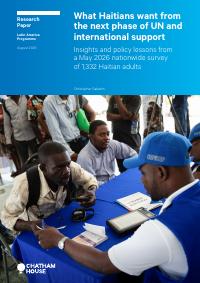
Cover image: Haitians register to vote in Port-au-Prince, 31 July 2026.
Photo credit: Copyright © Clarens Siffroy/AFP/Getty Images
ISBN 978 1 78413 689 5
DOI 10.55317/9781784136895
Cite this paper: Sabatini, C. (2026), What Haitians want from the next phase of UN and international support:
Insights and policy lessons from a May 2026 nationwide survey of 1,332 Haitian adults, Research Paper, London:
Royal Institute of International Affairs, https://doi.org/10.55317/9781784136895.
This publication is printed on FSC-certified paper.
designbysoapbox.com
Independent thinking since 1920
The Royal Institute of International Affairs
Chatham House
10 St James’s Square, London SW1Y 4LE
T +44 (0)20 7957 5700
contact@chathamhouse.org | chathamhouse.org
Charity Registration Number: 208223
What
Haitians
want
from
the
next
phase
of
UN
and
international
support
Christopher
Sabatini
Chatham
House