
Aperçu général de l'aide au développement pour Haïti (bulletin de l'Observatoire n° 3)
Résumé — Troisième bulletin de l'Observatoire sur les politiques publiques et la coopération internationale du CERFAS, qui examine ce que recouvre l'aide publique au développement destinée à Haïti.
Constats Clés
- L'analyse de l'aide par un centre de recherche haïtien lui-même, et non le compte rendu d'un bailleur.
- Soutient que les chiffres de l'aide publique au développement incluent les coûts administratifs, l'aide humanitaire et des dépenses de forces armées.
- Lit la relation d'aide à l'aune des principes d'appropriation et d'alignement de la Déclaration de Paris.
- Publié en français, créole, anglais et espagnol ; ceci est l'édition anglaise.
Description Complète
Troisième bulletin de l'Observatoire sur les politiques publiques et la coopération internationale du CERFAS, qui examine ce que recouvre l'aide publique au développement destinée à Haïti. Son argument : les montants annoncés englobent les frais administratifs, l'aide humanitaire et les dépenses des forces armées qui l'acheminent, de sorte que la somme promise n'est pas celle qui parvient au développement.
Texte Intégral du Document
Texte extrait du document original pour l'indexation.
CENTRE DE RECHERCHE, DE RÉFLEXION, DE FORMATION ET D’ACTION SOCIALE
OBSERVATORY ON pUBLIC POLICIES AND ON
INTERNATIONAL COOPERATION
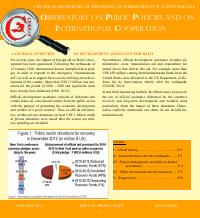
A GENERAL OVERVIEW OF DEVELOPMENT ASSISTANCE FOR HAITI
For several years, the impact of foreign aid on Haiti’s deve- Nevertheless, official development assistance includes ad-
lopment has been questioned. Following the earthquake of ministrative costs, humanitarian aid and expenditure for
12 January 2010, international donors multiplied their pled- armed forces that deliver this aid. For example, more than
ges in order to respond to the emergency (“humanitarian US$ 450 million coming from humanitarian funds from the
aid”) as well as to support the recovery and long-term deve- United States were allocated to the US Department of De-
lopment of the country. More than US$ 13 billion was pro- fense for its interventions shortly after the earthquake
mised for the period of 2010 - 2020 and significant sums (USAID, 2011)¹.
have already been disbursed (OSE, 2012)¹. In this third monitoring bulletin, the Observatory focuses on
Official development assistance consists of donations and the use of official assistance disbursed for the country's
certain loans (at concessional terms) from the public sector recovery and long-term development and wonders most
with the purpose of promoting the economic development particularly about the impact of these donations. Hence,
and welfare of a given country¹. Thus, in official aid statis- unless explicitly mentioned, our charts do not include hu-
tics, neither private donations (at least US$ 3 billion worth manitarian aid.
of private donations were traced after the seism) nor mili-
tary spending are included.
Content :
I - A brief history..……………………...........P.2
II - Aid architecture after the earthquake.........P.3
III - Project management according to donors'
procedures.……………………….....P.4
IV - Public investments into development.......P.5
V - Perspectives……………………...……….P.6
JANUARY 2013 - PORT-AU-PRINCE, HAITI - BULLETIN#3
-1-
I - A BRIEF HISTORY
The concept of development assistance emerged after the Figure 2 shows the evolution of official development as-
Second World War. It hinges on the idea that economic and sistance disbursed for Haiti between 1989 and 2009. The
social inequalities between nations can compromise peace blue part indicates the funds which were allocated for the
and that it is thus in the own interest of rich nations to country's long-term development. Thought should be given
contribute to the recovery of the economy of the nations to the impact of this aid.
considered as “less developed”. Since development in a country depends on multiple factors
Initially, development was exclusively compared with eco- (e.g. the functioning of its institutions, its political situation
nomic growth. Donor nations considered that they simply and its productive capacity), it is not possible to establish a
had to recopy the model of the “developed” countries and direct link between foreign assistance and trends in the tar-
focused their funding notably on potential political allies. geted sectors. Classifications and indicators related to deve-
lopment must thus always be used with caution.
With an increase of interventions during the second half of
the 20th century, it was shown nevertheless that the expec-
ted results were not going to be reached as easily and that
economic development did not lead automatically to an im-
provement of the living conditions of the most deprived
populations. Numerous theories on the complexity of the
phenomena of poverty and on the possibility of making de-
velopment aid more effective have since been developed.
Nevertheless, inequalities between rich and poor countries
have become more and more pronounced¹.
In Haiti, development aid and anti-poverty strategies really
started to flow in during the 70's. Although subject to fluctu-
ations along with political events and natural disasters, in-
ternational assistance has not stopped since. Nonetheless, a glance on certain indicators clearly confirms
that the employment of the funds disbursed as development
aid for Haiti was not able to generate a significant improve-
ment of the living conditions for the majority of the popula-
tion.
If we look at Figure 3 for example, we see that the Gross
Domestic Product (GDP = an indicator which measures
the production of final goods and services in a country
during a year) per capita has rather decreased. At the same
time, the purchasing power of the inhabitants was further
reduced due to price increases and the high rate of
unemployment. Moreover, according to its Human Deve-
lopment Index (which takes into account health, education
and income), Haiti continues to be classified as one of the
poorest countries in the world¹.
C E R F AS CENTRE DE RECHERCHE, DE RÉFLEXION, DE FORMATION ET D’ACTION SOCIALE
- 2-
II - AID ARCHITECTURE AFTER THE EARTHQUAKE
In order to understand the weak impact of international aid The percentage of the money that really reaches its destination
on the country's development, it seems necessary to examine depends largely on the administrative costs of the engaged
how the money disbursed for Haiti was used. organizations and companies. A report by the Center for Glo-
bal Development estimates that each one of these levels can
In December 2012, an analysis of official aid promised for absorb between 7 to 10% of administration expenses.
long-term development (see Figure 1), indicates that US$ 4
billion was disbursed and that an additional US$ 3.7 billion On the other hand, it is important to know if these funds enter
was pledged. This amount is important given that it clearly the local economy through the purchase of local products and
exceeds the internal revenues of the Haitian Government services. It is recognized that the revival of the Haitian eco-
during the period of 2010 - 2012. nomy depends significantly on the strengthening of Haitian
companies and substantial job creation. Nevertheless, a large
Nevertheless, this does not mean that all the money has alrea- part of the funds goes back to companies from the donor
dy been spent in Haiti. The methods of disbursement provide countries, which are often more competitive than the local
us with a first indication¹: ones. In this sense, an analysis of the contracts of the Europe-
To commit funds means that the donor has approved a pro- an Commission that are reported on the Web page of Euro-
ject or signed an agreement/contract. The money is thus peAid shows that more than 76.7% of the value of the alloca-
reserved for a project or any other type of support which is ted contracts, for a total of 32 million Euros in 2010 and
in the phase of preparation; 2011, was allocated to European companies. Only 7.48 milli-
To disburse funds means that they have been transferred to on Euros, therefore less than US$ 10 million (1€ =$US 1.3),
the institution that will implement the project or program- went to Haitian firms¹. Concerning USAID donations (United
me, but that this institution has not necessarily spent all of States' Agency for International Development), an analysis of
it. the Centre for Economic and Political Research, from Sep-
tember 2012, indicates that only 1.3% of the value of all
Once the donor has transferred the funds to the implementing contracts, meaning US$ 5.7 million of a total of US$ 446.7
institution, there is no more global follow-up of the expenditu- million, was directly allocated to Haitian firms¹.
re. This is notably due to
the great number of pro- Finally, a glance at
jects which are imple- the allocation of
mented according to their to ta l d o n at io ns
own budget and timefra- shows that the majo-
me. Before reaching their rity circumvents
destination, these funds Government institu-
were often decreased by tions. As reflected in
administrative costs, so- Figure 4, since 2010,
metimes even on several at least 84% of dis-
levels, because the imple- bursed reconstructi-
menting agencies often on funds, have been
sub-contract companies administered outside
or subsidize other organi- of the country's sys-
zations to implement the tems for financial
final activities. management and
procurement.
Observatory on Public Policies and on International Cooperation
-3-
III - PROJECT MANAGMENT ACCORDING TO DONORS' PROCEDURES
Traditionally, the majority of disbursed funds considered as cedures. To the maximum ex-
development aid were channeled through development pro- tent possible, the programme is
jects which were characterized by specific budgets, objec- carried out under the leadership
tives and calendars outside of the management systems of of the host country and it uses
the beneficiary country. On the one hand, this made it pos- local management systems¹.
sible to bypass weak institutions and insufficient financial During the International Do-
control systems in the aid receiving countries by establish- nors' Conference in New York
ing mechanisms of direct accountability between the imple- on 31 March 2010, it was re-
menting agency and the donor. On the other hand, this has called that a programme-based
led to a fragmented provision of services, duplication of development approach was
certain activities and to the marginalisation of Government essential for Haiti, most particularly because national leader-
institutions, which have to follow the priorities of the do- ship had to be reinforced.
nors instead of giving account to a population that uses and
pays for the services through its taxes. Nonetheless, the seism has again worsened the difficulty of
Haitian institutions to assume their role and, in comparison
Nevertheless, experience has shown that this approach had to the approaches used before 2010, practices have rather
trouble solving extremely complex structural problems. deteriorated (cf. OECD, 2011).
In this sense, a great number of States and multilateral The majority of the funds are still invested in dispersed pro-
agencies have agreed on the need for a better harmonization jects which are principally carried out by private stake-
of the interventions, so that development aid could generate holders and international agencies and to the detriment of
positive results in the long run. In the Paris Declaration on programmes likely to create sustainable national structures
Aid Effectiveness from 2005, the donor countries have thus for the future. Moreover, instead of dividing up tasks be-
committed to simplifying their procedures and to use com- tween them and thus decreasing the number of stakeholders
mon action plans, notably by providing 66% of their aid intervening in each sector, the major donors continue to
through programme-based approaches up to 2010¹. work in several areas at the same time (social, economic,
Although interpretation can vary, a development programme institutional, etc.).
is not only a group of projects linked to one another, but a Whereas many organizations privilege faster and autono-
logical approach in support of the locally-owned priorities of mous procedures, the construction of solid institutions as
development. It notably integrates a single comprehensive well as sustainable programmes that do not depend on aid
budget and program framework as well as coordinated pro- often seems to be sidelined.
JANUARY 2013 - PORT-AU-PRINCE, HAITI - BULLETIN #3
-4-
IV - PUBLIC INVESTMENTS INTO DEVELOPMENT
Development policies and strategies cannot do without sub- regularly funded with more than 2/3 by international aid. Ne-
stantial investments in the national economy (agriculture, vertheless, these investments often gather varied expenditures
local production, etc) and in basic services (education, for projects or programmes, and are therefore not always
health, infrastructure, etc). “investments“ in the authentic sense of the word (CEPALC,
During the last decades, Non-Governmental Organizations 2010)¹. Many of these expenditures are carried out by Project
and other private providers gradually took roles that concern Implementation Units (PIU) which function inside Govern-
substantial Government duties. On the one hand, this made ment institutions in order to carry out external cooperation
it possible to fill gaps in places where the authorities did not projects. Although aid effectiveness principles invite donors to
intervene. On the other hand, it contributed to the weake- “Avoid, to the maximum extent possible, creating dedicated
ning of Government institutions. structures for day-to-day management and implementation of
aid-financed projects and programmes”¹, the number of PIU's
Aid effectiveness principles underline that, in order to gene-
in Haiti has more than doubled between 2007 (39) and 2010
rate long-term development, the assistance has to reinforce
(92) (OECD, 2011)¹.
Government institutions and that this reinforcement is more
effective if the assistance is channelled through them. Ne- Consequently, the poor results of public investments may be
vertheless, many donors fear embezzlements in view of the explained - in addition to the difficulties of the national insti-
weaknesses of public financial management and accountabi- tutions - notably by the fact that the funds and the various
lity. stages of implementation remain under the control of the
donors and that the projects and programmes often experien-
As Figure 4 (page 3) illustrates, donors are thus generally
ce important delays. Hence, the Haitian Government is not
reluctant to give “budget support”, a modality that makes it
able to carry out the entirety of its investment budget. An
possible to allocate funds to the national treasury which ma-
analysis of the Civil Society Initiative (ISC) estimates that an
nages them in accordance with Haitian budgetary procedu-
average of 11,4% of the Haitian investment budget was spent
res. Only US$ 303 million, hence about 7% of the recovery
during the last six fiscal years (Figure 5).
funds for 2010-2012, were transmitted as budget support
since 2010.
In spite of that, the Haitian budget continues to be financed
greatly by loans or grants from the International Community.
These funds are given for projects or programmes that, partly
or entirely, are managed according to their own procedures.
The part of foreign aid is higher in the investments' rubric
(expenditures which are made to increase economic assets,
for instance through infrastructures or agriculture, but also
for the general improvement of living standards through edu-
cation, health, housing, etc.) than in the operation's rubric
(expenditures for daily affairs, wages and maintenance of
Government infrastructures).
During the last years, the investment bud-
get of the Haitian Government has been
CENTRE DE RECHERCHE, DE RÉFLEXION, DE FORMATION ET D’ACTION SOCIALE
C E R F AS
-5-
V - PERSPECTIVES
In spite of the increase in international development coopera-
tion during the second half of the 20th century, tangible re- Paris Declaration on Aid Effectiveness (PD), 2005 :
sults (translating into an improvement of the conditions and
Commitment 1 - Ownership : Partner countries exerci-
the quality of life of the population of “developing” coun-
se effective leadership over their development policies
tries) were not often up to par. In view of this situation,
and strategies and co-ordinate development actions.
States have agreed on a body of principles that aim at making
development assistance more effective. As reflected by the
Commitment 2 - Alignment : Donors base their overall
commitments of the Paris Declaration, these agreements
support on partner countries’ national development stra-
clearly stress the paramount role of the State and its institu-
tegies, institutions and procedures.
tions as the driving force for development in its country.
Although the reasons for the weak impact of the funds de- [...]
ployed in Haiti are multiple, it seems important to underline
three of them:
to operate according to different priorities, methodologies and
1) A consequent part of the money was not spent on Haitian strategies instead of joining their forces in a coordinated sys-
territory, in support of local institutions, companies and their tem where their competencies are well distributed and regu-
employees or even of Haitian products. lated by the Government.
2) Funds were rarely invested in structural programmes, de-
veloped in accordance with the priorities of the Haitian peo- It seems unlikely that a strategy towards the reduction of for-
ple or managed by its Government. eign assistance can be put into practice by the donors only. Its
feasibility depends rather on the strategic choices of the Gov-
3) The objectives pursued by development aid and trade poli-
ernment and the collaboration of its partners. At the end of
cies from donor countries have often been contradictory, be-
November 2012, a new framework for the coordination of
cause many trade agreements favor food dependency and
external assistance was launched. This one comes after the
limit Haiti's productive capacity.
Interim Coordination Framework (2004), the mechanisms of
Based upon the declarations from different stakeholders, there the Poverty Reduction Strategy Paper (2007), and the Interim
is a consensus that development at a national scale cannot be Haiti Recovery Commission (2010-2011)¹. Let us hope that its
without the strengthening of national institutions nor without implementation will provide more results than in the past and
the development of a common vision mobilizing all the forces that the donors will manage to align their interventions
in the country and gradually limiting the dependency on inter- (Principle 2 PD) on the strategies and policies controlled by
national aid. the Haitian State (Principle 1 PD).
Nevertheless, the multitude of foreign stakeholders continues
A CERFAS initiative with the support of Progressio and CAFOD
27, 1ère Avenue du Travail, Bois Verna, Port-au-Prince, Haiti
Phone #: (509) 3944-5572 / 222-5524
Email : observatoire@cerfashaiti.org; Web page: www.cerfashaiti.org
This bulletin is available in French, Creole, English and Spanish
¹ For more information and a bibliography: www.cerfashaiti.org/observatoire.htm
C E R F AS *** We welcome your suggestions, questions and comments***
Observatory on Public Policies and on International Cooperation
-6-
Comment citer
Centre de Recherche, de Réflexion, de Formation et d'Action Sociale, 2013, Aperçu général de l'aide au développement pour Haïti (bulletin de l'Observatoire n° 3), consulté via HaitiDocs, https://www.haitidocs.org/doc/cerfas-2013-apercu-general-aide-au-developpement