Texte Intégral du Document
Texte extrait du document original pour l'indexation.
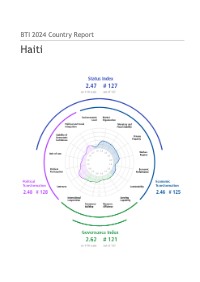
BTI 2024 Country Report
Haiti
This report is part of the Bertelsmann Stiftung’s Transformation Index (BTI) 2024. It covers
the period from February 1, 2021 to January 31, 2023. The BTI assesses the transformation
toward democracy and a market economy as well as the quality of governance in 137 countries.
More on the BTI at https://www.bti-project.org.
Please cite as follows: Bertelsmann Stiftung, BTI 2024 Country Report — Haiti. Gütersloh:
Bertelsmann Stiftung, 2024.
This work is licensed under a Creative Commons Attribution 4.0 International License.
Contact
Bertelsmann Stiftung
Carl-Bertelsmann-Strasse 256
33111 Gütersloh
Germany
Sabine Donner
Phone +49 5241 81 81501
sabine.donner@bertelsmann-stiftung.de
Hauke Hartmann
Phone +49 5241 81 81389
hauke.hartmann@bertelsmann-stiftung.de
Sabine Steinkamp
Phone +49 5241 81 81507
sabine.steinkamp@bertelsmann-stiftung.de
BTI 2024 | Haiti 3
Key Indicators
Population M 11.6
HDI 0.535
GDP p.c., PPP $ 3305
Pop. growth
1
% p.a. 1.2
HDI rank of 189 163
Gini Index
41.1
Life expectancy years 63.2
UN Education Index 0.455
Poverty
3
% 58.0
Urban population % 58.8
Gender inequality
2
0.635
Aid per capita $ 82.7
Sources (as of December 2023): The World Bank, World Development Indicators | UNDP, Human Development Report
2021-22. Footnotes: (1) Average annual growth rate. (2) Gender Inequality Index (GII). (3) Percentage of population
living on less than $3.65 a day at 2017 international prices.
Executive Summary
On July 7, 2021, President Jovenel Moïse was assassinated in his residence. Since then, the
political and security crisis has severely deteriorated against а backdrop of ongoing negotiations
to re-establish a democratically elected government. Prime Minister Ariel Henry – appointed by
Moïse two days before his death – took office on July 20 and swore in a new cabinet in late
November 2021. The interim government has been negotiating the prospects for new elections
with opposition groups. On August 30, 2021, a broad coalition of civil society members and
political groups, known as the Montana Accord (Bureau de Suivi de l’Accord de Montana, BSA),
proposed a two-year interim government. The goal of this government was to establish stability
and oversight until new elections could be held. The signatories of the accord rejected Henry’s
government and held elections on their own terms in early 2022. However, Henry’s administration
rejected those elections. The most recent round of negotiations, which took place in early March
2023 shortly after the review period, between the Montana Accord and the parties associated with
Henry’s government, also concluded without success.
On September 11, 2021, Henry signed an agreement with 20 main parties and civil organizations
for “peaceful governance” to establish a transitional government to serve until the next elections,
initially foreseen for the end of 2022. In the same month, the Control and Monitoring Authority
was formed to validate the government’s decrees, and a new cabinet was installed to implement
the agreement. Over a year later, in December 2022, after consultations with political leaders,
CSOs and private sector members, the government signed a new consensus, the National
Consensus agreement, which rescheduled elections for 2023 and the inauguration of the new
government for February 2024. It also established the High Transitional Council (HCT) to carry
out the tasks of revising the constitution, forming the Provisional Electoral Council (CEP), and
strengthening the judicial system, and the Body for the Control of Government Action (OCAG)
to ensure compliance with good management and transparency in public governance. The
opposition negatively assessed the conclusion of this agreement and the installation of the HCT
members.
BTI 2024 | Haiti 4
Amid failed political agreements, the security and economic situation have continued to decline.
An intensification of gang warfare throughout Port-au-Prince has caused many to flee their homes
and live in makeshift shelters. Gang control has also expanded beyond the capital into the suburbs
and other provinces. The number of killings has soared. In October 2022, amid the fuel shortage
crisis set off by the elimination of fuel subsidies and gang control over the largest fuel terminal
(Varreux), which had a disastrous impact on drinking water supply, Henry called for foreign
intervention to stop escalating gang violence – an appeal rejected by many Haitians and the
opposition. Instead, the United Nations imposed a sanctions regime (Resolution 2653) against
Haitian politicians, including two of Henry’s ministers, and businessmen suspected of collusion
with gangs and serious corruption.
The deteriorating security situation in the country is accompanied by an economic crisis marked
by the continued depreciation of the gourde and skyrocketing prices for basic consumer products.
Inflation levels reached 47.2% by the end of 2022, one of the highest in the country’s recent
history. Additionally, Haiti is on track to experience a fourth consecutive year of negative
economic growth. The government has been compelled to reduce social programs despite
increasing poverty and growing food insecurity. Beyond this, Haiti endured devastating
consequences from the earthquake in August 2021, resulting in the loss of approximately 2,000
lives. A resurgence of cholera – an infection associated with inadequate sanitation and limited
access to clean drinking water – also occurred toward the end of 2022.
History and Characteristics of Transformation
Haiti’s transformation process suffers from fragilities that have their roots in the country’s
tumultuous history. The democratic movement that emerged in the late 1980s aimed to quell the
country’s chronic instability by introducing new political norms and advocating for economic and
social inclusivity. Unfortunately, this movement faced formidable challenges from anti-
democratic forces, as evidenced by numerous coups and fraudulent manipulation of elections
designed to obstruct the democratic process. Nevertheless, attempts to reinstate authoritarian rule
have consistently encountered opposition from popular movements fueled by a desire for a better
life.
The democratic movement of the 1980s culminated in the ousting of the Duvalier regime (1957 –
1986) in 1986, when Jean Claude Duvalier was compelled to flee due to widespread protests and
pressure from the United States. In 1990, Haiti conducted its first free and democratic elections,
resulting in the election of Jean-Bertrand Aristide, a former priest, as president in early 1991.
However, a coup d’état disrupted the democratization process, forcing Aristide into exile and
ushering in a three-year military regime. In October 1994, Aristide returned from exile with the
assistance of two thousand American troops deployed by the Clinton administration in Operation
Restore Democracy. In 1996, René Préval, a close ally of Aristide, assumed the presidency.
BTI 2024 | Haiti 5
In 2000, Aristide regained power through contentious elections. Popular among the impoverished,
Aristide implemented wealth redistribution measures and reduced privileges for the affluent.
Faced with tough measures from the United States and international financial institutions, Haiti’s
fragile economy suffered multiple setbacks, making it increasingly difficult for Aristide to govern
amid mounting political polarization. Following violent protests and an armed rebellion, Aristide
was compelled to leave the country on February 29, 2004. Subsequently, the Boniface-Latortue
transitional government (2004 – 2006) took power and invited the United Nations to deploy a
peacekeeping mission. The UN Security Council authorized the deployment of a multinational
interim force to restore stability until the arrival of a UN peacekeeping mission (MINUSTAH). In
2017, MINUSTAH was succeeded by a smaller UN mission (MINUJUSTH), tasked with
reforming Haiti’s judicial system. In 2019, MINUJUSTH was replaced by a UN monitoring
program known as the United Nations Integrated Office in Haiti (BINUH).
During Préval’s second term (2006 – 2011), in January 2010, Haiti was devastated by a
catastrophic earthquake that claimed over 250,000 lives and made 1.5 million people homeless,
severely damaging the country’s already-fragile infrastructure. Amid this chaos, the international
community insisted on holding elections in November 2010. The elections were marred by
irregularities and violence, resulting in the election of Michel Martelly, a former singer, as
president. In 2015, Martelly was unable to organize general elections for a smooth transition of
power, leading to him relinquishing power to a provisional administration in February 2016. Haiti
finally conducted elections in late 2016, with the Provisional Electoral Council (CEP) declaring
Jovenel Moïse the winner with 55% of the vote. However, only 21% of eligible voters participated,
severely undermining Moïse’s legitimacy. Moïse assumed the presidency on February 7, 2017,
but was assassinated in mid-2021.
Haiti operates under a free market economic system that relies primarily on small-scale
subsistence agriculture, free trade, assembly industries, tariff liberalization and foreign exports. In
the 1980s, Haiti embarked on economic liberalization and became a key partner in the Reagan
administration’s Caribbean Basin Initiative, transitioning from a partially state-dependent
economy to an open system. This shift entailed the removal of protective import barriers and high
tariffs, along with restructuring local production, particularly in the agricultural sector, which had
to contend with subsidized agricultural products from the United States. Several structural
adjustment programs were also implemented to foster private sector growth, albeit with limited
success. Political instability, corruption and the government’s failure to modernize infrastructure
and legal systems have discouraged foreign investment and hindered economic growth.
BTI 2024 | Haiti 6
The BTI combines text analysis and numerical assessments. The score for each
question is provided below its respective title. The scale ranges from 1 (worst) to
10 (best).
Transformation Status
I. Political Transformation
1 | Stateness
Question
Score
The state’s monopoly on the use of force is contested by gangs that have formed a
federation called the G-9 Family and Allies against the Haitian National Police
(PNH). While the gangs have a sophisticated arsenal at their disposal, the PNH is
underequipped and unable to guarantee citizens’ safety against gang transgressions
(e.g., kidnappings, rapes, assassinations). According to the United Nations Integrated
Office in Haiti (BINUH), the actual ratio of active police officers to population is
1.2/1,000 which is far below the United Nation’s standard (2.2/1,000). Moreover, the
PNH’s workforce is deteriorating, affected by an increasingly high rate of desertions,
dismissals and imprisonments. Police are also prime targets for gangs. Gangs
murdered 150 officers between 2020 and 2022 and 14 more in January 2023 alone.
Nine police stations were attacked in the Port-au-Prince metropolitan area. The police
also suffer from increasing politicization, and some members have direct ties to
gangs.
Currently, gangs control several neighborhoods in the capital, including the whole
metropolitan area, including the neighborhoods of Martissant, Carrefour-Feuilles,
Cite Soleil, Village de Dieu, Delmas and Bel-Air. Gangs also have control over the
roads to several departments, including four through the blockade of Martissant, and
to Centre, Artibonite (considered the breadbasket of the country) and the international
road that leads to Haiti’s border with the Dominican Republic. Part of the
administrative city containing parliament and the Public Prosecutor’s Office is also
under their control. In recent months, gangs have extended their influence to
neighborhoods that were previously considered relatively calm, such as several
middle-class ones. The situation has deteriorated even further in 2023.
Monopoly on the
use of force
2
BTI 2024 | Haiti 7
The conditions for the emergence of the Haitian State have given it an anti-slavery,
anti-colonial and anti-racist character. All the constitutions promulgated by the
Haitian State have enshrined these values. The large majority of the population
accepts the nation-state as legitimate. However, from the moment of its foundation,
the new state was marked by a fracture between the urban elites and the rural
communities, between the French language spoken by a minority of citizens and the
Creole language spoken by all Haitians. This divide is expressed in social relations
by the existence of a certain social disdain on the part of the elites and of resentment
by those who feel excluded from society. Despite adopting the Creole language in the
1987 constitution as the country’s second official language, all acts, laws, decrees,
orders and court decisions are still published solely in French.
The Haitian State has failed to provide all citizens with civil status certificates and
identity documents. Access to viable identity documents has been one of the main
demands of the people since the beginning of the popular protests against the Duvalier
regime. President Moïse’s program to distribute identity documents failed, as it was
marred by multiple irregularities.
State identity
7
The Haitian State is secular, although Catholicism was for a long time the only
official religion and the Catholic Church enjoys privileges originating from the 1860
Concordat signed between the government and the Vatican. The 1987 constitution
recognized Voodoo as a legal religion before it became the country’s second official
religion in 2003. With this legal recognition, adepts of Voodoo can undertake legal
activities previously reserved only for the Catholic Church. The Catholic Church’s
influence has greatly diminished to the benefit of the Protestant Church, which is
considered closer to the working population. Other religions, such as Rastafarianism
and Islam, are also on the rise.
Though religion typically does not have a direct influence on politics, the Catholic
and Protestant churches have played an important role as facilitators in negotiations
to overcome political crises. In 2020, the Catholic and Protestant Churches also
protested against the draft law on the new penal code recognizing LGBTQ+ rights
and abortion, arguing that the draft was immoral and penalized discrimination based
on sexual orientation. Their efforts were unsuccessful.
No interference of
religious dogmas
9
Haiti’s physical infrastructure and services are concentrated in the capital and in a
few provincial towns. In poor urban and rural areas, mostly international technical
and financial partners and non-governmental and civil society organizations provide
social services. The central government does not allocate sufficient resources for
drinking water, health, education and electricity, and local authorities have few
resources to meet demands for basic services.
According to the World Bank, only 0.6% of GDP is spent at the communal level;
communal revenues account for only 1.7% of overall state revenues. According to
Direction Nationale de l’Eau Potable et d’Assainissement de l’Eau à Domicile
Basic
administration
1
BTI 2024 | Haiti 8
(DINEPA), 55% of the population had regular access to potable water in 2022 (48%
in rural areas and 68% in urban areas). Provision of electricity is irregular and subject
to frequent breakdowns; 46.9% of the population has access to electricity, of which
only 18% reaches rural areas. One out of five inhabitants does not have access to
improved sanitation, and only one out of ten inhabitants has access to a solid waste
collection system. More than one-third of the population has experienced high levels
of food insecurity; in July 2021, 66% of households reported that they did not have
enough to eat at least once in the previous month, according to the World Bank.
Transport services are inadequate, with 50% of the country’s territory poorly
connected. However, Haiti has made some progress in disaster risk management and
civil protection. Compared to the management of the 2010 earthquake, the
administrative structures were far more effective in managing the August 2021
earthquake that devastated the southern peninsula.
During the review period, the loss of territorial control to gangs further weakened the
state’s ability to provide basic social services. Blocking access to four departments in
the south of the country for more than two years has isolated the inhabitants of these
regions, making it harder for them to access basic services. Health services in the
regions have also deteriorated, with hospitals unable to obtain medicine supplies.
Provincial hospitals and schools remained closed for several months of the year.
The system of basic services, both in urban and rural areas, was further weakened by
the fuel crisis that the country experienced between June and September 2022. With
electricity production in the country depending on petroleum products for 86% of its
output, the crisis negatively impacted services that depend on diesel-powered
generators, such as drinking water, electricity and medical services.
2 | Political Participation
Haiti has a semi-presidential system, with the president elected for five-year terms
and the prime minister appointed by the president with confirmation from the
parliament. On February 7, 2017, Jovenel Moïse became president. However, the
2016 elections were marred by irregularities. Moïse was assassinated on July 7, 2021,
and an interim government led by Prime Minister Ariel Henry – appointed by Moïse
two days before his death – was installed with a cabinet of 10 out of 18 ministers
from Moïse’s administration. The Senate is supposed to include 30 members and its
lower legislative chamber, 119; no seats are filled. On January 10, 2023, the tenure
of the 10 remaining senators expired, leaving Haiti with no elected members in the
Senate or house. As of January 31, 2023, Haiti is without any elected authority, as
required by its constitution.
Free and fair
elections
1
BTI 2024 | Haiti 9
Currently, perhaps somewhat by “accident,” there are no elected political decision-
makers. Irrespective of that, there are various powerful groups capable of vetoing the
initiatives of those who may be democratically elected. Among these, the business
sector has increased its power in recent years and is able to influence election
outcomes through financial support and to impose its power on elected officials
afterwards. Moïse’s campaign exposed the problem of state capture by increasingly
powerful rentier networks, which control the public administration and short-circuit
public policy decisions. The state’s financial weakness and its dependence on foreign
donors, international organizations and NGOs reinforce this decline of effective
power to govern.
Effective power to
govern
1
The 1987 constitution guarantees the right of association, assembly and freedom of
expression. There are no prohibitions on independent political or civic groups or
interference in their assembly. There have been several cases of intimidation of public
protests organized by the opposition or movements critical of the government, and
also of protests by government supporters.
Haitian law (Decree of July 23, 1987 on public meetings) requires anyone wishing to
hold a public meeting or peaceful demonstration to notify the local police 48 hours
in advance. The person who has notified the police of the demonstration is
responsible for the proper conduct of the demonstrators and participants in the
gathering. Accordingly, the government grants demonstration permissions. However,
the government regularly permits the National Police to use lethal weapons to repress
authorized demonstrations. The Moïse government made excessive use of the PNH
to quell even the smallest demonstration against his regime, although the excessive
use of force by police is strictly prohibited by an internal order of the PNH. Under
the government of Ariel Henry, demonstrations and brutalities against demonstrators
have decreased mainly due to gangs terrorizing the slum neighborhoods, where most
of the demonstrations take place, and thereby preventing protests. According to the
United Nations, 1,490 demonstrations, roadblocks and barricades were recorded in
2022, an increase of 35.5% over last year.
Association /
assembly rights
4
The constitution guarantees freedom of expression and freedom of the press.
Journalism, particularly radio journalism, is rather robust and varied, which is the
result of a long struggle during the Duvalier years. In 2022, Reporters Without
Borders (RSF) ranked Haiti 70th out of 180 countries in terms of freedom of the press,
pointing out a dangerous and precarious work environment for journalists given
lawlessness and uncertainty, self-censorship, the 2017 defamation law and a lack of
financial resources.
Since the 2000s, the media landscape has changed significantly. Today, only two
daily newspapers exist, while there is a real proliferation of radio stations, television
stations and especially online media, which represent the most widespread means of
information. In September 2019, CONATEL (Conseil National de
Télécommunications) counted 398 broadcasting stations on the FM band, about 60
Freedom of
expression
4
BTI 2024 | Haiti 10
community radio stations and 111 TV stations. However, CONATEL denounced the
fact that many of the broadcasting stations were not operating legally and caused
interference to the telecommunications system.
It is very difficult for journalists to access public information regarding public
contracts and the execution of public works or audits. Journalists are also often
confronted with government allegations of defamation, which restricts them from
publishing reports on political figures. Investigative journalists are especially
vulnerable. Threats against them have led to self-censorship and avoiding reporting
on the involvement of public figures in drug and arms trafficking or corruption, for
fear of reprisal. Nine journalists were killed in 2022, according to the Inter-American
Press Association, a significant number for a small population of about 12 million.
Some were targeted by gangs, and at least two were shot by police. Actors in the
public sector usually enjoy impunity when violating freedom of the press.
3 | Rule of Law
The constitution establishes the separation and balance of power between the
executive, the two houses of parliament and the judiciary. However, both the head of
state and parliamentarians have always sought to undermine the balance of power.
Parliament has the means to oppose the claim of pre-eminence of the head of state,
but not always with the goal of strengthening institutions. Under Moïse’s
government, the previous year’s budget had to be renewed several times because the
deputies refused to vote for the budgetary law submitted to parliament by the
executive. During his presidency, Moïse appointed no less than seven prime ministers
because parliament would not approve his candidates for the post.
The executive branch in Haiti has two significant levers that effectively grant it power
over the other two branches: patrimonial control over the resources of the treasury
and the authority to call the populace to the polls. This electoral power is outlined in
the constitution and entrusted to the Permanent Electoral Council. Past presidents
have not taken the necessary steps to establish this council due to concerns about
losing influence over its composition, despite the fact that, by law, various
stakeholders must be involved in the process of selecting council members. Overall,
this situation jeopardizes the rule of law by providing an incentive for the president
to delay elections and avoid renewing the parliament. The PHTK governments have
frequently employed this tactic to postpone elections, ultimately consolidating
unchecked executive authority. President Moïse employed this strategy until his
death in mid-2021.
Under Moïse, the executive inserted itself into the judiciary’s affairs. In February
2021, he unilaterally dismissed and replaced the three sitting judges of the Court of
Cassation, despite their constitutional security of tenure. Additionally, the president
failed to renew the terms of judges approved by the CSPJ (Cour Supérieure de la
Police Judiciaire). Approximately 60 judicial positions remain vacant, making the
courts dysfunctional.
Separation of
powers
2
BTI 2024 | Haiti 11
The judicial system is based on the constitutional provisions that define different
jurisdictions. It is in a state of total dysfunction, plagued by corruption and objected
to several arbitrary decisions by Moïse’s government. Moïse’s intervened in the
judiciary to prevent the processing of multiple cases of corruption and assassinations
in which government representatives were involved.
The Cour Supérieure des Comptes et du Contentieux Administratif (CSCCA), which
is responsible for overseeing public finances, was restricted at the president’s
instigation in retaliation for the court’s willingness to prosecute government officials
for the misuse of PetroCaribe funds and other acts of corruption. Moïse criticized the
CSCCA for its slow processing of public procurement cases submitted by the
government and restricted the body’s oversight function because the court released a
report implicating Moïse in the spoliation of the PetroCaribe fund.
In February 2021, Moïse took action against Judge Yvickel Dieujuste Dabresil from
the High Court of Justice. This move was prompted by the judge’s engagement with
the opposition, who had asked him to step in as a temporary president to counter
Moïse’s desire to extend his time in power. As part of his strategy, Moïse forced the
retirement of court judges and hand-picked new judges who were aligned with his
interests. He also declined to renew the terms of judges suggested by the CSPJ. This
led to a situation in which 60% of judicial positions remained vacant, severely
hampering the courts’ functionality. Despite lacking the constitutional authority to
appoint judges to the Court de Cassation, Prime Minister Ariel Henry proceeded to
appoint eight new judges in February 2023, replacing those who had been removed
by Moïse.
Independent
judiciary
1
Impunity, which has a long tradition in the country, became widespread during the
review period. As abuses of power have multiplied, it has become considerably more
difficult to hold authorities accountable. During the review period, the Haitian Senate
issued two reports on the misappropriation of PetroCaribe funds and established the
responsibilities of high-level state officials. The reports were published by the
CSCCA, which also issued a report on the misappropriation of PetroCaribe funds. In
June 2021, the PetroCaribe investigation was suspended indefinitely, and the
defendants’ assets were released for lack of evidence. However, the judge did not
explicitly acquit the defendants.
Prime Minister Ariel Henry has not appeared before the government commissioner
in charge of the investigation into the assassination of President Moïse to respond to
accusations of his involvement. Several ministers in Henry’s government, including
the minister of justice and the minister of the interior, have been implicated in arms
trafficking scandals and kidnapping. Senators have also been publicly denounced for
having close ties with gang leaders. None of these officeholders have been arraigned
or prosecuted. Additionally, the judicial system has failed to follow up on numerous
massacres in which police and senior public officials were implicated. Police officers
frequently act with impunity when dealing with civilians, particularly during events
such as demonstrations and while conducting arrests.
Prosecution of
office abuse
2
BTI 2024 | Haiti 12
However, since the beginning of 2023, some actions have been taken by the judicial
and anti-corruption authorities against judges and former senators. On January 16,
2023, the Superior Council of the Judiciary published a list of 28 judges accused of
corruption, possessing false academic credentials or lacking moral integrity. As a
result, these judges were not certified to continue their roles. It’s worth noting that no
formal charges have been brought against these individuals, leaving open the
possibility for them to potentially serve as judges in the future.
In early March 2023, the Anti-Corruption Unit (ULCC) submitted nine investigation
reports on cases of flagrant corruption against eight former senators and a former
director of the General Administration of Customs. The senators will not be able to
participate in the next elections. The ULCC has formally requested that the judiciary
prosecute those denounced in its report. To date, no authority accused of abuse of
office, whether a member of the executive or parliament, has been brought to justice.
Civil rights are guaranteed by the constitution; however, access to justice is poorly
protected, making it difficult for citizens to claim their rights in court. Poor citizens
face discrimination in terms of access to justice, as judicial services are generally out
of reach. Moreover, the courts use French, rather than Creole, and legal decisions and
documents are in French, which effectively excludes most of the population.
With the deterioration of the security situation, protecting civil rights has become
even more difficult. Haiti has ratified the CEDAW and Belém do Para Conventions
on the elimination of all forms of discrimination against women and the achievement
of gender equality. The security situation and the expansion of gangs in the country
have, however, led to massive violations of the rights of women and girls, who are
raped, kidnapped and killed by gangs. Between January and March 2022, BINUH
counted an average of 98 victims of sexual violence each month. In August 2022,
clashes between gangs in Cite Soleil resulted in 52 acts of sexual violence. Other
clashes in the Croix des Bouquets area led to the gang rape of 40 women in November
2022. Multiple civil violations, even when they are well documented, are neither
prosecuted nor punished.
Haiti has ratified the International Covenant on Civil and Political Rights, which
guarantees the rights of nondiscrimination and equality before the law, but the
country’s poverty and the influence of religion in the formation of opinions influence
its widespread intolerance of LGBTQ+ people. The Senate approved during the 50th
legislature two anti-LGBTQ+ bills, one of which prohibits same-sex marriage.
Civil rights
1
BTI 2024 | Haiti 13
4 | Stability of Democratic Institutions
One reason for the poor performance of democratic institutions is the conflict
between the two heads of the executive, the Presidency and the Prime Minister’s
Office. The president is the head of state, elected by universal suffrage, and the prime
minister is from the party with a majority in the Assembly but appointed by the
president. The history of conflictual relations between the two heads of the executive
has been a factor in the institution’s instability and counter-performance. Conflicts
with the parliament over the appointment of the prime minister were the source of
institutional crises during the presidency of Moïse, who appointed seven prime
ministers in five years.
The president’s interference in the judicial system has ruined his legitimacy in the
eyes of the public and prevented him from playing his constitutional role. Corruption
in the judiciary has also contributed to its poor performance.
Political parties in Haiti are not actively contributing to the vitality of political life
and the strengthening of democratic institutions. Instead, they often resemble groups
associated with individual political figures that are able to exercise pressure and
which lack a genuine social base. The disorderly and fraudulent nature of many of
the country’s elections has led citizens to doubt the credibility of election results,
eroding their trust in the functioning of these institutions. Surveys conducted by
LAPOP on the opinions of Haitian citizens regarding the performance of their
democratic institutions consistently reveal a very low level of confidence in both the
institutions themselves and the individuals in charge of them. Prime Minister Henry
has inherited the institutional challenges left behind by Moïse, operating without clear
performance requirements and lacking accountability to any overseeing authority.
The mechanisms designed to maintain checks and balances are largely ineffective, if
not entirely absent.
Performance of
democratic
institutions
1
Currently, Haiti lacks functioning democratic institutions, primarily due to the
absence of elections. This absence alone underscores the questionable commitment
of most actors involved. This situation illustrates the extent to which politics in Haiti
are a ruthless pursuit of power, where individual and group interests often supersede
any consideration of the common good. Most democratic institutions are only weakly
accepted as legitimate by relevant actors, whether political or economic elites. There
are certain business interest groups, such as the Economic Forum (which is comprised
of major import businesses), the Haitian-American Chamber of Commerce, the
National Lottery Association and drug-trafficking networks, which aim to influence
the selection of a government that can be easily manipulated to serve their own
interests.
Commitment to
democratic
institutions
1
BTI 2024 | Haiti 14
5 | Political and Social Integration
The political landscape is structured around two types of organizations: a first circle
made up of parties such as ex-President Michel Martelly’s PHTK, the party in power,
the Lavalas Party and a set of parties and political organizations connected to the ex-
President Préval’s party, UNITÉ. These parties have various constituencies, although
the dividing lines between them are not clear and representatives can be found
changing sides. They have been able to exert their control over power for more than
30 years. They are all creations of presidents, a characteristic of the Haitian political
landscape. Deputies and senators, although they nominally belong to parties, must,
for several reasons, be approached as part of a special group of politicians. They
straddle the party, business sector, gang network and their social bases.
Other political parties in Haiti typically emerge as ad hoc coalitions of politicians
shortly before elections. These groups are usually led by a figure with some political
renown, positioning themselves as part of the winning candidate’s movement. They
also actively engage in numerous rounds of political negotiations to secure
appointments to public service positions. These parties have networks within society
that they can mobilize during these negotiations, lending an appearance of legitimacy
to the initiatives of the incumbent government. These parties lack a clear ideological
vision for Haitian society that would define their role in political struggles. Their
financial fragility makes them susceptible to capturing state resources in exchange
for their support. Despite successive governments having announced efforts to enact
a law on political party financing to enhance their independence, such endeavors have
not yielded significant success.
Party system
2
Various interest groups, like unions, represent several sectors of society (e.g., rural
communities). These groups have, however, lost their influence in state affairs and
dominance in sociopolitical struggles. They are victims of the transformation of the
political system from parties with a strong popular base and populist orientation to
new political actors who emulate an economic oligarchy. The dismantling and
privatization of public enterprises as part of neoliberal policies contributed to the
erosion of the power of these groups. The only unions active in the last two years are
the textile companies’ union and the transport union, which have participated in
several large demonstrations and strikes.
Students did hold sporadic demonstrations, but they were violently suppressed by the
PNH. Moreover, although professional associations are weak, they openly condemn
kidnapping for ransom, as professionals were prime targets for gangs during the
review period. Still, professional associations have little internal life or capacity for
mobilization.
Interest groups
3
BTI 2024 | Haiti 15
In summary, the most powerful interest groups in Haiti are those in the private
business sector. In recent years, this sector has established several representative
organizations through the numerous regional chambers of commerce and industry
and bilateral chambers of commerce. These organizations are points of contact for
international technical and financial partners in the country and actively engage in
negotiations aimed at addressing the ongoing crisis. Still, their real strength lies, as
observed during Moïse’s mandate, in the close ties they maintain with the presidency,
deputies and senators and, for some, with the gangs.
Since the fall of the Duvalier dictatorship, Haitians have continued to fight for the
deepening of the democratic process. However, this has experienced many setbacks
(rigged and contested elections, failure to respect electoral deadlines, failure to create
the Permanent Electoral Council provided for in the 1897 constitution) and impacted
confidence in democracy.
Support for democracy requires support for its institutions. While trust in elections
has increased in the region, from 38% in 2018 to 42% in 2021, in Haiti it is 27%, at
the bottom alongside Honduras and Colombia. Haitians display little pride in the
political system, at 28%, alongside Brazil.
Only 37% of Haitians think the country is a democracy. For democracy to work well
in a country it is not enough that trust in institutions be high, trust among citizens is
equally important. In Haiti, 54% of citizens say they trust their fellow citizens. Given
the crisis situation in the country and the proliferation of violence, this level of
interpersonal trust is most likely on the decline. Compared to other countries in the
region, Haitian citizens are less willing to sacrifice freedom of expression in order to
obtain a minimum income from a political regime. This does not prevent Haitians
from expressing their dissatisfaction with the democratic system.
Approval of
democracy
n/a
Social capital has different meanings in rural and urban settings. In rural areas, the
organization of mutual aid among peasants in agricultural work is based on
relationships of proximity, interpersonal trust and good reputation. The role of social
capital in promoting popular solidarity during the 2010 earthquake showed it can
contribute to strengthening the resilience of the population, helping it to cope with
the various shocks to which it was exposed and to compensate for the absence of the
state in providing basic social services. However, the multiple shocks to which the
country has been exposed in recent years have contributed to a weakening of
solidarity networks and interpersonal trust. The spread of gang violence and the
intensity of the mobility of people in a territory subject to a frantic pace of
urbanization have weakened the old solidarity networks and reduced the scope of
proximate interactions.
In urban environments, corruption networks and the practice of “passe-droit” in
public administration are only possible if people make intensive use of social capital.
However, according to LAPOP 2021, 54% of Haitians say that members of their
Social capital
3
BTI 2024 | Haiti 16
community are fairly or very trustworthy. The huge impact of gang violence during
the review period has, however, damaged the social fabric considerably. Community
trust has certainly deteriorated since the last LAPOP report.
II. Economic Transformation
6 | Level of Socioeconomic Development
Question
Score
Haiti is ranked 163rd out of 191 countries in the Human Development Index in 2021,
with a score of 0.535. According to World Bank estimates for 2021, the poverty rates
are 87.6% ($6.85/day), 58.7% ($3.65/day) and 30.32% for extreme poverty
($2.15/day). Haiti’s Gini coefficient is 0.61, making it one of the highest in the world.
The gender inequality index was 0.635 in 2021, which is also particularly high. These
two elevated levels demonstrate the stark division within Haitian society, with a
privileged economic elite controlling the formal sector of the economy, while the
majority of poor people and actors engage in the informal economy, accounting for
approximately 90% of employment. Women dominate the informal economy, which
is characterized by very small production units with low profit margins, and are
excluded from the bank credit system, government subsidy programs and public
procurement. In rural areas, the subsistence economy relies heavily on small farms
with low yields, which face competition on the domestic market from inexpensive
agricultural imports.
In addition to structural factors that constitute heavy socioeconomic barriers and
contribute to the reproduction of poverty among the vulnerable population (e.g., low
access to basic social services, financial exclusion, prejudice against women in the
labor market), the current crisis situation has reinforced socioeconomic barriers and
created new ones. Due to the disruption of supply chains caused by gang occupations
of the country’s main roads, women merchants cannot go to the markets to sell their
products. Women are also the main victims of inflation, as they are confronted by the
fall in demand on consumer product markets where they sell their products.
Socioeconomic
barriers
1
BTI 2024 | Haiti 17
Economic indicators
2019 2020 2021 2022
GDP $ M 15016.1 14508.2 20877.4 20253.6
GDP growth % -1.7 -3.3 -1.8 -1.7
Inflation (CPI) % 18.7 22.8 16.8 34.0
Unemployment % 13.8 15.1 15.0 14.8
Foreign direct investment % of GDP 0.5 0.2 0.2 0.2
Export growth % -2.1 -37.9 23.5 2.4
Import growth % 4.7 -18.3 2.3 4.9
Current account balance $ M -168.8 216.2 141.4 -
Public debt % of GDP 25.4 22.0 25.6 23.9
External debt $ M 2213.9 2317.7 2604.1 -
Total debt service $ M 21.6 25.5 25.3 -
Net lending/borrowing % of GDP - - - -
Tax revenue % of GDP - - - -
Government consumption % of GDP 7.2 7.3 7.5 6.9
Public education spending % of GDP 1.8 1.4 1.8 1.3
Public health spending % of GDP 0.4 0.4 - -
R&D expenditure % of GDP - - - -
Military expenditure % of GDP 0.1 0.2 0.1 0.1
Sources (as of December 2023): The World Bank, World Development Indicators | International
Monetary Fund (IMF), World Economic Outlook | Stockholm International Peace Research Institute
(SIPRI), Military Expenditure Database.
7 | Organization of the Market and Competition
The Haitian market comprises an informal sector estimated by the World Bank at
60% of GDP, along with a small, poorly regulated formal sector that is highly
concentrated. Haitian firms are primarily young microenterprises with few employees
and generally low levels of education. These firms exhibit a minimal level of
managerial skills and productivity. While women entrepreneurs play a prominent role
in the Haitian market, their businesses tend to be smaller than those owned by men.
Additionally, women are less inclined to take risks than men, particularly during the
review period, when acts of gang violence disproportionately targeted women.
Market
organization
3
BTI 2024 | Haiti 18
Liberalization in the 1980s was accompanied by an institutional framework that
guarantees competition, so the Haitian market remains highly concentrated despite
the country’s trade openness. Price setting is mainly determined by market forces,
but the existence of monopolies and oligopolies in many markets for goods and
services distorts the price mechanism.
The Haitian state does not impose any restrictions on the export of profits generated
in the country or on the free movement of business personnel. The government has
an incentive system for new investors in sectors such as agriculture but has had to
eliminate certain subsidies and exemptions because of their negative impact on
revenues.
Regarding currency convertibility, there is a structural scarcity of foreign exchange
in the country due to the low level of exports, despite the high level of remittances
from the diaspora. There is a system in place to channel foreign exchange to specific
essential imports, such as fuel. The central bank has attempted to protect the gourde
against the dollar by injecting dollars into the foreign exchange market, but these
efforts have proven unsuccessful.
Haitian markets for goods and services are controlled by a minority of actors who
enjoy monopoly and oligopoly positions. They use their parallel networks within the
government to pay very little tax. In a World Bank study on competition in Haiti, a
group of 17 families is singled out for their control over all the country’s major
markets for several decades. This explains why Haitian consumers pay the highest
prices for goods and services in the region and why new investors, although interested
in the Haitian market and eager to exploit its opportunities, are reluctant to invest in
the country.
Haiti does not have a price control system. Instead, efforts to control prices appear to
be arbitrary and are managed by the Ministry of Commerce and Industry through
mobile brigades. Consumer associations face difficulties organizing themselves
primarily due to financial constraints. Haiti also lacks a competition authority and is
not a member of the International Competition Network.
Efforts to enhance the legal framework for trade and establish quality control services
have waned due to a lack of political will, financial resources and qualified personnel.
The initiative to create a competition law and establish a competition authority has
not been pursued. The adoption of an anti-dumping law is crucial, considering the
prevalence of anti-competitive practices in the import market for goods and services
and their potential to hinder the development prospects of domestic production.
Competition policy
2
BTI 2024 | Haiti 19
Haiti became a WTO member in 1996 and a GATT member in 1950. Its economy
stands out as one of the most open in the Caribbean region. There is no discrimination
between local and foreign companies in the country’s legislation. As part of the
structural adjustment policies embraced during the 1980s, Haiti extensively
liberalized its economy by removing tariff and non-tariff barriers, while also opening
up the market to agricultural products. However, this liberalization occurred without
implementing any measures to enhance competitiveness, establish legislation to
counteract the entry of cheap imports at dumping prices or create effective
mechanisms to combat smuggling. Consequently, local production, particularly in the
agricultural sector, has suffered considerably, as the country dedicates a significant
portion of its foreign currency reserves to purchasing food products.
Haiti grants most-favored nation treatment to all of its partners. It is a member of the
Caricom Community and Common Market. The country has ratified the revised
Treaty of Chaguaramas, although implementation is pending. Similarly, the Caricom
Common External Tariff has not been published in the Official Journal Le Moniteur
of the Haitian State. Consequently, customs duties in Haiti are considerably lower
than in Caricom countries.
Under the Generalized System of Preferences (GSP), Haiti enjoys non-reciprocal
preferential treatment from several developed countries. Haiti has privileged access
to various markets, with the United States and the European Union being the most
important. However, the country is unable to fully benefit from this due to its
restricted capacity for exports. Haiti has comparatively low customs tariffs, but
importers face additional levies at the border, including verification fees, duties and
contributions to local government management funds. These additional charges may
surpass the consolidated duties.
The Haitian government has a very liberal incentive regime but has had to reverse
some of the benefits granted to investors because of the loss of revenue this incentive
regime represents as a significant proportion of its GDP. At the last trade policy
review of the country, these losses were equivalent to 4.1% of GDP. The country has
proceeded with a tariff rearmament by imposing a 5% tariff on all products that were
duty-free. Haiti applies a simple average most-favored nation (MFN) rate of 9.7% for
agricultural products and 4.2% for non- agricultural products (a total of 4.9%).
Liberalization of
foreign trade
6
The banking system is characterized by a high geographical concentration of banking
institutions in Port-au-Prince and a dominance of the banking market by three banks
– Unibank, Sogebank and BNC – which hold about 83% of the assets. The Bank of
the Republic of Haiti (BRH) supervises financial banking institutions through its
inspection and prudent standardization activities. The BRH has introduced a
supervisory framework for the banking system based on the Basel principles, aiming
to ensure that banks conduct their activities in a sound manner and that their capital
is sufficient to bear the risks.
Banking system
4
BTI 2024 | Haiti 20
The banks’ portfolio is highly concentrated – about 70% of loans are monopolized
by 10% of borrowers. Additionally, the banking system and capital market are poorly
differentiated. All banks are controlled by the same tiny business elite. The
intermediation function is parasitic, primarily benefiting speculation, causing an
incoherence between the financial sector and the real sector of the economy.
Banks have shown an improvement in their return on assets (ROA), according to a
recent central bank report (December 2022). The report highlights that the banking
system’s asset quality has deteriorated due to the sociopolitical crisis and the
deteriorating business climate. As of November 30, 2022, the ratio of non- performing
loans to gross loans reached 10.09%, compared to 6.67% as of September 30, 2022.
Additionally, the ratio of provisions for credit losses, as a percentage of gross non-
performing loans, decreased from 89.51% in September 2022 to 59.9% in November
2022. This decline signifies a reduction in the degree of coverage of the banking
system against the risk of default by debtors in the sector. Consequently, the banking
system’s coverage against the risks of default by system debtors has worsened.
Another major challenge is the laundering of illicit funds. The proliferation of illegal
trafficking, widespread corruption and incidents of kidnapping for ransom have
contributed to the growth of Haiti’s criminal economy, thereby placing the banking
sector in a precarious position. The sector is tasked with implementing measures to
combat these issues; however, there is a risk that foreign banks may decline to engage
in business with Haitian banks. Currently, Haiti is listed on the Financial Action Task
Force (FATF) blacklist and must begin adhering to control and transparency
standards for financial transactions by March 2023.
8 | Monetary and fiscal stability
The monetary policy pursued by the central bank over the past five years in an
economic context marked by negative growth rates for the fourth consecutive year (-
1.7% in 2018/2019, -3.3% in 2019/2020, -1.8% in 2020/2021, - 1.7% in 2021/2022)
is highly controversial. The central bank has failed to curb inflation. At the end of
January 2023, inflation reached the highest level in many years at 49.3%, according
to the Institut Haïtien de Statistique et d’Informatique (IHSI). This meteoric rise in
inflation can be attributed to the increase in world prices, the change in the exchange
rate, the high levels of insecurity and the October 2022 fuel crisis. One main factor
fueling price increases is the persistence of the budget deficit, which has been
accommodated by the central bank.
The exchange rate has been particularly volatile. The massive injunctions
implemented by the BRH on the foreign exchange market to slow down the
depreciation of the gourde against the dollar did not achieve their objective. The BRH
has made decisions to raise key rates and increase the coefficients on foreign currency
Monetary stability
4
BTI 2024 | Haiti 21
liabilities. The central bank has justified these interventions in the foreign exchange
market due to the adverse effects of weakening private transfers without counterparty,
recorded in Haiti as of July 2022.
The Staff Monitoring Program signed with the IMF (SMP, 2022) obliges the BRH to
provide guarantees related to limiting its interventions in the currency market and to
mitigate excessive volatility in exchange rate fluctuations. It will also need to develop
an appropriate, transparent mechanism for its interventions and continue
implementing a digital currency project. Financing the budget deficit should be
reduced to a level that aligns with low inflation.
On the fiscal side, the budget deficit was estimated at 2.5% of GDP in 2021, with an
energy sector subsidy share at about 1.3% of GDP. Haiti’s tax revenue is 13% of
GDP, the lowest in the region. Several factors have influenced the government’s
inability to raise revenue. The first is the loss of revenue to customs due to its capture
by influential members of the business sector and their ability to circumvent their tax
obligations. In addition, there has been a decline in economic activities due to the
combined effects of the sociopolitical environment of gang violence, the fuel crisis,
violent street demonstrations, strikes and the blocking of activities through the peyi
lòk operation. The drop in tax revenue has impacted the state’s ability to increase
public investments. The government has made cuts in social programs despite
increasing poverty and food insecurity, which affects 4.5 million people, according
to estimates by the National Food Security Council (CNSA).
The national debt in 2022 was 23.06% of GDP, a slight decrease from 2021 when it
was 24.23%. Government consumption in 2021 was 7.45% of GDP. The country’s
external debt was $445 per capita in 2021, compared to $274 in 2020. Net
international reserves in months of imports were six months in 2021, compared to
seven months in 2020.
The budget deficit has continued to grow in recent years. In 2022, the budget deficit
– representing 6% of GDP – was financed by the central bank, despite the existence
of a pact limiting its financing through increasing the money supply. Moreover, the
government’s capacity to collect taxes remains weak. In this, the implementation of
a tax code in October 2022, the publication of a tax procedures book, a new customs
code and the customs tariff are steps in the right direction. In customs, a clear increase
in revenue can already be seen after the application of restrictive measures against
members of the economic sector and against customs officials involved in smuggling
and influence peddling. As a result of these measures, customs revenues in the first
quarter of the 2022/2023 fiscal year almost doubled. The state has also ended several
subsidies.
Fiscal stability
3
BTI 2024 | Haiti 22
9 | Private Property
The constitution guarantees private property and assigns the state the duty to protect
and promote private entrepreneurship. According to the International Property Right
Index (2022), Haiti ranks at the bottom of a list of 129 countries in terms of property
rights, coming in at 127th. At the regional level, it ranks 20th out of 21 countries.
Respect for private property has significantly declined in recent years. Attacks by
gangs occur with impunity and target residences and business buildings, which are
often burned down, resulting in the displacement of their owners. Additionally, stores
and warehouses are regularly looted by bandits. In popular neighborhoods,
inhabitants are systematically chased out of their homes and robbed of their
possessions, while shopkeepers in markets are also targeted and robbed of their
merchandise.
The most violent and concerning expression of these attacks on private property is
the theft of land and land titles. Over the past decade, land theft has increased thanks
to a coalition of gang members, judges, police and notaries. The creation of the
Brigade d’Intervention Contre l’Insécurité Foncière (BRICIF) did not yield the
expected results, as this institution was soon implicated in acts of corruption. Gangs’
control over the Metropolitan Area of Port-au-Prince has enabled them to regularly
carry out land occupation operations and steal from residential homes, resulting in
disastrous consequences for the financial market and property owners who purchased
their properties with bank credit.
Certainly, this problem is not new to Haiti. Haiti’s unique history has made the state
the largest landowner in the country. It lacks a land registry system. This deficit is
the root cause of several problems the country faces, including an unstable land tenure
system, an increase in land conflicts and their negative impact on social stability,
subpar agricultural investments that are usually short-term and not financially viable,
and the inability to foster modern agriculture. Land instability has far-reaching
consequences for real estate credit, the growth of construction firms, mortgage loans
and the implementation of urbanization policies.
Property rights
2
In principle, private enterprises can operate without restriction in Haiti. However, the
country does not offer sufficient guarantees for the protection of private property and
lacks effective arbitration and mediation mechanisms.
The entrepreneurial sector comprises 96% individual or family businesses, with 77%
of these businesses engaged in the purchase and resale of mostly imported products.
There are very few production enterprises. These enterprises face numerous
difficulties as they operate within a regulatory framework that does not promote
private investment. Additionally, they must contend with a market dominated by anti-
competitive practices. The Business Support Services, introduced by the Ministry of
Commerce and Industry, have not significantly affected this situation. Firms still
Private enterprise
4
BTI 2024 | Haiti 23
receive minimal credit from the financial system and still lack management,
marketing and accounting skills. The presence of foreign companies is extremely
limited. A census conducted by the Ministry of Commerce and Industry revealed that
only three out of every 1,000 enterprises were owned by foreign investors.
The state has developed support programs to facilitate the access of Haitian
companies to regional and international markets and to make it easier for them to
obtain credit. However, the country’s dual economic and political crisis, which has
persisted for years, has caused these to be interrupted. A serious hindrance to the
expansion of private investment in the country is Haiti’s poor integration into the
global network of major shipping lines. Additionally, the costs of port operations in
Haiti are the highest in the region.
During the period under review, there was no privatization of public enterprises, but
the operation of former publicly owned enterprises indicates the problematic
practices developed by many of these entities. The public is not informed of the
financial performance of the privatized firms. Privatized through a public-private
partnership, the Haitian state is expected to receive dividends and taxes from these
firms. However, these firms accrue debts to the state and do not fulfill their tax and
dividend obligations.
10 | Welfare Regime
There is almost no welfare regime in Haiti. The social safety net is extremely
rudimentary, fragmented, limited in reach and underfunded. Public expenditure on
health in Haiti is relatively low, averaging around 0.5% over the past decade.
However, international aid and private expenditures significantly increase this
percentage. Life expectancy in Haiti is considerably the lowest in the region, 64.3
years in 2020.
Four institutions form the backbone of the welfare system: Office Assurance
Vieillesse (ONA), which provides benefits to employees of private establishments,
Office des Accidents du Travail, de la Maladie et de la Maternité (OFATMA), which
depends on the Ministry of Social Affairs and Labor (MAST) and provides insurance
against work-related accidents and disability to workers in the private and public
sectors, the Directorate of Civil Pensions (DPC), and the CAS, which caters to the
poorer segments of the population. The CAS provides personalized social assistance
to the needy, distributes food kits and subsidizes communal asylums.
These institutions face governance problems, weak financial means and corruption
scandals. Additionally, the contributory part of this system targets a very small
clientele – people who have a job and represent only 10% of the population. The
country has the lowest level of net safety transfer in the region. The rural poor, who
make up almost 70% of households and are considered chronically poor, are the most
Social safety nets
3
BTI 2024 | Haiti 24
excluded from basic services such as clean drinking water, sanitary waste
management and access to health care. Family and community networks function as
the only reliable safety net in rural areas. The largest contribution to social welfare
comes from the significant Haitian diaspora through remittances. Development
partners for Haiti play a crucial role in financing safety nets and providing education,
health care and nutritional support, but they lack coordination.
The constitution contains provisions to promote respect for the economic and social
rights of citizens and to inspire programs that correct inequalities in treatment.
However, these values have limited influence on public policy. No special legal
framework, apart from general provisions, has been established. Women have long
experienced widespread gender discrimination. Violence against women, girls,
people with disabilities and LGBTQ+ people represents the most severe form of
discrimination. Due to a history marked by significant social divisions and
institutional mechanisms that exclude the majority of the population, rural
communities and residents of poor neighborhoods face the greatest disadvantages in
accessing equal opportunities.
Gender is a significant risk factor for living below the poverty line. Historically,
women have never occupied more than 6% of the seats in the two official legislative
chambers. Additionally, there is a lack of public programs or initiatives aimed at
increasing gender equality. Haiti has a Ministry of Women’s Condition and Women’s
Rights; however, it suffers from inadequate funding, preventing successful
implementation of proposed legislation. Furthermore, despite a constitutional
amendment in 2012 mandating that 30% of public offices be held by women, no
subsequent action has been taken to enforce this provision.
Women receive an inferior education compared to men and face employment
limitations. In 2021, the Gender Inequality Index ranked Haiti among the worst
globally at 0.635. The literacy rate in Haiti is approximately 65.3% for males and
58.3% for females. Although there are no recent enrollment data available, 27.9% of
women and 41.0% of men have received at least some secondary education. The
female labor force accounted for 48.2% of the total labor force in 2021 but is
primarily concentrated in low-skilled (informal) employment. Haitian women’s
wages are, on average, 32% lower than those of men. While 62% of female-headed
households in rural areas live below the poverty line, the percentage for men is 54%.
The incidence of gender-based violence is a significant contributing factor to gender
inequality, with 13% of women in Haiti experiencing sexual violence.
The Social Protection and Promotion Policy document, elaborated in 2020 by the
Ministry of Social Affairs and Labor (MAST), outlines the areas of intervention to
promote to address inequalities of opportunity and initiate a policy of active social
promotion for vulnerable population segments. However, it has not yet been
implemented.
Equal opportunity
3
BTI 2024 | Haiti 25
11 | Economic Performance
Haiti has experienced negative per capita growth rates for three consecutive years:
2.9% in 2019, 4.5% in 2020 and 3.0% in 2021. Meanwhile, the GDP per capita PPP
decreased from $3,203 to $3,095 to $3,127. The economy has been consistently
contracting year after year. In 2021, the agricultural sector saw a decline in value of
4.1%, which followed a 2.4% decrease the year before. This downward trend has also
impacted the secondary and tertiary sectors, with respective contractions of 2.4% and
2% in 2021. Although unemployment has remained relatively stable at approximately
14% to 16% for several years, the more pressing concerns revolve around issues of
informality and underemployment.
The process of transforming the economy toward the predominance of the tertiary
sector over the agricultural sector, which accounted for 50% of GDP until the 1970s,
is constant. In 2021, the service sector accounted for 57% of GDP. The country
attracted foreign direct investment at 0.2% of GDP in 2021, after peaking at 2.5% in
2017.
Investments decreased by 21.8% in 2021 compared to the previous year, and the
inflation rate was close to 49.3% in January 2023, due to an increase in the exchange
rate of the U.S. dollar against the gourde.
The government consumption level was 7.45% of GDP in 2021, slightly higher than
in 2020 (7.13%). According to ECLAC, international reserves have remained at about
$1.3 billion since 2017 ($1.26 billion in 2021). The Joint World Bank/IMF Debt
Sustainability Analysis in July 2022 assessed the risk of debt distress as “high” but
considered the overall public debt sustainable. As of the end of 2021, public debt was
27.1% of GDP, with two-fifths of that external.
Output strength
1
12 | Sustainability
Haiti faces significant environmental degradation, which increases the country’s
vulnerability to natural disasters such as earthquakes and tropical storms. This
degradation has serious consequences for the population in terms of health, the
economy, biodiversity and security. The disappearance of biodiversity and the impact
of climate change illustrate the degradation of Haiti’s ecosystems, underscoring the
need for a dynamic environmental policy that addresses issues such as soil erosion,
protection of watersheds and the adoption of a low-carbon energy system. In 2017,
Haiti ratified the Paris Agreement, committing to reducing its greenhouse gas
emissions by 31% by 2030 and significantly increasing the proportion of renewable
energy in its energy production system. Additionally, the country pledged to enhance
the management of coastal areas.
Environmental
policy
2
BTI 2024 | Haiti 26
However, it has failed to make significant progress on all of these issues. It has a very
low percentage of protected areas, and its forest area makes up 12.6% of the national
territory (2020). Additionally, it has an Environmental Protection Index (2022) score
of 26.1 and ranks 173rd out of 180 countries in terms of environmental performance.
During the COP-27 in Egypt, Haiti expressed its need to reduce greenhouse gas
emissions to comply with the Paris Agreement and to mitigate its significant
vulnerability.
The Ministry of Environment, with the assistance of international technical and
financial partners, has developed a series of conservation programs. In 2017, the
Moïse government introduced a bill to protect the country’s watersheds, which should
allow the state to address the lack of access to drinking water. In 2022, Haiti finalized
its National Adaptation Plan (NAPA; 2022 – 2030), which will serve as a reference
framework for public policies to confront the impacts of climate change. The plan
includes the establishment of a national monitoring and verification system to track
greenhouse gas (GHG) emissions and the impact of mitigation measures.
Haitian families demonstrate a high level of commitment to education and are willing
to make significant sacrifices to ensure their children receive an education. However,
the quality of education in Haiti is rapidly declining. The education system is plagued
by numerous governance deficits and lacks sufficient public resources. A key issue
in the school system is the unequal access to education faced by children from low-
income families. Approximately 80% of schools in Haiti are private institutions that
collect prohibitively high fees, rendering them unaffordable for impoverished
families who have no choice but to send their children to public schools, where the
quality of education is not guaranteed. The prevalence of private schools in the
Haitian education system is exceptional in the Caribbean region. According to the
U.N. Education Index, Haiti ranks 109th out of the 134 countries covered by the BTI,
receiving a score of 0.455 in 2021.
The low level of resources available to the Ministère de l’Éducation Nationale et de
la Formation Professionnelle (MENFP) does not allow it to effectively exercise its
role as a regulator, even though the share of the budget devoted to education is high
compared to other sectors. Government spending on education in 2021 represented
16% of the national budget, equivalent to 1.37% of GDP. Government spending on
primary education represents 0.63% of GDP. The 2020 Competitiveness Report ranks
Haiti 139th in research quality out of 140 countries and 137th in research and
development, reflecting a total lack of connection between universities, business and
the public sector.
The Haitian state has not promoted a process of ownership of its strategies within its
administration. The resource gap is filled by a wide range of technical and financial
partners, including the World Bank, the IDB, UNESCO, the European Union and
UNICEF. These partners support the ministry in developing and implementing
numerous education projects in the areas of educational quality, education plans and
school access.
Education policy /
R&D
2
BTI 2024 | Haiti 27
Still, the higher education system is facing serious capacity problems. It is unable to
absorb the demand coming from secondary schools. There are about 15,000 high
school graduates. Yet, the university system can only absorb a small part of them due
to its low capacity and the weakness of its material, financial and human resources.
Haitian students are increasingly choosing to study at universities elsewhere in the
region, especially in the Dominican Republic. According to the Binational
Observatory on Migration, Education, Environment and Commerce (OBMEC),
citing the Dominican Ministry of Education, there are more than 60,000 Haitian
students in Dominican universities.
Research and development are practically nonexistent. According to the 2019 Global
Competitiveness Report, Haiti ranked at the bottom with regard to the quality of
scientific research institutions (137th out of 141).
BTI 2024 | Haiti 28
Governance
I. Level of Difficulty
The country has faced entrenched structural difficulties for decades, the permanence
of which makes it fragile. The persistence of macroeconomic imbalances is at the
root of low growth rates, resulting in a very high poverty level and the state’s severely
limited ability to meet the population’s needs for basic social services. These
macroeconomic imbalances are reinforced by an economy whose physical capital
accumulation and sector productivity is very low. This applies to the agricultural
sector, which has low productivity levels and is exposed to massive imports of
agricultural products into the country through smuggling.
In addition, the decades-long lack of competition enforcement structures has
facilitated the expansion of monopolistic and oligopolistic behavior in the markets,
with consequences for the quality and price of goods and services. The resulting high
prices of consumer goods, especially food products and consequent low purchasing
power, reinforce poverty and food insecurity for a large majority of the population.
The high recurrence of natural disasters, since at least the 2010 earthquake, has
contributed to a drop in GDP and the decapitalization of households. The losses and
damage caused by Hurricane Matthew in 2016 and the 2021 earthquake in the
southern peninsula of the country is estimated at 32% of GDP. The impact of natural
disasters is amplified by accelerated urbanization with a growing migrant population
in search of opportunities. This population generally settles in coastal areas where
they are exposed to serious environmental risks and live in situations of
environmental injustice.
Other serious shocks include the COVID-19 pandemic with its economic
consequences, such as the closure of factories, the collapse of formal sector activities
hit by the distancing measures enforced by the state, the resurgence of cholera, which
threatens to turn into a pandemic if measures against drinking water pollution are not
sufficiently effective. Another factor is heightened sociopolitical conflicts, the
expansion of violence and the reinforcement of practices of predation. The capture of
the state by the influential private sector and the political class hinders the production
of new wealth, maintains social inequalities and provokes growing disaffection
among the population regarding the democratic transformation of the country.
Structural
constraints
9
BTI 2024 | Haiti 29
Until 1986, the culture of civic participation was very weak. With the fall of the
Duvalier regime, there was a real explosion of civil society. In the years that followed,
there was the development of a dense network of organizations of all kinds: peasant
organizations, students, professional associations, religious communities, women’s
organizations, human rights organizations, etc. While the dictatorship had fostered a
climate of general suspicion among the population, the fall of the regime helped to
restore social trust, which allowed the emergence of many CSOs. The first generation
of social organizations played a key role in interfacing with the state in political
negotiations.
Social organizations were very active during Moïse’s presidency. It was in the streets
that social organizations expressed themselves, organizing and participating in large
demonstrations against impunity, corruption, the authoritarian drift of the president
and the illegitimate power of Prime Minister Henry.
New CSOs, such as NOU PAP DOMI, having launched a movement to denounce the
squandering of funds from the PetroCaribe Program and the corruption that plagues
the state, have given the protest movement against President Moïse and Prime
Minister Henry new dynamism by introducing new forms of struggle through social
media, sit-ins and advocacy before international bodies and the U.S. Congress. A
large number of parties and CSOs signed the Montana agreement, which is the result
of the rapprochement between civil society and political parties.
In December 2022, the private business sector, which was in the background during
all the negotiations that took place after President Moïse’s assassination, launched
the Alliance for Change, in which it called for signing a political agreement and
establishing a government of national unity and expressed its willingness to aid the
implementation of reforms establishing new rules of conduct in the business sector.
The 2010 earthquake showed the resilience of trust among the population, helping to
compensate for the absence of the state in providing basic social services. However,
the multiple shocks to which the country has been exposed in recent years have
contributed to the weakening of solidarity networks and interpersonal trust.
Civil society
traditions
7
Although Haiti has no ethnic, religious or racial conflicts, the country’s history is
marked by violent social and political conflicts. The original divide that exists in the
country between a minority economic and cultural elite and the vast majority of
citizens fuels social conflicts, which explode intermittently out of a context of
resentments accumulated over the course of history. The deep income inequality that
characterizes Haitian society, poverty, the long tradition of police and military
authoritarianism, and the lack of recognition of the general population’s social and
economic rights are the reasons for the repeated crises that the country is
experiencing.
Conflict intensity
8
BTI 2024 | Haiti 30
The country’s traditions do not include a culture of compromise and of listening to
divergent interests and just demands. Political parties and CSOs have not succeeded
in building mediation channels capable of reducing the intensity of crises and
providing lasting compromises. Although the promotion of dialogue and calls for
negotiated solutions to crises are part of the political vocabulary, there are few
moments of social understanding around common projects.
In a survey by BINUH, it was noted that, in the Metropolitan Area of Port-au-Prince,
the percentage of violent demonstrations rose from 56.5% in 2018 to 89.5% in 2021
due to the violent practices of the police, which indicates a clear desire to prevent the
population from expressing its demands and to force the state to take responsibility.
II. Governance Performance
14 | Steering Capability
Question
Score
The priorities defined by Moïse during his campaign were reaffirmed after his
presidential election: fighting corruption, modernizing the agricultural sector and
developing an organic food industry, providing electricity to the entire country during
the first two years of his administration, promoting a national dialogue with political
leaders and opposition groups in order to revamp the political system and launching
a vast program called the Caravan of Change aiming to fix the country’s deficits in
road, agricultural and environmental infrastructure. However, these priorities were
not defined within the framework of a coherent vision and a long-term
implementation strategy. The president came to power with no political or public
administration experience, having come from the business sector. He did not have a
team of experts capable of planning the implementation of his strategies and
monitoring them. Still, President Moïse tried to stay the course on at least two of his
priorities: the implementation of the Caravan of Change and electrification.
In the last two years of the presidency, apart from a campaign against energy sector
operators, other priorities were imposed on the administration, such as elaborating a
new constitution and penal code, organizing a constitutional referendum, establishing
a new Provisional Electoral Council and running presidential, legislative and
communal elections.
After Moïse was assassinated in 2021, Prime Minister Ariel Henry, who succeeded
him, continued his policies and kept most of the cabinet ministers, even though many
CSOS demanded that he replace them.
Prioritization
3
The priorities defined by President Moïse during his campaign were not
implemented. Corruption, which was one of the crucial points of his program,
Implementation
BTI 2024 | Haiti 31
continued and spread during his administration. Moïse himself was challenged by
reports from the CSCCA and was unable to put an end to the corruption scandals in
his administration. Nonetheless, he did attempt to stay the course regarding the
implementation of the Caravan of Change and electrification projects. However, he
was not able to assemble a competent technical team to address these matters. On the
contrary, he made promises that were not fulfilled within the time he set, which cast
doubt on his ability to deliver. Moreover, the numerous changes in the government
(seven prime ministers in five years) did not help ensure continuity in the pursuit of
strategic priorities, leaving Moïse as the sole bearer of these priorities in a context of
growing suspicion on the part of the population and the opposition questioning his
authority.
His flagship Caravan of Change project, which aimed to modernize and revive
agriculture in order to establish an organic food industry, was an abject failure. He
had to abandon the project. Introduced with great fanfare on May 1, 2017, during the
Fête de l’Agriculture in the canton of Bocozelle, in Artibonite, the country’s
breadbasket, the Caravan of Change was supposed to contribute to the irrigation of
100,000 hectares of land, the cleaning of about 200 kilometers of canals and the
rehabilitation of 100 kilometers of agricultural roads. In this region, there was a clear
decline in all sectors targeted by the program.
The electrification of the country and the modernization of EDH, the state electricity
company, was one of Moïse’s top priorities. His ambition was to provide the entire
country with electricity 24 hours a day. He personally led this project and intervened
with force during his term. Nevertheless, Moïse had to face powerful rentier interests
represented by operators in the energy sector, which held contracts for the delivery
of electricity to the state.
Achieving the other priorities Moïse set during the last two years of his administration
was not possible, as the president had to devote a lot of energy to a long, intense
political controversy about the date his term would end.
The government of Ariel Henry did not have a general policy document or an
implementation plan that could serve as a reference for its interventions. During
Moïse’s presidency and even more so with Henry’s government, the projects and
programs of the sectoral ministries were products developed for the most part by
international experts.
2
BTI 2024 | Haiti 32
President Moïse and his successor, Ariel Henry, have not learned from the failures of
previous administrations to adopt measures for better governance and a peaceful
dialogue with civil society. Contrary to their party campaign declarations announcing
Moïse’s willingness to engage in politics differently, he promoted an authoritarian
approach that cemented divisions instead of opening up space for dialogue with
society. One rare instance when Moïse’s government seemed to demonstrate policy
learning was during the creation of the Presidential Commission called the États
Généraux de la Nation (Sectoral States General of the Nation), charged with
conducting consultations with representatives of different sectors of national life.
Ariel Henry’s government did not learn from Moïse’s. Due to its lack of legitimacy,
it has mainly used political negotiations to obtain agreements with certain political
parties. Consultations around the elaboration and implementation of public policies
have not occurred. Even a sector as important as public security was not subject to
consultation with academic experts and professionals in that field.
Policy learning
2
15 | Resource Efficiency
Haiti faces severe financial constraints and difficulties in raising revenue. These
weaknesses are reflected in budget deficits that have grown under the impact of
several factors: the COVID-19 pandemic, the August 2021 earthquake, increased
social and health expenditures, the sociopolitical crisis, gang violence and the peyi
lòk phenomenon. Due to the above factors, as well as poor budgetary management,
waste and inefficiency in the management of financial resources, the state has had to
find other sources of financing to underwrite its expenditures, through monetary
financing, which has negatively affected inflation and the exchange rate of the
gourde.
Since increasing tax revenue is a top priority, the development of a tax code and a tax
procedure manual is a major step toward increasing public investment, creating
budgetary space for financing social protection and promotion programs, and
reducing dependence on external financing. Reorganizing the tax system would make
it possible to create a social contract by providing the state with a financial base that
would enable it to provide basic services to the population and to acquire sufficient
authority to require all citizens to comply with the rules of the game when it comes
to taxation.
Regarding human resources management, the public administration has very few
qualified personnel. According to the OMRH (Office de Management des Resources
Humanizes), fewer than 5% of public administration managers have a degree. The
number of civil servants is also limited, with the country having already lost a
significant number of executives (16,000) during the earthquake in 2010. Haiti has
the lowest proportion of civil servants in the region. For every 1,000 inhabitants, the
public administration employs only eight people (the Dominican Republic employs
34).
Efficient use of
assets
2
BTI 2024 | Haiti 33
Moreover, the public administration faces the politically motivated problem of
integrating new civil servants with each new election and each new government.
Through the State Modernization Program (2018 – 2023, PME-2023) piloted by
OMRH, efforts have been made to establish recruitment procedures based on
competence, but the many exceptions made to the new rules cast doubt on the
impartiality of the exercise.
The 1987 constitution enshrined the principle of decentralization, but the institutional
structures it introduced have proved cumbersome to implement, involving different
levels of territorial power that are difficult to reconcile. This affects the state’s
governance capacity in a context marked by deficits in administrative culture. The
state is faced with a duplication of its decision-making bodies and a confusion of
responsibilities that negatively influence its ability to govern. The weakness of
planning instruments and their limited technical and financial capacities make
effective implementation of public policies difficult.
There is also interference from actors interested in influencing the course of policies
and a great diversity of technical interlocutors, which is problematic, as Haiti’s
partners have during interventions. These various interventions require coherence
capacities that the public administration does not have.
Other factors include bureaucratic traditions that privilege a vertical style of
coordination, with negative effects, are both a lack of transparency and gaps in task
assignment. A weak communication culture in the public administration exacerbates
this situation. Ministerial cabinets are the result of political negotiations and are not
comprised of technicians used to collaborating and who share a vision of the
country’s issues and challenges.
Policy
coordination
2
President Moïse prioritized fighting corruption in his electoral campaign. However,
once in power, he protected those accused of corruption. He also helped strengthen
the power of corrupt officials by not taking measures to end impunity and by
weakening the judicial system. The country does have a single system in place to
monitor the management of state resources or to fight corruption. No fewer than five
institutions and agencies are responsible for monitoring the management of public
resources: the ULCC (Unité de Lutte Contre la Corruption), the UCREF (Unité
Centrale de Renseignements Financiers), the BAFE (Bureau des Affaires Financières
et Economiques), the CNMP (Commission Nationale des Marches Publics) and the
CSCCA (Cour Supérieure des Comptes et du Contentieux Administratif).
All these institutions have the institutional and legal means to carry out their oversight
work on paper but receive little support from the political authorities and have limited
technical and financial resources. In addition, reporting corruption by high- ranking
political figures and senior public officials can be very risky. This explains why,
according to an investigation by the National Human Rights Defense Network
(RNDDH) published in 2021, in the last 20 years, the CSCCA has only handed down
one conviction.
Anti-corruption
policy
2
BTI 2024 | Haiti 34
There is no system of party financing in Haiti, despite multiple efforts in the past to
introduce one. The excessive proliferation of parties and the heavy weight of co-
optation and corruption practices that characterize the political system prevent
implementation. Another handicap to the development of anti-corruption policies is
the systematic exclusion of the media from data about the functioning of public
markets and about the allocation and use of resources by public administrations. This
is especially true for collection agencies such as the DGI (Direction Générale des
Impots), the General Administration of Customs, the National Port Authority, the
Vehicle Insurance and Transport Control Agency and institutions like the National
Insurance Office, which collects contributions to the pension fund for private sector
employees.
16 | Consensus-Building
Multiple rounds of negotiations between Ariel Henry’s government, the opposition
parties and civil society raise the question of whether all the major actors involved in
these negotiations agree that Haiti should commit to democratic values and a market
economy as a long- term strategy. Negotiations revolve around two projects: a
government one that advocates a short transition and the organization of elections as
soon as possible and the opposition’s project, mainly the Montana Accord, which
advocates for a long transition during which the authority of the state should be re-
established, gang violence curbed and citizenship reconstituted.
Behind these two projects are two different, irreconcilable approaches to democracy,
which explains the difficulty of creating a robust and broad agreement to get the
country out of the crisis. The experiences of successful democratic transformation in
other countries have shown that such agreements between reformist political actors,
old elites and potential opponents of reform are possible. In the Haitian case, there
appear to be powerful actors among the negotiators who are fundamentally opposed
to deepening the country’s democratic transformation process. The Haitian paradox
lies precisely in the fact that those who most advocate the need to organize elections
as quickly as possible under any conditions do not necessarily adhere to the values of
democracy. They may not be ready to respect the rules of a market economy open to
competition and respectful of state prerogatives.
The acceptance of or support for the market economy in Haiti is not currently a topic
of intense public debate. The discussions surrounding Haiti’s economic choices were
particularly heated during the 1980s and 1990s, when two opposing groups clashed.
One group advocated for neoliberal values, pushing for a fully open economy, the
withdrawal of the state from the market and the privatization of public enterprises.
The other group, supported mainly by rural communities, trade unionists,
representatives of the middle classes and civil society organizations, believed that
Haiti’s underdeveloped state required an active state capable of making choices in
Consensus on goals
3
BTI 2024 | Haiti 35
the broader public interest. Support for neoliberalism came from multilateral agencies
and private sector associations. Now, almost 40 years later, the outcomes of these
years of unbridled trade liberalization are highly negative. Monopolistic and
oligopolistic positions have been reinforced, and those who supported trade
liberalization haven’t emerged as dominant figures in the country’s industries. The
Haitian case can be seen as a paradigm, and it would not be surprising if discussions
about democracy and the market economy as models for transformation resurface in
the public sphere.
The history of democratic struggles in Haiti demonstrates the capacity of anti-
democratic actors to oppose the country’s transformation process. The democratic
process has been interrupted many times by military coups and strategies to block
actors attempting to initiate reform.
The democratic transformation in Haiti has backslid. How President Moïse managed
the state, the massive use of violence as a political weapon and the extent of
corruption and impunity testify to the strength of authoritarian tendencies in Haitian
society and the influence of anti-democratic actors. Neutralizing these veto actors to
advance democracy does not necessarily involve the organization of elections.
Historically, a small economic and political elite has concentrated all power and
resources in its hands. Rentier behavior and corruption have weakened efforts to
institute democratic governance. Veto players have actively created a state that is
blind to the public’s interests. These players include members of the dominant,
monopolizing families of the commercial sector, the traditional political class, drugs,
arms and smuggling networks, and the administration and rural oligarchies.
Given the financial power of these actors, their control over power networks and their
history of manipulating elections, only truly transparent elections that respect the will
of voters can advance the process of democratic transformation in the country.
Anti-democratic
actors
3
The conflict between the executive and the judiciary reveals the persistence of strong
authoritarian tendencies and the weakness of institutions. Throughout Haitian history,
the controversial interpretation of term limits has led to prolonged periods of political
instability. Jovenel Moïse’s decision to stay in power beyond February 7, 2021, was
a factor that intensified the conflict between his government and the opposition. The
country then entered a turbulent phase, resulting in the assassination of the president
on July 7, 2021.
Negotiations between the political opposition, civil society and Prime Minister Ariel
Henry since July 2021 demonstrate that only discussions leading to granting positions
in the public administration are successful, while calls for in-depth reforms to the
state are swept aside by supporters of the status quo who veto the transformation of
the country and prefer chaos, which is conducive to all kinds of excesses.
Cleavage /
conflict
management
3
BTI 2024 | Haiti 36
Prime Minister Ariel Henry’s first negotiations with the opposition resulted in the
agreement of September 11, 2021, and the formation of a government that included
members of the opposition to President Moïse. This move helped to alleviate political
pressure on Henry’s administration because the coalition of parties that had
previously opposed him, including SDR, Fusion and INITE, were now working
alongside his government. With this support, Ariel Henry appeared less inclined to
engage in substantive negotiations with the representatives of the Montana-PEN
Accord.
In December 2022, Prime Minister Ariel Henry launched a second round of
negotiations with political parties, representatives of the business sector, and civil
society that resulted in the formation of the High Transitional Council (HCT) and the
Organe de Contrôle de l’Action Gouvernementale (OCAG). The resulting document,
entitled “National Consensus for an Inclusive Transition and Transparent Elections”
calls for holding presidential and legislative elections in 2023. In the Montana-PEN
Accord, several political parties and influential people did not participate in the
negotiations or sign this agreement, which suggests that this is not a solution to the
crisis.
President Moïse did not consult civil society actors when defining his agenda or when
formulating his policies, let alone for their implementation or evaluation. Coming
from the business community and not having participated in the struggles led by civil
society organizations to advance democracy in the country, President Moïse
considered CSOs particularly disruptive actors that would oppose his policies on
principle. One of the few times that Moïse’s government addressed civil society
actors and organizations was while creating the presidential commission, Sectoral
States General of the Nation, responsible for consulting with representatives from
different sectors of society.
The president, when presenting this commission, described it as a space for dialogue
between the different segments of the nation and the best way to help the country
emerge from the crisis and produce a pact for stability and economic and social
progress. Representatives of several social organizations from different regions
participated in these consultations. But the impression that emerged from their
participation was that the presidency was not at all willing to take into consideration
their recommendations and grievances. In fact, these recommendations were not
pursued.
The government of Ariel Henry has focused on meeting with members of political
parties and CSOs in order to reach political agreements. To date, it has not made any
efforts to consult with civil society on public policies to address the many challenges
facing the country.
Public
consultation
2
BTI 2024 | Haiti 37
The last year of President Moïse’s mandate showed that authoritarian traditions
remain strong in the country. This explains why no effort was made on the part of the
state to face the dark past of the dictatorship years and promote reconciliation.
Authoritarian tendencies assumed to have disappeared because the Duvalier regime
fell over 30 years ago are still very much alive. No case was successfully brought
against Duvalier before he died suddenly from a heart attack in October 2014.
Reconciliation
4
17 | International Cooperation
The international community and Haiti’s technical and financial partners have been
very active during the period under review. International assistance has been provided
for disaster management, the COVID-19 pandemic, education, provision of basic
social services, social protection and the development of programs to modernize the
state. This assistance is integrated into the national agenda. The government has
developed strategic documents for almost all these areas of intervention with the help
of technical and financial partners (TFPs). However, there is no road map specifying
the different steps to achieve defined objectives or the choice of necessary inputs.
The Haitian government has benefited from the support of the International Monetary
Fund in addressing problems related to reviving economic growth, improving
economic governance and reforming fiscal policy. The IMF has helped the Haitian
government put in place policies to create fiscal space for increased public investment
and safety-net transfers. As part of the Haitian government’s signing of a Staff
Monitored Program in September 2022, the IMF has provided technical support to
address monetary and exchange rate policy reform to help the central bank address
exchange rate volatility, improve its banking sector supervision and end its public
deficit financing policy. With help from the World Bank, USAID and the United
Nations World Food Program, another important area is the development of a social
protection system, the NSPPP, based on a social protection strategy and establishing
a social registry.
However, a number of problems have arisen in implementing international
cooperation in Haiti. First, there is the issue of the volatility of aid, which increases
considerably during disasters and then is drastically reduced. As a result,
humanitarian aid has allowed the country to respond to the numerous disasters it has
experienced in recent years but has not allowed it to effectively and continuously
address the country’s major priority development challenges.
International assistance has fueled a certain dependence among the sectoral ministries
on TFPs; it has not facilitated the development of national capacities to elaborate and
evaluate projects and programs. Moreover, coherence has been a weak link in these
interventions. TFPs have been known to shortchange national authorities in order to
obtain quicker results. As a result, the public sector does not sufficiently appropriate
Effective use of
support
3
BTI 2024 | Haiti 38
implemented policies. A serious handicap to the effectiveness of the aid is the high
level of corruption in the public administration and the scarcity of national expertise
in technical evaluation.
In the area of political advice, the weight of the international community has been
decisive but rarely takes into account the expertise of Haitian civil society. It has
accepted that Moïse’s government took advantage of its unconditional support to
engage in authoritarian rule that imposes policies for the application of which it has
not sought national compromise.
Over the last 20 years, successive Haitian governments have aligned themselves with
the international agenda and welcomed cooperation with donors and the main
international agencies, particularly those of the United Nations system. While there
is a clear willingness to meet the commitments arising from the conventions and
agreements Haiti signs, the achieved results are not satisfactory. In several areas, such
as human rights and conventions related to the International Court of Justice or the
International Criminal Court, the country has not been able to meet its commitments.
Regarding the commitments Haiti made regarding climate change or International
Labor Organization (ILO) core standards, efforts have been undertaken that need to
be pursued to ensure that they are fully respected. Thus, the Haitian government has
developed a National Adaptation Plan (NAPA; 2022 – 2030) in response to its
commitments regarding climate change. This plan will serve as a reference
framework for public policies to address the impacts of climate change.
In the area of labor standards, Haiti has developed, through the Ministere des Affaires
Sociales et du Travail (MAST) and in cooperation with USAID, the International
Finance Corporation (IFC) and the ILO, the Better Work project, which collaborates
with factory managers and workers in the textile industry to establish ways to improve
compliance with international labor standards.
On the economic front, the IMF’s mid-term review found that the country has made
significant efforts to meet the commitments made in the Staff Monitored Program
(SMP) signed in September 2022. Regarding Haiti’s outstanding external debt, it is
concessional, as is the debt to Venezuela, which represents 82.7% of the country’s
external public debt.
Credibility
3
Haiti is a member of specialized international agencies, all the organizations of the
U.N. family and all regional organizations, including the Caricom (Caribbean
Community Common Market). In 2018, it hosted the Conference of Heads of State
in Port-au-Prince. After Haiti’s progress in the first half of President Moïse’s term in
overcoming some delays in deepening its regional integration, relations with Caricom
have cooled. Caricom has played an active role in searching for solutions to Haiti’s
crisis and expressed interest in participating in mobilizing financial and technical
resources to facilitate normalization and the organization of elections in Haiti.
Regional
cooperation
5
BTI 2024 | Haiti 39
Haiti has maintained close cooperative relations with Cuba for over two decades.
Relations between Haiti and Venezuela, historically very close, have cooled
significantly after the decision of President Moïse to vote to expel Venezuela from
the Organization of American States (OAS), a motion presented by the United States.
Haiti’s relationship with its nearest neighbor, the Dominican Republic, is generally
amicable. However, there are ongoing disagreements between the two nations
regarding matters such as the citizenship status of Dominican Haitians and the
treatment of Haitian migrants in the Dominican Republic who are deported to Haiti.
BTI 2024 | Haiti 40
Strategic Outlook
As 2023 unfolds, Haiti faces an escalating economic, social and security crisis of alarming
proportions. The security landscape is marked by a disturbing loss of state control, with gangs
asserting dominance in all neighborhoods of Port-au-Prince and intensifying their attacks against
the Haitian National Police (HNP). The outlook for improving this dire situation is bleak,
particularly following the refusal of the United States and Canada to intervene and send troops to
confront these criminal groups. Rising insecurity, coupled with the government’s inability to
address it, has left the Haitian population to fend for themselves. Citizens have lost all faith in the
government’s ability to restore order and criticize Prime Minister Ariel Henry’s determination to
cling to power despite his failure to address the deteriorating situation. This insecurity, coupled
with the government’s lack of legitimacy, is exacerbated by mounting inflation, food shortages,
inequality and poverty, all of which intensify social tension.
All indications suggest that the political agreements upon which Prime Minister Ariel Henry’s
government partially bases its claim of legitimacy have failed to move the country toward social
and political reconciliation. Instead of engaging in negotiations aimed primarily at co-opting select
members of the opposition, the government must initiate open, sincere dialogues with all factions
of the opposition to achieve an inclusive solution to the crisis. These new negotiations should
prioritize the formation of an inclusive government that incorporates opposition members. The
revamped road map should clearly outline a realistic timeline for holding elections and a concrete
plan to ensure that these elections take place in a secure environment that enables voter
participation. This implies presenting strategies and actions to neutralize gangs, restore the state’s
control over violence, bolster national security and dismantle arms trafficking networks.
Admittedly, this is a complex undertaking. As noted by the Brookings Institute, the central
question is whether gangs can be persuaded to engage in less criminal behavior. However, having
a legitimate government in power that is willing to employ a range of strategies to weaken the
gangs’ hold on power is a necessary starting point.
Additionally, economic and social measures must be considered to stimulate economic growth,
guarantee basic food security and create job opportunities, particularly for women and youth. The
reduction of petroleum subsidies should release some capital, a portion of which should be directed
toward reconstruction efforts. Moreover, implementing measures to combat corruption and reform
the justice system, thus restoring citizens’ trust in the judicial system, is crucial. Fiscal reform
should be expedited to create conditions to reinforce the social contract, enabling the state to regain
legitimacy and enforce the rules of economic and political competition for all stakeholders. The
development of this new road map should be part of an ongoing social and political pact, built on
trust and inclusivity, involving all stakeholders committed to rescuing the country from the abyss
of a collapsed state, a crippled economy and a shredded social fabric. Haiti’s international partners
should provide the necessary financial and technical support to facilitate the implementation of
this program.