Texte extrait du document original pour l'indexation.
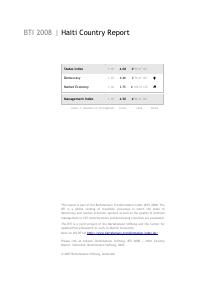
BTI 2008 | Haiti Country Report
Status Index
1-10
4.08
# 99 of 125
Democracy
1-10
4.40
# 79 of 125
Market Economy
1-10
3.75
# 109 of 125
Management Index
1-10
4.50
# 86 of 125
scale: 1 (lowest) to 10 (highest)
score
rank
trend
This report is part of the Bertelsmann Transformation Index (BTI) 2008. The
BTI is a global ranking of transition processes in which the state of
democracy and market economic systems as well as the quality of political
management in 125 transformation and developing countries are evaluated.
The BTI is a joint project of the Bertelsmann Stiftung and the Center for
Applied Policy Research (C•A•P) at Munich University.
More on the BTI at http://www.bertelsmann-transformation-index.de/
Please cite as follows: Bertelsmann Stiftung, BTI 2008 — Haiti Country
Report. Gütersloh: Bertelsmann Stiftung, 2007.
© 2007 Bertelsmann Stiftung, Gütersloh
�BTI 2008 | Haiti
2
Key Indicators
Population
mn.
8.5
HDI
0.48
GDP p.c.
Pop. growth1
% p.a.
1.4
HDI rank of 177
154
Gini Index
Life expectancy
years
53
UN Education Index
0.50
Poverty3
38.8
Gender equality2
Urban population %
-
$
1,479
59.2
%
78.0
Aid per capita $
60.4
Sources: UNDP, Human Development Report 2006 | The World Bank, World Development Indicators 2007 | OECD
Development Assistance Committee 2006. Footnotes: (1) Average annual growth rate 1990-2005. (2) Gender
Empowerment Measure (GEM). (3) Percentage of population living on less than $2 a day.
Executive Summary
The realization of presidential, parliamentary and local elections during the course of
the year 2006 marks a historic step toward a reinvigorated and sustainable democratic
transformation in crisis-ridden Haiti. The re-establishment of a legitimate political
order provides the necessary marge de manoeuvre to implement substantial economic
improvements for the impoverished majority. However, a high level of violence still
threatens the political stability that the return to constitutional order in 2006
established. National and international efforts to control this situation so far have met
with only partial success. Official documents recorded more than 530 armed-violencerelated deaths during 2006.
Contrary to the preceding transitional government, new President Rene Preval and
Prime Minister Jacques Edouard Alexis enjoy a high degree of acceptance and
credibility with large sectors of the population, as well as foreign governments and
multilateral agencies engaged in Haiti. The latter is important, since the Haitian
authorities rely heavily on continued international aid, which has resumed since the
transition. However, the international community’s failure to meet agreed timelines for
the disbursement of pledged funds has sparked tensions with the Haitian government.
In November 2006, the government was approved for debt reduction under the Heavily
Indebted Poor Countries (HIPC) initiative, which will free substantial state resources to
improve security and implement socioeconomic programs. In this context, the final
drafting of an Interim Poverty Reduction Strategy Paper (I-PRSP) could additionally
serve as a basis to install a coherent government program for the coming years. The
final passing in U.S. Congress of a trade preference bill known under the acronym
HOPE (Haitian Hemispheric Opportunity through Partnership Encouragement) in
December 2006 is considered another important event. It bears the potential to boost
the assembly sector that has suffered under political instability and rising insecurity in
�BTI 2008 | Haiti
recent years, reducing the number of businesses from 90 in the late 1990s to a mere 15
in 2007, and would thereby create thousands of new job opportunities. A good degree
of financial discipline as well as conducive macroeconomic factors have together
provided a good basis for economic transformation.
History and Characteristics of Transformation
The breakdown of the Duvalier regime in February 1986 represents the starting point
of a long and enduring process of democratic transformation in Haiti. After a period of
political transition that was marked by several coups d’état leading to military and
provisional governments, the first free and democratic elections were held in 1990, out
of which Jean-Bertrand Aristide emerged victorious. Ten months later, another coup
d’état interrupted the process of democratization, forcing Aristide into exile and
installing a three-year military regime (1991 – 1994).
The return to a constitutional order in 1994 – enforced by an international military
intervention under U.S. leadership – triggered substantial economical progress.
Accompanying factors such as increased external aid, the adoption of an urgency plan
to stimulate the economy and to an increase of money transfers by Haitians living
abroad stimulated this surge forward. Haiti witnessed valuable improvement of its
economic indicators during that time. Nevertheless, the program of structural
adjustment that the Aristide government introduced, which provided reforms like
liberalization of commerce, privatization of public enterprises and a modernization of
the public sector, was halted two years later due to growing protests denouncing its
negative social effects. President René Préval (1996 – 2001) reintroduced the reforms
during his first mandate only to face another rupture after Prime Minister Rosny Smart
resigned in 1997.
By this time, the conflict between Aristide and a reformist wing of the Lavalas
movement represented by the OPL (Organisation du Peuple en Lutte) had escalated so
far that it ultimately split the Lavalas movement, which resulted in a near complete
paralysis of the political administration. In the context of a political crisis triggered by
controversial parliamentary elections in 2000 and an increasingly difficult relationship
between the opposition and the Fanmi-Lavalas Party, Jean-Bertrand Aristide was
elected president for the second time the same year. The political crisis combined with
the blockade of international financial aid programs put the Aristide and his
government (under the leadership of Prime Minister Yvon Neptune) in a very awkward
situation. The application of his social and political program became increasingly
difficult. The oppositional parties, frustrated by Aristide’s second electoral victory,
tried to deter his party from expanding its hegemony over the Haitian political system
any further, and acted vehemently against the government’s mandate. Long-lasting
3
�BTI 2008 | Haiti
negotiations between the government and the opposition did not lead to a solution of
the political crisis; rather, it intensified to the point of violence. At the end of February
2004, an armed rebellion assembled by former militaries of the Haitian Armed Forces
that Aristide had dissolved in 1994 and rebels linked to armed gangs coming from the
north of the country instigated the breakdown of Aristide’s government and his
departure on 29 February 2004. Supreme Court Chief Justice Boniface Alexandre was
designated as provisional president. Following the recommendations of a Council of
Wise Men, composed of seven eminent personalities and in charge of charting the
country’s transition, Gerard Latortue was appointed to the position of interim Prime
Minister. He formed a transitional government charged with creating the conditions for
effective and democratic presidential and legislative elections, restoring
macroeconomic stability, improving economic governance and laying the foundations
for the rehabilitation of the weak national economy. This program was supported and
fostered by the international community under the so-called Interim Cooperation
Framework (ICF). The UN Security Council authorized the deployment of a
Multinational Interim Force (MIF) in order to re-establish stability in the country until
the arrival of the UN Peacekeeping Mission (MINUSTAH) in June 2004.
In April 2004, a political pact was signed between the transitional government, political
parties and civil society in order to create viable conditions for the organization of
democratic elections and the transfer of power to a newly elected government in
February 2006. The pact was boycotted by Aristide’s Fanmi-Lavalas party. Civil unrest
marked the tenure of the transitional government, which revealed the deterioration of
the state’s capacity to guarantee the rule of law and maintain its monopoly on the use
of force.
After several delays due to organizational and security problems, presidential and
parliamentary elections were finally held in February 2006. Former prime minister and
president Rene Garcia Preval was declared winner with a total of 51% after the first
round. Preval’s party Lespwa is the largest party in the Senate and the Chamber of
Deputies, but does not hold a majority in either house – it holds one-fifth of the seats in
the House of Deputies and one-third in the Senate. Jacques Edouard Alexis was chosen
as Prime Minister and formed a coalition cabinet with the participation of six different
parties form a broad spectrum. These agreements are widely recognized as an
important step towards political stabilization and the prospects for further democratic
and economic development in the country.
4
�BTI 2008 | Haiti
5
Transformation Status
I. Democracy
1 | Stateness
The state cannot assure its monopoly on the use of force effectively over the
entire territory. The transitional government, effective until May 2006, failed to
fully establish its authority in most provinces, where various armed groups and
ex-members of the dissolved Haitian Armed Forces acted unlawfully as security
providers. The gang warfare and general insecurity that characterize several
districts of the capital Port-au-Prince have reached alarming levels. Factions
sympathetic to former President Aristide manipulate many of the armed groups in
poor neighborhoods, while others lay under the influence of anti-Aristide groups,
drug-traffickers and other criminal organizations as well as elements of the
national business elite. The state’s capacity to respond to this phenomenon is
weak. Since the dissolution of the Armed Forces of Haiti (FAd’H) in 1995 the
National Police (PNH) represents the only security force in the country. But this
entity of about 6,000 members so far shows a low level of performance and does
not have the logistical means to effectively cover the entire territory of the
country. The UN Stabilization Mission (MINUSTAH) deployed in the country
since June 2004 is playing a vital –though widely criticized – role in stabilizing
the country and helping the state to gain back its monopoly on the use of force.
The implementation of a much more robust mandate since December 2006 has
shown considerable results in the joint effort with the government to reinstate
control over the entire territory. The installation of the National Commission for
Disarmament, Dismantlement and Reintegration (CNDDR) in August 2006 also
marked an important step. DDR activities aim to facilitate the negotiated
disarmament and reinsertion into civil society of members of gangs and other
armed groups. Late 2006 showed the first positive results in the implementation
of the DDR-strategy.
Monopoly on the
use of force
Haiti has no relevant ethnic diversity. Nevertheless, significant social cleavages
tied to culture, language and religion divide the country. Historically, the peasants
that represent the majority of the Haitian population have been considered as
State identity
�BTI 2008 | Haiti
6
“not-full-citizens” and have thus been prevented from exercising their civil and
political rights. The widespread demand for democracy expressed by the rural
population since the beginning of the transformation process reflects the legacy of
a centuries-old fight for their civil rights. Even today nearly 40% of the Haitian
population do not have their identity titles, without which they cannot exercise
their civil rights or position themselves within the nation-state.
Religious dogma does not play an important role in the legitimacy of the state and
the definition of the legal order in Haiti. Nevertheless a considerably high
presence of religious institutions of either Catholic or different protestant
denominations can be seen in political affairs. These religious organizations have
managed to have considerable impact on the political negotiations through
participation in such institutions as the Provisional Electoral Council (CEP). Still,
religious actors play a more facilitating than strategic role; that is, they do not
seek through their influence to impose a religious dogma on the state.
No interference
of religious
dogmas
The administrative system is highly deficient; it is centralized in the capital Portau-Prince and other smaller urban centers. It cannot distribute public resources
efficiently nor satisfy the basic needs of the majority of the population. Most rural
areas do not dispose of any administrative structure at all. NGOs and international
aid only compensate in part for the weakness of infrastructures and delivery of
basic services caused by the scarcity of state resources and increasing corruption;
their interventions are incoherent and are not coordinated by the state.
Basic
administration
2 | Political Participation
Since the beginning of the democratic transformation process, rulers have
generally been determined by free and fair elections – though there are serious
shortcomings. The period of investigation has seen the preparation and
organization of general elections (president and the totality of the two chambers
of Parliament), which were finally realized in February 2006. After President
Aristide’s departure in February 2004 and the nomination of a transitional regime,
the elections were necessary to return to a constitutional order and re-establish a
democratically legitimized executive and legislative. Considerable organizational
and logistical weaknesses marked the process as well as political confrontations
within the Provisional Electoral Council (CEP) that had been named by the
transitional government in 2005. The OAS (Organization of American States),
responsible for the process of voter registration and the issuance of identity cards
for all citizens who had registered to vote, denounced the lack of cooperation and
political will to realize the elections. MINUSTAH was responsible for security,
the transport of sensitive materials and provision of technical electoral assistance.
With the failure of local agencies, the role of the UN rapidly expanded. By the
end of the registration process in November 2005 official numbers reflected the
Free and fair
elections
�BTI 2008 | Haiti
7
registration of around 80% of potential voters. Despite these initial problems, the
day of the first round of the elections passed without major incident or signs of
fraud and with a voter participation of around 60%. As for the presidential
elections, the lack of a clear winner between the 34 candidates led to instability.
National electoral law requires an absolute majority for a candidate to win in the
first round, but none of the candidates received more than 50%. Due to the fear of
civil unrest and violent outbreaks the CEP and the international community
negotiated a settlement: Rene Garcia Preval, who had received most votes, was –
despite accusations of unconstitutionality and fraud – declared the winner. The
second round of parliamentary and senatorial elections for a total of 30 seats in
the Senate and 99 in the Chamber of Deputies were held in April 2006 with much
lower participation but generally undisputed outcomes. The president was
installed in May 2006 and the two newly convoked chambers of parliament
approved a coalition government under the leadership of Prime Minister Jaques
Eduard Alexis the same month. In December 2006, local elections were held in
accordance with the constitutional laws regarding territorial administration. The
results of these elections were widely disputed in several parts of the country; reelections had to be held and final results were published only in March 2007.
Generally rulers emerging from elections in Haiti have the power to govern. But
because of the strong polarization of the society and a predominant culture of
confrontation within the political class, real governing power is restrained. The
army, which traditionally represented a strong veto power, was dissolved in 1995,
but other forces, such as the private business sector or the traditional political elite
show a strong capacity to impede and isolate the executive and legislative. The
government installed in May 2006 encompasses a broad spectrum of political
parties and is widely considered a national unity government that tends to
integrate spoilers into the process of political stabilization rather than seeking
confrontation. As all major political players recognize the necessity of
reconciliation and national dialogue to improve the economy, they share a
commitment to cooperation.
Effective power
to govern
The Haitian constitution protects the right of independent political and civic
groups to associate and assemble freely. However, in the context of political
confrontation and polarization that dominated the past few years this principle
was de facto disregarded. Various political and civic groups suffered persecution
and acts of violence. In the aftermath of the 2006 elections, the situation has
ameliorated considerably and there are currently no constraints on free
association and assembly of political and civic groups.
Association /
assembly rights
The Haitian constitution proclaims and guarantees the right to freely express
opinions as well as the freedom of the press. Again, in the climate of radical
political confrontation that reigned in Haiti during the past few years these rights
were severely restricted and several people – including a number of journalists –
Freedom of
expression
�BTI 2008 | Haiti
8
suffered from acts of violence for opinions expressed in public. The majority of
these crimes still have not been persecuted. But it should be mentioned that the
media themselves contributed significantly to the situation of confrontation and
polarization, as they are often overtly politically biased and uncommitted to
providing an interest-free, information-oriented journalism. In early April 2007
President Preval expressed his concern regarding the freedom of the press
because of a growing tendency towards “auto-destruction” due to lack of
journalistic professionalism, and spoke in favor of the creation of an ethical code
for journalists and media workers.
3 | Rule of Law
The constitution guarantees the balance between the executive, legislative and
judicial power. However, implementing and maintaining this balance has proved
a challenge since the beginning of the democratization process. The problematic
collaboration between the executive and the legislative has been one of the main
sources of institutional instability in the country. Parliamentarians seem to believe
that the power of their office places them above being held accountable to their
electorate. The ratification of the budget, international treaties and important laws
for economic, social and political transformation are often postponed and treated
with a nonchalance, revealing a lack of professional capacity. There are no
adequate institutional mechanisms to push parliamentarians to do the work the
constitution and the people demand. Since the installment of the new government
in 2006, interference of the executive with the legislative has been reduced
considerably. However, the majority of the members of the newly elected lower
chamber of parliament have yet to prove a sufficient level of professional ethics
and capacity. The Senate, the pre-eminent player in the political system, enjoys a
nearly unlimited veto right. Over the last 15 years, this has led to parliamentary
anarchy and deadlock. In order to prevent authoritarianism, the constitution of
1987 checked presidential power with a strong parliament composed of two
independent chambers. With the coming to power of the newly elected president
and the prime minister, an administrative department has been created to facilitate
communication between the executive (the presidency and the prime minister)
and the legislative (the presidents of the two chambers of the parliament). Still
this institutional arrangement contains a risk if it has to deal with
uncompromising parliamentarians. The constitution of 1987 introduced a
distinction between the president of the republic, as chief of state and the prime
minister, as head of government in order to limit the power of the president.
Haiti’s strong tradition of presidentialism however makes it very difficult for the
Prime Minister to lead the governmental affairs. Nevertheless, recent
developments have shown considerable amelioration of this constraint on the
working separation of powers.
Separation of
powers
�BTI 2008 | Haiti
9
The judicial system is weak and widely dysfunctional due to a lack of resources,
infrastructure – much of which was destroyed in the wake of the departure of exPresident Aristide – professionalism and qualified judges, as well as to the high
costs of judicial procedures and a strong dependence on the executive. This latter
point is clearly visible in the politicization to which the judiciary was exposed
during the last years. The arbitrary imprisonment of leading Fanmi Lavalas
figures during the mandate of the transitional government provided yet another
indicator of this deeply ingrained malaise. Under-payment of judges has led to
widespread corruption, which and has fueled the popular belief that a party’s
capacity to pay bribes determines justice in both civil and criminal cases.
Widespread impunity from prosecution also contributes to the general loss of
confidence in jurisprudence. As in all former French colonies, Haiti has inherited
the five classic Napoleonic Codes. The penal and criminal procedure codes have
been left almost unchanged from the early 1800s. These antiquated provisions are
yet another cause for the lamentable state of justice. In 2006 a Conseil Supérieur
de la Magistrature (Judicial Council) has been created in order to enhance judicial
independence and integrity. But despite singular efforts and much donor support,
the national judicial system does not adhere to democratic standards and is in no
way prepared to confront the challenges posed by an acute rise in criminality, the
proliferation of armed groups, the uncontrolled transnational drugs and arms trade
and the corruption of state institutions. In general, the lack in prioritization,
strategic planning, donor coordination and political will has mired substantial
progress towards a modernization of the system. As of now, the judicial system
places severe constraints on the rule of law.
Independent
judiciary
Corruption is perceived by the population as widespread and nearly endemic to
all administrative structures of the state. The so-called politique du ventre – the
struggle for the acquisition of personal wealth through conquest, plundering and
misuse of state offices – is well established within the political tradition of the
country. According to the UN Office on Drugs and Crime, 90% of entrepreneurs
and 60% of households believe that corruption has increased in recent years.
Recognizing the importance of moralizing public affairs in Haiti, in 2004 the
transitional government created the Unité de Lutte Contre la Corruption (ULCC).
The ULCC was to be a semi-autonomous body under the Ministry of Finance
charged with taking the lead in helping to establish a broad-based national
strategy to promote good governance and combat corruption. As a first step, an
investigation in allegations of corruption and mismanagement by the Aristide
administration was conducted but results were long withheld from publication for
fear of political reappraisals. All major actors of the government elected in 2006
and key civil society sectors in Haiti today agree that corruption is a
manifestation of multi-faceted, systemic weaknesses and is sapping the country’s
capacity for economic development. Only a broad program of governance, public
sector reform and broader accountability throughout Haitian society and
Prosecution of
office abuse
�BTI 2008 | Haiti
10
government can address this problem. Although wide public debate and
stigmatization of officeholders usually accompany the recurrent corruption
scandals, the system of enforcement of legal and/or political penalties for those
who abuse their position is still underdeveloped, leaving impunity as the general
rule.
Several fundamental civil rights are systematically violated. Contempt for due
process represents one of the most salient examples. The National Ombudsman’s
Office (Office National Protecteur du Citoyen) stated in 2006 that approximately
92% of the detainees held in the 17 prisons currently functioning are being held in
prolonged preventative detention. More than a few have been in jail longer than
the maximum sentence of the crimes for which they were charged (or for which
they have been detained but not yet charged). The judicial system in Haiti does
not guarantee counsel for indigent criminal defendants. As the majority of the
population cannot afford legal services, this constitutes a severe restriction
regarding access to justice and equality before the law. In addition, Haiti has
neither a witness protection program nor security in courtrooms, which leaves
testifiers vulnerable to intimidation and thus interferes with their exercise of civil
rights.
Civil rights
4 | Stability of Democratic Institutions
During the period under review, substantial constraints have hampered the
performance of democratic institutions. As there was no effective legislative
during the mandate of the interim government (03/2004 – 05/2006) the country
was ruled by presidential decrees without any means of democratic checks and
balances. This situation has also affected the functioning of the administrative and
judicial system in so far as regulation and control were only exercised in limited
degrees. The realization of general and local elections during the course of 2006
allowed for the return to a democratically legitimized order. In order to strengthen
the level of performance of democratic institutions, steps toward decentralization
must follow.
Performance of
democratic
institutions
The transitional government under Prime Minister Gerard Latortue has not
contributed to an increase in the popular acceptance of democratic institutions.
The judicial system is a fine example for this failure. Measures taken by the
Ministry of Justice reinforced the general belief that the transitional government
applied a partisan justice, such as the detention without judgment of former
dignitaries of the Lavalas government and of Aristide partisans and the poorly
prepared court cases against perpetrators of human rights violations, members of
the rebel army and their affiliates Another important institution for the
improvement of democratic transformation in Haiti is the Electoral Council.
While the constitution of 1987 envisioned the creation of this council as a
Commitment to
democratic
institutions
�BTI 2008 | Haiti
11
permanent institution in charge of the organization of elections, 18 years later it
has yet to take root. Instead, a succession of provisional electoral councils have
sparked political controversies and allegations of partisan instrumentalization
through their work as well as the definition of their procedures and composition.
5 | Political and Social Integration
The traditional Haitian party system is characterized by a low degree of
institutionalization and coherence and does not mediate the interests of state and
society. Generally, parties do not focus on the integration of the population, nor
do they pay it any mind except during intensive moments of mobilization before,
during and after elections. This creates a rather authoritarian and paternalistic
image of parties and their role within the process of democratic transformation.
Political parties in Haiti work like a veto-club of personalities interested in
pursuing their own interests (more often than not, purely financial) and mainly
serve as a means to satisfy clientelist networks. For the parliamentary elections in
2006, more than 40 parties presented candidates for the 30 seats in the Senate and
the 99 seats in the House of Representatives, numbers indicating the extent to
which the party system suffers from fragmentation as well as volatility. Most of
these parties have never had a legislative mandate. Few parties have programs
known to the public, and only very few have a nationwide structure and
representation.
Party system
A variety of popular organizations, labor unions and peasant groups had a strong
impact on the political system at the beginning of the democratic transformation
process. However, partisan politicization, the integration and absorption of
leaders of these groups into the system created by Fanmi Lavalas and the
emergence of new, influential players like the private business sector has steadily
decreased influence of traditional cooperative associations and interest groups on
the political system in recent years. The transitional government confronted the
particular interests of diverse groups (police, former military and students) all
trying to take advantage of its weak social basis and political legitimacy. One of
the main tasks during the term of President Preval and the new government will
be to repair the social fabric, which events of recent years have badly damaged.
Political polarization, deepening antipathies between the majority of the
population and the elite, worsening poverty and a generalized sense of
hopelessness have weakened and silenced civil society structures that might
otherwise have provided viable mechanisms to mediate between society and the
political system.
Interest groups
Even though there generally is consent to and acceptance of democracy and its
norms and procedures, the disillusionment of the population regarding members
of the traditional political class and office bearers within the state’s administrative
Consent to
democratic
norms
�BTI 2008 | Haiti
12
structure constitutes an obstacle to democratic transformation. Ongoing efforts of
social and political integration are questioned by some sectors of the political and
economic elite that consider the actual crisis of the country to be a consequence
of the increased political participation of popular groups in the spheres of power
since the breakdown of the Duvalier regime in 1986. These forces hope to
maintain a political system that ignores the basic social needs of the population
and its desire to participate in the democratic and economic transformation of the
country. They fight for the restoration of a strong political regime and for the
reestablishment of the army, which traditionally has been used to suppress the
poor majority. This polarization reflects a nation historically divided into two
parts still unable to overcome this cleavage to establish an emancipative
democratic and economic order.
Haiti does not lack social resources but rather the ability and will to capitalize on
those resources. The aggravation of general living conditions in Haiti during
recent years (reflected in overall negative socioeconomic indicators) has led to a
new massive movement of migration – internally towards the metropolitan area
of Port-au-Prince and internationally toward the adjacent Dominican Republic,
the United States or other countries in the Caribbean. This high mobility and
accompanying high potential turnover in the labor force has deterred investment
in social capital. Most strikingly, this wave of migration proceeds from the
marginalized rural areas as well as from the urban middle class – two key sectors
for future progress in the process of democratic and economic transformation.
Cooperative and associative mechanisms of self-organization do exist – both in
the rural and urban context – but their economic potential and impact remains
underdeveloped.
Associational
activities
II. Market Economy
6 | Level of Socioeconomic Development
The key indicators show a low level of development for Haiti that obstructs the
majority of its citizens from adequate freedom of choice. Resources and power
are heavily concentrated in the hands of a few in Haiti; poverty-based exclusion
and marginalization, as well as a considerable education gap are evident. Income
inequality is among the highest in Latin America and the Caribbean region.
Nearly half of the national income goes to the richest 10% of the population.
Political instability and the high level of violence in recent years have contributed
Socioeconomic
barriers
�BTI 2008 | Haiti
13
to a net decline in socioeconomic development. The 2006 United Nations Human
Development Index ranked Haiti 154th out of 177 countries. An estimated 78%
of the population lives below the poverty line (on less than $2 a day) while
approximately 54% live in abject poverty (on less than $1 a day). Rural areas are
the worst affected, with close to four fifths of Haiti’s extreme poor living outside
the cities. But the slum areas of the capital Port-au-Prince also house large
pockets of urban poverty. Haiti has the worst social indicators in the region for all
sectors. Only 55% of children aged 6 to12 are enrolled in school. Gender
differences in access to education are apparent. Whereas up to the age of 10 the
percentage of females attending school is higher than for males, the ration turns
between the ages of 14 and 24. Only 39% of adult women are literate, compared
to 53% of adult men. Access to and quality of health care is very limited, which
has resulted in dire health conditions for Haiti’s marginalized poor and rural
populations. Infant and maternal mortality is the highest in the Americas.
According to UNAIDS 5.6% of the adult population is HIV positive. The
country’s enormous social and economic inequalities reflect a history of neglect
of secondary cities and rural areas. The result is a significantly underdeveloped
and impoverished rural sector where basic public goods – notably physical
infrastructure, law enforcement, judicial institutions, basic services,
environmental protection and regulatory frameworks – are almost entirely absent.
Economic indicators
2002
2003
2004
2005
GDP
$ mn.
3,419
2,935
3,822
4,268
Growth of GDP
%
-0.1
-0.6
-2.2
2.0
Inflation (CPI)
%
9.9
39.3
22.8
15.7
Unemployment
%
-
-
-
-
0.2
0.3
0.2
0.2
Foreign direct investment % of GDP
Export growth
%
-
-
-
-
Import growth
%
-
-
-
-
Current account balance
$ mn.
-87.6
-45.3
-54.3
54.1
Public debt
$ mn.
1,066.3
1,208.8
1,225.4
1,276.4
External debt
$ mn.
1,251.0
1,344.0
1,264.6
1,323.4
External debt service
% of GNI
0.8
1.8
2.6
1.4
Cash surplus or deficit
% of GDP
-
-
-
-
�BTI 2008 | Haiti
14
2002
2003
2004
2005
% of GDP
-
-
-
-
Government consumption % of GDP
8.7
8.0
-
-
Tax Revenue
Public expnd. on edu.
% of GDP
-
-
-
-
Public expnd. on health
% of GDP
3.0
2.9
2.9
-
R&D expenditure
% of GDP
-
-
-
-
Military expenditure
% of GDP
-
-
-
-
Sources: The World Bank, World Development Indicators 2007 | UNESCO Institute for
Statistics | Stockholm International Peace Research Institute (SIPRI), Yearbook:
Armaments, Disarmament and International Security
7 | Organization of the Market and Competition
The market in Haiti operates under a weak institutional framework with hardly
any regulatory mechanisms. Over the last 20 years, the informal sector in Haiti
has grown considerably. This sector – like all informal markets – generates a high
degree of insecurity, as markets clear rapidly and prices and incomes can
fluctuate substantially over short periods. Structures that could support and
protect those operating in the informal setting are absent. Careful estimates show
that there are some 300,000 informal micro enterprises in Haiti, which are mainly
concentrated in the trade and service sector. Some 36% of these businesses
belong to women. To a high degree, Haitians engage in informal business on a
day-to-day basis in order to ensure their survival.
Market-based
competition
The inherent trend towards monopolistic and oligopolistic practices in Haiti is not
sufficiently controlled. The weak institutional framework and a general lack of set
rules of the game smooth the path for powerful economic stakeholders to develop
unregulated rent-seeking strategies.
Anti-monopoly
policy
Haiti is one of the most open economies in the world, having significantly
liberalized its economy in the 1980s and 1990s. The tariff structure has been
simplified and rates greatly reduced because of broad structural adjustment
measures applied in a very short period. This has led to local markets being
flooded with cheaper imported goods, which has facilitated the demise of local
production. Haitian producers simply have not been able to compete against
imports, given the agricultural sector’s pre-existing (and continuing) low levels of
productivity and high vulnerability to natural risk. The rice sector is an exemplary
case for this development. Whereas in the 1980s, Haiti used to import only 8% of
the rice it consumed, nowadays between 60 and 68% of rice – which represents
Liberalization of
foreign trade
�BTI 2008 | Haiti
15
the basis of the daily diet of the majority of Haitians – is imported. As of 2006,
45% of food necessities were provided by local offerings, 50% by importations
and 5% by international (and to lesser extent national) food aid.
Even though the Haitian banking system has seen significant modernization in
recent years and applies most of the precautionary measures of the Basel Accords
it still lacks overall stability and trustworthiness. The surveillance of the banking
system by the central bank will be further reinforced through the envisaged
passing of a new banking law aimed at strengthening the central bank’s powers as
regards corrective measures and the enforcement of prudential rules. There are
currently ten commercial banks and two foreign banks operating in the country.
In June 2005, two banks, accounting for 11% of banking assets, lost around a
third of their deposits. In order to stabilize the situation, the BRH has acquired a
majority stake in the larger bank, and injected around $43 million (1% of GDP),
mostly in liquidity support. The smaller bank has been sold to a large local bank.
Unfortunately, a corruption scandal involving members of the senate and the
lower house of the parliament tainted the whole procedure, producing – once
again – mistrust in the population concerning the transparency of monetary
politics.
Banking system
8 | Currency and Price Stability
The newly elected government and the Ministry of Economy and Finance are
continuing a consistent policy on inflation and currency introduced by the
preceding transitional government. Tight fiscal and monetary discipline, a
strengthening exchange rate, lower international oil prices and a slight
improvement in local food production have produced and show potential to
sustain the current downward trend of inflation.
Anti-inflation /
forex policy
The fiscal policy of the new government involves a strong boost to revenue and
enhancement of budgetary management (at central and local government level) to
allow for more spending and investment, particularly as an effort to reduce
poverty. With the planned establishment of effective customs control throughout
the country and increase in direct and indirect tax revenue, there will be room to
reorient government expenditure from transfers and subsidies to public-sector
enterprises toward spending in key areas such as health, education and security.
As a result of increased revenues and tighter expenditure controls, the central
government’s overall deficit was reduced to 1.4% in 2006. This eliminated
recourse to Central Bank financing of the deficit. An Organic Budget Law has
been passed and, unlike previous years, the budgets for FY05, FY06 and FY07
were approved before the start of each fiscal year and key budget allocations and
execution information were disseminated to the public on a regular basis.
Macrostability
�BTI 2008 | Haiti
16
9 | Private Property
The Haitian constitution guarantees private property and assigns to the state the
duty of protection and promotion of private entrepreneurship. Haiti is a signatory
of the international conventions on patents and trademarks. Private companies
can generally act without restrictions. The only limitation is the complicated
registration of enterprises, which involves long administrative procedures. Taking
into account the importance of the peasant population, problems of land
ownership are very important in rural areas. The peasants working the lands
rarely have rights of land titles and the state does not facilitate their acquisition of
those titles. This has led to violent land conflicts throughout the country’s history.
The agrarian reform initiated during the first mandate of Rene Préval (1996 –
2001) was not sustained by the following administrations and consequently there
have been no subsequent developments of note.
Property rights
Though private companies represent the majority of actors on the national market,
public enterprises occupy strategically important sectors such as
telecommunication, electricity, ports and airports. Of the nine state enterprises
which have been targeted for privatization in the context of the structural
adjustment programs introduced in the second half of the 1990s, two have been
privatized: the state-owned flour mill (Minoterie d’Haiti) and the construction
materials plant (Ciment d’Haiti). These privatizations have had very negative
results. Prices for these products have increased, and there has been no
improvement in their distribution to the masses. This, for many, remains a
pressing issue for current officials to address. It is especially urgent that the
announced process of privatization of TELECO, the main communications
provider and a major revenue generator, follow global guidelines of
privatizations.
Private
enterprise
10 | Welfare Regime
A basic system of social security exists, but it excludes the majority of the Haitian
population as it is bound to the formal labor market represented by public and
private institutions. Networks of traditional solidarity like the family generally
manage social risks. But the economic crisis, increasing poverty and migration
have seriously eroded this kind of social security net. The most important
contribution to the social safety nets and compensation for social differences in
Haiti comes from Haitians living abroad. In 2006, remittances from Haitians
living in the United States, France and other countries exceeded $1 billion (21%
of the GDP). Initiatives of NGOs and of international organizations engaged in
Haiti also play an important role in compensating the gross social differences.
The newly elected authorities have planned to implement compensation measures
Social safety nets
�BTI 2008 | Haiti
17
for public sector employees improperly dismissed by the interim government in
the aftermath of the events in February 2004, as well as for ex-members of the
Armed Forces of Haiti (Forces Armées d’Haiti - FAd’H) dissolved in 1994.
As socioeconomic indicators show, there is no equality of opportunity. An
estimated 78% of the population lives below the poverty line (on less than $2 a
day) while approximately 54% lives in abject poverty (on less than $1 a day).
Income inequality is among the highest in Latin America and the Caribbean
region. Nearly half of the national income goes to the richest 10% of the
population. The Préval-Alexis Administration introduced in July 2006 a so-called
Program for Social Appeasement (Programme d’Apaisement Social - PAS) as
one of its main priorities. The PAS will fund a host of small development projects
in sectors with potential to generate jobs and improve living conditions, including
infrastructure, education and agriculture at the level of the country’s
administrative communes. The government plans to implement these small
projects as soon as possible, although they will cost a total $50 million over five
years. The projects are intended to address the immediate needs of the poorest
members of the population.
Equal opportunity
11 | Economic Performance
Since taking office, the new authorities have made concerted efforts to continue
the progress achieved by the transitional government. As a result, economic
growth is estimated to have reached 2.5% in 2006, inflation has fallen to around
12% and central bank reserves were increased to $126 million, all exceeding
expectations. Similarly, fiscal discipline was sustained, there was no reliance on
central bank financing and use of ministerial current accounts remained limited.
Output strength
12 | Sustainability
Haiti faces serious environmental degradation which has negative social and
economic effects and increases its vulnerability to natural disasters. Twenty-five
of Haiti’s 30 watersheds are without natural cover. The remaining forests –
currently covering only about 1% of the territory – are not able to play any
significant environmental or protective role. Deforestation and land degradation
in concert with the high level of poverty, weak infrastructure and a general lack
of investment in risk reduction activities exacerbate Haiti’s already high
vulnerability to natural disasters. There have been considerable efforts to
strengthen the national capacities in natural resource protection and natural
disaster management; however, these efforts fall short of mitigating the
macroeconomic impact of large natural disasters or integrating environmental
issues into broad economic and political planning.
Environmental
policy
�BTI 2008 | Haiti
The Haitian education sector suffers most acutely from the deterioration of its
service quality. The state’s lack of regulatory capacity, exacerbated by the influx
of private service providers, is a major cause of this deterioration. Available
statistical data (2005) indicate that 92% of schools are run by institutions other
than the state (national and international NGOs, religious missions etc.), which
causes considerable problems regarding efficiency, accountability and equity.
Around 70% of schools lack accreditation and 60% of teachers are unqualified or
underqualified. A National Education Plan was introduced in 1997, but during the
first ten years of its existence, the level of advancement remained low and public
expenditures in the sector remained static at around 2% of the GDP. Access to
higher education remains a big problem in Haiti and thus represents a further
serious obstacle to a sustainable progress in democratic and economic
transformation. Every year approximately 100,000-150,000 students obtain their
baccalaureate. Of this total only 10 to 15% can continue their education in any
meaningful way. Lack of financial means to pay for fees and tuition represents a
major constraint, but also the paucity of available institutions offering a solid
higher education. The state-run Université d’État d’Haiti is the largest university
in Haiti with some 15,000 students. Together with other private institutions, a
total of 25,000 students pursue higher education in Haiti. The majority of higher
education institutions are concentrated in the capital, which increases inequality
of opportunity in terms of access. An additional 2,000 young women and men
pursue higher education in the United States, Canada or European countries.
Seven thousand students have directed themselves to the well-established higher
education system in the Dominican Republic. Another constraint in this field is
the near-total absence of specialized institutions in technical formation, which
could serve as a base for self-contained national research and product
development.
18
Education policy
/ R&D
�BTI 2008 | Haiti
19
Transformation Management
I. Level of Difficulty
The structural constraints on governance are massive. The long economic crisis
that has continued for more than a decade, the high level of poverty afflicting the
majority of the population and the collapse of the infrastructure under
accelerated population growth make the transformation difficult. Add to these
hardships the weakness of democratic tradition, the exasperation of the political
struggle marked by continued confrontation and violence and the weak
implantation of directionless political parties. The weak capacity of the state to
satisfy the basic needs of the population in terms of education, security, and
public health has exacerbated civil society’s distrust with the state.
Structural
constraints
Haiti has rich civil society traditions at the local level, but many of its formally
organized groups have been co-opted and manipulated by political and economic
elites in recent years. Generally, organizations have little capacity to influence
national policies due to a lack of open channels for participation and a lack of
administrative and financial management capacity. The participation of a large
number of organizations in the massive manifestations against former President
Aristide was initially seen as a positive sign for a growing civil society.
However, it is obvious that Haitian civil society is still highly fragmented and
split along religious, social, political and cultural lines, which considerably
reduces the contribution that the civil society can make to the economic and
social transformation of the country.
Civil society
traditions
Although Haiti is not marked by significant ethnic or religious cleavages, social
conflicts are an inherent part of the country’s history and have impeded progress
in the process of democratic and economic transformation. The blatant exclusion
of large sectors of the population and the continuing enrichment of the powerful
political and economic elite have deeply divided Haitian society, and both sides
favor violence over dialogue.
Conflict intensity
�BTI 2008 | Haiti
20
II. Management Performance
14 | Steering Capability
The political leadership that came to power with the 2006 elections pursues
long-term aims and objectives that advance democracy and market economy, but
it faces the challenge of reconciling the pursuit of those goals with the provision
of short-term solutions to the immediate needs of the population. This approach
might result in friction, but it is coherent with the government’s prioritization
plan in its political program. The envisaged integration of the Program for Social
Appeasement into the framework of a long-term Poverty Reduction Strategy is a
viable example of this two-pronged approach. The authorities still must prove
their capacity to maintain these strategic priorities with regard to potential
spoilers both within the administrative system and outside it (e.g., those
engaging in undemocratic practices in the interest of political bargaining or
office-seeking).
Prioritization
During the period of investigation, the authorities have shown greater
commitment to the implementation of reform policies. In contrast, the reform
process initiated under the transitional government of Prime Minister Gerard
Latortue lacked democratic legitimization and consistent efforts to gain popular
approval. President Preval and the newly elected government dispose of much
greater popular support and have reached out to all strategic sectors of the
society and the international community in order to proceed with the
implementation of their initial reform policy. Their biggest challenges are to
keep this level of support, to overcome the public administration’s shortcomings
and to engage all territorial entities of the state in a common approach.
Implementation
The new political leadership still has to prove its degree of flexibility and
innovative capacity. Despite improvements in national dialogue and problemoriented political approaches the inherent traditions of the Haitian national
political class have spoiling potential. Polarization and a general lack of
disposition toward political compromise as well as the absence of programmatic
visions and strategies have historically made policy learning difficult.
Policy learning
�BTI 2008 | Haiti
21
15 | Resource Efficiency
Deficiencies in the areas of fiscal management and economic governance have
inhibited the efficient use of both domestic resources and external assistance in
recent years. The tax revenue of the country is very limited and one of the lowest
in the world. Both the transitional government and the newly elected government
have attempted to increase the tax revenue by rationalizing the tax recovery
system, but these measures still do not suffice to compensate the structural
deficiencies of the fiscal administration. The inadequate quality and quantity of
human resources have been a primary impediment to public sector efficiency in
Haiti. The situation stems both from the scarcity of skilled people in the country
(exacerbated by outward migration) and the lack of adequate incentives and
accountability system to attract, maintain and motivate civil servants. In 2004
(last available data), public sector employment corresponded to 0.7% of the
population, the majority of which were concentrated in the capital Port-auPrince. The low salaries in public administration encourage corruption practices
and disengagement of the officeholders. The lack of public sector capacity
represents a serious obstacle to aid absorption, as the state’s administration is
often ill-equipped to respond to the competing requirements of the different
donors. The transitional government and the newly elected government have
started to implement a series of measures in order to increase the efficiency in
the use of Haiti’s scarce human resources.
Efficient use of
assets
The formation of a coalition cabinet with the participation of six different parties
can be seen as a first major step to enhance dialogue between different political
forces and thus advance the administrations capacity in coordinating conflicting
objectives. Consent of the majority of the population with the policy of the
government is largely bound to rapid and measurable improvements in the living
conditions of the marginalized poor. Strategies to impede violence and to regain
the state’s monopoly on the use of force over the entire territory have to be
accompanied – as currently set out – by broad social measures in order to
contain these conflicting objectives. The Haitian Government relies heavily on
multilateral and bilateral aid flows, and must therefore continuously arbitrate
between the resistance of certain sections of the population to the conditionality
of aid programs and the frustrations of the donors over setbacks and problems of
policy implementation.
Policy coordination
A couple of integrity mechanisms have been implemented in recent years to
increase the government’s capacity to contain corruption. In the area of public
procurement, for example, the institutional framework was strengthened through
the creation of a National Commission for Public Procurement (Commission
National des Marchés Publics – CNMP) in 2005, which thereby affirmed the use
Anti-corruption
policy
�BTI 2008 | Haiti
22
of competitive procurement methods as the norm and introduced more effective
procurement controls in the public administration. Advances in transparency
have also been achieved through the preparation of standard bidding documents,
the publication of lists of awarded government contracts and a supplier database.
Also, international firms have conducted financial audits of public enterprises
(EdH, TELECO, APN) and the government has increased citizen and media
access to information through the creation of a public information center hosted
by the Ministry of Finance, which provides accounts of the Ministry’s activities,
expenditures and outcomes of procurement processes. The Anti-Corruption Unit
(ULCC) has conducted a comprehensive diagnostic survey of the state of
governance and the perception of corruption in Haiti to provide input to the
design of a national anti-corruption strategy, and has drafted a law for asset
declaration of public sector employees. However, these steps constitute
significant advancements the legal framework and judiciary capacity for
effective prosecution of corruption remains weak.
16 | Consensus-Building
The majority of influential political and social actors agree on a stable marketbased democracy as a goal for reform, although their ideas of how to reach that
goal vary considerably. The means and strategies of integration as well as the
pursuit of the decentralization process represent major points of dissent. Some
political and social actors articulate their skepticism towards the neoliberal
impetus of the reform process and criticize – with respect to historical evidence –
the lack of ownership.
Consensus on goals
Anti-democratic economic actors can impede democratization and economic
reform that would mitigate the country’s dramatic socioeconomic inequalities.
This economic elite is highly reluctant to establish democratic rules with the
overall support of the population and to distribute resources equally. The first
steps undertaken by the newly elected government, to reach out to the private
business sector, might lead to the establishment of a legal framework that would
reduce and/or control the impact of such groups.
Anti-democratic veto
actors
The current political leadership has inherited a legacy of political and social
polarization that has fostered recurrent armed violence in recent years. It has to
overcome the historic weakness of the state’s capacity and muster the political
will to mitigate the social cleavages.
Cleavage / conflict
management
One of the biggest weaknesses of the transitional government was its complete
neglect of the civil society within the formulation and implementation of its
policy. Even though the ICF (International Cooperation Framework) aimed to
seek substantial civil society participation, in reality, it achieved only weak
Civil society
participation
�BTI 2008 | Haiti
23
compliance. Several organizations on the national and international level have
complained about this failure and have urged the newly elected authorities to do
better. During the first year of their mandate, there have been approaches to
reach out to civil society and integrate various organizations into the consultation
process around the development of the national Poverty Reduction Strategy.
However, in general, the opportunity for viable civil society participation in the
political process is slim, and most civil society organizations lack the capacity to
act as a reliable and professional partner.
There has been little effort to halt impunity from legal prosecution for past
human rights violations, which taints the Haitian political and social system. The
imprisonment without trial of leaders of the Aristide party Fanmi Lavalas during
the first months of the mandate of the transitional government contributed to the
population’s loss of confidence in terms of their political will to initiate a
sustained process of national reconciliation. Confronted with heavy political
pressure, the newly installed authorities urged for the release in June and July
2006 of the most prominent convicts, including former Prime Minister Yvon
Neptune and former Interior Minister Jocelerme Privert. Both men were
incarcerated without trial on allegations of participation in the killing of Aristide
opponents in La Scierie, Saint-Marc in February 2004. While their release may
have been warranted given the state’s failure to properly try them, the La Scierie
case was never fully investigated and widespread doubts remain over
responsibility for the committed atrocities.
Reconciliation
17 | International Cooperation
The international community has played a mayor role in Haiti’s political and
economic transformation process since the beginning. After a period of intensive
international support in the aftermath of the return of President Aristide from
exile in 1994, relations deteriorated considerably from 1997 on. In 2004 bilateral
and multilateral donors developed an international assistance strategy known as
the Interim Cooperation Framework (ICF), which was based on four strategic
axes for intervention over a transitional period: strengthening political
governance and promoting national dialogue; strengthening economic
governance and contributing to institutional development; promoting economic
recovery and improving access to basic services. A first evaluation of the ICF
undertaken by the interim government in October 2005 stated that despite some
achievements, progress could only be classified as minimal and positive effects
on the quality of life of the population barely perceptible. Bureaucratic
procedures significantly delayed disbursements and the national administration
lacked coordination both within and with the international community, both of
which constitute key factors behind the lack of progress and the waste of funds
Effective use of
support
�BTI 2008 | Haiti
24
accorded to this exercise. A series of follow-up international meetings barely
masked the divergent powers and interests at play. The ICF was initially
designed to serve for the transitional period from 2004 to 2006, but its tenure has
since been prolonged till the end of 2007. The extended ICF has to be
coordinated with the national Social Appeasement Program (PAS) announced in
June 2006 by the newly elected government, as well as with the development of
a Poverty Reduction Strategy Paper, which will then serve as a new framework
for donor coordination.
Despite rising tensions with the donor community over the questions of
ownership and participation, the Haitian government will remain heavily reliant
on the continuation of multilateral and bilateral aid flows during the years to
come. The government has thus made efforts to maintain the support of the
governments of the United States, Canada and France, Haiti’s main trade
partners and aid donors, as well as that of multilateral agencies like the IMF,
IDB, UN and World Bank. In addition, the new government has reached out to
other countries in the region to diversify support. In May 2006, Haiti was
admitted to PetroCaribe, an oil regime established by Venezuela that allows the
purchase of this strategic good on conditions of preferential payments.
Venezuela has also granted funds to Haiti for the improvement of decentralized
airport infrastructure and the strengthening of national waste disposal capacities.
President Preval resumed the bilateral cooperation with Cuba he initiated during
his first mandate from 1996 to 2001. Cuba is financing scholarships for 800
Haitians enrolled in Cuban medical schools and intensified the deployment of
health brigades in rural areas. Currently 400 Cuban doctors and nurses serve to
improve access to basic health services for the marginalized rural population.
The agreements for debt relief with multilateral donors reached by the new
Haitian authorities reflect overall donor satisfaction and prove that the new
government has met necessary conditions in terms of both macroeconomic
targets and progress on policy. The preceding transitional government already
expended efforts to improve relations with the international community, which
had suffered considerably throughout the period political conflict since 1997
when international aid flows to the Haitian authorities were completely frozen.
Credibility
With the coming to power of a new, democratically elected government, Haiti
was able to reinstate its membership with CARICOM (it had been suspended
since March 2004 as CARICOM refused to recognize the interim government).
Although the process of joining CARICOM began in 1997, Haiti was not
admitted as a full member until 1999, and the Haitian Parliament only ratified its
final accession in May 2002. President Aristide signed the revised Chaguaramas
Treaty in July 2003, and trade between Haiti and the other countries of the
region officially began on 1 January 2004. After the interruption in this
relationship during the Latortue years, interest is now focused on what Haiti’s
Regional cooperation
�BTI 2008 | Haiti
membership of the region’s main economic and political body will mean in
practice. Haiti is the newest member of the 15-strong organization and has by far
the largest population – its over eight million people outnumber the combined
total of the populations of the other 14 member states – but it is also the poorest
member. It is believed that the creation of a CARICOM single market (CSM)
will have important ramifications for Haiti. The CSM is the first component of
what, by 2008, will become the CARICOM Single Market and Economy
(CSME). It came into existence at the end of January 2006 when six Caribbean
states – Jamaica, Barbados, Belize, Guyana, Suriname, Trinidad and Tobago –
signed an accord in Kingston. The CSME, which provides for the free movement
of goods, skills, labor and services across the region, is regarded by Caribbean
governments as the correct response to globalization and its accompanying
establishment of mega trading blocs and loss of preferential treatment for
regional goods and services on the world market. More immediately, the
Caribbean Development Bank (CDB) will allocate $17 million to fund Haitian
government development projects during FY2007.
25
�BTI 2008 | Haiti
Strategic Outlook
Despite a high level of difficulty and a multitude of structural constraints during
the review period, Haiti has entered into a promising new phase that could
actually provide advancements in the process of democratic and economic
transformation. The challenge for the new rulers in Haiti is not only to
overcome the long history of political and economic mismanagement, but also
to provide persuasive and sustainable answers to the many immediate problems
of the country. Most urgent action is needed to provide increased economic
opportunities for marginalized groups and to combat the surge of organized
crime through the sustainable disarmament of gangs and other armed groups as
well as the reformation and strengthening of the legal framework and National
Police (PNH).
Haiti must provide more elaborate strategies to attract private investment. These
should include the fortification of the rule of law and the reformation of the
judicial and penal systems, which would create effective mechanisms to combat
corruption and public mistrust of these institutions. In all efforts to attract
private investment however, special attention should be drawn to the needs of
the marginalized rural population in order to stem migration to the capital.
Approximately 75,000 people migrate to the metropolitan area of Port-au-Prince
every year, where uncontrolled bidonvillisation (ghettoization) contributes to
the degradation of living conditions and the growing vulnerability of its
population. The additional steady flow of legal and mostly illegal migrants
towards the Dominican Republican remains a sensitive topic bound to increase
friction in the bilateral relationship between the adjacent countries. Resolving
this problem has to be bolstered by common approaches, which should aim both
at the amelioration of the situation of migrants in the Dominican Republic (legal
status, access to basic services, enforcement and of the anti-discrimination
legislation) as well as the containment of migration through investment and
provision of income-generating activities in the frontier area.
The new government must maintain a political strategy of facilitating consensus
and cooperation between Haiti’s key political actors in order to address the
manifold challenges. However, this national dialogue should not be left to the
parties and better organized civil society organizations based in the capital.
Other parts of civil society, particularly peasant organizations and groups
representing the marginalized rural and urban sectors of the population must be
encouraged and given the means to fully participate in Haiti’s democratic and
economic transformation. There is urgent need for more international donor
coordination with Haiti under the framework of a Poverty Reduction Strategy.
26
�BTI 2008 | Haiti
The waste of international aid has been most obvious in the sector of justice
reform, where interventions could be described as ad hoc, incoherent and
redundant. Here a first step has been taken with the presentation of a
comprehensive plan for better coordination of Haitian and international
activities by the Ministry of Justice, which should now be put into practice with
the demonstration of clear political will. Serious investment in a coherent
agricultural development policy is also needed to raise the productivity of small
farmers and reduce the alarmingly high levels of poverty in the country. Donors
and the government should make agriculture one of their highest priorities
within economic recovery approaches and must guarantee the actual
disbursement of the funds promised to the sector.
27
�