Texte extrait du document original pour l'indexation.
Bertelsmann Transformation Index 2003
Haiti
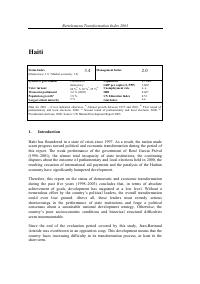
Status Index
(Democracy: 1.8 / Market economy: 1.6)
System of government
Voter turnout
Women in parliament
Population growtha
Largest ethnic minority
3.4
Management Index
Presidential
democracy
60 %b, 5-10 %c, 25 %d
3.6 % (2003)
1.9 %
5%
Population
GDP per capita ($, PPP)
Unemployment rate
HDI
UN Education Index
Gini Index
2.0
8.1 mill.
1,860
n. a.
0.467
0.51
n.a.
Data for 2001 – if not indicated otherwise. a) Annual growth between 1975 and 2001. b) First round of
parliamentary and local elections, 2000. c) Second round of parliamentary and local elections, 2000. d)
Presidential elections, 2000. Source: UN Human Development Report 2003.
1.
Introduction
Haiti has floundered in a state of crisis since 1997. As a result, the nation made
scant progress toward political and economic transformation during the period of
this report. The weak performance of the government of René Garcia Préval
(1996–2001), the almost total incapacity of state institutions, the continuing
disputes about the outcome of parliamentary and local elections held in 2000, the
resulting cessation of international aid payments and the paralysis of the Haitian
economy have significantly hampered development.
Therefore, this report on the status of democratic and economic transformation
during the past five years (1998–2003) concludes that, in terms of absolute
achievement of goals, development has stagnated at a low level. Without a
tremendous effort by the country’s political leaders, the overall transformation
could even lose ground. Above all, these leaders must remedy serious
shortcomings in the performance of state institutions and forge a political
consensus about a sustainable national development strategy. Otherwise, the
country’s poor socioeconomic conditions and historical structural difficulties
seem insurmountable.
Since the end of the evaluation period covered by this study, Jean-Bertrand
Aristide was overthrown in an opposition coup. This development means that the
country faces increasing difficulty in its transformation process, at least in the
short term.
�Bertelsmann Transformation Index 2003
2.
2
History and characteristics of transformation
With the overthrow of the Duvalier dictatorship (François Duvalier 1956–1971,
Jean-Claude Duvalier 1971–1986) in February 1986, Haiti embarked on a journey
toward democracy. The institutional framework for that democracy rests in the
constitution, which was adopted in 1987 and is still valid today. A critical high
point in the country’s transition came in 1990, when Aristide took office as the
nation’s first democratically elected president. Ten months later, a military coup
forced Aristide to flee the country. He returned to power three years later, in the
wake of military intervention by a multinational force under United States
command.
The United Nations subsequently stationed a peacekeeping force in Haiti. Its key
tasks—before the last contingent finally withdrew in March 2000—included
helping to restructure the security sector, primarily by developing the new Haitian
police force, the Police Nationale d’Haiti (PNH).
Haiti disbanded its armed forces in 1995, leaving the police as the nation’s only
security force. Their ability to maintain security and order throughout the country
is limited. The civilian component of the UN mission, with activities centered on
observing the human rights situation and supporting the government’s effort to
establish an independent judiciary, remained in Haiti until February 2001. Despite
some progress, Haiti’s judicial system has far to go before the rule of law prevails.
Since 1997, power struggles among members of the political class have brought
Haiti to near gridlock. These quarrels caused a rift in the former Lavalas alliance,
which broke into two opposing factions: Aristide and the members and supporters
of the Fanmi Lavalas (the party he founded in 1996), and a very diverse alliance
of 17 opposition parties, the Convergence Democratique. The spectrum of parties
in the opposition extended from the social democratic Organisation du Peuple en
Lutte (OPL) to the reactionary Mouvement Patriotique pour le Sauvetage
National (MPSN). Beyond their political battle against Aristide and the Fanmi
Lavalas, the opposition parties had few common ties. Only the OPL had more
than a limited presence throughout the country.
No true programmatic alternative to the “Aristide system” has yet emerged. The
skirmishes for power did not produce a clear outcome, but they did lead most
members of the political class to squander whatever trust the population had
placed in them. Of the euphoria and anticipation that accompanied Haiti’s first
steps toward democracy, only traces remain.
Haiti’s voyage toward economic transformation began some time earlier. After
Jean-Claude Duvalier’s proclamation of an “economic revolution” that would
make Haiti the Taiwan of the Caribbean, a strong manufacturing industry sprang
�Bertelsmann Transformation Index 2003
3
up in the mid-1970s around the capital city of Port-au-Prince. Investors were
drawn by significant customs and tax concessions, preferential access to the U.S.
market, a relative lack of organization of unions or other worker representation
and, especially, the low minimum wage—workers would actually accept wages
well below the minimum, a practice that continues even today. With these
incentives, the manufacturing sector expanded considerably until the early 1990s.
The economic embargo imposed following the military coup devastated
manufacturing. Most of the factories closed, and foreign capital migrated to other
low-wage countries in the region. Of approximately 46,000 factory jobs, all but
about 5,000 disappeared. The situation relaxed somewhat after 1994, and about
20,000 jobs were restored. However, even domestic investors still see Haiti as a
very high-risk prospect. Foreign investors are much more skeptical of the
country’s stability, and they take a correspondingly conservative stance.
Unremittingly poor prospects for steady work drive more and more people into
the informal sector, particularly in Haiti’s urban centers. According to
conservative estimates, more than 750,000 people already seek to earn a
livelihood in this market. Such enterprises have extremely low profit margins and
pay no taxes. Production methods in this sector are often quite labor-intensive and
technologically primitive. Most of the workforce has little or no formal education.
In addition to such independent initiatives, the Haitian economy increasingly
depends on direct transfers from the approximately 1.5 million Haitians living
abroad. According to the Inter-American Development Bank (IDB), in 2001 these
remittances amounted to a total of $810 million—24.5 % of the country’s GDP.
Before his return to Haiti in 1994, Aristide promised the international donor
community comprehensive reforms that essentially comprised a traditional
structural adjustment program.
The changes were to include privatization of state enterprises, rationalization and
reform of the public sector and deregulation of foreign trade. Because of
mounting political and social resistance to these measures, as well as the de facto
paralysis of Haiti’s legislature and executive branch between 1997 and 2000,
scant progress has been made toward implementing these projects. The
international community put increasingly heavier pressure on the administration
to implement reforms. Since 1997, international donors have withheld about $500
million in aid funds—a sum that does not include the IDB funds frozen since
2001.
After considerable political wrangling over the parliamentary, local and
presidential elections in 2000 (which gave Aristide the presidency yet again),
most bilateral and multilateral donors carried out their threats, suspending all
direct payments to the Haitian government until further notice. The World Bank
�Bertelsmann Transformation Index 2003
4
and the IDB halted their cooperation—and hence the disbursement of already
promised loans—when Haiti stopped its debt service payments in mid-2001.
3.
Examination of criteria for democracy and a market economy
3.1
Democracy
Haiti has barely begun to transform its political order. The greatest barriers
blocking its way are the historical and structural conditions it faced at the outset,
along with the inefficacy and instability of its state institutions.
3.1.1 Political order
(1) Stateness: Haiti’s national state identity and prevailing power structures
exhibit several fundamental flaws. In principle, the government’s monopoly on
the use of force had been established nationwide, but in practice it fell far short.
The rising crime rate—in large part linked to organized crime, and particularly the
drug trade—and the proliferation of politically motivated violence merely reflect
the inadequacy of the national police force. Furthermore, police officers have the
reputation of taking sides politically, and some are entangled in criminal
machinations themselves. Even the administrative system functions rather poorly,
fails to reach broad segments of the population and, in some cases, cannot even
carry out basic tasks.
The question of citizenship, and who qualifies as a citizen, is well defined and has
no particular political relevance. All citizens have the same rights. Ethnic
fragmentation is minimal and at present plays little role in politics. The political
process is basically secularized; that is, the prevailing religious dogmas exert no
appreciable influence on politics and law in Haiti.
(2) Political participation: By 1990 at the latest, the people of Haiti had accepted
general, free and fair elections as the means of filling leadership positions. As in
the past, the elections held during the evaluation period—the parliamentary and
local elections in May and July of 2000 and the presidential election in November
2000—were seriously flawed in design and in practice. According to international
observers, the tabulation of votes cast in the first round of Senate elections
involved massive irregularities that favored Fanmi Lavalas, the party in power.
The opposition parties, joining forces in the Convergence Democratique,
boycotted the second round—a factor that contributed to that round’s extremely
low voter turnout, estimated at between 5 % and 19 %.
�Bertelsmann Transformation Index 2003
5
Persistent political disputes about the legality of the election results also marked
the November 2000 presidential elections, which Aristide—running virtually
unopposed—won by a landslide, with 92 % of the vote. Widely varying figures on
voter turnout, with estimates ranging from 5 % to 61 %, along with charges of
electoral fraud cast considerable doubt on the legitimacy of these elections.
In principle, the leaders emerging from Haiti’s elections had the power to govern.
However, the severe polarization of society, the constant battles with the
opposition, and the reaction of the international community—which continues to
withhold the bulk of urgently needed aid funds—place major constraints on the
government and other state institutions. As a result, there are problems with
exercising the rights of political organization and communication. There are also
partial restraints—not consistent with democratic principles—on freedom of
association and assembly and on freedom of opinion and of the press. These
restrictions mainly affect the already weak workers’ organizations, as well as
certain private media, especially those critical of the government.
The severe polarization of Haiti’s society also somewhat limits political
organizations’ freedom of assembly. In recent years, street protests and other
demonstrations by opposition activists have drawn violent harassment by Fanmi
Lavalas loyalists. However, the opposition also harbors violence-prone groups
that add fuel to the fire.
(3) Rule of law: Haiti’s transformation also falls quite short in checks and
balances among the executive, legislative and judicial branches. The biggest
problem in this area is that the decentralization of powers mandated by the
constitution remains deficient, and the executive branch definitely outweighs the
legislative and judicial branches. Between 1997 and 2000, the balance of powers
on the national level virtually disappeared. After Prime Minister Rosny Smarth
resigned in the summer of 1997, the office remained vacant until early 1999,
because none of the nominees put forward by President Préval made it past the
opposition’s blockade.
Legislative elections scheduled for 1998 were cancelled. In January 1999, the
president, claiming that the delegates’ terms in office had officially expired,
dissolved Parliament and installed a new prime minister by decree. After the 2000
elections, the governing party held an absolute majority in both houses of
Parliament, 73 out of 83 seats in the Chamber of Deputies and 26 out of 27 seats
in the Senate, although the legality of the elections remained much in dispute. The
result of the controversy was that Parliament’s hands were effectively tied, and its
oversight over the executive branch was greatly limited.
The judicial system, though institutionally well differentiated in formal terms, has
severe functional deficits. The run of its writ, its equipment and its training all fall
�Bertelsmann Transformation Index 2003
6
short. The situation is troubling, particularly in regard to procedural efficiency:
Processing and prosecuting criminal offenses is so backlogged that in 2001, about
80 % of the more than 4,000 inmates of government prisons had not yet been
convicted of crimes. Furthermore, the judiciary is subject to serious charges of
corruption, as well as accusations of inadequate political independence in court
rulings. Abuse of office pervades other government institutions.
Institutions and political parties are riddled with corruption at all levels. Corrupt
officeholders are not prosecuted adequately under the law, although they do
occasionally attract adverse publicity. Compared with the decades of the Duvalier
family dictatorship and the excesses following the overthrow of Jean-Claude
Duvalier, especially under military rule (1991–1994), Haiti has made considerable
progress in the protection of human rights. However, in recent years, political
disputes have brought a new wave of severe human rights violations, including
harassment of critical journalists and members of different parties, as well as
politically motivated assassinations.
Also alarming are the instances of extralegal executions and other forms of
mistreatment carried out by members of the police force. Due to the weaknesses
of the judiciary and the weight of political pressure, these misdeeds escape
adequate prosecution. In dealing with human rights violations by previous
regimes, a few positive exceptions have emerged, such as the trial of those
responsible for the 1994 Raboteau massacre. On the whole, however, too many
violations have not been addressed.
3.1.2 Political patterns of behavior and attitudes
(1) Institutional stability: Democratic institutions are limited in their ability to
function, a situation that causes significant deficiencies in the political process.
The judicial system, in particular, has considerable shortcomings, and the muchneeded reform of this important institution has stalled. Most public institutions
were dominated by members or sympathizers of the Fanmi Lavalas, and they
often lacked political neutrality. The opposition parties challenged the legitimacy
of certain institutions.
(2) Political and social integration: The polarization and intense fragmentation
that characterize Haiti’s party system inhibit the transformation process. President
Aristide’s party claimed to legitimately represent the political will of the
majority—a claim that was challenged on the national level, especially by the
opposition parties.
The extremely diverse oppositional spectrum includes many groups whose
anchoring in society appears limited to a small circle and whose “party platforms”
�Bertelsmann Transformation Index 2003
7
often merely promote the particular interests of individuals. The opposition’s
organizational weakness constitutes a significant obstacle to the development of a
democratic party system. The landscape of interest groups is meager, important
social interests are underrepresented, and a few actors dominate the system of
interest groups.
Although no survey data is available, consent to democracy as a form of
government can be estimated as moderate to high. However, because of the
dismal education situation, much of the population is poorly informed about
democratic processes and mores. The extremely low voter turnout occasionally
seen in recent years does not reflect a fundamental opposition to democracy.
Rather, it results from poorly organized campaigns and bad public relations work
on the part of the relevant state institutions and parties, as well as widespread
popular disillusionment about the motives of elected officials.
The end of the Duvalier family dictatorship brought a tremendous growth of civic
organizations. Local church communities (ti Legliz) in particular began
organizing in an effort to compensate for the state’s failure to provide for basic
needs, such as ensuring general literacy, improving schools and maintaining
health care and nutrition. Social self-organization increased quantitatively in other
areas as well. Qualitatively, however, socioeconomic and infrastructural barriers
inhibit the effectiveness and overall influence of these groups, clubs and
organizations.
3.2
Market economy
Haiti also shows definite shortcomings in its economic transformation. The
disappointing pace of advances in development and reform is closely linked to the
problems on the political level.
3.2.1 Level of socioeconomic development
The fundamental data indicate a very low level of development. Even though the
country’s development status, as measured by the U.N. Human Development
Index, improved slightly during the period, most of the population lacks adequate
freedom of choice. Overall, 65 % of the population lives below the national
poverty line. In rural regions where about two-thirds of the population lives this
figure is about 80 %. The considerable income disparities—nationwide and
especially between rural regions and urban centers—entail substantial social
exclusion. The greatest barrier to the integration of additional segments of the
population is the persistently low education level, as is evident in the U.N.
Education Index.
�Bertelsmann Transformation Index 2003
8
3.2.2 Market structures and competition
Haiti’s market economy depends primarily on agricultural production; 44 % of its
workers engage in farming, chiefly subsistence farming. In addition, there is a
small industrial sector (5 %) that specializes in export-oriented textile mills. Most
economic activity (51 %) occurs in the informal sector. In Haiti, as elsewhere, the
informal sector features little government regulation and only rudimentary rules
of play for market participants.
The country’s informal sector serves as a general catchment basin for those who
cannot find work in the formal sector. Haiti’s unemployment rate is estimated
(roughly, given its structure) at 50 %. Most unemployed men—and especially
women, often their family’s sole source of support—must eke out an income in
the informal sector. For several years, the government promoted micro-credit
programs and cooperative banks, but these initiatives stalled after 2002, when
numerous scandals exposed their inadequate oversight and lack of regulation.
Structural reforms implemented in 1986–1987 had already reduced the
government’s influence on the import-oriented economy. Additional reforms in
1995 largely deregulated foreign trade and the international flow of capital. The
banking system is definitely underdeveloped and oversight is sketchy. The central
bank has become more independent. The formation of monopolies and oligopolies
is regulated occasionally, but inconsistently.
3.2.3 Stability of currency and prices
Despite Haiti’s many serious economic problems, its national currency has
remained relatively stable over the past years. For a long time, the gourde held
steady at five to the U.S. dollar. Although the central bank made every effort to
pursue a consistent policy on currency and prices, it could not prevent a marked
rise in the inflation rate, as well as a devaluation of the national currency by
nearly 30 %. In a classic scenario, fuel prices heavily influence the stability of
prices. This sector is one of the few in which the government intervenes directly.
�Bertelsmann Transformation Index 2003
9
In autumn 2000, and again in 2002, the precarious condition of the public budget
forced the government to reduce state subsidies for gasoline and other fuels,
triggering violent protests among the population. Despite a relatively low debtservice ratio, the government has fallen short of meeting its obligations to
international donors. This further complicates negotiations for new loans.
3.2.4 Private property
Property rights and property acquisition are adequately defined, but extremely
serious shortcomings hamper administrative processes and implementation. The
determination of property rights in regard to land titles remains a problem. The
agricultural reforms that sought to address this issue have stalled. As a result, the
questions over land ownership still trigger major conflict in some parts of the
country, especially in the fertile Artibonite valley. As part of negotiations with
international donors, the government in 1995 agreed to privatize the most
important state enterprises, but, outside of a few cases, it has made no real
progress.
3.2.5 Welfare regime
Apart from a few class- and sector-specific programs, Haiti’s existing social
safety nets to compensate for poverty and other such risks are socially organized.
Family structures, and, in rural areas, village structures, provide most of the
support. However, increasing migration—from countryside to city or to other
countries—puts these traditional structures in great jeopardy. The universal health
care system is embryonic. The government makes no systematic effort to fight
poverty. Glaring social disparities obstruct equal opportunity and exact a
particularly heavy toll on women.
3.2.6 Strength of the economy
The persistent political crisis has also brought a definite decline in Haiti’s
macroeconomic fundamentals. GDP per capita rose slightly at the start of the
period, but since 2000 the figures have languished. Employment in the formal
sector remains as low as ever. The mounting budget deficit—driven by higher
public expenditures, declining international aid payments, diminishing overall
economic activity and reduced tax revenues—poses the most serious problem.
The negative balance of trade also failed to improve. Buffeted by crises, the
government let economic performance slide. Unfavorable world market
conditions for an import-oriented economy exacerbate the situation.
�Bertelsmann Transformation Index 2003
10
3.2.7 Sustainability
Haiti faces major environmental problems. Deforestation—and the attendant
erosion, soil degradation and decreasing rainfall—is among the most serious
threats. The chief cause of deforestation is the country’s huge demand for
firewood and charcoal. Because other energy sources are so costly, Haiti now
meets about 71 % of its energy needs by burning wood. Despite relatively low per
capita energy consumption, the people find it increasingly difficult to cover the
country’s annual demand (about 7 million cubic meters). Ecological sustainability
is generally subordinated to growth efforts in other areas as well.
Haitian educational facilities fall short in quantity and quality. The national
illiteracy rate for adults age 15 and older averages 50 %. Only about 65 % of
children from 6 to 12 years of age attend school. In rural areas, this figure drops to
23 %. For secondary schools, the overall attendance rate is 22 %. The educational
system is mainly private, both in facilities and in financing. Approximately 89 %
of the elementary schools and 82 % of the secondary schools are private
institutions. These schools are often very poorly equipped, and the teachers poorly
educated, especially outside of the urban centers. Research and development are
rudimentary at best.
4.
Trend
(1) Democracy: During the five years surveyed, the transformation of Haiti’s
political order stagnated or regressed. In particular, the government’s monopoly
on the use of force was increasingly eroded, free and fair elections suffered
manifest problems, and structural deficiencies in the rule of law and the
administrative system persisted. The overall consolidation of democracy stalled at
a very low level. Above all, Haiti’s democratic institutions remain unstable and
ineffectual.
The citizenry’s options for organizing, social organizations’ free activity, freedom
of opinion and freedom of the press all show regressive tendencies. Consolidation
of checks and balances among the executive, legislative and judicial branches
slowed to a halt. Corruption remains widespread. The parties and associations
made no progress toward political and social integration. The number of civic
organizations grew, but their qualitative representation of interests and the breadth
of participation fall short. On the whole, the development of a civic culture as the
underpinning of democracy stagnated. The citizenry’s willingness to participate is
not assured.
�Bertelsmann Transformation Index 2003
11
(2) Market economy: Fundamental development indicators show a slight
improvement for the period studied, but on the whole, they remain extremely low.
Development overall is not sustainable.
Development of the institutional environment has stalled. The reforms in the
organization of the economy and competition introduced in the mid-1990s have
lost their momentum. No substantial new initiatives have materialized. The
economy as a whole is heading downhill. Growth rates rose slightly at the start of
the period but then definitely backslid, and now—like other macroeconomic
fundamentals—they show a negative trend.
Table: Socioeconomic indicators of modernization
UN
Education
Index
Political
representation
of womena
GDP per capita
($, PPP)
HDI
GDI
GDP
Index
1998
0.440
0.436
0.44
0.40
n.a.
1,467
2000
0.471
0.467
0.45
0.50
9.1 %
1,383
a
Percentage of women in Parliament.
Sources: UNDP: Human Development Report 2000, 2002.
Table: Macroeconomic fundamentals (1998–2002)
1998
1999
2000
2001
2002
Growth of GDP in %
2.9
2.9
1.9
-0.7
-1.5
Export growth in %
23.3
16.5
6.3
-14.5
n.a.
Import growth in %
6.6
22.7
29.3
-11.1
n.a.
Inflation in % (CPI)
7.4
9.7
19.0
8.1
10.1
Unemployment in %
n.a.
n.a.
n.a.
n.a.
n.a.
Budget deficit as % of GDP
-2.4
-2.4
-2.6
-2.7
-2.9
Current account balance in $ billions
-38.0
52.0
-31.0
-16.3
n.a.
Sources: World Bank. CEPAL. Banque de la République d’Haiti (BRH).
�Bertelsmann Transformation Index 2003
5.
Transformation management
5.1
Level of difficulty
12
Because of Haiti’s low level of economic and social development, high social
exclusion, ineffectual state administration and challenges to the state monopoly on
the use of force, the difficulty of transformation is very high. The economic
system is market-based in principle, but structural problems interfere with
implementation of uniform rules of the game. Serious irregularities in the conduct
of democratic elections also block the path toward deep and stable democratic
transformation. Haiti’s long history of authoritarian rule contributes to the
problem. It also shapes the attitudes of most of the nation’s political class, as well
as the cumbersome and apparently reform-resistant structures of state institutions.
Under these circumstances, it is not surprising that the potential influence of civil
society is relatively minor. However, the numerous local NGOs do make a
valuable contribution to establishing a civic culture. The crisis-ridden political
and economic developments are interlocked in a spiral that blocks further
substantial advances toward transformation.
5.2
Reliable pursuit of goals
The government’s economic reform strategies under Préval (before February
2001), and afterward, under Aristide, appeared irresolute and largely eclipsed by
the political crisis. Especially during the Préval administration, numerous projects
foundered, either because of the lack of support from parliament—which often
can influence the government’s policies only by voting them down in their
entirety—or because of insufficient resources.
Ad hoc measures and efforts to maximize short-term political gain take
precedence over the medium- and long-term goal of overcoming transformation
problems. Thus, important reform projects in agriculture, health and education—
which the Préval government had pursued with at least some consistency—
ground to a halt or suffered from a lack of strategic planning. Despite the Aristide
government’s heavily populist rhetoric, severe political polarization hindered the
inclusion of additional societal groups and organizations. The government and the
opposition were unwilling to work cooperatively. On the whole, social and
economic actors, both foreign and domestic, showed little confidence in the
future.
�Bertelsmann Transformation Index 2003
5.3
13
Effective use of resources
The government did not use available resources effectively. Personnel expenses in
the public sector were too high relative to the services offered by the state. The
restructuring measures initiated by the Aristide government must be continued
and intensified to maximize their intended results. The government’s fiscal
latitude remains extremely limited. The mounting deficit and persistently high
state debt suggests that government policies have not aimed at a balanced budget.
The bureaucracy is bloated, and inefficiency is widespread and entrenched.
Coordination among individual administrative branches and ministries is
inadequate. Furthermore, local administrative bodies lack the financial resources
that the law requires. The government carries out only some of the announced
reform projects and cannot keep to its own plans. The quality of state services—
especially when it comes to human resources development—cannot support
further substantial progress toward development and transformation.
Efforts to curb corruption are inadequate. Haiti’s cultural heritage affords the
political elite very little in the way of potential resources to advance
transformation. Yet Haiti’s society harbors many resources that go untapped,
because of the high degree of social exclusion and the limited ability of civil
society to organize.
5.4
Governance capability
The performance of Haiti’s political leaders during the period studied
demonstrates little willingness to learn from events. Any changes were so
marginal that policies remained stuck in the same rut. In general, disputes
between the government and the opposition relate only superficially to substantive
issues. For the most part, the disputes are about power games. Innovative policies
are not in evidence at this time. The continuing conflict over the 2000 elections
severely impaired the Aristide government’s authority and legitimacy at home and
abroad. Some of the population, for historical reasons, still saw President Aristide
as a charismatic leader. This afforded him a certain fundamental legitimacy, but
not enough—even assuming that he had the political will—to achieve substantive
progress toward transformation. The government largely ignores the
misallocations arising from its economic policies. The country’s reform-oriented
leaders have yet to tailor their tools and strategies appropriately to the
opportunities and limitations of their situation.
�Bertelsmann Transformation Index 2003
5.5
14
Consensus-building
Although Haitian society shares a broad fundamental consensus on building
democracy and a market economy, some actors give higher priority to pursuing
special interests and maintaining lucrative clientele networks. The goals of leaders
conflict significantly, above all, in terms of the need to redress socioeconomic
inequalities. These dissenting forces have not yet been satisfactorily integrated.
Because of the political situation, the government itself contributes to social
cleavage and has made very little effort to seek a lasting solution to the problem.
Haitian society does have a willingness to act with solidarity, but various political
actors exploit this willingness in ways that dissipate much of its potential
integrative power. The need to deal with past injustices is recognized in principle,
yet progress remains unsatisfactory, not least because of the weak judicial system.
Memories of historical injustices are manipulated as a weapon against political
opponents.
5.6
International cooperation
Relations between domestic and international players have definitely deteriorated
in recent years. After the considerable international attention—and corresponding
financial allocations—that Haiti attracted in the early 1990s, the persistent
political crisis brought international cooperation to a standstill. The continued
controversy over the outcome of the 2000 elections further exacerbated the
situation. Despite substantial international mediation efforts under the leadership
of the Organization for American States (OAS), the political actors have so far
failed to reach a generally accepted compromise.
The most important bilateral and multilateral donors refuse to resume financial
cooperation until Haiti meets the demands listed in September 2002 under OAS
Resolution 822. Negotiations with the IMF, the IDB, the World Bank and the
German Bank for Reconstruction (Kreditanstalt für Wiederaufbau, KfW) about
potential new loans have likewise stalled, because the government does not meet
the imposed obligations and stipulations. The ineffectuality of state administrative
structures makes it much more difficult to carry out humanitarian aid programs
effectively. In principle, however, the political actors are open to cooperation on
the regional and international level.
�Bertelsmann Transformation Index 2003
6.
15
Overall evaluation
In view of the initial conditions in Haiti at the beginning of the study, the
country’s status during the study and its evolution, as well as the actors’ political
achievements (management), this assessment concludes the following:
(1) Originating conditions: The starting conditions for purposeful transformation
were extremely difficult. The absence of traditions in the rule of law, civil society
and democracy created a crucial obstacle to the establishment of sustainable
democratic and market economy structures. The low development level of Haitian
society in general, along with the high degree of social exclusion, likewise
imposes a difficult burden on transition efforts. Other barriers to transformation
include the inadequate educational system and the poorly differentiated civil
society. In the economic arena, the greatest challenge is to rise above an economic
order that is essentially based on agricultural production, in a situation fraught
with ecological vulnerability.
(2) Current status and evolution: In light of Haiti’s history, its democratic
transformation has been of brief duration, and thus far, it has gained very little
ground. During the period of this report, the political decision-makers failed to
achieve substantial development advances or to quantitatively and qualitatively
broaden the transformation. On the whole, consolidation has faltered or lost
ground. Disregard for rule-of-law principles threatens Haiti’s democratic
structures from within; the state monopoly on the use of force has eroded; and
corruption and abuse of office run rampant—all indications that transformation
has only hobbled along.
The total ground gained in the transformation toward a market economy is
likewise fairly limited, even though the journey covers a longer time span. Here
too, the footing is still shaky. The period saw no stabilization of macroeconomic
development and no further improvement—building on past reform initiatives—in
the structures framing a market economy order. Any further advances along that
road would require the relevant actors to forge a political consensus about the
fundamental course of Haiti’s economic order and about socially tolerable
redistributive measures. The leadership failed to take these steps. As a result, the
overall development process has come to a standstill, and, in some respects, it
shows signs of backsliding.
(3) Management: The verdict on the actors’ relative management performance is
negative. The political and economic transformation both lack momentum and
have low prospects for success. The leadership has not demonstrated reliability in
achieving goals or in effective use of resources. The chief barrier to
development—with repercussions in the political and the economic spheres—is
that the members of the political class, both government and opposition, lack the
�Bertelsmann Transformation Index 2003
16
capacity and the will to reach a consensus on resolving the political crisis. They
also showed a lack of sensitivity in dealing with external actors and were unable
to repair the damage to these cooperative relationships.
7.
Outlook
The negative overall assessment of transformation outlined here tallies with that
of most observers, who draw a very bleak picture for Haiti’s future. After the
events surrounding the 2000 elections and Aristide’s controversial return to office
in February 2001, the possibility that the nation would return to its nearly chronic
authoritarian rule was on everyone’s lips. The ouster of Aristide, which took place
in 2004, just after the evaluation period, further contributed to short-term political,
social and economic instability. However, the workings of Haiti’s political system
are extremely complex: Seemingly obvious truths and facts often prove to be
illusions. The establishment of democratic structures is a long slow, process,
fraught with conflict and an uncertain outcome—and not just in Haiti.
The contradictions and paradoxes that now pervade Haiti’s political system
should be recognized as a hallmark of the transformation processes. There must
also be no doubt that the main obstacle to Haiti’s development is the weak
organizational capability of its political actors. To overcome the difficult starting
conditions, these actors must develop a workable and forward-looking strategy.
Above all, they must devote serious effort to improving the efficacy of state
institutions. Without capable institutions, most reform initiatives will disappear in
the sand.
An enduring culture of democracy rests on strong civil society structures and solid
opportunities for participation. To lay the necessary groundwork, the state must
expand its services in meeting the population’s basic needs and produce a
coherent strategy to fight poverty. Education must take a prominent position in
this endeavor. Better education will pave the way for advances in research and
development, which in turn hold the key to changes in the country’s economic
structure.
Furthermore, Haiti must restructure the conditions of agricultural production.
Programs already underway must be integrated into a comprehensive strategy of
rural development that supports further advances in environmental protection—a
task that calls for highly innovative thinking. For Haiti’s non-urban regions, the
strategy should include the creation and promotion of jobs outside of traditional
agriculture. The enormity of this undertaking and the paucity of the state’s
financial resources suggest that transformation in Haiti cannot rise to greater
intensity without help from abroad. The government should do whatever it must
�Bertelsmann Transformation Index 2003
17
to mend its fences with the international community as quickly as possible and lay
a sound foundation for the tasks at hand.
�