Full Document Text
Extracted text from the original document for search indexing.
www.ohchr.org Page 1 of 9
HAITI
FLASH REPORT
23 December 2024
Killings,
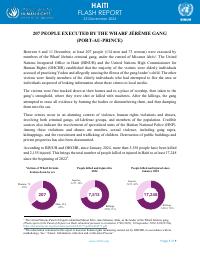
5358, 71%
Injuries,
2155, 29%
People killed and injured in
2024
Men, 134,
65%
Women, 73,
35%
Victims of Wharf Jérémie
broken down by sex
Between 6 and 11 December, at least 207 people (134 men and 73 women) were executed by
members of the Wharf Jérémie criminal gang, under the control of Micanor Altès
1
. The United
Nations Integrated Office in Haiti (BINUH) and the United Nations High Commissioner for
Human Rights (OHCHR) established that the majority of the victims were elderly individuals
accused of practicing Vodou and allegedly causing the illness of the gang leader’s child. The other
victims were family members of the elderly individuals who had attempted to flee the area or
individuals suspected of leaking information about these crimes to local media.
The victims were first tracked down at their homes and in a place of worship, then taken to the
gang’s stronghold, where they were shot or killed with machetes. After the killings, the gang
attempted to erase all evidence by burning the bodies or dismembering them, and then dumping
them into the sea.
These crimes occur in an alarming context of violence, human rights violations and abuses,
involving both criminal gangs, self-defense groups, and members of the population. Credible
sources also indicate the involvement of specialized units of the Haitian National Police (HNP).
Among these violations and abuses are murders, sexual violence, including gang rapes,
kidnappings, and the recruitment and trafficking of children. Destruction of public buildings and
private properties has also been documented.
According to BINUH and OHCHR, since January 2024, more than 5,358 people have been killed
and 2,155 injured. This brings the total number of people killed or injured in Haiti to at least 17,248
since the beginning of 2022
2
.
1
The United Nations Panel of Experts identified Monel Felix, alias Micanor Altès, as the leader of the Wharf Jérémie gang.
(Final report of the Panel of Experts on Haiti submitted pursuant to resolution 2700 (2023), 30 September 2024, S/2024/704),
https://documents.un.org/doc/undoc/gen/n24/243/73/pdf/n2424373.pdf
2
The information contained in this report is based on human rights monitoring carried out by OHCHR, in accordance with its
methodology. See: “Annex: Information collection and verification Process”.
207 PEOPLE EXECUTED BY THE WHARF JÉRÉMIE GANG
(PORT-AU-PRINCE)
7,513 207
Killings,
12013, 70%
Injuries,
5235, 30%
People killed and injured since
January 2022
17,248
www.ohchr.org Page 2 of 9
HAITI
FLASH REPORT
23 December 2024
Map 1: Wharf Jérémie, site of the incidents
Timeline of executions in Wharf Jérémie
What happened at Wharf Jérémie between 6 and 11 December?
www.ohchr.org Page 3 of 9
HAITI
FLASH REPORT
23 December 2024
Phase 1:
In early December 2024, after his young son fell seriously ill, the
leader of the Wharf Jérémie gang accused the Vodou priests and
elderly people living in Wharf Jérémie of being responsible. On
the evening of 6 December, he ordered the members of his gang
(around 300) to carry out a brutal “manhunt”. They stormed into
about ten alleys of the neighborhood and forcibly dragged the
victims out of their homes.
At least 127 elderly people (90 men and 37 women) were taken
to the gang’s stronghold – the so-called “training center” of
Wharf Jérémie, located along the coastline and used to train its
members. BINUH and OHCHR were able to establish that the
127 victims lived in
five areas located in
different parts of the
neighborhood (see map 1). Those who lived near the
“training center” were forced to walk, while others,
living in more distant alleys, were transported in a
pickup truck. From this center, the victims were taken
to an execution site nearby, known as “Nan Mangue”.
Some of them were shot, while others were killed with
machetes. The bodies were then burned with gasoline,
or dismembered and dumped into the sea.
The elderly were specifically targeted due to a widespread perception in certain sectors of the
Haitian population that they are associated with practitioners of Vodou and witchcraft. According
to credible sources, as a devout Vodou practitioner, the leader of the Wharf Jérémie gang
personally knew those who regularly participated in ceremonies in the neighborhood.
Phase 2:
The following day, on the evening of 7 December, 57 people (33 men and 24 women)
3
gathered
at Wharf Jérémie to participate in a Vodou mystical ceremony before taking a makeshift boat to
flee the country. Gang members then stormed the premises of the Vodou “temple” and kidnapped
them. The victims were then taken to the gang’s “training center”, where they were detained and
subjected to interrogations by the gang leader and his men throughout the night.
3
Among the participants in this Vodou ceremony were 50 followers, a Vodou priest, and 6 members of his family.
The leader of the Wharf
Jérémie gang was involved in
murders as a form of
punishment or for religious
reasons.
• In May 2008, he would
have executed at least
seven Vodou priestesses
during a ceremony,
justifying these murders
as his desire to
“strengthen his mystical
powers”.
• In 2012, 12 Vodou
priestesses were also
reportedly executed
following accusations of
witchcraft.
Training center in Wharf Jérémie
Credit: www.youtube.com/@DanielleDreis
www.ohchr.org Page 4 of 9
HAITI
FLASH REPORT
23 December 2024
Phase 3:
At dawn on 8 December, these 57 people were executed by the sea, at “Nan Mangue”, and their
bodies were also burned with gasoline or mutilated. When the news of the massacre began to
spread in the media on 8 December, the gang leader ordered the confiscation of all residents’
phones to identify those responsible for spreading the information beyond Wharf Jérémie. Gang
members also imposed movement restrictions, closely monitoring the only access road to the
neighborhood and forbidding residents from leaving their homes. In addition, they detained about
sixty people in the “training center”, accusing them of having reported the murders of their
relatives to the media and human rights organizations.
Phase 4:
On 9 December, five relatives of the elderly people
killed on December 6 (three men and two women)
tried to flee the Wharf Jérémie neighborhood, fearing
they would be targeted. They were captured and taken
to the “Nan Mangue” area, where they were executed
by the gang leader's deputy.
Phase 5:
According to information gathered by BINUH and
OHCHR, as news of these crimes spread through the
media, the gang leader tightened his grip on Wharf
Jérémie. On 10 December, he went to the homes of
several relatives of the victims, accusing them of
having reported the disappearance of their loved ones
to journalists. Thirteen people (eight men and five
women) were taken to the gang’s stronghold. They
were interrogated and mistreated one by one by the
gang leader himself, before being taken to the
execution site and killed. To eliminate the evidence,
their bodies were burned with gasoline.
Phase 6:
On 11 December, another serious incident was
reported. Five women were captured by gang
members while they were recording a TikTok video in
which they denounced the murder of their parents.
Taken to the “training center”, they suffered the same
fate as the previous victims. In an attempt to deflect
Verbatim of an audio attributed to the
leader of the Wharf Jérémie gang, on
certain social media platforms, on 11
December 2024
“Hello, colleagues of Viv Ansanm,
Greetings, I am King Micanor, and I will
tell you the events related to the incident in
my area. Many people are claiming that I
carried out a massacre and that there were
fatalities. The victims are sorcerers (loup-
garous), and the Viv Ansanm coalition
does not work with such individuals.
Can you imagine that my son, born
healthy, was plotted against by the elders
in the area who tried to kill him by casting
mystical spells? In such a case, I cannot
remain inactive; I must take my revenge.
In all Viv Ansanm bases, we will
exterminate the sorcerers and cleanse the
areas. I’ve heard many messages in the
press and from human rights
organizations. You know my hideout, you
know me. Come and get me. You are
cowards. I’m waiting for you, come and
get me. What I did, I fully own it.
The elders killed my son, do you think I
wasn’t going to react? A son that I love so
much. You are not the parents of the child,
and that’s why you are insensitive to the
pain. I, King Micanor, did not commit any
abuse. The people who were killed are
dead. If others must be killed, they will die.
All the gangs of Viv Ansanm will hunt
down the sorceres (loup-garous)”.
www.ohchr.org Page 5 of 9
HAITI
FLASH REPORT
23 December 2024
the accusations of his involvement in these executions, the leader of the Wharf Jérémie gang
released the 60 people he had been holding. He also distributed food to dozens of residents and
urged them to organize a march in the neighborhood to publicly support him and deny that he had
committed the murders. Meanwhile, about 70 residents of Wharf Jérémie, including relatives of
the victims, fled their homes out of fear of reprisals and found “refuge” in the La Saline
neighborhood, controlled by a rival gang.
Wharf harf Jérémie, a coastal neighborhood in the La Saline area of Port-au-Prince (see map 2),
has been under the control of a gang led by Micanor Altès for over 15 years. According to BINUH
and OHCHR, during this period, the gang has established its own criminal governance. As such,
it engages in various illegal activities, including theft, hijacking trucks transporting goods, and
extorting businesses. Moreover, it controls the socioeconomic fabric of Wharf Jérémie, extorting
residents and restricting their freedom of movement.
Since June 2022, the Wharf Jérémie gang has been engaged in a violent confrontation with the
gangs of Village de Dieu and Grand Ravine for control of the La Saline port area in Port-au-Prince.
This rivalry focuses on control of the roads leading to the National Port Authority (APN), the main
port of the capital, which houses the container warehouse of the Caribbean Port Services (CPS)
company. The Wharf Jérémie gang would also provide security services to protect the port of Port-
au-Prince and its container terminal. Its leader is said to impose “taxes” on the port management
consortium, particularly for the departure of containers, as well as on road transport companies
transporting goods from the port. In any case, this individual has positioned himself as a key
intermediary with national and international actors, seeking to gain access to the local populations
living in Wharf Jérémie.
Gang dynamics in Wharf Jérémie and La Saline: criminal governance and access
control to the port of Port-au-Prince
www.ohchr.org Page 6 of 9
HAITI
FLASH REPORT
23 December 2024
Map 2: Gangs operating in the port area and the industrial zone
While the gangs of Wharf Jérémie, Village de Dieu, and Grand Ravine initially were part of the
Viv Ansanm coalition, revived in early March 2024 with the aim of attacking state institutions and
destabilizing the Haitian government, the Wharf Jérémie gang withdrew from this alliance in May
2024, refusing to relinquish control of access to the port. Subsequently, violent clashes between
the three gangs have been regularly documented, resulting in at least 331 deaths and 227 injuries.
www.ohchr.org Page 7 of 9
HAITI
FLASH REPORT
23 December 2024
Recent Incidents of mass killings documented by OHCHR
In recent years, the influence and domination of the gang leader of Wharf Jérémie over the
residents of this neighborhood have intensified, coinciding with endemic impunity for human
rights violations and abuses. Haitian authorities have gradually withdrawn from this area. Credible
sources report that representatives of the police and the judiciary no longer have access to the
Wharf Jérémie area. As of the publication date of this report, the executions carried out between 6
and 11 December have not elicited any response from the Port-au-Prince prosecutor’s office. This
is also the case for other crimes documented by BINUH and OHCHR since 2022 (see table below).
On 12 December, however, the new Prime Minister instructed the Minister of Justice and Public
Security and the Director of the Judicial Police to mobilize all necessary resources to apprehend
those responsible for these crimes.
Date Place Perpetrators Killed Injured/Raped
Jul-Aug 2022 Cité Soleil Belekou, Brooklyn and Pierre VI 253 282 + 51 raped
Jan 2023 Cité Soleil Belekou, Boston, Pierre VI and Terre Noire 542 18
Mar 2023 Cité Soleil Belekou, Boston, Pierre VI and Terre Noire 158 93 + 6 raped
Apr 2023 Cité Soleil Belekou, Boston, Pierre VI and Terre Noire 171 84 + 11 raped
Apr 2023 Cabaret Canaan and Village de Dieu 39 16
Sep 2023 Croix-des-Bouquets Mawozo and Krazè Baryè 747 45
Nov 2023 Cité Soleil
Belekou, Boston, Brooklyn, Canaan, Chen Mechan
Pierre VI and Terre Noire
163 127 + 5 raped
Oct 2024 Saint Marc Gran Grif 100 16
Widespread impunity
www.ohchr.org Page 8 of 9
HAITI
FLASH REPORT
23 December 2024
Recommendations to Haitian authorities to urgently ensure access to justice for
the residents of Wharf Jérémie:
The Public Prosecutor:
- Establish 24/7 telephone lines to handle emergency calls and reports from victims who are
unable to come to the office.
- Deploy Deputy Prosecutors to the main police stations to collect complaints from victims
of gang violence.
- Instruct the Central Directorate of the Judicial Police (DCPJ) to initiate preliminary
investigations into the Wharf Jérémie massacre.
- Initiate legal action against individuals suspected of committing a crime.
The Transitional Presidential Council (TPC) and the Government:
- Establish a specialized judicial unit to combat crimes involving a high number of victims.
The General Directorate of the Haitian National Police:
- Develop a comprehensive plan to regain territorial control of areas affected by gang
violence and to protect the population.
Recommendations to the international community:
- Continue the deployment, as authorized by the Security Council in its resolutions 2699
(2023) and 2751 (2024), of the Multinational Security Support (MSS) Mission in Haiti, to
assist the Haitian National Police in restoring security in the country, while fully respecting
international law, including human rights.
- Provide support to the Haitian authorities in the development and implementation of
effective public policies to combat impunity.
- In the framework of Security Council resolutions 2653 (2022), 2700 (2023), and 2752
(2024), take urgent and stricter measures to prevent the provision, sale, or direct or indirect
transfer of arms and related materials of all types to Haiti, from their territory or through
their territory, or by their nationals, or by means of vessels flying their flag or aircraft
registered in their country.
- Continue updating the list of individuals and entities subject to the Security Council
sanctions regime in Haiti, particularly for preparing, ordering, or committing acts in Haiti
that violate international human rights law.
www.ohchr.org Page 9 of 9
HAITI
FLASH REPORT
23 December 2024
Appendix: Information collection and verification process
A. Data collection and verification process for the report “207 people executed by the Wharf
Jérémie gang (Port-au-Prince)”
1. The data collection process for this report followed a rigorous documentation and verification
procedure in three stages. The information was initially collected from primary sources, which are
not disclosed in this methodology for reasons of confidentiality and security. This information was
then cross-checked with that of independent third parties, including service providers not directly
linked to the sources of OHCHR, but with access to people affected by the events. Finally, a third
level of verification involved comparing and corroborating the collected data with reports from
partner organizations to ensure the consistency and accuracy of the information.
2. The following provides a detailed overview of the standards of evidence used, as well as a detailed
description of the data collection and verification process.
B. Standards of Evidence
3. In line with the methodology of OHCHR, the team applied the standard of reasonable grounds to
establish the facts concerning individuals, cases, incidents, and behaviors. These factual
observations formed the basis for the legal qualification of the incidents and behaviors,
characterizing them as violations or breaches of international human rights law.
4. The team determined that this standard was met when it was confident that a reliable and consistent
set of information had been gathered, corroborated by other sources, on the basis of which a
reasonable and ordinarily prudent person would have reason to believe that such an incident or
behavior had actually occurred.
5. When this report references a witness’s account, the team considered the statement to be truthful
and relevant, in accordance with its assessment, unless stated otherwise. Direct references to
specific witness statements in this report should not be interpreted as indicating that these
statements were the sole basis for the assessment of the issues addressed in the analysis. These
references and direct quotes are included as examples or illustrations.
C. Data collection and verification
6. Due to difficulties accessing Warf Jérémie, the team conducted the majority of interviews by phone,
taking measures to ensure their reliability while maintaining confidentiality.
7. The team paid particular attention to the principle of “do no harm” ensuring that all interaction with
sources were carefully evaluated to avoid any risk of negative impact on individuals and
organizations.
8. The team also used open-source information to conduct its investigations, including social media
(such as Facebook and WhatsApp). All this information was verified and cross-checked with
secondary sources deemed credible and reliable.