Texte extrait du document original pour l'indexation.
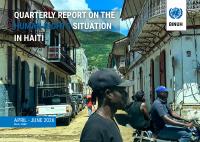
QUARTERLY REPORT ON THE
HUMAN RIGHTS SITUATION
IN HAITI
APRIL - JUNE 2026
Photo: ©HRS
BINUH
�TABLE OF CONTENTS
Main takeaways and recommendations .............................................................................................................................................................................. 3
1 Violence and human rights violations ................................................................................................................................................................................................... 5
1.1. Dynamics of gang-related violence and its impact on human rights ........................ .......................................................................................................................... 6
1.2. Dynamics of violence involving self-defense groups and unorganized members of the population in the context of the “Bwa Kalé” movement ...................................... 13
1.3. Dynamics of violence related to security force operations and excessive use of force ........................................................................................................................ 13
1.4. Kidnappings .................................................................................................................................................................................................................................. 15
1.5. Sexual violence .............................................................................................................................................................................................................................. 17
1.6. Impact of violence and exploitation of children by gangs .................................................................................................................................................................. 18
1.7. Impact of gang violence on economic, social and cultural rights ....................................................................................................................................................... 18
2 Judicial system .................................................................................................................................................................................................................................... 20
2.1. Functioning of the judiciary ............................................................................ ................................................................................................................................20
2.2. Judicial proceedings concerning massacres and other serious human rights violations ..................................................................................................................... 20
2.3. Judicial proceedings for supporting gangs and arms trafficking ....................................................................................................................................................... 21
2.4. Fight against corruption ................................................................................................................................................................................................................. 22
2.5. Fight against sexual violence .......................................................................................................................................................................................................... 22
2.6. Conditions of detention in Haitian prisons ....................................................................................................................................................................................... 23
2.7. International sanctions ................................................................................................................................................................................................................... 23
2.8. Investigations into human rights violations committed by police officers .......................................................................................................................................... 24
2.9. Investigations into human rights violations committed by the Public Prosecutor of Miragoâne ........................................................................................................... 24
3. Support for national institutions and civil society ................................................................................................................................................................................. 25
3.1. Support for public authorities ......................................................................................................................................................................................................... 25
3.2. Support for the Gang Suppression Force ......................................................................................................................................................................................... 26
3.3. Support for civil society organizations working in the field of protection ........................................................................................................................................... 27
Footnotes ............................................................................................................................................................................................................................................... 28
�Main Takeaways
BINUH
1,408 people were killed and 656 injured: 55% by
gangs, 5% by self-defense groups and members
of the population, and 40% during security
forces’ operations against gangs.
Recommendations
To the Haitian government: launch the first investigations by the specialized judicial units
(pôles judiciaires spécialisés) to combat mass crimes, including sexual violence, and
financial crimes.
To the Haitian government: ensure that the operations of the security forces against the
Expansion of gang attacks in the Artibonite
department and incursions by the Village de Dieu
gang into the South-East department.
Increase in kidnappings between April and June,
with 51 victims in the Port-au-Prince
metropolitan area.
At least 796 victims of gang-related sexual
violence were recorded.
gangs are conducted in full respect of international human rights law.
To the Haitian government, with the support of the international community: accelerate
the effective implementation of the vetting process within the police and bring to justice
police officers accused of being involved in serious human rights violations.
To the Haitian Government, with the support of the international community: strengthen
protection mechanisms and assistance services for people affected by gang violence,
particularly survivors of sexual violence, including by increasing safe accommodation
capacity and access to medical, psychosocial, legal, educational, and socioeconomic
At least 9 members of the population killed or
injured by explosive drones, including 6 children.
reintegration services.
Significant decrease in extrajudicial executions
and attempted executions (14 cases) committed
by police officers, compared with 2025.
and accelerate the establishment of a program for the prevention, disengagement, and
3 police officers were killed and 2 others injured.
To the international community: keep Haiti on the international agenda and accelerate the
To the Haitian Government, with the support of the international community: strengthen
rehabilitation of minors involved in gangs, as well as social protection and promotion
programs in affected areas, in order to reduce gang recruitment.
full deployment of the Gang Suppression Force (GSF), as authorized by Security Council
Inauguration of the premises of the specialized
judicial units (pôles judiciaires spécialisés) to
combat mass crimes, including sexual violence,
and financial crimes, and progress in the
assignment of magistrates and staff designated
for their operation.
Bureau intégré des
Nations Unies en Haïti
Resolution 2793 on 30 September 2025, in order to strengthen support for Haitian law
enforcement in the fight against gangs and contribute to the sustainable restoration of
security, in accordance with human rights norms and standards.
To States in the region: strengthen and increase the number of inspections of shipments
bound for Haiti within their territory, including at seaports and airports, in accordance
with United Nations Security Council Resolutions 2653 (2022), 2699 (2023), 2752 (2024),
and 2794 (2025), which impose an arms embargo.
�PEOPLE KILLED AND INJURED BETWEEN JANUARY 2022 TO JUNE 2026
killed
Injured
3000
2500
846
806
411
2000
609
656
713
418
533
369
1500
376
558
1000
314
599
348
1200
522
1708
1732
1642
1621
1523
1520
1395
500
580
745
1408
434
1239
1251
1101
947
844
651
164
531
334
0
Q1 2022 Q2 2022 Q3 2022 Q4 2022 Q1 2023 Q2 2023 Q3 2023 Q4 2023 Q1 2024 Q2 2024 Q3 2024 Q4 2024 Q1 2025 Q2 2025 Q3 2025 Q4 2025 Q1 2026 Q2 2026
United Nations
Integrated Office in Haiti
4
�I. VIOLENCE AND HUMAN RIGHTS VIOLATIONS
According to the Human Rights Service (HRS) of the United Nations Integrated Office
in Haiti (BINUH), between 1 April and 30 June 2026, at least 1,408 people were killed
and 656 injured due to violence perpetrated by gangs, self-defense groups and
unorganized members of the population, as well as during security forces’operations and
actions carried out by a private military company1.
United Nations
Integrated Office in Haiti
Men accounted for 85 percent of the victims, women for 11 percent, and children for 4
percent 2.
Geographical breakdown of killings and injuries
78%
17%
2%
2%
1%
WEST
DEPARTEMENT
The people killed and injured continue to be attributable to the following dynamics:
Distribution des incidents par acteur et/ou contexte
ARTIBONITE
DEPARTEMENT
CENTER
DEPARTEMENT
SOUTH-EAST
DEPARTEMENT
NORTH
DEPARTEMENT
During attacks perpetrated by gangs.
55%
During security operations conducted by the Haitian National Police
(HNP) against gangs, including summary executions involving police
officers, and actions carried out by a “task force”, composed of police
officers and a private military company.
40%
During violence by self-defense groups and unorganized members of
the population, in the context of the “popular justice” movement known
as “Bwa Kalé.”
5%
The vast majority of these incidents were documented in the Port-au-Prince metropolitan
area (78 percent), followed by the departments of Artibonite (17 percent), Centre (2
percent), South-East (2 percent), and the Grand North (1 percent).
Photo: ©HRS
United Nations
Integrated Office in Haiti
5
�I. Violence and human rights violations
Sexual violence perpetrated by armed gangs continued, with at least 796 victims
of rape (772 women, 23 girls, and one man). The majority of cases, 87 percent,
were collective rapes, that is, committed by multiple perpetrators. Ninety-eight
percent of the cases were reported in the West department.
Main gang attacks during the first quarter of 2026
Location
At the same time, during this same period, at least 81 people3 were kidnapped for
ransom by gangs, including 63 percent in the West department and 27 percent in
the Artibonite department4.
Furthermore, gangs continued to engage in the trafficking and exploitation of
children, forcing them to participate in criminal activitiess.
Plaine du Cul-deSac and other areas
of Cité Soleil (West)
1.1 DYNAMICS OF GANG-RELATED VIOLENCE AND ITS IMPACT ON HUMAN
RIGHTS
Security forces’ operations helped contain the advance of gangs in the Port-auPrince metropolitan area. This situation led to the displacement of some of these
gangs to other areas, which, in turn, recorded a significant increase in armed
violence.
Furthermore, gang violence also intensified in the Artibonite department and
spread to the South-East department. The situation remained tense in the Centre
due to the continued presence of gangs, particularly in Saut-d’Eau and
Mirebalais.
United Nations
Integrated Office in Haiti
Number of people
killed and injured
463 killed (170 people not
associated with gangs and
293 associated with gangs)
256 injured (78 people not
associated with gangs and
178 associated with gangs)
Duration of
the attacks
Throughout
the quarter
Séguin (South-East)
15 killed and one injured,
all not associated with
gangs
12–13 and 30
April, and 23
June
Several localities in
Dessalines, L’Estère,
and Petite Rivière de
l’Artibonite
(Artibonite)
42 killed and 48 injured, all not
associated with gangs
Troughout the
quarter
6
�I. Violence and human rights violations
West department: Port-au-Prince Metropolitan Area
In the Port-au-Prince metropolitan area, most gangs maintained their criminal
governance in their strongholds, where they continued to commit targeted
killings, serious physical assaults, and sexual violence against populations living
under their control.
The Plaine du Cul-de-Sac area and several neighborhoods of Cité Soleil were
particularly affected due to violent clashes between gangs.
Communes of Carrefour and Gressier
In the communes of Carrefour and Gressier, at least 55 people were killed and 35
others injured5 by members of the Ti Bois gang and the local cell of the Grand
Ravine gang known as “103 Zombies”.
Among the victims were members of the population who were targeted after being
accused of collaborating with the Haitian National Police (HNP) or because of
disputes with gang members. Others were killed for opposing abuses by gangs,
including for refusing to pay the “taxes” demanded at illegal checkpoints set up by
gangs, or for engaging in behavior supposedly prohibited by gangs, particularly
theft. Finally, members of the population were struck by stray bullets during
outdoor events or as a result of indiscriminate gunfire.
United Nations
Integrated Office in Haiti
Gang members were also killed as a result of disputes within gangs or accusations
of misappropriating revenues from illegal checkpoints.
Communes of Cité Soleil and Croix-des-Bouquets
During the quarter, at least 478 people were killed and 262 others injured6 by gang
violence in Cité Soleil and Croix-des-Bouquets.
Most of the victims (463 people killed and 256 injured) were documented during
violent clashes involving, in particular, the 400 Mawozo, Belekou, Boston, Canaan,
Chen Mechan, Pierre VI, Terre Noire, Tokyo et Wharf Jérémie gangs, in the area
known as the “Plaine du Cul-de-Sac”7 and several other neighborhoods of Cité
Soleil, between 1 April and 30 June.
Sixty-four percent of the people killed or injured were associated with gangs. They
were struck during exchanges of gunfire or killed after being subdued and
disarmed.
By contrast, 34 percent of the victims were members of the population who were
struck by stray bullets while in their homes or in the street attempting to flee the
violence*. Others were shot and killed because they were suspected of having ties to
rival gangs or the security forces.
In addition, at least 176 women and girls were victims of rape, including gang
rape, by gang members (for more details, see section 1.6. Sexual violence).
7
�Map of Businesses and Gang Presence in the Plaine du Cul-de-Sac and Cité Soleil Areas
United Nations
Integrated Office in Haiti
8
�I. Violence and human rights violations
Gang attacks against public and private buildings led to the suspension of
numerous services and activities, particularly in the education and health sectors,
and caused the displacement of more than 18,000 people8.
*Among the most violent incidents documented during this
period was the attack on a traditional musical group in the
Belekou area.
On 13 June, shortly after the FIFA World Cup match between
Haiti and Scotland, a gathering of more than 300 people,
including members of a traditional “rara” musical group as
well as members of the Wharf Jérémie gang, coming from the
Wharf Jérémie neighborhood, was targeted by gunfire from
members of the Belekou gang positioned on the rooftops of
several homes, as the gathering was heading to the Belekou
neighborhood. The attack left at least 61 people dead and 20
injured.
Following this attack, at least 66 people were held captive by
the Belekou gang, including 29 men, 19 women, 11 boys, and
seven girls. During their captivity, at least nine women and
four girls were raped by members of the Belekou gang, while
seven men were killed. The others were released a few days
later.
Source: HRS
United Nations
Integrated Office in Haiti
These clashes, which began in early March, took place in a context marked both by
the reconfiguration and weakening of the Viv Ansanm gang coalition and by
increased pressure from the security forces in other areas of the capital. This
pressure from the security forces led to the displacement of gang members toward
the Plaine du Cul-de-Sac, exacerbating tensions and struggles for control over
illicit revenue opportunities in this strategic area, which is home to several
commercial enterprises and two major roads linking the capital’s container port
and the Varreux oil terminal to the north of the country.
Commune of Delmas
In the commune of Delmas, gang-related incidents remained relatively limited,
with 15 victims9 documented in the neighborhoods of Carrefour Aviation, Delmas
4, Delmas 32, and Delmas 41.
Security operations conducted in the area contributed to a significant reduction in
incidents perpetrated by gangs, particularly following the withdrawal of the
Delmas 6 and Tokyo gangs to the areas of Fontamara (Carrefour) and Village de la
Renaissance (Cité Soleil), respectively.
Most of the victims were members of the population or individuals associated
with gangs who were involved in personal disputes with other gang members or
accused of collaborating with the police or “practicing witchcraft”.
Furthermore, at least one man was killed and another injured while resisting
kidnapping attempts in Delmas 41 and Delmas 75.
9
�I. Violence and human rights violations
Commune of Port-au-Prince
In the commune of Port-au-Prince, at least 50 people were killed and 23 others
injured10 by gangs despite ongoing security operations.
For example, at least 18 men were killed while attempting to bypass illegal
checkpoints established by the Grand Ravine and Village de Dieu gangs in the
Fontamara and Martissant areas. Others were killed after refusing to join gangs
or after being accused of collaborating with the police. Vodou practitioners also
continued to be targeted, particularly in the neighborhoods of La Saline,
Martissant, and Wharf Jérémie, where at least 10 women and two men were killed
for this reason11.
In addition to targeted attacks, at least eight people not associated with gangs
were killed and eight others injured during indiscriminate gunfire by members of
the Grand Ravine and La Saline gangs against police armored vehicles patrolling
areas of downtown Port-au-Prince, or during clashes between gangs in the Wharf
Jérémie area and surrounding neighborhoods.
During the quarter, two incidents were documented in Tabarre. In the first
incident, which took place on 1 June, members of the Chen Mechan gang shot and
killed three of their members after they were accused of raping a woman in an
abandoned house in Croix-des-Bouquets. In the second, documented on 25 June in
the Carradeux area, members of the Kraze Baryè gang killed a minibus driver and
his assistant, whom they suspected of collaborating with the police.
Commune of Kenscoff
In the commune of Kenscoff, despite a relative lull, violence perpetrated by the
Village de Dieu gang left at least 14 people dead and two injured, all of whom
were not associated with gangs12.
Five of these victims were documented on 1 April and 9 June in the localities of
Bake and Viard, during indiscriminate gunfire against homes or farmers working
in the fields, in retaliation, according to local sources, for police operations
conducted a few days earlier. The attacks against these localities were also followed
by the destruction of homes and the theft of cattle.
Communes of Pétion-Ville and Tabarre
Gang violence in Pétion-Ville and Tabarre remained limited, which could be
explained by the weakening of gangs’ operational capabilities, but also by the
displacement of several members to other areas under the control of their allies.
United Nations
Integrated Office in Haiti
Eleven other people were killed after resisting kidnapping attempts attributed to
members of the Village de Dieu gang in the areas of Bongard, Madeleine, and
Robin. Among them, at least five were farmers (three men and two women)
intercepted while on their way to Pétion-Ville to sell their crops.
10
�I. Violence and human rights violations
Other communes in the West department: Arcahaie,
Cabaret, and Léogâne
In the communes of Arcahaie and Cabaret, where the presence of gangs remains
sporadic, violence perpetrated by them remained relatively limited. However,
during the quarter, six people were killed and seven others injured13 as a result of
attacks carried out by the Canaan and Village de Dieu gangs.
For example, on 24 April, two men were killed in the Bercy area when members of
the Canaan gang opened fire on a passenger minibus that had failed to stop at an
illegal checkpoint set up by the gang.
In Cabaret, a man was also killed after being intercepted, while aboard a bus
traveling on National Road 1, by members of the Canaan gang, who accused him
of belonging to a self-defense group.
Furthermore, three members of the Canaan gang were killed by other members of
the same gang as punishment for raping two women in the Titanyen area.
No gang-related abuses were documented in Léogâne, a commune located south of
the capital. However, the interception and killing in this commune of several
individuals suspected of belonging to gangs by self-defense groups or members of
the population reflect the persistence of tensions in the area, where gangs
continue to seek to expand their control (for more details on this violence, see
section 1.2. Dynamics of violence related to self-defense groups and unorganized
members of the population in the context of the “Bwa Kalé” movement).
United Nations
Integrated Office in Haiti
Artibonite department
Continuing the trend from the first quarter and following a pattern of territorial
expansion14, gangs, particularly the Canaan, Cinq Étoiles, Grand Grif, Kokorat San
Ras, and Raboteau gangs, continued their attacks, targeting both members of selfdefense groups and residents. As a result, at least 73 people were killed and 77
others injured15.
The majority of the victims were recorded during armed incursions carried out by
the Gran Grif and Kokorat San Ras gangs in at least 18 localities in the communes
of Dessalines, L’Estère, Petite-Rivière de l’Artibonite, and Saint-Marc.
These raids were generally launched late at night or very early in the morning,
while residents were still asleep. Some victims were therefore killed inside their
homes or in the streets or on paths while attempting to flee. Others, belonging to
self-defense groups, were struck during exchanges of gunfire with gang members
while attempting to defend their localities.
In addition to the victims documented during these incidents, at least 17 other
people were killed or injured in isolated incidents by gang members as
“punishment”for acts perceived as contrary to their interests.
These victims were notably suspected of collaborating with the police, belonging
to self-defense groups, or “practicing witchcraft”, or had refused to pay the
“taxes”at illegal checkpoints established by the gangs along roads.
11
�I. Violence and human rights violations
*Attacks by the Village de Dieu gang in Séguin
Finally, seven other people (six men and one woman) were shot and killed while
resisting kidnapping attempts by members of the Gran Grif gang in the communes
of Dessalines, Petite-Rivière de l’Artibonite, Saint-Marc, and Verrettes. The
victims were attacked inside their homes, in the street, or in the fields.
South-East department: commune of Marigot
During the quarter, four attacks were carried out by the Village de Dieu gang in
the South-East department between 12 April and 23 June. They left at least 15
members of the population dead, including 14 men and one woman, as well as one
male resident injured. These attacks targeted the locality of Séguin (commune of
Marigot)*.
This increase in criminal activity in the department could reflect an intention by
the group to expand its presence and control there, particularly due to the
intensification of security operations targeting the Village de Dieu gang in the
Port-au-Prince metropolitan area. This department could indeed offer the gang
new sources of revenue, particularly through the potential control of roads
leading to the port of Marigot.
On 12 April, the Village de Dieu gang carried out a raid into the locality
of Séguin, in the commune of Marigot. In an agricultural area, its
members targeted a group of farmers working in a field, killing one of
them and injuring another.
During the night of 13–14 April, approximately 50 armed men belonging
to the same gang entered the urban center of Séguin and headed toward
the police station, where an individual suspected of being affiliated with
them was being held. During the attack, eight members of the local selfdefense group were shot and killed, while the two police officers present
were injured while attempting to flee. The detainee was freed and then
taken away by the attackers.
On the morning of 14 April, units of the Haitian National Police were
deployed from Port-au-Prince to the commune of Marigot. However,
these patrols did not prevent another attack by the Village de Dieu gang,
which occurred on 30 April. On that occasion, gang members opened fire
indiscriminately on farmers in a field, killing three people, including two
men and one woman. According to local sources, the attack was
reportedly carried out in retaliation for the deaths of 14 gang members
during a police operation in the area on 20 April.
A few days later, in the morning, members of the Village de Dieu gang
carried out another attack against the locality of Grand-Fond, in Marigot.
During the attack, three men residing in the area were shot and killed.
Source: HRS
United Nations
Integrated Office in Haiti
12
�I. Violence and human rights violations
Centre department: commune of Mirebalais
The number of victims of gang-related violence documented in the Centre
department remained relatively low during the quarter. This situation could be
explained by the fact that a large part of the population of the urban centers of
Mirebalais and Saut-d’Eau remains displaced since the 400 Mawozo and Canaan
gangs took control of parts of these towns in March 2025.
Between April and June, at least two men were killed and another injured in the
commune of Mirebalais. On 1 April, two of the victims, members of the Back-Up
Feray self-defense group, were struck during an exchange of gunfire with members
of the 400 Mawozo and Canaan gangs, in the context of a police operation
conducted in the locality of Narcis Évain, which the self-defense group was
supporting.
On 10 June, in downtown Mirebalais, a resident was intercepted by members of
the Canaan gang and forcibly taken to the gang’s base to perform household
chores. When he refused, he was severely beaten and died that evening from his
injuries.
1.2 DYNAMICS OF VIOLENCE RELATED TO SELF-DEFENSE GROUPS AND
UNORGANIZED MEMBERS OF THE POPULATION IN THE CONTEXT OF THE
“BWA KALÉ” MOVEMENT
During the quarter, at least 101 people were killed and 13 others injured16 by selfdefense groups or unorganized members of the population.
United Nations
Integrated Office in Haiti
The majority of cases recorded were in the Artibonite department (55 percent),
followed by the West department (38 percent), the Grand North region (6 percent),
and the Centre department (1 percent). The victims were targeted either for their
alleged affiliation with gangs or for having committed ordinary criminal offenses,
particularly theft, unrelated to gangs.
Fifty-eight percent of those killed and injured were gang members who were struck
during exchanges of gunfire with members of self-defense groups during attacks on
localities.
The remaining 42 percent were victims of the movement known as “Bwa Kalé,” while
they were unarmed or were not involved in an act posing an imminent lethal threat to
others. Some of the victims would have been apprehended while committing thefts in
abandoned homes or small businesses, before being killed with stones, sticks, or
machetes. In most cases, the victims’ bodies were then burned with gasoline at the
scenes of the killings. The Government informed BINUH that the “Bwa Kale”
phenomenon is a spontaneous response by the population to the gangs; that it
deplores these acts of vigilante justice and is making every effort to raise public
awareness against this form of violence.
1.3 DYNAMICS OF VIOLENCE RELATED TO SECURITY FORCES’ OPERATIONS
AND THE UNNECESSARY AND DISPROPORTIONATE USE OF FORCE
During the quarter, at least 584 people were killed and 223 others injured17 during
security forces’ operations against gangs. Seventy-five percent of the cases were
documented in the West department, while the Artibonite, Centre, and South-East
departments accounted for 18, five, and two percent, respectively.
13
�I. Violence and human rights violations
At least 12 percent of those killed or injured were members of the population who
were not associated with gangs. They were struck by stray bullets or drone
explosions while in their homes or in the streets. Among these victims were seven
children killed and four others injured.
During security force operations against gangs, three members of the Haitian
National Police (HNP) were killed and two others injured.
In line with the trend observed since March 2025, two types of interventions were
carried out by security forces: on the one hand, ground operations, conducted by
specialized HNP units, sometimes supported by the Armed Forces of Haiti
(FAd’H) and a “task force” established by the Government, composed of police
officers and elements from a foreign private military company, and, on the other
hand, operations involving the use of explosive drones, conducted by this same
“task force”.
Ground operations
During the quarter, at least 280 people were killed and 180 others injured during
ground operations conducted by the security forces, including 86 members of the
population, five of whom were children.
Aerial operations involving explosive drones
The majority of explosive drone strikes remained concentrated in the Port-auPrince metropolitan area, particularly in the areas of Martissant and downtown,
where they primarily targeted the Village de Dieu and Grand Ravine gangs.
Nevertheless, at least seven strikes were recorded in the Artibonite department,
particularly in the communes of L’Estère and Petite-Rivière de l’Artibonite,
targeting the Gran Grif and Kokorat San Ras gangs.
Among all those killed and injured during these drone operations, nine were
members of the population, including six children18.
It is important to recall that any use of lethal force by law enforcement officials,
or by any other actor acting on behalf or in support of the State, must always
comply with international human rights law and respect the principles of
legality, necessity, proportionality, non-discrimination, precaution, and
accountability19. To date, the HRS has received no information indicating that
the authorities have opened investigations to establish the circumstances and
responsibilities relating to the deaths and injuries caused during operations by
the security forces, including those involving elements from a private military
company.
The areas where the highest number of victims among the population was
documented were Cité Soleil (particularly Belekou and Sarthe), Croix-desBouquets (Cité Doudoune, Diaboule, Lilavois, Marin, and Shadda), Port-auPrince (Bel Air, downtown, La Saline, and Portail Léogâne), and Tabarre (Croixdes-Missions).
United Nations
Integrated Office in Haiti
14
�I. Violence and human rights violations
Summary executions
GSF Suppression Force
Outside security forces’ operations, persistent allegations of summary executions
or attempted summary executions involving certain members of specialized HNP
units were documented.
124
In total, during this quarter, at least 14 people, including 11 men and three
women, were victims of these executions or attempted executions20. The incidents
were documented in the West department (eight victims), Artibonite (three),
Centre (two), and North (one).
Since the beginning of 2026, 54 people have been victims of executions or
attempted executions, representing a significant decrease compared with the first
quarter of 2025 (124).
Victims of summary executions or attempted summary executions during the
first half of 2025 and the first half of 2026
Number of Victims
140
120
124
100
124
124
80
60
54
40
20
0
JAN-JUN
2025
Some of these victims were
apprehended during patrols or at
police checkpoints and then
executed on the spot. Generally,
they were either accused of
belonging to or supporting
gangs, or of committing theft.
The Gang Suppression Force (GSF), which has not yet been fully deployed, mainly
conducted regular patrols in certain areas of the Port-au-Prince metropolitan
area. On 21 June, during one of its operations in the Tabarre 43 area, it
apprehended 14 individuals suspected of association with gangs. Thirteen of them
were subsequently released by the judicial authorities due to insufficient evidence
linking them to criminal activities. One individual, however, remained in detention
pending further judicial proceedings.
1.4 KIDNAPPINGS
Between 1 April and 30 June 2026, at least 81 people were kidnapped for ransom
by criminal elements. The majority of cases, 63 percent, were documented in the
West department, followed by the Artibonite department (27 percent), NorthWest (7 percent), and Centre (3 percent).
These figures represent only a portion of the total number of people kidnapped.
In many cases, victims’ relatives do not report kidnappings to the police or service
providers and choose to negotiate directly with the kidnappers, believing that this
approach allows for a quicker release and avoids possible reprisals.
The number of kidnappings recorded during the period represents a 42 percent
increase compared with the previous quarter, during which 57 victims had been
recorded.
JAN-JUN
2026
United Nations
Integrated Office in Haiti
15
�I. Violence and human rights violations
Furthermore, two major peaks were observed in the Port-au-Prince metropolitan
area, between 1 and 18 April and then between 1 and 15 June. The neighborhoods
of Delmas 20–40 (Delmas), Bourdon (Port-au-Prince), and Avenue
Panaméricaine, Meyotte, Peguy Ville, and Place Boyer (Pétion-Ville) were
particularly affected. In these areas, victims were intercepted in the street, often
while traveling in their private vehicles to go to work, return home, or carry out
their daily activities. These circumstances suggest that the victims had been
previously targeted and monitored by gang members. They included, in particular,
business owners, senior government officials, and police officers who were off duty
at the time of their kidnapping.
Among other cases documented in the capital, on 1 May, two foreign nationals
who were crew members of a ship were kidnapped in the waters of Port-au-Prince
Bay. On 12 May, a woman who was a family member of a former Government
representative was also kidnapped from her home in Pèlerin after armed
individuals broke in.
By contrast, in the Artibonite, Centre, and North-West departments, victims were
often kidnapped while traveling aboard public transportation minibuses, working
in fields, or at home during attacks carried out against their localities.
United Nations
Integrated Office in Haiti
The Grand Ravine and Village de Dieu gangs remain responsible for the majority
of kidnappings (53 percent). Other cases also involved the Canaan, Chen Mechan,
and Kraze Baryè gangs in the Port-au-Prince metropolitan area, as well as the
Gran Grif and Kokorat San Ras gangs in the Artibonite department.
Some of the kidnappings documented in the capital were also perpetrated or
facilitated by individuals wearing uniforms similar to those of law enforcement.
For example, on 11 June, the chief of staff of the Minister of Defense, along
with three members of his family, were kidnapped in Bourdon after their vehicle
was intercepted by two other vehicles occupied by individuals wearing uniforms
similar to those of the Haitian National Police (HNP) Departmental Unit for the
Maintenance of Order (UDMO). According to local sources, the victims were
subsequently handed over to members of the Village de Dieu gang.
In response to these allegations of collusion between police personnel and gangs in
kidnapping activities, the Central Directorate of the Judicial Police (DCPJ) and
the General Inspectorate of the Haitian National Police (IGPNH) opened
investigations, particularly into the alleged involvement of police officers and
administrative personnel in these criminal acts.
16
�I. Violence and human rights violations
1.5 SEXUAL VIOLENCE
Between April and June, the Monitoring, Analysis and Reporting Arrangements
(MARA) documented 754 incidents of sexual violence perpetrated by gang
members against at least 796 victims (772 women, 23 girls, and one man). The
youngest victim was 10 years old, while the oldest was 71 years old.
Sexual violence, particularly gang-related sexual violence, nevertheless remains
largely underreported due to fear of reprisals, social stigma, and lack of trust in
the police and the judicial system.
Ninety-eight percent of the incidents were reported in the West department,
particularly in neighborhoods under gang influence in the communes of Cité
Soleil, Croix-des-Bouquets, Delmas, Kenscoff, and Port-au-Prince. This
proportion is similar to that observed in the previous quarter (97 percent). The
Artibonite and South-East departments each accounted for 1 percent of the
documented incidents.
Collective rape remains the main violation, accounting for 87 percent of cases,
followed by rape by a single perpetrator and sexual exploitation. According to
information collected by the HRS, these rapes occurred mainly in the victims’
homes (44 percent), which gang members forcibly entered. Other cases were
perpetrated while victims were walking in the street (40 percent), or at internally
displaced persons sites in the capital (5 percent).
At least 176 cases of rape were documented in the context of clashes between
gangs in the Plaine du Cul-de-Sac area, affecting victims between the ages of 10
and 71. These acts of extreme brutality were used as a form of “punishment,”
targeting in particular female residents of areas under the control of rival gangs.
The victims were severely beaten and then raped, often by multiple perpetrators
and in the presence of their children or other family members. In several cases,
their homes were ransacked and set on fire.
Among the survivors, Sophie, a 60-year-old woman, was raped in
her home in Sarthe by several masked men.
The assault took place on 19 April, when members of the Chen
Mechan gang invaded her neighborhood and clashed with the
Pierre VI gang, which controls the area.
That day, Sophie was at home with her husband and their six
children when several heavily armed men broke in. The assailants
beat the family members. When her husband intervened in an
attempt to protect her, he was shot and killed. Sophie was then
beaten again and raped repeatedly in front of her children. After
the clashes, she went to a health center, where she learned that
she had contracted HIV, which she attributes to the sexual assault
she suffered
Source: HRS
United Nations
Integrated Office in Haiti
17
�I. Violence and human rights violations
Beyond the immediate trauma, the long-term consequences of this sexual violence
are devastating and frequently result in lasting physical, psychological, economic,
and social impacts. Among the victims recorded during the period under review, at
least one died by suicide after being unable to overcome the psychological
consequences of the assault suffered, according to a note left by the victim.
With the support of the United Nations and other international partners, local
service providers continued their activities to prevent and respond to sexual
violence, including through medical, psychosocial, and legal care and other forms
of assistance. However, their capacity to meet the needs of all victims requiring
support remained limited by a lack of funding and personnel, as well as by
difficulties in relocating victims exposed to risks of reprisals, particularly due to
the insufficient number of shelters in safe areas.
1.6 IMPACT OF VIOLENCE AND EXPLOITATION OF CHILDREN BY GANGS
During the quarter, the dynamics concerning the trafficking and exploitation of
children by gangs continued21. The majority of the 26 gangs active in the country
continue to resort to the recruitment and exploitation of children, in a persistent
context of poverty, forced displacement, and deterioration of public services.
Boys remain particularly exposed to recruitment for various criminal activities,
ranging from “logistical” or surveillance functions to involvement in more serious
acts, while girls continue to be victims of sexual violence.
Among the cases recorded during the quarter, local service providers reported to
the HRS the situation of at least six girls, aged 14 to 16, who were forced to
engage in so-called “romantic” relationships with members of the Kokorat San Ras
gang in the commune of L’Estère (Artibonite department).
United Nations
Integrated Office in Haiti
Furthermore, institutional and community responses remain insufficient. Social
protection mechanisms and essential services, particularly in the areas of education,
mental health, and vocational training, continue to be limited, especially in
marginalized areas under gang influence.
1.7 IMPACT OF GANG VIOLENCE ON ECONOMIC, SOCIAL AND CULTURAL RIGHTS
Gang violence continued to have a negative impact on economic, social and cultural
rights.
During clashes and armed raids, gangs burned or destroyed nearly 300 homes and
other buildings, including two schools and the Dessalines police station (Artibonite).
Gang violence also led to the suspension of most commercial activities and basic
services in certain areas. For example, during the clashes in the Plaine du Cul-de-Sac
and Cité Soleil, transportation was paralyzed, while businesses and schools were
forced to suspend their activities. On 11 May, the health center operated by Médecins
Sans Frontières in Cité Soleil had to suspend its activities for several weeks and
evacuate its staff and patients to other areas of the capital22.
Business leaders operating in the area also issued several statements and engaged in
discussions with national and international actors to raise awareness of the risks to
their economic and logistical activities.
In rural areas, the destruction of agricultural inputs, as well as the theft of crops
and livestock, was frequent, undermining farmers’ livelihoods and worsening an
already critical humanitarian situation. For example, in the locality of Jean Denis
(Petite Rivière de l’Artibonite), on 3 June, members of the Gran Grif gang
18
�I. Violence et violations des droits de l’homme
deliberately destroyed several rice mills belonging to local farmers.
The persistence of illegal checkpoints established by gangs along strategic roads in
the West and Artibonite departments, particularly on National Roads 1 and 2,
continues to restrict freedom of movement, disrupt economic activities, and
hinder the population’s access to essential goods and services. In this context, in
June, civil society organizations as well as humanitarian and medical actors issued
public appeals warning of the risk of increased isolation of the commune of
Verrettes and neighboring localities in the Artibonite department.
According to the International Organization for Migration, in May, the date of
the latest available assessment, nearly 1.47 million people, more than 51 percent
of whom were children, were forcibly displaced across the country, representing an
increase of more than 1 percent compared with the March 2026 estimates23. This
increase was particularly marked in the Port-au-Prince metropolitan area and the
Artibonite department (6 and 5 percent, respectively). The increase was mainly due
to the resumption of clashes between gangs, particularly in the Plaine du Cul-deSac and Cité Soleil, as well as the persistence of attacks in the Artibonite
department.
United Nations
Integrated Office in Haiti
19
�II. JUDICIAL SYSTEM
United Nations
Integrated Office in Haiti
During the period under review, several advances were observed within the judicial system,
particularly in the effective establishment of two specialized judicial units. However,
persistent difficulties, notably in terms of resources, capacities, and institutional
organization, continue to pose significant challenges to the effective implementation of
responses.
2.1 FUNCTIONING OF THE JUDICIARY
In May, the Superior Council of the Judiciary (CSPJ) formalized the appointment,
renewal of mandates, or promotion of 120 magistrates. They included justices of the
peace, judges of courts of first instance, as well as magistrates assigned to courts of
appeal and specialized labor courts. These measures constitute important advances in
strengthening the effective functioning of the courts, consolidating the integrity of the
judiciary, and maintaining the provision of judicial services.
Furthermore, in June, the CSPJ ruled on the appeals of 67 magistrates who had
previously not been certified. At the conclusion of this process, six were certified, while
the appeals of the others were rejected, thereby confirming their exclusion from the
judiciary.
2.2 JUDICIAL PROCEEDINGS CONCERNING MASSACRES AND OTHER SERIOUS
HUMAN RIGHTS VIOLATIONS
Training delivered by the HRS to public prosecutors and judges
Photo : ©HRS
On 27 May, the Government officially inaugurated the building housing the specialized
judicial units (pôles judiciaires spécialisés) responsible for combating mass crimes,
including sexual violence, and financial crimes. The inauguration ceremony was held in
the presence of the Prime Minister, the Minister of Justice and Public Security, the
President of the Superior Council of the Judiciary, as well as several other senior
national authorities and representatives of the international community.
United Nations
Integrated Office in Haiti
20
�II. Judicial system
Following this inauguration, ten deputy public prosecutors were assigned (six at
first instance and four on appeal). Six investigating judges were also assigned at
first instance, while the assignment of judges on appeal remains to be confirmed.
Furthermore, with the support of the HRS, the Public Prosecutor and the Dean
of the Court of First Instance of Port-au-Prince jointly initiated a process to
inventory existing case files with a view to transferring them to these specialized
units, particularly those concerning massacres and other offenses falling within
their jurisdiction.
the investigating judge requested the intervention of the Central Directorate of
the Judicial Police (DCPJ) to execute arrest warrants issued against seven
individuals suspected of involvement in the President’s assassination. It is
important to note, however, that at the international level, on 8 May, a federal
court in Miami found four men guilty of participating in the planning, financing,
and execution of the President’s assassination.
No progress was recorded in prosecutions relating to emblematic cases of human
rights violations, including the Grand Ravine (2017), La Saline (2018), Bel Air
(2019), and Pont Sondé (2024) massacres. In the Wharf Jérémie case (December
2024), progress also remained limited following the Public Prosecutor’s decision
in March 2026 to request arrest warrants against ten individuals.
2.3 JUDICIAL PROCEEDINGS INITIATED FOR SUPPORTING GANGS AND ARMS
TRAFFICKING
Inauguration ceremony of the specialized judicial units
Photo : ©HRS
By contrast, very little progress was observed in emblematic judicial cases. In the
case concerning the assassination of President Jovenel Moïse, investigating judge
Jean Denis Cyprien of the Court of Appeal continued hearings of witnesses and
suspects as part of the re-examination of the case ordered by the Port-au-Prince
Court of Appeal on 13 October 2025. In parallel with these hearings, on 23 June,
United Nations
Integrated Office in Haiti
During the quarter, in April, the Port-au-Prince Court of Appeal ordered 56
defendants to stand trial in the arms trafficking case linked to the Episcopal
Church of Haiti, opened in 2022. The individuals concerned are suspected of
having participated in an alleged network involving arms and ammunition
trafficking, smuggling, and the circulation of counterfeit currency.
No progress was recorded in the proceedings against former deputy Prophane
Victor24, as well as against a former director of the Economic and Social
Assistance Fund (FAES), a former director of the National Solid Waste
Management Service (SNGRS), and ten other individuals arrested in early 2025 by
the DCPJ for their alleged financial and material support to armed gangs.
21
�II. Judicial system
Similarly, no significant progress was reported in the case concerning the alleged
acquisition of drones by gang members in the Dominican Republic.
trial on charges of forgery and use of forged public documents, as well as abuse of
office
Likewise, no progress was noted in the “Miss Lily” case, opened in 2022 and linked
to arms and ammunition trafficking in Port-de-Paix, in the North-West
department. The case remains with the prosecutor’s office at the Port-au-Prince
Court of First Instance, although it should have been transferred to the prosecutor’s
office at the Port-de-Paix Court of First Instance, the court with territorial
jurisdiction over the investigation.
2.5 FIGHT AGAINST SEXUAL VIOLENCE
In the case concerning former parliamentarian Nenel Cassy, who was being
prosecuted for the alleged financing of criminal organizations, the HRS confirmed
that the case had been closed without further action on 19 August 2025. This
decision followed his hearing before the Port-au-Prince prosecutor’s office, at the
conclusion of which the Public Prosecutor at the time had ordered his release.
2.4 FIGHT AGAINST CORRUPTION
The judicial system continued the investigation of corruption-related cases,
although progress remained limited. In early April, the Port-au-Prince Court of
Appeal overturned the investigating judge’s order to send former senator Youri
Latortue to trial for embezzlement of public funds and unlawful conflict of interest,
as well as former Senate President Joseph Lambert for obstruction of justice.
Furthermore, on 23 April, an investigating judge at the Hinche Court of First
Instance ordered former senator Willot Joseph and a former court clerk to stand
United Nations
Integrated Office in Haiti
During the quarter, the HRS continued to monitor the handling of complaints of
sexual violence reported to police stations in the capital.
According to the Haitian National Police (HNP), between April and June, 235
cases of sexual and gender-based violence had been reported to police services
across the country, 77 percent of which concerned incidents against children.
Among these 235 cases, three victims identified their perpetrators as gang
members. However, according to the HNP, the number of cases involving gang
members is higher in light of the information gathered during police
investigations.
In addition, six platforms on sexual and gender-based violence (SGBV), also
involving service providers, were organized in six police stations in the Port-auPrince metropolitan area and the Artibonite department.
Furthermore, the HRS supported the Ministry of Justice and Public Security
(MJSP) and the Superior Council of the Judiciary (CSPJ) in organizing a training
workshop for 54 judges and magistrates, including nine women, from eight
jurisdictions in the Grand’Anse, Nippes, and South departments. The training
aimed to strengthen their capacities to investigate, prosecute, and adjudicate cases
of sexual violence, particularly those linked to armed gangs.
22
�II. Judicial system
2.6 CONDITIONS OF DETENTION IN HAITIAN PRISONS
2.7 INTERNATIONAL SANCTIONS
As of 30 June, 7,563 people were detained in Haiti’s prisons (7,557 in March
2026), including 263 boys and 20 girls. Individuals in pretrial detention
represented 82 percent of the prison population (compared with 83 percent in the
first quarter of 2026), while prison overcrowding remains critical, with an
estimated occupancy rate of 313 percent and an average space of 0.31 m² per
detainee.
Nine individuals (including seven gang leaders and two former senior Haitian
State officials) and two entities (the Gran Grif gang and the Viv Ansanm gang
coalition) remain subject to the United Nations Security Council sanctions
regime26, which was extended in October 2025.
Conditions of detention remain inhuman and degrading. During the quarter, 49
detainees died, most due to a lack of medical care, unsanitary cells, insufficient
food, and limited access to drinking water.
Between April and June, the HRS continued its support to the judicial and prison
authorities in Port-au-Prince in processing 57 case files of minors that had been
reconstructed, with its support, during previous quarters. This support resulted in
the release of 30 of these minors, including 23 boys and seven girls. These releases,
however, had only a limited impact on prison overcrowding at CERMICOL25,
where more than 760 people are detained (668 adults and 92 minors), in a facility
originally designed to accommodate 93 minorss.
In Cap-Haïtien (North department), the HRS continued to provide technical
support to the judicial and prison authorities in processing the case files of
detained persons. Between April and June, 22 cases were reviewed, 12 of which
concerned minors. In total, 12 people were released, including 10 minors.
United Nations
Integrated Office in Haiti
At the bilateral level, on 26 June, the European Union decided27 to extend until 29
July 2027 the framework for its restrictive measures targeting nine individuals and
one entity accused of being responsible for threatening peace, stability and
security in Haiti or undermining democracy and the rule of law. The individuals
and entities included on the sanctions list remain subject to an asset freeze and a
prohibition on making funds or economic resources available to them, directly or
indirectly. In addition, a ban on entry into the territory of the European Union
applies to the individuals concerned.
Since 28 January 2026, Switzerland has expanded its sanctions regime concerning
Haiti by aligning itself with the autonomous restrictive measures adopted by the
European Union. Thus, 10 individuals and entities designated under the European
Union’s autonomous measures were added to the 11 individuals and entities
already targeted under the United Nations sanctions regime, bringing the total
number of individuals and entities subject to Swiss sanctions concerning Haiti to
2128.
23
�II. Judicial system
Furthermore, at least 36 individuals remain sanctioned by Canada, 21 by the
United States, and 13 by the United Kingdom for acts undermining peace, security
and stability in Haiti, as well as for serious human rights violations29.
2.8 INVESTIGATIONS INTO HUMAN RIGHTS VIOLATIONS COMMITTED BY
POLICE OFFICERS
During the quarter, the HRS documented 14 cases of extrajudicial executions and
attempted extrajudicial executions involving HNP personnel. These incidents
resulted in 12 people killed and two injured30. These cases will be transmitted
during the third quarter of 2026 to the General Inspectorate of the Haitian
National Police (IGPNH), within the framework of a dedicated informationsharing mechanism, with a view to enabling the continuation of investigations
and the adoption of appropriate measures.
United Nations
Integrated Office in Haiti
Limited progress was recorded, compared with the previous quarter, in the
handling of the 248 cases (264 victims) of extrajudicial executions and attempted
extrajudicial executions transmitted by the HRS to the IGPNH in 2025 and 2026.
Of the 248 cases, 226 are still under investigation, while 22 have been finalized
and remain pending closure reports.
2.9 INVESTIGATIONS INTO HUMAN RIGHTS VIOLATIONS COMMITTED BY THE
PUBLIC PROSECUTOR OF MIRAGOÂNE
No judicial proceedings have been initiated against the Public Prosecutor of
Miragoâne (Nippes department), Jean Ernest Muscadin, for his possible
involvement in at least 76 summary executions documented between 2022 and
2025.
24
�III. SUPPORT TO NATIONAL INSTITUTIONS AND CIVIL SOCIETY
United Nations
Integrated Office in Haiti
During the quarter, the HRS continued to support public institutions and civil society
actors with a view to strengthening their capacities and improving the response to human
rights violations.
3.1 SUPPORT TO PUBLIC AUTHORITIES
At the request of the Haitian National Police (HNP), the HRS launched a large-scale
training program on human rights and the use of force for specialized units engaged in
operations against gangs. Between May and June, more than 1,300 officers and 30
commanders from these units participated in 26 training sessions, jointly conducted by
Haitian police officers and HRS personnel. This initiative aims to strengthen the
operational capacities of the security forces while ensuring compliance with international
human rights norms and standards in the conduct of operations.
In June, the HRS, in support of the International Organisation of La Francophonie
(OIF), organized human rights awareness sessions for 20 senior HNP officials (18 men
and two women), as well as 60 officers from specialized HNP units and 20 police cadets
from the National Police Academy (13 men and seven women). In preparation for the
electoral process, particular emphasis was placed on the role of specialized units in
securing elections and on the democratic management of crowds in accordance with
human rights.
As part of its support for the preservation of civic space, the HRS, in collaboration with
the Provisional Electoral Council (CEP), organized training sessions during the quarter
for 369 journalists (339 men and 30 women) from traditional and online media outlets in
five departments. These training sessions aimed to foster a peaceful electoral process,
promote respect for human rights in media coverage, and strengthen the capacity of
media professionals to prevent and counter hate speech and disinformation.
Training of journalists, 6 May 2026
Photo : ©HRS
United Nations
Integrated Office in Haiti
25
�III. Support to national institutions and civil society
In addition, as part of its civic space project funded by the Peacebuilding Fund
(PBF), the HRS supported an international conference held in Port-au-Prince
from 28 to 30 May and organized by the Electoral Chair of the CEP and the State
University of Haiti. Bringing together approximately 100 participants from public
institutions, the CEP, academia, civil society organizations, political parties,
electoral observation groups, organizations representing women, young people,
and persons with disabilities, as well as the diplomatic corps and technical and
financial partners, the conference provided an inclusive forum for dialogue on the
conditions necessary for organizing credible, peaceful elections that respect human
rights. The Expert designated by the High Commissioner for Human Rights on
Haiti also participated in the initiative.
3.2
SUPPORT TO THE GANG SUPPRESSION FORCE
The HRS continued its support to the Gang Suppression Force (GSF) through
awareness-raising sessions on human rights, including on the use of force, for
newly deployed contingents in Haiti. More than 270 personnel, including 263 men
and seven women, participated. These sessions aimed to strengthen participants’
understanding of the human rights context in Haiti, the main risks of violations
that may arise during security operations, gang dynamics and methods of
operation, as well as the applicable rules of engagement. In addition, the training
included modules on the prevention of sexual exploitation and abuse and referral
United Nations
Integrated Office in Haiti
mechanisms for survivors, gender-based violence, and child protection, thereby
contributing to a better understanding among contingent members of the
accountability and protection frameworks applicable to their operations in Haiti.
In May, the HRS, with the support of the Peacebuilding Fund, organized a
lessons-learned workshop for the project “OHCHR Support to the Multinational
Security Support (MSS) mission in Haiti”. The activity brought together 40
participants, including 21 men and 19 women, from national institutions, the
GSF, the United Nations system, technical and financial partners, and civil society.
The workshop provided an opportunity to document and validate the project’s
main achievements in integrating human rights into security operations,
particularly through pre- and post-deployment training for forces, mechanisms for
monitoring human rights violations and protection incidents, as well as
community-based complaint and civic engagement mechanisms.
In June, with the support of the HRS, 20 senior officers from the GSF
headquarters participated in an immersion session on gang dynamics in Haiti, the
Force’s mandate, international human rights standards applicable to its
operations, and the principles governing the use of force. The session also clarified
expectations regarding the GSF’s respect for human rights, particularly with
regard to the prevention of sexual exploitation and abuse, the protection of the
population, and the appropriate treatment of children associated with gangs
following their arrest.
26
�III. Support to national institutions and civil society
3.3 SUPPORT TO CIVIL SOCIETY ORGANIZATIONS WORKING IN THE FIELD OF
PROTECTION
During the quarter, the HRS, in partnership with a local organization and with
the participation of the Office for the Protection of Citizens (OPC), organized a
series of training sessions in eight departments to strengthen accountability and
the fight against corruption through citizen oversight mechanisms. The training
focused on the design and use of tools for collecting data on corruption at the
local level, as well as on the collection and processing of this information and the
preparation of reports for the OPC, the national human rights institution. The
sessions brought together 149 participants, including 84 men and 65 women, from
civil society organizations and the OPC. Since the project was launched in 2025,
participating civil society organizations have documented and submitted six cases
of corruption affecting local institutions.
Following the human rights training program organized in 2025, with the
support of the European Union, for the benefit of 23 civil society organizations,
the project continued through mentoring support aimed at assisting them in
developing and implementing their community initiatives. During the quarter,
three organizations continued to implement their projects.
United Nations
Integrated Office in Haiti
Human rights training delivered by a civil society organization benefiting from an EU-funded
human rights training program organized by the HRS in 2025
Photo: ©HRS
This initiative forms part of the efforts of the HRS and its partners to
strengthen the capacities of community actors so that they can serve as local
focal points for the promotion of human rights, the prevention of violations,
and the strengthening of social cohesion within their communities.
27
�Footnotes
[1] During the first quarter of 2026 (January–March), at least 1,642 people were killed
(1,440 men, 172 women, 15 boys, and 15 girls) and 746 were injured (540 men, 175
women, 16 boys, and 15 girls).
[8] International Organization for Migration (IOM) (23 May 2026). « Haïti — Suivi des
Urgences 93.2 — Mise à jour sur les déplacements liés aux affrontements armés à Cité
Soleil (10 - 22 mai 2026) », available at https://dtm.iom.int/node/64796
[2] 1,408 people killed (1,222 men, 125 women, 46 boys, and 15 girls) and 656 injured
(533 men, 96 women, 13 boys, and 14 girls).
[9] Eight people killed: six not associated with gangs (five men and one woman) and two
not associated with gangs (two men); and seven people injured: six not associated with
gangs (four men, one woman, and one boy) and one man associated with gangs.
[3] 67 men, 10 women, three boys, and one girl.
[4] During the first quarter of 2026, at least 57 people were kidnapped for ransom by
gangs, including 89 percent in the West department and 11 percent in the Artibonite
department.
[5] 55 people killed: 36 people not associated with gangs (28 men, six women, one boy,
and one girl) and 19 others associated with gangs (17 men and two women); and 35 others
injured, all people not associated with gangs (19 men, 15 women, and one boy).
[6] 478 people killed: 171 people not associated with gangs (72 men, 55 women, 36 boys,
and eight girls) and 307 others associated with gangs (294 men and 13 women); and 262
people injured (78 not associated with gangs: 40 men, 20 women, eight boys, and 10 girls;
and 184 associated with gangs, all men).
[7] The Plaine du Cul-de-Sac comprises the localities of Duvivier, Pierre VI, Sarthe, and
Terre Noire (Cité Soleil); downtown Croix-des-Bouquets, Bon Repos, Canaan, Carrefour
Marassa, Cité Doudoune, Duval, Lilavois, Marin, Santo, and Shadda (Croix-desBouquets); and Cazeau, Clercine, Croix-des-Missions, and Damien (Tabarre).
United Nations
Integrated Office in Haiti
[10] 50 people killed: 34 not associated with gangs (28 men, five women, and one girl)
and 16 associated with gangs (13 men, one woman, and two boys); and 23 people injured:
19 not associated with gangs (nine men, nine women, and one girl) and four associated
with gangs (two men, one boy, and one girl).
[11] For more details, see BINUH and OHCHR (December 2024), “207 People Executed
by the Wharf Jérémie Gang (Port-au-Prince),”available at
https://binuh.unmissions.org/sites/default/files/flash_report_20241223_wharf_jeremie_
fr.pdf
[12] 14 people killed: 10 men and four women; and two others injured: one man and one
woman.
[13] Six people killed: three men not associated with gangs and three men associated with
gangs; and seven men not associated with gangs.
[14] In the first quarter, gang violence had resulted in 132 people killed and 72 injured.
See BINUH (8 May 2026), “Quarterly Report on the Human Rights Situation in Haiti,
January–March 2026,” available at https://binuh.unmissions.org/en/documentlibrary/quarterly-report-on-the-human-rights-situation-in-haiti-jan-march-2026
28
�Footnotes
[15] 73 people killed: 68 people not associated with gangs (54 men, 12 women, and two
girls) and two men associated with gangs; and 77 injured, all people not associated with
gangs (58 men and 19 women).
[23] International Organization for Migration (IOM) (May 2026). « Haïti — Rapport
sur la situation de déplacement interne — Round 13 (Mai 2026) », available at
https://dtm.iom.int/node/64841
[16] 101 people killed: 98 men, two women, and one girl; and 13 people injured: all men.
[24] Prophane Victor is subject to international sanctions imposed by the United Nations,
Canada, the United Kingdom, the European Union, and the United States due to his
alleged involvement in supporting gangs in Haiti.
[17] 584 people killed: 33 people not associated with gangs (18 men, eight women, five
boys, and two girls) and 551 associated with gangs (538 men, 11 women, and two boys);
and 223 others injured: 62 people not associated with gangs (27 men, 31 women, two
boys, and two girls) and 161 associated with gangs (all men).
[18] Five people not associated with gangs killed: one man, three boys, and one girl; and
four people not associated with gangs injured: two women and two boys.
[19] OHCHR (2020). « Guidance on less-lethal weapons in law enforcement », available at
https://www.ohchr.org/sites/default/files/Documents/HRBodies/CCPR/LLW_Guidance.p
df
[20] Twelve people killed (nine men and three women) and two others injured (men).
[21] BINUH and OHCHR (February 2026), “Children Trafficked by Gangs in Haiti:
Rethinking Responses,” available at sur https://www.ohchr.org/fr/documents/countryreports/ohchrbinuh-children-trafficked-gangs-rethinking-responses
[22] Médecins Sans Frontières (11 May 2026). “Haiti: MSF forced to evacuate hospital and
temporarily suspend activities in Cité Soleil”, available at https://www.msf.org/haiti-msfforced-evacuate-hospital-cite-soleil
United Nations
Integrated Office in Haiti
[25] The Rehabilitation Center for Minors in Conflict with the Law (CERMICOL),
located in Delmas 33 (commune of Delmas), was originally established to accommodate
boys in conflict with the law. Following gang attacks against the three prisons in the West
department in 2023 and 2024 – the Cabaret women’s prison, the National Penitentiary in
Port-au-Prince, and the Croix-des-Bouquets prison – CERMICOL is the only detention
center still operational in the capital.
[26] Updated list – Security Council Resolution 2374, available at
https://main.un.org/securitycouncil/fr/content/un-sc-consolidated-list
[27] https://www.consilium.europa.eu/es/press/press-releases/2026/06/26/haiti-eurestrictive-measures-extended-until-july-2027/pdf/?
__cf_chl_f_tk=0AagjcghTMijsiPRCXoajFfZsc1PwMYUwxCdCXEL9no-17828256821.0.1.1-Ex3UNT8BDTMRdWMsKgMf_ZXWvpzVLpXizXhd_UoP3oI
[28] Swiss State Secretariat for Economic Affairs. Measures concerning Haiti, available at
https://www.seco.admin.ch/fr/mesures-concernant-haiti
29
�Footnotes
[29] Canada : 12 people killed (nine men and three women) and two men injured; United
States : 12 people killed (nine men and three women) and two men injured; Union
européenne : 12 people killed (nine men and three women) and two men injured ; Royaume
uni : 12 people killed (nine men and three women) and two men injured ; Nations Unies :
12 people killed (nine men and three women) and two men injured.
[30] 12 personnes tuées (neuf hommes et trois femmes) et deux hommes blessés.
United Nations
Integrated Office in Haiti
30
�