
Note d'information ACAPS : Haïti, crise complexe, 23 mars 2020
Résumé — Note d'information ACAPS : Haïti. Le document compte 7 pages.
Constats Clés
- Note d'information ACAPS : Haïti.
- Voir le résumé anglais.
Description Complète
Note d'information ACAPS : Haïti. Le document compte 7 pages. Voir le résumé anglais pour le détail.
Texte Intégral du Document
Texte extrait du document original pour l'indexation.
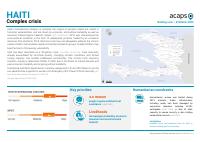
HAITI
Complex crisis
Briefing note – 23 March 2020
I THIN
Haiti’s humanitarian situation is complex: the origins of people’s needs are rooted in
historical vulnerabilities, and are driven by economic and political instability as well as
recurrent meteorological hazards’ impact (CFR 12/03/2018). 2019 was characterised by
socio-political instability in the form of widespread protests, fuelled by an economic
downturn that started in 2018. Short-term aid may not adequately address the chronic
nature of Haiti’s humanitarian needs, and certain population groups, notably children, may
bear the brunt of increasing vulnerability.
Haiti has been described as a “forgotten crisis” (UN CERF 13/12/2019). Food insecurity,
already exacerbated by structural poverty, changing climatic conditions, and limited
coping capacity, has notably challenged communities. The chronic food insecurity
situation is likely to deteriorate further in 2020, due to the threat of natural hazards and
past economic instability and ongoing political instability.
Grand’Anse and West departments, currently categorised in Crisis (IPC Phase 3), are the
two departments projected to worsen into Emergency (IPC Phase 4) food insecurity (IPC
Haiti Acute Food Insecurity Analysis 31/10/2019).
(At right: Map of Haiti, OCHA 2019)
Key priorities
4.6 million
people require multisectoral
assistance (HNO 2020)
Livelihoods
increasingly stunted by economic
downturn and environmental
hazards
Humanitarian constraints
Humanitarian access was limited during
2019
protests.
Public
infrastructure,
including roads, has been damaged by
successive disasters including 2010’s
earthquake (HNO 2020). A lack of state
capacity to ensure security is also limiting
humanitarian access (HNO 2020).
Limitations
Available fiscal and statistical data for Haiti is
limited, including data on criminality.
Any questions? Please contact us at info@acaps.org
ACAPS Briefing Note: Complex crisis in Haiti
Crisis overview
goods, or reducing their number of daily meals (IPC Haiti Acute Food Insecurity Analysis
31/10/2019) (FEWS NET 31/01/2020).
Historical information
The growing food insecurity is driven by 2019’s economic instability and by ongoing
political instability, as well as factors including drought and water scarcity, which has
resulted in low crop yields in the recent past.
Haiti’s complex crisis is driven by underdevelopment of critical infrastructure, as well as
a lack of political and economic stability, and entrenched poverty, factors resulting in
extensive vulnerability. Many of these factors are connected to Haiti’s history.
Haiti was established as a Spanish colony, part of Hispaniola island that now also
comprises the Dominican Republic, in 1492 (BBC Haiti Profile 2019). The island’s western part
(Haiti) was ceded to France in 1697 (BBC Haiti Profile 2019). Slavery was a common practice
on the island for centuries, mainly used in the production of sugar. In 1801 Toussaint
Louverture, a former slave, led a rebellion and gained control over the country, abolishing
slavery (BBC Haiti Profile 2019). France forced Haiti to pay reparations, totalling USD 22 billion
in today’s terms, as a condition for recognition (CFR 12/03/2018) and Haiti paid these debts
over 120 years, at some points accounting for 80% of its national revenue. Some have
suggested this debt repayment disrupted industrialization, policy and institutional
development, and economic investment in the country (CFR 12/03/2018). Haiti was then
successively occupied by foreign countries, and subject to wealth extraction and
exploitation. Corruption and capital flight remain major issues in Haiti.
The country is very exposed to a number of sudden-onset natural hazards, further
challenging its economic and institutional development. The earthquake that struck the
country on 12 January 2010 killed 220,000 Haitians and displaced 1.5 million (CFR
12/03/2018) (UN SG 01/2020). The shallow earthquake notably affected the densely-populated
capital of Port-au-Prince, and, due to poor infrastructure, caused widespread destruction
(Columbia University 2010). The UN Peacekeeping mission, active after the earthquake, was
later identified as the origin of a cholera outbreak which affected more than 800,000
people over the next decade (PAHO 01/2020). Another notable hazard was 2016’s Hurricane
Matthew which killed 600 people (Abella et al., 2020) and led to widespread destruction of
housing, infrastructure, and livestock, particularly in Grand’Anse and Sud departments
(The Guardian 7/10/2016) (CFR 12/03/2018).
Drivers of the current crisis & outlook
Growing food Insecurity: IPC projections for March to June 2020 estimate that ongoing
socio-economic difficulties will push 4.1 million people, or 40% of Haiti’s population, into
Severe food insecurity (Phase 3 and above), including 1.2 million at Emergency level
(Phase 4) (IPC Haiti Acute Food Insecurity Analysis 31/10/2019). This is an increase of close to
1,800,000 people compared to estimates for March -June 2019 (IPC Haiti Acute Food Insecurity
Analysis 01/10/2018). Households currently living in food insecure conditions have been
pushed to adopt negative coping strategies such as consuming low quality food, selling
Poverty and income inequality: 25% of Haiti’s population live below the poverty line (under
$1.90 a day) (UNESCO Haiti Country Page 2020) (IPC Haiti Acute Food Insecurity Analysis 31/10/2019).
Additionally, 40% of Haiti’s population has access to less than 6% of the country’s income,
whilst the richest 2% control 26% of the national wealth (Food Security Portal, last accessed
11/02/2020). Haiti has a historical pattern of inequality, currently ranking number 4 on the
GINI Index, which measures the inequality in the distribution of family income in the
country (measured through the use of information from 2012, at latest) (CIA Factbook last
accessed 11/02/2020) (World Bank Country Profile 2015).
Some analysis suggests that households living in poverty and constrained by income
inequality may face more limited opportunities for investment and income diversification,
key to building household financial resilience (J. Stiglitz 2012). Haitians’ coping capacity and
resilience continue to be strained by poverty and inequality, and a large portion of the
population is extremely vulnerable to sudden onset crises or even to slight shifts in
market prices, as demonstrated by the widespread protests in 2018 (The New Humanitarian
13/01/2020) (J. Stiglitz 2012).
Economic instability: The ongoing economic downturn is driven by many interacting
factors, including low economic growth, civil unrest, and currency inflation, compounding
increasingly dire food access issues: over 2019, the price of basic food items such as
rice, beans, and sugar has increased by 34% (The New Humanitarian 13/01/2020). Additionally,
foreign direct investment has fallen, and the country’s 12-month growth rate was
estimated at 0.1%, the lowest since 2010 (IPC Haiti Acute Food Insecurity Analysis 31/10/2019). The
government has imposed drastic cuts to social programmes and capital investments,
while expensive energy subsidies remain ongoing (HNO 2020); Haiti was formerly
dependent on Venezuelan subsidized fuel (Venezuelan oil-funded development funds
specifically, known as Petrocaribe) leading to high levels of public debt (CFR 16/10/2019).
The International Monetary Fund’s attempts at restructuring the debt included cutting
energy subsidies, which would have resulted in oil prices increasing by 50% overnight in
2018 (CFR 16/10/2019).
However, Haitian households live in extremely vulnerable conditions and lack financial
flexibility: These reforms were abandoned after widespread protests in the summer of
2018 broke out against prices increases (Al Jazeera 08/07/2018) (CFR 16/10/2019). The
provision of Venezuelan oil was stopped in 2014 (Time 24/06/2019) forcing Haiti to buy oil
at the international standard rate – resulting in shortages for core infrastructure
2
ACAPS Briefing Note: Complex crisis in Haiti
(AlterPresse 03/09/2019) as Haitians cannot pay international standard market rates for
petrol without international subsidies such as those previously provided by Venezuela.
Additionally, economic activity was hampered by protests, and people’s access to
services and basic goods became increasingly restricted as shops were closed, roads
blocked, and traders unable to import or export goods (NPR 31/12/2019). Already limited
medical infrastructure was further restricted by road inaccessibility, leading to medicine,
water, and oxygen shortages (HNO 2020).
Since August 2018, Haiti’s gourd currency has been subject to a sharp depreciation – it
lost 17.4% of its value against the dollar over the course of 2019 (OCHA 16/12/2019), leading
to inflation and a reduction in the purchasing power of most Haitians. Recent drought
conditions in 2018/2019 had a notable impact on inflation, due to poor harvests resulting
in low food stocks (HNO 2020). Further depreciation of the gourd is expected in the
upcoming lean season (a time between the fall and the spring harvest, from March to
June, that is also associated with food deficits) (IPC Haiti Acute Food Insecurity Analysis
31/10/2019).
Households currently living in food insecure conditions have been pushed to adopt
negative coping strategies resulting in asset erosion, although income diversification
activities, like coal collection, may mitigate the effects of high food prices (IPC Haiti Acute
Food Insecurity Analysis 31/10/2019).
Political instability: Haiti’s history has included a succession of foreign interventions,
disrupting efforts to establish national policies (CFR 12/03/2018). US occupation and control
over the country’s security and finances, lasting from 1915 to 1934, was characterised
by human rights violations, forced labour policies and press censorship. The U.S.supported dictatorship of Francois Duvalier and his son, starting from 1957 and lasting
until 1986 with a popular uprising against “Baby Doc”, the son, was characterised by
human rights violations and corruption (New Yorker 06/10/2014). The most recent President,
Jovenel Moise, was elected amid opposition fraud allegations in 2016, leading to an
interim government until early 2017 when second elections confirmed his victory. He has
recently been at the center of embezzlement allegations. Haiti’s prospects for alleviating
corruption may be limited: Haiti is ranked 159 out of 176 countries on Transparency
International’s latest Corruption Perceptions Index, one of the lowest rankings in the
world (Transparency International Corruption Perceptions Index 2016).
Protests over the course of 2019 paralysed the country. They were triggered in July 2018
when structural reforms were pushed by the IMF in reaction to Haiti’s debt for Venezuelan
oil. The reforms were reversed when protests broke out. Despite this, protests continued
after a legislative commission supported corruption findings for officials like Moise,
including embezzlement of Venezuelan oil-funded development funds (known as
PetroCaribe), and accused state agencies of interference in the investigation, charges
Moise has denied (NPR 31/12/2019) (The Economist 18/02/2020). The then-national parliament
passed a motion of no confidence for the removal of the government headed by Prime
Minister Céant, leading to dissolution of the national legislature (HNO 2020). This resulted
in the absence of a government-approved national budget for the second year in a row, a
dearth of public sector financing, and a lack of government support for humanitarian and
development projects (The New York Times 16/10/2019) (The Economist 18/02/2020) (HNO 2020).
Since March 2019 there has been no functioning legislature in Haiti although there may
be a prospective date for elections (UN SC 13/02/2020) (The Economist 18/02/2020); President
Moise is currently ruling by decree as the mandates for lower house and several upper
house parliamentarians expires in January, although a Prime Minister has been
nominated although not ratified (UN SC 13/02/2020). Negotiations between Moise and
opposition groups are reportedly ongoing, although he has struggled in the past to form
a coalition, naming four prime ministers since his ascension to power in 2017 (The
Economist 18/02/2020) (Haiti Libre 09/02/2020).
The protests constrained access to basic services and resulted in a loss of livelihoods,
restricting economic activity across the country and the political deadlock hampered
humanitarian responses. For responders, preparation for the 2019 June-November
cyclone season was restricted, as the Direction for Civil Protection (Direction de la
Protection Civile, or DPC, in French), humanitarian agencies’ primary state-level partner,
had few resources and provided limited support
This may have placed many
more people at risk of being inadequately prepared in case of a cyclone. Financing gaps
notably resulted in no reconstruction for buildings damaged by the October 2018
earthquake (HNO 2020).
Underlying variables of the crisis
Environmental hazards: Haiti is subject to many different and often compounding
meteorological hazards having a range of economic and social effects. Much of Haiti’s
population lives along the coast, bearing the brunt of sudden and protracted hazards,
such as rising sea-levels (HNO 2020). Haiti is also subject to periodic droughts, most
recently between 2018 and 2019 (HNO 2020), and the whole country remains vulnerable
(HNO 2020).
Haiti is located on a geological fault line and is subject to earthquakes, which often have
high death tolls and cause widespread destruction (Columbia University 2010). It is also
situated along a seasonal hurricane path, from August to November (HNO 2020) (World Bank
2017) (NHC NOAA Last accessed 13/02/2020).
Widespread deforestation and other environmental degradation have left much of the
country prone to flooding, soil erosion, mudslides, and the drying up of rivers (HNO 2020).
3
ACAPS Briefing Note: Complex crisis in Haiti
Climate change and an increase in global average temperatures mean Haiti is likely to be
affected by an increasing number of hurricanes and other meteorological hazards (Abella
et al., 2020). Overall, casualty rates in Haiti after natural hazards are high indicating the high
vulnerability of Haiti’s population (World Bank 2017).
Underdeveloped infrastructure: Haiti lacks city planning and building codes, resulting in
the proliferation of informal housing and infrastructure (World Bank 2017) (CFR 12/03/2018)
(Abella et al., 2020). Large populations are settled in flood zones, placing them at risk of
flooding and flooding-related health and WASH hazards (World Bank 2017).
Humanitarian impact
Food & livelihoods: Food needs are high across the country. 2019’s protests disrupted
livelihoods and compounded already-restricted access to food caused by high prices,
inflation, and low crop yields, pushing vulnerable households into increasingly difficult
economic circumstances (The New York Times 16/10/2019) (IPC Haiti Acute Food Insecurity Analysis
31/10/2019). Haiti is additionally highly dependent on food imports, another factor of
vulnerability in case trade is disrupted leading prices rises (CSS 09/02/2017).
Human rights violations: Human rights violations, often involving state security forces
(The Economist 18/02/2020) put pressure on local people and hamper their daily lives.
Accusations include arbitrary detention, torture, targeted violence against the press and
civil society, impunity, and forced labour (HNO 2020). Although figures vary, up to 200
people, including police officers, may have died during the protests and security forces
are known to have fired live ammunition (The Economist 18/02/2020).
Although Haiti also produces food, this production is fragile. Agricultural production in
2019 dropped by 12.3% compared with 2018 due to climatic shocks including drought
(IPC Haiti Acute Food Insecurity Analysis 31/10/2019). Alongside the direct effect this has on food
stocks, this has led to significant losses for households dependent on agriculture for their
livelihoods – of the country’s employed people, 63% of Haitian men and 34% Haitian
women work in agriculture, indicating the significance that abrupt environmental
changes can have for people of working age (World Bank last accessed 11/02/2020).
Additionally, subsistence farmers and their families, who depend on their yields for food
and gain little to no profit from their own farming, have been heavily impacted. Yields in
Nord and Nord-Est are believed to have been limited by ongoing disruptive weather (FEWS
NET 31/01/2020).
It is unclear whether Haiti’s human rights situation will change without further focus on
political accountability and without further support to civil society.
Urban households have also seen the erosion of their livelihoods (including employment
and assets) over recent years due to meteorological and political-economic shocks.
Gang violence: Violence is pervasive in Haiti, and in 2019 Haiti saw high rates of common
criminality, kidnappings, hijackings, and robberies (UN SC 13/02/2020). Violent attacks by
gang members was also common, however there is a lack of reliable information on its
extent and severity (OSAC 2019) although recent figures on hospital admissions in the Portau-Prince area for persons with violence-related wounds, such as gun-shot wounds, have
been high (MSF 06/03/2020). Gangs control drug and arms trades and extort local
communities. Some human rights groups have suggested that gangs may be affiliated
with different political actors, gaining leverage from and providing illicit services to those
in power (Freedom House 2019) (Thomas Reuters Foundation 10/12/2019). Although gangs were
active across the country in the past, price hikes, a lack of investment in social
infrastructure, and a proliferation of small arms in the context of increased protests may
have driven a spike in activity (HNO 2020). Some reports suggest that the reduced presence
of security forces following the departure of the UN Stabilization Mission (known by its
French acronym MINUSTAH) in 2017 could be linked to an increase in violent incidents
Vulnerable households across the country require food assistance to cope with food
scarcity, price increases, and livelihood erosion (see map on page 6) (IPC Haiti Acute Food
Insecurity Analysis 31/10/2019). Markets however are functioning across the country,
permitting a stable source of access to food except in Croix-des-Bossales in the Port-auPrince area (IPC Haiti Acute Food Insecurity Analysis 31/10/2019).
There is a severe lack of healthcare services and infrastructure across the country: only
31% of Haitians have access to healthcare services (HNO 2020). If unaddressed, the
underdevelopment of basic services and reliable physical and state infrastructure will
continue to exacerbate needs, especially after sudden-onset crises.
(Thomas Reuters Foundation 10/12/2019).
Health: Health infrastructure is limited and underfunded, with few qualified personnel; it
does not cover the needs of the whole country (HNO 2020). During protests, vital medicine,
oxygen, and fuel supplies were held up at roadblocks, and many hospitals cut their
services or closed (The New York Times 16/10/2019).
Malaria, diphtheria, and measles are common pathogens. Caseloads are aggravated by
severe shortages in healthcare infrastructure, medication shortages, a low vaccination
rate, and nation-wide WASH limitations (HNO 2020). A cholera epidemic which had affected
over 800,000 people since 2010 was controlled in 2019, and no confirmed cases have
since been reported, although the risk of outbreak remains (PAHO 01/2020).
Haiti’s Global Acute Malnutrition (GAM) rates are the highest in the northern hemisphere;
in 2018, half of Haiti’s population was considered to be undernourished (WFP 2019), and
4
ACAPS Briefing Note: Complex crisis in Haiti
this may increase in the IPC’s projected March-June 2020 period for areas in Emergency
(IPC Phase 4) (IPC Haiti Acute Food Insecurity Analysis 31/10/2019) (Orrico et al. 2019). Malnutrition
plays an aggravating effect on overall health, exposing malnourished people to other
illnesses, which can worsen malnutrition (HNO 2020).
WASH: Around 26% of Haiti’s population does not have access to an improved source of
water (40% in rural areas) (HNO 2020). Access to clean water sources has dropped
significantly since 1990 (The Economist 18/02/2020), and WASH infrastructure, particularly in
rural areas, is often not maintained (HNO 2020). The origin of the cholera outbreak that
spread from 2010 onwards has been identified as UN Peacekeeper camp waste that was
discharged directly into the Meille river, a primary source of water for many communities
(National Geographic 18/08/2016) – indicative of the structural lack of resources available and
the vulnerability of inhabitants.
Only 14% of households in Haiti have access to water in-house, indicating that most
Haitians must travel to some degree to meet their household WASH needs. This may
pose protection risks especially to women and girls (HNO 2020).
Shelter and NFIs: Infrastructure and housing development is very poor in Haiti, notably
around urban centres where slums are common. Across the country many Haitians live
in “self-produced” housing, built with little technical expertise, posing a danger to
households (Abella et al., 2020).
Investment in housing and shelter is also lacking. Houses damaged since Hurricane
Matthew (2016) are reportedly still damaged. Populations living in informal shelters are
especially vulnerable to the effects of sudden-onset natural hazards.
Protection: Civilian protection violations, including gender-based violence, are often
related to criminal violence. Some reports suggest there has been an increase in violent
incidents since the departure of the UN stabilization mission in 2017 and peacekeeping
mission at the end of 2019 (Thomas Reuters Foundation 10/12/2019) as local police forces are
reportedly undertrained, underfunded, and susceptible to corruption (The Economist
18/02/2020). Incidents were also reported during the 2019 protests, including gang
violence.
Another protection issue in Haiti is the high number of children forced into labour, with
an estimated 225,000 to 500,000 children exploited (PADF 13/01/2013) (The Conversation
08/05/2019), mostly girls; many work in hazardous conditions and are often subject to illtreatment and neglect. Research suggests that many of these children come from
destitute families who are promised that their children will attend school and earn a living,
indicating that poverty may be a driver of protection violations and exploitation (The
Conversation 08/05/2019); There has also been a reported increase in kidnappings since
January 2020, echoing “kidnapping sprees” of previous years and reportedly targeting a
range of Haitian civilians, although some cases have been contested (Miami Herald
13/02/2020).
Education: Two out of ten children in Haiti do not attend primary school (WFP 2019); other
estimates place 320,000 school-age children in Haiti as not attending school (HNO 2020).
Additionally, 100,000 children are estimated to be attending non-rehabilitated schools,
placing them at risk in the case a sudden-onset hazard affects their school (HNO 2020).
Many schools in Haiti were closed due to protests and only 60% of schools have
reopened since the protests ended at the end of 2019 (The New Humanitarian 13/01/2020).
Vulnerable groups affected
People living in public institutions, such as orphanages, hospitals, and penitentiary
centres, may be especially affected by Haiti’s political and economic instability, and may
bear the brunt of further cuts to public spending – notably in access to WASH
infrastructure and food provisions (HNO 2020). Other vulnerable groups include
subsistence farmers as well as the urban poor, who may face increased humanitarian
needs resulting from their precarious livelihoods’ situations. Women and children may be
especially vulnerable to the effects of the complex crisis.
The Haitian diaspora in the Dominican Republic is also under particular pressure after the
passing of recent laws stripping the children of undocumented persons of their legal
status (PBS 06/04/2019). Human rights groups have stated that the laws are racist and
specifically target persons of Haitian descent (PBS 06/04/2019). Many have been forced to
return to Haiti and live along its border; an estimated 9,000 people per month since 2015
have voluntarily or been forcibly returned from the Dominican Republic, according to rare
estimates of their numbers (HNO 2020). They often do not receive support or follow-up
related to their reintegration and access to basic services although their numbers are
unclear (HNO 2020). Returnees without livelihoods or resources, and those living in informal
camps along the border may be especially vulnerable to hazards and economic
conditions.
Humanitarian and operational constraints
Many operational constraints for NGOs exist in Haiti. Humanitarian personnel have been
threatened by criminal violence as well as protest groups. NGO compounds were also
deliberately attacked in 2019 (MSF 07/07/2019). After the departure of the UN stabilization
mission, the UN Humanitarian Air Service (UNHAS) has ensured transport for the
humanitarian community, but lack of financing means their support may not last into
2020. This has the potential to further restrain humanitarian access and operations (HNO
2020).
5
ACAPS Briefing Note: Complex crisis in Haiti
A lack of road infrastructure and poor maintenance of existing ones, particularly in rural
areas, has limited access for humanitarian workers and people in need (HNO 02/2019).
Roadblocks and barricades have limited access in the recent past, notably during times
of protest (HNO 02/2019); protests have inhibited civilians’ access to basic services, as well
as schools and businesses (Al Jazeera 06/2019).
Local and national response capacity
Petrol/fuel shortages are a major challenge faced by civilians, public services, and
humanitarian actors, which hampers both response and coping capacity (HNO 02/2019).
National Response bodies, including the DPC’s Centre for Emergency Departmental
Operations (or Centres d’Opération d’Urgence Départementaux in French) are limited by
funding inadequacies and communication gaps (HNO 2020). Many of these bodies do not
have sufficient electricity or fuel, access to clean water, or pre-positioned contingency
stocks (HNO 2020). The State’s WASH institution, DINEPA, requires further support to train
personnel in response planning (HNO 2020). The government has promised a national fooddistribution programme, although it is unclear when this would start (The Economist
18/02/2020).
Volunteer-led municipal civil protection committees (or Comités Communaux de
Protection Civile, or CCPCs, in French) have been active in recent years ensuring quick
reaction times and response planning after sudden-onset disasters (Abella et al., 2020). They
have been associated with a reduction in the loss of lives after sudden-onset hazards.
Other early warning tools have been established in the country in the years following the
2010 earthquake, including forecasting workstations (WMO 2017). A national website
publishing daily meteorological updates exists and is open to the public although it is not
available in Creole, the language spoken by the majority of Haiti’s population (Bulletin Météo
Haiti en Ligne, last accessed 13/02/2020). In effect, Haiti’s early warning systems continue to face
challenges (Abella et al., 2020)
International response capacity
UN bodies operate in country. A large number of INGOs working in development and in
humanitarian and livelihoods response are present across the country, notably in the
Port-au-Prince area (OCHA Physical Presence document 07/10/2019). Nonetheless aid flows have
been, historically, inconsistent and reactive primarily to political events and there have
been criticisms against NGOs for their lack of accountability, particularly after the 2010
Earthquake (The Guardian 15/04/2015). Furthermore, short-term humanitarian aid may not
cover the needs of what has become a chronically complex crisis (The Intercept 22/10/2019)
(World Bank Country Profile 2015).
6
ACAPS Briefing Note
Projected Food Insecurity (IPC Phases) in Haiti’s
Departments
Source: Projected IPC phases for March – June 2020, IPC Acute Food Insecurity Analysis
7
Comment citer
Assessment Capacities Project (ACAPS), Note d'information ACAPS : Haïti, crise complexe, 23 mars 2020, https://acaps.org/fileadmin/Data_Product/Main_media/20200323_acaps_briefing_note_complex_crisis_in_haiti_0.pdf