Texte Intégral du Document
Texte extrait du document original pour l'indexation.
HAITI
Earthquake - Artibonite, North and North-West departments
Briefing note – 12 October 2018
Any questions? Please contact our senior analyst, Alex Odlum: ao@acaps.org
A magnitude 5.9 earthquake struck Haiti on 6 October, and was followed by a
magnitude 5.2 aftershock on 7 October and a magnitude 4.2 aftershock on 8 October.
The departments affected by seismic activity were Artibonite, North and North-West.
So far, 17 people have died and at least 421 have been injured. The earthquakes
destroyed 353 houses and damaged 7,430. An estimated 31,132 people were affected,
although needs assessments are still being completed.
Considering the presence of UN agencies, the scale of pre-positioned aid and the
reported response by the government as well as national and external relief actors, the
need for international assistance and the impact are estimated at low to moderate.
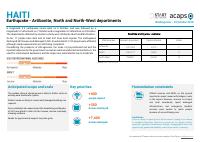
Fatalities and Injuries - overview
Affected areas Resident population People affected Killed
Artibonite
1,727,524
8,712
7
North 1,067,177 2,420 0
North-West 728,807 20,000 10
Source: DPC 08/10/2018
Anticipated scope and scale Key priorities Humanitarian constraints
The sudden influx of injured people is likely to further strain an
already weak healthcare system.
Shelter needs are likely to remain until damaged buildings are
repaired.
Some residents who experienced the devastating earthquake
of 2010 are afraid to return to their houses, and are reportedly
sleeping outdoors.
Needs for psychosocial support may also grow.
+400
people injured
Official sources and NGOs on the ground
reported no major issues with bridges, roads
or the airport. However, sources in at least
one rural community report damaged
infrastructure, and emergency medical
services were unable to reach people
because of an overflowing river.
+350
homes destroyed
+7,400
homes damaged
Limitations
There is a delay in reporting from official sources, leading to the release
of outdated information. Reports by sources on the ground conflict,
especially regarding infrastructural damage. Disaggregated data with
regard to age, gender and disability, as well as per sector, is missing.
ACAPS Briefing Note: Earthquake in Haiti
2
Crisis impact
On Saturday 6 October at 20:12 local time, a magnitude 5.9 earthquake struck Haiti. The
epicentre was about 19 km northwest of Port-de-Paix, at a depth of 11.7 km . The
following day, at approximately 15:00 local time, a magnitude 5.2 aftershock occurred .
The epicentre of the aftershock was 15.7 km north-northwest of Port-de-Paix and had a
depth of 10 km . On Monday 8 October at 01:04 local time, a magnitude 4.2, aftershock
struck north of Tortuga Island. The Haiti DPC (Directorate of Civil Protection) did not issue
a tsunami alert.
The departments of Artibonite, North- West (including Tortuga Island) and North were
affected. The latest figures released by the Haiti Directorate of Civil Protection (DPC)
(updated on Monday 8 October at 13:00) show that 17 fatalities were recorded and at
least 421 people were injured across the three departments. Search-and-rescue
operations ended on 8 October, with no reported case of missing people or displacement
(OCHA 06/10/2018, OCHA 09/10/2018, Telegraph 08/10/2018, Tribune 08/10/2018) .
Department Town (Commune) Deaths People Injured
Artibonite Gros-Morne 7 118
Artibonite Terre-Neuve 0 4
Artibonite Gonaïves 0 20
North Borgne 0 1
North Cap-Haïtien 0 14
North Grand-Rivière 0 0
North Plaisance 0 4
North Pilate 0 15
North Quartier Morin 0 0
North-West Port-de-Paix 9 200
North-West Saint Louis du Nord 1 25
North-West Bassin Bleu 0 20
Total 17 421
Source: (DPC 08/10/2018)
Shelter is the most pressing need for people affected by the earthquakes. Some 31,132
people (7, 783 households) need urgent shelter assistance, due to the total or partial
destruction of their houses. Overall, 353 houses were destroyed, while 7,430 were badly
or lightly damaged. Initial assessments in predominantly urban areas found 729 people
were living in shelters
(
CWS 11/10/2018). The breakdown of residential houses destroyed or
damaged is as follows, as recorded by the DPC up to 8 October at 13:00
(DPC 08/10/2018,
UN 2017)
.
Department Town (Commune) Houses
destroyed
Houses
damaged
People affected
(HH affected)
Artibonite Gros-Morne 115 2,050 8,660 (2,165)
Artibonite Terre-Neuve 8 0 32 (8)
Artibonite Gonaïves 0 5 20 (5)
North Borgne 2 16 72 (18)
North Cap-Haïtien 0 0 0
North Grand-Rivière 1 15 64 (16)
North Plaisance 6 30 144 (36)
North Pilate 57 476 2,132 (533)
North Quartier Morin 1 1 8 (2)
North-West Port-de-Paix 163 4,836 19,996 (4,999)
North-West Saint Louis du Nord 0 0 4 (1)
North-West Bassin Bleu 0 0 0
Total 353 7,430 31,132 (7,783)
Source: (DPC 08/10/2018)
Health: Earthquake casualties were taken to hospitals in the North- West, Artibonite and
North departments. In Port-de-Paix, the hardest -hit Haitian city, medical personnel at the
Immaculate Conception Hospital reported they were struggling to treat the wounded and
were running out of the supplies needed for treatment. In Gros -Morne, parts of a hospital
collapsed
(
DPC 08/10/2018) .
On 8 October, a local official said many of the people injured in Pilate couldn’t get to
emergency medical services because of an overflowing river
(Miami Herald 08/10/2018) .
Food: Local media sources reported that affected people need food and supplies (News
Press 12/10/2018)
. On 11 October, local authorities of Port -de-Paix said the distribution of
food kits that was taking place was insufficient to respond to the needs of the population
(AlterPresse 11/10/2018) . The food security situation in Haiti was fragile before the
earthquakes. The last IPC report classified 1.32 million people as severely food insecure
in early 2018
(OCHA 01/2018) . Late but good rains in July and August meant that most of
the affected departments were in IPC Phase 1 or 2 in September, and were projected to
remain so until January 2019
(FEWS NET 09/2018). However, populations still recovering
from drought in 2015/16 and recent hurricanes – including Matthew, Irma and Maria,
which affected agricultural livelihoods in the northern departments of Haiti – and local
ACAPS Briefing Note: Earthquake in Haiti
3
fishers, who lost all their equipment, including boats engines and fishing nets , remain
susceptible to shocks
(OCHA 01/2018) . The earthquakes hit in the middle of the land
preparation and planting season, and could have longer lasting impacts on agriculture
and food security.
WASH: Haiti continues to recover from a cholera outbreak that caused 447 deaths in 2016
and 159 deaths in 2017, as well as 35 deaths in the first seven months of 2018. A n upward
trend in the number of suspected cases was observed in April and May, with localised
outbreaks due to heavy rains
(ACAPS 2018) . A robust and timely response that covers the
provision of safe drinking water and sanitation facilities is critical to control the spread of
cholera
(WHO 01/02/2018) .
Education: According to DPC, 42 institutional buildings (schools, churches and others)
were damaged across Artibonite (DPC 08/10/2018) . In Gros-Morne, several classrooms of
the San Gabriel National School were severely damaged, interrupting educational
activities for around 500 students
(Telegraph 08/10/2018) . In Pilate (North department), four
national and private schools were destroyed. On 11 October, local authorities of Port-de-
Paix and Plaisance said educational activities were paralysed in the two communes
(AlterPresse 11/10/2018) .
Vulnerable groups affected
Children, older people and people with disabilities are particularly vulnerable to
earthquakes, as they are slow to react and to move to safe environments. Protection
concerns arise in temporary shelters, especially for girls and women
(CFE-DM 06/2018) .
More than 37,000 people are still living in IDP camps following the 2010 earthquake, and
are in need of protection and WASH assistance, as they lack access to drinking water and
sanitation facilities and risk violence and exploitation. They are more likely than the
general population to be affected by new disasters
(OCHA 01/2018, AlterPresse 12/01/2018) .
Humanitarian and operational constraints
The Haiti DPC as well as some local sources reported that there had been no major
damage to bridges, roads or the airport following the earthquakes
(DPC 08/10/2018, CWS
11/10/2018)
. However, other sources reported damage to local infrastructure, such as in
Pilate, a rural community
(Miami Herald 08/10/2018) .
With the three affected departments having a large population living in rural settings, it is
likely that response will be delayed in remote or hard-to-reach areas.
In Port-de-Paix, the police station was reported damaged ( North-West department),
potentially hampering the response if the security situation deteriorates
(DPC 08/10/2018) .
According to local media reports, a food kit truck was attacked and looted in Montrouis
(south of Saint Marc, Artibonite department) overnight between 10
–11 October (Haiti Libre
12/10/2018).
Aggravating factors
Healthcare system
According to the 2018 HRP, concerns include a generally weak health system at organisational and structural level, and persistent difficulties regarding access to
healthcare in some communes, particularly isolated areas. Haiti is not well prepared to
respond to disaster situations, despite its high exposure to natural disasters and
epidemics
(OCHA 01/2018) .
Type of housing/infrastructure
Haitian officials have struggled to shore up buildings despite the two major fault lines
along Hispaniola, which is the island that Haiti shares with the Dominican Republic. Deep
poverty remains one of the main reasons that weak homes and structures vulnerable to
earthquakes have not been reinforced
(Telegraph 08/10/2018) .
Population density
Dense populations are at risk of higher death tolls and injuries in earthquakes. According
to data from 2016, Haiti has the 28
th
highest population density in the world, at 398 people
per sq.km
(World Bank 2016) . The population of Port-de-Paix, where considerable damage
occurred, is higher than the national average, with 420 people per sq.km
(IHSI 2015) .
Internal displacement
Official reports covering events up to 9 October did not mention displacement, but local
media reported such instances on 10 October. A local source said the earthquakes had
caused people to leave Port-de-Paix, with some moving to rural regions, either because
their houses were too seriously damaged or because they feared more aftershocks
(Catholic Register 10/10/2018) .
2010 earthquake
Most of the population ex perienced the 2010 earthquake, which caused the death of
more than 220,000 people. Trauma of the event remains. In Gros-Morne, it was reported
that many residents are sleeping in the outdoors, as they are afraid of more aftershocks
(Catholic Register 10/10/2018) .
By early 2018, 37,667 IDPs remained displaced from the 2010 earthquake. Most
IDPs registered in 26 camps in Ouest department are in communes in the metropolitan
ACAPS Briefing Note: Earthquake in Haiti
4
area of Port-au-Prince, with others in Leogane and Gressier. More than 45% (17,000
people) of the IDPs still live in camps in areas at risk of flooding and landslides. Besides
being vulnerable to new natural disasters, the IDPs are in need of protection and WASH
assistance as they lack access to drinking water and sanitation facilities and are at risk
of violence and exploitation. Any influx of new IDPs to the camps is likely to exacerbate
current needs
(ACAPS 2018) .
Hurricanes Matthew, Irma and Maria
Hurricane Matthew, a Category 4 hurricane, struck Haiti on 4 October 2016, affecting 2.1
million people. Two hurricanes threatened the country in September 2017: Irma
(Category 5) and Maria (Category 3), which both passed the northern coast of Haiti. The
hurricanes brought torrential rains, strong winds and rising tides that caused
considerable damage, including in the departments of North -West and Artibonite. Homes
were destroyed and the agricultural sector, the main source of income in rural
communities, was affected
(OCHA 01/2018) . The October 2018 earthquakes are likely to
have affected victims of the hurricanes, adding to their needs.
Key characteristics
Key indicators (IHSI
2015)
North-West North Artibonite
Total population
728,807 1,067,177 1,727,524
% population in rural
areas
72.06% 49.5% 57.17%
Gender distribution of
population
Male: 361,310
Female: 367,497
Male: 524,433
Female: 542,744
Male: 854,910
Female: 872,614
Overall PIN (HRP 2018)
111,000
93,000
760,000
Response capacity
Local and national response capacity
DPC leads operational coordination with the support of national entities as well as the
international community. The overall coordination of the response is under the authority
of the P rime Minister in close liaison with the Office of the President
(OCHA 09/10/2018) .
The National Emergency Operations Centre remains partially activated. Communication
is maintained with the hierarchy of the National Risk and Disaster Management System,
with the Departmental Emergency Operations Centre involved in the response
(OCHA
09/10/2018)
.
As of 9 October at 09:00, the Haiti government was developing a response plan focusing
on the shelter recovery needs of the affected, evaluating buildings in the North- West, and
clearing and cleaning works in Gros-Morne (Artibonite). Schools were expected to be
assessed on 9 October. Additionally, the Ministry of Defenc e sent a contingent of 14
soldiers to Port de Paix (North-West) and Gros Morne (Artibonite) for clearing and
cleaning works. A second contingent of 70 soldiers was on standby
(OCHA 09/10/2018) . The
Ministry of Education had assessed affected schools and was identifying relocation and
psychosocial support solutions for affected children
(OCHA 09/10/2018) .
The Haiti Red Cross had, as of 8 October, activated its national and North- West branch
Emergency Operations Centre, and was coordinating with the DPC and the regional
disaster management committees in each department. A medical team and 35 blood
bags were sent to North-West department. Thirty volunteer were providing first aid in
Port-de-Paix; 10 first aid personnel were mobilised in Gonaives
(IFRC 09/10/2018)
International response capacity
By 9 October, OCHA announced it was collaborating with the DPC to collect information
and ensure the implementation of coordination mechanisms. Representatives of t he
Haitian government and the international community met on 8 October to discuss the
situation. The key ministries, the DPC, a mbassadors, the Special Representative of the
UN Secretary General (SRSG), the Deputy Special Representative of the UN Secretary
General/Resident Coordinator/Humanitarian Coordinator DSRSG/RC/HC and UN h eads
of agencies and CLIO representatives (NGO coordination platform) attended the meeting
(OCHA 09/10/2018) .
According to the OCHA Situation Report of 7 October, some UN agencies are ready to
respond (UNICEF, WHO in North-West; IOM, WFP, UNICEF in Artibonite; IOM, WHO,
UNICEF and WFP in North). Stocks already pre-positioned include 2,000 shelter kits in
Cap-Haitien and Port-au-Prince, as well as 2,260 metric tons of food. WASH stocks are
available in North, North- West and Artibonite departments. Staff and cars are available to
support rapid assessments
(OCHA 07/10/2018) .
On 9 October, EU ECHO announced it was monitoring the situation, having deployed two
technical experts to Haiti to support needs assessments and coordination. The EU's
Copernicus Emergency Management Service was activated on 8 October to produce
satellite maps to assess the extent of the damage (
ECHO 09/10/2018)
ACAPS Briefing Note: Earthquake in Haiti
5
On 9 October, the Pan American Health Organization (PAHO) announced it was
evacuating people by helicopter, having also sent surgeons to the field, while two PAHO
teams were conducting assessments and distributing emergency kits (
PAHO 09/10/2018).
Caritas Haiti announced on 10 October that it was distributing emergency food supplies,
sanitation kits, tents and shelter materials as well as solar lamps, shovels and
wheelbarrows to the affected population
(Catholic Register 10/10/2018) .
Cuban authorities sent two mobile surgical teams to affected areas of northwest Haiti on
7 October to assist Haitian healthcare workers
(Miami Herald 08/10/2018) .
Information gaps and needs
• Although official sources did not report on internal displacement, local media sources
did report that displacement was taking place. Concrete information is missing about
the level of displacement (if any) and the capacity of the receiving areas to cope with
any influx.
• Information is scarce regarding damage to roads and other infrastructure. On 8
October, media cited local officials as saying the local infrastructure in Pilate had
been destroyed, but gave no details
(Miami Herald 08/10/2018) . Such information has not
been reported on by the DPC.
• Information is missing on WASH needs of the people affected
• The full extent of damage has not yet been reported as assessments continue and
some areas are difficult to access .
Lessons learned
Humanitarian access after the 2010 earthquake was reportedly difficult in mountain
areas, in Grande’Anse, Ouest, Sud-Est, Centre and Artibonite
(Deseret News 25/05/2011).
Following the 2010 earthquake, coordination and leadership were challenges from the
outset. It is necessary to ensure that key experienced staff are in place and supported,
and that operational protocols are established early on
(DAC 06/2011) . Conversely, closer
cooperation with local actors, the UN and security forces has facilitated rapid and
efficient food distribution in the past
(HPN 08/2010).
A high population density can be leveraged to improve distribution operations (water,
food, NFI)
(ACF 19/03/2009).
It is important to improve capacity building, coordination and advocacy when addressing
post-disaster psychological issues, and to facilitate the participation of the affected
people
(IOM 2010).
Haiti still has a limited ability to cope, recover and adapt to shocks from natural disasters.
The increased frequency and magnitude of disasters in recent years highlight the need
for greater focus on disaster risk reduction and for more durable preparedness measures
to be put in place
(OCHA 01/2018).
ACAPS Briefing Note: Earthquake in Haiti
6
Haiti – Reference Map
Source: OCHA