Description Complète
L'unité Analyse et cartographie de la vulnérabilité du Programme alimentaire mondial publie ce bulletin de suivi des marchés pour Haïti. Cette édition couvre août 2025.
Le panier alimentaire national coûte 24 203 gourdes en août, 2 pour cent de plus que les 23 784 relevés en juillet. Par rapport à août 2024, le coût est inférieur de 10 pour cent, ce que le bulletin attribue à une meilleure disponibilité alimentaire après la troisième récolte de maïs et de riz. La baisse nationale ne vaut pas partout : les Nippes, le Sud et le Sud-Est enregistrent des hausses allant jusqu'à 4 pour cent sous l'effet des prix locaux.
Dans la zone métropolitaine de Port-au-Prince, le panier coûte 25 349 gourdes, contre 25 875 en juillet, mais reste supérieur de plus de 5 pour cent à la moyenne nationale, ce que le bulletin lit comme une pression persistante sur le pouvoir d'achat urbain. Sur l'ensemble des produits suivis, les prix sont pour la plupart stables ou en baisse ; le riz, en hausse de 9 pour cent, et l'huile végétale font exception.
La disponibilité sur les marchés enquêtés est globalement satisfaisante. Le haricot rouge fait de nouveau exception, rare ou absent en particulier dans les Nippes, le Nord et le Nord-Ouest. Les commerçants détiennent en moyenne 12 jours de stock, de quoi couvrir la demande des ménages jusqu'au réapprovisionnement suivant, les stocks les plus élevés étant signalés dans le Centre, l'Ouest et le Nord-Ouest. Vingt-quatre pour cent des commerçants déclarent une rupture de stock dans le mois, surtout de haricots, et citent le manque de liquidités pour financer le réapprovisionnement comme contrainte principale. Les blocages routiers et les pratiques d'extorsion continuent de perturber la circulation des marchandises entre départements.
Pour le quatrième mois consécutif, les prix des denrées de base restent relativement stables dans la plupart des départements, soutenus par une meilleure disponibilité des produits locaux.
Texte Intégral du Document
Texte extrait du document original pour l'indexation.
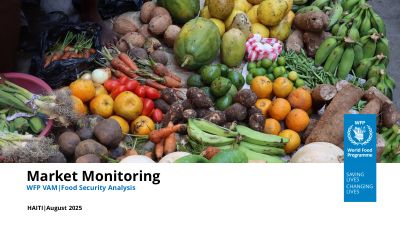
Market Monitoring
WFP VAM|Food Security Analysis
HAITI|August 2025
�Key Highlights
❑ National Food Basket Cost: A 2% monthly increase was recorded, rising from HTG
23,784 in July to HTG 24,203 in August. However, compared to August 2024, the cost
reflects a 10% annual decline, largely attributed to improved food availability following
the third harvest of maize and rice.
❑ Departmental Trends: Despite the national decline, localized increases of up to 4%
were observed in the departments of Nippes, Sud, and Sud-Est, driven by rising prices
of key commodities in these areas.
❑ Metropolitan Area of Port-au-Prince: The food basket cost stood at HTG 25,349 in
August, marking a slight decrease from HTG 25,875 in July. Nonetheless, it remains over
5% higher than the national average, underscoring continued pressure on urban
household purchasing power.
❑ Commodity Price Movements: Most monitored food items showed stable or
declining prices. Notable exceptions include rice, which rose by 9%, and vegetable oil,
which saw a modest increase.
❑ Market Availability: Overall, food products remained broadly available across
surveyed markets in August. However, red beans continue to be scarce in several
locations, indicating persistent supply constraints for this essential staple.
�Food availability-August 2025
Share of traders reporting food shortages
Overall, food availability across surveyed markets remained generally
satisfactory throughout August. A notable exception was red beans, which
continued to be scarce or unavailable, particularly in the departments of
Nippes, Nord, and Nord-Ouest.
Traders held on average only 12 days of stock, just enough to meet
household demand until the next restocking cycle. Retailers in the Centre,
Ouest, and Nord-Ouest departments reported higher stock levels than
those in other regions.
Additionally, 24% of traders reported stockouts during the month, primarily
Source: WFP, 2025
Variation compared to July
affecting beans. Among those who experienced shortages, the main
constraint cited was a lack of liquidity to finance restocking operations.
Persistent structural challenges continue to hinder supply chains, notably
road blockages and extortion practices, which disrupt the smooth flow of
goods across departments.
Source: WFP, 2025
�Price trends for staple foods – Août 2025
Average food prices per kilogram by department (in haïtien gourdes)
For the fourth consecutive month, staple food prices have remained
relatively stable across most departments, largely supported by
improved availability of locally produced goods.
Despite
ongoing
challenges
affecting
the
interdepartmental
movement of goods, major wholesalers have implemented adaptive
strategies, maintaining an average stock coverage of 12 days to sustain
supply chains, ensuring continued access to essential food items for
small retailers and households.
This price stability was particularly evident for wheat flour, ground
maize, sugar, and beans. However, two notable increases were
Price trends for products monitoring over the year
recorded:
700
Rice: +9%
600
1400
500
1200
Vegetable oil: +2%
1600
1000
400
800
300
600
200
400
100
200
0
0
Wheat flour (1kg)
Black Beans (1kg)
Maize meal (1kg)
Red Beans (1kg)
Rice (1 kg)
Vegetable Oil (1 gal)
Sugar (1kg)
�Food Basket Cost Trends– August 2025
In August, the median cost of the food basket for a household of five
reached HTG 24,203, continuing a trend of stability or slight decline
observed over the past four months. This represents a moderate
increase of HTG 412 compared to July’s figure of HTG 23,784.
At the departmental level, a decrease in food basket costs was
recorded across most regions. However, localized increases were
observed in Nippes and Sud-Est (both +4%), as well as in the Sud
(+3%), reflecting rising prices for several key food items in these areas.
In the Metropolitan Area of Port-au-Prince, the food basket cost
rose by HTG 324 in July compared to June, before declining by HTG
525 in August to settle at HTG 25,349. Despite this reduction, the cost
remains above the national average, indicating continued pressure
on urban household purchasing power.
�Description of Methodological approach of market monitoring
The methodology used is the same as that of the Joint Market Monitoring Initiative (JMMI) for
harmonization purposes with the system of other actors in the Cash Transfer Working Group (CWG ).
• Data are collected through face-to-face interviews with five traders per product on the market. A total
of 413 traders across 69 markets are surveyed .
• Ten (10) departments are covered by the data collection, with a focus on the Metropolitan Are .
•
minimum of four (4) markets per department were selected based on their level of importance .
Choice of foodstuffs and data collection units.
The selection of food items included in the food basket is based on the Minimum Expenditure Basket
(MEB).
It focuses on seven (7) staple products that make up the typical food basket of Haitian households,
taking into account the energy needs of a five-person household (with a daily energy requirement of
2,100 kilocalories
• Wheat flour (30 kg); Rice (20 kg); Ground corn (10 kg); Sugar (3 kg); Black beans (10 kg); Red beans (10
kg); Vegetable oil (1.5 gallons) .
• Data collection is conducted on a monthly basis.
• Data collection tools: Mobile Operational Data Acquisition (MODA) – WFP Data Collection Platform
Limitations and Challenges.
The limited availability of certain traders, especially wholesalers during periods of high demand or
specific products in certain markets due to the security situation, may have hindered the ability to reach
the planned sample sizes in some areas, thereby reducing the accuracy of the estimates .
PAM | Haïti
Wanja KAARIA, Country Director
Erwan RUMEN , Deputy Country Director
Technical Team:
Telesphore OUEDRAOGO, Head of RAM unit
Wilfried CHIGBLO, VAM officer
Kendy MASSENA, VAM Associate
Samuel BEAUSEJOUR, GIS Associate
Contact : telesphore.ouedraogo@wfp.org
@WFP_Haiti
�