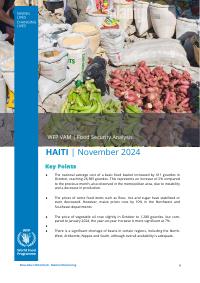
Description Complète
Ce bulletin de suivi des marchés VAM du PAM couvre octobre 2024. Le coût moyen national d'un panier alimentaire de base a augmenté de 411 gourdes (2 pour cent) pour atteindre 26 385 gourdes, une hausse également observée dans la zone métropolitaine, attribuée à l'instabilité et à une baisse de la production. Les prix de la farine, du riz et du sucre se sont stabilisés ou ont baissé, mais le maïs a augmenté de 10 pour cent dans les départements du Nord-Ouest et du Sud-Est, et l'huile végétale a légèrement augmenté à 1 280 gourdes, soit une hausse de 7 pour cent en glissement annuel par rapport à janvier 2024.
Une pénurie importante de haricots a persisté dans le Nord-Ouest, l'Artibonite, les Nippes et le Sud, bien que la disponibilité globale soit restée adéquate ; 62 pour cent des commerçants interrogés ont signalé une pénurie de produits alimentaires en octobre, principalement de haricots et de riz, attribuée au mauvais état des routes, au pouvoir d'achat limité, aux fortes pluies et à la dépendance aux importations des États-Unis et de République dominicaine qui a réduit la disponibilité des produits d'origine locale comme le maïs.
Au niveau départemental, le Nord a enregistré des baisses de prix de 5 pour cent tandis que l'Ouest a chuté de 4 pour cent, alors que le Sud-Est et les Nippes ont connu des hausses de 7 pour cent et 6 pour cent respectivement. La méthodologie de fonctionnalité des marchés du bulletin reprend celle de l'Initiative conjointe de suivi des marchés utilisée par le Groupe de travail sur les transferts monétaires, s'appuyant sur des entretiens en face à face avec 282 commerçants dans 57 marchés des dix départements.
Texte Intégral du Document
Texte extrait du document original pour l'indexation.
Market Monitoring
WFP VAM | Food Security Analysis
HAITI | November 2024
Key Points
The national average cost of a basic food basket increased by 411 gourdes in
October, reaching 26,385 gourdes. This represents an increase of 2% compared
to the previous month, also observed in the metropolitan area, due to instability
and a decrease in production.
The prices of some food items such as flour, rice and sugar have stabilized or
even decreased. However, maize prices rose by 10% in the Northwest and
Southeast departments.
The price of vegetable oil rose slightly in October to 1,280 gourdes. but compared to January 2024, the year-on-year increase is more significant at 7%.
There is a significant shortage of beans in certain regions, including the NorthWest, Artibonite, Nippes and South, although overall availability is adequate.
Octobre
2024|
Haiti - Suivi
de marchés
November
2024|Haiti
Market
Monitoring
1
�AVAILABILITY
Throughout October, many retailers faced shortages of
food, particularly beans. These supply chain disruptions
were caused by a combination of factors, including poor
road conditions, limited purchasing power and heavy
rains, which hampered transport and market operations.
In addition, reliance on imports from the US and the Dominican Republic reduced the availability of locally produced goods, such as maize.
Source: WFP, 2024
PRICE TRENDS FOR STAPLE FOODS
Prices remained largely stable between September
and October, with the exception of maize, red beans
and vegetable oil, which rose by 10%, 4% and 1% respectively. Notably, black bean prices remained stable
despite the limited availability of beans in some mar-
Source: WFP, 2024
kets.
Average food prices per kilogram by department (in Haitian Gourdes)
Department
Weat flour
Rice
Maize
Sugar
Black Beans
Red beans
Vegetable oil
Centre
175
-18%
240
- 7%
217
+ 5%
241
0%
417
- 2%
583
+33%
1150
+11%
Artibonite
188
- 3%
231
0%
168
- 3%
207
-11%
458
+10%
599
- 4%
1200
+12%
Nippes
200
0%
212
+10%
217
+11%
250
+ 7%
458
+10%
531
+ 2%
1476
+15%
Nord
225
- 5%
231
- 8%
196
-10%
207
-14%
500
- 6%
604
0%
1119
+ 2%
Nord-Est
263
0%
250
- 7%
217
- 5%
241
0%
510
+ 2%
625
+15%
1160
+ 7%
Nord-Ouest
188
0%
231
0%
174
0%
207
0%
417
0%
625
0%
1150
+ 6%
Ouest
200
-20%
231
0%
326
+ 7%
207
0%
417
0%
536
+ 3%
1134
+ 7%
Sud
200
0%
231
+20%
174
-20%
241
0%
417
- 9%
625
+ 3%
1279
0%
Sud-Est
325
+ 3%
231
0%
250
+64%
284
- 6%
417
0%
542
+13%
1279
0%
Grand’Anse
200
- 6%
231
0%
217
- 9%
259
0%
417
-11%
792
+41%
1250
- 1%
increase
decrease
Stable
November 2024|Haiti - Market Monitoring
�Price trends for products monitored over the year
EVOLUTION OF THE FOOD BASKET
Despite the difficult security situation, the average cost of a food basket rose by 2% in October to
26,385 gourdes. While the North and West recorded price decreases of 5% and 4% respectively, the
Southeast and Nippes experienced more significant increases of 7% and 6%. To cope with these
changes, retailers are adjusting their strategies by sourcing from nearby departments.
Variation in the Cost of the Food Basket (National and ZM PAP)
Cost of food basket from January to November 2024, National and in Port-au-Prince Metropolitan Area
November 2024|Haiti - Market Monitoring
�Graph 1 : Monthly Variation of the Food Basket Cost
Graph 2 : Annual Variation of the Food Basket Cost
Octobre
2024 |
Haiti - Suivi
de marchés
November
2024|Haiti
Market
Monitoring
4
�Methodology
The methodology used is the same as that of the Joint Market Monitoring Initiative (JMMI), for
reasons of harmonisation with the system used by other actors in the Cash Transfer Working
Group (GTTM).
•
Data is collected through face-to-face interviews with 05 traders per product in the market.
In total, 282 dealers from 57 markets were interviewed.
•
10 divisions were covered by the data collection, with a focus on the metropolitan area. A
minimum of four (4) markets per department were selected due to their importance.
Selection of products and observation units
The selection of food products that make up the food basket is based on the Minimum
Expenditure Basket (MEB). It includes seven (7) basic products that make up the ICSM basket,
taking into account the energy requirements of a household of five (5) persons (energy
requirement of 2100 kcal).
•
Wheat flour (30 kg); Rice (20 kg); Maize (10 kg); Sugar (3 kg); Black beans (10 kg); Red beans
(10 kg); Vegetable oil (1.5 gallons).
Data are collected monthly.
Tools : Mobile Operational Data Acquisition) - WFP Data Collection Platform.
Limitation and field challenges
The lack of availability of certain traders, particularly wholesalers during periods of high demand,
or of certain products in certain markets, due to the security situation, may have hampered the
achievement of the planned coverage in certain areas and therefore might affect the accuracy of
the estimates.
PAM | Haïti
Wanja KAARIA, Country Director
Erwan RUMEN , Deputy Country Director
Technical Team:
Smaila GNEGNE, Head of RAM unit
Wilfried CHIGBLO, VAM officer
Kendy MASSENA, VAM Associate
Contact : smaila.gnegne@wfp.org
@WFP_Haiti
Octobre
2024|
Haiti - Suivi
de marchés
November
2024|Haiti
Market
Monitoring
5
�