Texte Intégral du Document
Texte extrait du document original pour l'indexation.
[page 1]
% Global Network
Z Against Food Crises
# INTEGRATED ACTIONS FOR LASTING SOLUTIONS
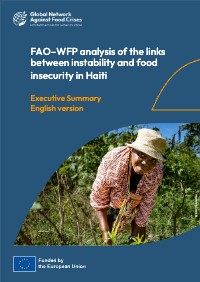
FAO-WFP analysis of the links
between instability and food
insecurity in Haïti
Executive Summary
English version
«***, | Funded by
DR the European Union
[page 2]
Disclaimer
This study was produced by FAO and WFP within the framework of the joint programme "Fulfilling the mandate of
the Global Network against Food Crises — a Game Changer" funded by the European Union. The study is part of a
series of analytical products produced under the Global Network Against Food Crises initiative contributing to the
generation and sharing of consensus and evidence-based information for preventing and addressing food crises.
This translation was created by the Technical Support Unit of the Global Network Against Food Crises. FAO, WFP,
and any other of the Global Network Against Food Crises’ partners are not responsible for the content or accuracy
of this translation. The original French edition shall be the authoritative edition.
[page 3]
Executive summary
Background and objective of the study
Very high levels of food insecurity and political upheavals, together with widespread
social unrest and outbreaks of violence, are endemic in Haiti and mutually sustaining.
This study was sponsored by the Haitian humanitarian food security sector, with the
support of the Global Network Against Food Crises, to better understand the interplay
between rural development and food and nutrition insecurity, on the one hand, and
recurrent sociopolitical crises on the other. It aims to inform national planning processes
and identify the conditions for political engagement with the stakeholders involved
in agricultural development and food and nutrition security in Haïti. It is nationwide in
scope and covers a variety of considerations, providing context and a starting point for
programming that will make provision for the conflicts and focus on specificities with a
greater degree of granularity.
Study context
The study was carried out while the country's political, socioeconomic and security situation
was deteriorating sharply. The assassination of President Jovenel Moïse in July 2021,
followed by an earthquake on the southern peninsula in August, had ushered in a period
of extraconstitutional governance, with the rise of armed gangs, and acute humanitarian
crisis. The food emergency in Haiti is among the ten most serious in the world.
Structural factors of fragility in Haïti
Haiïtis chronic protracted crises are attributable to rifts and weaknesses that date
back to the early days of the republic. The underlying factors of fragility are deeply
embedded in contemporary Haïitian society and highly topical. No social contract of
the kind that binds citizens to each other and to a legitimate and responsible state has
ever been entered into. Haïti remains characterized by strong social stratification, weak
governance and insufficient social cohesion at every level. Those persistent conditions
for structural violence underpin a fierce competition for resources and status, where
coercion and the use of force for political, economic or criminal ends are widespread.
The deepest fault line in Haïti is the opposition between farmers and the urban
authorities, which places the agrifood system at the centre of conflicting identities and
aspirations. Rural farm workers have long occupied a lower-ranking position. Spatial
segregation is a determinant of the sociopolitical order, with the cities, especially
Port-au-Prince, having become the places where power and wealth are concentrated.
[page 4]
i
SR p”? + n
| fl y | Al » j
> eg < il Nr œ €
f | ÿ #: À —— ITS # < A
nm Liomgas D 24 ES: 4 Mg, LE
D an A ie 2 Es DU nn 0)
Over time, the exploitation and neglect of rural areas has caused a gradual decline in
agricultural productivity, which now stands at among the lowest in the world. That has
led to a mass migration from the countryside to the informal neighbourhoods of urban
areas that represent pockets of extreme vulnerability and, hence, places of conflict and
criminality fuelled in part by gang violence.
Haïti remains deeply divided and inegalitarian. According to estimates from the World
Bank, the most well-to-do 20 percent of the population owns more than 64 percent
of the country's wealth, while the poorest 20 percent have barely 1 percent! À small
economic elite controls the strategic economic sectors, including food exports and
imports. For the seven million or so people living on USD 2.41 or less per day, life is a
struggle for dignity and security. The Haïitian Government has been unwilling and unable
to provide marginalized populations with protection and basic services. Institutionalized
corruption is a drain on public resources and seeps into every trading relationship,
fostering opportunistic behaviours and a weakening of social ties. Meanwhile, the local
solidarity networks that have long represented a source of resilience in rural society
are gradually disintegrating as a result of economic and environmental pressures. À
profound lack of legitimacy is the main obstacle to a general agreement that could lift
the country out of the current crisis.
Haïitians also have an unshakeable feeling of foreign interference in their domestic
affairs, to the country's detriment. Many national actors would prefer the international
community's role to be less directive. That raises the question of Haitis heavy
dependence on international aid as a result of its persistent instability and serious
humanitarian situation. Food aid and business practices are hotly contested in Haiti,
fuelling narratives on foreign domination that are undermining the country's quest for
self-determination.
1 https://www.worldbank.org/en/country/haiti/overview#1
[page 5]
The agrifood system bears the hallmarks of the conflicts of interest and values inherent
to Haïitis continuing fragility, the role of agriculture in its national development trajectory
being a fundamental source of tension. The prevailing model of the past few decades
has been an outward-looking policy favouring trade in food products and investment in
large agribusiness enterprises. That approach, however, has not brought greater gains
in terms of livelihoods and food security for the rural and urban poor.
Rapid trade liberalization in the 19905 did not improve access to food: the monopolistic
structure of the food trade with respect to imported goods has kept the price of imported
staples higher than in the rest of the Latin America and the Caribbean region. At the same
time, the already fragile state of agricultural livelihoods in Haiti has deteriorated further,
With imports of cheaper — often subsidized — food leading to a reduction in domestic
production. While demographic and environmental change may have contributed to the
decline in productivity, it is trade policy choices that lie at the heart of grievances linked to
injustices in the food system.
Largely self-sufficient in the 19805, Haiti today is incapable of meeting the domestic
demand for food items. The resulting bottomless trade deficit and weak currency have
contributed to spiralling food inflation, further aggravated by global supply shocks.
Despite significant efforts to promote larger-scale commercial operations and integrate
farmers into high value-added supply chains, agricultural produce accounts for just
a small share of Haitian exports. The competitiveness of the international market is
a drawback, as is the reluctance of farmers to accept changes in land use and crop-
growing models, which is a key driver of conflict. Such changes are regarded as carrying
the threat of greater dependence between Haitian and the foreign interests mistrusted
by farming populations.
— Vi : m2
Q& L .
EL 4 +
\ : s _’
\ sc à / :
4 ne — É s "
3 re mt -
2 ,
©
[page 6]
ÿ La
£ ET
> "T
a À PRE
Min « ù |
à. Les
È
Ë
ff
Farmers have long survived with the help of informal microproduction and food-barter
arrangements placing a premium, first and foremost, on self-reliance and resilience.
They regard small-scale farming as a lifestyle with deeply held social and environmental
values, in keeping with the food sovereignty model. Resistance to the concentration of
control over land, seeds and water and the commercialization of food contribute to their
misgivings about, inter alia, the large-scale investment projects promoted by the Haitian
Government and a share of the international community. Developed in a context where
land tenure governance ensures neiîther security of tenure nor social and environmental
safeguards, those projects are criticized for the travelling and deterioration in livelihoods
that is involved.
Generally adverse structural conditions, especially in the Haïtian food system,
constitute a permanently high risk of conflict and violence. Food-related conflicts are
often localized and concern disputes over plots of land or fruit trees, for instance; in
emergency situations they are reflected in disruptions in the distribution of food aid.
In spite of the absence of systematic monitoring, and even though their impact at the
individual level is limited, those localized conflicts are globally considered to occur
frequently enough to chill investment, erode social cohesion and diminish food security
on an increasingly significant scale.
The conflicts include attacks on, or the appropriation by force of, productive assets
such as land and water. Gang violence in urban areas and in the rice-growing Artibonite
region directly targets food system infrastructure, such as irrigation canals, markets
and warehouses. In 2021; the distribution of food from the countryside to the capital
was disrupted by gang warfare and roadblocks on strategic transport routes, damaging
livelihoods for farmers and traders and limiting the delivery of aid to vulnerable persons
affected by the crisis. The gangs also use food as a tool to recruit new members,
including women and children, and to force communities living in desperate economic
conditions into submission.
[page 7]
Food insecurity is a powerful symbol of wider grievances about the cost of living in Haiti
(lavichè or la vie chère), triggering mass protests that have had major political and economic
ramifications over the past few decades. Those upheavals have, in turn, had an impact
on the functioning of the food system and on the population's level of food security.
Transform the structural conditions in Haiti's food system:
use a national framework to initiate change
There is repeated criticism and disapproval of the place of agriculture and food security
in national programmes. The policies appear not to have been properly embedded in an
integrated rural development approach, managed at the national level; they are regarded
as a reflection of social constructs that exclude and discriminate against rural interests,
as well as of the State’s disdain for the conditions of the majority of poor citizens. The
national policy and strategy for food sovereignty, food security and nutrition in Haïti
(PSNSSANH) represents a major step forward and a promising new framework within
which to develop a model to make amends for the injustices and strengthen a nascent
social contract through interventions in the agrifood sector.
LES É > ' à a) e Œ 23 L] TAPIS < DH? Le ' ri
CR LAN), DUR ENG R
SLR Wir, , A \— PAS ( De --E
AE ee A" € Ms. (7 nn | ISsr
rh NS { = = = \ CARE
»'E@ > MTS : pi wma meer pe WT AUS
PET SAT EN BEN a “À ec RSS =
ASE PA) » T , At ki DL e— ‘EH SSSSSS
s Fe Ar f NV — - - nes (::|
MS "ONE L ‘a | er ES ———— | ee
AVE gs £ = "À À > N
4 $ | { 2 N # : — Rs — + À |
#7 à _ © = — CE —— Ë
214 | | — / DEEE — NY NS _ 3 LE, À
4 | i à ner — My a + 01 7 Le
; er D ———/ dr À « »°
ca RE & EUSO À.
REA 11 PAT. 7 CR
Ce RS , : [us < 20
Re } ! = 1 msn EE
ie ï ne MNINS
+ = L Lor-« 00 < PR — "à 4 j »
= 7 D"
© — 4 en
[page 8]
The PSNSSANH policy and strategy seeks to regain the ability to take action, adopting
food sovereignty as a core principle and reasserting the value of Haïtian assets and
traditions. It relies on small-scale family farming and the national food sector to revive
the overall economy and stimulate job creation. In addition to a dramatic adjustment to
agrifood and investment policies, it is introducing a new, sectoral, style of governance
aimed at seeking consensus among the key stakeholders.
The national policy and strategy was approved before the assassination of the
president. Its implementation presents some significant challenges in terms of
leadership, the political will, stakeholder alignment and the capacity to embrace a
transformation of the food system. In the longer term, responsibility for the changes
will lie with the Haïitians themselves. The support of the international community is
nonetheless crucial, not only for its sector-specific technical expertise but also in order
to manage conflict and establish extensive consultations on the sensitive issues under
consideration.
Development partners could draw on the work under way to design the approaches and
actions needed to create momentum for the policy and strategy and restore the national
food system to a more equitable footing:
1. Raising awareness among decision makers, other key stakeholders and the general
public of the national policy and strategy as a basis upon which to reform the food
industry;
2. Mapping and evaluating more fully the stakeholders in order to structure the
consultations and maximize their chances of success by, inter alia, classifying
the issues, identifying the areas where agreements might be easier to reach and
deferring more sensitive sectors until a later stage;
3. Building confidence in the activities of the international community by increasing the
provision of local food commodities through aid programmes as a sign of support for
Haiïtis agriculture-based economy and national interests;
4. Strengthening social cohesion within communities and among food system actors
through consultations and the introduction of sustainable income-generating
activities at the local level, with genuinely representative management structures
and operational networks. Those efforts would also serve to strengthen the local
partnerships and knowledge that help to minimize conflict and abuse in post-crisis
humanitarian operations. United Nations agencies have a great deal of experience with
such local initiatives in Haïti.
[page 9]
Le Global Network
71 Against Food Crises
INTEGRATED ACTIONS FOR LASTING SOLUTIONS
The Global Network Against Food Crises:
@& www.fightfoodcrises.net
Follow on X:
X @fightfoodcrises
YouTube:
@ Global Network Against Food Crises
The European Union, FAO and WFP founded the Global Network Against Food
Crises at the 2016 World Humanitarian Summit to step up joint efforts to address
food crises along the humanitarian-development-peace nexus and continue
to raise global awareness and commitment from all relevant actors. The Global
Network offers a coherent coordination framework to promote collective efforts in
analysis and strategic programming for more efficient use of resources to prevent,
prepare for and respond to food crises and, ultimately, support collective outcomes
related to SDG 2 for lasting solutions to food crises.
Through its work, the Global Network Against Food Crises facilitates a fundamental
transformation in the way international and local actors interact to holistically
address food crises worldwide.
Members:
REA Food and Agriculture Panne
dE Organization of the USA D
Eu United Nations SUP” mom THE AMERICAN PEOPLE
TA
VA N World Food