Description Complète
Haïti fait face à une crise économique et humanitaire qui s'aggrave avec un PIB en baisse de 2,6% au premier semestre de l'année fiscale 2025, causée par l'expansion de la violence des gangs, l'instabilité politique et la détérioration des conditions sécuritaires. Le territoire contrôlé par les gangs s'est considérablement étendu, déplaçant 1,3 million d'Haïtiens d'ici juin 2025 et aggravant une crise humanitaire déjà sévère. L'agriculture a subi la plus forte contraction à -5,8%, exacerbant l'insécurité alimentaire qui touche plus de la moitié de la population.
L'environnement des affaires reste sévèrement contraint par la capture de l'État, des institutions faibles et des défis sécuritaires. La suspension des vols commerciaux américains et les fermetures intermittentes de frontières avec la République dominicaine ont davantage isolé le pays. Malgré des politiques monétaires et fiscales restrictives, l'inflation s'est accélérée à 28,4% en juin 2025, menée par les prix alimentaires (31,5%) et les coûts du logement (43,9%). Le déficit du compte courant s'est légèrement élargi en raison de l'augmentation des importations, bien que les solides afflux de transferts de fonds aient apporté un certain soutien.
Pour l'avenir, le PIB devrait se contracter de 2,0% en 2025 avant qu'une croissance modeste ne reprenne en 2026, conditionnellement aux améliorations de la stabilité politique et des conditions sécuritaires. Les taux de pauvreté continuent d'augmenter, avec environ 48,7% des Haïtiens vivant avec moins de 3,00$/jour en 2025, contre 42,2% en 2021. Le Conseil présidentiel de transition composé de neuf membres fait face à des défis pour organiser les élections prévues fin 2025 dans un contexte de contraintes sécuritaires.
Les perspectives demeurent très incertaines et dépendent de manière critique du succès de la transition politique et des améliorations sécuritaires. Les priorités clés incluent le renforcement de l'environnement des affaires, l'expansion de la protection sociale, l'amélioration de la gestion des risques de catastrophe, et la mise en œuvre de politiques fiscales et monétaires appropriées pour traiter l'inflation et soutenir la croissance.
Texte Intégral du Document
Texte extrait du document original pour l'indexation.
HAITI
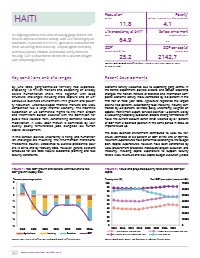
An ongoing political crisis and increasing gang violence con-
tinue to depress economic activity, with GDP declining by an
estimated 2.6 percent in H1FY25. Agriculture contracted the
most, worsening food insecurity. Despite tighter monetary
and fiscal policies, inflation accelerated, led by food and
housing. GDP is projected to decline for a seventh straight
year, deepening poverty.
Key conditions and challenges
By June 2025, gang-controlled territory had expanded,
displacing 1.3 million Haitians and deepening an already
severe humanitarian crisis. This, together with deep
structural challenges including state capture and an un-
conducive business environment limit growth and pover-
ty reduction.Underdeveloped financial markets and weak
competition fuel a large informal economy. The indefinite
suspension of US commercial flights to the main airport
and intermittent border closures with the Dominican Re-
public have isolated Haiti, constraining domestic resource
mobilization. A weak labor market is dominated by low-
quality, poorly remunerated jobs, alongside low human
capitaldevelopment.
In this context, political uncertainty is rising, and humanitar-
ian challenges are mounting. The nine-member Transitional
Presidential Council,established to exercise presidential pow-
ers, is set to end by February 2026. However, general elections
scheduled for late 2025 require substantial planning and face
securityconstraints.
Population
1
Poverty
2
million millions living on less than $3.00/day
11.8 4.1
Life expectancy at birth
3
School enrollment
years primary (% gross)
64.9 ..
GDP
4
GDP per capita
5
current US$, billion current US$
25.2 2142.7
Sources: WDI, MFMod, and official data. 1/2024. 2/2012 (2021 PPPs). 3/2023.
4/2024. 5/2024.
Recent developments
Economic activity weakened due to expanding gang control in
the Centre department, political discord, and abrupt leadership
changes. The Haitian Institute of Statistics and Information com-
posite economic activity index contracted by 2.6 percent in the
first half of fiscal year 2025. Agriculture registered the largest
decline (-5.8 percent), exacerbating food insecurity. Industry con-
tracted by 4.5 percent, as trade policy uncertainty weighed on
apparel, Haiti’s main export. Services declined 1.4 percent, led by
a weakening hospitality subsector. Despite strong remittances in-
flows, the current account deficit (CAD) widened by 0.1 percent
of GDP from a balanced position in the same period in 2024, as
importstickedup.
The bleak business environment contributed to weak tax rev-
enues, estimated at 3.5 percent of GDP at the end of Q3FY25.
Recurrent expenditures have performed according to the budget
plan. Capital expenditures, however, have been constrained by
weak procurement processes, inadequate project execution, and
insecurity, including capital expenditure to support security
forces. Weak revenues and slow capital budget execution yielded
FIGURE 1 /Real GDP growth and sectoral contributions to real
GDP growth (supply side)
-5
-4
-3
-2
-1
0
1
2
2018201920202021202220232024e
Agriculture Industry ServicesGDP
Percent, percentage points
Sources: Haiti Statistical Office (IHSI) and World Band staff calculations.
FIGURE 2 /Actual and projected poverty rates and real GDP per
capita
0
10000
20000
30000
40000
50000
60000
70000
0
10
20
30
40
50
60
70
80
90
100
20122014201620182020202220242026
International poverty rateLower middle-income pov. rate
Upper middle-income pov. rateReal GDP pc
Real GDP per capita (constant LCU)Poverty rate (%)
Source: World Bank. Notes: See footnotes in table on the next page.
Macro Poverty Outlook / October 20251
a small fiscal surplus estimated at 0.1 percent of GDP by Q3FY25.
Tight monetary policy, and strong remittance inflows eased pres-
sure on the gourde, which appreciated 1.3 percent against the US
dollar over the first nine months of the fiscal year. Against this
backdrop, the current account registered a deficit of 0.07 percent
ofGDPduringH1FY2025.
Inflation reached 28.4 percent by June 2025, up from 25.3 percent at
the outset of the fiscal year in October 2024 as security conditions
worsened.Inflation was led by higher food prices (31.5 percent in
June 2025) and housing and electricity (43.9 percent in June). More
than half of Haiti’s population faced high levels of acute food inse-
curity in the March to June 2025 period, and an estimated 8,400
displaced people are experiencing catastrophic hunger. The share
of Haitians living on less than US$3.00/day 2021 PPP is estimated to
have increased from 42.2 percent in 2021 to 48.7 percent in 2025.
Outlook
GDP is forecast to contract 2.0 percent in 2025 owing to uncertainty
about the political process, insecurity, an unconducive business en-
vironment, and receding private consumption. Modest GDP growth
is expected by 2026 as investment increases from a low baseline,
assuming marginal improvements on the political and security
fronts. Uncertainty around the renewal of preferential access to
US textile markets may further depress textile exports in the near
term. Exports are forecast to accelerate in 2026, contingent on
reaching a trade agreement with the United States. The share of
Haitians living on less than US$3.00/day 2021 PPP would fall from
48.7 percent in 2025 to 47.3 percent by 2027, if GDP returns to
growth over the medium term.
The current account deficit (CAD) is expected to narrow in 2025
supported by resilient remittances inflows, widening in subsequent
years as imports pick up with modest GDP growth. Increased gov-
ernment spending ahead of planned elections is expected to con-
tribute to inflationary pressure in 2025, moderating over the medi-
um term if security conditions relax supply constraints.With elec-
tion spending, the fiscal deficit is expected to reach 0.8 percent in
2025. Tax revenue may gradually improve over the medium term
as a new general tax code goes into effect and tighter customs
controlsareimplemented.
The path ahead remains fraught with downside risks and depends
on an effective political transition and improvements in security. A
credible budgetary framework and an appropriate mix of fiscal and
monetary policy will remain key to reducing inflation and strength-
ening growth prospects. Inclusive growth will require strengthen-
ing the business environment, expanding social protection, and en-
hancing the institutional framework for disaster risk management,
including better preparedness and response systems.
Recent history and projections 2021/22 2022/23 2023/24 2024/25e2025/26f2026/27f
Real GDP growth, at constant market prices -1.7 -1.9 -4.2 -2.0 2.0 2.5
Private consumption -0.7 0.1 -5.2 -4.6 1.6 1.1
Government consumption 17.6 3.3 1.6 35.0 7.4 2.0
Gross fixed capital investment -9.9 -17.6 -36.3 -16.8 20.0 60.5
Exports, goods and services 2.4 -9.6 -31.9 -15.3 5.5 6.1
Imports, goods and services 4.9 -0.4 -16.2 1.0 6.5 7.3
Real GDP growth, at constant factor prices -1.8 -3.6 -4.4 -2.0 2.0 2.5
Agriculture -4.5 -5.6 -5.6 -3.2 1.0 2.0
Industry -0.4 -3.8 -4.7 -0.6 2.5 3.4
Services -1.6 -2.9 -3.9 -2.2 2.0 2.2
Employment rate (% of working-age population, 15 years+) 55.8 55.8 55.4 55.4 55.4 55.4
Inflation (consumer price index) 27.6 44.2 25.8 28.1 19.5 12.0
Current account balance (% of GDP) -2.4 -2.6 -0.6 -0.4 -0.8 -1.4
Net foreign direct investment inflow (% of GDP) 0.2 0.1 0.2 0.2 0.1 0.1
Fiscal balance (% of GDP) -3.2 -2.1 -0.1 -0.8 -0.5 0.1
Revenues (% of GDP) 6.6 7.4 6.0 6.2 6.7 7.2
Debt (% of GDP) 26.6 24.8 15.0 15.0 15.7 15.5
Primary balance (% of GDP) -2.9 -1.8 0.2 -0.6 -0.3 0.4
International poverty rate ($3.00 in 2021 PPP)
1,2
43.5 44.6 47.1 48.7 48.3 47.3
Lower middle-income poverty rate ($4.20 in 2021 PPP)
1,2
62.5 64.2 66.4 67.7 67.3 66.8
Upper middle-income poverty rate ($8.30 in 2021 PPP)
1,2
89.5 90.0 91.5 92.1 91.9 91.5
GHG emissions growth (mtCO2e) 0.2 -1.5 -0.7 1.3 3.6 3.9
Source: World Bank, Poverty and Economic Policy Global Departments. Emissions data sourced from CAIT and OECD.
Notes: e = estimate, f = forecast. Data in annual percent change unless indicated otherwise.
1/ Calculations based on SEDLAC harmonization, using 2012-ECVMAS. Actual data: 2012. Nowcast: 2013-2025. Forecasts are from 2026 to 2027.
2/ Projection using neutral distribution (2012) with pass-through = 0.87 (Med (0.87)) based on GDP per capita in constant LCU.
Macro Poverty Outlook / October 2025 2