Teks Konple Dokiman an
Teks ki soti nan dokiman orijinal la pou endeksasyon.
Bringing HOPE to Haiti’s Apparel
Industry
Improving Competitiveness through Factory-level
Value-chain Analysis
November 2009
Public Disclosure Authorized
Public Disclosure Authorized
Public Disclosure Authorized
Public Disclosure Authorized
Public Disclosure Authorized
Public Disclosure Authorized
Public Disclosure Authorized
Public Disclosure Authorized
II BRINGING HOPE TO HAITI‘S APPAREL INDUSTRY
Bringing HOPE to Haiti’s
Apparel Industry
Improving Competitiveness through
Factory-level Value-chain Analysis
PREPARED FOR
Commission Tripartite de la Mise en Oeuvre de la Loi HOPE (CTMO-HOPE)
as part of a technical assistance program led by the World Bank
with funding from the Multidonor Trust Fund for Trade and Development
SUBMITTED BY
Nathan Associates Inc.
November 2009
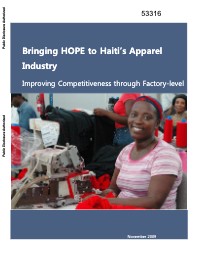
Cover photo © Marc Lee Steed for the Association of Haitian Industries
CONTENTS III
Contents
Glossary vii
Acknowledgments xi
Executive Summary xiii
1. Introduction 1
Apparel Industries Worldwide 2
Apparel Value-Chain Elements 5
U.S. Apparel Trade Trends 7
Labor Rights in Apparel Industries 9
Report Organization 12
2. Apparel Trade Program Benefits and Trade Flows 13
Comparison of Benefits Under HOPE, CBTPA, and DR-CAFTA 13
Haiti‘s Trade With the United States 19
3. Overview of Haiti’s Apparel Industry 23
Institutional Players 23
History 25
Factories, Ownership, and Industrial Zones 28
Government Support to Encourage Exports 30
Range of Products and Customers 31
Factory Size 32
Investment Intentions 34
Ports and Shipping 34
Haiti‘s Labor Sector 35
4. Haitian Apparel Industry Cost Analysis 41
Factory-Level Cost Analysis 42
Benchmarking Haiti‘s Costs 43
IV BRINGING HOPE TO HAITI‘S APPAREL INDUSTRY
Productivity 50
Product Cost Analysis: Men‘s Chinos Trousers 52
Product Cost Analysis: Men‘s T-Shirts 52
Summary of Apparel Cost Analysis 59
5. Conclusions and Recommendations 61
Appendix A. Composition of CTMO-HOPE
Appendix B. Haiti’s Apparel Manufacturers
Appendix C. Comparison of Benefits under Trade Agreements
Appendix D. Meetings
Appendix E. Sources Consulted
ILLUSTRATIONS
Figures
Figure 1-1. Apparel Industry Value-Chain, Global and in Haiti 5
Figure 1-2. Regional Sources of Supply to U.S. Apparel Market 9
Figure 2-1. Value of Haiti's Exports ($US Millions) 20
Figure 3-1. Key Institutional Players Shaping Haiti’s Apparel Industry 25
Figure 3-2. Ownership in Haiti’s Apparel Industry 28
Figure 3-3. Haiti Population Pyramid, 2009 36
Figure 4-1. Chinos, FOB Costs 58
Figure 4-2. Chinos, CIF Costs (Including Duties Paid) 58
Figure 4-3. T-Shirts, FOB Costs 59
Figure 4-4. T-Shirts, CIF Costs (Including Duties Paid) 59
Tables
Table 1-1. Summary of Strategic Initiatives in Haiti 3
Table 1-2. U.S. Apparel Imports, Top 25 Suppliers ($US Million) 8
Table 2-1. Haiti‘s Leading Trade Partners ($US Thousands) 18
Table 2-2. Value of Haiti‘s Exports ($US Millions) 20
Table 2-3. U.S. Apparel Imports Under Trade Preference Programs 21
Table 2-4. Haitian Factories‘ Reported Export Destinations 22
Table 2-5. U.S. Apparel Imports Under HOPE 22
CONTENTS V
Table 3-1. Key Actors and Policy and Market Variables Influenced 26
Table 3-2. Haiti‘s Political History and Global and U.S. Apparel Trade Developments 27
Table 3-3. Fabric Sourcing Patterns (Number of factories) 32
Table 3-4. Factory Size, by Number of Sewing Machines 33
Table 3-5. Factory Size, By Employees 33
Table 3-6. Factory Investment Priorities (Number of factories) 34
Table 4-1. Factory-level Cost Analysis Per Product 42
Table 4-2. Cost Comparison 44
Table 4-3. Labor Cost Comparison (January–June 2009) 45
Table 4-4. Comparison of Tax Incentives 50
Table 4-5. Productivity Targets, Casual Pants or Jeans 51
Table 4-6. Cost Analysis: Men‘s Chino Trousers 54
Table 4-7. Cost Analysis: Men‘s T-Shirts 56
Table 5-1. Strategic Considerations for the Apparel Industry 64
Exhibits
Exhibit 3-1. Haiti’s Apparel Companies 24
Glossary
ADIH Association des Industries d‘Haïti (Association of Haitian Industries)
AGOA African Growth and Opportunity Act
BASC Business Alliance for Secure Commerce
BC Beneficiary country/countries
BFC Better Factories Cambodia
BSR Business for Social Responsibility
BTA Bilateral textile agreement
C. Convention
CBERA Caribbean Basin Economic Recovery Act
CBTPA Caribbean Basin Trade Partnership Act
CBI Caribbean Basin Initiative
CFI Centre de Facilitation des Investissments (Center for Investment Facilitation)
CFPO Centre de Promotion des Femmes Ouvrieres (Center for Promotion of Women
Workers)
CIF Costs plus insurance and freight
CLED Centre pour la Libre Entreprise et la Démocratie (Center for Free Enterprise and
Democracy)
CMT Cut, make, and trim
CODEVI Compagnie pour le Développement Industriel (Industrial Development Company)
CSH Coordination Syndicale Haïtienne (Haitian Union Coordination)
CTH Conféderation des Travailleurs Haïtiens (Confederation of Haitian Workers)
CTMO-HOPE Commission Tripartite de Mise en Oeuvre de la Loi HOPE
CWG Competitiveness Working Group
DR Dominican Republic
DR-CAFTA Dominican Republic-Central American Free Trade Agreement
DSNCRP Document de Stratégie Nationale pour la Croissance et la Réduction de la Pauvreté
(National Strategy for Growth and Poverty Reduction)
DZF Direction des Zones Franches (Free Zone Department, of the Ministry of
Commerce and Industry)
VIII BRINGING HOPE TO HAITI‘S APPAREL INDUSTRY
EDH Electricité d‘Haïti (Haitian Electricity Authority)
ELVIS Electronic Visa Information System
ENAM Ecole Nationale des Arts et Métiers (National School for the Arts and Handicrafts)
FIAS Foreign Investment Advisory Service
FOB Free on board
FTA Free trade agreement
FTZ Free trade zone
GAL Guaranteed access level
GDP Gross domestic product
GSP Generalized System of Preferences
GTC Groupe de Travail sur la Competitivité (Competitiveness Working Group)
HOPE Haitian Hemispheric Opportunity through Partnership Encouragement Act
HTG Haitian Gourde
HTS Harmonized Tariff System
IADB Inter-American Development Bank
IFC International Finance Corporation
IHSI Institut Haitien de Statistique et d‘Informatique
ILO International Labor Organization
ISPS International Ship and Port Facility Security Code
ITUC International Trade Union Confederation
KwH Kilowatt-hour
LDP Landed duty paid
LM Linear meter
MFA Multilateral Fibre Arrangement
MINUSTAH United Nations Stabilization Mission in Haiti
MMF Man-made fiber
MOISE Mouvement des Organisations Indépendentes Intégrées and des Syndicats
Engagés (Movement of Independent, Integrated Organizations and Engaged
Unions)
MPCE Ministry of Planning and External Cooperation
MAST Ministère des Affaires Sociales et du Travail (Ministry of Social Affairs and Labor)
NAFTA North American Free Trade Agreement
QIZ Qualifying industrial zone
SME Square meter equivalent
SONAPI Société Nationale des Parcs Industriels (National Industrial Parks Company)
TAICNAR Technical Assistance Improvement and Compliance Needs Assessment and
Remediation program
TEU Twenty-foot equivalent unit
GLOSSARY IX
TPL Tariff preference level
TRQ Tariff-rate quota
USAID U.S. Agency for International Development
USCBP U.S. Customs and Border Protection
USTR Office of the U.S. Trade Representative
VAT Value-added tax
WRAP Worldwide Responsible Apparel Production
WTO World Trade Organization
Acknowledgments
Sponsored by the World Bank‘s Latin America and Caribbean Economic Policy Sector Unit and
conducted at the request of Haiti‘s Commission Tripartite de Mise en Oeuvre de la Loi HOPE
(hereafter, CTMO-HOPE), this study received generous financial support from the
governments of Finland, Norway, Sweden, and the United Kingdom through the Multidonor
Trust Fund for Trade and Development.
This study was carried out under the guidance of the World Bank and CTMO-HOPE. The
World Bank team consisted of Yolanda Strachan (PRMTR), Emmanuel Pinto Moreira (LCSPE),
and Luc Razamifandimby (LCSPE). The analysis was undertaken by Nathan Associates Inc.
and its partners, Werner International and the Centre pour la Libre Entreprise et la Démocratie
(CLED). The report was prepared by Don Feeney of Werner International, and Lynn Salinger
and Jane O‘Dell of Nathan Associates. Industry survey data were collected and analyzed by
Jean-Robert Joseph, a consultant to CLED, assisted by Allison Russell and Emma Fawcett,
summer interns from the New School for Social Research (New York).
The authors would like to express their gratitude to the factories whose senior managers
explained company operations and who provided us with extensive detail on income and
expenditures. To preserve confidentiality, sources of cost data are not named here and
company data have been adjusted in the report so that individual companies cannot be directly
identified.
The authors are especially grateful to ADIH‘s Georges Sassine for arranging our access to
factories, CTMO-HOPE‘s Lionel Delatour for his fervent conviction of the importance of this
work and his commitment to the industry, and CLED for providing the highest quality of
support during our stay in Haiti. Together, their efforts ensured that our work was brilliantly
organized, without which this report could not have been completed. The authors are also
grateful for comments received from Cornelia Staritz, Paul Brenton, Thomas Farole, and Ian
Gillson, Briana N. Wilson, Robert Krech, and Jean-Louis Warnholz.
Executive Summary
Thirty years ago, Haiti‘s apparel industry was a reliable supplier of assembled goods to the U.S.
market and employed as many as 100,000 workers. Chances were pretty good that U.S. baseball
pitchers were throwing balls sewn in Haiti, and that U.S. children were sleeping in pajamas
sewn in Haiti. The intervening years have been difficult for Haiti, marked by a struggle to
stabilize governance, to institutionalize respect for political and human rights, to modernize
infrastructure, and to encourage environmental stewardship rebuild after decades under the
poor leadership of the Duvaliers (1957–1986). Meanwhile, businesses around the world have
built supply chains that deliver raw materials from the most efficient capital-intensive
economies for processing in the most productive labor-intensive economies. The global
economy has rewritten the rules of trade, eliminated quotas on textiles and apparel, and
spawned preferential arrangements and free trade agreements across multiple geopolitical
partnerships. In this context, what trade advantages, if any, does Haiti‘s apparel industry have
and what are its strengths?
In 2008, the United States—one of the world‘s largest consumer markets despite the current
economic recession—extended trade preferences to Haiti. The Haitian Hemispheric
Opportunity through Partnership Encouragement Act, or HOPE II, grants Haitian apparel
exports duty-free entry into the United States. At the same time, Haiti remains
a beneficiary under the Caribbean Basin Trade Partnership Act (CBTPA).
HOPE II allows Haitian apparel factories flexible use of third-country materials
in production, subject to value-added requirements and quantitative limits
(expiring in 2011) and quantitative limits only for woven and knit apparel
(expiring in 2018). To stimulate textile industry development and regional
trade integration, CBTPA extends benefits to garments made from fabrics
produced in the region of U.S. yarn. Together, HOPE II and CBTPA give Haiti
an advantage over all other U.S. trade partners in the most valued trade benefit
for apparel: the right to use fabrics produced outside its borders—whether from the United
States, U.S. trade agreement and trade preference partners, or third countries—to manufacture
apparel, export it to the United States, and qualify for duty-free benefits.
HOPE II
grants Haitian
apparel
exports duty-
free entry into
the United
States.
XIV BRINGING HOPE TO HAITI‘S APPAREL INDUSTRY
In designing HOPE II, U.S. lawmakers provided maximum flexibility and required that apparel
factories respect labor rights—such as rights to organize, bargain collectively, and be free of
employment discrimination—in order to qualify for benefits. As mandated by HOPE II, Better
Work, a multicountry program managed by the International Labor Organization and the
International Finance Corporation, was recently established in Haiti as the Technical Assistance
Improvement and Compliance Needs Assessment and Remediation (TAICNAR) program . In
addition, the legislation includes a provision that apparel produced in Haiti can be exported
from the Dominican Republic to the United States. This accommodates goods produced in Haiti
along the Haitian–Dominican border in the free trade zone at Ouanaminthe.
Foreign investors are taking notice of the rebirth of Haiti‘s apparel industry.
The industry currently employs only 25,000, but 23 companies—all but one in
Port-au-Prince—manufacture a wide assortment of clothing items. Ten of these
companies represent Dominican, Korean, and U.S. investors, and several have
indicated their intention to expand their workforces. Brazilian investors also
seem eager to invest in Haiti. CODEVI, Haiti‘s largest single apparel factory
and the only one outside Port-au-Prince, represents an experiment in Haiti.
Owned by Grupo M of the Dominican Republic, the factory is located in a free
trade zone on the Dominican border, employs between 3,700 and 4,000 workers
and is ready to add several hundred more, and is the only apparel factory in Haiti whose
workers are represented by a labor union. Electricity, telecommunications, and transport to and
from ports are all provided in the Dominican Republic. In Haiti, ―free trade zones‖ and
―industrial zones‖ qualify for similar benefits and support. Haiti‘s investment laws allow for
temporary admission of raw materials needed for export-oriented industries, and customs
officials work effectively with manufacturers to ensure timely inspection of containers at the
factories.
Aside from the generous terms of access to the U.S. market under HOPE II,
Haiti‘s labor force is its biggest asset—in terms of cost and quality. The low
minimum wage of 70 Haitian Gourdes ($1.75) per day that was in effect during
the study period was raised to 125 HTG ($3.13) on October 1, 2009, with further
increases scheduled in October 2010 (150 HTG) and October 2012 (200 HTG).
Total earnings of workers in the apparel industry, inclusive of production
quota bonuses, are in excess of the minimum wage today. While not the lowest
worldwide, these labor costs are competitive with regional and global
benchmarks. Just as important, Haiti‘s apparel workers are eager for steady employment and
are reliable—despite low wages and high costs associated with employment (e.g., transport to
and from work, meals away from home, occupational health concerns, workplace stresses).
Absenteeism and turnover are both low at 2 percent and 4-6 percent per year, respectively. And
in late 2009, a training center being designed with input from [TC]
2
, a leading U.S. center for
applied apparel industry research and training will begin training sewing operators and mid-
level personnel for what is expected to be an expanding labor force.
Forty percent of
Haiti’s apparel
factories are
foreign-owned
or joint
ventures.
Haiti’s labor
force is its
biggest asset—
in terms of cost
and quality.
EXECUTIVE SUMMARY XV
To take full advantage of its trade agreements and its solid, reliable workforce, Haiti‘s apparel
industry has to meet challenges in general infrastructure, factory productivity, and
international image. First, the two most commonly cited infrastructure
constraints are unreliable and costly electricity and the dwindling
supply of available industrial space. Electricity costs for industrial users
are an extremely high 23 U.S. cents per kilowatt-hour—well above
regional and global benchmarks, and soon to be increased by the Haitian
Electricity Authority. Unless curbed by special tariffs, these costs will
discourage development of a textile industry, a longstanding dream of
planners in Haiti‘s apparel industry. Industrial space is reportedly still
available in Port-au-Prince—some 100,000 square meters were said to be
open in August 2009. But with urban areas growing at rates three times
that of the overall population, Haiti needs to plan for its future now and consider which other
coastal towns might provide platforms for industry development. Donors are addressing these
constraints by working to improve energy sector governance, electrical generation capacity, and
electrical distribution security, and to plan and finance new industrial parks in Port-au-Prince
and elsewhere, such as in Cap-Haïtien. The World Bank and International Finance Corporation
are financing efforts to reduce losses and expand supply in the energy sector, and the Inter-
American Development Bank will fund strategic planning for expansion of industrial space.
Second, compared to global industry ―standard times‖ the productivity
of Haiti‘s apparel operations is low. Many factories operate at 35 to 40
percent of standard. In a well-run factory, productivity rates are between
60 and 75 percent of standard, as consistently achieved in various
countries. The current challenge for Haiti‘s industry is to increase its
levels to 50 percent of standard, or better.
Third, Haiti‘s apparel firms have a reputation as being little more than T-
shirt manufacturers—but in reality they manufacture a surprising range
of fairly complex products. Most are made of 100 percent cotton fabrics,
but factories also work with woolens and manmade fiber fabrics. Factories operate as cut-make-
trim companies, subcontractors, and even full-package service companies. Some have
automatic fabric spreading or computer-aided cutting or manufacturing facilities, others offer
their own pattern marker and embroidery capabilities. They produce for a wide range of clients
in North America, including two well-known undergarment and activewear companies (Hanes
and Gildan) and a wide variety of fashion, performance, active, and work wear companies. In
fact, none of the following points of ―common wisdom‖ about the industry are true:
Haiti only makes T-shirts and workers lack the skills to do more. In fact, Haitian operators
are skilled in needle work and produce a wide range of products, even tailored men‘s suits.
Haitian firms dominate the local apparel industry. Haiti already attracts foreign investors to
its industry. Forty percent of companies are joint ventures or foreign owned.
Electricity
costs for
industrial users
are well above
regional and
global
benchmarks.
Haiti’s apparel
firms should
increase
productivity to
50 percent of
standard, or
better.
XVI BRINGING HOPE TO HAITI‘S APPAREL INDUSTRY
Hanes and Gildan dominate Haiti’s commercial landscape. These two
renowned North American brands are significant, but are better viewed as
anchors in a diversified customer network.
Haiti’s factories only assemble garments from knit cotton fabric sourced
from the Dominican Republic. Haiti‘s factories source fabric from all
over the world, manufacturing garments of cotton, manmade fiber, wool,
and other fabrics.
Haiti’s apparel factories only provide cut, make, and trim services. A
number of Haiti‘s factories offer specialized sourcing and production
services.
Haiti’s apparel industry is not yet taking advantage of HOPE. Haiti‘s apparel firms are
responding to HOPE II trade opportunities, and the relative share shipped under HOPE has
increased significantly in 2009.
These are significant findings. Haiti‘s apparel industry presents global investors and apparel
buyers advantages and challenges. On balance, prospects are quite good, with the industry
likely to expand, perhaps even double, in the coming two years. No other supplier matches
Haiti for its wages, trainable and dedicated workforce, trade preferences into the U.S. market,
and physical proximity to customers (hence, short delivery times to market).
Our findings on production costs also bode well for the industry‘s
competitiveness. Haiti‘s apparel companies are profitable and able to
attract business—and are expanding as a result. Average pay levels in
Haiti‘s apparel companies are high, and electricity costs paid by the
industry are high but manageable. In most firms, productivity levels are a
concern; improving worker nutrition may be one simple way to boost
productivity.
Haiti‘s apparel industry is starting to grow again. Business, labor, and government leaders
recognize the importance of the industry to economic growth and poverty reduction, and
appear ready to ensure that HOPE II leads to meaningful economic activity, employment, and
improved welfare for Haitians. To help ensure such an outcome, Haiti should consider all
possible niches it might fill in the global industry. Factories should commit to achieving higher
productivity and to using various production management methods to smooth workflow
through factory production lines without unduly taxing production personnel. Mindful of the
TAICNAR program‘s focus on labor rights compliance and remediation, the industry should
prepare now for unionization among a larger share of the apparel workforce. Private electricity
generation capacity and industrial zone space, in Port-au-Prince and possibly in Cap-Haïtien,
should be pursued. Finally, the energy and enthusiasm of Haiti‘s industry, labor, and
government leaders, engaged through Commission Tripartite de Mise en Oeuvre de la Loi HOPE
(CTMO-HOPE), should be tapped in shaping a new image for Haiti‘s apparel industry abroad.
Haitian firms
are skilled in
needle work
and produce a
wide range of
products, even
tailored men’s
suits.
Haiti’s apparel
firms are
responding to
HOPE II trade
opportunities.
1. Introduction
In October 2008 the United States Congress enacted legislation that gave the Republic of Haiti
expanded, flexible access to the U.S. market for its apparel exports. The Haitian Hemispheric
Opportunity through Partnership Encouragement Act of 2008 (HOPE II, updated from the
original legislation passed in 2006) was welcomed for its potential to revitalize a decaying
industry, attract new foreign investment, expand formal sector employment, and jumpstart
growth and opportunity for Haiti‘s people. A presidential commission, the Commission
Tripartite de Mise en Oeuvre de la Loi HOPE (CTMO-HOPE), works to ensure successful
implementation of the legislation.
1
The purpose of the analysis of Haiti‘s apparel value-chain in this report is to provide a
comprehensive view of the advantages and challenges of manufacturing in Haiti relative to
manufacturing in the Caribbean and Central America and elsewhere. It situates Haiti‘s
attributes and suggests priorities for improving its competitiveness relative to that of other
suppliers. An apparel buyer in the United States today juggles an impressive list of potential
suppliers from China and elsewhere in Asia and from Latin America and beyond. Each country
offers a unique combination of workforce skills, business environment, costs, ―full-package‖
services, proximity to raw material or to end markets, preferential access to the U.S. market,
and thus competitiveness. This report helps readers to see how Haiti fits into this ever-changing
global apparel market kaleidoscope.
Research for this analysis was conducted using a combination of instruments, including (1) a
structured survey questionnaire, in which three-quarters of the industry participated;
2
(2)
detailed cost analysis for two standard products made in Haiti—knit T-shirts and woven men‘s
―chinos‖ trousers—using cost data collected from nine firms; and (3) rapid appraisal interviews
of representatives of Haiti‘s apparel industry and its broader private sector, Haiti‘s labor sector,
donor organizations and donor-funded programs, and government, to understand the policy
and business environments in which the industry operates. Field work took place between July
20 and August 15, 2009. In addition, trade benefits available to Haiti under the HOPE II
1
See Appendix A for information on the composition of the commission.
2
Appendix B lists Haiti‘s apparel manufacturers.
2 BRINGING HOPE TO HAITI‘S APPAREL INDUSTRY
agreement were compared with those available under the Caribbean Basin trade preference
program, and with those available to Haiti‘s competitors under the Dominican Republic (DR)-
Central American Free Trade Agreement.
Findings presented here aim to enrich understanding of the industry in light of several strategic
discussions being held in Haiti today (Perito 2009). Haiti‘s National Growth and Poverty
Reduction Strategy Paper, prepared in 2007 and updated in 2009, is being implemented with
broad support from the donor community, including the United Nations, multilateral
development banks, and bilateral donor organizations (Republic of Haiti 2007; Collier 2009;
IADB 2009a). Special United Nations envoys to Haiti—former U.S. President Bill Clinton and
his deputy Dr. Paul Farmer, co-founder of Partners in Health—have been engaged in these
discussions, including discussions with Haitians residing abroad. The Haitian Diaspora Unity
Congress held its second annual international conference in Miami in August 2009 to strategize
overseas Haitians‘ support for their homeland. A Haitian Presidential Commission on
Competitiveness has issued its ―Shared Vision for an Inclusive and Prosperous Haiti,‖
facilitated by the OTF Group. The apparel cluster is among five priority growth clusters
identified in the strategy, and the Competitiveness Working Group is developing priority
actions for it (CWG 2009).
In the apparel sector, industry stakeholders have been developing a strategic vision for the
industry‘s future in Haiti (ADIH and I-Trade 2009). That vision aims for the industry to become
a global supplier of choice, not only for apparel, but for home furnishings and accessories,
increasing industry value-added to $1.6 billion worth of sales, one-third of which is to come
from full-package operations, and expanding employment to 200,000. Table 1-1 summarizes
strategic initiatives.
As discussed more fully below, the Better Work Haiti program of the International Labor
Organization and International Finance Corporation (ILO/IFC) launched the TAICNAR
program on July 1, 2009 to address factories‘ compliance with core labor standards. In
presenting a detailed, survey-based analysis of apparel industry operations to date, this survey
complements this strategic planning.
Apparel Industries Worldwide
Around the world, apparel companies defy the odds. Clothing items are produced for the
world market in countries where the minimum wage is $1.50 per day and in countries where it
is $15.00 per day, in factories clustered next to the seaport in an industrial or free trade zone
and in factories that spread around an inland capital city and send their filled containers by
truck on a four-hour ride to the nearest port, in countries that enjoy free or preferential trade
relations into their lead markets and in countries that do not. There is no one formula for
success, as many different kinds of garments, human resource and skill sets, sourcing patterns,
INTRODUCTION 3
and value-chain strengths and weaknesses allow for the creation of infinite niches by various
producers around the globe.
Table 1-1
Summary of Strategic Initiatives in Haiti
Initiative Lead Other Key Actors Strategic Role of Apparel Industry
National Growth
and Poverty
Reduction
Strategy Paper
Haiti Ministry of
Planning and
External
Cooperation
United Nations &
Columbia
University‘s Earth
Institute
Manufacturing not considered to be a ―growth
vector,‖ though the textiles are seen as a ―highly
promising area.‖
From Natural
Catastrophe to
Economic Security
Professor Paul
Collier, Oxford
University
Prepared for the
United Nations
Secretary-General
With advantages of HOPE II, garments production
seen as logical lynchpin of economic recovery
strategy. ―From the important perspective of
market access Haiti is now the world‘s safest
production location for garments.‖
Shared Vision for
an Inclusive and
Prosperous Haiti
Presidential
Commission on
Competitiveness
OTF Group Apparel considered to be one of five priority
growth clusters for Haitian economy; priority
actions being defined.
Apparel Industry
Strategic Plan and
Roadmap
ADIH I-Trade Project, led
by Chemonics Int‘l,
supported by
USAID
Holistic vision; analysis of strengths, weaknesses,
opportunities, and threats; consideration of
marketing, communications, and business
environment priorities.
Better Work Haiti ILO/IFC ADIH, CTMO-
HOPE
Responsible for the Technical Assistance
Improvement and Compliance Needs Assessment
and Remediation program.
That being said, the global apparel industry is undergoing tremendous consolidation in the
wake of the 2005 elimination of multilateral quotas on textiles and apparel trade. Production in
far-flung places such as Saipan (part of the U.S. Commonwealth of the Northern Mariana
Islands in the western Pacific) and Namibia (in southwest Africa) has ground to a halt. Even
production in once prospering platforms is contracting. For example, shortly after the United
Nations‘ Transitional Authority in Cambodia ended in 1993, apparel sector employment was
under 20,000; it grew in ten years to 250,000 workers, then peaked in 2008 at about 350,000
workers (Salinger et al. 2005; EIC 2008), before losing an estimated 50,000 jobs to the
combination of global recession, competition, and industry consolidation. In Lesotho, apparel
industry employment soared from under 10,000 in 1999 to over 50,000 in mid-2004, four years
after the African Growth and Opportunity Act (AGOA) was implemented; however, by 2005,
garment industry employment in Lesotho had fallen to 40,000 under pressure from an
overvalued currency and looming changes to origin requirements under AGOA (Bennet 2006).
Moreover, the global economic slowdown has reduced apparel imports into the United States
by 10-20 percent, as of the first half of 2009, depending on whether one looks at volume or value
statistics. Thus the challenges facing a relative ―newcomer‖ to the global apparel trade, such as
Haiti, are daunting. This underscores the importance for Haiti to attract foreign direct
investment, and the value-chain savvy that it brings, into its apparel industry.
4 BRINGING HOPE TO HAITI‘S APPAREL INDUSTRY
The apparel industry has been an engine of growth and industrialization for developing
countries around the world. It is one of the first formal sector opportunities to provide jobs and
often higher incomes to its workforce, relative to their other livelihood opportunities. The
attractiveness of such employment is underscored by the rural-to-urban migration that
typically accompanies the emergence of an apparel industry. However, the ―easy‖ advances
made by early industrializers, such as South Korea, are not as easily replicated today. Whereas
the industry‘s internal logic was driven by the need to diversify sources of manufacturing in
order to get around constraints imposed by textile trade quotas (i.e., before 1995), the internal
logic today is driven by retailers‘ desires to offload as many risky dimensions of the business as
possible to vertically integrated, globally networked, technologically savvy, and socially
responsible producers. These are likely to be far fewer in number, although buyers also strive to
maintain some diversification for risk management.
As workers gain experience and skills the processing of relatively simple goods such as
clothing, higher value-added manufacturing activities in footwear, automobile components,
toys, and sporting goods typically begins to take hold. Eventually, with continued
industrialization and economic growth, industrial sectors push into increasingly sophisticated
manufacturing of electronics components, machinery, and the like. As manufacturing skills
advance and the value-added of products produced increases, wages also rise. This can lead to
displacement of an apparel industry, as alternative employment in higher paying
manufacturing pulls labor away and apparel manufacturers re-establish themselves in
country‘s with more abundant and less costly labor supplies. This pattern has been observed in
a number of European, North African, and Asian countries.
With its heavy reliance on women workers, the apparel industry has also been an engine of
empowerment for uneducated and low-skilled women in many countries. Access to earned
income contributes to a new independence for women workers, many of whom shed the
confines of their rural traditions as they move to cities to take up assembly work (Kabeer 2000;
Gammage et al. 2002). Some portion of that income may be remitted home to support families‘
investments in agriculture, children‘s and siblings‘ education, and other priorities.
Industrial work, however, also may expose apparel workers to new risks, potential rights
abuses, and the costs of being in the workforce for long hours each day. This in turn puts
additional stress on families, as traditional means of food preparation and care of children and
the elderly must be adapted to women‘s long working hours. Yet women‘s employment in
garment factories may be steadier, with a more reliable income stream, than the terms of
employment faced by their male counterparts. Uneducated, low-skilled men are likely to be
employed in informal sector jobs (e.g., construction, transportation, fishing) that offer few labor
protections and even more variable income streams. In cases where women workers are
married, this can introduce new pressures on traditional gender roles within the family.
As is discussed in Section 3 below, Haiti‘s apparel industry—like the economy overall—has had
a turbulent history. Increasing factory jobs in the apparel industry, coupled with independent
[... middle sections omitted for long document ...]
Appendix E. Sources Consulted
American Center for International Labor Solidarity. 2003. Unequal Equation: The Labor Code and
Worker Rights in Haiti. Washington, DC. July.
Armbruster-Sandoval, Ralph. 2003. Globalization and Transnational Labor Organizing: The
Honduran Maquiladora Industry and the Kimi Campaign. Social Science History 27:4
(Winter): 551-76.
Association Des Industries d’Haïti and I-Trade Project. 2009. Taking Advantage of HOPE II: A
Strategic Plan and Roadmap by the Haitian AHFA™ Industry. Unpublished. Port-au-
Prince.
Birnbaum, David. 2009. Analysis: The new garment supplier—where, who, what. Parts I (12
May), II (26 May), and III (7 July). www.just-style.com.
Blakeley, Michael. 2008. Apparel Exports to the United States: A Comparison of Morocco,
Jordan, and Egypt. Prepared for U.S. Agency for International Development, Morocco
mission. Arlington, VA: Nathan Associates Inc., October.
Brooks, Ethel C. 2007. Unraveling the Garment Industry: Transnational organizing and women’s
work. Minneapolis: University of Minnesota Press.
Collier, Paul. 2009. Haiti: From Natural Catastrophe to Economic Security. Prepared for the
Secretary-General of the United Nations. Oxford University, January. Mimeo.
Commission Tripartite de Mise en Oeuvre de la Loi HOPE. 2009. « Rapport de la Mission du Brésil. »
Unpublished. Port-au-Prince.
Compa, Lance A. and Stephen F. Diamond, eds. 1996. Human Rights, Labor Rights, and
International Trade. Philadelphia: University of Pennsylvania Press.
Competitiveness Working Group. 2009. Shared Vision for an Inclusive and Prosperous Haiti:
Draft Report. Prepared by Presidential Commission on Competitiveness with facilitation of
the OTF Group.
Correia, Maria. 2002. A Review of Gender Issues in the Dominican Republic, Haiti, and Jamaica.
Report No. 21866-LAC. Washington, DC: World Bank.
E-2 APPENDIX E
Deese, William, Heidi Colby-Oizumi, William Powers, and Laura Rodriguez. 2008. Textiles and
Apparel: Effects of Special Rules for Haiti on Trade Markets and Industries. Investigation No. TR-
5003-1. Washington, DC: U.S. International Trade Commission, June.
Diamond, Jared. 2005. One Island, Two Peoples, Two Histories: The Dominican Republic and
Haiti. Chapter 11 in Collapse: How Societies Choose to Fail or Succeed. New York: Penguin
Books.
Feeney, Don and Peter Minor. 2007. Factory-Level Value Chain Analysis of Cambodia‘s
Apparel Industry. Prepared for U.S. Agency for International Development, Cambodia
Mission, with support from the Garment Industry Productivity Center and the Garment
Manufacturers Association in Cambodia. Arlington, VA: Nathan Associates, September.
Flintoff, Corey. 2009. In Haiti, A Low-Wage Job Is Better Than None. Port-au-Prince: United
Nations Development Program. 18 June.
Foreign Investment Advisory Service and Business for Social Responsibility. 2008.
Competitiveness and Corporate Social Responsibility in the Jordanian Apparel Industry.
January.
François, Lhermite. 2009. Impact Eventuel du Nouveau Salaire Minimum sur l‘Avenir de
l‘Industrie de la Sous-Traitance en Haïti. Port-au-Prince : Strategic Management Group,
May.
Gammage, Sarah, Helene Jorgensen, Eugenia McGill, and Marceline White. 2002. Trade Impact
Review. Washington, DC: Women‘s Edge Coalition, Global Trade Program.
Gardella, Alexis. 2006. Gender Assessment for USAID/Haiti Country Strategy Statement.
Arlington, VA: DevTech Systems.
Gelb, Bernard A. 2007. Haitian Textile Industry: Impact of Proposed Trade Assistance. CRS
Report for Congress, RS21839. Washington, DC: Congressional Research Service, January
19.
Government of Haiti. 2003. Trade Policy Review, Haiti: Report by the Government. Geneva: World
Trade Organization.
Hornbeck, J. F. 2008. The Haitian Economy and the HOPE Act. CRS Report for Congress,
RL34687. Washington, DC: Congressional Research Service, October.
Hufbauer, Gary Clyde, Jeffrey J. Schott, Lee L. Remick, Diana E. Clark, and Rosa M. Moreira.
1993. North American Free Trade: Issues and Recommendations. Washington, DC: Institute of
International Economics.
Inter-American Development Bank. 2009a. Haiti: a new paradigm.
______. 2009b. Development of the Industrial Park Model to Improve Trade Opportunities for
Haiti. HA-T1074. 12 August.
APPENDIX E E-3
International Finance Corporation. 2009. Doing Business 2010: Haiti. Washington, DC. Available
from www.doingbusiness.org.
International Trade Union Confederation. 2009. Haiti. In Annual Survey of Violations of Trade
Union Rights. Available from www.ituc-csi.org.
Jaramillo, Laura and Cemile Sancak. 2007. Growth in the Dominican Republic and Haiti: Why
has the Grass Been Greener on One Side of Hispaniola? IMF Working Paper WP/07/63.
Washington, DC: International Monetary Fund.
Kabeer, Naila. 2000. The Power to Choose: Bangladeshi Women and Labour Market Decisions
in London and Dhaka. London: Verso Books.
Kenyon, Paul. 2000. Gap and Nike: No Sweat? BBC news report, October 15. Available from
http://news.bbc.co.uk.
Kernaghan, Charles. 1996. Children Exploited by Kathie Lee/Wal-Mart. Testimony before
Democratic Policy Committee, U.S. Congress. April 29. Available from www.nlcnet.org.
______. 2006. U.S. Jordan Free Trade Agreement Descends Into Human Trafficking: Tens of
Thousands of Guest Workers Held in Involuntary Servitude. New York: National Labor
Committee.
Lerner, Michael, Lynn Salinger, and Jeffrey Wheeler. 2008. The Role of Labor Sector Issues in
the Foreign Assistance Framework: Cambodia Labor Assessment. Prepared for
USAID/DCHA. Burlington, VT: Associates in Rural Development.
Makin, Jennifer. 2007. Cambodia: Women and Work in the Garment Industry. Phnom Penh: ILO
Better Factories Cambodia and World Bank‘s Justice for the Poor Program.
Minor, Peter, Jane O‘Dell, and Pooja Pokhrel. 2009. Post-Quota Textiles and Apparel Trade in
Developing Countries. Prepared for U.S. Agency for International Development, Bureau of
Economic Growth, Agriculture, and Trade. Arlington, VA: Nathan Associates Inc., May.
Nathan Associates Inc. 2004. Dominican Republic Textile and Apparel Export Competitiveness : Trade
and Industry Report. Prepared for USAID under the TCB Project. Arlington, VA, November.
Perito, Robert. 2009. Haiti: Is Economic Security Possible if Diplomats and Donors Do Their
Part? USIPeace Briefing. Washington, DC: United States Institute of Peace, May.
Polaski, Sandra. 2006. Combining Global and Local Forces: The Case of Labor Rights in
Cambodia. World Development, 34, 5: 919-932.
Priest, Matt, Maria Dybczak, and Laurie Mease. 2008. Introduction to Haiti HOPE II‘s Earned
Import Allowance Program. Presentation. Washington, DC : Department of Commerce,
International Trade Administration.
Republic of Haiti. 1984. Décret du 24 février 1984 actualisant le Code du travail du 12 septembre
1961. Available from ILO‘s NATLEX database. Geneva: ILO.
E-4 APPENDIX E
______. 2002. Loi portant sur le Code des Investissements Modifiant le Décret du 30 Octobre
1989 Relatif au Code des Investissements. Le Moniteur, Numéro Spécial, no. 4. Port-au-
Prince, 26 November.
______, Institut Haitien de Statistique et d‘Informatique. 2003. Enquête sur les Conditions de
Vie en Haïti 2001. Volumes I and II. Port-au-Prince, July.
______, Ministry of Commerce and Industry, Direction des Zones Franches. The Engine for Job
Creation. Port-au-Prince.
______, Ministry of Planning and External Cooperation. 2007. National Growth and Poverty
Reduction Strategy Paper (Document de Strategie Nationale pour la Croissance et pour la
Réduction de la Pauvrété, DSNCRP) : Making a Qualitative Leap Forward. November.
Available in English from www.imf.org and in French from www.ht.undp.org.
Salinger, Lynn, Sok Hach, Chea Samnang, Neou Seiha, Mauro Pereira, Heinz Reich, and Jan
Urlings. 2005. Measuring Competitiveness and Labor Productivity in Cambodia’s Garment
Industry. Prepared for USAID/Cambodia. Arlington, VA: Nathan Associates Inc.
SOFHIDES. 2009. La composante ‗textile‘ du secteur de la sous-traitance en Haiti. Unpublished
presentation. Prepared for the I-Trade Project, Chemonics International.
State Department, U.S. 2009. Investment Climate Statement—Haiti. Available from
www.state.gov.
Taft-Morales, Maureen. 2009. Haiti: Current Conditions and Congressional Concerns. CRS
R40507. Washington, DC: Congressional Research Service, June 17.
U.S. Customs and Border Protection. 2009. QBT-09-111: Elimination of the Paper Requirement
for the Haiti HOPE Electronic Visa (ELVIS) Program. September 30.
U.S. Department of Commerce, Office of Textiles and Apparel. 2009. Trade Data: U.S. Imports
and Exports of Textiles and Apparel. Available from www.otexa.ita.doc.gov.
U.S. Department of State, Bureau of Democracy, Human Rights, and Labor. 2009. 2008 Human
Rights Report: Haiti. Washington, DC, February 25. Available from
http://www.state.gov/g/drl/rls/hrrpt/.
U.S. International Trade Commission. 2008. Textiles and Apparel: Effects of Special Rules for Haiti
on Trade Markets and Industries. Investigation No. TR-5003-1, USITC Publication 4016.
Washington, DC, June.
Verhoogen, Eric and Charles Kernaghan. 1996. The U.S. in Haiti: How to Get Rich on 11 Cents
an Hour. National Labor Committee, http://www.nlcnet.org/article.php?id=202.
Verner, Dorte. 2008a. Making Poor Haitians Count: Poverty in Rural and Urban Haiti Based on
the First Household Survey for Haiti. Policy Research Working Paper 4571. Washington,
DC: World Bank, March.
APPENDIX E E-5
______. 2008b. Labor Markets in Rural and Urban Haiti: Based on the First Household Survey
for Haiti. Policy Research Working Paper 4574. Washington, DC: World Bank.
Wheeler, Jeffrey S. and B. Lynn Salinger. 2009. The Role of the Labor Sector in the Foreign
Assistance Framework: Technical Paper. Prepared for USAID, Bureau of Democracy,
Conflict, and Humanitarian Affairs, Office of Democracy and Governance, USAID Bureau
of Economic Growth, Agriculture, and Trade, and U.S. Department of State, Bureau of
Democracy, Human Rights, and Labor. Updated, May.
World Bank. 2006a. Haiti: Options and Opportunities for Inclusive Growth, Country Economic
Memorandum. Washington, DC, June.
______. 2006b. Project Appraisal Document on a Proposed Grant in the Amount of SDR 4.1
Million to the Republic of Haiti for an Electricity Loss Reduction Project. Report No. 36364-
HT. Washington, DC, June.
______. 2009. Country Assistance Strategy for the Republic of Haiti for the Period FY09-FY12.
Report No. 48284-HT. Washington, DC, May 4.