
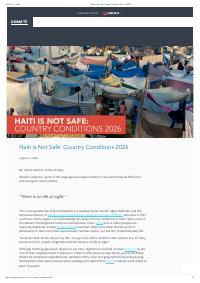
Haïti n'est pas sûr : conditions dans le pays, 2026
Résumé — L'évaluation des conditions dans le pays réalisée par l'USCRI, à jour en juillet 2026, soutient qu'Haïti n'est pas sûr pour le retour de ressortissants haïtiens alors que les États-Unis mettent fin au statut de protection temporaire. Elle s'appuie sur des entretiens avec cinq spécialistes d'Haïti, dont trois basés dans le pays, parmi lesquels Pierre Espérance du Réseau National de Défense des Droits Humains et l'anthropologue Greg Beckett. Le rapport décrit des gangs agissant en collusion avec des responsables corrompus, une impunité généralisée et un État incapable de protéger ses citoyens, avec plus d'un million de personnes déplacées internes et au moins 16 000 personnes tuées depuis 2022. Il traite de la corruption et de l'impunité, des besoins humanitaires, de l'effondrement des infrastructures médicales, des violences sexuelles et fondées sur le genre, et de la situation des personnes renvoyées, et conclut que ces retours violeraient le principe de non-refoulement.
Constats Clés
- L'USCRI conclut qu'Haïti n'est pas sûr pour les retours et que renvoyer des personnes violerait le principe de non-refoulement.
- Plus d'un million de personnes sont déplacées internes et au moins 16 000 ont été tuées depuis 2022.
- L'évaluation est à jour en juillet 2026 et repose sur des entretiens avec cinq spécialistes, dont trois basés en Haïti.
- Les gangs agissent en collusion avec des responsables corrompus et l'impunité est généralisée.
- Le rapport traite de la corruption, des besoins humanitaires, de l'effondrement des infrastructures médicales, des violences sexuelles et de la situation des personnes renvoyées.
Texte Intégral du Document
Texte extrait du document original pour l'indexation.
8/20/26, 11:39 PM
Haiti is Not Safe: Country Conditions 2026 - USCRI
LANGUAGE OPTIONS
ENGLISH ▼
DONATE
Haiti is Not Safe: Country Conditions 2026
August 12, 2026
By: Alexia Gardner, Policy Analyst
Reader’s advisory: Some of the language and subject matter in this article may be difficult or
distressing for some readers.
“There is no life at night.”
This is the perspective of Pierre Espérance, a leading Haitian human rights defender and the
Executive Director of Réseau National de Défense de Droits Humains (RNDDH) who lives in Portau-Prince, Haiti’s capital. I am interviewing him about country conditions in Haiti. Haiti is one of
the Western Hemisphere’s foremost humanitarian crises. More than a million people are
internally displaced; at least 16,000 people have been killed since 2022. But the scale of
devastation in Haiti cannot be captured with numbers alone, so I ask him to describe daily life.
“Daily life? Well, let me tell you my life. I can go to my office. And then also, where I live, it’s okay
because I live in a [safer neighborhood]. But there is no life at night.”
Although Haiti’s gangs launch attacks at any hour, nighttime is favored. Civilians wake up to the
roar of their neighborhoods in flames. In a March 2026 attack on Jean-Denis, part of the Petite
Rivière de l’Artibonite neighborhood, members of the Gran Grif gang held off attacking during
the daytime, when police were present, waiting until nighttime to begin a massacre that killed at
least 70 people.
https://refugees.org/haiti-is-not-safe-country-conditions-2026/
1/7
8/20/26, 11:39 PM
Haiti is Not Safe: Country Conditions 2026 - USCRI
The country is also hit by rolling blackouts, making nighttime even more unsafe: the power cuts,
and life plunges into the darkness. Last year, gang seizures of Port-au-Prince’s main power plant
left the city without power for three days. The functions of daily life come to a halt: schools are
shut down, food spoils without refrigeration, the internet won’t connect. Blackouts are also
deadly. Without power or alternative fuel, the hospital equipment needed to keep patients alive
cannot run. The cover of darkness enables criminals: power shortages in humanitarian
emergencies have been linked to increases in rape and other atrocities.
“I don’t go out, I don’t do the night thing. I don’t drive at night…Because it’s just the way it is, for
the women especially. You are forced to do what you have to do during the daytime. You cannot
afford to be outside at a certain time, just to make sure that you will not be a victim,” shared a
representative of a women’s organization living in Port-au-Prince, who wished to remain
anonymous.
Anthropologist Dr. Greg Beckett’s work explores how Haitians used the term blakawout, or
blackout, as a metaphor to encapsulate a state of political and economic deprivation. For
Haitians, blakawout describes not just the loss of electrical power, but personal power and
autonomy. That grief lives in the body, manifesting in physical ailments. Beckett writes: “Living in
a blackout wasn’t just living with the lights off—it was living with the constant possibility of your
own death.” Beckett’s field research focused on the aftermath of the 2004 coup and 2010
earthquake. Widespread gang control of the country today means that conditions in Haiti have
only further deteriorated.
Gangs have captured an estimated 80-90 percent of the capital. They have expanded their
presence to five of Haiti’s ten departments, with even the southeast, a ‘safer’ region of the
country, now seeing more frequent gang-related attacks. Few humanitarian organizations have a
presence on the ground in Port-au-Prince anymore. Even the famously intrepid Médecins Sans
Frontières/Doctors Without Borders (MSF) has routinely suspended lifesaving medical services in
Port-au-Prince after staff were assaulted by gangs while treating patients. The country has one of
the world’s highest homicide rates, the violence and insecurity so intense that at least one in ten
people in Haiti have been forcibly displaced.
Despite these conditions, the United States is proceeding with terminating Temporary Protected
Status (TPS) for over 330,000 Haitians, putting them at risk of deportation. Haiti is not a safe
place to deport people to. Upon arrival in Haiti, returnees would face a country where massacre
is normalized. Gangs operate in collusion with corrupt government officials; impunity is rampant,
the state unable to take even basic action to protect the lives of their citizens. Even the dead
suffer: bodies are mutilated in the morgues, massacre victims piling up with no proper burial.
The sections that follow document these conditions in detail, drawing on reporting from
humanitarian organizations, human rights monitors, and Haitian civil society.
This report begins with discussion of the political background and gang violence that shapes
the nation’s current humanitarian crisis. The report then covers humanitarian needs, including a
lack of medical infrastructure and supplies, before discussing gender and sexual violence. We
conclude with a brief discussion of persecution that people deported back to Haiti are likely to
face.
Methodology
The following is a continuation of our 2024 report on humanitarian conditions in Haiti. All
information is current as of July 2026.
To deepen our reporting on country conditions in Haiti, USCRI staff spoke to five experts on
Haiti’s political crisis, three of whom are currently based in Haiti. To protect their privacy, two
interviewees are referred to anonymously:
Pierre Espérance, Executive Director at Réseau National de Défense des Droits Humains
Dr. Greg Beckett, Professor of Anthropology at the University of Western Ontario;
Author of There Is No More Haiti
Representative in Port-au-Prince of a Haitian women’s organization
Chief Medical Director and Physician, Medical Provider in the Western Department
Amber Lynn Munger, Senior Program Officer, American Jewish World Service
Political Situation and Background
https://refugees.org/haiti-is-not-safe-country-conditions-2026/
2/7
8/20/26, 11:39 PM
Haiti is Not Safe: Country Conditions 2026 - USCRI
Haiti’s deteriorating infrastructure and public order reflect years of political instability,
institutional erosion, and insecurity. The assassination of President Jovenel Moïse in July 2021
deepened the country’s political crisis, while armed gangs were able to expand their control
under intensified violence, particularly in and around the capital.
Once the wealthiest colony in the Western Hemisphere, the ongoing legacy of colonial extraction
has made Haiti the poorest country in the region. When the Haitian government announced the
end of fuel subsidies in 2018, increasing the price of fuel by up to 51 percent, it burdened
families already unable to afford food, sparking a wave of demonstrations against thenPresident Jovenel Moïse. Protesters demanded the President’s resignation. He refused. In
October 2019, an electoral council decided to indefinitely postpone the elections, with Moïse
ruling by decree until his assassination in 2021. Haiti has not elected a president since.
During his time in office, Moïse fomented a climate of impunity and corruption. High-ranking
government officials often colluded with armed gangs to suppress political opposition. A
2021 report done by Harvard Law School in conjunction with RNDDH concluded that gang
violence in Haiti is not random, but “constitute[s] both widespread and systematic attacks
targeted at civilians… evidence suggests that the attacks were pre-planned and furthered both
an organizational policy of the gangs and an implicit state policy to repress political opposition.”
In a 2018 attack against the La Saline neighborhood, government officials appointed by Moïse
not only paid gang leaders to perpetuate atrocities against civilians but also assisted in planning
the attack, bringing weapons, vehicles, and resources to bear. At least 71 people were murdered.
To date, the attack’s perpetrators, including the government officials involved, remain free.
“To this day, not a single leader of the gangs has been captured, killed, or held to account,”
shared Amber Lynn Munger, a Senior Program Officer covering Haiti for American Jewish World
Service. “There are no consequences for wrongdoing. In fact, it’s rewarded. Even when police
arrest gang members, corruption often undermines accountability and enables their release.
Impunity is rewarded at all levels. And in a society where violence and human rights abuses face
no consequences, violence will continue to flourish.”
In July 2021, Moïse was assassinated in his home, opening a power vacuum that the gangs—
empowered by years of government corruption—stepped in to fill. With the Parliament
disbanded and Prime Minister Ariel Henry ruling by an unpopular decree, the state lacked
legitimacy. That same year, Haiti was hit by a 7.2-magnitude earthquake, killing more than 2,000
people and plunging an additional 700,000 people into acute food insecurity. The combined
effects of corruption, impunity, environmental disaster, and Moïse’s assassination compounded
to create Haiti’s current humanitarian crisis, giving armed gangs the leverage they needed to
take over between 80 and 90 percent of Port-au-Prince.
Today, the influence of gang violence in Haitian daily life is omnipresent and overwhelming. Last
year, criminal groups carried out 24 massacres and armed attacks in the Artibonite region of
central Haiti alone. Gang violence in Haiti is designed to inflict as much pain as possible. In 2024,
a gang massacred 207 people, targeting elderly Vodou practitioners in Port-au-Prince’s Cité Soleil
neighborhood. The gang’s leader wrongly blamed them for the death of his son, and extracted
retribution with impunity. In another incident, a gang member ripped a baby from their mother’s
arms, throwing the child—alive—into a fire. The mother wandered around in shock for two days,
eventually dying from the trauma at a police station.
These stories are not exceptional, but representative of the collapse of law and order in Haiti, of
the violence that haunts dai
ly life. A representative of a Haitian women’s organization living in
Port-au-Prince told USCRI that her days are marked by constant worry over safety: “For
everyone, including men, women, and especially girls, the first thing that will come to mind [in
the morning] is how am I going to keep myself safe from not being kidnapped, from not being
assaulted, and for not being the victims or the survivors of gang violence.” Dr. Beckett mirrored
her sentiment. He shared that even obtaining a bag of rice was so dangerous and so expensive
that Haitian friends of his in Canada asked someone flying down from Miami to pack rice into
their bags to give out to their family in Haiti.
There is no easy solution, no quick fix, to this epidemic. There is no state protection in Haiti.
Armed gangs are equipped with better weaponry than the police. They control all the main
access routes into Port-au-Prince, including the port, allowing them the power to decide what—if
any—humanitarian aid gets in. Government officials are still embroiled with the
gangs, choosing to enrich themselves instead of providing basic safety to their citizenry.
https://refugees.org/haiti-is-not-safe-country-conditions-2026/
3/7
8/20/26, 11:39 PM
Haiti is Not Safe: Country Conditions 2026 - USCRI
Espérance, uses the phrase banalisation de la vie, or the “trivialization of life” to describe the lack
of state care towards its citizens, how normalized deadly violence has become in Haiti. “When we
remember that this [humanitarian crisis] is fueled by state authorities–who prefer to provide
gangs with arms and ammunition in order to satisfy their thirst for power, rather than to
strengthen the police institution—the situation becomes revolting, denoting the level of
trivialization of life by the state authorities.”
Humanitarian Needs
Since January of 2022, 1.5 million Haitians have been displaced by the concurrent forces of gang
violence and state collapse. At least 16,000 people have been killed. 6.4 million people need
urgent humanitarian assistance.
More than half of the country is hungry. The most recent Integrated Food Security Phase
Classification (IPC), tracking food insecurity in Haiti from March 2026 to June 2026, shows that
more than half of the country, or 5.83 million people, are experiencing acute food insecurity.
Some 1.2 million are children under the age of five. The most recent IPC report on malnutrition,
covering 2023-2024, warned that 125,000 children were severely malnourished. Children who
are severely malnourished for extended periods of time will suffer for the rest of their lives. Their
bones do not grow properly, their brains do not fully develop. Severely malnourished children
are also 11 times more likely to die of key preventable diseases than well-nourished children.
In Haiti, emergency medical care is scarce. Only 10 percent of the nation’s in-patient medical
facilities are operational. Hospitals are often the target of gang violence. In one incident, gangs
shot up the neonatal unit at a hospital, firing at the incubators and injuring newborn babies.
As of last year, 70 percent of Port-au-Prince’s healthcare facilities were closed. Hôpital
Universitaire La Paix is the city’s last remaining public hospital. Beds, staff, crucial equipment,
and medicine are all in short supply. “Every day, the operating theatres are at full capacity. We
have to prioritize certain critical cases and postpone others, sometimes at the cost of human
lives,” Dr Jean-Philippe Lerbourg, the hospital’s Medical Director told the International
Committee of the Red Cross.
The medical director of a clinic in Haiti’s Western Department told USCRI that while demand for
medical services has surged, access to life-saving medication is limited and unaffordable. Many
people are not vaccinated against diseases like diphtheria, a serious bacterial infection that
damages the heart and lungs. Once uncommon in Haiti, diphtheria has emerged as a public
health concern. As of June 2026, Haiti had 159 reported cases of diphtheria; Brazil and Peru were
the only other countries in the Americas reporting cases, with two each.
The medical director of the clinic in Haiti’s Western Department further reported an outbreak of
a scabies-like infectious skin disease known as sarcoptosis.
Camps that house internally displaced people (IDPs) are particularly vulnerable to the spread of
infectious diseases like sarcoptosis and cholera. People live in small, cramped quarters, six
people to a room. Displaced people are housed in schools or improvised camps on bare plots of
land. Residents do not have access to clean water, or waste and sanitation facilities. Living
conditions are difficult and dangerous, with a high risk of waterborne diseases.
Women and girls in IDP camps lack access to menstrual hygiene support, increasing their risk of
urinary and reproductive tract infections. Even outside of IDP camps, period products are
prohibitively expensive. A representative from a Haitian women’s organization told USCRI that
people sometimes “make a choice between eating today and getting a pack of [menstrual] pads
for [their] needs.”
Sexual and Gender-Based Violence
The year 2025 saw an alarming increase in sexual violence in Haiti. The United Nations reported
a 163 percent increase in verified cases of sexual violence in 2025. As most cases are never
reported, the magnitude of sexual violence in Haiti is likely ten or twenty times that.
A representative of a national women’s organization interviewed by USCRI credited the weakness
of the Haitian state as a driving cause of the uptick in rates of sexual and gender-based violence.
“We have women-led organizations that are doing their best to work with survivors of sexual
violence. We have a Ministry of Women’s Affairs. But because we are not organized, because the
state is weak, you don’t feel their presence.”
https://refugees.org/haiti-is-not-safe-country-conditions-2026/
4/7
8/20/26, 11:39 PM
Haiti is Not Safe: Country Conditions 2026 - USCRI
Gangs in Haiti use sexual violence as a weapon to terrorize the population, specifically targeting
women and girls. At an MSF clinic in Port-au-Prince, nearly 17,000 victim-survivors of sexual
violence were treated between 2015 and 2025. 57 percent of victim-survivors were attacked by
members of armed groups. At least 100 survivors were assaulted by 10 or more perpetrators at
the same time.
Children are particularly targeted: according to UNICEF, since 2023, there has been an 1,000
percent increase in sexual violence against minors. Amnesty International interviewed 18
children victimized by sexual violence in Haiti for a 2025 report. Children, they report, are often
abducted and then sexually assaulted, qualifying them as trafficking victims under international
law. Many young girls become pregnant after being raped; despite efforts to change it, abortion
is not legal in Haiti, leaving children to raise children. Some then become the victims of
commercial sexual exploitation, one minor telling Amnesty that, after becoming pregnant by a
gang-related attack, she could not feed herself or her child. She thus had no choice but to
engage in commercial sex work with gang members—a severe human rights violation under
International Labour Organization (ILO) conventions.
Returning to Haiti is Not Safe
Haiti is not a safe place to return people to.
The challenges facing deportees are numerous. Even the logistics of landing a plane in Haiti are
complicated. After several incidents of commercial planes being shot at by the gangs, the Federal
Aviation Administration extended its ban on U.S. commercial flights landing in Port-au-Prince.
Many people were initially displaced because of gang occupation in their neighborhood. Upon
return, they have no home to go back to. Even if they did, navigating the gang checkpoints to get
from where the plane lands to their home could prove deadly. Human rights advocates report
that people who cannot justify their presence in a particular area are increasingly often
assaulted, and even killed, while attempting to cross a gang checkpoint.
Deportees themselves likely face political persecution upon return. “Anybody coming back from
the diaspora or returning from TPS status is going to be seen as a threat,” shared Dr. Beckett.
“They’ll be seen as somebody who would vote against the gangs or would go against the gangs.”
He went on to add that people who have worked for the government or civil society
organizations, or who have any kind of connections to a rival authority or power, would also be
particularly at risk of gang-related violence upon return.
Espérance reflected similarly on threats deportees are likely to face in Haiti. “Where will they
stay? Where?” he asks. “They will have to live with the gangs. And when the gang member sees
that you came back [to occupied territory], they will kidnap you. They will kidnap you, they will
target you, because they think you left because of them.”
Despite these challenges, and the known humanitarian crisis in Haiti, deportations continue:
Groupe d’Appui aux Rapatriés et Réfugiés, Haiti’s leading organization supporting returnees,
reported that more than 68,000 Haitians were deported back to the country in just the first three
months of 2026, surpassing the 55,000 recorded during the same time period in 2025. Although
most of these deportations came from the Dominican Republic, deportations from the U.S. are
expected to rise.
Haiti’s crisis is not over. Nor does any of the evidence gathered here suggest it will ease in the
near term. Returning people to a country where they face a well-founded fear of persecution
contravenes the principle of non-refoulement, a binding obligation the United States has
accepted. But the legal violation is not the whole of it. Much reporting on Haiti treats its suffering
as a fixed condition. That framing has made it easier for policymakers to look at the evidence
and deny the humanity of people seeking protection. The conditions documented here are not
the natural state of a country. They are massacres with names and dates, hospitals with closure
orders, children whose assaults were counted. Taking them seriously is the minimum owed to
the 330,000 people whose protection the United States is now withdrawing.
Help us make a difference. Donate.
https://refugees.org/haiti-is-not-safe-country-conditions-2026/
5/7
8/20/26, 11:39 PM
Haiti is Not Safe: Country Conditions 2026 - USCRI
Follow us:
Related Posts
World Humanitarian Day 2026: Growing...
On World Humanitarian Day, we pause to recognize the importance of providing lifesaving assistance to those in need,
and to...
READ FULL STORY
Ceuta, Spain – How Social...
In the weeks following the end of July 2026, the media has been flooded with pictures and videos of tens of thousands...
READ FULL STORY
Return Without Protection: Afghan Refugees...
Edited by William Evans, Policy Analyst In February 2026, when the U.S.-Iran War first broke out, military and geopolitical
dimensions...
READ FULL STORY
https://refugees.org/haiti-is-not-safe-country-conditions-2026/
6/7
8/20/26, 11:39 PM
Haiti is Not Safe: Country Conditions 2026 - USCRI
For media inquiries please email us at
MEDIA@refugees.org
Careers
Network login
For all other inquires please email us at
USCRI@refugees.org
Refugee Travel Loans
Sign-Up Here
96% of every dollar goes to our
programs
U.S. Committee for Refugees
and Immigrants 2231 Crystal
uscri@refuge
Drive, Suite 350 Arlington, VA
es.org
Copyright 2024
https://refugees.org/haiti-is-not-safe-country-conditions-2026/
(703) 3101130
Privacy Policy
22202
Disclosure Statement
7/7
Comment citer
U.S. Committee for Refugees and Immigrants (USCRI), Haïti n'est pas sûr : conditions dans le pays, 2026, https://refugees.org/haiti-is-not-safe-country-conditions-2026/