Teks Konple Dokiman an
Teks ki soti nan dokiman orijinal la pou endeksasyon.
This publication was produced for the United States Agency for International Development. It was prepared by DevTech, Inc.,
under the LAC Education Support Contract (7200AA18M00024). The authors’ views expressed in this publication do not
necessarily reflect the views of the United States Agency for International Development or the United States Government.
FAITH-BASED EDUCATION IN HAITI:
COUNTRY CASE STUDY
FINAL REPORT
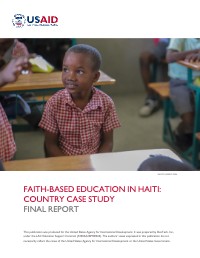
PHOTO CREDIT: FEPH
FAITH-BASED EDUCATION IN HAITI:
COUNTRY CASE STUDY
FINAL REPORT
Submitted to
Nathaniel Haight, Contracting Officer’s Representative
USAID/LAC
Submitted and prepared by:
DevTech Systems, Inc.
Contract GS-10F-0048L/7200AA18M00024
The Global Center for the Development of the Whole Child
Institute for Educational Initiatives
University of Notre Dame
Notre Dame, IN 46556
Lead Author: Fabiola Lopez-Minatchy
Subject: Faith-based education in Latin America and the Caribbean (FE-LAC)
Activity Managers: Alexandra Rice and Nathaniel Haight
Place of Performance or country focus: Latin America and the Caribbean
Period of Performance: June 2022-February 2023
1 | FAITH-BASED EDUCATION IN HAITI: COUNTRY CASE STUDY, FINAL REPORT USAID.GOV
CONTENTS
ACRONYMS 2
EXECUTIVE SUMMARY 4
PURPOSE 7
RATIONALE AND BACKGROUND OF STUDY 7
OBJECTIVES 8
BRIEF METHODOLOGY OVERVIEW 8
KEY STUDY FINDINGS 9
RECOMMENDATIONS 11
INTRODUCTION 13
FAITH-BASED EDUCATION IN HAITI 13
BRIEF HISTORY 13
POLICY CONTEXT 21
RELIGIOUS DEMOGRAPHY 24
METHODOLOGY OVERVIEW 28
FINDINGS 29
STUDY QUESTION 1: THE ROLE AND CONTRIBUTION OF FAITH -BASED EDUCATION 29
STUDY QUESTION 2: CHALLENGES FACING FAITH -BASED SCHOOLS 39
STUDY QUESTION 3: COMPARING FAITH BASED SCHOOLS TO STATE SCHOOLS 41
STUDY QUESTION 4: PARTNERING WITH FAITH BASED SCHOOLS AND ACTORS 44
RECOMMENDATIONS 47
GENERAL RECOMMENDATIONS 47
RECOMMENDATIONS FOR GOVERNMENT 47
RECOMMENDATIONS FOR DONORS 48
RECOMMENDATIONS FOR FAITH -BASED ACTORS 49
SPECIFIC RECOMMENDATIONS LINKED TO SDG 4 49
BIBLIOGRAPHY 51
ANNEXES 52
ANNEX 1: KEY DATASETS 52
ANNEX 2: LIST OF KIIS AND ORGANIZATIONS 54
ANNEXE 3: MINI-CASE STUDIES 55
HAITI MINI-CASE STUDY AND HIGHLIGHTS 1 55
HAITI MINI-CASE STUDY AND HIGHLIGHTS 2 57
HAITI MINI-CASE STUDY AND HIGHLIGHTS 3 59
HAITI MINI-CASE STUDY AND HIGHLIGHTS 4 61
USAID.GOV FAITH-BASED EDUCATION IN HAITI: COUNTRY CASE STUDY, FINAL REPORT | 2
ACRONYMS
BDS Bureaux de district scolaire (School district offices)
CEEC Commission Episcopale des Écoles Catholiques
CIE Carte d’Identification des écoles (School Identification Card)
CFEF Centre de formation pour l’école fondamentale (Basic Education Training Center)
CRS Catholic Relief Services
DAEPP Direction d’Appui à l’Education Privé et au Partenariat (Directorate for Private
Teaching Support and Partnership)
DPCE Direction de la Planification et de la Coopération Externe (Planning and External
Cooperation Directorate)
FEPH Fédération des Ecoles Protestantes d’Haïti (Federation of Protestant Schools in Haiti)
FNE Fond National pour l’Education
FONHEP Fondation Haïtienne de l’Enseignement Privé (Haitian Foundation for Private
Education)
IDB Inter-American Development Bank
KII Key Informant Interview
MENFP
Ministère de l'Éducation Nationale et de la Formation Professionnelle (Ministry of
National Education and Vocational Training)
ONAPE Office National de Partenariat en Haiti
3 | FAITH-BASED EDUCATION IN HAITI: COUNTRY CASE STUDY, FINAL REPORT USAID.GOV
PRONEI Programme National d’Education Intégrée (Integrated Education National Program)
SIGE SIGE (Système d'Information sur la Gestion de l'Education, (System of Information and
Management for Education)
UDCL Unité de Développement des Compétences en Lecture (Early Grade Reading
Development Unit)
UND
University of Notre Dame (Indiana)
USI Unité d’Information et de Statistiques (Statistics and Information Unit)
USAID
U.S. Agency for International Development
USAID.GOV FAITH-BASED EDUCATION IN HAITI: COUNTRY CASE STUDY, FINAL REPORT | 4
EXECUTIVE SUMMARY
The contributions of faith-based education actors and institutions have been extremely important since
the early days of the Haitian nation. With the signing of the Concordat in 1860, the engagement with
religious organizations has made it possible to increase the response to an ever-growing demand for
education for which the State had neither the human nor financial means to meet. In addition, faith-
based actors put the emphasis on sub-segments of the Haitian population, and areas of interest that are
often overlooked by the public actors. With consideration of a market share approximately reaching
84% for non-state schools (most of which are faith-based at an estimated 43% market share), the service
provision and the scope of their delivery is critical for the Haïtian education system.
In 1982 there were 2,132 public versus 1,000 non-public schools. In 1996 there were more than 10,413
non-public schools compared to 2,221 public schools. In terms of infrastructure building, between 1979
and 1981, 1,300 private schools were built versus only 158 public schools. In 2014 a census conducted
by the Ministry of Education counted approximately 18,639 total of schools in the country
1, and among
these 15,721 are considered non-public (84%), and 6,787 are faith-based schools (43%). This number
accounts for both Catholic and Protestant schools. 136 of these 6,787 faith-based schools are listed as
public. Therefore, it’s key to underscore the following points:
• Faith-based institutions and actors contribute to a large degree to increasing access to education
in all the departments in Haiti. Although the majority are concentrated in four departments
(Ouest, Artibonite, Center, North), they provide educational services in all of the ten
departments of the country.
• Although faith-based institutions and actors contribute to the public sector, the vast majority of
faith-based schools are in the non-public sector where they represent almost half of the market
share.
• Public schools are completely outnumbered by non-public schools in every department of Haiti.
Some departments are considerably underserved with a lower number of schools (both public
and private) like the North-East and Grande-Anse.
• Data shows that among the non-public sector and faith-based schools, the majority of schools
are Protestant.
In the past 50 years, the Haitian education sector has shifted from predominantly public national schools
to predominantly non-public/private and faith-based schools. While the number of non-public schools
infrastructures was higher, data suggest that until 2012 student enrollment was higher in public schools.
Even with less infrastructure the public sector welcomed more students than the non-public sector. This
was due to the provision of more classes per grade-level and overcrowded classrooms.
It is important to stress that the lack of verified data is a dire concern in Haiti. Therefore, obtaining
recent and reliable data has been a challenge. The data reported in this document originates from official
datasets obtained by official sources at the Haitian Ministry of Education (MENFP), and also NGO
partners or bibliographical sources from donor partners’ reports.
1
The general numbers provided by the Ministry of Education are to be used with extreme caution, because the
datasets revealed a high risk of double counting. The Ministry’s DAEPP is working on curating what they called
“dataset zero”. And from the 18,639 count of total schools it’s estimated that approximately 2,000 schools might be
counted twice. In addition, there is an important gap in the count of Catholic schools. The official numbers from the
Ministry present 1,564 Catholic schools with 404,634 students, while the 2012 census conducted by CEEC, CRS and
UND are presenting a count of 2,315 schools and 602,149 students (CEEC/CRS/UND, June 2012). Résultats de
l’enquête sur les écoles catholiques en Haïti, Rapport Final.
5 | FAITH-BASED EDUCATION IN HAITI: COUNTRY CASE STUDY, FINAL REPORT USAID.GOV
Key takeaways
Among the 6,787 faith-based schools nationally, less than half are officially holders of a school license
from state authorities. Only 3,254 faith-based schools are licensed by the MENFP/DAEPP.
2 This
challenge of governance has been described frequently in accounts of the Haitian education system,
which often note that the State does not have the capacity to effectively regulate and oversee the
activities of the non-public sector. The number of Catholic schools is 2,315
3 of which the majority are
presbyteral (parish sponsored) schools (878). The number of Protestant schools is 5,223, with a higher
number of mission-sponsored schools (2,765).
Given that one of the identified challenges of the Haitian system is the low internal efficacy, it is
important to acknowledge that only 40% of the schools nationwide participate in the official national
exams. Only 40% of the schools present students to the 9th grade exam at the end of Fundamental
school, and only 18% of the schools present students to the Baccalaureate, which is the end of senior
high school exam.
4
The student enrollment number in Catholic schools is 602,149 students based on the CEEC/CRS/UND
report. For Protestants, the number of students reaches 1,045,718 based on MENFP data.
Over the past decade, faith-based institutions gained significant experience working on donor partners
projects (USAID, UNICEF, World Bank, etc.) and with various implementing partners (RTI International,
FHI360, AIR, etc.). This has resulted in the development of critical technical knowledge and local
capacity development for example in:
• early childhood education
• early grade reading materials development and deployment in classrooms
• reading assessments (EGRA)
• basic skills acquisition in early grades
2
Until 2014, schools had to receive an authorization from the MENFP/DAEPP. With Minister Manigat’s 12
Measures, from 2014 on, schools had to also obtain their identification card (Carte d’Indentification des Ecoles,
CIE)
3
Based on the CEEC, CRS and UND report, the count of Catholic schools and enrolled students in these schools
is considerably higher. Given the level of trust on the quality of the data collection of the CRS/UND census, the
figures from this specific report are used rather than the MENFP census. However, since a similar census is not
available for the Protestant schools, the data from the MENFP is used as a reference (CEEC/CRS/UND, June 2012,
Résultats de l’enquête sur les écoles catholiques en Haïti, Rapport Final).
4
Data from MENFP/BUNEXE for officials exams during the 2021/2022 school year.
USAID.GOV FAITH-BASED EDUCATION IN HAITI: COUNTRY CASE STUDY, FINAL REPORT | 6
However, while they have developed this important past experience, these institutions are rarely the
direct recipients of donor funds. Further analysis could be done in order to better understand how they
could be more directly in charge of project implementation.
After the analysis of the data collected, two general recommendations can be made:
Recommendation 1: Focus on underserved rural areas
Recommendation 2: Focus on school accreditation and teacher certification
From these recommendations emerge opportunities to improve the quality of the system both at the
school and the classroom level, and to improve learning outcomes by ensuring that teachers hold basic
subject matter content-knowledge. From these recommendations there is also the potential to reverse
the trends related to rural migration and urbanization with all the problems deriving from them (WASH,
sanitation, homelessness, unemployment and social distress, violence and crime, etc.). Focusing on
underserved rural areas leads to “make the rural environment a bud of Haiti’s renewal” (FBS leader).
Note on data limitations
One key limitation of research work in Haiti is the availability of reliable and up-to-date data. Despite
the attempts to fully implement the SIGE (Education Information and Management System), the Ministry
of Education (MENFP) has struggled to collect regular and accurate data and most of the information
collected relies on a census made 8 to 10 years ago. These numbers do not necessarily reflect the
current situation, and, therefore, are very poor tools in the orientation of decision-making.
5 In addition,
the disaggregation is not necessarily available for the faith-based subcategories. Another strong point is
that an important gap exists between the data reported by the MENFP for the Catholic schools and the
data reported in the last report on the census conducted in 2012. While a similar census doesn’t exist
for the Protestant networks, and the data might seem old, the numbers from the Catholic dataset seem
to be a reliable source of information and they will be highlighted as a mean to provide a wider range of
the number of schools and enrollment rates that might be closer to the reality on the field.
5
The general numbers obtained from the 2014 national census are used with extreme caution, because some datasets
revealed a high risk of double counting. In this report, the data referred to are mostly based on the officially registered
schools, but not the existing schools that are not registered in the official database. It is understood that these
numbers are lower than the reality on the field.
7 | FAITH-BASED EDUCATION IN HAITI: COUNTRY CASE STUDY, FINAL REPORT USAID.GOV
Faith-Based-Education Data summary
PURPOSE
The purpose of this country case study is to research the role of faith-based actors in education
development in Haiti as part of a broader study of faith-based education in the LAC region. The goal for
this research is to produce an overview of the role, contributions, challenges, and opportunities of faith-
based education in Haiti and to inform future education programs and policies. The regional study
placed a particular focus on services for marginalized and vulnerable children and youth in the LAC
region over the past 30 years.
RATIONALE AND BACKGROUND OF STUDY
The school system of the Republic of Haiti is deeply related to faith-based institutions and structures,
where state prerogatives are intertwined with religious implementers. Faith-based educational
institutions have a long history implementing and contributing to education outcomes in Haiti, pre and
post-colonial times. Therefore, it is critical to understand the historical roots of faith-based education in
a context where more than two centuries after the creation of the Haitian nation, the picture of the
USAID.GOV FAITH-BASED EDUCATION IN HAITI: COUNTRY CASE STUDY, FINAL REPORT | 8
education system still reflects historical arrangements, official agreements, and ad-hoc adaptation to the
evolving social context.
This report will attempt to shed light on the history of faith-based schools in Haiti, to better document
the contributions of these actors, and to understand their potential role in advancing development aims
related to quality education for all.
This study sought to reach a diversity sample across multiple faith traditions, areas of the education
sector, and type of organizations. Document analysis and key informant interviews (KII) were conducted
to explore the context of faith based education in Haiti from an inclusive perspective. The contributions
of Voodouists, Muslims, and Baha’i faith, were considered, however, due to the extremely volatile
context during the time of the data collection, we were unable to reach as many informants as hoped.
The multiple constraints due to the unstable socio-political context between May and November 2022
limited the reach to the two main religious groups in terms of demographic composition: Catholic and
Protestant.
The attention to this topic is of particular importance in the context of a looming crisis in which the
public sector has been significantly weakened. The support and promotion of quality education for all is
not only a state affair but demands the support of all involved: public, non-public, faith-based and
independent partners hold a major role in shifting the education system and supporting a more stable,
peaceful, equitable and prosperous Haiti.
OBJECTIVES
This country case study aims at:
1. informing USAID’s strategy, activity design, and implementation on faith-based education in
Haiti.
2. contributing to the global knowledge of faith-based education programming and advancing the
evidence base for the USAID Education Learning Agenda.
The data collected for this study are compiled so as to equitably reflect the key stakeholder groups
within the system and cases highlighted here serve as illustrative examples of successful initiatives,
inspiring attempts, and/or groundbreaking work that hold strong potential for future programing.
BRIEF METHODOLOGY OVERVIEW
This study is based on a synthesis of available literature, secondary data, and key informant interviews.
The work undertaken will help to increase the understanding of the scope and market-share of faith-
based school networks in the country. Key informant interviews have been conducted: 1) to assist in
identifying secondary datasets, 2) to assist in identifying relevant documents, 3) to understand the role,
contributions, challenges, distinctiveness, and opportunities for engagement of faith-based educational
actors, and 4) to identify and collect data about illustrative mini-cases. The sample of mini-case studies
selected reflects initiatives undertaken in school communities, disadvantaged and/or violence-prone
neighborhoods, and can serve to inspire activity design in Haiti.
In the approach followed for this study, faith-based actors and institutions are defined as non-state
entities with a direct or indirect religious sponsorship or affiliation. This can include local faith
communities (LFC) (e.g. churches, temples, mosques), church-sponsored or religious entity-sponsored
schools or networks of schools (e.g. a school sponsored by an LFC or another religious group),
international or local NGOs with a direct or indirect religious affiliation and identity (e.g. World Vision,
Catholic Relief Services, Caritas, Compassion International), and religiously sponsored higher education
institutions (e.g. Université Episcopale d’Haiti, Université de Notre-Dame d’Haiti, Lumière University
MEBSH, etc.). Education will be considered as including early childhood education and development,
preprimary, fundamental schools (corresponding to three cycles covering primary to junior high
9 | FAITH-BASED EDUCATION IN HAITI: COUNTRY CASE STUDY, FINAL REPORT USAID.GOV
schools), secondary schools (corresponding to senior high schools), youth engagement, and child
protection. Higher education institutions are given minor consideration as this is not the primary focus
of this study. An important note for Haiti is to consider that some of the national schools are
administered by faith-based congregations, therefore, datasets of public schools sometimes require a
more refined disaggregation.
KEY STUDY FINDINGS
1. What is the role and contributions of faith-based education actors and institutions
in providing education services, especially for marginalized and vulnerable children
and youth (e.g. those experiencing extreme poverty, affected by irregular
migration, affected by violence, girls and boys, those with disabilities, ethnic and
linguistic minorities, rural and urban, etc.)?
Key Findings
● Faith-based institutions play a critical role in providing access to education services
in Haiti. They represent approximately 43% of the market share and they are ensuring services
that the Haitian government is not able to provide due to lack of financial means and personnel.
● Faith-based institutions are reaching populations in rural and remote areas where
the public offers are scarce.
● Faith-based actors are responding to a need to support marginalized and vulnerable
children and youth in rural, urban, or peri-urban areas that are underserved or face extreme
poverty and/or violence.
● Faith-based actors are providing technical expertise in the sector by supporting the
government in the development of policies and instructional content/materials.
● Faith-based actors are supporting segments of the population often ignored by the
Haitian government such as overaged and out-of-school children and youth, children in
domestic service, vulnerable young girls, children with disabilities, etc.
● Faith-based actors play an important role in the reduction of illiteracy and
improvement of adult literacy through afternoon or Sunday classes for adults.
2. What are the challenges faith-based schools face in regards to achieving education
outcomes, especially in communities affected by insecurity, poverty, and migration?
Key Findings
● Faith-based institutions face an increased difficulty to financially sustain education
services in schools and communities. High inflation and the increase of violence and
insecurity makes it more challenging to safely and cost-effectively reach beneficiaries and
operate schools.
● Faith-based actors do not feel that they have a sustained dialogue with the
Haitian government and have a limited advocacy role and little weight on education
policy decisions despite their large market share.
● Faith-based organizations lack means for self-generated revenues to ensure
sustainable activities and personnel, and rely mostly on external funds, members
fees, and school fees which are not sufficient to meet their needs and support long-
term development aims.
● General challenges faced by faith-based schools
■ Limited funds
USAID.GOV FAITH-BASED EDUCATION IN HAITI: COUNTRY CASE STUDY, FINAL REPORT | 10
■ Limited capacity to auto-generate revenues
■ Socio-political instability
■ Unsustained political dialogue and political will
■ Negative perception of the role of faith-based institutions perceived as
“competitors” by the State
■ Lack of institutional/political power of faith-based institutions
■ Migration (in particular in Eastern region bordering the Dominican Republic)
● Challenges facing faith-based schools to achieve desired educational
outcomes
■ The absence of quality standards for teaching and learning creates high disparities
and low educational outcomes
■ The limited educational offer concentrates on Fundamental and Secondary
schooling, and less so on preschool, higher education and vocational training
■ The cost of school enrollment does not always allow inclusive and equitable
education.
■ There is limited availability of qualified teachers and limited funds to pay them,
■ There is limited access to water and electricity, two basic conditions needed to
carry out education services with minimal quality standards
■ Schools are unable to guarantee school feeding for all students
■ There is limited instructional time (disruptions in school days due to political
instability or ineffective organization of instructional time)
■ There is limited infrastructure to respond to the needs of students with disabilities
■ There is limited capacity to provide training in innovative technologies to be
responsive to global trends and innovations (due to lack of trained teachers,
electricity shortages, unavailable materials, etc.)
■ There is limited content available for Global Citizenship Education, Risk Prevention
and Natural Disaster Response
● Specific challenges facing faith-based schools in efforts to serve
marginalized communities
■ Insecurity and violence
■ Poverty
■ Socio-political instability
■ Limited funds and limited access to development opportunities
■ Inflation and increased cost of fuels and basic supplies
3. How do faith-based schools compare to state-run schools in terms of resources (and
sources), accessibility (urban/rural), safety, parental and community engagement,
perceived advantages and disadvantages, quality and learning outcomes, especially
for marginalized and vulnerable populations, adaptability to shocks (e.g. COVID,
violence, migration), and curricular differences?
Key Findings
● Faith-based schools and state-run schools are both more prevalent in urban areas.
However, only faith-based schools reach higher numbers of schools in rural and/or
remote areas. The presence of schools in rural and/or remote areas is primarily ensured by
faith-based institutions.
● Funding of faith-based schools comes from a combination of public funding (state-
run non-public schools, and other subsidies for non-state run schools such as
11 | FAITH-BASED EDUCATION IN HAITI: COUNTRY CASE STUDY, FINAL REPORT USAID.GOV
national education funds
6, school feeding credits, etc.), school fees paid by parents,
and sometimes support from churches and missions. Diverse sources of fundings are
available but they come with no regularity, which inhibits the school networks’ ability to
effectively manage financial planning.
● Faith-based schools are reported to have more parental and community
engagement than state-run schools. In the building of social capital and enabling civic
participation, faith-based schools offer more space for engagement, in particular through school
committees (Conseils d’école). These committees are local governance structures that also
familiarize beneficiaries with the experience of democratic values and norms (regular elections,
voting, building common projects for the benefit of the community, etc.).
● Teacher attendance and local accountability is reported to be higher in faith-based
schools than in state-run schools. The supervision of school directors, and the presence of
regional supervision structures (for the Catholic schools with the Diocesan Bureaus in each
department) tends to foster higher levels of monitoring and accountability in non-public and
faith-based schools.
4. What are the effective ways and opportunities for donors and the public education
sector to engage religious communities and partner with faith-based organizations
to leverage/improve education outcomes?
Key Findings
● Catholic and Protestant schools networks are united under an umbrella
organization representing the non-public sector: FONHEP (Haitian Foundation for
Private Education, Fondation Haïtienne pour l’Enseignement Privé). The different
networks are already united under this organization, however, FONHEP - initially a USAID-
funded project - has suffered from loss of personnel due to financial constraints and the local
insecurity and instability in the context.
● Public-private partnerships between the government and faith-based networks for
conducting school supervision and school monitoring tasks is a possible strategy for
improving quality standards and accountability in the system. Establishing standards
and delegating tasks that the MENFP struggles to manage independently represents a strategic
option that could complement and extend state services.
● Donor partner grants and contracts for faith-based institutions come with a lot of
institutional burden. Managing funds from donor partners can be time-consuming and even
result in institutions losing money. An option is to launch a mechanism of awards/prizes to
reward innovative initiatives that can be scaled up with a reduced bureaucratic burden.
● Faith-based organizations need capacity building in development, advocacy and
outreach to better serve the education sector.
Based on the different analyses and key findings, a series of recommendations has been made at 3 levels:
for the government, for donors, and for faith-based actors. In addition, a complementary list is provided
in relation to the Sustainable Development Goals (SDG), under SDG 4: Sustainable Education which
“aims to ensure inclusive and equitable quality education and promote lifelong learning opportunities for
all.”
6
FNE: Fond National pour l’Education
USAID.GOV FAITH-BASED EDUCATION IN HAITI: COUNTRY CASE STUDY, FINAL REPORT | 12
General recommendations
Recommendation 1: Focus on underserved rural areas
Recommendation 2: Focus on school accreditation and teacher certification
Recommendations for government
Recommendation 3: Focus on collaborating with faith-based schools to regulate the sector
Recommendation 4: Increase exchange opportunities with faith-based networks for improved
policy dialogue
Recommendation 5: Collaborate with faith-based networks for improved instructional content
Recommendations for donors
Recommendation 6: Promote regional approaches and value community education
Recommendation 7: Consider supporting existing initiatives
Recommendation 8: Consider increasing localization and local capacity strengthening by
supporting established local networks
Recommendation 9: Value the Haitian cooperative model (“Konbit”)
Recommendation 10: Envision “prizes” or “awards” with minimal institutional constraints
Recommendations for faith-based actors
Recommendation 11: Develop a coordinated strategy at the national level
Recommendation 12: Create a development office in charge of looking for funding and reaching
outside the scope of usual bilateral donors
Recommendation 13: Develop vocational education options and envision partnerships with the
private sector
Recommendation 14: Unite to advocate for cross-cutting issues and leverage higher amounts of
money
Recommendation 15: Develop a range of incentives at different stages of teachers’ careers
Recommendation 16: Increase access to books and resources
Specific recommendations linked to SDG 4
Recommendation 17: Fund a faith-based education research or census
Recommendation 18: Support the MENFP’s curricular efforts (including for distance learning)
and develop free content focused on work-specific and transferable skills
13 | FAITH-BASED EDUCATION IN HAITI: COUNTRY CASE STUDY, FINAL REPORT USAID.GOV
INTRODUCTION
FAITH-BASED EDUCATION IN HAITI
Since colonial times, religious actors have been an integral part of education in Haiti. After
independence, facing the lack of infrastructure and trained personnel, the Concordat of 1860 was an
agreement between the Catholic Church -the Vatican- and the Haitian government. The Concordat
recognized the new Haitian republic and provided a privileged role for Catholic schools within the
education system, including state funding of Catholic schools. This political action of the new nation was
a way to both address a sectoral need and to gain acceptance by the international community. The
recognition of the Haitian nation was a major issue during the first decades of its existence, this helps to
understand the importance of adopting and sharing the same values as the Western world and the place
given to Christianity.
Due to the lack of resources, teachers and materials were often imported. The lack of national human
resources explains some political decisions. For example, the choice to switch to the Lancastrian model
was a strategic move to step away from the French system but also a way to address these challenges in
a simple and rapid manner. Indeed, given the lack of qualified teachers, having more students per teacher
seemed to be a solution for the governments of the time.
Over the years, the lack of infrastructure, trained teachers, and available appropriate, student-friendly
and culturally-friendly materials are systemic challenges that have never been addressed in a sustainable
way. The government’s inability to take strong and consistent steps in the direction of free quality
education for all explains in part how the non-public sector has progressively expanded and surpassed
the market share of the public sector. Between 1843 and 1930 the Haitian education sector had over 64
ministers. This partly explains the State’s inability to sustain education policies, initiatives and reforms.
Establishing a clear typology of schools in Haiti is an extremely arduous task. The school system in Haiti
is complex because -as a result of the Concordat- some public schools are managed and administered by
Catholic congregational entities. Therefore, the data received for public schools does not accurately
depict the proportion of the faith-based entities. There is a quantity of national/public schools that are
not counted as faith-based while their administration and the way they are functioning is typical of
religious schools of the non-public sector. After a brief presentation of the Haitian history and policy
context, key findings and recommendations stemming from the grey literature and KIIs will be
presented, and a series of success stories will be highlighted as mini-cases in the country context.
BRIEF HISTORY
FAITH-BASED EDUCATION DURING COLONIAL TIMES (1492 -1804)
The island of Haiti was coveted by the big European nations following the arrival of Christopher
Colombus on the Northeast coast, at the Morne St Nicolas. The history of the school system stems
from the colonial epoch where the education of the slaves was linked to the mastery of specific abilities
and a very general religious education as a result of the will to Christianize the African workforce. The
Black Code specified that slave masters must ensure the catechetical education of slaves and preparation
to receive Sacraments. Historians describe the education practices at the time primarily as oriented
towards religious conversion, the eradication of belief in autochthonous cults, and the inculcation of the
foundations of Catholicism.
USAID.GOV FAITH-BASED EDUCATION IN HAITI: COUNTRY CASE STUDY, FINAL REPORT | 14
From historical references, it appears that the schools in the colonial era served mainly two categories
of people: freed slaves and colonists. These schools were based on French instruction in basic literacy
skills, literature, science, astronomy, general culture, and philosophy.
7
In this configuration, education was related to two distinct currents:
-the indoctrination of the masses of slaves focused on Christianization (religious instruction) and
workforce development for the plantations (instruction in specific abilities related to key needs: wood
work, iron work, agricultural work, house work, etc.).
-professional training for freedmen (veterinarians, nurses, masons, musicians, dancers, artists etc.)
considered more socially valued skills for the purpose of managing the plantations and entertaining the
masters.
Slave masters and certain freedmen received more formal education based on European standards,
however, this was available to few people within the colony.
The legal establishment of the provision of education can be traced through Haiti’s constitutional law.
Haiti has had 29 constitutions and other amendments since independence. The first constitution was
initiated at the time of the Haitian anti-slavery revolution of 1801 under the leadership of General
Toussaint Louverture, general of the army of Saint-Domingue, and transmitted to general Napoleon
Bonaparte, head of the French nation. Among the 77 articles of this first constitution was an article
focused on education, which is considered to be at the very inception of the Haitian education sector. It
states: "Every person has the right to form special educational and instruction institutions for young
people under the authorization and supervision of municipal administrations." Experts analyze this article
as the foundation of the open door to widespread non-public education. But it mostly represents the
very core of the first precept of the right of education for all –regardless of ethnicity, social origins,
place of residence, etc. Indeed, this was revolutionary at the time, in particular, as it stood in opposition
to the dehumanization of slavery. Most importantly, it recognized the inalienable right of education for
all. And the fact that it placed education under the regulation of the State (municipalities) shows an
attempt to install the foundation of state governance. While the door was left open to all to allow
increased access to education, it established regulations and a state-led orientation.
In summary, as per the guidelines of the Black Code, during colonial times, education consisted of faith-
based instruction related to mass Christianization and workforce development on the one side, and the
education of elites on the other side. During the transition years of the Haitian revolution, General
Louverture’s Constitution established the right to education for all under the regulation of the State.
7
Brutus E. (1948). Instruction publique en Haiti : 1492-1945. Imprimerie de l’Etat, Port-au-Prince.
15 | FAITH-BASED EDUCATION IN HAITI: COUNTRY CASE STUDY, FINAL REPORT USAID.GOV
FAITH-BASED EDUCATION DURING POST -COLONIAL TIMES (1804-1934)
Over two centuries it is striking to see that Haiti had 29 constitutions, and by going through the multiple
texts, two common themes emerge: the idea of free education and the compulsory nature of education.
Since the revolutionary constitution of Toussaint Louverture, these principles are well-established in the
texts; however, these declarations of intent often failed to concretize in practice. After Haiti’s
declaration of independence in 1804, the country’s first official Constitution was initiated under Jean-
Jacques Dessalines in 1805. The priority of the freed slaves at the time was the defense of the territory
of the young Haitian nation, which was not recognized by the international community.
8 In this
constitution of 53 articles only two deal with education.
9 The article 19 establishing that each military
district shall have a public school for the instruction of young people
10 and article 40 putting education
under the responsibility of the Minister of Finance and the Interior. It appears that education was mostly
8
Despite the help of the revolutionaries of Haiti in the fighting of 1774-1775 for the independence of the United
States in 1776, the US refused to recognize the independence of Haiti. Official relations only began in 1862 under
the administration of Abraham Lincoln. Delima P., (2014). Constitutions, lois et éducation en Haïti 1801-2018 – Eléments
de politiques éducatives. Editions Mémoire, Québec, Canada.
9
Delima P., (2014). Constitutions, lois et éducation en Haïti 1801-2018 – Eléments de politiques éducatives. Editions
Mémoire, Québec, Canada.
10
Education was dedicated to the military forces in the 6 military districts of the Haitian territory. The 6 military
districts were: St Marc, Port-au-Prince, Cap-Haïtien, Port-de-Paix, Anse-à-Veau, and Cayes.
USAID.GOV FAITH-BASED EDUCATION IN HAITI: COUNTRY CASE STUDY, FINAL REPORT | 16
limited to urban areas and provided for the military elites, and was not available for the mass of field
workers and rural inhabitants.
In the first constitution of the emerging Haitian nation, the educational policy of Toussaint favored
freedom of education and made the Roman Catholic religion compulsory. The close link between
education and religion was replicated from the prevailing models from Europe and the Western world,
and served as a basis for promoting Haiti’s acceptance by foreign powers.
The following Haitian constitution of Henri Christophe
11 in 1806 (for the North), was composed of 200
articles, though none focused on education. However, Christophe had a very clear idea of what Haitian
education should look like. In his inaugural speech, Christophe established education as a priority for the
liberation of people during the post-colonial period, and for raising the masses against the ignorance and
degradation of slavery. One of Christophe's first decisions was the break with the French education
system of the former colony, and fostering greater alignment with the British model. He established an
education system based on the British Lancasterian model. The language of communication ceased to be
French, and English became not only the official language, but also the language of instruction. In
addition, schooling was compulsory and the law punished any parent who did not send his child to
school.
The educational policy of Henri Christophe, in his attempt to generalize education by Lancasterian
methods, also brought a commitment to mass education
12 that broke with the elitist tradition of the
great European nations of the time. Christophe was a visionary who broke with the French system, and
tried to respond to critical educational needs. Acknowledging the gap between demand and offer, he
also called on qualified foreigners to respond to the lack of trained local teachers.
While Christophe’s policy promoted openness in the Northern part of Haiti, Pétion’s educational policy
for the West and the South remained mostly focused on the military and urban elites. One key aspect of
Pétion’s constitution of 1816 was, however, the promotion of free and equal access to education. In
addition, Education was under the responsibility of the State, where the contents and programs were
defined by the government. The prerogative to educate Haitians was not transferred to foreign
institutions or religious entities.
11
After the assassination of Dessalines, the Haitian territory was divided between Henri Christophe who reigned
over the Northern part, and Alexandre Pétion who reigned on the West and South of Haiti.
12
What is now known as plethoric classroom in Haiti is the result of these Lancastrian practices. It’s important to
note that at the time in Europe, the mass education wasn’t yet widespread which confirms Christophe as a
trailblazer.
17 | FAITH-BASED EDUCATION IN HAITI: COUNTRY CASE STUDY, FINAL REPORT USAID.GOV
After the death of Pétion and Christophe, Boyer reunited the North and the South of Haiti and annexed
the current Dominican Republic. In the era of expansion the education sector remained marked by
elitism. The University of Santo Domingo, founded in 1538, was closed. Additional Lancastrian schools
were opened, including two in the Dominican Republic, and instruction was mostly done in French. One
important milestone was achieved in girls’ education with the creation of special schools for young girls
in 1819. Today this might appear as a sign of segregation or lack of inclusiveness, but considering the
historical context, this was cutting edge.
In 1860, the bilateral agreement known as the “Concordat” was signed between the recently
independent Haitian Republic and the Vatican. This decision met strategic and political needs, on the one
side, and addressed sectoral needs, on the other. Indeed, the young republic was unable to respond to
the education needs of a mass of former slaves without basic instruction and a series of challenges were
yet to be solved, including the lack of school infrastructure, the lack of trained teachers, the lack of
funding for education,
13 and the lack of adapted materials in the mother-tongue.
14 In order to respond to
the first two challenges, to align with the mainstream western culture, and to finally be officially
recognized by the occidental nations, the choice of the Haitian government to partner with the Catholic
Church was strategic. It was also prudent in terms of educational aims, as the Concordat sought to
engage Catholic religious institutions in support of the government’s efforts to meet its constitutional
obligation to provide free compulsory education services to all.
From 1843 to 1915, the education sector had 54 ministers or secretaries of state. Then between 1921
and 1930, in less than 10 years, what became the Ministry of Public Instruction had no less than 10
ministers. This instability and lack of continuity in reform and policy direction has been a major problem
in the history of Haiti.
13
At the time, most of the nation’s fundings were allocated to protecting the Haitian territory for potential
attempts by the French to reconquer the land. In addition, after the agreement with France to pay the
“Independence Debt”, a very high percentage of the national revenues were reversed to the former occupant.
14
Most of the former slaves were not French speakers. After the decimation of the Natives, replaced by the
Africans, Creole became the mother tongue. Haitian Creole became the widespread native language of the
inhabitants of the republic. French remained predominant for official and diplomatic communications. Therefore,
this dual linguistic approach is long established.
USAID.GOV FAITH-BASED EDUCATION IN HAITI: COUNTRY CASE STUDY, FINAL REPORT | 18
During the American Occupation from 1915 to 1934, public instruction was neutralized and under
guardianship, and the Americans sought to remake the Haitian system to mirror the American model.
There was a strong will to separate church and state as an echo to the First Amendment of the
American Bill of Rights, denying public funds to religious schools. Given the need for a better skilled
workforce, a major focus was placed on investments in vocational and technical training based on the
American system of vocational education. Vocational schools thus emerged as a new social instrument
capable of educating a new class of skilled workers, and scholarships were given to Haitian students to
study in the US.
RECENT SHIFTS (1934-TO PRESENT)
The American occupation enabled the emergence of a new layer of elite from among the ranks of black
and popular Haitians. After the U.S. occupation the Haitian education sector embarked on a phase of
massification with increased schooling of students of rural and popular origin.
19 | FAITH-BASED EDUCATION IN HAITI: COUNTRY CASE STUDY, FINAL REPORT USAID.GOV
When the Americans left, Haitian leaders tried to reform the traditional education system. But the
reforms are generally regarded as reinforcing the urban/rural duality.
15 For example, the opening of
farm-schools and rural schools is an initiative to respond to the specific needs of peasants in the rural
areas, and these schools depended on the Ministry of Agriculture, not on the Ministry of Education.
During the 1960’s, there was strong population growth. In addition, there was a mass exodus of rural
populations to urban areas in search of economic opportunity, improved quality of life, better access to
health care, and educational opportunity. The introduction of instruction in two shifts, in morning and
afternoon, was introduced to address the growing urban population and educational demand.
Four important events represent shifts in the way the Haitian sector evolved in the 5 past decades until
the present:
1. The 1979 reform: led by Minister Bernard under the presidency of Jean-Claude Duvalier, remains
a critical text for the sector until today. The educational context that led to this reform is based
on the will to increase access and to expand the foundational knowledge by creating a common
core of skills for all Haitians in 9 “fundamental” school years. The former division pre-school,
primary, secondary, and high school, seemed outdated. The new model sought to create a
foundation in fundamentals that went beyond primary school and opened perspectives to the first
years of secondary school, while giving options to alternative vocational routes. This reform also
represents an attempt to address the challenge of bilingualism. The language of instruction
became Haitian Creole at the beginning of schooling and French was to be introduced orally, with
an eventual transition to French as the language of instruction. Lastly, the reform attempted to
structure professional training and created vocational centers to break with the elitist policy of
traditional secondary schools as the only option. The intent was to allow a parallel option while
meeting the demand for skilled workers.
2. The GTEF (Groupe de Travail en Éducation et Formation) created in 2008: is a cross-sectoral
working group which led to the development of the MENFP’s Operational Plan 2010-2015. It can
be considered as the first strategic and management document of its kind. Indeed, given the high
turnover rate among ministers, having a five year operational plan was an important step towards
a more consistent sectoral approach. One of the key challenges was the alignment between
donor partners’ agendas and the government’s plans, and the financing of the different sub
15
Delima P., (2014). Constitutions, lois et éducation en Haïti 1801-2018 – Eléments de politiques éducatives.
Editions Mémoire, Québec, Canada.
USAID.GOV FAITH-BASED EDUCATION IN HAITI: COUNTRY CASE STUDY, FINAL REPORT | 20
sectors. For example, most bilateral partners are mobilized in early grade education. Few
partners were interested in secondary or superior education, and even less in vocational training.
This resulted in high difficulty for financing some subsectors and maintaining reform efforts
remains a challenge.
3. The 2010 earthquake: Haiti is located in a geographic area prone to high natural risks (hurricanes,
earthquakes, etc.). In January 2010 the country was hit by an earthquake of 7 on the Richter
scale, which killed over 300,000 people and caused massive destruction, including the loss of
about 4,200 schools. This led to a major crisis due to the difficulty to channel and structure
international aid. Until 2017, seven years after the earthquake, numerous schools were still in
temporary shelters despite the interventions of the donor partners.
4. The “Twelve Measures,” initiated by Minister Nesmy MANIGAT in 2014, are key orientations for
the Haitian education system. They cover the Ministry’s attempt to improve quality education in
schools. These measures include the obligation that all schools be accredited by the MENFP, all
teachers hold a teacher permit, all children receive vaccinations, etc.
KEY CHALLENGES
Throughout its history, Haiti has faced chronic challenges that hindered the progress of the education
sector and limited the learning outcomes of Haitian students:
• Since independence, limited access has been an element of blockage. There are not enough
schools to respond to the demand.
• Since independence, the lack of qualified teachers and lack of teacher training institutes has been
identified as a bottleneck. In 1995, there were only 18 teacher training institutes in the entire
country.
21 | FAITH-BASED EDUCATION IN HAITI: COUNTRY CASE STUDY, FINAL REPORT USAID.GOV
• Since independence, the high turnover of presidents and education ministers led to a legacy of
incomplete and unimplemented reforms with little continuity of vision.
In addition, the lack of governance, ineffective and inefficient internal and external performance,
devalorization of the status of teachers, and under remuneration are recurring problems identified in the
sector:
• Since independence, the education sector has been underfunded as the priorities have shifted
between defense, roads and infrastructure, agriculture, tourism etc. Efforts were initiated
between the 1980’s and 1990’s to raise the education budget, but was not consistently achieved.
A decreasing share of the national budget has been allocated to education since 1995, after an
increase between 1988 and 1995 from 19% to 22.8%. Between 2001 and 2006, the state budget
for education fell from 17% to 10% with a focus on operating expenditure (more than 80% for
the Ministry of Education’s budget).
16
The challenges above are important to highlight as they represent repeating patterns that are still
relevant today. Based on their specific agendas, donor partners often try to address them by operating
in silos versus adopting a holistic and sustainable perspective to support the Haitian government.
17
Bottlenecks in the system have been regularly discussed within sectoral working groups. Nonetheless,
without a realistic yet holistic plan by the government to cope with the diverse obstacles, it is unlikely
that the current unconsolidated approaches will help the sector flourish. Key bottlenecks include:
• Geographic disparities: inequalities caused by unequal or no access to schools for students in
rural or remote areas
• Inappropriate educational infrastructure: a high number of schools are operating in
locations and buildings not conceived for educational purposes and not conducive to learning.
Only 57% of the schools operate with appropriate infrastructure. 12% of the schools are based
in residential buildings and 15% in churches. In addition, school infrastructure is very rarely
adapted for access for people with disabilities.
• Lack of basic resources: a high number of schools are operating in locations without clean
water, electricity, and access to food.
• Lack of data: available databases are often outdated and not reliable, therefore, not suitable
for decision-making and policy dialogue.
POLICY CONTEXT
Since the first constitution of the republic under Dessalines in 1805, the Haitian government authorized
private entities to provide instruction under the regulation of the State. The idea of private schools was
introduced in 1801 and amplified by the constitution of 1807 with the idea of “particular schools.” In the
successive constitutions, the principle of the governance of the State has always been underlined. The
first important attempt to structure governance came from Henri Christophe with the “Royal Chamber
of Public Instruction,” which ensured the proper functioning of all private institutions and was
responsible for the development of curricula and the selection of books used in schools.
16
There is a clear imbalance in expenditure allocation practices in the Haitian education system: 90% of the
MENFP’s budget is spent for staff payment versus only 10% for teaching materials, staff training and operating
costs. Financial resources come mainly from donor partners. The education system relies essentially on
international assistance: in 1995-1996 65% of the national budget of the sector came from external aid.
MENJS/RTI-AED Educat : Diagnostic technique du système éducatif haïtien, 1995.
17
One considerable caveat is that the successive Haitian governments are considerably unstable and not able to
demonstrate strong and consistent political will. That in itself can be considered as a challenge for the education
sector.
USAID.GOV FAITH-BASED EDUCATION IN HAITI: COUNTRY CASE STUDY, FINAL REPORT | 22
In Haiti, public funding of faith-based schools occurs under the legal structure of the Concordat signed in
1860, which led to the exclusive support of Catholic schools. Church organizations both own and
operate schools, and deliver educational services. The Catholic schools thus include both non-public and
public schools.
18
Under the partnership installed by the Concordat, the Haitian government assumed the obligation to
pay for the operations of some Catholic schools, including personnel (teachers and administration
salaries), infrastructure maintenance, and materials. Similar public funding support is not provided to the
other faith-based actors and institutions.
This privileged position of Catholic schools is often considered a critical advantage by other actors
within the education sector and speaks to the historical influence of the Catholic Church in Haiti.
19 An
estimated 11% of the current 2,315 Catholic schools were receiving public funding as of a 2012 census
of Catholic schools. Among faith-based actors, Catholic institutions were often considered privileged.
However, over the past decades State subsidies are said to have decreased,
20 and a study led by the
Catholic schools showed that 44% do not receive these grants regularly or do not receive them on
time.
21
18
They have a complex subdivision among which: the congregational (public and non-public), the autonomous schools (recognized
by the State, and not recognized), and the presbyteral (national, congregational).
19
United States Department of State Office of International Religious Freedom (2022). 2021 Report on International Religious
Freedom: Haiti.
20
Based on KII it is said that State financing has considerably decreased and is received irregularly by the schools.
21
CEEC/CRS/UND, (June 2012). Résultats de l’enquête sur les écoles catholiques en Haïti, Rapport Final.
23 | FAITH-BASED EDUCATION IN HAITI: COUNTRY CASE STUDY, FINAL REPORT USAID.GOV
The other faith-based category is Protestant schools. They also have a complex subdivision but for a
simple presentation they are usually subdivided in two groups: the “independant” and the “mission”
schools.
22 The Protestant schools, like most Catholic schools, are primarily tuition funded, yet they have
access to limited public resources (National Education Fund, school feeding subsidies, etc.). For a limited
number of schools, funding is offered in the form of per pupil subsidies (in part or in full) to support the
cost of education for parents regardless of religious affiliation. This is also the case for school feeding
programs. In addition, over the past decade, in an attempt to expand free education for all, President
Martelly launched PSUGO,
23 where non-state schools received per pupil subsidies from the government
in exchange for waiving student tuition fees. Various implementation challenges, including widespread
allegations of fraud, led the program to be discontinued and this policy approach to be abandoned.
The regulation schools and the sector more broadly is a great challenge in a country with over 18,000
schools and only 555 inspectors. In addition, it is well established that these inspectors do not
necessarily have the transportation means to access the schools. Therefore, there is limited capacity of
the State to enforce regulatory control.
In 2014, Minister Nesmy MANIGAT initiated a series of measures to reinforce the regulation of the
State over the education system with the aim of improving the quality of education. Among these
measures, the school identity card (Carte d’Identité d’Ecole) was launched, and the teaching permit
(Permis d’Enseigner) for teaching personnel was initiated. Data is not available to reflect the current
situation, however, in the following section the numbers will show that in 2014 less than half of non-
public (including faith-based) schools were officially registered.
The State provides national regulation over the system through laws and the issuance of ministerial
decisions (“Décisions Ministérielles”) published in the official newspaper “Le Moniteur”. The MENFP
sets guidance for curricular content (through the grade-level detailed program “Programme Détaillé”),
and over the price of school fees, for example. Although the Haitian political context has not allowed
for the passage of new laws for at least the past 5 years, it seems that the challenge lies less in the
issuing of regulations and more in the ability of controlling their implementation and compliance in the
field. The lack of accountability systems is a major concern in Haiti. Even the participation in state official
exams
24 is not sufficient to pull the system up to higher standards.
One of the MENFP’s current attempts is to start regular evaluation of students’ learning achievements in
key subject areas in order to participate in the international PISA assessment. The DEF is working in this
with the support of the Inter-American Development Bank (IBD).
In the 2000s, the government took steps to acknowledge and respond to the importance of the non-
public sector by creating the ONAPE (National Office for Partnerships in Education). The ONAPE is an
autonomous body under the supervision of the Ministry of Education. Despite the importance of its
role, this national office is not given the priority it deserves given the primary role of non-state schools
in the Haitian context. Seven years passed between the passing of the law promulgating its creation
(2007) and its official launch (2015). Since its launch, this office is not yet able to play a leadership role in
education policy-making, and its influence is not as central as could have been envisioned. Indeed, the
role of the ONAPE is to coordinate and support the non-public sector. The mission defined for the
ONAPE is: to promote the effective participation of the non-public sector, to develop and implement
development education policies and programs in Haiti, to participate in the development of policy and
the definition of objectives of the ministry regarding partnership between the two sectors (private and
public), to participate in the development of plans, programmes, and projects related to the objectives of
22
In Haïti, Protestant schools are often differentiated in two categories: the “independent schools” not linked to
any Protestant mission or church, and the “Mission” schools, led by a Pastor and specific faith-community.
23
PSUGO: Programme de Scolarité Universelle Gratuite Obligatoire, free compulsory universal education
program.
24
The end of Fundamental school 9th Grade exam, and the end of Secondary Baccalaureat for example.
USAID.GOV FAITH-BASED EDUCATION IN HAITI: COUNTRY CASE STUDY, FINAL REPORT | 24
the National Plan of Education and Training (PNEF), and to carry out activities related to the
management of the public and non-public partnership in the education sector. With an 85% non-state
school market-share, this office should spearhead the most important segments of the Haitian Education
sector, yet it seems to play a rather limited role. Further investigation should seek to better understand
the constraints and bottlenecks keeping it from fully realizing its mission.
Overall, the partnerships between faith-based entities and the Haitian government reflects both political
expediency and education policy realism. Indeed, since its independence, Haiti has been facing an inability
to respond to the high demand for education. Most partnerships allowed a contribution to the
expansion of the school infrastructure and overall increase of access to education in the most
underserved geographic areas and segments of the population. For example, overaged children, children
in domestic service, and children with disabilities are provided little to no service.
RELIGIOUS DEMOGRAPHY
The estimated Haitian population reached 11,905,897 people in 2021, among which 1,701,327 are located
in the West department.
25 The constitution provides for the free exercise of all religions. The religious
groups must obtain official recognition through a multi-step registration process with the Bureau of
Worship (Bureau des Cultes).
26 The religious demography in Haiti is difficult to identify from official data.
Datasets from the Haitian Institute of Statistics and Information (IHSI) do not provide this information and
the Bureau of Worship has very limited datasets. In a survey conducted in 2016,
27 88% of the population
surveyed declared having a religion. The survey reveals approximately 52% identified as Protestant
(Protestant, Episcopalian, Methodist, Seventh-day Adventist, or Jehovah’s Witness), 35% as Catholic, and
2% as Vodouists, while 11% identified as being of “no religious affiliation”.
Two points should be noted here: i) those participating in some degree of Vodouist practices is often
undercounted because many also belong to another Christian religion; ii) the social stigma on the Vodou
religion has been very high, which often discourages people from officially disclosing their participation.
Indeed, despite its cultural importance since before the birth of the Haitian Republic, it was only in 2003
that Vodou was officially considered a national religion. Official data does not indicate number of other
religious adherents, including Jewish, Muslim, Bahai, which remain unaccounted for. Data is often directly
collected from religious institutions. For example, the Church of Jesus Christ of Latter-day Saints states
that it has 24,000 adherents. Based on numbers provided by the president of the National Council for
Haitian Muslims there are approximately 6,000 adherents across three branches of Islam – Sunni, Shia,
and Ahmadiyya. But only members of the Sunni and Shia communities belong to the council. The number
of Jewish adherents reported by the Jewish community is approximately 20 individuals.
From the State Department 2021 report on Religious Freedom, data from the Bureau of Worship has
registered 9,195 certified Protestant pastors, 704 certified Catholic priests, and two certified Vodou clergy
at the end of 2021. These numbers are said to be similar to those of 2020. The government has not
certified any Muslim clergy.
The market-share trends in the Haitian education sector are difficult to identify given the scarcity of
reliable databases. Recent data from the MENFP generally do not identify schools’ faith affiliation. Religious
affiliation and market-share described in the following pages comes from official databases,
archives/historical data, civil society databases, and estimates. In the following section, a quick overview of
the evolution of the faith-based school market-share is presented, then a snapshot of the current trends
are detailed.
28
25
Data from the Haitian Institute of Statistics and Information (IHSI).
26
The Bureau of Worship is a unit within the Ministry of Foreign Affairs (Ministère des Affaires Etrangères).
27
EMMUS VI, Enquête Mortalité, Morbidité et Utilisation des Services, Rapport de synthèse, MSPP, UNICEF (2018)
28
These data are obtained with the great contribution of the Statistics and Information Unit of the MENFP (USI).
25 | FAITH-BASED EDUCATION IN HAITI: COUNTRY CASE STUDY, FINAL REPORT USAID.GOV
After independence, public education started officially with 6 national schools for the entire territory, one
for each of the military districts. These schools served the armed forces, and were totally insufficient to
cover the needs of the larger population. This explains why the successive governments encouraged the
opening of private schools. From the ministerial decree of 1893 it was established that the directors of
private schools remain completely free in the choice of methods used to teach the subjects provided by
the State.
Historical data show that 20 years after the signing of the Concordat agreement in 1860, Catholic schools
were implemented in the country’s 10 departments, and they comprised 20 of the country's 371 schools,
of which 188 were rural and 183 were urban primary schools
29. This was the beginning of a strategy of
the Catholic Church to found a large number of schools that would become the reference point in Haitian
education from the 1900s. It is also the period of the acceleration of the creation of rural Catholic Parish
schools to support the schooling demand in rural areas.
After the American occupation, the multiplication of private schools seemed to accelerate. This
acceleration was moderate between 1940 and 1970, then increased at a more rapid pace from 1970 to
the present. This steady growth of private schools since the 70s is very striking. In 1995, 80% of schools
in Haiti were private and were mostly founded in the last ten years:
30
In 1982 there were 2,132 public versus 1,000 non-public schools. In 1996 there were more than 10,413
private schools - a 10x increase in 14 years - compared to 2,221 public schools. In terms of physical
infrastructure, between 1979 and 1981, 1,300 private schools were built versus only 158 public schools
31.
The gap is striking. From the Ministry of Education’s data, in 2014 the total count of schools in Haiti was
approximately 18,639. These numbers include 1,564 Catholic schools and 5,223 Protestant schools.
However, a 2012 census conducted by the CEEC, CRS and UND identified 2,315 Catholic schools serving
602,149 students (compared with MENFP data suggesting 1,564 schools serving 404,634 students).
32 This
gap might be due to the undercount of the schools in rural remote areas. Indeed, a high number of Catholic
schools are located in rural areas and sometimes in remote areas requiring hours walking to reach them.
In order to display a range that seems closer to the reality of the field, the numbers from the census on
Catholic schools are used alongside the MENFP estimates for Protestant schools:
33
29
Joint L-A., (2006). Système éducatif et inégalités sociales en Haïti – Le cas des écoles catholiques. L’Harmattan, Paris.
30
MENJS/RTI-AED Educat, Diagnostic technique du sytème éducatif haitien, 1995.
31
Joint L-A., (2006). Système éducatif et inégalités sociales en Haïti – Le cas des écoles catholiques. L’Harmattan, Paris.
32
CEEC/CRS/UND. Résultats de l’enquête sur les écoles catholiques en Haïti, Rapport Final, 2012
33
For the sake of comparability datasets from the MENFP will be mostly used through this Haiti Report.
USAID.GOV FAITH-BASED EDUCATION IN HAITI: COUNTRY CASE STUDY, FINAL REPORT | 26
The post-earthquake context has accelerated the demand and the emergence of new actors in private
education, both secular and religious. A portion of the market share of non-public schools are funded
and managed by families and private entrepreneurs.
34 Though under the oversight of the Ministry of
Education, the non-public sector is organized as a parallel set of entities with their own organs of
governance.
In Haiti the private sector is usually considered to represent roughly 80 percent of the market share and
is divided between three key actors:
• The Catholic schools, organized under the CEEC (Commission Episcopale de l’Education
Catholique).
• The Protestant schools, organized under the FEPH (Fédération des Ecoles Protestantes d’Haïti).
• The independent schools, organized under the CONFEPIH (Confédération des Ecoles Privées
Indépendantes d’Haiti).
• These three entities are associated under FONHEP (Fondation Haitienne pour l’Enseignement
Privé), an organization supporting the non-public, faith-based sector.
34
Rapport FONHEP, Contributions du secteur privé de l’éducation à l’élaboration d’un plan véritablement national
d’éducation et de formation, 1997.
27 | FAITH-BASED EDUCATION IN HAITI: COUNTRY CASE STUDY, FINAL REPORT USAID.GOV
The funding of the non-public and faith-based schools come from:
• parents’ tuition fees
• community support (financial and in-kind)
• diverse government subsidies (incentives to improve access through the National Funds for
Education (FNE), the school feeding program providing subsidies based on number of students,
etc.)
• diverse NGOs (Education Sans Frontières, Compassion International, Catholic Relief Services,
etc.) and donor partners funding (USAID, World Bank, IDB, etc.)
The Haitian education sector is regarded as significantly underfunded. As a result of the Concordat, a
small portion of Catholic schools receive subsidies for teachers salaries, infrastructure maintenance etc.
For example, the CEEC has been receiving government financial support for the presbyteral (parish)
schools in an attempt to increase the reach of educational services in remote areas. Over the past 5
years, the organization collected about 140 million gourdes (HTG) which approximately converts to 1
million american dollars (USD).
35 Yet the funds received by the State are not a panacea. The 2012 study
on Catholic schools shows that only 11% of Catholic schools were receiving public subsidies. Of these
grant-aided schools, 44% did not receive all of these grants or did not receive them on time. 71% of
Catholic schools depend on tuition fees to finance the cost of their operations and teachers' salaries.
Lastly, 32% of Catholic schools are considered to have “no "budget" or "do not keep any financial
register." Similar data are not available for the Protestant schools.
Theoretically, all schools, both public and non-public, operate under the control of the MENFP. Without
enough inspectors or means for supervision, however, the Ministry struggles to exercise control over
non-state schools.
Large differences exist in the quality of the education offered by private sector partners. The schools
range from faith-based elite schools to the very low quality schools called the “Borlette schools.”
36 Over
the past decade, the Ministry’s section in charge of regulating the private sector and partnerships (the
DAEPP)
37 established an obligation that non-public schools obtain a permit
38 delivered by the Ministry to
ensure compliance with the basic quality standards in terms of infrastructure, level of training of
teachers, etc. In June 2022 the “Local Management Policy” (Politique de Gestion de Proximité) was
issued by the DAEPP/MENFP to promote more collaboration and involvement of local communities and
school partners in school management. This policy promotes school councils as a means of establishing
new, decentralized governance structures to replace the centralized approach that has predominated.
35
Information shared by KII. Calculated at the rate of 140 Haitian gourdes per dollar.
36
These schools suffer from inadequate premises, poorly trained teachers, lack of equipment, etc.
37
DAEPP: Direction d’Appui à l’Enseignement Privé et aux Partenariats.
38
“Permis de Fonctionner” issued by DAEPP.
USAID.GOV FAITH-BASED EDUCATION IN HAITI: COUNTRY CASE STUDY, FINAL REPORT | 28
METHODOLOGY OVERVIEW
This study is based on a synthesis of available literature, secondary data, and key informant interviews.
The work undertaken will help to increase the understanding of the scope and market-share of faith-
based school networks in the country. Key informant interviews have been conducted: 1) to assist in
identifying secondary datasets, 2) to assist in identifying relevant documents, 3) to understand the role,
contributions, challenges, distinctiveness, and opportunities for engagement of faith-based educational
actors, and 4) to identify and collect data about illustrative mini-cases. The sample of mini-case studies
selected reflects initiatives undertaken in school communities, disadvantaged and/or violence-prone
neighborhoods, and can serve to inspire activity design in Haiti.
In the approach followed for this study, faith-based actors and institutions are defined as non-state
entities with a direct or indirect religious sponsorship or affiliation. This can include local faith
communities (LFC) (e.g. churches, temples, mosques), church-sponsored or religious entity-sponsored
schools or networks of schools (e.g. a school sponsored by an LFC or another religious group),
international or local NGOs with a direct or indirect religious affiliation and identity (e.g. World Vision,
Catholic Relief Services, Caritas, Compassion International), and religiously sponsored higher education
institutions (e.g. Université Episcopale d’Haiti, Université de Notre-Dame d’Haiti, Lumière University
MEBSH, etc.). Education will be considered as including early childhood education and development,
preprimary, fundamental schools (corresponding to three cycles covering primary to junior high
schools), secondary schools (corresponding to senior high schools), youth engagement, and child
protection. Higher education institutions are given minor consideration as this is not the primary focus
of this study. An important note for Haiti is to consider that some of the national schools are
administered by faith-based congregations, therefore, datasets of public schools sometimes require a
more refined disaggregation.
29 | FAITH-BASED EDUCATION IN HAITI: COUNTRY CASE STUDY, FINAL REPORT USAID.GOV
FINDINGS
STUDY QUESTION 1: THE ROLE AND CONTRIBUTION OF FAITH-BASED EDUCATION
1. What is the role and contributions of faith-based education actors and institutions in providing
education services, especially for marginalized and vulnerable children and youth (e.g. those
experiencing extreme poverty, affected by irregular migration, affected by violence, girls and boys,
those with disabilities, ethnic and linguistic minorities, rural and urban, etc.)?
Key Findings
● The division between public and non public sector shows a largely predominant
share for the non public sector. The non public sector represents approximately 84%.
○ Datasets from the Ministry of Education show a distribution where the market share of the
non-public sector is more than four times greater than the public sector. Although the most
recent data is from 2014, and would need cross-verification due to risks of double counting,
the proportions are widely accepted by the education community to be close to the current
reality.
Since the 1980’s there has been a continued expansion of the non-public sector to respond
to the ever increasing demand. The public school offer is too limited to respond to the
growing Haitian population.
● Faith-based institutions play a critical role in providing access to education services
in Haiti. And faith-based institutions are reaching populations in rural and remote
areas where the public offers are scarce. They represent approximately 43% of the market
share and they are ensuring services that the Haitian government is not able to provide due to
lack of financial means and personnel.
○ Evidence from the Ministry of Education’s datasets provide clear evidence about the
importance of faith-based institutions in the education sector. Reaching almost half of the
market share, faith-based institutions are critical partners in Haiti.
Datasets from the Ministry indicate that some regions are underserved by national schools
and primarily receive services from faith-based actors. The the Noth-East, Sud, Nippes and
Grande’Anse are both the most underserved departments and those where the gap
between public and nonpublic provision is largest. In addition, most KIIs confirmed that
faith-based institutions are reaching geographical areas that are often remote and under-
served. Indeed both government and independant actors are reluctant to invest in these
locations because of remoteness and reduced populations.
● Faith-based actors are responding to a need to support marginalized and vulnerable
children and youth in rural, urban, or peri-urban areas that are underserved and facing extreme
poverty and/or violence.
○ Data reports very few schools dedicated to out-of-school children and youth, and children
with special needs in Haiti.
39 About 70% of Haiti’s population is under 30. The majority of
these youth have received little formal education or training, thereby limiting their capacity
to participate in the formal economy. With inadequate schooling and training, these children
and youth are not prepared to compete for the limited legitimate employment opportunities
that are available in Haiti. Consequently, many are unable to succeed within the country’s
legitimate power and economic structure and instead choose to participate in deviant
39
Study on Out-of-School Children and Youth. Preliminary report. USAID/Haiti. Phareview. 2014
USAID.GOV FAITH-BASED EDUCATION IN HAITI: COUNTRY CASE STUDY, FINAL REPORT | 30
subcultures and pursue illicit financial opportunities.
40 This situation has produced gang
violence that has been a source of increasing disruption and destabalization in Haiti in recent
years.
● Faith-based actors are providing technical expertise in the sector by supporting the
government in the development of policies, and instructional materials.
○ In many occasions, faith-based institutions have supported the government in developing
programs and instructional materials. For example the FEPH has played an important role in
supporting the development of instructional modules for Risk Prevention and Management
and these materials are currently been adapted by the MENFP for dissemination in Haitian
schools. Another example is the key roles of the CEEC, FEPH, and FONHEP in the initial
development of the scripted early grade reading materials funded by USAID (M ap Li Nèt
Ale). In addition, FONHEP has made major contributions to early grade reading as a p of the
priority in government’s agenda with dedicated staff at the Ministry of Education’s “Early
Grade Reading Development Unit” (Unité de Développement des Compétences en Lecture,
UDCL).
● Faith-based actors are supporting segments of the population often ignored by the
Haitian government such as overaged and out-of-school children and youth, children in
domestic service, vulnerable young girls, children with disabilities, etc.
○ KII from all key faith-based organizations sampled stressed the importance of faith-based
institutions in supporting the right to instruction for all by providing schooling to the most
marginalized populations in their networks of schools through free afternoon classes.
41
● Faith-based actors play an important role in the reduction of illiteracy and
improvement of adult literacy through afternoon or Sunday classes for adults.
○ KII from faith-based organizations reported their actions towards increasing literacy among
adults with afternoon classes and Sunday after mass classes. Informants stress the fact that
these opportunities are not provided by the State and are an effective way to promote adult
literacy.
The contributions of faith-based education actors and institutions have been extremely
important since the early days of the Haitian nation. Since the signing of the Concordat, the
recourse to religious organizations makes it possible to respond to an ever-growing demand
for education and for which the State has neither the human nor financial means to meet. In
addition, these actors put the emphasis on sub-segments of the Haitian population, and
areas of interest that are often overlooked by the public sector. With consideration of
approximately 43% of faith-based schools, the service provision and the scope of their
delivery is critical for the Haïtian education system.
The unique contribution of these actors seems to be mostly in their attempt to remain as
close as possible to the local realities. For example, many Catholic rural schools develop
school gardens that are not valued at large scale but have a very important potential in
terms of community involvement, environmental promotion, and revenue generating
opportunities.
40
Justesen, Michael and Verner, Dorte (2007) “Factors Impacting Youth Development in Haiti”. World Bank Policy
Research Paper.No. 4110.
41
See list of organizations in annexes.
31 | FAITH-BASED EDUCATION IN HAITI: COUNTRY CASE STUDY, FINAL REPORT USAID.GOV
The distinctive contribution of faith-based actors and institutions appears to be their
strength in reaching marginalized populations. Participants emphasized the value-add of their
non-for-profit activities towards street children. Another example is the service to orphans,
and children in domestic service. Several institutions of all faith-based affiliation operate in
various parts of the country to support communities in need (St Luke Foundation,
Fondation Père Arthur Volel, Fondation Lafontant, etc.). The St Luke Foundation is an
interesting example of a Catholic institution providing health, parenting, and education
services in gang-prone areas. Their support project is presented in the detailed mini-case
presented in the annexes.
● Faith-based institutions are reaching populations in dangerous and violence-prone
areas where the government is often not welcomed. For example, in peri-urban gang-
prone neighborhoods, such as Cité Soleil, Catholic and Evangelical schools operate and
implement youth programs.
○ Several faith-based organizations (St Luke Foundation, FEPH, CEEC) have reported working
in difficult neighborhoods located in “red zones”. Their programs are often supporting
populations in areas where state actors are not welcomed and often pushed away by gangs.
CURRENT TRENDS IN FAITH-BASED SCHOOL MARKET-SHARE
The data compiled below is the result of a collaboration with the MENFP’s USI (Unité de Statistiques et
d’Information). They have been curated to provide a more refined snapshot of the mapping of the faith-
based schools between departments, between sector (public versus non-public), and by category
(congregational, episcopal, presbyteral, protestant -schools listed within a mission, or listed as
independent structures).
SCHOOL MARKET-SHARE TRENDS
Number of schools by department:
While the Haitian education sector is clearly marked by a gap between non-public and public (with
public schools in a large minority), a similar gap appears within the non-public sector where currently
data trends show that the Catholic schools are in large minority compared to the Protestant schools.
Based on data from the MENFP/DPCE collected in 2016, faith-based schools appear to be present in all
USAID.GOV FAITH-BASED EDUCATION IN HAITI: COUNTRY CASE STUDY, FINAL REPORT | 32
departments in higher numbers than public schools, and mostly in the four following departments:
• West (Ouest)
• Artibonite
• North (Nord)
• South (Sud)
The latest data from the MENFP depicts the overall school panorama as follows:
42
Department Public schools Non-public schools Total
Ouest 247 5601 5848
Centre 246 1140 1386
Artibonite 451 2606 3057
Nord 441 1557 1998
Nord'Est 187 347 534
Nord'Ouest 217 919 1136
Sud 326 1367 1693
Sud'Est 324 1009 1333
Nippes 193 582 775
Grand'Anse 286 593 879
Total 2918 15721 18639
The total number of schools in Haiti is estimated at 18,639. Among these, 15,721 are non-public and
2,918 are public schools. Among the 2,918 public schools, 136 are faith-based schools receiving State
subsidies and are also considered “public.” If these are removed, the total number of “public schools”
excluding faith-based is 2,782. Thus only about 15% of schools are secular public schools.
42
Relevant consolidated data comes from data collected by the MENFP in 2014.
33 | FAITH-BASED EDUCATION IN HAITI: COUNTRY CASE STUDY, FINAL REPORT USAID.GOV
Proportion of faith-based administered public schools
Number of faith-based schools by sector and by department
Department Public schools Non-public schools Total
Ouest 28 2238 2266
Centre 8 406 414
Artibonite 14 1033 1047
Nord 15 706 721
Nord'Est 7 160 167
Nord'Ouest 10 449 459
Sud 25 691 716
Sud'Est 8 387 395
Nippes 4 327 331
USAID.GOV FAITH-BASED EDUCATION IN HAITI: COUNTRY CASE STUDY, FINAL REPORT | 34
Department Public schools Non-public schools Total
Grand'Anse 17 254 271
Total 136 6651 6787
Based on the MENFP’s data, within the 15,721 non-public schools, 6,787 are faith-based schools (about
43%). This number accounts for all subcategories (Catholic: congregational, independent, presbyteral;
and Protestant: independent and mission). Given the complexity of the Haitian education sector it is
important to remember that part of the faith-based schools receive government subsidies for
infrastructure, staff, and materials and are considered “public”. The remaining proportion are non-public,
fully privately funded schools with no financial connection with the Haitian government.
136 faith-based schools are listed as public. It is key to underscore the following points:
• Faith-based institutions and actors significantly contribute to increasing access to education in all
the departments in Haiti. Although the majority are concentrated in four departments, they
provide educational services in all of the ten departments of the country.
• Although faith-based institutions and actors contribute to the public sector, they are
overwhelmingly non-public and they represent roughly half of that sector.
Number of faith-based schools (all categories combined) by department (USI/MENFP)
The Haitian population is very densely populated in Port-au-Prince and neighboring areas. Therefore, the
West department is also the one with the highest density of faith-based schools (2,266 of the total of
6787 faith-based schools nationally).
Data shows that among the non-public sector of faith-based schools, the majority of schools are
Protestant. These Protestant schools are divided between independent schools without any affiliation,
35 | FAITH-BASED EDUCATION IN HAITI: COUNTRY CASE STUDY, FINAL REPORT USAID.GOV
and mission-affiliated (or church-affiliated).
43 The significant expansion of private Protestant institutions
seems to have been accelerated during the Jean-Claude Duvalier administration’s national education
campaign during the 1970s and 1980s, which required missionaries to build an affiliated school with the
construction of any church as a means to increase access to education.
Number of faith-based schools by department and by category
Based on official data, the number of Catholic schools is 1,564 (though a UND, 2012 census places this
number at 2,315) while the number of Protestant schools is 5,223. Protestant mission schools are
approximately twice as numerous than Catholic schools. This gap is particularly important in the West,
Artibonite, and South departments. The North-East is the department where there is less difference
between subgroups and where Catholic and Protestant schools are closest in market-share. This might
be due to the remoteness of the area and the low density of population in the region.
While the education sector is dominated by the non-public sector and by faith-based educators and
actors, one big challenge within the Haitian education system is school registration. Of the total of 6,787
faith-based schools, less than half are officially licenced.
Number of licensed faith-based schools by department and by level (preschool,
fundamental, secondary)
44
Among the 6,787 faith-based schools nationally, only 3,254 faith-based schools are licensed by DAEPP.
45
Although there is no data for the Protestant network, the study conducted on Catholic schools in 2012
more or less corroborates these numbers.
46 The 2012 Final Report of the study on Catholic schools
shows that most of the secondary Catholic schools are accredited (71%), versus 28% for the
Fundamental and 34% for Catholic preschools. It is important to consider several points:
• as the result of the Concordat, some Catholic schools do not hold an accreditation but are
holders of an “operation permit” (29% of preschools, 33% of Fundamental schools, and 17%
of Secondary schools) or even a “continuous operation permit” (7% of preschools, 7% of
Fundamental schools, and 6% of Secondary schools).
For the Protestants schools further research is required, however, information obtained during KIIs
suggest that mission schools can also obtain an authorization to operate through the Ministry of Foreign
Affairs’ Bureau of Worship. If this is confirmed, data from the two ministries will need to be cross-
examined.
Based on the Ministry of Education’s data, the majority of faith-based schools are concentrated at the
Fundamental level (1,401) and in secondary (1,644). This is partly due to the lack of capacity of the
national schools at the secondary level and high demand. The preschool level is very underserved.
Departments such as South, South-East, Nippes, and North-West have no services listed in the
MENFP’s datasets at that level. An important note is that although it is promoted by the MENFP,
preschool education is not mandatory in Haiti. In addition, while the official datasets are not accounting
for preschools, these regions most probably have preschools that are not officially listed.
43
Protestant schools are often differentiated in two categories: the “independent schools” not linked to any
Protestant mission or church, and the “Mission” schools are led by a Pastor and local faith community.
44
The following data comes from the Ministry’s DAEPP census.
45
Until 2014 schools had to receive an authorization from the MENFP/DAEPP. With Minister Manigat’s 12 Measures,
from then on schools had to obtain their identification card (Carte d’Indentification des Ecoles, CIE)
46
“The percentage of accredited schools is much higher in urban areas (57% of schools) than in rural (21% of schools).
This difference highlights once again the disparities between these two types of schools, rural and urban”. in Résultats
de l’enquête sur les écoles catholiques en Haïti, Rapport Final, CEEC/CRS/UND, June 2012
USAID.GOV FAITH-BASED EDUCATION IN HAITI: COUNTRY CASE STUDY, FINAL REPORT | 36
Given that one of the challenges of the Haitian system is the low internal efficacy, it is important to
acknowledge that only 40% of the schools nationwide participate in the official national exams. Only 40%
of the schools present students to the 9th grade exam at the end of Fundamental school and only 18%
of the secondary schools present students to the Baccalaureat, which is the end of senior high school
exam. These data require additional inquiry. It seems that the low-rates of official registration pose a
barrier to schools’ participation in state exams or their students are presented to the exams by another
school that does hold an official school identification.
Students enrollment in faith-based schools by department and by category
Based on the MENFP’s data the number of students attending Protestant schools (both independent and
mission) is higher than the number of students enrolled in Catholic schools. The official student
enrollment number in Catholic schools is estimated 404,634 students
47. This number seems to have an
underestimate of approximately 200,000 students as the CEEC/CRS/UND study reports 602,149
students enrolled in Catholic schools. For Protestants, the number of students in official datasets is
1,045,718. Interview respondents indicated that, after a period of Catholic dominance in the school
market between 1860 and 1960, Protestant market share has steadily risen and now outnumbers
Catholic schools throughout most regions.
47
Note that data presented here is obtained from official sources of the MENFP, and there is a gap in the
enrollment numbers compared to the results of the study of Catholic schools led in 2012, where enrollment
numbers reached 602,149 students. However, to understand this gap one must remember that these numbers
reflected numbers that also counted preschool students (117,533), while the ministry’s numbers only reflect
student numbers starting in 1st grade (Année Fondamentale) of Fundamental School. In addition, the Ministry’s
numbers mostly account for officially registered schools, therefore a very high number of students might not be
accounted for in official numbers. in Résultats de l’enquête sur les écoles catholiques en Haïti, Rapport Final,
CEEC/CRS/UND, June 2012
37 | FAITH-BASED EDUCATION IN HAITI: COUNTRY CASE STUDY, FINAL REPORT USAID.GOV
VOCATIONAL EDUCATION TRENDS
Number of faith-based vocational/technical schools by department and by sector (public,
non-public, subsidized)
Department Public Non-public Subsidized Total
Artibonite 1 15 2 18
Centre 3 7 0 10
Grand'Anse 1 5 1 7
Nippes 1 1 0 2
Nord 4 8 2 14
Nord'Est 1 2 1 4
Nord'Ouest 0 5 2 7
USAID.GOV FAITH-BASED EDUCATION IN HAITI: COUNTRY CASE STUDY, FINAL REPORT | 38
Department Public Non-public Subsidized Total
Ouest 10 97 10 117
Sud 1 13 3 17
Sud'Est 2 10 1 13
Total 24 163 22 209
Throughout Haitian history, vocational education has rarely been given priority. During the American
Occupation, centers were created and the number of school farms increased with an effort to augment
the proportion of skilled manpower. Current data show that there are only 209 institutions devoted to
vocational education for the entire country. The data is not disaggregated by category and it is unclear
what part can be attributed to faith-based actors and institutions. However, these institutions are again
mostly in the West department. Very interestingly, the South and South East appear to receive
considerable service compared to others. The numbers are superior to what exists in the North, and
approximately double of what exists in the North West and North East. This might be due to the
agricultural importance of these regions. For example, the South is very well known for its vetiver
production sold to international luxury perfume makers such as Guerlain.
Although the data is not disaggregated, interesting numbers are found from cross-research. Among the
209 vocational training institutions, at least 72 can be identified as Catholic Technical Schools. 26 (36%)
of these 72 technical schools are located in rural areas, and 46 (64%) are in urban areas.
48 In his
research, Joint explains that these technical schools have not been into any form of partnerships. Only
about one-third of Catholic technical schools reported working in partnership with private sector
companies. The percentage of technical schools participating in this type of partnership is higher in rural
areas (62%) than in urban areas.
HIGHER EDUCATION TRENDS
Number of faith-based institution at the Higher Education level by sector (Public and non-Public) and by
department
Data from the MENFP’s DESRS/DPCE census in 2013 shows that there are 141 superior institutions
including universities and research structures. 117 are non-public for only 24 public structures in the
country. Most of them are in the West department (101), Artibonite (10), and the North (9). Most of
the superior sector is non-public and non faith-based. In contrast with the market-share in Fundamental
Schools, in Higher Education non-public institutions are mostly non-faith based (22), and among the
faith-based category, they are mostly Catholic (16) with 13 Protestant.
48
39 | FAITH-BASED EDUCATION IN HAITI: COUNTRY CASE STUDY, FINAL REPORT USAID.GOV
STUDY QUESTION 2: CHALLENGES FACING FAITH-BASED SCHOOLS
2. What are the challenges faith-based schools face in regards to achieving education outcomes,
especially in communities affected by insecurity, poverty, and migration?
Key Findings
● Faith-based institutions face an increased difficulty to financially sustain education
services in schools and communities. Inflation and the increase of violence and insecurity
makes it more challenging to safely and cost-effectively reach beneficiaries and schools.
○ KII from both Catholic and Protestant networks have stressed the increased difficulty to
face financial obligations. With the dizzying inflation, they are more and more unable to face
the needs of their administrations and their beneficiaries.
● Faith-based actors do not feel that they have a sustained dialogue with the Haitian
government, and have a limited advocacy role and little influence in education policy decisions.
○ Interviews with Key Informants from both Catholic and Protestant networks indicate that
leadership from faith-based institutions are desiring a more sustained dialogue with political
actors and the Haitian government. They do not percieve that their voice is heard enough
and desire to play a more important advocacy role and influence key education policy
decisions. For example, the Ministry of Education has recently launched the “Unique
Schoolbook”. However, this important decision was made without the key actors of the
sector. They use this example to demonstrate that the dialogue between both parties could
be improved to ensure fluidity in the implementation of new education policies.
● Faith-based organizations are lacking means for self-generated revenues to ensure
sustainable activities and personnel, and rely mostly on external funds, membership fees,
USAID.GOV FAITH-BASED EDUCATION IN HAITI: COUNTRY CASE STUDY, FINAL REPORT | 40
and school fees, which are not sufficient to meet their needs and support long-term
development.
○ One of the most common challenges encountered by the different organizations, at different
levels, is the limited and irregular money flow. The initial means for generating revenues
(wood workshop, printing unit, etc.) are not allowing them to sustain their needs. This is
specially caused by the dire situation of the Haitian economy after successive lockdowns due
to the pandemic, and political unrest over the past 3 years.
Many respondents emphasized the importance relying on self-generated revenues. Indeed,
too often the majority of funds are coming from donor partner projects and are
unsustainable. Therefore, finding innovative means to self-generate revenues is a critical
ability that they wish to develop.
● General challenges faced by faith-based schools
o Limited funds
o Limited capacity to auto-generate revenues
o Socio-political instability
o Unsustained political dialogue and political will
o Negative perception of the role of faith-based institutions perceived as
“competitors” by the State
o Lack of institutional/political power of faith-based institutions
o Migration (in particular in Eastern region bordering Dominican Republic)
● Challenges facing faith-based schools to achieve desired educational
outcomes
o Absence of quality standards for teaching and learning, creating a high disparity and
low educational outcomes
o Limited educational offer concentrated on Fundamental and Secondary school, and
not so much on preschool, higher education and vocational training
o Cost of school enrollment does not always allow inclusive and equitable education.
Faith-based institutions, in particular some Catholic congregational schools, appear
to be “elite” schools
o Limited availability of qualified teachers and limited funds to pay them
o Limited access to water and electricity for quality education
o Inability to guarantee school feeding for all students
o Limited instructional time (disruptions in school days due to political instability, or
due to an ineffective organization of instructional time).
o Limited capacity of infrastructure to respond to the needs of students with
disabilities
o Limited capacity to provide training in innovative technologies to be responsive to
the current evolution worldwide (due to lack of trained teachers, electricity
shortages, unavailable materials, etc.)
o Limited adapted contents for Global Citizenship Education, Risk Prevention and
Natural Disaster Response
● Specific challenges facing faith-based schools in efforts to serve
marginalized communities
o Insecurity and violence
o Poverty
o Socio-political instability
o Limited funds and limited access to development opportunities
o Inflation and increase of cost of fuels and basic supplies
41 | FAITH-BASED EDUCATION IN HAITI: COUNTRY CASE STUDY, FINAL REPORT USAID.GOV
STUDY QUESTION 3: COMPARING FAITH BASED SCHOOLS TO STATE SCHOOLS
3. How do faith-based schools compare to state-run schools in terms of resources (and sources),
accessibility (urban/rural), safety, parental and community engagement, perceived advantages and
disadvantages, quality and learning outcomes, especially for marginalized and vulnerable
populations, adaptability to shocks (e.g. COVID, violence, migration), and curricular differences?
Key Findings
● Faith-based schools and state-run schools are both more predominant in urban
areas. However, only faith-based schools reach higher numbers of schools in rural
and/or remote areas. The presence of schools in rural and/or remote areas is in majority
ensured by faith-based institutions.
○ Ministry of Education data provides evidence that faith-based schools are more numerous in
rural areas than national public schools.
The main reason explained earlier is the fact that the remoteness and the reduced
population are not incentives for other non-public actors for whom profitability is an
important consideration. Based on KII, it is believed that non-public faith-based actors put
less weight on such financial incentives and are more focused on their presence and on the
service to the communities.
● Funding of faith-based schools is in part coming from the State (state-funded non-
public schools, and other subsidies for non-state schools such as FNE, school feeding
credits, etc.), school fees paid by parents, and support from the churches. Diverse
sources of fundings (public and private) are available but they come with no regularity which
inhibits school networks’ ability to effectively manage financial planning.
○ For the public schools run by faith-based actors, fees for the maintenance of the schools,
and employee salaries are fully funded by the government.
Other faith-based institutions not benefiting from this support receive other types of
subsidies. Faith-based education network leaders interviewed explained that they receive
subsidies from the government as a yearly fee per pupil to help increase the access to
education. However, these fees do not come regularly, and may vary from year to year.
In addition, there are other specific fees supported by donor partners such as, the Education
For All Project through its "Tuition Waiver", and the "Public Management Schools"
programme financed by the World Bank, the Inter-American Bank of Development, the
Caribbean Development Bank and the Canadian International Development Agency. And
the PRONEI (Programme National d’Education Intégrée/ National Integrated Education
Program) financed by the Public Treasury.
○ During the 2020-2021 school year, the Ministry of Education disbursed a total of 100 million
gourdes ($1 million) to religious schools through the National Education Fund: 50 million
($501,000) to Catholic schools; 40 million to Protestant schools ($401,000); and 10 million
($100,000) to Episcopalian schools, which the Ministry counted separately from Protestant
schools. Funds were roughly distributed in proportion to each religious group’s percent
share of the student population. Based on the ONAPE, the same amounts would be
disbursed for the 2021- 2022 school year but the KIIs from the faith-based networks did not
confirm this disbursement.
49
49
United States Department of State Office of International Religious Freedom (2022). 2021 Report on International
Religious Freedom: Haiti.
USAID.GOV FAITH-BASED EDUCATION IN HAITI: COUNTRY CASE STUDY, FINAL REPORT | 42
○ In 2020, the government signed a three-year agreement with the Catholic Church calling for
annual public financial support for Catholic schools, especially those in vulnerable areas, as
identified jointly by political and civil society leaders. By year’s end, there was no
announcement regarding funding under this agreement.
50
● Faith-based schools are reported to have more parental and community
engagement than state-run schools. In the building of world communities sharing equitable
and sustainable values, faith-based schools offer more space for engagement, in particular
through school committees (Conseils d’école). These committees are local governance
structures that also familiarize beneficiaries with the experience of democratic values and
practices (regular elections, voting, building common projects for the benefit of the common
good, etc.).
○ KIIs from the leadership of the Catholic network explained the importance of parental and
community engagement in their schools. Although this data is not captured in the key
reports consulted, they explained that most schools of the Catholic network have
functioning school committees. Mostly attached to Parish schools. In the Protestant network
similar information was not reported.
● Teacher attendance and local accountability is reported to be higher in faith-based
schools than in state-run schools. The supervision of school directors, and the presence of
regional supervision structures
51 can be considered a higher guarantee in non-public and faith
based schools.
○ Both Catholic and Protestant networks leaders have reported teacher absenteeism to be a
crucial problem in the Haitian education sector. Based on the CEEC/CRS/UND report, the
main reason for teachers absence is related to health (67%), and to remoteness of schools
(48%), However, although there is no quantitative data to corroborate this, KIIs indicate the
perception that teacher absences are lower in non-public schools and faith-based schools
due to the following reasons: i) teachers in these schools have higher risks to see their
contracts revoked than in public schools; ii) accountability systems are stronger in faith-
based networks.
○ Faith-based schools are more numerous in the West department, however, they cover most
of the national territory, reaching remote areas, and violence/gang prone regions where
state-run schools are often not available. They also reach marginalized populations and
certain categories of people at risk of marginalization (single mothers, orphans, people with
disabilities, etc.). Faith-based institutions offer services that most state-run/public schools do
not offer such as after-school homework support, etc.
○ Another important advantage of the faith-based schools, in particular, the congregational
Catholic schools, is the perceived quality of education and support resulting in better
student achievement and success on national exams. These schools are often considered
“elite” schools and a small proportion benefit from government financing. There is
inadequate evidence to explore possible religious school effects beyond some suggestive
evidence.
○ Non-public schools have a fairly large margin of freedom in terms of curricular choices.
However, it seems that both the Protestant (FEPH) and Catholic (CEEC) networks are
following the Ministry’s guidance for the sector. Most faith-based schools rely on the
MENFP’s curricular guidance. However, it has been shown that most teachers do not follow
the grade-level detailed curricular program (“Programme Détaillé”), and it is unsure the
degree to which they align with the program.
50
United States Department of State Office of International Religious Freedom (2022). 2021 Report on International
Religious Freedom: Haiti.
51
For the Catholic schools the Diocesan Bureaus are present in each department.
43 | FAITH-BASED EDUCATION IN HAITI: COUNTRY CASE STUDY, FINAL REPORT USAID.GOV
A last important finding is related to “curricular specialties” in the following subcategories in the faith-
based network:
Early-grade reading: improving students’ learning outcomes in literacy.
For the past 10 years CEEC and FEPH have been collaborating on USAID projects related to
early-grade reading. These faith-based networks have benefited from technical assistance to
implement reading programs and support the development of state-of-the-art student-friendly,
culturally appropriate reading instructional materials in Haitian Creole and French. Early-grade
reading has become a field where their past experience has grown strong, and they have been
able to use this capacity as a critical value-added to attract other projects and funding
opportunities.
Socio-emotional learning: valuying social and emotional intelligence.
In 2015, with the technical assistance of the University of Notre Dame and various Haitian
experts, the CEEC spearheaded the development of a framework to support whole child
development. Valuying not only intellectual intelligence, but social and emotional intelligence as
well. The objectives of the SEL (Social and Emotional Learning) programming are to establish a
positive and cooperative climate by offering educational and fun activities that remove barriers
between students and teachers, and the school community in general. School members learn to
promote connection, trust, and mutual acceptance. Children, as well as adults, learn to transfer
these collaborative and empathic skills and behavioral attitudes in other life contexts.
Environmentally conscious education: Risk and disaster prevention.
In the past decade since the 2010 earthquake, risk preparedness has come to the forefront of
preoccupations in Haiti. In a country positioned in the midst of dreadful possibilities of natural
disasters, the Protestant network FEPH has developed curricular contents and guidelines for the
schools in collaboration with the Ministry of Education. These materials are envisioned to
receive government approval so that they can be used nationwide and beyond their specific
religious network.
School gardens and fish production bassins.
The Catholic network, CEEC, has been developing school gardens and fish production basins in
school settings and neighboring lands to help students learn the art of soil preservation, growing
plants, flowers, vegetables, local medicinal herbs, and producing food for canteens and sales
(revenue generation).
These “curricular specialties” developed by the specific networks could be adapted to the
benefit of all schools beyond specific networks, in collaboration or partnership with the Ministry
and other funding partners.
Table: Comparing faith-based and state run schools
Categories Faith-based schools State run schools
Perceived advantages
and disadvantages
● Advantages:
-More sustained teacher
attendance
-Curricular specialties developed
and sustained
● Disadvantages:
● Advantages:
-Compliance with official regulations
-Benefiting from donor partners
support for school feeding, materials,
vaccination, etc.
● Disadvantages:
USAID.GOV FAITH-BASED EDUCATION IN HAITI: COUNTRY CASE STUDY, FINAL REPORT | 44
Categories Faith-based schools State run schools
-Extreme rigor and outdated
instructional modalities
-Lower retention rates based on
grades
-Lack of rigor and quality standards
-Low learning outcomes
-Less instructional time
Quality / perceived
quality (learning
outcomes - test
scores, attainment,
retention)
-High learning outcomes
-High rates of success in national
exams
-Higher quality of teachers
-Cost (lower prices)
Resources (and
financial sources)
-State
-Parents
-Church
-State
Accessibility
(urban/rural)
-High accessibility in urban areas
-Accessibility in rural areas even
remote and/or dangerous
neighborhoods
-Moderate access in urban areas
-Moderate access in rural areas
-Low accessibility in remote areas
Safety -Very diverse safety procedures -Improved infrastructures after 2010
Earthquake
Parental and
community
engagement
-High parental engagement and
community participation
-Low parental engagement and
community participation
STUDY QUESTION 4: PARTNERING WITH FAITH BASED SCHOOLS AND ACTORS
4. What are the effective ways and opportunities for donors and the public education sector to
engage religious communities and partner with faith-based organizations to leverage/improve
education outcomes?
Key Findings
● Faith-based education is represented by FONHEP (and COSPE). Faith-based
school networks are united under the umbrella organization representing the
non-public sector known as FONHEP (Haitian Foundation for Private Education,
Fondation Haïtienne pour l’Enseignement Privé). Catholic and Protestant networks
are united under this organization. FONHEP was originally founded in 1988 with USAID
funding. Due to funding constraints, FONHEP is not as strong as it used to be and, as many
Haitian organizations, suffered from a loss of personnel due to financial constraints and the
local insecurity/instability in the context. However, given past experience and knowledge of
the Haitian sector, FONHEP represents an important partnership structure that can be used
for effective coordination with the FBSs sector.
● Public-private partnerships between the government and faith-based networks
for carrying school supervision and school monitoring tasks is potentially a critical
45 | FAITH-BASED EDUCATION IN HAITI: COUNTRY CASE STUDY, FINAL REPORT USAID.GOV
next step for improving quality standards in the system. Establishing standards and delegating
tasks that the MENFP cannot really afford itself represents a strategic planning option that
could relieve the State.
○ FBO stakeholders suggested that their organizations could play a larger role in
supporting supervision from the State through a public private partnership, at least in
their own schools and with some financial support.
● Donor partners’ grants or financial aid for faith-based institutions come with a
lot of institutional burden. Managing funds from donor partners can be time-consuming,
and even result in institutions losing money.
○ Both Catholic and Protestant leadership highlighted the institutional constraints related
to implementing donor partners’ projects. A KII suggested that it would be appropriate
to identify simple yet effective mechanisms to financially support networks and schools
with innovative contracting mechanisms. Prices, and awards with sets of well-defined
criterias are manageable options that can be great incentives, without the institutional
burden on each side.
● Faith-based organizations need capacity building in developpement, advocacy
and outreach to better serve the education sector.
○ KII from faith-based education networks have stressed the need for on-the-job capacity
development for outreach and development. Very often these organizations do not have
the experts to help them find funding. This is an area of expertise in itself, and financing
such experts would be critical for further growth. With current budget limitations in the
system, it can be envisioned to have one shared expert/team for the entire faith-based
category. Indeed, under the umbrella organization, network-specific options could be
defined.
During the past decades, the faith-based institutions have been implementing projects and activities as
subcontract holders for bigger American or international firms. While these prime project holders often
receive the biggest share of funds, they delegate field activities to these local institutions who are more
familiar with the Haitian context and have the needed connections. Faith-based organizations often have
the heavy lift on the field without the corresponding financial means and with a lot more scrutiny. Over
the last ten years, faith-based institutions gained significant experience working on donor partners
projects (USAID, UNICEF, World Bank, etc.) and with implementing partners (RTI International,
FHI360, AIR, etc.), and have gained critical technical knowledge in areas such as:
• early childhood education
• early grade reading materials development and deployment in classrooms
• reading assessments (EGRA)
• basic skills acquisition in early grades
Although they have developed this important past experience, gained significant expertise, and hold the
institutional memory and the lessons learned of implemented projects, these institutions rarely receive
direct funding. Therefore, they continue to serve as secondary recipients even when they are the
primary implementers. Partnership opportunities are rarely created except for under donor-funded
projects. However, with proper market research and development experts, funding avenues can be
identified.
Partnership opportunities themes Potential partners based on past activities
Enhancing accessibility/quality for
marginalized groups
CEEC
FEPH
USAID.GOV FAITH-BASED EDUCATION IN HAITI: COUNTRY CASE STUDY, FINAL REPORT | 46
Partnership opportunities themes Potential partners based on past activities
St Luke Foundation
Early childhood education
CEEC
FEPH
Basic skills acquisition in early grades
(literacy, numeracy)
CEEC
FEPH
Early grade reading materials development
and deployment in classrooms
CEEC
FEPH
Reading assessments (EGRA)
CEEC
FEPH
Child protection
FEPH
Violence mitigation
St Luke Foundation
Youth and gang prevention / remediation
St Luke Foundation
Youth and workforce training
St Luke Foundation
Vocational and Technical Education
St Luke Foundation
Soeurs Salésiennes
Fondation Coeurs-Unis
Environmentally-friendly approaches
CEEC (School gardens, fish production
bassins)
FEPH (Risk preparedness modules)
47 | FAITH-BASED EDUCATION IN HAITI: COUNTRY CASE STUDY, FINAL REPORT USAID.GOV
RECOMMENDATIONS
Specific actions can be taken by donors, government, or faith-based organizations based on the findings
presented. After presenting general recommendations, more specific elements will be proposed for:
• the Haitian government
• the donors partners
• faith-based institutions and actors
Then a series of recommendations based on the SDGs will be proposed to meet the objectives for
2030.
GENERAL RECOMMENDATIONS
Recommendation 1: Focus on underserved rural areas - Support to faith-based education can be
channeled to areas in the most need and suffering from lack of minimal quality standards. Based on data
presented, the geographic areas that should be more highlighted are: Grande Anse, Nippes, Sud, Sud-
Est, Centre, Nord-Ouest, Nord-Est. Given current tensions between Haiti and the Dominican Republic
about immigration, the entire border region is an area of crucial investment. Inter-mission collaboration
could be a plus for advancing more resilient and peaceful communities. In addition, this strategic
programing is an effective means to retain the population in the rural areas where people have land and
housing, instead of further inflating the urban population living in inappropriate conditions, and prone to
fall prey to the spiral of violence and gang recruiting.
Recommendation 2: Focus on school accreditation and teacher certification - Data showed
that a high proportion of faith-based schools are not holders of the school identification card. To
promote minimal quality in the schools, efforts should be taken by all stakeholders to ensure that
schools meet minimal criteria and teachers hold their teaching permit.
RECOMMENDATIONS FOR GOVERNMENT
Recommendation 3: Focus on collaborating with faith-based schools to regulate the sector
- Data showed that a high proportion (~43%) of Haitian schools are faith-based schools. While they are
critical partners, many are not officially accredited. It would be valuable to focus governance work on
their full recognition. It has been noted that most accredited schools are in the West department and
Artibonite, which are areas close to the capital. To augment the internal efficacy of the system and
improve the governance mechanisms, it would be appropriate to reinforce decentralized accreditation
practices and promote online, more transparent solutions for procedures that can be completed even in
cases of limited electricity and internet.
Recommendation 4: Increase exchange opportunities with faith-based networks for
improved policy dialogue - KIIs highlighted the lack of collaboration between these
networks/organizations (CEEC, FEPH, FONHEP) and the MENFP. Too often they are perceived as
competitors by Haitian officials rather than being seen as partners in implementing better standards for
improved learning outcomes. For this reason, there is a need to shift the perception within government
regarding the role of non-public partners as necessary assets for the system. This can be accomplished,
in part, through the creation of more opportunities for dialogue.
Recommendation 5: Collaborate with faith-based networks for improved instructional
content - Since the fall of the Education Minister Claude BERNARD, the education reform named after
USAID.GOV FAITH-BASED EDUCATION IN HAITI: COUNTRY CASE STUDY, FINAL REPORT | 48
him has stalled. A big limitation for the implementation of this reform is the availability of appropriate
instructional materials. For example, FONHEP has a pool of content developers. The Ministry could tap
into this capacity for developing contents that are student-friendly and culturally appropriate. Another
example: the MENFP is currently looking into promoting radio programs as a response to regular
lockdowns. Under USAID-funding, in the nineties FONHEP implemented a radio-based instructional
project and there could be interesting partners with lessons learned to build upon. The same can be
considered for the Ministry of Education’s current initiative with the “Livre Unique” (Single Book).
RECOMMENDATIONS FOR DONORS
Recommendation 6: Promote regional approaches and value community education -
Geographic areas away from the capital are less affected by socio-political turmoil and having quality
education services offered in the regions reduces the need of rural exodus, and the attraction of the
masses towards Port-au-Prince and its periphery for better health and education services. This also
potentially reduces the spiral feeding urban violence. The strong role of faith-based school networks in
rural areas of the country can make them strategic partners in a regional approach.
Recommendation 7: Consider supporting existing initiatives - Donors can strategically invest in
promising local initiatives within the context that need to be replicated and scaled-up, and faith-based
providers offer many such quality programs and would make strategic partners. Strategic investments
include work with: (see the table under RQ4 for areas of work and prospective partners).
Recommendation 8: Consider increasing localization and local capacity strengthening by
supporting established local networks (CEEC, FEPH, FONHEP, etc): Donors should explore
creating opportunities to directly fund local organizations while supporting capacity strengthening
opportunities to bolster these organizations’ financial and reporting capacity. Procurement reasons and
perceived low capacity of local institutions are often named as reasons for not directly funding them.
However, these faith-based institutions remain key field implementers, and greater localization is a
strategic priority of USAID and other partners.
Recommendation 9: Value the Haitian cooperative model (“Konbit”). “Konbit” in Creole
means working together, and refers to a cultural tradition of local-community collaborative work. These
practices are a deep part of Haitian culture. In addition, it is the underlying model even on the Haitian
flag with the saying “L’union fait la force” (United we are stronger). First, this implies less top-down
development, and more co-creation, collaborative work, and bottom-up development orientation. This
should also involve deepening a focus on community-based approaches and community participation that
seek to build upon existing social structures. In this, faith-based institutions can be key partners. At a
national level, they are vital civil society partners representing the largest networks of schools, and their
engagement should be a priority. At a local level, local faith-communities (churches, schools, and their
various outreach programs) can be vital partners given their reach, deep community relationships, and
existing social service commitments. This model of collaborative professional support can be also
adapted though different types of communities of practice and mentoring mechanisms.
Recommendation 10: Envision “prizes” or “awards” with minimal institutional constraints.
The establishment of a program of yearly “prizes” can be envisioned to support faith-based organizations
and to promote capacity-building in a sustainable way. That option minimizes the institutional constraints
and administrative burden of small grants. Too often financial aid received by donor partners requires
twice as much resources and is twice as time-consuming than independently implemented activities.
Here the idea is to provide small prizes that require very little interventions in order not to burden
organizations nor USAID staff. These awards to the organizations can be focused on key areas
highlighted in this report and support the implementation of exemplary programs or activities to
marginal actors. This takes the administrative burden out while encouraging innovative initiatives.
49 | FAITH-BASED EDUCATION IN HAITI: COUNTRY CASE STUDY, FINAL REPORT USAID.GOV
RECOMMENDATIONS FOR FAITH-BASED ACTORS
Recommendation 11: Develop a coordinated strategy at the national level to reinforce
advocacy efforts with government and donor partners in order to expand subsidies to faith-based
institutions and schools. This strategy can be focused on increasing the number of school supervisors,
replicating school gardens, expanding the use of classroom libraries, and scaling up SEL materials and
programs, for example. Faith-based schools should unite to advocate for cross-cutting issues
and leverage higher amounts of money than they would separately. The different networks
are already united under the umbrella-organization FONHEP, and coming as a united front could
increase their power when talking to donors.
Recommendation 12: Create a development office in charge of looking for funding and
reaching outside the scope of usual bilateral donors. Too often faith-based institutions knock on
the traditional funding partners’ door and underutilize international philanthropy as possible sources to
support activities with less administrative burden. None of the faith-based organizations have a
Development Office capable of outreach to funding opportunities.
Recommendation 13: Develop vocational education options and envision partnerships with
the private sector. The faith-based education has limited investments in Higher Education and
vocational training, while the needs in these areas are significant. Increased investment in these areas
would also allow the increase in on-the-job/professional development options for youth (SDG 4 target
C), as well as income generation for faith-based institutions. Deeper engagement with the private sector
would ensure skills demanded by the market and better networking.
Recommendation 14: Unite to advocate for cross-cutting issues and leverage higher
amounts of money. Faith-based institutions and networks would gain in uniting to carry out activities
and projects related to cross-cutting issues such as gender, environment, and inclusive education. This
way, they could potentially come more powerfully, with considerable past experience and excellent
knowledge of the sector.
Recommendation 15: Develop a range of incentives at different stages of teachers’ careers.
With the very low salaries of teachers, it might be difficult to ask for a generalized increase, although
necessary. One option would be to help maintain the positive image of teachers by valuing their work
and involvement. A range of incentives can be created to support teachers’ income. They can relate to
innovative practices, environmental-friendly instructional activities, or anything else highlighted as a
priority in the network. Networks can negotiate lower interest rates with banking partners for example.
Recommendation 16: Increase access to books and resources. Data shows that all faith-based
schools do not have a library that is accessible to students. Therefore, efforts should be made to
multiply small classroom libraries in grades 1 to 9 in Fundamental schools in the two national languages.
This would enable greater access to books. This will also increase the demand for student-friendly,
content-knowledge books in Haitian Creole.
SPECIFIC RECOMMENDATIONS LINKED TO SDG 4
Recommendation 17: Fund a faith-based education research or census to gather more refined
and updated data. Available, up-to-date, and reliable data is very scarce in Haiti. It is well-established
that, for appropriate decision-making and policy orientations, data is critical. One of the first activities is
to conduct an updated census on both the Catholic and Protestant schools and to gather more reliable
data. In Haiti, the context is fast-evolving, and donor/government program cycles are not necessarily
able to remain in sync with local realities. Yet the most recent available official data is usually between 6
and 10 years old. Meanwhile, major national and global events have occurred that have changed the
USAID.GOV FAITH-BASED EDUCATION IN HAITI: COUNTRY CASE STUDY, FINAL REPORT | 50
context. It is, therefore, very appropriate to consider gathering updated data to guide future
programing.
Recommendation 18: Support the MENFP’s curricular efforts (including for distance
learning) and develop free content focused on work-specific and transferable skills such as
problem solving, critical thinking, creativity, teamwork, communication skills and conflict resolution that
can be used across a wide range of contexts and occupational fields. After many episodes of lock down
due to “Peyi Lòk” caused by social unrest or to the pandemic, school instructional time has been greatly
reduced in a country where low classroom time was already a major problem. Therefore, having options
that can be accessed even in times when schools are not open is a means to avoid knowledge-loss for
students, and to maintain motivation for teachers.
51 | FAITH-BASED EDUCATION IN HAITI: COUNTRY CASE STUDY, FINAL REPORT USAID.GOV
Brutus E., (1948). Instruction publique en Haïti : 1492-1945. Imprimerie de l’Etat, Port-au-Prince.
Banque Mondiale, (1997). Haiti Poverty Assessment Vol 2. Technical Papers.
CEEC/CRS/UND, (June 2012). Résultats de l’enquête sur les écoles catholiques en Haïti, Rapport Final.
Delima P., (2014). Constitutions, lois et éducation en Haïti 1801-2018 – Eléments de politiques éducatives.
Editions Mémoire, Québec, Canada.
ECVMAS Statistics (2014). Study of Out of School Children and Youth- Preliminary Report. USAID/Haiti.
EMMUS VI, (2018). Enquête Mortalité, Morbidité et Utilisation des Services. Rapport de synthèse, MSPP,
UNICEF.
IDEJEN, (2011). Evaluation Report, USAID/Haiti.
IOS Partners, SG Group (2011), Diagnostic opérationnel et organisationnel du MENFP. Projet d’Appui à la
Gestion des Ressources Humaines du Secteur Public.
Jacob S., Mathurin S. (2018). Economie politique et gouvernance de l’éducation en Haïti au XXIe siècle ou L’Art
du Paradoxe. Editions Pédagogie Nouvelle, Haïti.
Joint L-A., (2006). Système éducatif et inégalités sociales en Haïti – Le cas des écoles catholiques.
L’Harmattan, Paris.
Johnston J. and LORENTZEN A. (2022), Capacity Development for Whom? An agenda for USAID Reform in
Haiti, CEPR Center for Economic and Policy, Washington.
Justesen, M. and Verner, D. (2007). Factors Impacting Youth Development in Haiti. World Bank Policy
Research Paper. No. 4110.
MENFP (2013), Vers la refondation du système éducatif haïtien. Plan Opérationnel 2010-2015 Bilan à mi-
parcours Octobre 2010-Décembre 2012, Haïti.
MENJS/RTI-AED, (1995). Educat : Diagnostic technique du sytème éducatif haitien.
Rapport FONHEP, (1997). Contributions du secteur privé de l’éducation à l’élaboration d’un plan véritablement
national d’éducation et de formation, Haïti.
Roblin Y., (2017). Les grands axes en matière d’éducation en Haiti : des stratégies pour la réduction de
pauvreté et pour la paix sociale. Bibliothèque Nationale d’Haiti, Haiti.
Tardieu C., (1988). L’éducation en Haiti de la période coloniale à nos jours.
United States Department of State Office of International Religious Freedom (2022). 2021 Report on
International Religious Freedom: Haiti.
www.sdg4education2030.org
www.menfp.ht
www.ihsi.ayiti.digital
USAID.GOV FAITH-BASED EDUCATION IN HAITI: COUNTRY CASE STUDY, FINAL REPORT | 52
ANNEXES
ANNEX 1: KEY DATASETS
Number of faith-based schools by sector, by department and by category
Departme
nt
Congregatio
nal
Epsicopal Presbyteral Protestant
(independant)
Protestant
(mission)
Total
Artibonite 47 15 116 467 402 1047
Centre 25 29 79 119 162 414
Grand'Anse 37 3 62 54 115 271
Nippes 15 8 66 79 163 331
Nord 56 8 95 246 316 721
Ouest 192 66 178 993 837 2266
Nord'Est 14 1 32 44 76 167
Nord'Ouest 26 0 49 185 199 459
Sud 73 13 143 151 336 716
Sud'Est 28 30 58 120 159 395
Total 513 173 878 2458 2765 6787
Department Catholic Protestant Total
Artibonite 30615 175755 206370
Centre 33172 52767 85939
53 | FAITH-BASED EDUCATION IN HAITI: COUNTRY CASE STUDY, FINAL REPORT USAID.GOV
Department Catholic Protestant Total
Grand'Anse 15577 25759 41336
Nippes 12503 32432 44935
Nord 42707 117368 160075
Ouest 148217 422844 571061
Nord'Est 14215 28022 42237
Nord'Ouest 19684 78107 97791
Sud 49889 72574 122463
Sud'Est 23507 40090 63597
Total 404634 1045718 1450352
Department Public Non-public Subsidized Total
Artibonite 1 15 2 18
Centre 3 7 0 10
Grand'Anse 1 5 1 7
Nippes 1 1 0 2
Nord 4 8 2 14
Nord'Est 1 2 1 4
USAID.GOV FAITH-BASED EDUCATION IN HAITI: COUNTRY CASE STUDY, FINAL REPORT | 54
Department Public Non-public Subsidized Total
Nord'Ouest 0 5 2 7
Ouest 10 97 10 117
Sud 1 13 3 17
Sud'Est 2 10 1 13
Total 24 163 22 209
Organizations included in interviews or as case studies
Organization Type
Ministry of National Education and of Professional Formation
(MENFP) Various sub-units Government
EDUQUAT FBN, Youth, OSY
Institut Haïtien de Statistique et d'Informatique Government
Episcopal Commission for Catholic Education (CEEC) FBN
Federation of Protestant Schools of Haiti (FEPH) FBN
National Office for Partnership in Education (ONAPE) Government
St. Luke's Foundation / NPH FBN, Youth, OSY, schools
Soeurs Salésiennes (Salesian Sisters) FBN
Soeurs St Joseph de Cluny (Sisters of St. Joseph of Cluny) FBN
Filles de la Sagesse (Daughters of Wisdom) FBN
Brothers of Christian Instruction FBN
55 | FAITH-BASED EDUCATION IN HAITI: COUNTRY CASE STUDY, FINAL REPORT USAID.GOV
ANNEXE 3: MINI-CASE STUDIES
HAITI MINI-CASE STUDY AND HIGHLIGHTS 1
Program: Little Stones (St Luke Foundation)
Sector: Youth, Violence prevention and response
Location: Cité Soleil, Port-au-Prince, Haiti
Caribbean region
Faith affiliation: Catholic
MISSION:
The St. Luke Foundation for Haiti, is a faith-based organization that believes in the possibility of a more
prosperous and independent Haiti. Their programs are run by highly skilled Haitian leaders. Their aim is
to make an impact, lead by example, and create local opportunities. Their shared-vision for the future is:
“we will walk hand-in-hand towards making that vision a reality”.
BRIEF HISTORY:
The St Luke Foundation for Haiti: With the support of American Passionist Missionaries, a group of
Haitian leaders founded the programs of Fondation St. Luc in 2000. Together, these leaders worked in
the densely populated slums in the Port-au-Prince area. Their actions covered running medical clinics as
well as simple schools. Within 20 years, with the assistance of international partners, the programs of
Fondation St Luc have greatly increased.
The “Little Stones” program: Initiated in the past decade, this program was launched with the aim
to create a peaceful community within a violent gang neighborhood. The underlying assumption is that a
gang is nothing else than a deviated family, community, or society. With the will not to duplicate what
schools are already doing while using faith to educate and promote key social values. The program is
based on playing together, and favoring inter-generational interaction.
St Luke Foundation believes that a community can only be successful if it grows organically, therefore, it
invested a lot of time and volunteers to build community involvement. The program started in the slums
of Cité Soleil and has been duplicated in several different regions in Haiti since then.
The “Little Stones” is an holistic program seeking to empower children in gang-prone areas where there
seems to be no solutions. “Little Stones” is inspired from the Christian story of David and Goliath
where the smaller one has been able to win a fight against a bigger and stronger one, thanks to the little
stones he had in his hands. This program seeks to provide the “little stones” these Haitian children need
to have in their hands to successfully face the world and be prosperous:
• Human dignity (hygiene, self-knowledge)
• Community building (appropriately interact)
• Social justice
• Environment and street cleaning
• Peace building
ORGANIZATIONAL STRUCTURE :
The St. Luke Foundation is a native, Haitian organization inspired by influential and inspiring American
priests. The St. Luke Foundation is part of the Roman Catholic Church called corporal and spiritual
USAID.GOV FAITH-BASED EDUCATION IN HAITI: COUNTRY CASE STUDY, FINAL REPORT | 56
works of mercy. From KIIs it is assessed that all aspects of the work of the St. Luke Foundation, financial
and operational, are carried out in full independence of Church and State. They tend to be respectful of
the diverse opinions and beliefs of both those who they support and those who support them.
The St. Luke Foundation was founded by young adults who were raised, from childhood, in the Haitian
branch of Nuestros Pequeños Hermanos (in Haiti called "Nos Petits Frères et Soeurs"), founded by Fr.
William Wasson. His dream was that his homes for vulnerable children would produce young adults
who would be deeply caring leaders, and fully engaged in improving conditions for the people of their
impoverished homelands. (www.stlukehaiti.org)
While the St. Luke Foundation and Nos Petits Frères et Soeurs are sister missions that work in full
collaboration, the St. Luke Foundation is autonomous and independent of all partners, and is the sole
owner and manager of our multiple programs and initiatives.
Their endeavors reach healthcare, education, agriculture, community development and disaster relief in
Haiti.
DISTINCTIVE/ILLUSTRATIVE CONTRIBUTIONS : KEY LESSONS AND INSIGHTS
Three distinctive points around peace and conflict resolution are: community building, social justice, and
environment maintenance.
CONTACTS:
Father Enzo del BROCCO, Fondation St Luke, enzodelbrocco@gmail.com
57 | FAITH-BASED EDUCATION IN HAITI: COUNTRY CASE STUDY, FINAL REPORT USAID.GOV
HAITI MINI-CASE STUDY AND HIGHLIGHTS 2
PROGRAM: Child Protection Hotline (Protestant Education Federation)
SECTOR: Child protection, Violence prevention
LOCATION: Port-au-Prince, Haiti with national reach
Caribbean region
FAITH AFFILIATION: Protestant
MISSION:
The FEPH: Present in the ten geographical departments of Haiti, and reaching approximately 3000
schools FEPH’s mission is to support improving the quality of education and increasing the school offer,
child protection as well as advocacy for equity and quality in the national education system for the
benefit of Haitian children without distinction of sex and religion.
FEPH is a Christian institution, which through the supervision of its members, aims to:
• support child development through quality education at all levels of the education system.
• Promote child development and child protection in an inclusive manner.
• Have influence of public education policies in Haiti.
The Child Protection Hotline: is a free phone number/school alert system that is being piloted. It
can be accessed nationally. It’s an easy to remember combination of numbers and it’s widely
communicated and posted in all participating schools. Children can use it anonymously if they feel a
danger to themselves or others, if they want to report an inappropriate behavior, harassment, or even
abuse. The terminal is installed at the central office and facilitators/school volunteers are assigned to
each school for a quick intervention, providing guidance and support as needed.
BRIEF HISTORY:
The Federation of Protestant Schools of Haiti (FEPH) is a non-profit Christian school support institution,
created in 1986 by Missions, Churches and Protestant Organizations involved in education. It oversees
its affiliated schools in the objective of expanding the quality of the education provided in these schools.
It’s centered on Christian values and on reinforcing each person into a citizen capable of contributing to
the development of his/her country. Over the past 40 years, the FEPH’s has collaborated on various
programs and with various funders, partners and implementers.
FEPH is the key institution supporting teachers training, school networks management. Main subjects
relates to:
• child protection
• risk and disaster prevention and response in school settings
• early grade reading
With the leadership of their Executive Director Christon St FORT, they are trying to be more visible
and involved in public policy dialogues with the Ministry of Education and donor partners.
ORGANIZATIONAL STRUCTURE :
The FEPH is a Haitian organization inspired by Christian values. It functions as an umbrella network and
schools are considered totally independent. They perceive membership fees from Mission and Churches
USAID.GOV FAITH-BASED EDUCATION IN HAITI: COUNTRY CASE STUDY, FINAL REPORT | 58
in the form of a lump sum based on the number of schools. For example: 1,000 Haitian gourdes (about 7
US dollars in November 2022) for every ten schools.
They have a Port-au-Prince office where all activities are monitored with the support of field
supervisors.
DISTINCTIVE/ILLUSTRATIVE CONTRIBUTIONS : KEY LESSONS AND INSIGHTS
Three distinctive points are around education and disaster preparedness: early-grade reading and
materials developpement, natural risks prevention and response.
CONTACTS:
Christon St FORT, Executive Director, christonstfortfeph@gmail.com
59 | FAITH-BASED EDUCATION IN HAITI: COUNTRY CASE STUDY, FINAL REPORT USAID.GOV
HAITI MINI-CASE STUDY AND HIGHLIGHTS 3
PROGRAM: EDUCAT Numeracy School Application
SECTOR: Early grade education, numeracy
LOCATION: Port-au-Prince, Haiti with national reach
Caribbean region
FAITH AFFILIATION: Catholic
Mission:
EDUQUAT: is a support educational faith-based institution for an integral, inclusive and equitable
education of the Haitian citizen, as an agent of the development of his/her country. The aim is to
supervise the educational community in order to promote an innovative quality learning context by
accompanying management teams, training pedagogical staff, and modernizing learning tools to enable
each of learner to develop his/her potential.
The EDUQUAT numeracy tool is a free smartphone/tablet/computer application to support maths
instruction for students in grades 1-6 in Fundamental School. It has been piloted in 9 schools of 3
Catholic congregations (Frères de l’Instruction Chrétienne, Soeurs de St Joseph de Cluny, Soeurs de la
Sagesse).
BRIEF HISTORY:
The Brothers of Christian Instruction (FIC), the Daughters of Wisdom (FDLS) and the Sisters of Saint
Joseph de Cluny (SJC) are three very committed congregations, working for decades in the education
sector in Haiti schooling generations of Haitian women and men. EDUCAT is grouping these three
congregations to support increasing learning outcomes in a context where the needs are dire and the
tendency to remain in the status quo is stronger than the eagerness to promote innovation.
These congregations have the reputation to be high quality schools. And, in October 2016, together
they launched the TICE project including the numeracy app to improve access to quality education in
Haitian schools. The objective is to widespread the use of new technologies to modernize learning tools
in their Catholic schools.
ORGANIZATIONAL STRUCTURE :
EDUQUAT is a grouping of three congregations functioning as a board. As a new endeavor, it had to
initiate works on all fronts: develop the group’s Manual of Procedures, recruiting teams, develop
contents, pilot instructional materials, etc. Therefore during its early start-up, the first structure is
supported by a Pedagogic Coordinator, and a small support team in charge of mounting the entire
apparatus, developing the contents of the numeracy app, etc.
The objective is to start providing support to Catholic schools and then extend to non-religious schools
and partners.
USAID.GOV FAITH-BASED EDUCATION IN HAITI: COUNTRY CASE STUDY, FINAL REPORT | 60
DISTINCTIVE/ILLUSTRATIVE CONTRIBUTIONS : KEY LESSONS AND INSIGHTS
Two distinctive points are around educational contents and tools: use of new technology, development
of numeracy contents, and the inception of a group of research on innovation in education.
CONTACTS:
Anouk EWALD, Pedagogic Coordinator, anouk.ewald@uniq.edu
61 | FAITH-BASED EDUCATION IN HAITI: COUNTRY CASE STUDY, FINAL REPORT USAID.GOV
HAITI MINI-CASE STUDY AND HIGHLIGHTS 4
PROGRAM: Social Emotional Learning (SEL)
SECTOR: Early grade education
LOCATION: Port-au-Prince, Haiti with national reach
Caribbean region
FAITH AFFILIATION: Catholic
MISSION:
SEL (Social Emotional Learning): SEL is a specific teaching-learning module developed in a
collaboration between the Catholic school network (CEEC), University of Notre-Dame and a series of
partners and local experts. The key objective is to create content to promote a positive and cooperative
climate by offering educational and fun activities that remove barriers between individuals. The SEL
intends to increase the connection, openness, mutual acceptance, in both children/students and adults
(teachers and pedagogical teams, parents etc.).
BRIEF HISTORY:
The development of this SEL module started in 2015/2016 with the observation that Haitian schools left
very little place for social, and emotional skills, and emotional intelligence was not a subject for school
actors. After over a year of content development phase, in 2018 a piloting phase was conducted for 4
years and to be ended in 2022. Critical aspects highlighted:
• self-awareness, the ability to recognize emotions;
• self-control, the ability to control one's emotions;
• social awareness, empathy towards others;
• the ability to manage relationships with others and collaborate, learn to resolve conflicts, ask for
help;
• the ability to make responsible decisions, to make choices based on ethics/values
In a country where corporal punishment in schools has been forbidden by law, but where it is still
widespread, a series of tools are proposed to:
• Establish of a positive classroom climate
• Practice of positive discipline
• De-dramatize error in learning
• Foster teacher-student trusting relationships
• Practice of active listening with empathy
• Teaching problem-solving techniques
DISTINCTIVE/ILLUSTRATIVE CONTRIBUTIONS : KEY LESSONS AND INSIGHTS
One key distinctive point is noted around education contents and tools: development of culturally-
adapted contents to support the establishment of a positive school/classroom climate.
CONTACTS:
Jean Julien LADOUCEUR, Director, pereladouceur@yahoo.fr