Texte Intégral du Document
Texte extrait du document original pour l'indexation.
PRODUCTIVE LANDSCAPES
(PROLAND)
PROMOTING SUSTAINABLE WOODFUEL SYSTEMS: A
REVIEW OF THE LITERATURE AND
RECOMMENDATIONS FOR PROGRAM DESIGN
JULY 2021
This publication was produced for review by the United States Agency for International Development.
It was prepared by Tetra Tech.
The Productive Landscapes (ProLand) project supports USAID Missions to improve land use management using a
systems approach to resilient development that integrates ecological, economic, and governance aspects. Using
primary and secondary research, ProLand develops and disseminates evidence-based guidance around best
management practices for sustainably intensifying land use. The ultimate objective of the guidance is to help
USAID achieve integrated impacts related to increased food production, reduced biodiversity loss, reduced
greenhouse gas emissions, and increased resilient and inclusive economic growth. Accordingly, USAID tasked the
ProLand team to review the evidence-based literature to develop recommendations for promoting sustainable
woodfuel production.
Prepared for the United States Agency for International Development (USAID) contract
number AID-OAA-I-13-00058/AID-OAA-TO-14-00050, Productive Landscapes (ProLand),
under the Restoring the Environment through Prosperity, Livelihoods, and Conserving
Ecosystems (REPLACE) Indefinite Delivery Indefinite Quantity Contract.
This report was produced by ProLand team member David Miller, with contributions from
ProLand COP Mark Donahue.
Tetra Tech Contacts: Mark Donahue, Chief of Party
Mark.Donahue@tetratech.com
Ed Harvey, Project Manager
Ed.Harvey@tetratech.com
Tetra Tech
159 Bank Street, Suite 300, Burlington, VT 05401
Tel: (802) 495-0282, Fax 802 658-4247
www.tetratechintdev.com
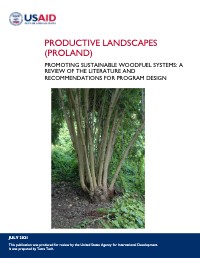
Cover Photo: Coppice from live stump, Haiti. Photo by Glenn Smucker
PRODUCTIVE LANDSCAPES
(PROLAND)
PROMOTING SUSTAINABLE WOODFUEL SYSTEMS: A
REVIEW OF THE LITERATURE AND RECOMMENDATIONS
FOR PROGRAM DESIGN
JULY 2021
DISCLAIMER
The author’s views expressed in this publication do not necessarily reflect the views of the United States
Agency for International Development or the United States Government.
PROLAND: PROMOTING SUSTAINABLE WOODFUEL SYSTEMS: A REVIEW OF THE
LITERATURE AND RECOMMENDATIONS FOR PROGRAM DESIGN i
TABLE OF CONTENTS
TABLE OF CONTENTS ............................................................................................................i
ACRONYMS AND ABBREVIATIONS .....................................................................................ii
PREFACE .................................................................................................................................. iii
1.0 PURPOSE, SCOPE, ORGANIZATION, METHODS, AND THE LIMITS OF OUR
UNDERSTANDING ...........................................................................................................1
2.0 THE WAYS WOODFUEL IMPACTS FORESTS .............................................................3
2.1 The Sources of Woodfuel ............................................................................................................................. 3
2.2 The Impact of Harvesting Regimes .............................................................................................................. 4
3.0 THE FOUR COMPONENTS OF AN INTEGRATED APPROACH TO PROMOTING
INCLUSIVE, SUSTAINABLE WOODFUEL MARKETS ..................................................6
3.1 Component One: Government-Led Reforestation ................................................................................. 6
3.1.1 Challenges to National Reforestation Campaigns ....................................................................... 7
3.2 Component Two: National Government Regulation of Woodfuel .................................................... 8
3.2.1 The Unsuccessful Regulation of this Challenging Sector Forestalls Formalization, and
Biases Larger Actors ........................................................................................................................... 8
3.2.2 Recommendations for Providing Support to Improve Woodfuel Regulation ..................... 11
3.3 Component Three: Strengthening Local Governance of Woodfuel Production ........................... 12
3.3.1 Challenges to Strengthening Local Governance of Woodfuel Production .......................... 12
3.3.2 Recommendations for Strengthening Local Governance of Woodfuel ................................ 15
3.4 Component Four: Fostering Woodfuel Production by Smallholders ............................................... 16
3.4.1 Challenges to Creating Conditions that Support Smallholder Tree Cultivation ................ 18
3.4.2 Recommendations towards Fostering Sustainable, Inclusive Woodfuel Production and
Sale ........................................................................................................................................................ 18
4.0 CROSS-COMPONENT RECOMMENDATIONS FOR DESIGNING WOODFUEL
INVESTMENTS ................................................................................................................21
4.1 Overarching Recommendations for the Design of Integrated Sustainable Woodfuel Programs ...
21
4.2 Considerations for Deciding the Level of Effort to Invest ................................................................... 21
4.3 Topics to be Assessed Prior to Program Design ................................................................................... 22
REFERENCES ..........................................................................................................................24
ANNEX I: ABSTRACT OF THE PROLAND WOODFUEL CASE STUDIES ......................32
ANNEX II: DOCUMENTS PROVIDING KEY INFORMATION OR P R
ACTICAL
GUIDANCE, LISTED BY COMPONENT .......................................................................34
PROLAND: PROMOTING SUSTAINABLE WOODFUEL SYSTEMS: A REVIEW OF THE
LITERATURE AND RECOMMENDATIONS FOR PROGRAM DESIGN ii
ACRONYMS AND ABBREVIATIONS
BME Bureau of Mines and Energy
CBFM Community- Based Forest Management
CIAT International Center for Tropical Agriculture
DENR Department of Environment and Natural Resource
ESMAP Energy Sector Management Assistance Program
FAO United Nations Food and Agriculture Organization
FMU Forest Management Unit
FRA Forest Replacement Associations
GIZ Deutsche Gesellschaft für Internationale Zusammenarbeit
IEA International Energy Agency
IEMS Inclusive Entrepreneurial Market Systems
IPCC Intergovernmental Panel on Climate Change
IUCN International Union for Conservation of Nature
Mha Million Hectares
MEDD Ministry of Environment and Sustainable Development
NNNP North Negros Natural Park
NPPFRDC Ngan, Panansalan, Pagsabangan Forest Resources Development Cooperative
NYDF New York Declaration on Forests
ProLand USAID Productive Landscapes Project
USAID United States Agency for International Development
WB World Bank
YISEDA Young Innovators for Social and Environmental Development Association
PROLAND: PROMOTING SUSTAINABLE WOODFUEL SYSTEMS: A REVIEW OF THE
LITERATURE AND RECOMMENDATIONS FOR PROGRAM DESIGN iii
PREFACE
Countries dependent on woodfuel recognize the threat this energy source represents to their forests.
In areas of high demand such as around urban centers, overharvesting trees for fuel can damage forests
and lead to deforestation. Governments work to reduce demand through attempts to transition users
to other energy sources, and they invest in technologies to transform and burn woodfuel more
efficiently. They complement these efforts with programs to protect natural forests and increase overall
tree cover. Governments also undertake afforestation campaigns, regulate the forest sector, and
strengthen local forest stewardship. Less directly, governments influence the woodfuel sector by altering
the agricultural context and business climate for smallholder tree cultivation. These four components of
a sustainable woodfuel program can reinforce each other. Government-led reforestation campaigns
generate political will and popular awareness, while efficient and equitable regulation controls
overharvesting and supports inclusive markets. Decentralizing forest management empowers and
engages local communities, while enabling smallholder tree cultivation creates a sustainable alternative to
wood harvested from natural forests. In this paper, we describe each of these components and the
considerable challenges governments face implementing them, and offer recommendations for
addressing those constraints. We give special attention to the growing trend of smallholder tree
cultivation, which plays a critical role in enabling inclusive and sustainable woodfuel markets.
PROLAND: PROMOTING SUSTAINABLE WOODFUEL SYSTEMS: A REVIEW OF THE
LITERATURE AND RECOMMENDATIONS FOR PROGRAM DESIGN 1
1.0 PURPOSE, SCOPE, ORGANIZATION,
METHODS, AND THE LIMITS OF OUR
UNDERSTANDING
Governments and the international development community are increasingly concerned about the
impact of woodfuel harvesting on forests (Arnold et al., 2006; Sola et al., 2017; FAO, 2017). Forests play
a critical role in sustaining the world’s biodiversity, mitigating climate change, and supporting global
economic growth. Overharvesting for woodfuel can diminish these benefits and, in extreme cases,
destroy forests. Improved woodfuel management supports international environmental goals, is an
element of landscape revitalization efforts such as the Bonn Challenge , and contributes to global efforts
to reduce forest carbon emissions. Donors and governments also see woodfuel as a potential driver of
rural development and income generation (Smith et al., 2019) . This paper aims to assist development
practitioners to strengthen programming intended to reduce the environmental impact of woodfuel
harvesting. It provides an overview of the woodfuel sector and four components of sustainable woodfuel programming, lists common challenges facing the sector, and includes recommendations intended to
orient national-level programming.
This study focuses on the sustainable production of
woodfuel. It provides only limited information on other
topics related to woodfuel such as: the impact of woodfuel
use on health; income impacts from woodfuel sales; and the
sale, transformation, transportation, and marketing of
woodfuel. Nor does it focus on the important topic of the
marginalized role of women in the sector, or the
introduction of alternatives to woodfuel. For information
about clearing forests for agriculture, an important source of
woodfuel in many countries, see ProLand's Agriculture's Footprint: Designing Investment in Agricultural
Landscapes to Mitigate Tropical Deforestation report.
This paper begins with a description of woodfuel sources, and the impacts on forests associated with
them. The chapters that follow describe four interrelated components of a sustainable woodfuel
program and present the challenges faced in the application of each. They also illustrate challenges to
decentralizing national woodfuel management through two “mini-case studies” describing efforts in
Burkina Faso and the Philippines. The final chapter offers recommendations for government and donor investment to promote the sustainable production of woodfuel.
Annex I provides abstracts and links to woodfuel case studies ProLand conducted in Senegal, Madagascar, and Haiti. These cases illustrate the points made in this paper and provide the basis for
many of our recommendations. The Madagascar study describes the factors that influence the sustainability of woodfuel sourcing at national and regional scales. The Senegal study chronicles the
regulatory challenges the country faces in the transition to increased local management of forests
producing woodfuel. The Haiti case study focuses on the factors that influence smallholder tree
cultivation. Annex II presents an annotated list of tools useful in the design of programs to promote
sustainable woodfuel markets.
This document draws on a review of recent scientific literature and selected development literature.
While we have used the best information available, additional research could increase the confidence of
our claims. Despite the increase in research on woodfuel since 2000, gaps remain regarding the
Women bear a woodfuel burden
Of the 850 million people engaged in the
arduous tasks of collecting fuelwood or
producing charcoal, about 83 percent are
women (FAO, 2018). Cooking with
woodfuel, which produces various
airborne toxins, also damages the health
of women more frequently than men.
PROLAND: PROMOTING SUSTAINABLE WOODFUEL SYSTEMS: A REVIEW OF THE
LITERATURE AND RECOMMENDATIONS FOR PROGRAM DESIGN 2
institutions and behaviors that provide the requisite controls and incentives in the woodfuel sector.
Speculative prescriptions dominate the development literature, in which claims of success are often
made with a few sentences, bullet points or paragraphs. In 2017, Sola et al. (2017) systematically mapped
recent peer-reviewed research of the woodfuel value chain in sub-Saharan Africa and found significant
weaknesses in the design of almost all the 152 selected studies, concluding that current literature
provides a “weak and geographically limited evidence base” upon which to develop policy
recommendations. Additionally, some technical questions at the core of woodfuel harvesting remain
unanswered, such as the impacts of different harvesting plans and regeneration rates in different forest
types. Other topics addressed in our study require research on adjacent subjects. For example, a
complete understanding of the incentives for field tree cultivation would require targeted research on
non-market drivers, such as associated benefits to agricultural production, which is currently missing in
the literature as noted by Mendum and Njenga (2018). The Intergovernmental Panel on Climate Change
(IPCC, 2019b) concluded that, overall, much remains to be learned concerning the traditional biomass
sector, including woodfuel.
PROLAND: PROMOTING SUSTAINABLE WOODFUEL SYSTEMS: A REVIEW OF THE
LITERATURE AND RECOMMENDATIONS FOR PROGRAM DESIGN 3
2.0 THE WAYS WOODFUEL IMPACT S
FORESTS
Governments, the development community, and researchers have long debated the role of woodfuel
production on forest health. The absence of credible information regarding the impact of harvesting has
allowed for large shifts in the attention given to this sector. Periods of limited concern may be
attributable to the belief that dependence on woodfuel as an energy source does little damage to
forests. Properly managed, woodfuel can be a sustainable source of energy (Neufeldt et al., 2015).
Woodlands in many countries can eventually regenerate the biomass and biodiversity lost from tree
harvesting, although that may take 30 years (Chidumayo & Gumbo, 2013; Woollen et al., 2016; Doggart
& Meshack, 2017).
More recently, attention has returned to woodfuel harvesting because the threat it poses to forest
health has become clear. In 2019, the IPCC concluded that national dependence on woodfuel for energy
causes high land and climate impacts (IPCC, 2019b). Demand has increased as urban populations
continue to grow and expected shifts to alternative
energies have not occurred (see the “What constrains
the transition to other energy sources?” text box).
Recent projections find that woodfuel harvesting will
result in long-term forest degradation (Santos et al.,
2017). Even though woodfuel harvesting for fuel rarely
causes deforestation, and when it does, the impact is
localized (Chidumayo & Gumbo, 2013 ; Bailis et al.,
2015; Masera et al., 2015; FAO, 2017; Santos et al.,
2017), harvesting woodfuel is among the most
significant causes of degradation in the world’s forests
(New York Declaration on Forests [NYDF ]
Assessment Partners, 2019).
What constrains the transition to other
energy sources?
This paper gives most attention to one segment of the market, charcoal production for urban
populations, because it both contributes the most to the creation of hotspots of forest loss and provides
opportunities for intervention since it is geographically concentrated and more closely regulated than
rural consumption patterns. Charcoal commoditization provides opportunities to use inclusive market
system approaches to increase income generation. We focus primarily on woodfuel systems in Africa
because the continent contains countries with some of the hottest hotspots and greatest woodfuel
energy deficits.
2.1 THE SOURCES OF WOODFUEL
The 2019 IPCC Special Report on Climate Change and L
and notes that woodfuel use impacts forests
differently depending on the process through which it is produced. The strength of demand and the harvesting regime determine the impact of
woodfuel harvesting on forests. Land type, local
climate, and initial carbon stocks also play a role
(IPCC, 2019a). Below we provide an overview of supply sources and dem
and, and how the manner and
timing of harvesting impact forests differently.
Woodfuel emissions
Approximately 30% of woodfuel consumed exceeds
rates of regrowth. This unsustainable portion emits
an estimated 1–2.4 Gt of CO2e annually and
contributes 2 to 7 percent of global anthropogenic
emissions (Bailis et al., 2015; FAO, 2016b).
Continued dependence on woodfuel is commonly associated with rapid population
growth, low incomes, limited access and
unreliable supply of other sources of energy,
and a constrained capacity to generate more
electricity. Consumer preference also plays a
role; many households continue to cook with
woodfuel even as other options are available.
PROLAND: PROMOTING SUSTAINABLE WOODFUEL SYSTEMS: A REVIEW OF THE
LITERATURE AND RECOMMENDATIONS FOR PROGRAM DESIGN 4
Forests. By far the greatest portion of woodfuel is harvested from forests whose trees have regrown
naturally after being cleared. Primary forest also provides woodfuel, but these forests tend to be more
remote, and better protected.
Plantations. A much smaller portion of woodfuel comes from trees that have been planted. China,
India, and Brazil harvest a growing portion of their woodfuel from trees planted in monocrop
plantations. Brazil has established more than 4Mha of large-
scale charcoal producing Eucalyptus plantations (Deutsche
Gesellschaft für Internationale Zusammenarbeit [GIZ], 2015).
While growth led by these countries increased the area of
global planted forest by more than 30 percent between 2000
and 2017, plantations still represent only 7 percent of all
forested land (World Bioenergy Association, 2019). Africa
sources a much smaller proportion of its woodfuel from
planted trees, less than 5 percent (Drigo et al., 2014; Sepp et
al., 2014; FAO, 2017). In East Africa, where the largest
plantations are found, governments and donors have been
reducing funding in plantations since the beginning of this
century, leading to a slow decline in their economic
sustainability. See the ProLand Madagascar case study (Miller
et al., 2021) for a description of woodfuel production on plantations in one country.
Agricultural lands. People also harvest and sell wood from trees planted in small woodlots, orchards,
field boundaries and pastures. In Senegal, non-forest woodfuel sources include relatively stable parklands
with a 5 to 10 percent tree cover and extensive orchards in peri-urban areas (Herrmann et al., 2013). In
rare cases, woodfuel markets depend on trees cultivated on agricultural lands. Smallholder farmers
produce over 90 percent of Haiti’s domestically sourced energy (International Energy Agency [IEA],
2020; Bureau of Mines and Energy [BME], 2005).
Clearing land for agriculture. In some contexts, land-use change produces significant amounts of
woodfuel.
1 Countries with large forest areas derive a greater percentage of their woodfuel as a
byproduct of land clearing and logging. Given accessible markets, woodfuel produced through land
clearing may enter commercial streams and generate income. In this case, woodfuel demand is not the
primary driver. Its sale does not stimulate additional logging or forest clearing (Drigo et al., 2014; FAO,
2017).
Minor sources that provide woodfuel as a byproduct include remnants, chips, or pulp produced
during timber processing (Drigo et al., 2014; FAO, 2017).
2.2 THE IMPACT OF HARVESTING REGIMES
Intensity, methods, and the tree selection criteria. These three factors may determine whether
harvesting results in regeneration, degradation, or deforestation. Distance to forests plays a role in the
frequency and extent of harvesting. Because woodfuel is a bulky, low value commodity, transportation
costs strongly influence economic returns. Poor or costly transportation networks create pressure to
harvest from nearby forests. As a result, supply zones typically expand outwards from urban centers
over time as closer sources are exhausted.
1
This potential for land-use change to generate woodfuel explains much of the uncertainty in estimates of woodfuel supplies, as there is no
reliable data regarding proportions of cleared trees that are converted to woodfuel.
Area in plantations (ha)
• Zambia: 52,000
• DRC: 58,000
• Kenya: 153,000
• Madagascar: 312,000
• Uganda: 465,000
• Tanzania: 553,000
• Ethiopia: over a million
• Sub-Saharan Africa average: 196,000
(FAO, 2020)
PROLAND: PROMOTING SUSTAINABLE WOODFUEL SYSTEMS: A REVIEW OF THE
LITERATURE AND RECOMMENDATIONS FOR PROGRAM DESIGN 5
In rural areas with a low population density,
harvesting for domestic use has little impact,
especially when the wood is primarily collected
from dead trees and fallen branches. Conversely,
commercial operations more frequently harvest
large portions of forests, and lead to slow
regrowth rates and impaired ecosystem services.
Charcoal, the most commercialized form of
woodfuel, is widely associated with intensive
harvesting and land degradation (IPCC, 2019b). In
parts of eastern and southern Africa, prolonged
and frequent harvesting of a high percentage of
trees for charcoal has transformed areas of
woodlands to scrub lands (Chidumayo & Gumbo, 2013 ). Urban markets for charcoal contribute strongly
to modeling projecting overharvesting in the future (Santos et al., 2017; B ailis et al., 2017).
Some commercial charcoal producers clear- cut. This removal of all trees clearly destroys forests. In
Africa, clear-cutting appears to be more widespread in east and southern Africa. In West Africa,
selective harvesting may be more prevalent (Chidumayo & Gumbo, 2013). In certain regions, charcoal
enterprises exclusively harvest hardwoods because they result in a higher quality product. This selective
harvesting for woodfuel, if it is continuous, alters forest composition and impairs forest ecosystem
functions, resiliency, and productivity (Bailis et al., 2015; FAO, 2016a). Woodfuel may also be harvested
through coppicing, which entails cutting trees back at ground level. Here too, the regime makes a
difference. Harvesting trees of the right size at the right height for their species may greatly increase
regrowth rates (Syampungani et al., 2017).
TABLE 2.1: SOURCES OF WOODFUEL BY TREE ORIGIN AND SCALE OF
MANAGEMENT
TREE ORIGIN
NATURAL REGROWTH PLANTED
MANAGEMENT SCALE
HOUSEHOLD
Primary forest cleared
for agriculture
Fallow, field trees, coppiced
fallow
Orchards, woodlots,
hedges, windbreaks,
perennial crops
COMMUNITY
Primary forest managed
or owned by
communities
Secondary forest managed or
owned by communities,
enclosures
Community woodlot
NATIONAL
Primary forest in
protected areas and
concessions
Secondary forest in protected
areas and concessions
Reforestation programs
The potential to reverse charcoal’s damage
to Zambia’s forests
Growth of urban populations has produced a 45- fold
increase in the demand for charcoal in Zambia since
1969. This demand spike in turn drove a ten-fold
increase in degraded forest area (Ziba & Grouwels,
2017).
The damage is not necessarily permanent
everywhere. Biodiversity eventually returns to the
country’s miombo forests after harvesting has been
discontinued (Dlamini et al., 2016). Carbon stocks
recover after 20 years (Kalaba et al., 2013).
PROLAND: PROMOTING SUSTAINABLE WOODFUEL SYSTEMS: A REVIEW OF THE
LITERATURE AND RECOMMENDATIONS FOR PROGRAM DESIGN 6
3.0 THE FOUR COMPONENTS OF AN
INTEGRATED APPROACH TO
PROMOTING INCLUSIVE, SUSTAINABLE
WOODFUEL MARKETS
Sustainable woodfuel programs require long-term investments that integrate complementary
approaches. Governments promot e sustainable woodfuel production through: afforestation campaigns;
forest sector regulation; decentralization of forest management; and actions altering the agricultural
context and business climate for smallholder tree cultivation. Government-led reforestation campaigns
generate political will and raise popular awareness, while efficient and equitable regulation controls
overharvesting and supports inclusive markets. Decentralizing forest management empowers and
engages local communities, while enabling smallholder tree cultivation creates a sustainable alternative to
wood harvested from natural forests. Despite the potential of the growing trend in smallholder tree
cultivation, reforestation and afforestation do not substitute for protecting forest. Natural forests
support substantially greater levels of biodiversity than lands where trees have been planted, and on
average store 40 times more carbon than plantations, and 6 times more carbon than agroforestry
(Chamshama & Nwonwu, 2004; NYDF Assessment Partners, 2019). Nor does progress in reforestation
necessarily slow loss of natural forest, as shown in Vietnam (Kull et al., 2019). Governments and their
partners need to attend to all four of the components to successfully promote sustainable and inclusive
woodfuel markets.
3.1 COMPONENT ONE: GOVERNMENT -LED REFORESTATION
Efforts to increase woodfuel supply fit naturally within national- led campaigns to increase the regrowth
and cultivation of trees. Throughout modern history, governments have undertaken large-scale tree
cover restoration campaigns to increase timber supply, provide ecosystem services, and combat erosion
or flooding. To achieve their goals, governments may use compulsory measures such as land
expropriation, or implement incentive programs that rely on payments or other benefits, such as rights
in land. The campaigns may promote regrowth in forests, monoculture plantations, or trees on
agricultural lands. While few campaigns focus on the woodfuel market, they all contribute to woodfuel
supply.
Between 1953 and 2007, South Korea expanded forest cover from 35 percent to 64 percent of the country’s total area. Between 1940 and 2010, Puerto Rico raised its forest cover from 6 percent to 60
percent of the island. Sweden and Costa Rica have also experienced large-scale
restoration (Hanson et al., 2015). Large-
scale government-led reforestation
programs have most often demonstrated
success where strong centralized
governments target specific, urgent
needs, such as reducing soil erosion or
meeting the demand for commercial
timber. Addressing these challenges of
national importance often requires
dramatic reforms of forest policies and
increased investment of government
Factors behind progress in El Salvador
• El Salvador restored 122,000 hectares of forest between
2014 and 2018. Key factors in making the political will for
reforestation a reality were:
• Participatory planning process from the beginning
• Restoration goals integrated into strategies, policies, and
laws across ministries and at all levels of government
• A National Monitoring Plan
(NYDF Assessment Partners, 2019)
PROLAND: PROMOTING SUSTAINABLE WOODFUEL SYSTEMS: A REVIEW OF THE
LITERATURE AND RECOMMENDATIONS FOR PROGRAM DESIGN 7
resources over a long time period. Successful campaigns require organized, thorough, and persistent
effort. They also require a systematic approach to land resource management, and effective local and
national reward systems (Mansourian et al., 2017; Stanturf et al., 2019). China launched the large-scale
“Grain for Green” program to address flooding and soil erosion and increased forest cover by 9.5
million hectares (Mha) between 2000 and 2010, primarily through afforestation with timber species on
erosion-prone mountainous terrain and barren lands. The PRC Government motivated farmers to
participate in the voluntary program by providing seedlings, grain subsidies, and annual cash stipends, in
addition to forest land-use rights certificates. Vietnam increased forest cover by 2.5 Mha over the same
period, largely through state timber plantations (NYDF Assessment Partners, 2019; Rudel et al., 2020).
Countries collaborating on the Bonn Challenge take a variety of approaches to promote reforestation.
The campaigns are as varied as the countries that undertake them, targeting cocoa agroforestry systems
(Ghana); financing small-scale farmers (Rwanda); assisting natural regeneration (Burkina Faso); and
restoring degraded mangrove areas (Vietnam, Thailand, Indonesia).
2 As of 2019, 13 countries expressed
commitments to restore 44 Mha , principally through silviculture and natural regeneration on degraded
forest lands, and agroforestry on agricultural lands. A small percentage are supporting commercial
plantations to restore degraded lands (Dave et al., 2019).
3.1.1 Challenges to Natio nal Reforestation Campaigns
Countries where governments have invested fewer resources over less time have not seen an enduring
change in tree cover. African plantation programs of the 1970s and 1980s designed to provide woodfuel
for urban centers rarely proved sustainable, and when donor funding dried up activities were
discontinued and production gradually deteriorated on the unmaintained woodlots and plantations.
Ethiopia established as many as 40,000 hectares of energy plantations between 1975 and 1994 in peri-
urban areas that were neither maintained nor expanded upon ( Chamshama & Nwonwu, 2004). Projects
promoting community-level plantations elsewhere in Africa over the same period faced similar
challenges, and similar fates. Parallel to planting campaigns, woodfuel harvested from natural forests
continued to be sold at prices that undermined the economic viability of plantations established by governments, while poor management, lack of technical expertise, and conflicts over land also proved detrimental (Hofstad et al., 2009; Chidumayo & Gumbo, 2013; GIZ, 2015). In the 1970s and 1980s , over
approximately 12 years, the Government of the Republic of Niger, supported by international
development agencies, implemented projects that planted 60 million trees. The effort is often
considered a success, yet less than half of the planted trees survived (Hanson et al., 2015).
Despite global commitments and apparent governmental will, countries that have taken up the Bonn
Cha
llenge have fallen short of their targets. Even
El Salvador, one of the most successful countries, has met only 12 percent of its restoration pledge (see “Factors behind progress in El Salvador” text box). Overall rates of reforestation in participating countries have slowed over the past decade
(NYDF Assessment Partners, 2019).
Critics argue that restoration takes too long,
costs too much, and produces too few benefits to justify public or private expenditures (Stanturf et al., 2019). Successful campaigns require more
political will and resources than many
2
More information on all these efforts and those of other countries may be found at the Bonn Challenge website and the International
Union for Conservation of Nature (I UCN) Bonn Challenge portal.
Challenges to landscape restoration
The Madagascar 2017 National Strategy for Forest
Landscape Restoration and Green Infrastructure
identifies four primary challenges to landscape
restoration that may hinder the afforestation
initiative: 1) weak management by the national
government; 2) a lack of local governance capacity; 3)
a shortage of technical skill; and 4) a lack of national
and international financial support (Ministère de
l'Environnement et du Développement Durable
[MEDD], 2017).
PROLAND: PROMOTING SUSTAINABLE WOODFUEL SYSTEMS: A REVIEW OF THE
LITERATURE AND RECOMMENDATIONS FOR PROGRAM DESIGN 8
governments can dedicate. They are weakened by competing interests and conflict between prioritizing
livelihoods versus biodiversity (Dave et al., 2017).
Whether undertaken as one component of a restoration campaign, or designed exclusively to increase
the availability of woodfuel, sustainable and substantial growth in woodfuel production at a national scale
requires a supportive policy and regulatory context, the engagement of local stakeholders, and a vibrant
and inclusive market for smallholder-produced woodfuel. The following sections provide background
and recommendations for the implementation of these three complementary components of an
integrated woodfuel program.
3.2 COMPONENT TWO: NATIONAL GOVERNMENT REGULATION OF
WOODFUEL
Management of the woodfuel sector naturally falls under the much larger domain of forest policy.
Woodfuel regulation typically focuses on the protection of natural forests through restrictions on the
location, methods, and frequency of harvesting. It may also limit production through controls on
transformation, transportation, storage, and sales. Common policy tools governments use to achieve
these objectives include harvesting plans, licenses and permits. They may also require permits and assess
fees higher up the supply chain to enforce standards for the transport, transformation, storage , and sale
of woodfuel. Ideally, policymakers base woodfuel policies on forest and supply chain monitoring. The
revenue generated through regulations may become an important source of revenue for the forest
service.
3.2.1 The Unsuccessful Regulation of this Challenging Sector Forestalls Formalization, and Biases
Larger Actors
Governments in the developing world
have difficulty fostering sustainable,
equitable, transparent, and efficient
woodfuel markets (de Miranda et al.,
2010; Blundo, 2011; Zulu & Richardson,
2013; Schure et al., 2013; Sepp et al.,
2014; Iiyama et al., 2015; Faye & Ribot,
2017). The sector is perhaps most
challenged in Africa, but these challenges
are not unheard of elsewhere, as
evidenced by recent studies of corruption
and elite control in the woodfuel value
chain in Peru and the Philippines (Bennett
et al., 2018; Pulhin & Ramirez, 2016).
Three characteristics common to woodfuel markets make this sector particularly difficult to regulate: 1)
They are complex, as woodfuel comes from multiple sources of different scales and types; 2) They are
geographically diffuse, as woodfuel comes from large geographic zones that reach
into remote areas; and 3) They are
informal, as the woodfuel value chain
receives little capital investment and is
dominated by person- to-person
transactions (Sepp et al., 2014). These
characteristics of the sector, combined
African NDCs shortchange woodfuel
When African countries have expressed their commitments to
reduce national emissions and adapt to the impacts of climate
change in their Nationally Determined Contributions (NDCs)
they have given little weight to the woodfuel sector. NDCs
commonly suggest woodfuel is a “backwater technology,” gloss
over specifics, and fail to identify institutional responsibilities
(Amugune et al., 2017).
Barriers to better policy
• Policymakers assume woodfuel is an underlying cause of
forest degradation and deforestation
• International initiatives fail to recognize the importance of
wood energy as part of the energy mix
• Policy makers regard woodfuel energy as “primitive” or
“backward,” and promote unattainable alternative
“modern” energy sources
• Reliable forest sector data is unavailable and does not
inform government policies and strategies (World Bank
[WB], 2013)
PROLAND: PROMOTING SUSTAINABLE WOODFUEL SYSTEMS: A REVIEW OF THE
LITERATURE AND RECOMMENDATIONS FOR PROGRAM DESIGN 9
with other common constraints on woodfuel sector policies (see: “Barriers to better policy” text box),
regularly lead governments to: 1) develop incomplete, coercive policies that suppresses economic
activity and 2) improperly and incompletely administer policies, which leads to overharvesting and
market concentration.
Incomplete, coercive policies that suppress economic activity. National policy frameworks for
woodfuel are often a low priority, poorly developed, and rely on penalties more often than incentives.
Governments treat woodfuel as a
sector of lesser importance and invest
insufficient resources to developing
policies. Forestry may be the most
natural “home” for woodfuel
regulation, but policy in this sector
often focuses exclusively on regulating
the timber industry. Policy regarding
the use of forest products focuses on
logging concessions and their
administration, while policy regarding
trade in forest products focuses on
roundwood. Rather than developing
unified coherent legislation for
woodfuel, governments tend to
address it piecemeal and across
multiple sectors. Rules that impact the
production and marketing of woodfuel
may be found in legislation concerning
forestry, agriculture, environment, local
government, land law, commerce, and
other sectors. In Africa, rules that
address woodfuel most often appear
within the laws codifying the management of decentralized forests (Kohler & Schmithüsen, 2004). Many
of the governments with an overall woodfuel strategy, such as Zambia, Cameroon, Malawi, Democtratic
Republic of Congo, and Kenya, have rules regarding woodfuel in the legislation of multiple sectors (Sola
et al., 2019). Legislation regarding charcoal generally receives even less attention than does woodfuel. As
of 2006, in East Africa, only Kenya and Northern Sudan specifically addressed charcoal in policy (Mugo &
Ong, 2006). Because they are conceived
independently and at different times, the
various rules often overlap, conflict, and are
incomplete or unclear (WB, 2011a; Schure et
al., 2013; I iyama et al., 2015; Neufeldt et al.,
2015; Sola et al., 2019). Malawi is one of the
few countries in Africa with a comprehensive
charcoal strategy. (See “One country with a
charcoal strategy” text box.)
The poorly developed policies that
governments promulgate tend to rely on coercive powers. They rarely include incentives to improve forest stewardship or promote reforestation or afforestation, such as tax incentives, payments for
environmental services, cost sharing, or improved access to markets (Sepp et al., 2014; Smith et al.,
2019). The punitive measures at their core, such as taxes, fines, and permits, are designed to control
behavior and dampen economic activity (WB, 2011a; Sola et al., 2019). As a result, they do not exploit
Successful policy innovation: woodfuel replacement
Begun in Brazil in the 1980s, Forest Replacement Associations
(FRAs) contract farmers to grow trees to replace woodfuel
consumption by businesses. Key elements:
• Law requires businesses to replace the wood they consume.
• To meet this requirement, businesses pay a fee to a local
FRA, which contracts with farmers to produce trees. The
government monitors the process.
• The FRA provides seedlings to local farmers. It may also
provide technical assistance, fertilizer, pesticides, or fencing
materials.
• Farmers own the trees, but agree to give the participating
business first refusal when the wood is sold.
• Farmers may be required to meet conditions, such as
dedicating a specific area to trees, or a percentage to native
fruit and wood species.
• FRAs function less well at a distance from wood-consuming
businesses and where there is less available land that is
unsuitable for agriculture, but suitable for tree crops.
(Source: WB, 2013; GIZ, 2015).
One country with a charcoal strategy
The Malawi National Charcoal Strategy promotes fuel-
efficient cooking; improved collection and dissemination
of information; better enforcement and regulation; and
the cultivation of fast-growing tree species through
concessions to large- scale commercial interests and on
degraded government plantation land, in combination
with smallholder out-growers producing on marginal
lands or homesteads (Republic of Malawi, n.d.).
PROLAND: PROMOTING SUSTAINABLE WOODFUEL SYSTEMS: A REVIEW OF THE
LITERATURE AND RECOMMENDATIONS FOR PROGRAM DESIGN 10
the sector’s potential to provide broad-based incomes and economic development in rural areas (Iiyama
et al., 2017).
Incomplete and improper administration of poorly developed policies leads to
overharvesting and market concentration. Governments complement lax policy development
with underfunded implementation. The forestry services tasked with administration are strapped for
resources: too few field agents allotted too few vehicles monitor remote forests ineffectively, review
harvesting plans inadequately, and administer systems of permits and fines ineffectively and inequitably.
Rather than working in forests, agents are often posted in easy-to-access locations, such as
transportation routes and markets (United Nations Food and Agriculture Organization [FAO], 2014).
Beyond the reach of the forest service, value chain actors reuse permits, or do not make the effort to
obtain or update them. Transporters evade regulation by driving at night or on unregulated routes.
Actors all along the value chain rely on bribes when they get caught (Hofstad et al., 2009; de Miranda et
al., 2010; Schure et al., 2013; Neufeldt et al., 2015; Iiyama et al., 2015).
This threadbare implementation of poorly developed po
licy produces perverse consequences. It creates
a bias towards larger actors and enables corrupt behavior. The administrative burdens of regulation
create a bias towards individuals with the know- how, connections, and resources to navigate
administrative controls (Neufeldt et. al, 2015). They also push market actors towards the gaps produced
by the incomplete coverage, and towards illicit behaviors and unregulated geographies beyond
government’s reach. This increases the amount of illicitly produced woodfuel which, by escaping the
costs of regulated production, sells at lower prices than regulated woodfuel, thus undercutting the goals
of regulation. The continued informal nature of the sector reinforces negative perceptions and
decreases the potential for investment from the government and the private sector necessary to
develop a more sustainable system (Owen et al., 2013; Doggart & Meshack, 2017; Sola et al., 2019). The
ProLand Senegal case study (Miller et al., 2020) presents one country’s experience confronting these and
other common regulatory challenges.
Mini-case study 1: Burkina Faso, promising local forest management has been hampered
by stalled decentralization
Burkina Faso may have the oldest locally managed production forests in Africa, created through a woodfuel
scheme supported with project funding in the 1980s.. Local associations called Forest Management Units (FMUs)
implement forest harvesting plans and provide revenue to workers, local institutions, and the national
government. In 2006, an estimated 55,000 people earned income from the value chain. The largely self-
sustaining FMUs depend on NGOs for capacity building, but otherwise operate independent of project support.
Now in their second 20-year rotation, the forests appear to be managed sustainably, if not in perfect accordance
with harvesting plans. They provide about one fifth of all woodfuel consumed in the country.
The endurance and apparent success of FMUs belies critical limitations to the approach. Local forest
management in Burkina Faso has not lived up to the promise of decentralization under which it was initiated.
After the creation of the FMUs, the Forest Service increased its role in local forest management and constrained
the authority of local management groups. Justified as part of a process to empower local communities, the
approach, funded by donors, enabled the Forest Service to extend its control and more thoroughly regulate the
FMU forests (Cô te & Gautier, 2018). A cadre of urban merchants took advantage of continued management by
the national government, widespread corruption, and lacunae and contradictions in the regulatory framework to
capture the lion’s share of revenue generated by the value chain.
Revisions to the Forest Code in 2011 granted greater community participation, but top-down governance remains
the rule (Arevalo, 2016). This is in part due to conflicts among local jurisdictions. In some cases, locally managed
forests span several administrative units. This creates conflicts of authority among local governments, traditional
governments, and the managers of forest management units (Coulibaly-Lingani et al., 2011).
PROLAND: PROMOTING SUSTAINABLE WOODFUEL SYSTEMS: A REVIEW OF THE
LITERATURE AND RECOMMENDATIONS FOR PROGRAM DESIGN 11
The approach has not spread across the country. When donor support was discontinued, no new FMUs were
created. The stalled national process of decentralization and the government’s inability to extend the approach to
other areas of the country has left much of the country’s forests unmanaged. The Forest Service and local
governments effectively control only a very small portion of the country’s forest; today, most of the woodfuel
consumed in Burkina Faso continues to be harvested illegally, outside of managed forests.
This mini-case study is based on common findings in the following articles, with only exceptions cited above:
(Coulibaly-Lingani et al., 2011; Sawadogo & Tiveau, 2011; Bouda et al., 2011; Arevalo, 2016; Côte & Gautier,
2018; Foli et al., 2018).
3.2.2 Recommendations for Providing Sup port to Improve Woodfuel Regul ation
3
Over the long term, broad improvement in governance may provide the foundation for progress
t
owards sustainable and inclusive woodfuel markets. Analysis of data across 45 sub- Saharan countries
suggests that deforestation driven by commercial woodfuel systems can be reduced by improving
governmental effectiveness and controlling corruption (Sulaiman et al., 2017). Recommendations for
more targeted programs follow.
Strengthen the policy context:
• Address stigma associated with woodfuel and highlight the sector’s importance as a potential source
of revenue and income generation.
• Conduct cross-sectoral studies on woodfuel policy to identify gaps and conflicts in regulation.
• Support coherence in the development of woodfuel policies, and support their harmonization with
policy in other sectors.
• Integrate support for tree planting and plantations into overall forest policy.
Support effective policy:
• Explore creating regulatory incentives to counterbalance punitive measures. Examples include
differentiated taxation systems that impose tax only on wood sourced from non-managed areas
other than private land; and payments for ecosystem services schemes providing payments to
landholders who invest in sustainable woodfuel production.
• Pr
omote scalable policy reforms that
pose achievable resource demands on the
national government; can be adopted at
the local level without ongoing financial
support; and depend on local knowledge
and expertise or persons hired by local
communities.
• Develop flexibility in the legal and
regulatory framework to accommodate local community, forest, and market
characteristics. Technical and administrative requirements should be
3
These recommendations draw from Schure et al. (2013); FAO (2004); FAO (2017 ); de Miranda et al. (2010); WB (2011a ); and Smith et al.
(2019). The ProLand Senegal, Madagascar, and Haiti case studies also provide a basis for these recommendations, some of which are
discussed at greater length in those documents.
Tools to support transparency
Transparency International’s INDEPENDENT REDD+
GOVERNANCE MONITORING provides civil society
organizations and practitioners involved in tackling
REDD+ corruption and governance issues an overview of
key considerations for the design and implementation of
effective independent governance monitoring systems.
Transparency International and United Nations Human
Settlement Programme’s Tools to Support Transparency
in Local Governance provides a collection of p ractical
tools that civil society organizations and other advocacy
groups can use in their efforts to promote accountable
and responsive local governments.
PROLAND: PROMOTING SUSTAINABLE WOODFUEL SYSTEMS: A REVIEW OF THE
LITERATURE AND RECOMMENDATIONS FOR PROGRAM DESIGN 12
adaptable to the capacity and needs of communities managing small forests and commercial
enterprises working larger areas.
• Support low-cost systems of improved monitoring for wood fuel harvesting and the value chain.
Improve implementation of regulations:
• Invest in institutional practices and staff capacity development to create accountability mechanisms.
• Institutionalize transparency and ease of public monitoring through such measures as:
– campaigns to increase awareness of laws and regulations;
– public decision-making;
– public presentation of results of monitoring, and posting of harvesting and transportation
permits allotted; and
– the creation of accessible procedures for seeking recourse (see: “Tools to support
transparency” text box).
3.3 COMPONENT THREE: STRENGTHENING LOCAL GOVERNANCE OF
WOODFUEL PRODUCTION
Research suggests that when forest communities have secure rights over their land, they are more likely
to conserve and sustainably utilize that land (Agrawal, 2007; Robinson et al., 2014; Seymour et al., 2014).
This idea that local communities can effectively manage forests they control has led many countries—
often supported by international donors—to take steps to progressively devolve national authority over
forest management to the local level. Countries as diverse as South Korea, Nepal, Burkina Faso, the
Philippines, and Mexico have sought to improve forest stewardship by conferring rights and
responsibilities at the local level. Improved forest management, including more sustainable woodfuel
harvesting, may not be the sole objective of this process. Governments devolve power over forests to
achieve equity and economic objectives as well. The steps taken by governments to increase the role of
local actors in forest management range from the assignment of minor tasks to profound changes in
governance. At one end of the spectrum, the forest service invites local partners to undertake specific
activities, such as creating firebreaks or replanting trees. At other end of the spectrum, changes in forest
management take place in a larger process of land tenure reform and the decentralization of
fundamental powers of government. The process in this latter case, which requires decades to
complete, may include deconcentrating national administrative institutions (granting new powers to
regional forest service offices, for example), the formalization of local governments, or empowering
traditional institutions. Countries may grant the authority to manage trees and products such as
woodfuel to private individuals, individual communities, groups of communities or villages, indigenous
governments, or elected local governments. In some countries, such as Côte d’Ivoire and Ghana, the
government limits local communities to a consultative role. In others, such as Tanzania and The Gambia,
the government grants local authorities control over forest management (Wily, 2002). Governments
may also allow for varying levels of decentralization in different regions of a country (see “The
Philippines” mini- case study found on page 14 for an example of this approach.)
3.3.1 Challenges to Strengthening Local Governance of Woodfuel Pr oduction
Few countries have completely decentralized forest stewardship to local governments, a process that
requires national governments to transform their centralized administrative systems and create
functioning local governments. A review of 40 years of community-based forest management by the
PROLAND: PROMOTING SUSTAINABLE WOODFUEL SYSTEMS: A REVIEW OF THE
LITERATURE AND RECOMMENDATIONS FOR PROGRAM DESIGN 13
FAO concludes that the process of conferring tenure to local actors requires not only legal reforms but
also accompanying development measures. Defining national objectives in legislation may take years.
Administrations must then develop, communicate, and oversee the implementation of a framework of
new policies, regulations, and protocols. They then need to develop and implement procedures for
enforcing the exercise of these new powers by local institutions. Community-based forest management
providing charcoal to commercial markets requires capacity building of government staff, community
members, and other value chain actors. They need to learn and institutionalize a raft of technical and
business skills. Enterprises and government institutions must be created. Business management skills and
governance procedures need to be institutionalized. Existing patterns of behavior and relationships of
power may need to change. Rather than completing this process rapidly, the efforts of many countries
have either stalled and/or created new systems that constrain local authorities with technical and
bureaucratic barriers (Riedl & Dickovick, 2010; Larson, 2012; RECOFTC – The Center for People and
Forests, 2013).
In Africa, newly created decentralized governments are thus far limited in their powers, sidelined by
better resourced, more influential national forest services. Or they are “upwardly accountable” and
more responsive to the agendas of national institutions, such as political parties, than of local
communities. National government natural resource exploitation for revenue may override local
environmental protection priorities. The result may be continued overharvesting of woodfuel (Zulu,
2010; Ribot et al., 2010; Larson, 2012; Adam & Eltayeb, 2016; Atisa et al., 2018).
Resource and capacity limitations. Although decentralization may be intended to confer authority
upon local institutions, the process may expand the oversight role of the forest service, at least during the transfer of control. In countries where forest services already strain to meet their responsibilities,
developing and implementing additional responsibilities correctly may be impossible. For example, control by local governments may depend on the development and implementation of forest management plans, which will require the forest service to provide training and assistance to local communities or governments to complete the plans, and consequently to review them and monitor
their implementation ( WB, 2013).
Local institutions will also need to ma
ke vast strides. The local governments granted new authority will
need to develop skills and processes to manage the new resources. Success will require the provision of
impartial oversight over the commercial exploitation of forests, ensuring that benefits and
responsibilities are equitably distributed among community members, and preventing local institutions
from being coopted by external actors. If woodfuel enterprises exist locally, decentralization may
require them to learn new administrative and technical procedures (Miller et al., 2020).
Impediments to the transition of power. Decentralizing
forest management to local institutions will take place in a
context of rebalancing of control over productive resources. The
forest service may resist the loss of authority and opportunities
for revenue and illicit rent. When national governments authorize
the forest service to oversee the transition of power from
national to local institutions, which is often the case, it puts that
agency in a position to create barriers to local management.
Forest services commonly require technically valid but unrealistic
requirements that prevent communities from asserting authority
conferred through laws (Djeumo, 2001; FAO, 2004; Kohler &
Schmithüsen, 2004; Miller et al., 2020). Urban- based
entrepreneurs may also resist a shift to local management.
Confusion and conflict may stall decentralization efforts where
USAID's Sourcebook for
Community-Based Forestry
Enterprise Programming aims t
inform the design and
implementation of community
forestry interventions that seek to
deliver social, environmental, and
economic outcomes in developing
countries and contains an annotated
list of guides and tools to support
practitioners investing in activities
to develop local forest management
and forest product enterprises.
PROLAND: PROMOTING SUSTAINABLE WOODFUEL SYSTEMS: A REVIEW OF THE
LITERATURE AND RECOMMENDATIONS FOR PROGRAM DESIGN 14
local governments’ jurisdictions do not coincide with traditional institutions, or where new formal
jurisdictions do not coincide with the land covered by forests (Stanturf et al., 2019).
Mini-Case Study 2. The Philippines: variations in state control over rights,
responsibilities, and rewards for communities and elites
In the Philippines, where woodfuel gathering and charcoal production are key drivers of deforestation,
(Carandang et al., 2013), the government has engaged community members in forest management activities
since the early 1990s, and promoting active community participation in the protection and governance of forest
resources is a principal of the national forest management strategy. In recent decades, the strategy has played
out differently in different locations as the Department of Environment and Natural Resources (DENR) has
employed approaches that give varying weight to the objectives of protecting the environment, local
empowerment, and equitable economic growth (Guiang et al., 2001; Lasco & Pulhin, 2006).
In Negros Occidentale province, harvesting trees for charcoal production is one of the main threats to the North
Negros Natural Park (NNNP). Much of the harvesting is illegal; it also serves as one of the largest sources of
income for local smallholders. The DENR manages Community-Based Forest Management (CBFM) programs on
government land that promote controlled reforestation and crop planting in multi- use areas, and provide small
stipends to volunteer forest guards in the protected areas. The approach does not entail a transfer of tenure over
land to local communities. In this case, continued control by the DENR may provide the poorest segments of
society with access to land use and forest products (Chechina et al., 2018).
In Negros Occidentale the Young Innovators for Social and Environmental Development Association (YISEDA)
gained a CBFM with the DENR. Under the CBFM, YI SEDA appears to have reduced pressure on local forests due
to smallholders diversifying their sources of fuelwood by planting trees on household lots and field trees
(Mohammed et al., 2016). This positive environmental impact was not produced through increased community
control, however. Under the CBFM agreement, local farmers gain reforestation and protection responsibilities;
they do not gain rights in land, nor do they increase their authority to manage forest. Rather, under the
arrangement the DENR has been able to extend its control to local forests. DENR was hardly present before
CBFM, and “individual farmers had sole and full control over their farmlands in forest areas.” Under the CBFM
project, “all control over the CBFM area seemingly lies with the DENR” (Peras et al., 2016).
In Mindanao, the experience of the Ngan, Panansalan, Pagsabangan Forest Resources Development Cooperative
(NPPFRDC) demonstrates that communities face additional challenges in the commercialization of forest
products despite being allotted stronger tenure rights. In recent years, government policy has evolved in response
to feedback that CBFM in the Philippines confers responsibilities rather than rights to smallholders. The
government now allocates renewable 25-year tenure agreements to “people’s organizations .” Over a third of the
country’s forestlands now fall under such agreements.
Acquiring these agreements does not come easily. Communities must undertake several expensive and time-
consuming steps to formalize agreements and legally exploit forest products. Steps include developing and
submitting forest management and harvest plans. Even after forest management and harvesting plans have been
approved, stringent regulation continues to constrain harvesting and marketing of forest products. These policies
are meant to protect the existing forest cover and sustain the flow of goods and services obtained from the
forest, yet rigorous regulation—often beyond the management and technical capacity of communities—creates
the opportunity for corruption by those in power (Pulhin & Ramirez, 2016).
Overall, CBFM in the Philippines has not been considered a success (Peras et al., 2016). Despite progress
towards devolving greater rights over forest management to communities, and developing a rigorous regulatory
framework, illegal harvesting continues, and the largest landholders and political elites continue to reap the
greatest advantages in the forest product markets (Pulhin & Ramirez, 2016; Chechina et al., 2018).
PROLAND: PROMOTING SUSTAINABLE WOODFUEL SYSTEMS: A REVIEW OF THE
LITERATURE AND RECOMMENDATIONS FOR PROGRAM DESIGN 15
3.3.2 Recommendations for Strengthening Local Governance of Woodfuel
4
Focus on the fo
ur conditions critical to the establishment of sustainable community-based
forest enterprises (CBFE):
• Secure rights to manage and sell a forest product or service and support long-term CBFE
investment.
• Strengthen communal forest and enterprise governance and management through increased
leadership, technical knowledge, accountability, and financial integrity.
• Establish a viable social enterprise model that produces financial benefits for reinvestment and
provides economic or social benefits to the community.
• Support value chain partnerships—with government, donors, civil society, and the private sector—
for funding, technical support, and market access (Deshmukh & Donahue, 2020).
Ident
ify and support laws, regulations, and procedures that foster, rather than hinder,
community forest management.
5
• S
environmental standards and required to collect only essential information. Examples:
– Plans that consist of simple zones associated with a conservative rotational cycle.
– Simplify r ules regarding species and size of trees to be harvested and methods to be used for
comprehensive inventories.
– Define lower limit to the size of a forest requiring a plan. Forests under 25ha in Ghana do not
require a plan.
– Develop criteria for community forest management plans separately from commercial
requirements, and specify fewer requirements, as in Cameroon.
• Support laws and protocols that allow communities or local governments to establish or adapt
standards for forest management.
– Guinea, Madagascar, Senegal, and The Gambia require that owners or users, rather than the
administration, prepare plans (although this may bias larger forest owners).
– Require local participation in the development and implementation of plans. Forest law in Benin
includes procedural rules that require local engagement.
– Establish protocols that rely on local expertise and community members trained and certified by
the forest service, managed and paid locally.
– Build capacity among local institutions for monitoring, research, and learning rather than
imposing technical prescriptions.
– Allow for approval of forest management plans by decentralized authorities rather than national
administration, as in Madagascar and Burkina Faso.
4
These recommendations draw from: Schure et al. (2013); FAO (2004); FAO (2017); de Miranda et al. (2010) ; WB (2011a ); and Smith et al.
(2019). The ProLand Senegal, Madagascar, and Haiti case studies also provide a basis for these recommendations, some of which are
discussed at greater length in those documents.
5
This set of recommendations is based on ProLand woodfuel case studies and Kohler and Schmithüsen (2004 ).
PROLAND: PROMOTING SUSTAINABLE WOODFUEL SYSTEMS: A REVIEW OF THE
LITERATURE AND RECOMMENDATIONS FOR PROGRAM DESIGN 16
3.4 COMPONENT FOUR: FOSTERING WOODFUEL PRODUCTION B Y
SMALLHOLDERS
As natural forest continues to be lost,
examples of localized private sector
production of “out of forest” trees
contributing to the woodfuel supply
proliferate (Arnold et al., 2006; Iiyama et
al., 2014; Gazull & Gautier, 2015; Peltier, 2019). Woodfuel from trees outside of
forests can be sourced from those in
and around fields, and from woodlots
maintained by rural producers and urban
investors. They may take the form of
agroforestry systems, orchards, or in
hedgerows; or abandoned pastures or
fallows enriched with specific species. Smallholders produce woodfuel by clear -cutting woodlots,
selective harvesting of trees, and repeatedly cutting trees down to the stump, a process called
“coppicing.”
Smallholders in Bangladesh, Indonesia, and the Philippines have undertaken tree-based farming at scale
(Rahman et al., 2017). In Tanzania, Niger, Haiti, and Madagascar, smallholders and entrepreneurs
cultivate trees specifically for woodfuel. In Ethiopia, rural households have increasingly been converting
farmland to eucalyptus woodlots (Alemayehu & Bewket, 2018). An in-depth analysis of the Mekong region using satellite data reveals that most reforestation in the area since 2010 has taken place outside
of forests; tree cover is increasing on croplands, shrublands, and other non- forest land uses at a higher
rate than inside forests (NYDF Assessment Partners, 2019). Rwanda, one of the few African countries with increasing forest cover, presents the most striking example of self-sustained reforestation by
smallholders. In this country, the expansion of plantations drove the growth of tree cover by 7 percent from 2000 to 2005. Currently, virtually all woodfuel in the country comes from planted trees (GIZ,
2015; Lindegaard, 2019).
Governments may strongly influence incentives for smallholder tree cultivation. Widespread tree planting may also be driven by broad
contextual changes beyond the control of governments or not
specifically directed at restoring landscapes. These include changes in
climate that force new livelihood strategies; removal of energy
subsidies that change market demand; resolution of conflict that
stabilizes land tenure; the spread of a new species; or an influx of
migrants (Lambin & Meyfroidt, 2010; Kull, 2017). Yet, even in these
contexts, governments influence smallholder tree cultivation and
sustainable woodfuel markets. They do so through four sets of
factors: demand for woodfuel; the “fit” of tree cultivation within household livelihood strategies;
expectations regarding rights in trees; and the availability of appropriate tree varieties. We discuss how
these factors can create supportive conditions for smallholder tree cultivation below.
Competitive woodfuel prices. Effective government suppression of the harvest of naturally grown
trees may foster smallholder cultivation. The increased scarcity of wood in Madagascar, Rwanda, and Indonesia, caused in part by stronger constraints on illicit harvesting, raised prices and thus fostered tree planting (WB, 2013; Rahman et al., 2017).
Key factors influencing a household’s decision to
produce trees
• Access to markets
• Household demographics, assets and livelihood strategy
• Rights in agricultural and non- agricultural land
• Land suitability of trees vs. crops
• Characteristics of available trees
• Access to technical support
Adapted from Kennedy (2015); McConnell et al., 2015; and
Ahimbisibwe, 2018.
Not just a last resort
While the poorest continue to
rely on woodfuel as a safety
net, larger producers
increasingly invest their capital
in tree cultivation and/or
produce charcoal to diversify
their livelihood strategies
(Iiyama et al. 2017).
PROLAND: PROMOTING SUSTAINABLE WOODFUEL SYSTEMS: A REVIEW OF THE
LITERATURE AND RECOMMENDATIONS FOR PROGRAM DESIGN 17
A decline in local forest may also increase incentives for
smallholder tree cultivation through market demand.
Examples have been reported in Sri Lanka, Bangladesh, the
Philippines, and Kenya (Rahman et al., 2017). Transportation
costs may have a parallel impact. In some countries, distance
to natural forests correlates with tree planting. Further
distances to forests may support the economic viability of
urban woodlots, for example (Meyfroidt & Lambin, 2008;
WB, 2013 ; Bervoets et al., 2017).
Smallholder ability to integrate tree cultivation into their household livelihood strategies.
Smallholders consider a range of costs and benefits when deciding whether to invest in the cultivation of trees. Standing trees provide ecological services, such as erosion control and improving soil fertility, and other products, such as wood and bark. They may also be used to store wealth or serve as collateral for loans. Smallholders try to limit opportunity costs through measures such as expanding tree cultivation
only on degraded lands no longer suitable for other crops, or planting them only in contexts where theft
has reduced the viability of livestock raising (Rahman et al., 2017; Miller et al., 2021).
Benefits to smallholders from planting trees may also include a lower risk to livelihoods through the
diversification of income sources (Rahman et al., 2017; Smucker & Miller, 2021). Farmers lower their
overall household risk when they add woodfuel as a new source of income because production and
market risks affect tree crops differently than they do food crops or livestock production. By increasing
the different types of risk to which they are vulnerable, farmers limit the potential for any one hazard to
cause catastrophic damage. Climate extremes and pest outbreaks raise production risk, while price
variations from political instability and changes in government policy create market risk. So, farmers that
cultivate trees for woodfuel reduce their overall risk because the relevant tree species tolerate a wide
range of climate and environmental hazards, and woodfuel prices are stable and demand is growing.
Woodfuel may allow for greater flexibility and income in contexts where smallholders have the option
of producing charcoal from the trees they grow (Smucker & Miller, 2021).
Sufficient access to land and control over trees.
The expectation of future rights to harvest and sell tree
products influences smallholder decisions to plant trees.
In some contexts, weak or unstable rights over trees
constrain reforestation efforts (Van Noordwijk et al.,
2008). In such contexts, government steps to strengthen smallholder perception of rights in trees, such as land certification or title, may increase the
likelihood of tree planting (Arnold et al., 2006; Rahman et al., 2017; Kulindwa & Ahlgren, 2018). In other
contexts, smallholders do not require government
allocated titles to cultivate trees. Under some tenure
regimes, smallholders may strengthen their rights in
land by planting trees. In others, non- formal
arrangements create sufficiently strong security for smallholders to take the risk of cultivating trees
(Smucker & Miller, 2021).
Access to appropriate tree species. The characteristics of a vailable tree varieties influence tree
planting (Van Noordwijk et al., 2008). The quality of wood a variety produces may influence smallholder
decisions to plant a tree. Customers tend to prefer species with a high calorific value. Yet, woodfuel
products are rarely differentiated by type (Iiyama et al. 2017), and ease of cultivation tends to play a
more important role in smallholder calculations. The trees that smallholders prefer must be suitable to
In Rwanda, rising woodfuel prices led tea
farmers to invest in tree cultivation,
especially on marginal lands. The lower
production costs of small-scale Eucalyptus
plantations increases farmer profitability
by 47% over tea plantations (GIZ, 2015;
WB, 2011b ).
Tenure as a business risk
Haiti’s farmers weigh tenure against other
considerations when they plant trees. They
plant trees more often when they have a
formal title, but still cultivate trees
surprisingly often on land for which they
have only informal title or time-limited
forms of tenure. Rights in trees are never
absolutely secure, yet many of Haiti’s
smallholders have decided that the potential
benefits from mature trees outweigh the
small risk of losing rights to the trees they
cultivate (Smucker & Miller, 2021).
PROLAND: PROMOTING SUSTAINABLE WOODFUEL SYSTEMS: A REVIEW OF THE
LITERATURE AND RECOMMENDATIONS FOR PROGRAM DESIGN 18
local agroecological conditions. They should establish themselves with ease, withstand poor conditions,
and grow in agroecological niches inhospitable to other livelihoods. Smallholders often decide to plant
trees on eroded, sloped lands less suitable for crops (Lambin & Meyfroidt, 2010; McConnell et al., 2015;
Iiyama et al., 2014; Rudel et al., 2020). In some countries, the abandonment of land has resulted in the
influx of woody vegetation that has been harvested for woodfuel. Prosopis juliflora has spread rapidly in
the drylands of India and Haiti and now constitutes a major source of fuelwood in these countries
(Arnold et al., 2006; Smucker & Miller, 2021).
3.4.1 Challenges to Creating Conditions that Support Smallholder Tree Cultivation
The absence of inclusive markets creating the conditions described above will reduce the
likelihood of smallholders to cultivate trees for
woodfuel. A number of characteristics inherent
to trees, some of which are not found in other
crops, also strongly influence the potential for
their commercial cultivation.
Characteristics of trees as a crop. The time
it takes to produce woodfuel distinguishes this
crop from many others. Producers used to annual
crop cycles may have a particularly hard time integrating trees into their portfolio. Because returns on
the labor, land, and capital invested in trees materialize no sooner than four or five years, and in many
cases much later, the long-term nature of the investment in trees alters the financial calculus for
investors, discouraging many (Enters et al., 2004).
Characteristics of woodfuel as a commodity. Woodfuel is a bulky, low- value commodity with
limited opportunities to upgrade. It is also widely disbursed across countries and landscapes. Rainy
season may prevent transport for sale, making it a seasonal crop. Unlike other commodities, producers
depend on governments to suppress local competition from forests (Arnold et al., 2006). Effectively
exploiting economies of scale present in tran sformation, transportation, and storage requires resources
often only attainable by larger enterprises.
Characteristics of trees as property. Th
e complex, overlapping, changing, latent, and informal mesh
of rights may hinder investments in trees. Rights to plant; use the fruit, branches and leaves of; and
harvest trees may differ from each other, and likely differ from the rights in the land on which the trees grow. Tenure rules regarding trees are also variable, and often hard to enforce. Farmers may lose their
rights in field trees if they leave the field to fallow. In tenure regimes in which tree planting confers rights in land, authorities may attempt to control tree planting more closely (Van Noordwijk et al., 2008;
). Even in contexts of scarce woodfuel—such as among the ultra-poor of Malawi—an
absence of secure rights in land may constrain tree planting (Lindegaard, 2019).
Iiyama et al., 2015
3.4.2 Recommendations towards Fostering Sustainable, Inclusive Woodfuel Production and Sale
6
Inclusive markets for sustainable woodfuel generally depend on a country’s business climate, as the design of programs to strengthen the context for smallholder tree cultivation will draw on market system approaches developed for other products and markets. In this section, we list considerations
6
These recommendations draw from: Schure et al. (2013); FAO (2004); FAO (2017); de Miranda et al. (2010); and Smith et al. (2019). The
ProLand Senegal, Madagascar, and Haiti case studies also provide a basis for these recommendations, some of which are discussed at
greater length in those documents.
Marketlinks: Sharing good practices for market
systems development | Marketlinks
The USAID Marketlinks website provides extensive
resources and networking opportunities to assist
practitioners strengthen smallholder engagement in
markets. The Value Chain Development Wiki , just
one example, provides information on value chain
development and emerging learning in inclusive
market systems development for both experts and
people new to the value chain approach.
PROLAND: PROMOTING SUSTAINABLE WOODFUEL SYSTEMS: A REVIEW OF THE
LITERATURE AND RECOMMENDATIONS FOR PROGRAM DESIGN 19
that appear most frequently in woodfuel
literature and include descriptions of resources
for a broader perspective.
Help local enterprises build their networks
horizontally and vertically.
• Encourage organizational measures that
increase the market position of smallholders.
Producers leverage economies of scale
through grower/producer associations or cooperatives. By organizing, they may reduce costs and
strengthen negotiation through aggregation and more direct access to markets. National federations
built from the bottom up may h elp with policy advocacy.
• Support the business skills of entrepreneurs and re inforce commercial networks. Support multi-
sectoral dialogue through networking events. Facilitate communication and relationships between
local enterprises and lead enterprises in the woodfuel value chains.
• Improve coordination among value chain actors by formalizing business relationships, such as
through agreements to transport or store charcoal for local associations.
Help producers add value.
• Support methods to increase efficiencies in
harvesting, transformation, transportation, and storage that improve the product—principally
lower-cost or longer-burning charcoal, but
potentially other upgrades in quality (wood type), or service (consistency of supply or delivery).
• Mot
ivate smallholders to plant trees and invest in
efficient charcoal kilns through differential taxation
and other forms of government fiscal incentives; use
“green” branding, certification, or other means to
increase prices.
• Improve market access through improved diffusion of market information, as well as infrastructure
improvements, including upgrading roadways and neighborhood charcoal markets.
Support adequate property rights and tenure.
• Private land titles may not be necessary. Adopt a “good-enough” approach to land tenure. Identify
current local arrangements of customary and formal institutions that together provide sufficiently stable rights in land for tree cultivation. Land certificates or better-regulated customary systems may
suffice.
• Where land titling exists, support procedures that facilitate smallholder capacity to update titles.
This may include the elimination of onerous tax burdens.
• Public education and improved enforcement may be necessary to reduce fire and theft of trees and
their produce.
FAO's The Charcoal Transition, Greening the
charcoal value chain to mitigate climate change and
improve local livelihoods report uses a comprehensive
analysis of the latest data and empirical evidence to
present a transformational pathway for greening the
charcoal value chain, thereby supporting sustainable
livelihoods and providing energy security, especially
for the world’s poor.
International Center for Tropical Agriculture’s
(CIAT) Linking Farmers to Markets Research
Group has developed Tools and
methodologies to make market linkages work
to support NGOs, development agencies, governmental institutions or private sector actors that are interested in implementing
participatory agribusiness development
programs. It includes methodologies, tools and
learning approaches that have been developed
based on numerous collaborative projects in
Latin America, Africa and South-East Asia.
PROLAND: PROMOTING SUSTAINABLE WOODFUEL SYSTEMS: A REVIEW OF THE
LITERATURE AND RECOMMENDATIONS FOR PROGRAM DESIGN 20
Reduce regulatory constraints.
• Reduce government-imposed bureaucratic and financial requirements—such as management plans,
harvesting permits, or transportation fees—for small producers and traders.
• Consider working in smaller markets, where small- scale commercial producers feed smaller urban
areas that have not yet been captured by urban elites and benefits are more equitably distributed
(Smith et al., 2019).
PROLAND: PROMOTING SUSTAINABLE WOODFUEL SYSTEMS: A REVIEW OF THE
LITERATURE AND RECOMMENDATIONS FOR PROGRAM DESIGN 21
4.0 CROSS- COMPONENT
RECOMMENDATIONS FOR DESIGNING
WOODFUEL INVESTMENTS
4.1 OVERARCHING RECOMMENDATIONS FOR THE DESIGN OF INTEGRATED
SUSTAINABLE WOODFUEL PROGRAMS
Build on existing institutions, capacities, and practices. Building up from existing assets, a good
approach in many development contexts, is particularly appropriate for programs integrating the four
components of a sustainable woodfuel program. The implementation of policy innovations, local
institution formation, woodfuel market strengthening, and farming system diversification will need to
take place across large portions of remote, resource-poor regions. For these changes to persist without
ongoing support, they need to be based on current practice, local knowledge, and available expertise.
Experience shows that adapting local institutions, rather than creating new ones, facilitates the transition
to local forest management (Ferguson & Chandrasekharan, 2012; Brooks et al., 2013). Working with
local methods, rather than importing new technologies, accelerates adoption. Haiti’s smallholders supply
a thriving and sustainable woodfuel market using common methods for direct seeding; transplanting
volunteer seedlings; selecting high-quality stumps; applying improved techniques for pruning, and
protection from fire and animal predation; as well as improved silvo-pastoral strategies (Smucker &
Miller, 2021). The recommendations below include additional examples of the building-on-assets
approach appropriate to the woodfuel sector.
Combat the persistent threats of market concentration and corruption. The politics and
economics of woodfuel markets tend to favor wealthy, urban-based entrepreneurs. Their greater
resources and access to government officials enable them to understand, satisfy, and evade regulations in ways that smaller, rural- based traders and producers cannot. In addition to influence over the drafting
and implementation of regulations, they use their resources to acquire rights in land, dominate local
forest management institutions, and monopolize woodfuel transport and storage. Program design will
benefit from the insights of the growing body of practical resources to promote inclusive market
systems, in addition to the recommendations above that target empowering smallholders in the
woodfuels market. (See “Practical Analytical Framework for Inclusive Market Systems [IEMS] ” text box.)
Adaptive management. Cer
tain questions will
be very difficult to answer prior to the launch of
activities due to the complexity of the
sociopolitical and biophysical environment in
which woodfuel systems occur. Programs
reforming regulations and modifying market
incentives often produce unexpected behaviors.
Questions specific to the woodfuel sector that arise in the literature and need to be explored through
practice include 1) the regeneration rates of trees and the impacts of different harvesting plans; and 2)
the mix of incentives that drives smallholders to harvest and cultivate trees.
4.2 CONSIDERATIONS FOR DECIDING THE LEVEL OF EFFORT TO INVEST
Market, governance, and donor conditions influence the potential for progress towards inclusive
sustainable woodfuel markets. The decision to engage in the sector should not depend on the presence of overharvesting hotspots alone. Conditions that will support investment in this sector include:
USAID's Practical Analytical Framework for Inclusive
Entrepreneurial Market Systems (IEMS) tool provides
structured guidance on how to examine underlying,
informal variables in market systems that may present
barriers or opportunities in the enabling environment
for private sector engagement efforts.
PROLAND: PROMOTING SUSTAINABLE WOODFUEL SYSTEMS: A REVIEW OF THE
LITERATURE AND RECOMMENDATIONS FOR PROGRAM DESIGN 22
• Demand for directly harvested woodfuel: A strong demand for woodfuel, especially an urban
demand for charcoal, and a low likelihood of transition to other forms of energy are necessary
conditions, but not sufficient. Different approaches may be necessary where demand is primarily met
through imports, or as a byproduct of land clearing.
• Government posture: Commitments to international conventions towards landscape restoration
provide a basis for action, while steps towards implementing coherent reforestation policy provide a
more auspicious indicator. Experimentation using incentives to influence harvesting, rather than an
exclusive reliance on deterrent measures, may indicate a willingness to innovate more broadly .
Programs targeting a transition to local forest management may only be possible where the
government as a whole is moving towards decentralization.
• Donor commitment: Sustained transformational growth will require long-term investments.
Policy reform usually requires changes beyond the woodfuel sector, involving sectors such as forest
management, land tenure, and local governance. The process of promulgating and implementing new
regulations in these areas may take several decades.
4.3 TOPICS TO BE ASSESSED PRIOR TO PROGRAM DESIGN
Programming interventions in the woodfuel sector require assessments of the political and economic
lan
dscape, market conditions, and local institutions. Annex I includes resources, some of which fall
outside of the forestry sector, that may support assessment of the topics of particular importance for
investment in the woodfuel sector described below:
Assess the political and economic landscape.
• Patterns and levels of nonformal and corrupt behavior: Do not underestimate the potential
for resistance to changes in the forest and woodfuel sector. Members of the government, and the
forest service may perceive reforms as contrary to their interests. The administration may depend
heavily on fees and fines, and forest service staff may rely on informal and illegal payments. Politically
connected entrepreneurs may also seek to delay or divert reforms. Decentralization and increased
smallholder production may reduce their revenue. An understanding of political relationships
between the national and local levels is also important, as political parties may influence decisions at
the lower level. Reaching out to experts outside of the forest sector may prove useful.
• Power in the market system: Woodfuel markets may be controlled by a limited number of
better-financed, politically connected entrepreneurs. Design should be based on an understanding of
the extent of concentration, the interests of key stakeholders, and identifying champions for reform.
This may require innovative methods due to the illicit and informal nature of the market and the
potential for stakeholders to be members of the political or economic elite.
Assess the value chain.
• How much “formalization” can the sector bear? Woodfuel sales may not justify the
development of rigorous harvesting plans, paid forest guards, or hard-copy permitting systems. Cost
is one reason enterprises do not comply with the requirements of the formal sector. Constraints to
commercializing woodfuel, some of which were discussed above, limit the amount of revenue local
enterprises and the institutions that manage them can generate. Estimates of potential growth in
revenue generated by value chain assessments provide a basis for deciding how to formalize the
sector.
• Because legal restrictions on harvesting, wood availability, and transportation costs vary across
countries, assessments of woodfuel value chains require a geographic component. While consistent
PROLAND: PROMOTING SUSTAINABLE WOODFUEL SYSTEMS: A REVIEW OF THE
LITERATURE AND RECOMMENDATIONS FOR PROGRAM DESIGN 23
and increasing demand for woodfuel is the norm, assessments will identify opportunities for
upgrading the value chain.
• In many countries, the sector may not generate the revenue necessary to support the costs of local
forest management. USAID should be realistic in its assessment of the business case for formal local
woodfuel enterprises.
Assess local institutional capacity and smallholder technical skills.
• Program design should be based on an understanding of patterns of forest exploitation and its
management. An understanding of the strengths and weaknesses of local institutions, and of their
capacity to manage forest use, should inform the collaborative development of new systems. Key
questions include: Who currently exploits forests, and how are they managed? What are the
interests of extra-local actors?
• Forests rarely fall cleanly into manmade jurisdictions, whether those jurisdictions are defined by
traditional institutions or the national government. Program design should include an understanding
of any plans for resolving any potential conflict over their management.
• Investments in the promotion of smallholder cultivation of trees will be strengthened by a clear
understanding of the farmer-preferred tree and shrub varieties available, and of any existing
knowledge or experience in tree cultivation on which they might build.
Assess conditions for community and smallholder tree cultivation and transpor tation of
woodfuel.
• Agroecological zones: Identify locations where farmers may be motivated to integrate trees into
their farming systems. This may result from declining opportunities for other crops combined with
degraded landscapes . Farmers may welcome planting trees on slopes no longer viable for other
crops, for example.
• Transportation networks: The low-value, bulky nature of woodfuel means that transportation costs
need to be managed to make community forests profitable or to stimulate smallholder production.
In addition to exploring modes of transportation, length of routes, seasonal variations, and storage
options, the potential for innovative financing, contracts and cooperation should be weighed. In the
charcoal value chain, locating efficient kilns closer to points of harvest also influences transportation
costs.
PROLAND: PROMOTING SUSTAINABLE WOODFUEL SYSTEMS: A REVIEW OF THE
LITERATURE AND RECOMMENDATIONS FOR PROGRAM DESIGN 24
REFERENCES
Adam, Y. O., & Eltayeb, A. M. (2016). Forestry decentralization and poverty alleviation: A review. Forest
Policy and Economics, 73, 300-307.
Agrawal, A. (2007). Forests, governance, and sustainability: Com
mon property theory and its
contributions. International Journal of the Commons, 1(1), 111–136.
Ahimbisibwe, A. (2018). Contribution of on-farm wood fuel sources to energy requirements of
households around Budongo Forest, Masindi District, Uganda [Doctoral dissertation, Bangor
University].
Alemayehu, A., & Bewket, W. (2018). Trees and rural households’ adaptation to local environmental
change in the central highlands of Ethiopia. Journal of Land Use Science, 13(1-2), 130-145.
Amugune, I., Cerutti, P. O., Baral, H., Leonard, S., & Martius, C. (2017). Small flame but no fire: Wood
fuel in the (Intended) Nationally Determined Contributions of countries in Sub-Saharan Africa.
Working Paper 232. Bogor, Indonesia: CIFOR. Arevalo, J. (2016). Improving woodfuel governance in Burkina Faso: The experts’ assessment. Renewable
and Sustainable Energy Reviews, 57, 1398-1408.
Arnold, J. E. M., Kohlin, G. & Per
sson, R. 2006 Woodfuel, livelihoods, and policy interventions: changing
perspectives. World Development, 34(3), 596-611.
Atisa, G., Zemrani, A., & Weiss, M. (2018). Indigenous people’s environmental concerns: The missing
piece in ongoing administrative and political decentralization in Africa. Journal of Sustainable
Development, 11(5).
Bailis, R., Wang, Y., Drigo, R., Ghilardi, A. , & Masera, O. (2017). Getting the numbers right: Revisiting
woodfuel sustainability in the developing world. Environmental Research Letters, 12 (11).
http://iopscience.iop.org/article/10.1088/1748-9326/aa83ed/meta
Bailis, R., Drigo, R., Ghilardi, A. and Masera, O. (2015). The carbon footprint of traditional woodfuel.
Nature Climate Change, 5(3), 266.
Bennett, A., Cronkleton, P., Menton, M., & Malhi, Y. (2018). Rethinking fuelwood: People, policy and the
anatomy of a charcoal supply chain in a decentralizing Peru. Forests, 9(9), 533.
Bervoets, J., Boerstler, F., Borelli, S., Duma-Johansen, M., Thulstrup, A., & Xia, Z. (2017). Achieving food
and wood security in the context of climate change: The role of urban forests and agroforestry
in the Nationally Determined Contributions in sub- Saharan Africa. Nature & Faune, 31(1), 22-25.
Blundo, G. (2011). Comme un ballon de foot: La gestion quotidienne des ressources humaines dans les
services forestiers en Afrique de l’Ouest. In N. Schareika, E. Spies, & P-Y Le Meur (Eds.), Auf
dem Boden der Tatsachen. Festschrift für Thomas Bierschenk (pp. 377–94) . Köln: Rüdiger Köppe
Verlag. Bouda, H. N., Savadogo, P., Tiveau, D., & Ouedraogo, B. (2011). State, forest and community: Challenges
of democratically decentralizing forest management in the Centre‐West Region of Burkina
Faso. Sustainable Development, 19(4), 275-288.
PROLAND: PROMOTING SUSTAINABLE WOODFUEL SYSTEMS: A REVIEW OF THE
LITERATURE AND RECOMMENDATIONS FOR PROGRAM DESIGN 25
Brooks, J., Waylen, K. A., & Mulder, M. B. (2013). Assessing community-based conservation projects: a
systematic review and multilevel analysis of attitudinal, behavioral, ecological, and economic
outcomes. Environmental Evidence, 2(1), 2. https://doi.org/10.1186/2047-2382-2-2
Bureau des Mines et de l ’Energie (BME). (2005). Brochure version number 3, Energie en Chiffres,
covering the period 1998 to 2003, PNUD. BME web site accessed 8.10.20. http://www.bme.gouv.ht/enenchif/EEC.pdf
Carandang, A. P., Bugayong, L. A., Dolom, P. C., Garcia, L. N., Villanueva, M. M. B., & Espiritu, N. O.
(2013). Analysis of key drivers of deforestation and forest degradation in the Philippines. GIZ,
https://www.giz.de/en/downloads/giz2013-en-key-drivers-deforestation-forest-degradation-
philippines.pdf.
Chamshama, S. A. O., & Nwonwu, F. O. C. (2004). Forest plantations in sub- saharan Africa. Lessons
learnt on sustainable forest management in Africa. Report. KSLA, AFORNET, FAO.
Chechina, M., Neveux, Y., Parkins, J. R., & Hamann, A. (2018). Balancing conservation and livelihoods: A
study of forest- dependent communities in the Philippines. Conservation and Society, 16(4), 420-
430.
Chidumayo, E. N., & Gumbo, D. J. (2013). The environmental impacts of charcoal production in tropical
ecosystems of the world: A synthesis. Energy for Sustainable Development, 17(2), 86-94.
Côte, M., & Gautier, D. (2018). Fuelwood territorialities: Chantier d’Aménagement Forestier and the
reproduction of “political forests” in Burkina Faso. Geographica Helvetica, 73(2), 165-175.
Coulibaly- Lingani, P., Savadogo, P., Tigabu, M., & Oden, P. C. (2011). Decentralization and community
forest management in Burkina Faso: Constraints and challenges. International Forestry
Review, 13(4), 476-486.
Dave, R., Saint-Lau
rent, C., Moraes, M., Simonit, S., Raes, L., Karangwa, C. (2017). Bonn Challenge
Barometer of Progress: Spotlight report 2017. Gland, Switzerland: International Union for
Conservation of Nature (IUCN). 36pp.
Dave, R., Saint-Laurent, C., Murray, L., Antunes Daldegan, G., Brouwer, R., de Mattos Scaramuzza, C.A.,
Raes, L., Simonit, S., Catapan, M., García Contreras, G., Ndoli, A., Karangwa, C., Perera, N., Hingorani, S. and Pearson, T. (2019). Second Bonn Challenge progress report. Application of the
Barometer in 2018. Gland, Switzerland: IUCN. xii + 80pp.
de Miranda, R. C., Sepp, S., Ceccon, E., Mann, S., & Singh, B. (2010). Sustainable production of commercial
woodfuel: Lessons and guidance from two strategies. Washington, D.C.: The International Bank for
Reconstruction and Development /The World Bank.
Deshmukh, I., & Donahue, M. (2020). A sourcebook for community-based forestry enterprise programming.
Produced by Tetra Tech under USAID’s Productive Landscapes (ProLand) project.
Djeumo, A. (2001). The development of community forests in Cameroon: Origins , current situation and
constraints. Rural Development Forestry Network N etwork Paper 25b. Rural Development Forestry
Network and Overseas Development Institute.
Dlamini, C. , Moombe, K. B., Syampungani, S., & Samboko, P.C. (2016). Load shedding and charcoal use in
Zambia: what are the implications on forest resources? Indaba Agricultural Policy Research Institute
Working Paper No. 109. IAPRI, Lusaka. 29p.
PROLAND: PROMOTING SUSTAINABLE WOODFUEL SYSTEMS: A REVIEW OF THE
LITERATURE AND RECOMMENDATIONS FOR PROGRAM DESIGN 26
Doggart, N., & Meshack, C. (2017). The marginalization of sustainable charcoal production in the policies
of a modernizing African nation . Frontiers in Environmental Science, 5, 27.
https://doi.org/10.3389/fenvs.2017.00027
Drigo, R., Bailis, R., Ghilardi, A., Masera, O., & Suber, M. (2014). Pan-tropical analysis of woodfuel supply,
demand and sustainability. Tier I: Final Report. Yale-UNAM NRB Project.
Enters, T. Brown, C., & Du
rst, P. (2004). What does it take? The role of incentives in forest plantation
development in the Asia-Pacific region. Asia-Pacific Forestry Commission. Bangkok: Food and
Agriculture Organization of the United Nations Regional Office for Asia and the Pacific.
FAO. (2004). Simpler forest management plans for community forestry. Rome: Food and Agriculture
Organization of the United Nations.
FAO. (2014). State of the world’s forests 2014. Rome : Food and Agriculture Organization of the United
Nations
FAO. (2016a). State of the world’s fo rests 2016. Forests and agriculture: land-use challenges and
opportunities. Rome.
FAO. (2016b). Forestry for a low-carbon future: Integrating forests and wood products in climate change
strategies. FAO Forestry Paper No. 177. Rome: Food and Agriculture Organization of the United
Nations
FAO. (2017). The charcoal transition: Greening the charcoal value chain to mitigate climate change and improve
local livelihoods. J. van Dam. Rome, Food and Agriculture Organization of the United Nations.
FAO. (2018). The State of the World’s Forests 2018 - Forest pathways to sustainable development.
Rome. License: CC BY-NC-SA 3.0 IGO.
FAO. (2020). Global Forest Resources Assessment 2020: Main report. Rome.
https://doi.org/10.4060/ca9825en Faye, P., & Ribot, J. (2017). Causes for adaptation: Access to forests, markets and representation in
Eastern Senegal. Sustainability, 9(2), 311.
Ferguson, I., & Chandrasekharan, C. (2012). Paths and pitfalls of decentralization for sustainable forest
management: experiences of the Asia Pacific region. In The Politics of Decentralization (pp. 77- 99).
Routledge.
Foli, S., Ros-Tonen, M. A., Reed, J., & Sunderland, T. (2018). Natural resource management schemes as
entry points for integrated landscape approaches: evidence from Ghana and Burkina
Faso. Environmental management, 62(1), 82-97.
Gazull, L., & Gautier, D. (2015). Woodfuel in a global change context. Wiley
Interdisciplinary Reviews:
Energy and Environment, 4(2), 156-170.
GIZ. (2015). Towards sustainable modern wood energy development: stocktaking paper on successful
initiatives in developing countries in the field of wood energy development. Eschborn, Germany,
Deutsche Gesellschaft für Internationale Zusammenarbeit (GIZ).
Guiang, E. S., Borlagdan, S. B., & Pulhin, J. M. (2001). Community-based forest management in the
Philippines: a preliminary assessment. Institute of Philippine Culture, Ateneo de Manila University .
PROLAND: PROMOTING SUSTAINABLE WOODFUEL SYSTEMS: A REVIEW OF THE
LITERATURE AND RECOMMENDATIONS FOR PROGRAM DESIGN 27
Hanson, C., Buckingham, K., Dewitt, S., & Laestadius, L. (2015). The Restoration Diagnostic - A M ethod for
Developing Forest Landscape Restoration Strategies by Rapidly Assessing the Status of Key Success
Factors. Washington, DC: World Resources Institute.
Herrmann, S., Wickhorst, A., & Marsh, S. E. (2013). Estimation of tree cover in an agricultural parkland
of Senegal using rule-based regression tree modeling. Remote Sensing 5 (10) 4900–4918.
Hofstad, O., Köhlin, G., & Namaalwa, J. (2009). How can emissions from woodfuel be reduced. Realising
REDD, 19, 237.
IEA. (2020). World energy statistics and balances, Haiti. https://www.iea.org/data -and-statistics/data-
tables?country=HAITI. Accessed 10/29/2020.
Iiyama, M., Neufeldt, H., Dobie, P., Hagen, R., Njenga, M., Ndegwa, G., ... & Jamnadass, R. (2015).
Opportunities and challenges of landscape approaches for sustainable charcoal production and
use. Climate-smart landscapes: multifunctionality in practice, 195, 209.
Iiyama, M., Neufeldt, H., Dobie, P., Njenga, M., Ndegwa, G., & Jamnadass, R. (2014). The po
tential of
agroforestry in the provision of sustainable woodfuel in sub -Saharan Africa. Current Opinion in
Environmental Sustainability, 6, 138-147. Iiyama, M., Neufeldt, H., Njenga, M., Derero, A., Ndegwa, G. M., Mukuralinda, A., ... & Mowo, J. (2017).
Conceptual analysis: the charcoal-agriculture nexus to understand the socio-ecological contexts
underlying varied sustainability outcomes in African landscapes. Frontiers in Environmental
Science, 5, 31.
IPCC. (2019a). IP
CC Special Report on Climate Change, Desertification, Land Degradation, Sustainable
Land Management, Food Security, and Greenhouse gas fluxes in Terrestrial Ecosystems
Summary for Policymakers. Date of draft: 07 August 2019
IPCC. (2019b). Special Report Climate Change and Land. Chapter 7: Risk management and decision
making in relation to sustainable development Date of Draft: 07/08/2019 Kalaba, F. K., Quinn, C. H., Dougill, A. J., & Vinya, R. (2013). Floristic composition, species diversity and
carbon storage in charcoal and agriculture fallows and management implications in Miombo
woodlands of Zambia. Forest Ecology and Management, 304, 99-109.
Kennedy, N. S. (2015). The
Economics of Smallholder Households in Central Haiti (Doctoral dissertation,
Virginia Tech).
Kohler, V., & Schmithüsen, F. (2004). Comparative analysis of forest laws in t welve Sub- Saharan African
countries. FAO Legal Papers Online, 37.
Kulindwa, Y. J., & Ahlgren, E. O. (2018). Evaluation of the impact of fuelwood tree planting programmes
in Tanzania. Energy Procedia, 147, 154-161.
Kull, C. A. (2017). Forest transitions: a new conceptual scheme. Geographica Helvetica, 72(4), 465-474.
Kull, C. A., Harimanana, S. L., Andrianoro, A. R., & Rajoelison, L. G. (2019). Divergent perceptions of the
‘neo-Australian’forests of lowland eastern Madagascar: Invasions, transitions, and
livelihoods. Journal of environmental management, 229, 48-56.
Lambin, E. F., & Meyfroidt, P. (2010). Land use transitions: Socio-ecological feedback versus socio-
economic change. Land use policy, 27(2), 108-118.
PROLAND: PROMOTING SUSTAINABLE WOODFUEL SYSTEMS: A REVIEW OF THE
LITERATURE AND RECOMMENDATIONS FOR PROGRAM DESIGN 28
Larson, A. M. (2012). Democratic decentralization in the forestry sector: lessons learned from Africa,
Asia and Latin America. In The politics of decentralization (pp. 46- 76). Routledge.
Lasco, R. D., & Pulhin, J. M. (2006). Environmental impacts of community-based forest management in
the Philippines. International Journal of Environment and Sustainable Development, 5(1), 46- 56.
Lindegaard, L. (2019). Energy Access and Reforestation Efforts for Ultra-Poor Households in Southern
Malawi.
Mansourian, S., Dudley, N., & Vallauri, D. (2017). Forest landscape restoration: Progress in the last
decade and remaining challenges. Ecological Restoration, 35(4), 281-288.
Masera, O. R., Bailis, R., Drigo, R., Ghilardi, A., & Ruiz-Mercado, I. (2015). Environmental burden of
traditional bioenergy use. Annual Review of Environment and Resources, 40, 121-150.
McConnell, W., Viña, A., Kull, C. A., and Batko, C. (2015). Forest transition in Madagascar’s highlands:
initial evidence and implications, Land, 4 (4), 1155-1181.
Mendum, R., & Njenga, M. (2018). Integrating wood fuels into agriculture and food security agendas and
research in sub- Saharan Africa. Facets, 3(1), 1-11.
Meyfroidt, P., & Lambin, E. F. (2008). The causes of the reforestation in Vietnam. Land use policy, 25(2),
182-197.
Miller, D., Dennison, S., and Faye, P. (2020). Lessons from Regulating Urban Woodfuel Markets: The Case of
Senegal. Produced by Tetra Tech for USAID under the Productive Landscapes (ProLand)
project.
Miller, D., McConnell, W., and Rakotoarivel, M. (2021). Stimulating Smallholder Tree Cultivation for
Woodfuel: Learning from Success i n Madagascar. Produced by Tetra Tech for USAID under the
Productive Landscapes (ProLand) project.
Ministère de l'Environnement et du Développement Durable (MEDD). (2017). Stratégie nationale sur la
restauration des paysages forestiers et des infrastructures vertes à Madagascar.
Mohammed, A. J., Inoue, M., Peras, R. J., Nath, T. K., Jashimuddin, M., & Pulhin, J. M. (2016).
Transformation strategy for managing coupled socio-ecological systems: case studies from
Bangladesh and the Philippines. Small -scale forestry, 15(2), 213-227.
Mugo, F., & Ong, C. (2006). Lessons from eastern Africa’s unsustainable charcoal business.
Neufeldt, H., Fuller, J., & Langford, K. (2015). From transition fuel to viable energy source: improving
sustainability in the sub- Saharan charcoal sector. Nairobi: World Agroforestry Centre.
NYDF Assessment Partners. (2019). Protecting and Restoring Forests: A Story of Large Commitments
yet
Limited Progress. New York Declaration on Forests Five-Year Assessment Report. Climate
Focus (coordinator and editor). Accessible at forestdeclaration.org.
Owen, M., van der Plas, R., & Sepp, S. (2013). Can there be energy policy in Sub-Saharan Africa without
biomass?. Energy for sustainable development, 17(2), 146-152.
Peltier, R. (2019). Quelles évolutions pour la consommation d'énergie domestique et la gestion des
res
sources naturelles dans les bassins d'approvisionnement des grandes villes du Sud?.
Peras, R. J., Pulhin, J., Inoue,
M., Mohammed, A. J., Harada, K., & Sasaoka, M. (2016). The Sustainable
Livelihood Challenge of REDD+ Implementation in the Philippines. Environ. Nat. Resour.
Res., 6(3), 91-105.
PROLAND: PROMOTING SUSTAINABLE WOODFUEL SYSTEMS: A REVIEW OF THE
LITERATURE AND RECOMMENDATIONS FOR PROGRAM DESIGN 29
Pulhin, J. M., & Ramirez, M. A. M. (2016). Timber regulation and value chain i n community-based timber
enterprise and smallholder forestry in the Philippines. Forests, 7(8), 152.
Putzel, L., Kelly, A. B., Cerutti, P. O., & Artati, Y. (2015). Formalization as development in land and
nat
ural resource policy. Society & Natural Resources, 28(5), 453-472.
Rahman, S. A., Sunderland, T., Roshetko, J. M., & Healey, J. R. (2017). Facilitating smallholder tree
farming in fragmented tropical landscapes: Challenges and potentials for sustainable land
management. Journal of environmental management, 198, 110-121.
RECOFTC – The Center for People and Forests. (2013). Community forestry in Asia and the Pacific:
Pathway to inclusive development. Bangkok, Thailand: RECOFT.
https://www.recoftc.org/research-papers/community-forestry-asia-and-pacific-pathway-inclusive-
development
Republic of Malawi. ( n.d.). Ministry of Natural Resources and Mining. NATIONAL CHARCOAL
STRATEGY 2017–2027.
Ribot, J. C., Lund, J. F., & Treue, T. (2010). Democratic decentralization in sub-Saharan Africa: its
contribution to forest management, livelihoods, and enfranchisement. Environmental Conservation,
37(1) 35-44.
Riedl, R. B., & Dickovick, J. T. (2010). Comparative assessment of decentralization in Africa: final report
and summary of findings.
Robinson, B. E., Holland, M. B., & Naughton- Treves, L. (2014). Does secure land tenure save forests? A
meta-analysis of the relationship between land tenure and tropical deforestation. Global
Environnemental Change, 29, 281–293. http://www.
sciencedirect.com/science/article/pii/S0959378013000976.
Rudel, T. K., Meyfroidt, P., Chazdon, R., Bongers, F., Sloan, S., Grau, H. R., ... & Schneider, L. (2020).
Whither the forest transition? Climate change, policy responses, and redistributed forests in the
twenty-first century. Ambio, 1-11.
Santos, M. J., Dekker, S. C., Daioglou, V., Braakhekke, M. C., & van Vuuren, D. P. (2017). Modeling the
effects of future growing demand for charcoal in the tropics. Frontiers in Environmental Science, 5,
28.
Sawadogo, L., & Tiveau, D. (2011). Twenty years of experience of joint dry forest management in
Burkina Faso.
Schure, J., Ingram, V., Sakho-Jim
bira, M. S., Levang, P., & Wiersum, K. F. (2013). Formalisation of charcoal
value chains and livelihood outcomes in Central- and West Africa. Energy for Sustainable
Development, 17(2), 95-105. Sepp, S., Sepp, C., & Mundhenk, M. (2014). Towards sustainable modern wood energy
development. Global Bioenergy Partnership. Bonn, Germany.
Seymour, F., La Vina, T., & Hite, K. (2014). Ev
idence linking community- level tenure and forest condition:
an annotated bibliography. Climate and Land Use Alliance .
Smith, H. E., Jones, D., Vollmer, F., Baumert, S., Ryan, C. M., Woollen, E., ... & Grundy, I. M. (2019).
Urban energy transitions and rural income generation: Sustainable opportunities for rural
development through charcoal production. World Development, 113, 237-245.
PROLAND: PROMOTING SUSTAINABLE WOODFUEL SYSTEMS: A REVIEW OF THE
LITERATURE AND RECOMMENDATIONS FOR PROGRAM DESIGN 30
Smucker, G. & Miller, D. (2021). Stimulating smallholder woodfuel production: lessons learned from Haiti’s
thriving charcoal market. Produced by Tetra Tech for USAID under the Productive Landscapes
(ProLand) project.
Sola, P., Cerutti, P. O., Zhou, W., Gautier, D., Iiyama, M., Schure, J., ... & Shepherd, G. (2017). The
environmental, socioeconomic, and health impacts of woodfuel value chains in Sub-Saharan
Africa: a systematic map. Environmental Evidence, 6(1), 1-16.
Sola, P., Schure, J., Eba’a Atyi, R., Gumbo, D., Okeyo, I., & Awono, A. (2019). Woodfuel policies and
practices in selected countries in Sub- Saharan Africa—A critical review. Bois et Forêts des
Tropiques, 340, 5-19.
Stanturf, J. A., Kleine, M., Mansourian, S., Parrotta, J., Madsen, P., Kant, P., ... &
Bolte, A. (2019).
Implementing forest landscape restoration under the Bonn Challenge: a systematic
approach. Annals of Forest Science, 76(2), 50.
Sulaiman, C., Abdul- Rahim, A. S., Mohd-Shahwahid, H. O., & Chin, L. (2017). Wood fuel consumption,
institutional quality, and forest degradation in sub- Saharan Africa: Evidence from a dynamic panel
framework. Ecological indicators, 74, 414-419.
Syampungani, S., Tigabu, M., Matakala, N., Handavu, F., & Oden, P. C. (2017). Coppicing ability of dry
miombo woodland species harvested for traditional charcoal production in Zambia: a win–win
strategy for sustaining rural livelihoods and recovering a woodland ecosystem. Journal of Forestry
Research, 28(3), 549-556.
Van Noordwijk, M., Roshetko, J. M., Angeles, M. D., Fay, C., & Tomich, T. P. (2008). Farmer tree
planting barriers to sustainable forest management. In Smallholder tree growing for rural
development and environmental services (pp. 429- 451). Springer, Dordrecht.
Wily, L. A. (2002, February). Participatory forest management in Africa: an overview of progress and
issues. In second international workshop on participatory forestry in Africa. Defining the way forward:
sustainable livelihoods and sustainable forest management through participatory forestry, Arusha, United
Republic of Tanzania (pp. 18-22).
Woollen, E., Ryan, C. M., Baumert, S., Vollmer, F., Grundy, I., Fisher, J., ... & Lisboa, S. N. (2016).
Charcoal production in the Mopane woodlands of Mozambique: what are the trade-offs with
other ecosystem services?. Philosophical Transactions of the Royal Society B: Biological
Sciences, 371(1703), 20150315.
World Bank (2011a). Wood-based biomass energy development for sub-Saharan Africa: issues and approaches.
World Bank.
World Bank. (2011b). Establishing a green charcoal chain in Rwanda: A feasibility stud (Vol. 2): Main Report
(English). Washington D.C.
World Bank. (2013) . Commercial Woodfuel Production : Experience from Three Locally Controlled
Wood Production Models. Energy Sector Management assistance Program (ESMAP);knowledge
series 012/12. Washington, DC. © World Bank.
World Bioenergy Association (WBA). (2018) . Global bioenergy statistics. Stockholm.
http://www.worldbioenergy.org/global -bioenergy-statistics Ziba, V., & Grouwels, S. (2017). Greening Zambia’s charcoal business for improved livelihoods and
forest management through strong producer groups. Forests Farm Facility, Food and Agriculture
Organization of the United Nations, Rome, Italy.
PROLAND: PROMOTING SUSTAINABLE WOODFUEL SYSTEMS: A REVIEW OF THE
LITERATURE AND RECOMMENDATIONS FOR PROGRAM DESIGN 31
Zulu, L. C. (2010). The forbidden fuel: charcoal, urban woodfuel demand and supply dynamics,
community forest management and woodfuel policy in Malawi. Energy Policy, 38(7), 3717-3730.
Zulu, L. C., & Richardson, R. B. (2013). Charcoal, livelihoods, and poverty reduction: Evidence from sub-
Saharan Africa. Energy for Sustainable Development, 17(2), 127-137.
PROLAND: PROMOTING SUSTAINABLE WOODFUEL SYSTEMS: A REVIEW OF THE
LITERATURE AND RECOMMENDATIONS FOR PROGRAM DESIGN 32
ANNEX I: ABSTRACT OF THE PROLAND
WOODFUEL CASE STUDIES
Productive Landscapes (ProLand): Stimulating Smallholder Tree Cultivation for Woodfuel:
Learning from Success in Madagascar
Deforestation and forest degradation are common challenges for countries that rely heavily on
woodfuel. To reduce damage to forests, governments undertake efforts to manage harvesting and
increase the supply of trees. They promote alternative energy sources and energy-efficient stoves. They
regulate actors in the value chain, confer forest stewardship to local institutions, and launch afforestation
campaigns. They also, usually with less intentionality, create the conditions for commercial production of
woodfuel by smallholders. In Madagascar, the government appears to have gone a long way in creating
conditions that stimulate private-sector tree cultivation. Forest plantations, woodlots, and individually
planted trees flourish on the island. In this case study, we examine the environment that enables tree
cultivation in three regions of the country. To do so, we describe the production, governance, and
business factors that either stimulate or hinder widespread smallholder tree cultivation supplying
charcoal to urban centers. In the process, we identify opportunities for intervention applicable to
Madagascar and other countries whose forests are threatened by the heavy dependence of their urban
centers on woodfuel.
Productive Landscapes: Lessons from Regulating Urban Woodfuel Markets: The Case of
Senegal
Governments regulate urban woodfuel markets to achieve a variety of public objectives. Countries value
the sector’s economic contribution and the revenue it generates for the government. They also regulate this value chain to manage environmental impacts and control how and when trees are harvested to produce fuel. Regardless of the objectives countries select, efforts to govern this diffuse and largely
informal sector often falter. Poorly conceived policies and their incomplete and improper
implementation allow for corruption, politicization, and the oligopolistic control of the market.
Corruption and elite control afflict the charcoal value chain in Peru (Bennett, Cronkleton, Menton, &
Malhi, 2018), while widespread illicit trading and local resistance weaken efforts to roll out new
regulations in Zambia (Ziba and Grouwels, 2017). Similar challenges undermine regulations intended to
reduce overharvesting and promote sustainable forest management in many countries (de Miranda,
Sepp, Ceccon, Mann, & Singh, 2010; Blundo, 2011; Schure, Ingram, Sakho-Jimbira, Levang, & Wiersum,
2013; Sepp, Sepp, & Mundhenk, 2014; Liyama, et al., 2015; Faye & Ribot, 2017).
Senegal presents a well- documented example of the hurdles governments face as they regulate behavior
in the woodfuel market. In recent decades, the Senegalese government has developed and implemented
national policy reforms designed to transform the market system supplying charcoal to the country’s
urban centers. Undertaken in the context of a larger process of governmental decentralization, a suite of
laws, regulations, executive orders, declarations, and donor-financed projects has sought to empower
local governments to manage woodfuel harvesting and sales in their communities.
Productive Landscapes (ProLand): Stimulating Smallholder Woodfuel Production: Lessons
from Haiti's Thriving Charcoal Market
In countries that rely heavily on woodfuel, overharvesting often threatens remaining natural forests.
Governments of these countries use a variety of strategies to reduce this practice, protect forests, and
increase national tree cover. They promote alternative energy sources and energy-efficient stoves. They
regulate actors in the value chain, confer forest stewardship to local institutions, and launch afforestation
PROLAND: PROMOTING SUSTAINABLE WOODFUEL SYSTEMS: A REVIEW OF THE
LITERATURE AND RECOMMENDATIONS FOR PROGRAM DESIGN 33
campaigns. They also—usually with less intentionality—create the conditions for the commercial
production of woodfuel by individuals. In Haiti these conditions appear to have been met without
deliberate government policy. Sustainable smallholder production of charcoal flourishes on the island.
So that other countries may draw lessons from Haiti’s experience, this case study explores the reasons
why hundreds of thousands of Haitian smallholders invest their limited resources to produce woodfuel.
A strong market stimulates production of woodfuel, especially charcoal. Scarcity and poverty also
contribute to this practice: a paucity of natural forest, a lack of alternative forms of energy, shortages in
labor, and the absence of more lucrative sources of farm and off-farm income motivate smallholder
farmers to embrace this livelihood. Through our review of Haiti’s experience, we provide
recommendations to inform the design of donor investments supporting sustainable tree cropping and
reduced harvesting of natural forest for woodfuel. We highlight the importance of inclusive markets that
meet smallholders’ needs for income and flexibility; the potential of customary land tenure institutions,
local technical skills, and available tree species; and the need to match design with smallholder
productive resources and livelihood strategies. Our conclusions also provide insights into the broader
topic of interest in the development community: how to leverage economic incentives to protect and
restore natural resources.
PROLAND: PROMOTING SUSTAINABLE WOODFUEL SYSTEMS: A REVIEW OF THE
LITERATURE AND RECOMMENDATIONS FOR PROGRAM DESIGN 34
ANNEX II: DOCUMENTS PROVIDING KEY
INFORMATION OR PRACTICAL GUIDANCE,
LISTED BY COMPONENT
COMPONENT ONE: GOVERNMENT -LED REFORESTATION AT THE LANDSCAPE
LEVEL
The Restoration Diagnostic, developed by the World Resources Institute and the International Union
for Conservation of Nature as part of the Restoration Opportunities Assessment Methodology
(ROAM), is a structured method for determining the status of enabling conditions within a landscape
being considered for restoration, and for designing the requisite policies, practices, and measures
needed for successful restoration.
The Global Partnership on Forest and Landscape Restoration an
d The Bonn Challenge websites have
many resources describing forest landscape restoration ( FLR) principles and practices. FAO's The
Forest and Landscape Restoration Mechanism also has numerous publications, web inars, presentations,
and links to other websites focused on assessing landscape degradation and restoration opportunities as well as monitoring and evaluating restoration projects.
COMPONENT TWO: NATIONAL GOVERNMENT REGULATION OF WOODFUEL
FAO's Policy Brief: Incentivizing Sustainable Wood Energy in Sub-Saharan Africa (SSA) reviews country
experiences with woodfuel policies and regulations in SSA aimed at avoiding the negative impacts of
woodfuel sourcing and accentuating the benefits, and presents six main findings for promoting
sustainable wood energy in the region.
Transparency International’s INDEPENDE
NT REDD+ GOVERNANCE MONITORING is a guidance
document that provides civil society organizations and practitioners involved in tackling REDD+
corruption and governance issues with an overview of key steps and considerations for the design and
implementation of effective independent governance monitoring systems. It draws on a growing body of
experiences and case studies undertaken by civil society organizations within and outside the
Transparency International movement, and across different tropical forest countries. It provides an
overview of good practices, methodologies, and practical tools for monitoring REDD+ governance. The
document also discusses key enabling conditions and lessons learned for scaling-up and replicating
existing initiatives.
Transparency International and United Nations Human Settlement Programme’s Tools to Support
Transparency in Local Governance offers a collection of practical tools that civil society organizations
and other advocacy groups can use in their efforts to improve the transparency of local governments. The Toolkit highlights the potential of civil society to create mechanisms for scrutiny and control of public institutions and to demand and promote accountable and responsive public administration.
COMPONENT THREE: STRENGTHENING LOCAL GOVERNANCE OF WOODFUEL
PRODUCTION
USAID's Sourcebook for Community-Based Forestry Enterprise Programming aims to inform design and
implementation of community forestry interventions that seek to deliver social, environmental, and
economic outcomes in developing countries. It includes an annotated list of guides and tools to support
practitioners investing in activities to develop local forest management and forest product enterprises.
PROLAND: PROMOTING SUSTAINABLE WOODFUEL SYSTEMS: A REVIEW OF THE
LITERATURE AND RECOMMENDATIONS FOR PROGRAM DESIGN 35
FAO’s Sustainable Forest Management (SFM) Toolbox has a module on Wood Energy with a section on
tools that range from guides to assessments. There are several other modules that have useful
information including, Management of Non-Wood Forest Products, Management of Planted Forests, and
Development of Forest Based Enterprises.
Methodological guide for village forest management for wood energy production i
s a French language
guide developed by the Regional Program for the Promotion of Domestic and Alternative Energies in the Sahel (PREDAS) based on Sahelian experiences in the management of natural forests for the production of wood. It is accompanied and supplemented by a Training Module on Village Forest
Management for Energy Wood Production.
FAO’s Simpler forest management plans for participatory forestry is a working paper that aims to
present and stimulate thinking about some of the constraints imposed when conventional forest
management plans (FMPs) are used for participatory forestry. It describes approaches to address these
constraints, mostly based on a study of forest management plans in 22 countries. The study also focused
on some promising experiences in simplifying forest management plans for livelihood-oriented and
enterprise-oriented forestry. Traditionally, FMPs were developed primarily for large-scale timber
concessions, and thus focus on the requirements of large scale timber and production- oriented forest
management. The formats of such FMPs require forest managers to have high levels of technical and
financial capacity. This working paper shows that some FMPs are simpler than conventional FMPs
although there is much variation in the level of simplification taking place. However, many of these FMPs
are still too complicated for collective forest managers ( CFMs) and it remains difficult for CFMs to
prepare such FMPs by themselves without receiving significant external professional assistance. A
number of relevant policy issues which affect the preparation and implementation of FMPs are also
discussed.
USAID's Technical Note on THE 5RS FRAMEWORK IN THE PROGRAM CYCLE describes the “5Rs
Framework”, a practical methodology for supporting sustainability and local ownership in projects and activities through ongoing attention to local actors and local systems. The 5Rs Framework is intended as
a simple and practical tool to promote good systems practice. The 5Rs Framework highlights five key dimensions of systems: Results, Roles, Relationships, Rules and Resources. Collectively these 5Rs can serve as a lens for assessing local systems and a guide for identifying and monitoring interventions designed to strengthen them. This Technical Note is divided in two parts. The first part introduces the
5Rs Framework and the systems practice from which it emerges. The second part demonstrates how systems practice can be embedded in the Program Cycle by continuously applying the 5Rs, especially to the design, implementation, and monitoring of USAID projects and their accompanying activities.
COMPONENT FOUR: FOSTERING WOODFUEL PRODUCTION BY SMALLHOLDERS
FAO's Arid zone forestry: A guide for field technicians is
a working guide for field technicians involved in
arid zone forestry practices. The manual is organized into ten sections, including a general description of
the arid environment, the function and place of trees and shrubs in arid zones, techniques of nursery
operations in arid regions, the establishment and management techniques of forest plantations, special
forest plantations, irrigated forest plantations, rehabilitation of saline environment, non-wood forest
products, the involvement of local people, and tree and shrub species for arid zone forestry.
FAO's The Charcoal Transition, Greening the charcoal value chain to mitigate climate change and
improve local livelihoods report uses a comprehensive analysis of the latest data and empirical evidence
to present a transformational pathway for greening the charcoal value chain, thereby supporting
sustainable livelihoods and providing energy security, especially for the world’s poor. Targeting the
entire chain – sourcing, production, transport, distribution, and use – is a key to success. The report
presents policy options for creating a climate- smart charcoal sector, such as developing national policy
PROLAND: PROMOTING SUSTAINABLE WOODFUEL SYSTEMS: A REVIEW OF THE
LITERATURE AND RECOMMENDATIONS FOR PROGRAM DESIGN 36
frameworks for the sustainable management of the charcoal value chain; reforming land tenure and
increasing resource access to attract new investments in a greener, healthier charcoal value chain; and
making the charcoal value chain a specific component of nationally determined contributions to mitigate
climate change.
Energypedia’s Woodfuel Production Options website includes information and numerous links to
practical manuals, example forest management plans (FMPs), and other relevant information related to
forest plantations, management of natural forests, and trees outside of forests.
CROSS-COMPONENT RECOMMENDATIONS FOR DESIGNING WOODFUEL
INVESTMENTS
USAID’s Marketlinks: Sharing good practices for market systems development web
site provides
extensive resources and networking opportunities to assist practitioners strengthen smallholder
engagement in markets. The Value Chain Development Wiki, just one example, provides infor mation on
value chain development and emerging learning in inclusive market systems development for both experts and people new to the value chain approach.
International Center for Tropical Agriculture’s (CIAT) Linking Farmers to Markets Research Group has developed Tools and methodologies to make market linkages work to support NGOs, development
agencies, governmental institutions or private sector actors that are interested in implementing participatory agribusiness development programs. It includes methodologies, tools and learning approaches that have been developed based on numerous collaborative projects in Latin America,
Africa, and South- East Asia. The approaches focus on three dimensions: (i) capable producers; (ii) willing
buyers; and (iii) the enabling environment. When these factors come together, it is possible to establish
trading relationships that are both durable and profitable for farmers and buyers and thus contribute to
the reduction of poverty and hunger. The presented methodologies follow the theories of knowledge
management to help facilitate a continuous learning experience of the various actors involved in rural
development processes.
USAID Feed the Future’s Practical Analytical Framework for Inclusive Entrepreneurial Market Systems is
a first step in building on existing enabling environment tools and market system theoretical frameworks
to provide concrete guidance to USAID Missions, Operating Units, and implementing partners on how
to examine the underlying variables in systems that may present barriers or opportunities to private
sector engagement efforts. Designed by the Feed the Future Enabling Environment for Food Security
(EEFS) project team in collaboration with EcoVentures International, the IEMS framework: identifies and
clearly documents a comprehensive set of underlying, systemic variables that influence new business
formation, growth, and inclusive gains in market systems; builds on existing business enabling
environment measurement tools and indices that have focused on formal legal/regulatory variables to
include a more explicit consideration of the informal, underlying variables that influence the policymaking
process and the enforcement of formal rules; and provides practical guidance for USAID and
implementing partners to assess systemic factors that may affect project investment outcomes.
PROLAND: PROMOTING SUSTAINABLE WOODFUEL SYSTEMS: A REVIEW OF THE
COMMENDATIONS FOR PROGRAM DESIGNLITERATURE AND RE 1
U.S. Agency for International Development
1300 Pennsylvania Avenue, NW
Washington, DC 20523
Tel: (202) 712-0000
Fax: (202) 216-3524
www.us
aid
.gov