Texte Intégral du Document
Texte extrait du document original pour l'indexation.
USAID/HAITI HOME
PERFORMANCE EVALUATION REPORT
HOME OWNERSHIP AND MORTAGE EXPANSION
Haiti Evaluation and Survey Services
AUGUST 2020
This publication was prepared independently by Social Impact, Inc., at the request of the United States
Agency for International Development.
USAID/HAITI HOME OWNERSHIP AND
MORTGAGE EXPANSION (HOME)
PERFORMANCE EVALUATION
Final Report
USAID/Haiti
Evaluation Mechanism No: AID -521-A-15-00009
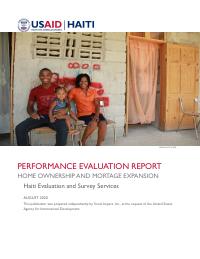
Cover Photo Credit: USAID/Haiti HOME
This publication was produced at the request of the United States Agency for International
Development. It was prepared independently by Sandra Wark (Team Leader) and Phanol Philippe
(Assistant Team Leader) on behalf of Social Impact, Inc.
Contact: Jennifer Mandel, Chief of Party
2300 Clarendon Blvd, Suite 1000
Arlington, VA 22201, USA
DISCLAIMER
The authors’ views expressed in this publication do not necessarily reflect the views of the United States
Agency for International Development or the United States Government.
i | USAID/HAITI HOME EVALUATION REPORT USAID.GOV
ABSTRACT
Social Impact’s Haiti Evaluation and Survey Services conduct ed an independent final evaluation of the
United States Agency for International Development (USAID)/Haiti’s Home Ownership and Mortgage
Expansion (HOME) activity. The World Council of Credit Unions (WOCCU) implemented HOME in
partnership with Habitat for Humanity International (HFHI) and the Affordable Housing Institute (AHI).
Using a mix of pay for performance (P4P) incentives and technical assistance, HOME aimed to increase
access to safe and durable housing by low-to-middle income Haitians by catalyzing private sector
investment. The a ctivity was largely successful in motivating three local property developers to build
eco-friendly commercial housing developments affordable to middle -class (but not lower -income)
households. Even though HOME’s results in terms of the quantity of houses build fell short of its end-of-
activity targets, most key informants broadly agreed that one property developer’s success showed that
a viable market exists, mainly among the middle class, for affordable, standard housing financed through
bank and credit union mortgages. HOME also facilitated the provision of mortgages for the sales of
some of these units and supported the expansion of housing microfinance by three credit unions. In
addition, the technical assistance provided to credit union partners to improve their housing loan terms
and conditions for owner-driven housing improvements contributed to the issuance of the first
mortgage by a credit union in Haiti. In the short-term, however, any significant housing development
expansion will suffer from Haiti’s current economic conditions and persistent governance challenges.
USAID.GOV USAID/HAITI HOME EVALUATION REPORT | ii
CONTENTS
Tables and Figures ii
Abbreviations and Acronyms iii
Executive Summary i
I. Introduction 1
Project Background 1
HOME Activity Goal and Objectives 2
HOME’s Theory of Change 3
Evaluation Purpose and Audience 4
Evaluation Questions 4
II. Evaluation Design 5
Sampling 5
Data Collection Methods 5
Analysis 8
Limitations and Mitigation Strategies 9
III. Findings and Conclusions 10
EQ1: To what extent and in what ways has the HOME activity promoted successful models to support affordable
housing development in Haiti? 10
EQ2: To what extent and in what ways was the HOME- promoted “pay for performance” methodology effective
in generating results and will be replicable and sustainable? 22
EQ3: To what extent and in what ways has HOME’s facilitation approach helped to create local real estate
developers, reinforce housing financing, improve the ecosystem, and create an enabling environment? 33
IV. Recommendations 38
Annex A: Evaluation Statement of Work 40
Annex B: References 47
Annex C: Evaluation Team Members 49
Annex D: Evaluation Design Matrix 50
Annex E: List of Persons Interviewed 56
Annex F: Informed Consent Scripts & Data Collection Protocols 58
Annex G: Disclosure of Conflict of Interest 81
TABLES AND FIGURES
Table 1: Key informant interviews by stakeholder group and sex ........................................................................ 7
Table 2: Focus Group Discussion by Stakeholder Group and Sex ........................................................................ 7
Table 3: Overview of HOME property developer projects’ progress- to-date................................................. 11
Figure 1: HOME results framework .............................................................................................................................. 3
Figure 2: HOME property developers’ units planned, built, and sold ................................................................. 15
Figure 3: Number of credit union housing loans before and after award .......................................................... 18
Figure 4: Gender distribution of credit union partner loans at end of HOME................................................. 27
Figure 5: Evolution of credit union housing portfolio before, immediately after award, and 18–24 months
later ..................................................................................................................................................................................... 29
iii | USAID/HAITI HOME EVALUATION REPORT USAID.GOV
ABBREVIATIONS AND ACRONYMS
AHI Affordable Housing Institute
CPF Caisse Populaire Fraternité
EDGE Excellence in Design for Greater Efficiency
EPPLS Public Enterprise for the Promotion of Social Housing
ESS Evaluation and Survey Services
ET Evaluation Team
EQ Evaluation Question
FGD Focus Group Discussion
GI Group Interview
HTG Haitian Gourd
HFHI Habitat for Humanity International
IFC International Finance Corporation
GOH Government of Haiti
HOME Home Ownership and Mortgage Expansion
KII Key Informant Interview
M&E Monitoring and Evaluation
MFI Microfinance Institution
P4P Pay for Performance
PAP Port-Au-Prince
PAR Portfolio at Risk
PFI Partner Financial Institutions
SI Social Impact
SME Small and Medium-Sized Enterprise
UNOPS United Nations Office for Public Service
USAID United States Agency for International Development
USD United States Dollar
i | USAID/HAITI HOME EVALUATION REPORT USAID.GOV
EXECUTIVE SUMMARY
The United States Agency for International Development (USAID) in Haiti requested that Evaluation and
Survey Services (ESS) of Social Impact, Inc. (SI), design and conduct an independent final evaluation of the
Home Ownership and Mortgage Expansion (HOME) activity. HOME is implemented by the World
Council of Credit Unions (WOCCU) in partnership with Habitat for Humanity International (HFHI) and
the Affordable Housing Institute (AHI). The purpose of this report is to present the evaluation team’s
(ET’s) main findings, conclusions, and recommendations.
EVALUATION PURPOSE AND EVALUATION QUESTIONS
The purpose of this final evaluation is to inform USAID’s future programming that might use HOME’s
“pay for performance” (P4P) development model in Haiti and elsewhere. The evaluation also assess es
the extent to which HOME achieved intended results, identifies any lessons learned, and recommends
possible follow-up actions. The primary audience for this final evaluation includes USAID/Washington,
USAID/Haiti, the grantee and subgrantees (WOCCU, HFHI, and AHI), other donors, Haitian private
sector entities, and the Government of Haiti (GOH).
This report addresses the following evaluation questions (EQs):
1. To what extent and in what ways has the HOME a ctivity promoted successful models to support
affordable housing development in Haiti? The ET should consider both the real estate developing
and the financing aspects of the model and the relationship between the two, highlighting what
worked, what did not, and why.
2. To what extent and in what ways was the HOME-promoted ‘pay for performance’ methodology
effective in generating results and will be replicable and sustainable? The evaluation team should
identify any specific elements of the approach that are likely to be replicable/sustainable and those
that will not be.
3. To what extent and in what ways has HOME’s facilitation approach helped create local real estate
developers, reinforce housing financing, improve the ecosystem, and create an enabling
environment (notaries, related associations, Central Bank, Public Private Unit at the Ministry of
Finances)? In this context, sustainable local real estate developers and financial institutions should
be understood as those that will continue the work started under HOME. Among other
empowerment criteria, the evaluation should consider the level of leadership taken by local
entities in the undertaken activities and success in terms of housing projects and housing finance.
ACTIVITY BACKGROUND
In 2015, USAID/Haiti developed the HOME activity to facilitate access to safe and durable housing
through market-based solutions in the Port-Au-Prince (PAP), Cap-Haitian, and Saint-Marc development
corridors. HOME set out to achieve two results: build and improve houses and provide housing finance
to low- and medium- income Haitian households. To achieve private- sector-led solutions to Haiti’s
housing deficit, HOME provide d a mix of performance-based financial incentives and technical assistance
to local property developers to create housing developments for underserved low -to-middle-income
Haitians. HOME also assisted and incentivized financial institutions to develop home finance products
and increase their home loan and mortgage portfolios serving low- to-medium-income Haitians,
USAID.GOV USAID/HAITI HOME EVALUATION REPORT | ii
particularly households headed by women. In 2015, WOCCU and its sub-grantees, HFHI and AHI,
launched HOME, initially through a three-year, USD 6,999,683 grant. In 2018, USAID/Haiti extended
HOME for two additional years and increased its budget to USD 10,669,683. The activity planned to end
in June 2020 but was recently extended to January 2021.
EVALUATION DESIGN, METHODS, AND LIMITATIONS
The ET used a primarily qualitative evaluation design, with data collection methods consisting of a
document review, key informant interviews (KIIs), group interviews (GIs), focus group discussions
(FGDs), and loan portfolio and HOME monitoring and evaluation ( M&E) data analysis. The ET
interviewed 53 individuals (23 women and 30 men) from various stakeholder groups. The ET also
organized six FGDs with housing microfinance loan recipients, two sex-segregated groups from each of
HOME’s three credit union partners, reaching 39 participants in total (16 women, 23 men). The ET used
purposeful sampling to select informants, including HOME personnel, property developer and financial
institution partners, other value chain entities, other stakeholders such as USAID officials, and
homebuyers.
The ET conducted all data collection remotely because of COVID -19 public health restrictions.
Evaluation limitations included recall, response, selection, and gender bias, as well as communication
challenges. The ET mitigated potential bias and limitations by selecting informants who were well
informed about the activity and represented diverse stakeholder groups, preparing and using detailed
data collection protocols, triangulating information from multiple sources, and using various data
collection methods, as well as identifying and using various communication technologies.
FINDINGS AND CONCLUSIONS
EQ1: TO WHAT EXTENT AND IN WHAT WAYS HAS THE HOME ACTIVITY PROMOTED
SUCCESSFUL MODELS TO SUPPORT AFFORDABLE HOUSING DEVELOPMENT IN HAITI?
To support the emergence of an affordable housing market in Haiti, HOME provided technical assistance
and financial incentives to five partner financial institutions (PFIs) and three property developers. In
collaboration with its partners, HOME sought to support affordable housing development in Haiti
through two models:
• Model 1: Mortgage-financed, commercially driven affordable housing developments and
• Model 2: Credit union housing microfinance loan-funded, owner-driven affordable housing
development.
HOME was largely successful in making a business case for commercially driven housing developments
for a middle-class market segment (Model 1). Through Model 1, HOME’s three property developer
partners initiated six affordable housing developments, with a total of 257 homes planned, all located in
PAP. HOME leveraged USD 9.6 million from private sector developers and USD 627,000 from PFI for
the housing developments. As of mid-August 2020, HOME property developer partners reported
completing 47 housing units. To date, one developer has sold a total of 22 units, 17 of which were
financed through mortgages. Even though HOME’s results in terms of the quantity of houses built fell
short of its end-of-activity targets, most key informants broadly agreed that the one property
iii | USAID/HAITI HOME EVALUATION REPORT USAID.GOV
developer’s success showed that a viable market exists, mainly among the middle class, for affordable,
standard housing financed through bank and credit union mortgages.
This positive demonstration effect, although tangible, was nevertheless diminished by the challenges and
delays affecting other HOME property developer partners. One HOME partner’s project is currently
halted because of financing issues and may also suffer from the development location’s insecurity and
access issues. A third HOME partner reported good progress and is confident about completing the first
phase of its development once COVID -19 related delays are overcome. However, evidence that homes
in the development will sell is still pending.
Rigorous market testing and HOME’s activities demonstrated that offering commercially
driven housing developments for lower-income Haitians was not a viable business case in
current market conditions. Although one development featured six low- priced houses, all of which
have been sold, the conditions under which the development was built appear challenging for others to
replicate at scale. A dozen or more key informants agreed that, in the absence of government incentives
such as increased investment in basic infrastructure and services, re-zoning publicly owned land for
commercial housing developments, and/or other fiscal incentives for developers, commercially driven
housing developments are unlikely to be profitable at prices that are affordable to low-income Haitians
because of high construction costs.
HOME property development partner experiences produced useful lessons learned that may help guide
future investments in commercially driven housing developments in Haiti:
• Construction finance is as important as buyer access to mortgages;
• Smaller developments and building in phases appear less risky and easier to finance than larger
developments;
• Pre-construction financing appears largely unviable due to trust issues;
• Property development location and access to basic services are important success factors; and
• Increasing the supply of commercial, affordable housing is an important condition for increasing
mortgage lending to lower- and middle-income homebuyers.
Model 2 (credit union housing microfinance loans) effectively helped low- income Haitians access housing
finance to improve their homes under more favorable conditions. Overall, HOME leveraged USD 7.2
million from credit unions for housing finance activities. HOME was successful in strengthening the
housing finance products and services of its credit union partners, who exceeded activity portfolio
expansion targets and whose mainly lower-income members enjoyed lower interest rates, longer loan
reimbursement periods, and improved credit agent outreach and support during the HOME award
period. Model 2 successfully contributed to the first credit union mortgage product by one credit union
partner, a milestone toward the democratization of mortgage lending in Haiti. Model 2’s success is
mitigated by the ubiquity of housing microfinance in Haiti and its association with the spread of
unregulated, informal, and unsafe housing.
USAID.GOV USAID/HAITI HOME EVALUATION REPORT | iv
EQ2: TO WHAT EXTENT AND IN WHAT WAYS WAS THE HOME -PROMOTED ‘PAY
FOR PERFORMANCE’ METHODOLOGY EFFECTIVE IN GENERATING RESULTS AND
WILL BE REPLICABLE AND SUSTAINABLE?
HOME used P4P incentives effectively, flexibly adapting the modality to the activity’s
objectives and context and producing several positive outcomes. By moderating real and
perceived risks, HOME P4P incentives effectively motivated property development partners to invest in
affordable housing and improve their building practices. P4P incentives and concessional loans were also
largely effective at expanding housing microfinance lending by HOME’s credit union partners. P4P also
incited significant cost-sharing from the Haitian private sector. Shared risk and the promise of tangible
rewards effectively focused HOME’s partners’ efforts to achieve contract benchmarks. Even though
HOME’s award structure evolved to reward incremental progress, increasing USAID/Haiti’s risk that its
investment could fall short of achieving desired outcomes, the change was justified by Haiti’s worsening
economic context, the high cost of construction finance in Haiti, and the limited time HOME had to
achieve results.
HOME’s use of P4P also had some shortcomings. The modality, in conjunction with the time
allocated for implementation, did not effectively facilitate access to awards by builders and construction
firms lacking large amounts of seed capital, which limited the scale of interventions and opportunities
afforded to less well- off entrepreneurs. Although women-hea ded households represent a large segment
of potential homebuyers, HOME’s interventions to overcome gender bias were limited. In addition,
HOME’s allocations for mortgage subsidies were not effective at facilitating access to mortgages for a
significant number of homebuy ers to date (July 2020). The limited supply of finished houses in affordable
housing developments and banks’ reluctance to allocate subsides both appear to be reasonable
explanations for this intervention strategy’s lack of success.
Expanded credit union housing lending will probably be sustained after HOME, but with
modifications to terms and conditions. Two of HOME’s three partner credit unions have managed
to continue expanding their housing finance portfolio 18–24 months after the end of HOME subsidies,
suggesting continued commitment to the segment. However, information provided by credit union key
informants shows that some of the qualitative benefits of HOME’s subsidies to borrowers have not been
replicated post-award since credit unions did not maintain lower interest rates and decreased the size
and length of housing loans. Credit unions’ aspirations to help their members access housing through
mortgage lending, shown in their deal- making with property developers, is also a promising sign that
credit union mortgage lending will be sustained and possibly replicated after HOME.
HOME’s success catalyzing a market for affordable housing developments will probably be sustained and
replicated after the end of subsidies but may face short term setbacks. Property developer and financial
institutions’ actions and stated interest in continuing and potentially increasing their investments in
mortgage-driven affordable housing developments are promising. Property developers’ perceptions that
new building practices HOME introduced saved them money and added value to their developments
also portend well for sustainability. The likelihood that property developers will finish current
developments and expand into new developments in the short term is negatively affected by Haiti’s
current political and economic troubles, and, for at least one developer, depends on the firm
overcoming its current financing challenges. HOME’s efforts to mobilize new sources of financing and
v | USAID/HAITI HOME EVALUATION REPORT USAID.GOV
technical assistance are positive for all three property developer partners, but short-term results remain
uncertain in light of Haiti’s currently poor investment climate.
EQ3: TO WHAT EXTENT AND IN WHA T WAYS HAS HOME’S FACILITATION
APPROACH HELPED TO CREATE LOCAL REAL ESTATE DEVELOPERS, REINFORCE
HOUSING FINANCING, IMPROVE THE ECOSYSTEM , AND CREATE AN ENABLING
ENVIRONMENT?
HOME was largely effective in facilitating the emergence of local real estate developers. By
changing builders’ and construction firms’ financing and development paradigm from individual client -
driven to developer-driven, the activity contributed to the emergence of local property developers.
HOME’s technical assistance to improve partners’ management and financial structures, although
initiated somewhat late, appears to have spurred changes that might facilitate access to needed
construction financing. The activity’s learning-by- doing approach was effective in building partner self-
reliance while keeping HOME focused on achieving its results. In addition to facilitating change within
individual enterprises, support for the property developers’ association enabled needed collective
solutions and experience sharing, potentially strengthening the voice and advocacy power of the nascent
developer community.
HOME’s facilitation was moderately effective at reinforcing housing financing. Encouraging
credit union mortgage product development and interest in partnerships with property d evelopers both
contributed to more equitable access to mortgages. However, credit unions’ concerns about expanding
longer-term lending too rapidly suggest limited growth potential without additional capital infusions.
Based on one property developer’s success obtaining commercial bank mortgages for its homebuyers,
HOME also contributed to PFIs’ willingness to accord mortgages to middle-class borrowers. However,
based on commercial bankers’ own as well as others’ testimony, HOME could not moderate bank
mortgage lending terms and conditions, and, as a result, qualifying for a bank mortgage remains difficult
and expensive. HOME’s contribution to expanding mortgage lending overall was minimal, largely because
it did not significantly increase the affordable housing supply.
HOME’s interventions also had a relatively small but positive effect on the housing sector
ecosystem and enabling environment. By establishing the good practice of subdividing land and
registering titles before construction, HOME reinforced ecosystem actors’ capacity and facilitated
mortgage access. At the end of HOME, property developers still cannot apply Haiti’s Condominium
Law, leaving the promise of “building up” to alleviate Haiti’s housing deficit unrealized. However, HOME
has contributed to clarifying what is needed to resolve the impasse and taken steps that others, including
property developers’ association members, can build on as they move toward solutions.
RECOMMENDATIONS
1. In future activities, USAID grantees should focus earlier and more overall on interventions to
facilitate property developers’ access to construction financing and credit unions’ access to
affordable capital loans.
2. In future similar activities, USAID grantees should focus more on increasing the supply of
affordable houses in the initial implementation phases , especially in areas where it has PFI
partners.
USAID.GOV USAID/HAITI HOME EVALUATION REPORT | vi
3. In future activities, USAID grantees should strengthen incentives and capacity building for
partners to encourage single women-headed households’ access to affordable housing. More
broadly, USAID/HAITI should ensure that future programming is informed by gender analysis
that enables it to respond to specific barriers and biases that may affect women’ s equal access
and ability to benefit from housing finance.
4. USAID/Haiti should provide technical support to overcome regulatory barriers to building
apartment buildings.
5. USAID/HAITI should maintain contact with the property developers’ association and provide
guidance when needed.
1 | USAID/HAITI HOME EVALUATION REPORT USAID.GOV
I. INTRODUCTION
The United States Agency for International Development (USAID) in Haiti requested that Evaluation and
Survey Services (ESS) of Social Impact, Inc. (SI), design and conduct an independent final evaluation of
USAID/Haiti’s Home Ownership and Mortgage Expansion (HOME) a ctivity, implemented by the World
Council of Credit Unions (WOCCU) in partnership with Habitat for Humanity International (HFHI) and
the Affordable Housing Institute (AHI) (see Annex A for the evaluation S tatement of Work).
The evaluation team (ET) reported initial findings based on a document review (see Annex B for list of
documents consulted and Annex C for the team members’ profiles) and proposed the evaluation design
in an Inception Report/Evaluation Design, which USAID/Haiti approved before the team started
fieldwork (see the summary of evaluation design in the Evaluation Design Matrix in Annex D). This
report presents the evaluation’s principal findings, conclusions, and recommendations.
PROJECT BACKGROUND
Haiti has a housing deficit estimated at half a million to a million units in a country of only 11 million
people. A 2010 earthquake destroyed approximately 250,000 homes, adding to an existing shortfall of at
least 300,000 homes. Despite several donor interventions to rebuild Haiti’s housing stock, enduring
shortages, high population growth, and urban migration continue to fuel demand for urban housing. As a
result, most urban residents still live in precarious shelters and continue to be vulnerable to climatic and
seismic hazards ten years after the earthquake.
1
Both the demand and supply sides are driving Haiti’s housing deficit.
2 On the demand side, most low-to-
medium- income Haitians cannot afford to buy a home and may also face challenges financing home
rehabilitation. Despite relatively high levels of liquidity, Haitian banks are risk -averse to mortgage
lending. In 2015, there were only about 1,000 mortgages in Haiti, and the average value of the
mortgaged homes was over USD 200,000, a price tag well out of reach for low-to-middle-income
households. Also, few low-to-middle-income households are eligible for mortgage financing because they
earn too little or their income stems from informal employment, which is difficult to underwrite.
3 Weak
land tenure also hinders banks from providing loans, since homeowners cannot offer their property as
collateral without proof-of-ownership.
4 Women are especially affected, since uneven power dynamics
between men and women make it difficult for women to gain needed land ownership and the
accompanying deeds required to access housing credit. Moreover, because many women have limited
1 Amnesty International, “15 Minutes to Leave: Denial of the Right FN Adequate Housing in Post-Quake Haiti,”
2015.
2 The demand side represents people’s ability to borrow money to finance the purchase of a new home or repair
an existing home. The supply side of the housing value chain looks at the number of homes being produced.
3
Adapted from Caldwell and Clodomir, “Haiti HOME: Catalyzing Haiti’s Affordable Housing Market.”
4 Haiti does not have an effective national cadastre and lacks a comprehensive, functional system for recording land
ownership. Before the earthquake, only 40 percent of landowners in Haiti possessed ownership documentation,
such as a legal title or transaction receipt. See P. Giampaoli and M. Freudenberger, “USAID Issue Brief: Land
Tenure and Property Rights in Haiti,” (USAID, January 2010), https://www.land -links.org/wp-
content/uploads/2016/09/Land-Tenure-and-Property-Rights-in-Haiti-1.pdf.
USAID.GOV USAID/HAITI HOME EVALUATION REPORT | 2
disposable income and savings, they remain dependent on male providers to cover housing costs,
heightening their vulnerability to domestic violence .
5
Non-bank financial institutions (credit unions and microfinance institutions [MFIs]) typically offer
unsecured, short-term housing microloans at rates upwards of 24 percent per year. C lients frequently
take costly, successive short-term loans to fi nance a home over the long term. Constraints affecting
non-bank financial institutions’ capacity to offer larger, longer-term home loans include lack of know-
how to develop and market new financial products sustainably, as well as lack of capital.
6
On the supply side, Haiti’s formal real estate market offers few affordable homes for sale. The average
home price in Port-au-Price (PAP) in 2018 was approximately USD 300,000. With constraints like
limited appropriate land availability,
high-cost construction materials, unclear, costly and time-consuming
regulations associated with building and selling real estate, and limited access to financing both for
construction and mortgages, property developers have unsurprisingly been afraid to invest in what they
perceive to be a high-risk and low-reward affordable housing market.
HOME ACTIVITY GOAL AND OBJECTIVES
In 2015, USAID/Haiti developed the HOME activity to facilitate access to safe and durable housing for
low-to-middle-income Haitian households, particularly women-headed households, through market-
based solutions. HOME sought to catalyze the affordable housing market in Haiti by working with local
private sector developers and financial institutions in the PAP , Cap-Haitian, and Saint-Marc development
corridors. HOME used a mix of pay-for- performance incentives and technical assistance to address both
supply- and demand-side constraints affecting the affordable housing market. In 2015, WOCCU and its
sub-grantees HFHI and AHI launched HOME, initially through a three-year, USD 6,999,683 grant. In
2018, USAID/Haiti extended HOME for two additional years and increased its budget to
USD 10,669,683. In July 2020, USAID/Haiti awarded WOCCU a no-cost extension that delayed
HOME’s closure until January 2021.
HOME’s overall goal wa s to increase low -to-middle-income Haitian households’ access to longer-term
financing, enabling them to construct, rehabilitate, and purchase safe, durable, and affordable housing. To
contribute to this goal, HOME aimed to achieve two results, each with two intermediate results, as
described in Figure 1 below.
5 “The Haiti Gender Report,” A Coalition Gender Shadow Report of the 2010 Haiti Post-Disaster Needs
Assessment (PDNA), p. 27.
6 Caldwell and Clodomir, “Haiti HOME: Catalyzing Haiti’s Affordable Housing Market.”
3 | USAID/HAITI HOME EVALUATION REPORT USAID.GOV
FIGURE 1: HOME RESULTS FRAMEWORK
HOME’S THEORY OF CHANGE
USAID/Haiti designed HOME to catalyze and create an enabling environment for Haiti’s private sector
to meet low- and medium- income Haitians’ demand for safe, durable, and affordable homes. WOCCU
and its subgrantees HFHI and AHI hypothesized that the private sector in Haiti is capable of “working
around” or directly overcoming many of the challenges affecting affordable home ownership, so long as
housing value chain stakeholders have the right incentives and capacities.
7 By providing financial
incentives to mitigate the real and perceived risks facing financial institutions and real estate developers,
as well as technical expertise to build local capacity to apply good home finance and real estate
development practices, HOME theorized that it could unlock sustainable, private-sector-led solutions to
Haiti’s affordable housing deficit.
On the demand side, HOME assumed that it could improve access to financing to build, rehabilitate, and
purchase homes by providing technical assistance and incentives to microfinance institutions, credit
unions, and banks. HOME’s interventions included pay for performance (P4P) incentives to motivate
lending to female-headed households, effectively motivating and capacitating lending institutions to offer
more home loans to low- to-medium-i ncome households. HOME aimed to shrink the home financing gap
facing low-to-medium-income Haitians by incentivizing banks to lower minimum mortgage values, while
also building the capacity of and providing financial incentives to credit unions to increase their housing
7
HOME assumed that Haitian companies are familiar with the country’s land issues, know which land is under
dispute, and can navigate Haiti’s complex land registration system.
USAID.GOV USAID/HAITI HOME EVALUATION REPORT | 4
loan values, lengthen payback periods, and lower interest rates. By overcoming perceived risks and
capacity constraints, HOME assumed that banks and credit unions would realize the business potential
of providing home loans and mortgages to l ow-to-medium-income households and would continue to
serve this market segment without subsidies or other assistance.
On the supply side, instead of using donor funds to build housing projects, HOME postulated that it
would be more effective and efficient to provide technical support and financial incentives to Haitian
developers to motivate them to expand “down market” into affordable housing segments. HOME
calibrated its financial incentives for hitting construction and sales benchmarks to cover the amount
needed to make up the “profitability deficit” of building and offering housing at prices affordable to low-
and medium- income buyers, while using green building techniques and satisfying international building
safety standards.
HOME further assumed that once developers saw the business potential of supplying
green, safe, affordable housing, they would continue to build and expand supply even without subsidies.
To ensure that HOME’s technical assistance and incentives would benefit low-to-middle-income
Haitians, HOME limited its supply-side support to homes sold to income-qualifying households through a
mortgage (which HOME ensured would be available through its demand-side interventions, such as
down-payment subsidies).
EVALUATION PURPOSE AND AUDIENCE
This final evaluation aims to inform future USAID programming that uses HOME’s P4P development
model in Haiti and elsewhere. The evaluation also assesses the extent to which HOME achieved its
intended results, identifies lessons learned, and recommends possible follow- up actions. The primary
audience for this final evaluation includes USAID/Washington, USAID/Haiti, HOME’s grantee and
subgrantees (WOCCU, HFHI, and AHI), other donors, Haitian private sector entities, and the
Government of Haiti (GOH).
EVALUATION QUESTIONS
When answering these evaluation questions (EQs), the ET considered stakeholder satisfaction,
unintended results, and lessons learned.
1. To what extent and in what ways has the HOME activity promoted successful models to support
affordable housing
8 development in Haiti?
To answer this question, the ET will consider both the real estate development and finance aspects of
the model and the relationship between the two, highlighting what worked, what did not, and why.
2. To what extent and in what ways was the HOME-promoted ‘pay for performance’
9 methodology
effective in generating results and will be replicable and sustainable?
8
According to HOME’s Performance Indicator Reference Sheet, the target income range of Haitian households for
home loan loans and mortgages was between HTG 10,000 and HTG 250,000 per month (or the USD equivalent,
USD 90–2,230 at time of writing this report).
9 Pay for results or performance is an umbrella term for initiatives that pay upon accomplishment of results rather
than efforts to accomplish those results. For example, a funder or a project implementer sets aside financial
incentives for an entity to deliver predefined results and pays these incentives after verifying the results.
5 | USAID/HAITI HOME EVALUATION REPORT USAID.GOV
To answer this question, the ET will identify any specific elements of the approach that are likely to be
replicable/sustainable and those that will not.
3. To what extent and in what ways has HOME’s facilitation approach helped to create local real
estate developers, reinforce housing financing, improve the ecosystem, and create an enabling
environment (notaries, related associations, Central Bank, Public Private Unit at the Ministry of
Finances)?
The ET understands sustainable local real estate developers and financial institutions as those that will
continue the work they initiated under HOME. Among other empowerment criteria, the ET will
consider the level of leadership local entities have demonstrated in undertaking activities and their
success in terms of housing projects and finance.
II. EVALUATION DESIGN
SAMPLING
The ET collected data on the perspectives and experiences of key stakeholders involved in HOME
activity using a purposeful sampling technique (see list of persons consulted in Annex E). Key
stakeholder groups included HOME personnel, property developer and financial institution partners,
other value chain entities, other stakeholders (including USAID officials), and homebuyers and credit
union microfinance loan recipients. Evaluation respondents were from all three geographic zones in
which HOME operated: the PAP , Saint Marc, and Cap Haitian development corridors.
The ET supplemented purposeful sampling with snowball sampling to identify additional key informants
and fill gaps in its initial list of key stakeholders. For example, the ET used snowball sampling to identify
key informants such as: notaries, land surveyors and lawyers who had worked with HOME partners;
bank representatives who supplied mortgages without a formal partnership agreement with HOME;
credit union credit agents who participated in HOME training; government officials with whom HOME
personnel interacted; and HOME partner housing development unit homebuyers. During initial
interviews, HOME personnel and property developer and financial institution partners provided
additional names and contact information for missing individuals.
Overall, the final informant sampling allowed the ET to compare the perspectives of different key
stakeholder groups and cross-check and fill gaps in HOME ’s reporting. Although there were more m ale
than female respondents (58 percent male respondents versus 42 percent female), the proportion
reflected the roles played by men and women in HOME.
DATA COLLECTION METHODS
The ET used a predominantly qualitative design. The ET extracted quantitative data from HOME’s
monitoring and evaluation (M&E) systems and data on credit union partners’ loan portfolios. The ET
compared and complemented project-supplied data with qualitative data collected through various
methods, consisting of document review, key informant interviews (KIIs), group interviews (GIs), and
focus group discussions (FGDs). The ET reviewed a ctivity documents and produced an inception report
in May and June 2020. The ET carried out data collection in two phases. From June 1 to 12, the ET
interviewed members of HOME’s implementation team. From June 29 to July 13, the ET interviewed all
USAID.GOV USAID/HAITI HOME EVALUATION REPORT | 6
other stakeholder groups and carried out FGDs with credit union loan recipients. Due to COVID-19-
related public health restrictions, the ET conducted all data collection remotely by telephone and
various online conferencing technologies.
The ET developed data collection protocols (see Annex F) to: (1) ensure all key issues were covered
during data collection, (2) elicit rich, sometimes unanticipated, information from respondents , (3) help
organize information in a form that c ould be usefully and efficiently analyzed, and (4) ensure that the ET
collected sex-disaggregated data. The protocols consisted of questions that address and derive from the
EQs, as well as from the ET’s document review, its initial discussions with USAID, and its knowledge of
evaluation design.
DOCUMENT REVIEW
The ET reviewed HOME documents to understand HOME’s design and implementation, extract findings
relevant to the EQs, and inform data collection protocol development so that instruments appropriately
supplemented background documents. The ET reviewed the following categories of documents (see
Annex B for a full listing):
• HOME grant proposal,
• HOME quarterly and annual reports,
• HOME annual work plans,
• HOME M&E plans,
• Activity descriptions and modifications, and
• Journals and other publications.
The ET also analyzed data on loan numbers, housing loan volume, loans made to women borrowers, and
portfolio at risk (PAR, the percentage of loans with payments in arrears) provided by HOME for its three
credit union partners’ housing microcredit loan portfolios. For most of these, HOME provided three data
points: baseline values, values at the end of the award contract, and in December 2019, 18–24 months
after the end of HOME’s credit union housing microfinance interventions.
KEY INFORMANT INTERVIEWS
The ET interviewed 53 individuals (23 women and 30 men) from various stakeholder groups. The ET
interviewed most key informants individually, except for GIs with property developer partners teams
(Tecina, Panamera), credit union credit agents, and members of the property developers’ association.
Because of the small sample size, the ET interviewed all possible key informants within the HOME
personnel, property developer partners, and partner financial institution (PFI) stakeholder categories.
Findings from KIIs contributed to the ET’s responses to all EQs. Table 1 shows the distribution of
interviews by key stakeholder group and sex . Each KII followed an interview protocol adjusted for
different respondent types of respondents and was conducted in French, English, or Haitian Creole,
depending on the key informant’s preference.
[... middle sections omitted for long document ...]
79 | USAID/HAITI HOME EVALUATION REPORT USAID.GOV
INFORMED CONSENT AGREEMENT – FGD
Thank you all for agreeing to participate in todays’ call.
I am a researcher from Social Impact, a company that is based in the United States. Our team is
conducting a study of the USAID/HAITI HOME activity. HOME is a project to facilitate access to safe
and durable housing by Haitian households. HOME helped [NAME OF FINANCIAL INSTITUTION] to
develop its home loan activities.
Procedures: Today we are going to discuss your experience and opinion of the [NAME OF FINANCIAL
INSTITUTION]. The discussion with last about one hour. Your answers will be kept confidential. [NAME
OF FINANCIAL INSTITUTION] has shared your information with us but will not know whether you chose
to participate or any details of your response. Your responses will be summarized in a report about the
HOME program but your name will not be included in the report.
Risks/Benefits: You will not receive any direct benefit or compensation for participating in this survey,
either from Social Impact or from [NAME OF FINANCIAL INSTITUTION]. If you have not already, you will
be provided with a credit stipend of [amount] to cover the data costs of participating. We hope that our
results will help your credit union and its partners to improve its loan programs.
Voluntary Participation: Participation in this survey is completely voluntary. If at any point, you don’t
want to continue, please let me know.
Do you have any questions? [Interviewer should answer any questions]
Permission to Proceed
I understand the purpose of the interview as outlined above and understand that I can withdraw from
the interview at any time and for any reason. I agree to participate in the interview (Evaluator records).
Yes No
Initials of evaluator to indicate receipt of verbal consent: _____________________
Date _________________________
Brief Description of FGD Process
This will be conducted as a focus group. I will ask a series of questions to the group and facilitate
some discussion. We want everyone to feel free to express themselves and participate, especially
if you have a different opinion than what is being shared by others. Not everybody needs to
respond to each question, though we hope you to speak up if you have something to share.
Because we are having this discussion over Whatsapp instead of in person, I may call on individuals
to make sure everyone has an opportunity to contribute. If at any point you do not wish to
respond you can say so.
USAID.GOV USAID/HAITI HOME EVALUATION REPORT | 80
1. How did you hear about the possibility to get a loan for housing from your credit union?
2. For what purpose did you take your loan? (Prompts: new home construction, home
improvements, home repairs) How, if at all, has taking the loan affected your quality of housing?
3. What other options did you consider for financing for housing? (Prompts: loans from relatives?
Other microfinance institutions?) What made you select your credit union compared to other
alternatives [if applicable]?
4. How did you decide to take the loan? Who was involved in the decision? If you are living with a
partner, how was your partner involved in the decision to take the loan?
5. Have you taken out loans in the past that you used for housing improvements or construction? If
so, was there any difference in the loan terms and conditions in your recent housing loan (taken
out in the last 4 years) than loans you had in the past? For example, where there any difference
in:
• What you needed to qualify for the loan?
• The administrative process to apply and receive the loan?
• The maximum size of the loan?
• Interest rates?
• Repayment schedules?
6. What role did the credit agent have in your experience taking out a housing loan? Did you receive
any advice or assistance from your credit union on your housing improvement projects? For
example, what to improvements to start with first? What to expect in terms of costs? How to
monitor progress?
7. How confident do you feel that you will be able to repay the loan?
8. Do you have any suggestions for how to improve [name of credit union] home loan products?
9. Thank you for taking the time to participate in our discussion . Is there anything you would like to
add before we finish?
81 | USAID/HAITI HOME EVALUATION REPORT USAID.GOV
ANNEX G: DISCLOSURE OF CONFLICT OF INTEREST
USAID.GOV USAID/HAITI HOME EVALUATION REPORT | 82
83 | USAID/HAITI HOME EVALUATION REPORT USAID.GOV