Texte Intégral du Document
Texte extrait du document original pour l'indexation.
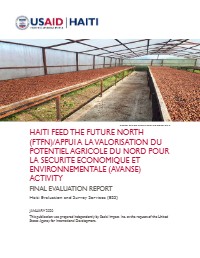
CACAO DRYING TABLES, ACUL DU NORD, HAITI
HAITI FEED THE FUTURE NORTH
(FTFN)/APPUI A LA VALORISATION DU
POTENTIEL AGRICOLE DU NORD POUR
LA SECURITE ECONOMIQUE ET
ENVIRONNEMENTALE (AVANSE)
ACTIVITY
FINAL EVALUATION REPORT
Haiti Evaluation and Survey Services (ESS)
JANUARY 2020
This publication was prepared independently by Social Impact, Inc. at the request of the United
States Agency for International Development.
USAID.GOV USAID/HAITI AVANSE FINAL EVALUATION REPORT | ii
HAITI FEED THE FUTURE NORTH
(FTFN)/ APPUI A LA VALORISATION
DU POTENTIEL AGRICOLE DU
NORD POUR LA SECURITE
ECONOMIQUE ET
ENVIRONNEMENTALE (AVANSE)
ACTIVITY
FINAL EVALUATION REPORT
Date: January 2020
Submitted To: USAID/Haiti
Evaluation Mechanism Number: AID- 521-C-17-00002
Haiti Evaluation and Survey Services for USAID/Haiti
This publication was prepared independently by Social Impact, Inc. at the request of the United
States Agency for International Development.
Contact: Jennifer Mandel, Chief of Party
2300 Clarendon Blvd, Suite 1000
Arlington, VA 22201, USA
DISCLAIMER
The authors’ views expressed in this publication do not necessarily reflect the views of the
United States Agency for International Development or the United States Government.
iii | USAID/HAITI AVANSE FINAL EVALUATION REPORT USAID.GOV
ABSTRACT
The United States Agency for International Development (USAID)/Haiti requested an
independent final evaluation of the Feed the Future North (FTFN) activity, also known as Appui
à la Valorisation du potentiel Agricole du Nord pour la Sécurité Economique et Environnementale
(AVANSE). DAI Global, LLC (DAI) implemented AVANSE , valued at USD 87.8 million, from
2013 to 2019.
To increase agricultural incomes, AVANSE promoted approaches and technologies to increase
farmers’ capacity and performance, build input systems through agricultural input shops and
private agro-businesses, and strengthen relations in three value chains (cacao, rice,
banana/plantain).
Farmers appreciated AVANSE’s impact on increased income and yields. Many will continue
applying these technologies, while some would ap preciate ongoing training and support. Most
farmers noted water shortage as a barrier to continued use of these approaches and
technologies. Based on increased yields, and the existence of underserved and new areas, scaling
up potential exists for AVANSE-promoted approaches and technologies. Private enterprises are
potential partners for continuing to promote these approaches/technologies. However, access
to water and finance are necessary to both continued use and sustainably scal ing up AVANSE
impact.
Storeowners felt that AVANSE capacity building support helped them function more
professionally and agricultural input subsidies helped to increase their incomes. They will
continue selling inputs and farmers will both buy inputs and produce their own seeds /seedlings.
Value chain actors described the market partnerships AVANSE promoted as beneficial. Private
enterprises benefited from access to increased quantity and quality products. Farmers benefited
from access to secure markets and embedded support services.
USAID.GOV USAID/HAITI AVANSE FINAL EVALUATION REPORT | iv
CONTENTS
ABSTRACT III
ACRONYMS V
EXECUTIVE SUMMARY VII
INTRODUCTION 1
EVALUATION SCOPE OF WORK 4
EVALUATION METHODOLOGY 5
PHASE III: DATA ANALYSIS AND REPORTING 7
FINDINGS AND CONCLUSIONS 9
RECOMMENDATIONS FOR USAID 30
ANNEX A: EVALUATION STATEMENT OF WORK 32
ANNEX B: LIST OF DOCUMENTS CONSULTED 40
ANNEX C: PROFILES OF THE EVALUATION TEAM MEMBERS 42
ANNEX D. EVALUATION DESIGN MATRIX SUMMARY 46
ANNEX E: LIST OF PERSONS INTERVIEWED 50
ANNEX F: GEOGRAPHIC LOCATION OF INTERVIEWS 52
ANNEX G: DATA COLLECTION PROTOCOLS 53
ANNEX H: MAIN TECHNOLOGIES PROMOTED BY AVANSE 82
ANNEX I: LIST OF MAIN APPROACHES PROMOTED BY AVANSE 83
ANNEX J: MAIN INPUTS AND EQUIPMENT USED BY CROP 85
ANNEX K: NON-DISCLOSURE AGREEMENTS 86
TABLES
TABLE 1: RESPONDENT GROUPS AND VALUE CHAINS 7
v | USAID/HAITI AVANSE FINAL EVALUATION REPORT USAID.GOV
ACRONYMS
AVANSE Appui à la Valorisation du potentiel Agricole du Nord pour la Sécurité
Economique et Environnementale
BAC Communal Agricultural Offices (Bureau Agricole de la Commune)
BAP
BIA
Best Agricultural Practices
Boutiques d’Intrants Agricoles (Input stores)
CBO Community Based Organization
CLES Collective Against Social Exclusion (Collectif de Lutte contre l’Exclusion Sociale)
CNSA Conseil National de Sécurité Alimentaire
COMAG Commerce Agricole S.A.
COP Chief of Party
COR Contracting Officer’s Representative
DAI Development Alternatives Inc.
DEC Development Experience Clearinghouse
DEED Développement Economique pour un Environnement Durable
ESS Evaluation and Survey Services
ET Evaluation Team
EQ Evaluation Question
EQUI
®
Evaluation Quality, Use, and Impact
®
FCR Findings, Conclusions, and Recommendations
FECANO Federation of Cacao Cooperatives of the North (Fédération des Coopératives
Cacaoyères du Nord
FFS Farmer Field School
FGD Focus Group Discussion
FTF Feed the Future
FTFN Feed the Future North
GOH Government of Haiti
GUC Grant Under Contracts
HAP Hillside Agriculture Program
IDB Inter-American Development Bank
IFAD International Funds for Agricultural Development
IFPRI International Food Policy Research Institute
IR Intermediate Result
KII Key Informant Interview
LOE Level of Effort
LOP Life of Project
M&E Monitoring and Evaluation
MARNDR Ministry of Agriculture, Natural Resources, and Rural Development (Ministère de
l'Agriculture des Ressources Naturelles et du Développement Rural)
MFI Micro-Finance Institution
MSU Michigan State University
MT Metric Tons
NRM Natural Resources Management
OIG Office of Inspector General
PE Performance Evaluation
USAID.GOV USAID/HAITI AVANSE FINAL EVALUATION REPORT | vi
PIF Intensive Production via Fragmentation (Production intensive par fragmentation)
PISA Produit des Iles S.A.
PO Producer Organization
PTTA Program for Technology Transfer to Small Farmers
QA Quality Assurance
SI Social Impact, Inc.
SIBA
SIMA
System of Incentives through Purchase Vouchers (Système d’incitation via les bons
d’achat)
Agriculture Market Information System (Systeme d'Information sur les Marches
Agricoles)
SRA Système de Riziculture Amélioré
SRI Intensive Rice-growing System (Système rizicole intensif)
SOW Scope of Work
TA Technical Assistance
U-FE Utilization-Focused Evaluation
USAID United States Agency for International Development
USD United States Dollar
USG United States Government
vii | USAID/HAITI AVANSE FINAL EVALUATION REPORT USAID.GOV
EXECUTIVE SUMMARY
The United States Agency for International Development (USAID)/Haiti requested that Social
Impact’s (SI) Haiti Evaluation and Survey Services (ESS) project design and conduct an
independent final performance evaluation of the Feed the Future North (FTFN) activity, also
known in French as Appui à la Valorisation du potentiel Agricole du Nord pour la Sécurité Economique
et Environnementale (AVANSE). USAID/Haiti developed the FTFN/AVANSE activity after the
January 2010 Haiti earthquake to improve incomes in Haiti’s northern corridor. DAI Global,
LLC (DAI) implemented this activity, valued at USD 87.8 million, from 2013 to 2019.
EVALUATION PURPOSE AND EVALUATION QUESTIONS
The purpose of this evaluation report is to inform USAID’s possible future agriculture
programming in Haiti. The primary audience includes USAID/Haiti, DAI Global, and Government
of Haiti (GOH) institutions, including the Ministry of Agriculture, Natural Resources, and Rural
Development (Ministère de l'Agriculture des Ressources Naturelles et du Développement Rural
[MARNDR]) and the Communal Agricultural Offices (Bureau A gricole de la Commune [BAC]).
This final evaluation seeks to answer the following evaluation questions (EQs):
• To what extent and in what ways will AVANSE’s approaches and technologies used in the rice, plantain, and cacao value chains continue to be used at the end of the activity,
and why?
• To what extent and in what ways has AVANSE strengthened inputs systems in the activity area?
• To what extent and in what ways could approaches and technologies promoted by
AVANSE be scaled up?
• To what extent have AVANSE activities created partnerships that could, over the long
term, guarantee farmers’ access to markets and private sector led provision of services?
ACTIVITY BACKGROUND
AVANSE began on April 1, 2013, and continued through December 31, 2019.
1 In line with GOH
and United States Government post -earthquake strategies, AVANSE’s goal was to increase
agricultural incomes in the northern corridor.
2 The activity incorporated priorities set under
Feed the Future to combat hunger and food insecurity by boosting agricultural productivity and
increasing market opportunities for smallholder farmers. The activity’s design specifically targeted the banana/plantain, cacao, and rice value chains.
Subsequent to an audit by USAID’s Office of the Inspector General, USAID/Hai ti significantly
revised the activity’s focus in 2015. As part of these revisions, USAID/Haiti established the
following goals and objectives for the activity: to increase agricultural incomes for at least 28,000
rural households, and double the export volume that AVANSE-supported cacao farmers
produce. AVANSE expected to achieve these goals through three Intermediate Results (IRs):
• IR 1: Agricultural Productivity Increased
• IR 2: Watershed Stability Above Selected Plain Improved
• IR 3: Agricultural Markets Strengthened
1 AVANSE has requested a cost -free extension to March 31, 2020. It plans to use extension to complete remaining
activities interrupted by political unrest that occurred in 2019 in Haiti.
2 The northern corridor consists of the following departments: North and Northeast.
USAID.GOV USAID/HAITI AVANSE FINAL EVALUATION REPORT | viii
EVALUATION DESIGN, METHODS, AND LIMITATIONS
The evaluation team (ET) conducted this qualitative evaluation across three departments (West,
North, and Northeast) from September 2019 to January 2020 in four phases: desk review;
fieldwork; data analysis; and, reporting. The first phase generated preliminary findings and
highlighted information gaps to inform the evaluation methodology design and subsequent
fieldwork. The fieldwork phase objective was to collect primary data to answer the evaluation
questions. During the data analysis phase, the ET aggregated interview data for content analysis
triangulation and cross-comparison to provide evidence for the findings and subsequent
conclusions.
The ET conducted fieldwork in Northern Haiti in Novembe r 2019. They employed two data
collection methods: Key Informant Interviews (KII) and Focus Group Discussions (FGDs). The
team completed a total of 80 interviews, of which 51 were KIIs and 29 were FGDs. The sample
included 392 respondents, of which 144 were women (37 percent) and 248 (63 percent) were
men. The ET conducted all interviews in-person.
The ET developed mitigation strategies to overcome potential response, selection, and gender
bias risks in data collection and analysis. To avoid potential bias and strengthen cross-cutting
analysis of evaluation findings, the team asked similar questions to all informant groups and
triangulated responses.
FINDINGS AND CONCLUSIONS
EQ 1 - TO WHAT EXTENT AND IN WHAT WAYS WILL AVANSE’S APPROACHES
AND TECHNOLOGIES USED IN THE RICE, PLANTAIN, AND CACAO
VALUE CHAINS CONTINUE TO BE USED AT THE END OF THE ACTIVITY,
AND WHY?
The ET found that farmers acquired capacity to continue using approaches and technologies
AVANSE promoted through: (i) increased technical skills (mainly through Farmer Field Schools);
(ii) subsidized inputs use; and, (iii) ease of applying and adapting technologies to their situation.
AVANSE promoted a total of 32 technologies to increase cacao , rice, and banana value chain
production. These included Système de Riziculture Intensive (SRI), Production Intensive par
Fragmentation (PIF), nurseries and demonstration plots to promote Best Agricultural Practices
(BAP). The activity also promoted a total of ten approaches through which to disseminat e
knowledge, including Farmer Field Schools (FFS), Lead Farmers , farmer- to-farmer exchange
visits, and increasing input access through a system of declining subsidies.
Many farmers will continue to use AVANSE promoted technologies, particularly those relatively
easy to use. However, farmers using more complicated rice value chain technologies may
require additional support. According to farmers in all three value chains, the primary
motivation for continuing AVANSE promoted technology use is observed increases income and
yields, as well as cost efficiency. These positive results also had a demonstration effect for non-
beneficiaries, some of whom adopted AVANSE techniques without support from the activity.
The evaluation found four main obstacles to continued use of AVANSE’s promoted approaches
and technologies: drought; political unrest; the quality, quantity and timeliness of input
availability; and, the lack of GOH capacity to continue to support activities begun under the
activity.
ix | USAID/HAITI AVANSE FINAL EVALUATION REPORT USAID.GOV
EQ 2 - TO WHAT EXTENT AND IN WHAT WAYS HAS AVANSE STRENGTHENED
INPUTS SYSTEMS IN THE ACTIVITY AREA?
A key component of the activity’s approach to increasing input access was building input
systems’ actors capacity. The activity used a market-based approach to strengthen both the
supply and demand sides of the input value chain.
To increase agricultural input access, AVANSE implemented a system of subsidized vouchers
that could be redeemed at local agricultural input stores. Farmers used subsidies to purchase
inputs such as fertilizer, equipment such as motor pumps, and services such as plowing. Shop
owners indicated they will continue to sell inputs. Farmers reported their intent to continue
buying them, though in smaller quantities and less frequently in the absence of subsi dies.
The activity also provided eight agricultural input stores technical and financial assistance to
make physical improvements in their shops, and improve their management and accounting.
AVANSE worked directly with farmers to increase their capacity to produce and sell inputs
through seedling nurseries. Farmers, particularly women, appreciated that these nurseries
provided them ongoing access to healthier inputs.
AVANSE promoted partnerships among input stores to form a buyers’ network to purchase
from wholesalers in bulk, reducing their costs and improving input access. By distributing
vouchers for subsidized inputs through local Microfinance Institutions (MFIs), AVANSE also
encouraged farmers to build relationships with financial services providers. Building relationships
within value chains encouraged private enterprises to provide farmers with embedded support
services such as inputs, credit, and technical assistance.
According to input shop owners, the voucher system increased the number of clients and
improved their business turnover. MFIs also noted an increase in the number of clients visiting
their branches due to the voucher program. While farmers may not purchase the same
quantities of inputs without subsidies, their increased input use during the activity produced a
positive demonstration effect.
Farmers stated that lack of access to water was a major constraint to their input use. Farmers of
all three crops also mentioned lack of access to finance as a constraint to using inputs. Finally,
the GOH’s distribution of free tools, seeds, and fertilizer created potential competition with
AVANSE’s market-based approach to supporting input systems.
EQ 3 - TO WHAT EXTENT AND IN WHAT WAYS COULD APPROACHES AND
TECHNOLOGIES PROMOTED BY AVANSE BE SCALED UP?
Most stakeholders believed that farm product demand is greater than supply, and others
indicated the existence of underserved and new areas that increase potential for scaling
production. Beneficiaries and non-beneficiaries both noted a demonstration effect of improved
yields and higher income that encouraged their adoption and use of technologies AVANSE
promoted. However, farmers described important constraints a future activity must address to
increase their use of AVANSE’s approaches and technologies, primar ily access to water and
training. In addition, ease of use (and potential for scaling up use) of technologies varies by value
chain. Some technologies (particularly the rice value chain) are more complicated and
demanding. Farmers expressed the need for additional support to continue their use. They also
cited other technologies, such as shade control for cacao trees, as much simpler to use and,
thus, easier to scale.
Many of the activity promoted approaches and technologies were popular with farmers, namely
pruning, shade control, seedling production, PIF, and SRI. Some private enterprises are offering
embedded support services to farmers using these same technologies. While it is likely that they
USAID.GOV USAID/HAITI AVANSE FINAL EVALUATION REPORT | x
will continue to do so without any outside support, private enterprises are focused on farmers
with whom they already have buying relationships, and are not positioned to scale up these
services on a sector wide basis.
Farmers described the primary obstacles to scale as the lack of access to water, lack of labor for
weeding and mechanized plowing services, and l ack of access to finance. Farmers, GOH officials,
and private enterprises all mentioned the ongoing socio-political unrest as a barrier to scaling up
their activities. According to interviews with multiple respondents, although the GOH would
like to support scale-up of AVANSE-promoted approaches and technologies, it lacks the
resources.
Farmer of all three crops described the positive demonstration effects of applying AVANSE-
supported approaches and technologies, as well as unmet demand for agricultural products.
These conditions establish a foundation for scale-up among both beneficiaries and non-
beneficiaries. Farmers indicated several important preconditions that future activities will need
to address to build the foundations for growth in the sector, a ccess to water and finance.
EQ 4 - TO WHAT EXTENT HAVE AVANSE ACTIVITIES CREATED PARTNERSHIPS
THAT COULD, OVER THE LONG TERM, GUARANTEE FARMERS’ ACCESS
TO MARKETS AND PRIVATE SECTOR LED PROVISION OF SERVICES?
According to interviews with farmers, private enterprises and AVANSE staff, the activity
successfully promoted relationships among value chain actors in the cacao and rice value chains.
However, AVANSE staff stated that efforts to promote partnerships in t he banana value chain
were less successful for various internal and external reasons.
Through partnerships established with private enterprises, producers said that they benefited
from more diversified markets and increased prices, as well as embedded support private
businesses provided, such as inputs, equipment, training and technical assistance, credit, and
transport to market. Private enterprises stated that they benefited from the partnerships in
terms of increased quantity, quality, and consistency of products sold to the business .
Both farmers and private enterprises agreed that these relationships helped increase their
profits, and that they are interested in continuing them. Some farmers said they formed
marketing groups to further increase their bargaining power through bulk sales. Because of
these direct relationships, farmers and private enterprises said they were also able to work
together to upgrade to higher end production (particularly organic and Fair -Trade cacao).
Most actors up and down the value chain intend to continue the relationships that AVANSE
promoted. Continuation of these relationships implies that in selected value chains, farmers will
have long- term access to markets and embedded support services.
RECOMMENDATI ONS FOR USAID
USAID should continue to support synergistic approaches to value chain
strengthening.
AVANSE’s successes were due, in large part, to its use of synergistic strategy to market building
and value chain strengthening. Future activities should include the following c omponents of this
synergistic strategy: capacity building; input system strengthening; reinforcing value chain
relations; and, private sector engagement.
USAID should continue supporting capacity building activities for farmers.
Farmers expressed their appreciation for the activity’s capacity building approaches and main
technology packages (SRI, PIF, and BAP). USAID/Haiti should ada pt these approaches and
xi | USAID/HAITI AVANSE FINAL EVALUATION REPORT USAID.GOV
technologies to new conditions, continue in current intervention communes, and expand to
additional communes and farmers.
USAID should continue supporting capacity building for private value chain actors
to foster private sector engagement.
Future activities should use capacity building support to private value chain actors to incentivize
expansion to new and underserved areas, and partnering with more farmers, including providing
extension services aim ing at increasing agricultural production.
USAID should support capacity building for GOH offices and CBOs.
To ensure the long-term sustainability of agriculture sector building activities, it is critical that
USAID provide capacity building for GOH and CBOs, and support the coordination and
ownership of government and civil society organizations in activity implementation.
USAID should further strengthen the input systems using integrated, market-based
approaches.
To sustainably increase access to inputs, USAID should further strengthen input systems,
focusing on improving market capacity to supply the right quality and quantity of inputs at the
right time. This should include strengthening both the capacity and relationships among market
actors, prioritizing improving market system efficiency and reaching new markets and farmers.
Improving access to water should be a priority of future USAID agricultural
programming.
It is very likely that drought and flooding will be the new normal in Haiti. Future programming
should include irrigation and watershed management components, and work with a range of
government, private sector and community actors to increase access to water and improve
water resource management.
USAID should continue to reinforce value chain relations.
Future activities should build relations among value chain actors through intra- value chain
partnerships, embedded support services, and improved market access. Upgrading to new
products and higher end markets (such as Fair-Trade and organic) will require increased capacity
and ongoing engagement of farmers, private agro -enterprises, and investors.
Future USAID projects should implement more responsive and flexible approaches.
USAID/Haiti’s activity planning should include periodic assessment of the context, conditions,
and lessons learned to adaptively manage new barriers and take advantage of new opportunities.
In addition, given the instability of the current situation in Haiti, future programming requires
flexibility in planning and implementation to overcome new constraints that arise during activity
implementation.
Access to finance is integral to building sustainable agricultural value chains and
attract new investors.
To reduce subsidy dependency, promote modern farming, and increase long-term financial
autonomy, USAID/Haiti should consider access to finance as an integral component of
agricultural sector building. USAID should promote broad market-based approaches, such as
loan guarantees, equity investment, public-private partnerships, foreign direct investment,
leasing, joint-ventures, intra-value chain financial services, and village savings and loan
associations.
1 | USAID/HAITI AVANSE FINAL EVALUATION REPORT USAID.GOV
INTRODUCTION
GENERAL OVERVIEW
The United States Agency for International Development (USAID)/Haiti requested that Social
Impact’s (SI) Haiti Evaluation and Survey Services (ESS) project design and conduct an
independent final Performance Evaluation (PE) of the Feed the Future North (FTFN) activity,
also known in French as Appui à la Valorisation du potentiel Agricole du Nord pour la Sécurité
Economique et Environnementale (AVANSE). DAI Global, LLC (DAI) implemented this activity,
valued at USD 87.8 million, in Haiti from 2013 to 2019 (s ee Annex A for the evaluation
Statement of Work).
3
Prior to conducting the fieldwork for this evaluation, the Evaluation Team (ET) conducted a
document review to generate initial findings (see Annex B for list of documents the ET
consulted, and Annex C for the ET members’ profiles). The ET presented these findings i n an
inception and design report that USAID/Haiti approve , and based on which they prepared an
evaluation design. USAID/Haiti approved the design prior to the fieldwork start (see summary of
evaluation design in the Evaluation Design Matrix found in Annex D).
Upon completing the fieldwork, the ET triangulated data from the document review with the
primary data, crosschecked results, and applied qualitative analytic methods to develop
evidence-based findings. The ET presented the findings from this analysis, along with their
conclusions and recommendations, to USAID/Haiti in an out -briefing. This final evaluation report
represents the culmination of the ET’s research and analysis process, and incorporates feedback
the Mission provided during the out-briefing.
ACTIVITY BACKGROUND
3 Throughout the report, “AVANSE” is referred to as “the activity.”
ACTIVITY OVERVIEW
Name: Feed the Future North (FTFN) Project
Program Objective: Increase agricultural incomes
for 28,000 households in Northern Corridor and
double export volume of cacao produced by
supported farmers
Period of Performance: April 2013 – December
2019
Total Funding Amount: USD 87.8 million
Main Implementing Partner: DAI Global
Key Partner: Government of Haiti (namely, Ministry
of Agriculture, Natural Resources, and Rural
Development)
Geographic Presence: North and Northeast
departments, Haiti
USAID.GOV USAID/HAITI AVANSE FINAL EVALUATION REPORT | 2
Although less than half of the country's agricultural supplies are produced locally, Haiti’s
agricultural sector has very high production potential.
4 In addition, Haiti has potential to upgrade
to higher-end crops, such as coffee, cacao , mango, organic rice, and essential oils (vetiver).
5 In
2017, banana, plantain, and rice were among the top ten Haitian agricultural products, with
production of 259 million Metric Ton (MT), 243 milli on MT, and 179 million MT, respectively.
6
For the same year, rice was Haiti’s 11
th most exported product, with USD 6.4 million in sales.
However, Haiti’s agriculture sector has faced many challenges, including environmental
degradation, limited access to capital, weak public or private agricultural extension services, and
poor access to markets. According to the International Fund for Agricultural Development
(IFAD), “agricultural productivity is severely constrained by a number of factors. Small farmers
generally lack access to appropriate technology and key production factors, especially irrigation
water. Post-harvest losses are considerable, often the result of a lack of storage and processing
facilities. In addition, the condition of road infrastructure is poor, and small farmers and poor
rural households have extremely limited access to credit for productive activities.”
7
These impediments have limited farmers’ potential to increase crop productivity and sales of
food and cash crops.
8 As noted in the AVANSE activity description, “following the January 2010
earthquake, the importance of jumpstarting agricultural productivity has been echoed strongly
by Government of Haiti (GOH), the United States Government (USG), and throughout the
international community.”
9 As a result, USAID/Haiti developed the AVANSE activity to improve
farmers’ incomes in Haiti’s northern corridor, one of three regions targeted for concentrated
U.S. Government support.
10
The USD 87.8 million AVANSE activity began on April 1, 2013, and continued through
December 31, 2019.
11 In line with GOH and USG post-earthquake strategies, the AVANSE
activity goal was to increase agricultural incomes in Haiti’s northern corridor. Reflecting lessons
learned from similar past initiatives, USAID/Haiti designed AVANSE to work in entire
watersheds and their associated plains in the northern region.
12
According to the original a ctivity description, AVANSE aimed to increase agricultural incomes
for at least 63,500 rural households, with the goal of doubling agricultural income for 43,500 households.
13 The activity’s design targeted the banana/plantain, beans, cacao, corn, and rice
value chains with four Intermediate Results (IRs):
IR 1: Agricultural Productivity Increased;
IR 2: Watershed Stability above Selected Plains Improved;
IR 3: Agricultural Markets Strengthened; and
IR 4: Capacity of Local Organizations Strengthened (Cross-Cutting).
4 Center for the Facilitation of Investments, Agricultural Sector Fact Sheet,
http://opendata.investhaiti.ht/fxmmuxd/agricultural-sector.
5 Ibid.
6 Most recent data available from http://opendata.investhaiti.ht/fxmmuxd/secteur -agricole.
7 IFAD, Country Assistance Strategy 2019, https://www.ifad.org/en/web/operations/country/id/haiti.
8 USAID/Haiti, AVANSE Scope of Work, September 2013.
9 Ibid.
10 USAID, “Post-Earthquake USG Haiti Strategy - Toward Renewal and Economic Opportunity,” January 3, 2011.
11 AVANSE has requested a cost- free extension to March 31, 2020. It has planned to take advantage of this extension
to complete remaining activities paused by political unrest occurred in 2019 in Haiti.
12 USAID/Haiti, AVANSE Scope of Work, September 2013.
13 Ibid.
3 | USAID/HAITI AVANSE FINAL EVALUATION REPORT USAID.GOV
Initially, AVANSE integrated two U.S. Government programs:
Feed the Future (FTF), which the Obama Administration launched in 2009 as the President’s
Global Hunger and Food Security Initiative following riots related to escalating food prices in
several countries, including Haiti. This initiative addresses global hunger and food security
challenges around the world. By supporting country-driven approaches, FTF seeks to address
the root causes of hunger and poverty and find long-term solutions to under-nutrition and
chronic food shortages by helping countries transform their own agricultural sectors to
sustainably grow enough food to feed their population.
USAID Forward, also known as “Local Solutions,” was the Agency’s ambitious reform
initiative to build local organizations’ capacity to directly implement USAID-funded activities.
14 In
line with this initiative, USAID initially anticipated that AVANSE would create a pool of local
organizations that would meet USAID’s eligibility criteria for direct funding by the activity’s third
year. Subsequently, these organizations would become the primary implementers of future
USAID agriculture activities in the northern corridor.
Originally, activities under IRs 1, 2, and 3 included research and technical assistance partners,
such as Michigan State University (MSU), Tufts University, the University of Nebraska,
Zamorano University, and the International Food Policy Research Institute (IFPRI). Along with
Haitian institutions, these partners sought to identify and test new approaches and technologies
in selected watersheds to improve productivity and natural resource management (NRM). The
activity also included private sector companies in the marketing of selected value chain products.
The primary implementation tools for IR4 and USAID Forward were sub-contracts and grants
under contracts (GUCs) to Haitian organizations. Sub-awards served the dual purpose of
activity implementation and preparing local firms to become eligible for direct USAID funding,
while DAI/AVANSE served as a management unit overseeing sub-awardees. This implementation
strategy proved more challenging than anticipated , and elicited insufficient participation from
local organizations. USAID’s Office of Inspector General (OIG) performance audit noted this
lack of progress in strengthening local organizational capacity, and USAID ultimately dropped
this component of the activity.
15
Significant problems related to contract management undercut the first years of activity
implementation. As a result, USAID reduced the scope of the initial activity contract in 2015.
For example, the activity originally aimed to increase average agricultu ral income for beneficiary
households by 88 percent. USAID reduced this target to 65 percent.
16 USAID dropped bean and
corn value chains from the list of target crops, and also dropped most agro- forestry activities,
some market strengthening activities, all local organization strengthening activities, and all road
and hillside stabilization activities (access to irrigation activities continued).
17
In September of 2015, USAID modified the activity results framework to the following IRs:
18
• IR 1: Agricultural Productivity Increased
o 1.1: Knowledge and Availability of Improved Technologies and Systems Increased
o 1.2: Strengthened Extension of Agricultural Technologies and Nutrition Information
o 1.3: Access to Inputs Increased
1.4: Irrigation Systems Rehabilitated/Constructed
14 USAID, “USAID FORWARD”, 2017.
15 USAID/Office of the Inspector General, Audit Of USAID/Haiti’s Feed The Future North Project, October 2015.
16 “AVANSE Indicator Performance Tracking Table FY19”, DAI for USAID, July, 2019.
17 USAID/Haiti, AVANSE Modified Scope of Work, September 2015.
18 Ibid.
USAID.GOV USAID/HAITI AVANSE FINAL EVALUATION REPORT | 4
o 1.4.1: Management Capacity of User Associations Increased
• IR 2: Watershed Stability Above Selected Plain Improved
o 2.1: Critical Slopes Stabilized Through Farmer-Level Investment
• IR 3: Agricultural Markets Strengthened
o 3.1: Improved Access to Storage and Processing Facilities
o 3.2: Improved Market Information Systems
o 3.3: Relationships in Targeted Value Chains Strengthened.
DEVELOPMENT HYPOTHESIS
The activity’s current overall approach is based on three development hypotheses:
19
IR 1 Hypothesis: Increased agricultural production and productivity will increase the quantity
and diversity of available foods, contributing directly to higher nutrition outcomes. It will also
boost incomes through sales and farm jobs, enabling households to increase consumption of
nutritious foods and reducing income poverty.
IR 2 Hypothesis: Stabilizing hillsides will both protect crops grown on the plains and boost
production of mango, cashew, avocado, cacao, and other crops. This will increase incomes and,
therefore, enable households to increase consumption of nutritious foods and reduce income
poverty. Mango production spillovers to local consumption will also increase nutrition outcomes
directly.
IR 3 Hypothesis: Strengthening agricultural markets will create additional sales channels for
farmers and agribusinesses and create new off- farm jobs along the agricultural value chain. This
will increase incomes and, therefore, enable households to increase consumption of nutritious
foods and reduce income poverty.
EVALUATION SCOPE OF WORK
PURPOSE AND AUDIENCE
The purpose of this final evaluation of the AVANSE activity is to inform possible future USAID agriculture programming in Haiti. Primary stakeholders include USAID/Haiti, DAI Global, and GOH’s institutions, especially the Ministry of Agriculture, Natural Resources and Rural
Development (Ministère de l’Agriculture, des Ressources Naturelles et du Développement Rural
[MARNDR]), including the central office and Communal Agricultural Offices (Bureau Agricole de
la Commune [BAC]) located in the north and northeast departments.
EVALUATION QUESTIONS
This final evaluation sought to answer the following Evaluation Questions (EQs):
20
To what extent and in what ways will AVANSE’s approaches and technologies used in the rice, plantain, and cacao value chains continue to be used at the end of the activity, and why?
The evaluation should highlight constraints and facilitators to continued use of new approaches and technologies.
19 DAI, AVANSE Monitoring and Evaluation Plan, January 9, 2016.
20 Comments in italics added by USAID for clarification of EQs
5 | USAID/HAITI AVANSE FINAL EVALUATION REPORT USAID.GOV
To what extent and in what ways has AVANSE strengthened inputs systems in the project
area? The evaluation should consider all types of inputs, including, but not limited to, seeds,
fertilizers, and pesticides in its analysis.
To what extent and in what ways could approaches and technologies promoted by AVANSE
be scaled up? Among other possible constraints and facilitators, the evaluation should consider the
enabling environment in its analysis.
To what extent have AVANSE activities created partnerships that could, over the long term,
guarantee farmers’ access to markets and private sector-led provision? The evaluation should
consider partnerships and access to market through a sustainability lens.
EVALUATION METHODOLOGY
GENERAL APPROACH
The ET conducted this qualitative evaluation from September 2019 to January 2020 in four
phases: desk review; fieldwork; data analysis; and, reporting.
PHASE I: DESK REVIEW
The first evaluation phase was reviewing the following documents: the AVANSE contract and
modifications, quarterly and annual reports, annual work plans, monitoring and evaluation (M&E)
plans, and related background materials. To better understand some performance indicators
AVANSE reported, the ET consulted the reports and da ta other key actors published (See
Annex B for a full list of sources). The purpose of this first phase was to generate preliminary
findings and highlight gaps in information to inform the evaluation methodology design and
subsequent fieldwork.
PHASE II: FIELD WORK
The ET carried out the fieldwork phase of th e evaluation from November 6th to 23rd, 2019,
with the objective of collecting primary data to fill the gaps identified during the desk review.
DATA COLLECTION METHODS
The ET employed two data collection methods: Key Informant Interviews (KII) and Focus Group
Discussions (FGDs). The ET completed a total of 80 in- person interviews, including 51 KIIs and
29 FGDs. A total of 392 respondents participated, of which 144 were women (37 percent ) and
248 (63 percent) were men. The ET determined t he total KII and FGD numbers based on time
and resource constraints, as well as the prevailing security situation.
KEY INFORMANT INTERVIEWS
The ET conducted KIIs to better understand AVANSE stakeholder experiences, including
successes and challenges, and their intentions to continue interventions initiated through the
activity. The ET used these interviews to gather background information on the adoption of
approaches and technologies, strengthening of input systems, potential for scale- up and value
chain relationships.
Over the course of fieldwork, the ET conducted a total of 51 KIIs with a purposively selected
sample of 52 individual stakeholders in 18 communes four departments. Of this total, local
research firm, SIKSE, conducted eight KIIs, and the ET conducted the remainder.
USAID.GOV USAID/HAITI AVANSE FINAL EVALUATION REPORT | 6
FOCUS GROUP DISCUSSIONS
The ET conducted FGDs to obtain beneficiary insights into their experiences with AVANSE
activities, particularly their influence on the farming systems, as well as stakeholders’ intentions
to continue activities in the future. The ET used this information to fill data gaps identified during
the document review.
SIKSE conducted 29 FGDs with a total of 336 beneficiary producers, marketing groups, and non-
beneficiaries. The ET determined this number to be proportionally stratified by crop based on
total beneficiary numbers, as of the latest AVANSE reporting period. The ET further
disaggregated FGD participants across intervention sites in the North and Northeast
Departments.
FGDs included 17 with cacao farmer groups, six with banana farmer groups, and marketing
groups, and six with rice farmer groups. The ET conducted FGD s in the two departments of the
Northern Haiti (22 in the North Department, seven in Northeast). FGDs covered a total of 18
communes (see Annex E for full list of interviews by location).
RESPONDENT SELECTION
The ET identified respondents using a purposeful selection technique (see list of persons
consulted in Annex F ). The ET coordinated closely with USAID and AVANSE staff on the final
respondent selection, based on the likelihood that selected individuals possessed information or
experiences relevant to the EQs and data gaps.
The ET supplemented purposeful selection with snowball sampling to identify additional key
informants and fill gaps in the initial list of key stakeholders. The ET consulted AVANSE staff to
identify individuals and beneficiary groups within the list of stakeholders who had a good
understanding of the activity, and belonged to selected respondent groups. In addition, the ET
modified the respondent list in response to logistical and security considerations. For example,
the ET dropped one commune (Borgne) from the list for security reasons, as the road was
blocked by protesters.
For FGDs with beneficiary producers, the ET selected farmers by primary crop (cacao, rice,
bananas) and type of assistance (FFS, Système d’incitation via les bons d’achats [SIBA] vouchers,
Lead Farmers) based on total reported beneficiary numbers as of latest AVANSE reporting.
FGDs also included beneficiary marketing groups (cacao and rice) and non-beneficiaries (cacao,
rice and bananas). The ET interviewed t wo women’s farmer groups ( cacao and banana) to
gather gender specific insights.
To determine specific participants in each FGD, the ET selected eight to twelve beneficiary
households based on primary crop and commune using beneficiary lists AVANSE provided. The
ET sought to include both men and women from farmer specific groups. Although more men
than women participated in KIIs (63 percent men and 37 percent women), the proportion was a
fair reflection of the roles played by men and women in the activity.
21
The ET identified a total of ten respondent groups based on analysis of key activity stakeholders.
They interviewed most respondent groups in Northern Haiti, with the remainder interviewed in
Port au Prince. All interviews were in-person. For some respondent groups, the ET conducted
multiple interviews, particularly with implementing partners and GOH. For example, the ET
21 According to AVANSE reporting from Q3 2019 (DAI, AVANSE IPTT report, November 2019), women made up
24 percent (1,347 women) of farmers applying improved technologies or management practices, and 33 percent
(972 women) of farmers who have received agricultural sector productivity or food security training.
7 | USAID/HAITI AVANSE FINAL EVALUATION REPORT USAID.GOV
interviewed 11 AVANSE staff and six GOH officials (see data collection protocols in Annex G ).
The following table details respondent groups and value chains of farmers the ET interviewed.
TABLE 1: RESPONDENT GROUPS AND VALUE CHAINS
RESPONDENT GROUPS RESPONDENTS
NUMBER OF
RESPONDENTS
Beneficiary Producers Cacao, rice and bananas – including women’s
groups
25
Implementing Partners AVANSE, AGRIDEV 13
Input Suppliers BIA, plowing service owners 9
Beneficiary Marketing
Groups
Cacao and rice – including women’s groups 6
GOH Central level, department level, commune level 6
Private Enterprises AgroTech, CLES, UPBH, NOVELLA, PISA,
FECANO
6
Non-Beneficiaries Cacao, rice and bananas 5
International Organizations USAID, World Bank, Interamerican
Development Bank
4
Financial Institutions Unibank, Le Levier credit union, Fonkoze 4
Civil Society Organizations Université Henry Christophe de Limonade,
Université Chretien du Nord
2
Total Interviews 80
VALUE CHAINS DEPARTMENTS
NUMBER OF
RESPONDENTS
Cacao North, Northeast 25
Bananas North, Northeast, Northwest 16
Rice North, Northeast 12
Farmers in Selected
Value Chains
53
PHASE III: DATA ANALYSIS AND REPORTING
DATA ANALYSIS
The ET’s approach to analysis involved data triangulation to crosscheck results, as well as the
following qualitative methods, to provide evidence for the evaluation’s findings and subsequent
conclusions.
DATA ANALYSIS METHODS
For qualitative data collected during fieldwork, the ET’s anal ytic methods included:
Content Analysis: Content analysis entailed the ET’s intensive review and systematic coding of
KII and FGD notes to identify and highlight key themes and their frequencies. The ET then
summarized these standardized data to better understand the outcomes of specific interventions
and experiences.
Triangulation: Triangulation enabled the ET to cross-verify and cross-validate findings that
emerged from the content analysis, and to identify trends among findings to draw conclusions.
The ET also utilized methodological triangulation by asking the same or similar questions across
KIIs and FGDs.
USAID.GOV USAID/HAITI AVANSE FINAL EVALUATION REPORT | 8
Gender Analysis: The ET’s analysis include gender-based findings and conclusions. The team
worked across all EQs to capture and compare the responses of women beneficiaries with
those of men. Additionally, the ET organized interviews specifically for women beneficiaries and
analyzed for effects on both male and female participants to show any major differences.
DATA PROCESSES
At the outset of fieldwork, the ET staff trained and supported the local research firm, SIKSE, in
the use of the data collection tools. Throughout fieldwork, the ET and local research firm
maintained daily contact, both in-person and remotely. The ET used t hese internal debriefs to
discuss progress, make any necessary adjustments to the evaluation schedule, and develop
probing questions in response to emerging findings. All team members took detailed notes of
KIIs and FGDs, and subsequently cleaned and shared electronic summaries continuously
throughout fieldwork. The ET conducted frequent spot checks, and began identifying emerging
patterns for analysis during coding.
To facilitate data analysis, the ET aggregated and analyzed inter view notes in a comprehensive,
cohesive, and consistent manner using Excel-based tally sheets.
22 The ET developed a tally sheet
matrix, which listed key themes that emerged from each KII and FGD. The ET used the t ally
sheet to examine trends across themes by stakeholder group, value chain, geographic area,
gender, etc. This enabled the ET to identify trends within and across respondent groups and
geographies. The ET also triangulated primary interview data with secondary data from AVANSE
reports and published literature, to identify trends, and gain insights into lessons learned.
Following data analysis, the Team Leader transferred findings, conclusions, and
recommendations (FCR) in an Excel-based matrix that categorizes analysis by EQ. This matrix:
(i) ensured that the ET prepares a systematic and thorough response to each EQ; ( ii) verified
that the analysis accounts for gender and social dimensions; ( iii) identified any gaps where
additional clarification or analysis may be necessary; and, ( iv) served as the basis for developing
the evaluation report.
DISSEMINATION AND UTILIZATION
The report offers evidence-based recommendations for USAID’s consideration when designing
future agriculture interventions in Haiti and other similar countries. In addition, in keeping with
SI’s commitment to Utilization-Focused Evaluations (U-FE), ESS presents recommendations in a
manner that identifies the issue, action, responsibility, and timeline for implementation.
To promote utilization across USAID and the broader development community, ESS will
collaborate with USAID to disseminate findings, present and discuss the results to the Mission,
and will post the Final Evaluation Report on the Development Experience Clearinghouse (DEC).
POTENTIAL BIASES AND MITIGATION STRATEGIES
Potential bias associated with the methodology for this final evaluation include:
Response Bias: Response bias is the risk that key informants may be motivated to provide
responses they consider socially desirable or influential in obtaining donor support. The ET
mitigated this bias by posing questions that sought to uncover causal chains, as opposed to
asking participants to simply describe outcomes, as well as by probing for both successes and
challenges.
22 King, Gary, Robert Keohane, and Sydney Verba, “Designing Social Inquiry: Scientific Inference in Qualitative Research”,
Princeton University Press, Princeton University Press, 2016.
9 | USAID/HAITI AVANSE FINAL EVALUATION REPORT USAID.GOV
Selection Bias: Selection bias is an inherent risk when implementing partners facilitate contact
with beneficiaries and stakeholders. To mitigate the risk of implementers directing the ET
toward only the most active, satisfied, or “successful” stakeholders, the ET identified
respondents independently from contact lists provided by AVANSE staff. The ET made the final
selection with the objective of reaching a broad range of respondents in different geographies
and value chains.
Gender Bias: Gender bias is a risk because most individuals have a subconscious sense of
appropriate roles and behavior for women and men. The ET reviewed gender-sensitive
approaches during the inception period using USAID’s “Gender 101” training, discussing
possible gender preconceptions and reviewing how to minimize these preconceptions during
data collection and analysis. To mitigate potential bias and encourage open discussion, the ET
met with women-only farmer groups in all three value chains, as well as female input suppliers
and businesswomen.
FINDINGS AND CONCLUSIONS
This section synthesizes the evaluation’s main findings and conclusions by EQ.
EQ 1 - TO WHAT EXTENT AND IN WHAT WAYS WILL AVANSE’S
APPROACHES AND TECHNOLOGIES USED IN THE RICE,
PLANTAIN, AND CACAO VALUE CHAINS CONTINUE TO BE
USED AT THE END OF THE ACTIV ITY, AND WHY?
In answering this question, the ET first analyzed the data for an indication of the ability of
producers to continue using AVANSE-promoted approaches and technologies. It also assessed
the motivation of beneficiary and non- beneficiary producers to use AVANSE-promoted
approaches and technologies, as well as the factors that limit their adoption. Based on the
different stakeholders’ responses across the various value chains, and triangulating their specific
outlooks, the ET identified findings about the reasons, extent, and ways stakeholders will
continue to use AVANSE’s approaches and technologies at the end of the activity.
FINDINGS
AVANSE support increased the ability of farmers to apply approaches and
technologies.
AVANSE used a synergistic combination of approaches and technologies to increase farmers’
capacity (see Annex H and Annex I for a full list of approaches and technologies AVANSE
promoted). According to AVANSE’s monitoring and evaluation plan for FY19, the activity
introduced 32 new technologies or agricultural practices for farmers in the Northern Corridor
in the cacao, rice and plantain value chains.
23 Based on interviews with farmers, the most
popular technology packages were SRI for rice, PIF for plantain, and Best Agriculture Practice
(BAP) for cacao .
“We will continue using all the approaches and technologies learned because we have
enough knowledge that allow us to perform better and we spend almost nothing to
implement them.”
23 DAI, Monitoring and Evaluation Plan FY 2019, November 2018.
[... middle sections omitted for long document ...]
85 | USAID/HAITI AVANSE FINAL EVALUATION REPORT USAID.GOV
ANNEX J: MAIN INPUTS AND EQU IPMENT USED BY CROP
Crops Cacao Banana Rice
Inputs None Plowing services and
fertiliser 20-10-20
Fertilizer (NPK, urea,
DAP)and plowing
services
Equipment Pruning shears and
electric saw; Scale;
Metallic tables and
tarpaulins; Prelates
Wheelbarrows, pickaxes,
rakes, carpets, wood
Spray pumps and marker
rollers; prelates, threshing machines, boots, mops, sprinkler pump, sprinkling
equipment
Source: Field visits in the Northern region, November 2019
USAID.GOV USAID/HAITI AVANSE FINAL EVALUATION REPORT | 86
ANNEX K: NON- DISCLOSURE AGREEMENTS
87 | USAID/HAITI AVANSE FINAL EVALUATION REPORT USAID.GOV
USAID.GOV USAID/HAITI AVANSE FINAL EVALUATION REPORT | 88
89 | USAID/HAITI AVANSE FINAL EVALUATION REPORT USAID.GOV