Teks Konple Dokiman an
Teks ki soti nan dokiman orijinal la pou endeksasyon.
DISCLAIMER- The authors’ views expressed in this publication do not necessarily reflect the views of the United States Agency for
International Development or the United States Government.
Photo Credit:
PERFORMANCE EVALUATION OF
WORKFORCE AUGMENTATION PROGRAM
KONEKTE
EVALUATION REPORT
NOVEMBER 2018
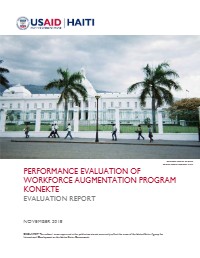
NATIONAL PALACE OF HAITI
PHOTO CREDIT: DRGULAS, 2009
PERFORMANCE EVALUATION OF
WORKFORCE AUGMENTATION
KONesans E Konpetans TEknik
(“KONEKTE”)
EVALUATION REPORT
November 2018
Evaluation Mechanism Number: AID-521-C-17-00002
Haiti Evaluation and Survey Services for USAID/Haiti
ABSTRACT
Social Impact’s Haiti Evaluation and Survey Services project conduct ed an independent final evaluation of
the United States Agency for International Development (USAID)/Haiti’s Workforce Augmentation
Program KONesans E Konpetans TEknik (KONEKTE) Activity implemented by Management Systems
International. KONEKTE was designed to fill workforce vacancies and provide Technical Advisors (TAs)
to select G overnment of H aiti (GOH) counterparts to support the United States Government’s post-
earthquake strategy. The evaluation report assesses whether KONEKTE achieved intended results,
identifies lessons learned, and provides guidance for future USAID/Haiti programs.
KONEKTE placed 45 TAs with 11 GOH counterparts. However, recruitment was slower than planned.
Changes in USAID, Implementing Partner and GOH counterpart leadership, challenges aligning multiple
key stakeholders’ vision and needs and external social, political and economic factors affected efficiency.
Although USAID largely determined priority intervention areas, KONE KTE’s GOH counterparts chose
and managed their own TAs, which made the Activity relevant to counterpart concerns and needs.
GOH officials indicated that KONEKTE strengthened their voice in day- to-day decision-making within
USAID programs.
KONEKTE technical expertise and tools contributed to on- going improvements in GOH recruitment
and human resource (HR) management systems. However, KONEKTE did not make significant progress
building GOH capacity to assess HR needs systematically. In addition, KONEKTE was not very effective
at transferring knowhow to GOH counterparts due to their limited absorptive capacity, TAs’ focus on
doing versus transferring skills, and weak oversight to promote TA deliverables’ use.
Some KONEKTE GOH counterparts are sustaining KONEKTE TAs work, while many others are not.
Likely sustainable KONEKTE interventions include introducing new laws supporting on-going reforms
and creating tools and guidelines to support offices and institutions’ core activities.
TABLE OF CONTENTS
ABSTRACT II
TABLE OF CONTENTS III
LIST OF TABLES AND FIGURES IV
ACRONYMS V
EXECUTIVE SUMMARY I
I. INTRODUCTION 5
Project Background 5
Theory of Change 6
Activities/Components 6
Stages/Activities Completed 7
Evaluation Purpose and Audience 8
Evaluation Questions 9
II. EVALUATION DESIGN 9
Sampling 9
Data Collection Methods 10
Analysis 11
Limitations and Mitigation Strategies 12
III. FINDINGS AND CONCLUS IONS 13
EQ1: To what extent was the original project design relevant to the GoH concerns and needs? 13
EQ2: How effectively was the activity implemented and managed? 16
EQ2A. The extent to which activity interventions actively built GOH capacity to identify and hire appropriate
technical assistance 19
EQ2B. The extent to which technical assistance provided through the activity transferred knowledge and capacity
to GOH officials and offices 24
EQ3: How sustainable are the activity’s interventions? 27
IV. RECOMMENDATIONS FOR USAID 31
ANNEX A: EVALUATION STATEMENT OF WORK 32
ANNEX B: REFERENCES AND ENDNOTES 38
ANNEX C: EVALUATION TEAM MEMBERS 40
ANNEX D: EVALUATION DESIGN MATRIX 42
ANNEX E: LIST OF PERSONS INTERVIEWED 45
ANNEX F: INFORMED CO NSENT SCRIPTS & DATA COLLECTION PROTOCOL S 48
ANNEX G: DISCLOSURE OF CONFLICT OF INTER EST 63
LIST OF TABLES AND FIGURES
Table 1: KONEKTE Sub-purposes, Outputs, and Activities 7
Table 2: Key Informant Interviews by Stakeholder Group and Gender 11
Table 3: Focus Group Discussions by Stakeholder Group and Gender 11
Table 4: KONEKTE: Timing of Changes in Key Stakeholder Institutions’ Leadership 18
Figure 1: Four Pillars of the USG’s Post-Earthquake Strategy for Renewal and Economic Opportunity in
Haiti 6
Figure 2: Number of TAs by Institution 8
Figure 3: Steps in KONEKTE Recruitment Process 20
ACRONYMS
CFET
CG
COP
Centre de Formation et d’Encadrement Technique
Coordinator General
Chief of Party
COR
CRM
D&G
DIS
Contracting Officer’s Representative
Client Relations Manager
Democracy and Governance
Department of Information Systems
DRH Directeurs et Directrices des Ressources Humaines
EPAP Public Administration Performance Evaluation
ESS Evaluation and Survey Services
ET Evaluation Team
EQ
FGD
Evaluation Question
Focus Group Discussion
FY Fiscal Year
GOH
HICD
Government of Haiti
Human and Institutional Capacity Development
HR
HRD
HRMIS
HQ
IFMS
Human Resources
Human Resources Department
Human Resources Management Information System
Headquarters
Integrated Financial Management System
IP Implementing Partner/Counterpart
IT
KII
Information Technology
Key Informant Interview
KONEKTE KONesans E Konpetans TEknik
M&E
MARNDR
MAST
MENFP
Monitoring and Evaluation
Ministry of Agriculture, Natural Resources and Rural Development
Ministry of Social Affairs and Labor
Ministry of National Education and Vocational Training
MOEF Ministry of Economy and Finance
MSI Management Systems International
NGO Nongovernmental Organization
OMRH Office of Management and Human Resources
SI Social Impact, Inc.
SOW Scope of Work
TA
TL
Technical Advisor
Team Leader
USAID United States Agency for International Development
USG United States Government
i| KONEKTE PERFORMANCE EVALUATION USAID.GOV
EXECUTIVE SUMMARY
The United States Agency for International Development (USAID)/Haiti requested that Social Impact
Inc.’s (SI) Evaluation and Survey Services (ESS) project design and conduct an independent final
evaluation of the Workforce Augmentation Program KONesans E Konpetans TEknik (KONEKTE)
implemented by Management System International (MSI) under Contract No. AID-521-C-13-00001. The
purpose of this report is to present the e valuation team’s (ET) main findings, conclusions , and
recommendations.
EVALUATION PURPOSE A ND EVALUATION QUESTI ONS
The objective of the KONEKTE final evaluation is to assess the extent to which the Activity achieved
intended results/outcomes, identify any lessons learned, and recommend possible follow-up actions, as
well as provide guidance for similar USAID programs in Haiti and elsewhere. Its primary audience is
USAID/Haiti, which may use the evaluation findings and recommendations to inform the Mission’s future
programming in the areas of governance and institutional strengthening. The secondary audiences are
MSI, MSI’s local subcontractor, Centre de Formation et d’Encadrement Technique (CFET), and KONEKTE’s
main Government of Haiti (GOH) counterpart, the Office of Management and Human Resources
(OMRH), which may also consider evaluation findings and recommendations in their current programs
and possible future collaboration with USAID/Haiti.
This final evaluation will answer the evaluation questions (EQs) below. When answering these EQs, the
ET will consider stakeholder satisfaction, unintended results, and lessons learned.
1. To what extent was the original project design relevant to the GOH concerns and needs?
2. How effectively was the Activity implemented and managed?
a. In answering this question, the evaluation assessed two fundamental Activity
elements:
b. The extent to which Activity interventions actively build GOH capacity to identify and
hire appropriate technical assistance.
c. The extent to which technical assistance provided through the Activity transferred
knowledge and capacity to GOH officials and offices.
3. How sustainable are the Activity’s interventions?
PROJECT BACKGROUND
On October 30, 2012, USAID awarded the Haiti “Workforce Augmentation Program” contract, known
as “KONEKTE” to MSI and its local counterpart , CFET, with a ceiling price of $21,795,809. KONEKTE
was designed to fill workforce vacancies and provide technical expertise to select USAID GOH
counterparts in support of the post-earthquake United States Government (USG) Haiti strategy.
The Activity was intended to contribute to achieving USAID objectives under the strategy's four pillars:
Infrastructure and Energy, Food and Economic Security, Health and Other Basic Services, and
Governance and Rule of Law.
Beginning in November 2015, KONEKTE expanded its strategy to include interventions to strengthen
OMRH institutional capacity to lead human resource (HR) management-related reforms within the
Haitian government’s civil service.
EVALUATION DESIGN, METHODS, AND LIMITATIONS
The ET used a qualitative evaluation design, consisting of document review, key informant interviews
(KIIs), focus group discussions (FGDs) and direct observation. During three weeks of in-country data
collection, the ET interviewed 52 individuals (18 women and 34 men) from various stakeholder groups.
The ET also organized one FGD with GOH Human Resource Department (HRD) personnel with 12
ii| KONEKTE PERFORMANCE EVALUATION USAID.GOV
participants (eight female, four male). The team used purposeful sampling to select informants who were
well-informed about the Activity and represented diverse stakeholder groups including representatives
of USAID, MSI and CFET , OMRH and other GOH counterparts, technical advisors (TAs) , other donors,
and other USAID Activities.
The ET was aware of potential recall, selection, response, and gender bias risks in data collection and
analysis, and developed mitigation strategies to overcome these. To overcome bias and increase the
validity of evaluation findings, the team asked similar questions to all informants and triangulated
responses. The team also prefaced all interviews and group interviews with a protocol highlighting the
evaluation purpose and the confidentiality of interviews. Although some key stakeholders were no
longer in Haiti, the ET was able to interview most by telephone or Skype. The ET obtained interviews
with individuals from all stakeholder categories , but interviewed fewer USAID technical office and
OMRH officials than planned.
FINDINGS AND CONCLUSIONS
EQ1: TO WHAT EXTENT WAS THE ORIGINAL PROJECT DESIGN RELEVANT TO THE
GOH CONCERNS AND NEEDS?
Based on Activity reports and KIIs , KONEKTE’s design enabled GOH officials and offices to choose and
manage their own technical assistants. This made KONEKTE relevant to its main GOH counterparts’
concerns and needs. The Activity administered client satisfaction surveys where high marks were
received and feedback from GOH officials the ET interviewed indicate overall high levels of GOH
counterpart satisfaction with KONEKTE-supported TAs. KONEKTE filled gaps in both strategic and
day-to-day needs of GOH counterparts.
In theory, KONEKTE assistance started with GOH counterpart requests. In practice, USAID technical
offices oriented GOH institutions’ requests to intervention areas that aligned with its priorities, limiting
the GOH counterpart s’ opportunity to set their own priorities for KONEKTE assistance. USAID’s
Democracy and G overnance office allowed the 2012 – 2016 OMRH leadership a greater role in setting
KONEKTE’s agenda within t his office than did other USAID technical offices, which appeared to use
KONEKTE to reinforce existing programs, narrowing KONEKTE’s scope to pre-determined
intervention areas.
Based on GOH officials’ accounts, KONEKTE strengthened GOH counterpart s’ voice in day-to-day
decision-making within USAID programs. Embedding senior TAs in GOH offices strengthened GOH
dialogue with USAID, and in some cases, GOH oversight of USAID implementor interventions. This was
not an explicit objective of KONEKTE, but is a highly positive, unintended consequence of placing TAs
in USAID GOH counterpart offices.
EQ2: HOW EFFECTIVELY WAS THE ACTIVITY IMPLEMENTED AND MANAGED?
KONEKTE's implementation was not efficient during its first 12 to 18 months, and again at the Activity’s
end. Although, after a slow start, it recruited approximately the targeted number of TAs, KONEKTE
was significantly less efficient than planned in terms of the number of days required to field a TA after
receiving a validated scope of work (SOW ) from USAID. The causes of inefficiency were related to
variety factors, some within the control of USAID and the IP and others not. USAID was slow issuing
written approvals of implementing partner (IP) work and monitoring and evaluation (M&E) plans as well
as modifying the contract to reflect changes in the A ctivity’s scope, which resulted in over-dependence
on oral agreements and created management uncertainty at times. Fre quent changes among decision-
makers within USAID, GOH counterpart s, and the IP, also negatively affected KONEKTE's overall
effectiveness. During its five-year implementation period, KONEKTE had three Chiefs of Party (COPs),
four USAID Contracting Office Representatives (CORs), three OMRH Coordinator Generals (CGs),
and experienced several changes in government. USAID and IP internal management factors such as lack
iii| KONEKTE PERFORMANCE EVALUATION USAID.GOV
of shared vision and cohesive management, too many decision-makers, poorly-defined and
communicated roles and responsibilities, as well as unclear conditions for receiving KONEKTE
assistance in the early implementation stages (USAID and IP) likewise also diminished implementation
efficiency.
EQ2A. THE EXTENT TO WHICH ACTIVITY INTERVENTIONS ACTIVELY BUILD GOH
CAPACITY TO IDENTIFY AND HIRE APPROPRIATE TECHNICAL ASSISTANCE
KONEKTE contributed to building GOH counterparts’ capacity to identify and hire appropriate
technical assistance. KONEKTE used an open and transparent recruitment process in which GOH
counterparts were actively engaged, potentially contributing to the GOH personnel’s awareness and
hands-on experience applying good recruitment practices.
MSI and USAID showed vision and adaptive capacity in re-framing KONEKTE for OMRH institutional
capacity building, the GOH entity mandated to oversee public sector HR reforms. Although its
contributions ended up being more modest than planned, KONEKTE supplied specialized technical
assistance and recruitment and HR management tools that shaped OMRH intervention strategies and
affirmed OMRH leadership of ongoing improvements in GOH recruitment and other HR management
practices.
KONEKTE did not make significant progress building GOH counterpart s’ capacity to use systematic
approaches to identify HR needs such as the Human and Institutional Capacity Development (HICD)
framework, which was cancelled by USAID before planned implementation was complete. A specific
focus on gender equity was not explicitly required in KONEKTE’s SOW. IP team members indicated
that the Activity made efforts to ensure woman candidates for TA positions were proposed when
possible, but did not require GOH counterparts, who were responsible for selecting TAs, to have a
policy of “affirmative action.” According to KONEKTE Activity reports, out of a total of 45 TAs, seven
were female (16 percent). Capacity- building for HRD personnel remains a significant need in this area as
well as other HR management areas.
EQ2B. THE EXTENT TO WHICH TECHNICAL ASSISTANCE PROVIDED THROUGH THE
ACTIVITY TRANSFERRED KNOWLEDGE AND CAPAC ITY TO GOH OFFICIALS AND
OFFICES
Overall, KONEKTE was not very effective at transferring capacity and knowledge to GOH counterparts.
KONEKTE TAs carried out a wide variety of activities and produced most planned deliverables to the
satisfaction of GOH counterparts, especially during its first three years of implementation. By their
nature, many of these deliverables (guides, manuals, plans, training modules, etc.), could have been used
to transfer capacity and knowledge, but due to weak GOH ownership of some TA work, these
outcomes were limited. Getting OMRH buy-in for KONEKTE work done in collaboration with the
original CG was especially problematic after his departure. There were, however, exceptions including
KONEKTE’s work with the Ministry of National Education and Vocational Training (MENFP) on
improving the teaching of reading, and with OMRH and HRD s on recruitment and HR management (as
highlighted in EQ2a findings).
KONEKTE TAs faced significant external obstacles to transferring capacity and knowledge to its GOH
counterparts, but also made tactical errors. The limited absorptive capacity of GOH coun terparts was a
significant factor preventing KONEKTE assistance from contributing to large-scale institutional capacity
improvements. However, insufficient support for TAs on assessing needs and coaching, and weak
oversight by IP and USAID managers to promote the use of TAs’ deliverables also limited KONEKTE’s
effectiveness at transferring knowledge and capacity.
EQ3: HOW SUSTAINABLE ARE THE ACTIVITY’S INTERVENTIONS?
Some KONEKTE GOH counterpart institutions are currently able to sustain some work started by
iv| KONEKTE PERFORMANCE EVALUATION USAID.GOV
KONEKTE TAs while many others are not. Institutional restructuring/strengthening work within
OMRH, MENFP, and Ministry of Agriculture, Natural Resources, and Rural Development’s (MARNRD)
Department of Innovation contributed to organizing the institutions’ work and attracting government
and other donor resources to support their activities. The positive outcomes of TA work in most other
GOH institutions appears to have been short-term and did not lead to any lasting improvement in the
host institutions’ capacity. Frequent changes in Haiti’s political landscape, overall weak governance
capacity, and severely under-resourced government offices were significant obstacles to sustainability.
KONEKTE TA interventions that are likely to have sustainable outcomes include the changes
introduced in the legal framework supporting on-going reforms, and creating tools and guidelines to be
used by offices and institutions for their core activities. KONEKTE’s experiment recruiting OMRH TAs
on the government salary scale to fill middle management vacancies conditioned by their recruitment
into the civil service after one year was a mixed success. OMRH retained two of four TAs recruited in
this way, but none have stayed with OMRH post-Activity. KONEKTE TAs who integrated into the civil
service were moved to other host institutions and expressed disappointment in the opportunities
afforded them to contribute reforms outside the context of KONEKTE.
There appears to be political will within the GOH to continue KONEKTE-supported HR reforms,
especially with current OMRH leadership. All GOH counterpart s expressed willingness to collaborate
with USAID in future programs.
RECOMMENDATIONS FOR USAID
1. USAID should not use a stand-alone, HR out-sourcing mechanism like KONEKTE to fill
gaps in its counterparts’ capacity in Haiti in the future. KONEKTE showed that such a
mechanism is not a useful way to streamline assistance to fill critical HR vacancies in an emergency
recovery situation or more generally. The mechanism did not appear to help to overcome
administrative and management burdens within USAID nor to save time.
2. USAID should continue to involve GOH counterparts in the implementation of its
future programs. Ways to do this may include seconding TAs in GOH counterpart offices
through existing technical Activities (versus through a stand- alone mechanism), as well as other
institutional capacity building interventions. KONEKTE demonstrated that it is possible to involve
GOH counterparts as implementers in USAID programs, in ways that enhance interventions’
sustainability. Even though KONEKTE showed there are significant obstacles to sustainably
increasing GOH offices and officers’ capacity, not involving the GOH only reinforces weak
governance.
3. USAID should consider additional support for OMRH on civil service administrative
reforms. Among other topics, future programs should identify interventions to promote
nondiscrimination in hiring. Future programs should explore work on policy and regulatory issues
that affect the GOH ability to attract qualified candidates such as wage and professional
advancement programs.
4. USAID should ensure that the future program agendas that cross-cut USAID technical
offices are led/monitored by senior USAID staff, if not the Mission Director, to ensure
coherence and buy-in from mission technical offices. To strengthen oversight and decision-
making by technical offices, USAID should avoid using basket funding mechanisms except in
situations where there is strong demand and similar objectives and needs across technical offices.
5. USAID should approve workplans, M&E frameworks, and process contract
modifications in a timely manner to guide consistent decision-making by implementers,
and avoid implementation preceding formal, written approvals.
5| KONEKTE PERFORMANCE EVALUATION USAID.GOV
I. INTRODUCTION
The United States Agency for International Development (USAID)/Haiti requested that Social Impact Inc.’s (SI)
Evaluation and Survey Services (ESS) project design and conduct an independent final evaluation of the
Workforce Augmentation Program, KONesans E Konpetans TEknik (KONEKTE), implemented by
Management System International (MSI) (see Annex A for the evaluation Statement of W ork).
1
Prior to conducting the fieldwork for this evaluation, the e valuation team (ET) presented its initial findings
based on a document review (see Annex B for list of documents consulted and Annex C for profiles of the ET
members) in an inception report. The ET presented its evaluation design, a detailed report approved by
USAID/Haiti prior to starting fieldwork (see summary of evaluation design in the Evaluation Design Matrix
found in Annex D ). The purpose of this report is to present the ET’s main findings, conclusions, and
recommendations.
PROJECT BACKGROUND
The 2010 earthquake had disastrous effects on people’s
lives and national infrastructure, and exacerbated the
pre-earthquake development challenges of poor
governance, weak institutions, and widespread
corruption. United States Government (USG)
assistance for re-building was guided by the
Government of Haiti’s (GOH) Action Plan for National
Recovery and Development and its subsequent
Strategic Development Plan.
2
On October 30, 2012, USAID awarded the Haiti
“Workforce Augmentation Program” contract, known
as “KONEKTE” to MSI and its local counterpart Centre
de Formation et d’Encadrement Technique (CFET), with a
ceiling price of $21,795,809. KONEKTE was designed
to fill workforce vacancies and provide technical
expertise to select USAID GOH counterparts in
support of the post-earthquake USG Haiti s trategy.
3
The Activity was intended to contribute to achieving
USAID objectives under the strategy's four pillars:
1 Throughout the report, “KONEKTE” is used interchangeably with “the Activity.” For example, a “KONEKTE technical advisor (TA)” is an advisor
recruited through the KONEKTE Activity. “KONEKTE was effective…” Refers to the outcome of the Activity which includes the outcomes of both
external and internal management factors. Specific references to the actions and outcomes attributed to implementing partners (IP) or USAID are
clearly labeled.
2 Post-Earthquake USG Haiti Strategy: Toward Renewal and Economic Opportunity, https://reliefweb.int/report/haiti/post-earthquake-usg-haiti-strategy-
toward-renewal-and-economic-opportunity accessed 8/29/18.
3 The Activity scope of work included the possibility of hiring TAs for private sector and nongovernmental organizations (NGOs) as well as GOH
partners, but USAID decided early on to limit KONEKTE’s focus to GOH partners.
Box 1. Program Overview
Workforce Augmentation Program, KONEKTE
(KONesans E Konpetans TEknik)
Program Objective: To fill human resource gaps
and provide technical expertise to select Haiti
government partners in support of the “Post-
Earthquake USG Haiti Strategy: Toward Renewal and
Economic Opportunity.”
Period of Performance: November 2012 –
October 2017
Award Number: AID-521-C-13-00001
Total Funding Amount: $21,795,809
Implementing Partners: Management Systems
International (MSI) and the Centre de Formation et
d'Encadrement Technique (CFET)
Key Partner: Government of Haiti’s Office de
Management et des Ressources Humaines (OMRH),
Geographic Presence: Port-au-Prince, Haiti
Figurel:FourPillarsoftheUSG'sPost-EarthquakeStrategyforRenewalandEconomicOpportunityinHaiti4
InfrastructureandEnergy:
Intermediate ResultI:
"ImprovedInfrastructurethat
SupportsCommunity and
CommercialDevelopment"
PILLAR I
Health andOther BasicServices:
Intermediate Result3:
"ImprovedHealthStatusand
LearningEnvironment"
PILLAR 3
THEORY OFCHANGE
FoodandEconomicSecurity:
Intermediate Result2:
"Increased FoodandEconomic
Security"
PILLAR 2
Governance andRuleofLaw:
Intermediate Result4:
"MoreResponsiveGovernance
andImprovedRuleOfLaw"
PILLAR 4
KONEKTE'smaindevelopmenthypothesis5was"ifhighlyqualifiedtechnicaladvisors(TAs)aresecondedto
selectGOHministriesandagencies,thenGOHcapacitytosupportandsustainthepositiveoutcomesofthe
USG'spost-earthquakeassistancewillbeenhanced.
BeginninginNovember2015,KONEKTE expandeditsstrategytoincludeinterventionstostrengthenthe
institutionalcapacityoftheOfficeforHumanResourceManagement(OMRH)toleadHumanResource(HR)
management-relatedreformswithintheHaitiangovernment'scivilservice.ThispartofKONEKTE's
interventionstrategywasbasedontheassumptionsthatifGOHinstitutionspossessthecapacitytocarry-out
fair,transparent,andcompetitiverecruitmentprocesses,anddevelopandapplybetterHRpoliciestomanage
civilservants,thecivilserviceperformancewillimproveandcontributetotheGOHreachingitsdevelopment
andreformobjectives.
ACTIVITIES/COMPONENTS
KONEKTE'soverallpurposewastofillgapsinboththeskillsandnumbersofworkersinselectedHaitian
governmentinstitutionssothattheseGOHcounterpartshadmorecapacitytocarryouttheirmandated
activities.ThiswastobeaccomplishedbyhiringTAsandsecondingthemtoUSAIDGOHcounterpart
institutions.KONEKTE wasalsochargedwithsupplyingtheessentialtoolsTAsneededtodotheirjob
(computers,internetconnections,andlogisticssupport).
StartinginSeptember2015,KONEKTE establishedfoursub-purposes(oneofwhichUSAIDcancelledinMarch
2016),eachwithspecificoutputsandsetsofactivitiesassummarizedinTableIbelow:
4USAID/Haiti.KONEKTE ProgramYear5AnnualProgressReport.N.p.:USAID,2017.Print.
5ProjectdocumentsdonotexplicitlystateKONEKTE'stheoryofchangeexceptinthedraft2016AMELP,whichwasnotapprovedbyUSAID.
61KONEKTE PERFORMANCE EVALUATION USAID.GOV
7| KONEKTE PERFORMANCE EVALUATION USAID.GOV
Table 1: KONEKTE Sub- purposes, Outputs, and Activities
SUB-PURPOSES AND ASSOCIATED OUTPUTS AND ACTIVITIES
SUB-PURPOSE OUTPUTS MAIN ACTIVITIES
Activity Sub-Purpose 1: TAs placed
in select GOH entities efficiently
Timely recruitment of appropriate,
qualified TAs.
• Establish and implement a competitive
and transparent recruitment process
to hire TAs and place them in
requesting GOH counterpart
institutions;
• Support TA work place integration and
monitor their work;
• Manage TA remuneration, annual leave,
and other benefits ;
• Report on TA activities to USAID.
Activity Sub-Purpose 2: HR
Management in OMRH and selected
GOH ministries improved
OMRH approved TA deliverables. • Provide qualified long and short-term
TAs to OMRH (as above);
• Procure complementary expertise,
materials, and logistic support for
OMRH capacity building activities;
• Implement “Job Portal” module of the Inter-Ministry System for HR
Management.
Activity Sub-Purpose 3: Contract
management skills in OMRH
improved
Removed from scope as per
Contract Modification 4.
Activity Sub-Purpose 4: Local service
provider capacity in managing
USAID/GOH projects improved
Plans, manuals, systems, procedures and tools related to CFET
institutional capacity development
plan.
• Assess needs and procure technical
assistance, training, complementary
software packages, and other logistic support to build CFET’s capacity based
on the needs outlined its institutional
capacity development plan.
STAGES/ACTIVITIES CO MPLETED
From 2012 – 2017, the IP received and processed USAID-validated GOH requests to hire 92 TAs. According
to its final report, over five years, KONEKTE placed 45 TAs (38 men and seven women) with GOH
counterparts. KONEKTE seconded TAs to 11 GOH counterpart s including the presidency, the Prime
Minister’s office, ministries, secretaries of state, and autonomous organizations.
As part of the recruitment process, the IP helped to refine the scope of work (SOW) and candidate profiles
that were drafted by the GOH institution, advertised the positions, screened applicants, supported GOH
counterparts to evaluate finalists and select the final candidate, negotiated salaries, and issued a contract. After
hiring TAs, the IP also, procured basic equipment and logistical support and monitored TA progress against the
assignment SOW.
8| KONEKTE PERFORMANCE EVALUATION USAID.GOV
Figure 2: Number of TAs by Institution
6
From September 2015 through October 2017, KONEKTE added interventions to strengthen OMRH’s
institutional capacity to promote improvements in public sector HR management systems. In this phase,
KONEKTE planned to strengthen OMRH’s capacity to conduct public administration performance assessments,
monitor and evaluate State reform initiatives , update and deploy an existing computerized HR management
system, and create an online public sector job portal. KONEKTE carried out activities in all planned
intervention areas. USAID cut short work on the public administration performanc e assessment in 2016.
KONEKTE did not complete planned activities
related to the HR management system or finish the
job portal before the Activity closed.
In the context of USAID Forward,
7 KONEKTE’s
second phase, which started in 2015, also set out a
strategy and implemented activities to develop
OMRH capacity to manage government-to-
government contracts. USAID later cancelled the
planned interventions for developing OMRH’s contract management capacity in the Activity’s final contract
amendment in March 2016. In addition, phase two planned and delivered activities to strengthen the
institutional capacity of MSI’s local counterpart, CFET, with the aim of preparing the organization to
counterpart directly with USAID and/or to provide recruitment services to the GOH following KONEKTE’s
completion. CFET is a Haitian consulting company that offers HR outsourcing and capacity building services to
national and international organizations and businesses with activities in Haiti.
KONEKTE concluded activities on October 31, 2017.
EVALUATION PURPOSE AND AUDIENCE
The objective of the KONEKTE final evaluation was to assess the extent to which the Activity achieved
intended results/outcomes, identify any lessons learned, and recommend possible follow-up actions as well as
provide guidance for similar USAID programs in Haiti and elsewhere. Its primary audience is USAID/Haiti,
which may use the evaluation findings and recommendations to inform the Mission’s future programming in the
areas of governance and institutional strengthening. The secondary audiences are MSI, MSI’s local
subcontractor, CFET, and KONEKTE’s main GOH counterpart, the OMRH, which may also consider
6 USAID/Haiti. KONEKTE Program Year 5 Annual Progress Report. N.p.: USAID, 2017. Print.
7 The USAID Forward reform initiative ran from 2010-2016. One of its pillars which guided the KONEKTE strategy was to “Promote sustainable
development through high-impact partnerships and local solution.” In particular, phase two of the Activity sought to build the capacity of OMRH of
CFID, a local organization, to obtain and manage contracts directly with the USG.
Under the direct authority of the Prime Minister’s
office, OMRH is mandated to oversee public sector
reforms to modernize and standardize HR systems
and practices across the GOH. It is likewise changed
with overseeing government devolution and
decentralization initiatives.
0
1
1
1
1
2
3
5
6
7
18Bureau du Ministre à la Sécurité Energétique
Ministère de la Santé Publique et de la Population
Bureau du Secrétaire d'Etat à l'intégration des Personnes Handicapées
Primature
Presidency
Ministry of Agriculture, Natural Resources and Rural Development
Ministry of Social Affairs and Labor
Direction de la Protection Civile
Ministère de l'Economie et des Finances
Ministry of National Education and Vocational Training
Office of Management and Human Resources
9| KONEKTE PERFORMANCE EVALUATION USAID.GOV
evaluation findings and recommendations in their current programs and possible future collaboration with
USAID/Haiti.
EVALUATION QUESTIONS
The final evaluation answers the questions below. When answering these evaluation questions ( EQs), the ET
considered stakeholder satisfaction, unintended results, and lessons learned.
1. To what extent was the original project design relevant to the GOH concerns and needs?
In answering this question, the evaluation focused particularly on the extent to which the Activity design
facilitated empowering GOH officials and offices to project their own HR needs and identify their own
technical experts. The evaluation examined these issues comparing GOH , implementing
partner/counterpart (IP), and USAID perspectives, and how they evolved throughout the life of the
Activity.
2. How effectively was the Activity implemented and managed?
In answering this question, the evaluation assessed two fundamental Activity elements:
a. The extent to which Activity interventions actively build GOH capacity to identify and hire
appropriate technical assistance.
b. The extent to which technical assistance provided through the Activity transferred knowledge
and capacity to GOH officials and offices.
To answer this question, the evaluation examined the interaction between USAID technical offices, the
Contracting Officer’s Representative (COR), and KONEKTE. Specifically, the ET a ssessed how effectively
the Activity managed GOH requests for technical assistance to ensure that it was appropriate and
effectively used, including the extent to which the GOH was involved in the identification of the HR needs
and the selection of appropriate technical experts to fill identified gaps.
3. How sustainable are the Activity’s interventions?
To answer to this question, the evaluation specifically addressed the implications of USAID’s decision not
to extend the Activity beyond five years, the impact of this decision on USAID’s relationship with the
GOH, and the GOH’s willingness and ability to continue the Activity’s interventions in the absence of
USAID support.
II. EVALUATION DESIGN
SAMPLING
The ET collected data on the perspectives and experiences of key stakeholders involved in the KONEKTE
Activity using a purposeful sampling technique (see list of persons consulted in Annex E ). The team sampled
representatives from all key stakeholder groups: USAID, MSI and CFET, TAs, GOH counterparts, and other
donors or USAID Activity implementor representatives who collaborated with KONEKTE. Within each
stakeholder group, the ET selected stakeholders from different subcategories:
• USAID COR, as well as technical office representatives
8,
• IP personnel from (a) the prime and subcontractor organizations, (b) h eadquarters (HQ) and Haiti-based
personnel, and (c) Chiefs of Party (COP) and other program staff,
• TAs who had (a) served for various lengths of time, (b) had varying degrees of seniority, (c) were men
and women, and (d) who had worked with a variety of GOH counterparts,
10| KONEKTE PERFORMANCE EVALUATION USAID.GOV
• GOH counterparts from among the various government offices that collaborated with KONEKTE, both
senior leaders and TA technical interfaces,
• Different donor organizations.
In cases where several different individuals held the same position, the ET endeavored to interview as many
individuals as possible who held a given position to collect as many viewpoints as possible and limit bias. For
example, the ET interviewed two out of three MSI COPs, three out of five USAID CORs, five MSI HQ based
backstopping personnel, 17 out of 38 technical advisors, etc.
Purposeful sampling was supplemented by snowball sampling to enable the ET to identify additional key
informants and fill gaps in its initial list of key stakeholders, which was provided by MSI. For example, the initial
list did not include a list of all USAID CORs, a complete list MSI technical and administrative backstopping
personnel, USAID technical office representatives, or CFET client relations managers. During initial interviews,
MSI, CFET and USAID provided addition names and contact information for missing individuals.
Overall, the final in formant sampling allowed the ET to compare the perspectives of different key stakeholder
groups and cross-check and fill gaps in KONEKTE reporting. Although more men than women participated in
key informant interviews (KIIs), the proportion was a fair reflection of the roles played by men and women in
KONEKTE.
DATA COLLECTION METHODS
The ET used a qualitative design, consisting of several different data collection methodologies, including
document review, analysis of Activity monitoring and evaluation d ata, KIIs, focus group discussions (FGDs) and
direct observation of KONEKTE- supported activities. The ET reviewed Activity documents and produced an
inception report in June 2018. The team conducted interviews, FGDs, and direct observation during the
evaluation fieldwork period, from July 31, 2018 – August 29, 2018.
The ET developed data collection protocols to guide fieldwork, which are found in Annex F . The purpose of
the protocols was to : (1) ensure all key issues are covered during data collection, (2) elicit rich, sometimes
unanticipated, information from respondents , (3) help organize information in a form that could be usefully and
efficiently analyzed, and (4) ensure that sex- disaggregated data w ere collected. The protocols consisted of
questions that address and derive from the EQs, as well as from the ET’s document review, its initial
discussions with USAID, and its evaluation design knowledge.
DOCUMENT REVIEW
The ET reviewed KONEKTE documents to understand the Activity design and implementation, extract findings
relevant to the EQs, and inform data collection protocol development so that instruments appropriately
supplemented background documents information. Categories of documents are listed below and detailed in
Annex B:
• KONEKTE annual reports
• KONEKTE annual work plans
• KONEKTE monitoring and evaluation (M&E) plans
• Activity descriptions and modifications
• Journals and other publications
KEY INFORMANT INTERVIEWS
The ET interviewed 52 individuals (18 women and 34 men) from various stakeholder groups. The team
interviewed nearly all informants individually, except for one group interview of three informants. Findings from
KIIs contributed to the ET’s responses to all EQs.
The ET conducted face-to-face interviews in the Haitian capital, Port-au-Prince, or via phone, or Skype. Table 2
shows the distribution of interviews by key stakeholder group and gender.
11| KONEKTE PERFORMANCE EVALUATION USAID.GOV
Each KII was guided by an interview protocol adjusted for different types of respondents (See Annex F for
protocols), and was conducted in French or English.
Table 2: Key Informant Interviews by Stakeholder Group and Gender
FOCUS GROUP DISCUSSIONS
The ET organized one FGD with HR Directors from various GOH institutions. The ET held the discussion at
the end of a regular meeting organized by OMRH. The discussion was brief, but allowed the team to initiate
contact with members of the group. The ET followed up and organized KIIs with four group members to
supplement FGD information on current practices and challenges facing GOH HR Managers.
Table 3: Focus Group Discussions by Stakeholder Group and Gender
STAKEHOLDER TOTAL FEMALE MALE
GOH HR directors 12 8 4
DIRECT OBSERVATION
The ET triangulated interview data with direct observation when possible and relevant. It observed whether or
not the KONEKTE -supported biometric time and attendance keeping system was still functional , if the web
applications developed for OMRH (the job portal, the website) were online, and participated in a meeting
organized by OMRH with HR Directors from various ministries to observe how OMRH was following up on
HR management capacity building activities carried out by KONEKTE TAs.
ANALYSIS
ET took detailed notes of all KIIs and FGDs, and cleaned and shared electronic summaries on a rolling basis
throughout fieldwork. Team members conducted internal debriefs regularly throughout fieldwork to discuss
progress and make adjustments that were needed in the evaluation schedule. The team also discussed evidence
collected to help answer the EQs, as well as to identify discrepancies.
During the debriefs the team also developed and updated a findings, conclusions and recommendations matrix,
focused particularly on findings. This ser ved as a basis for identifying key themes that emerged from the data
collection. The team then developed a coding framework called a tally sheet, in which each set of notes,
organized by stakeholder group, KI and sex, was coded using the identified set of themes. The tally sheet is a
matrix that allows for identification of dominant themes. It also easily facilitates comparative analysis both
within and across stakeholder groups and by sex.
The ET employed several data analysis methods to identify key findings from the collected data, as well as to
draw conclusions and make recommendations for Activity follow-up or future potential USAID programming
like KONEKTE.
1. Content Analysis – The ET reviewed and coded KII and FGD data to identify and highlight notable
examples of KONEKTE successes (or lack of success) that contributed to (or inhibited) achievement of
its objectives.
2. Trend Analysis – The team examined KONEKTE M&E data on its indicators over time to identify
trends in performance relative to its Activity targets.
STAKEHOLDER INTERVIEWS FEMALES MALES
Total 52 18 34
USAID 5 3 2
Implementing Counterparts 14 10 4
Technical Advisors 17 3 14
GOH Counterparts 14 2 12
Other Donors/USAID Activity 2 0 2
12| KONEKTE PERFORMANCE EVALUATION USAID.GOV
3. Gap Analysis – The team analyzed where KONEKTE fell short of anticipated performance targets,
and the likely factors contributing to these gaps.
4. Comparative Analysis – The ET compared different stakeholder groups perspectives to assess
either convergence or divergence.
5. Gender Analysis – All data collected through KIIs and FGDs were disaggregated by sex and analyzed
for effects on both male and female beneficiaries to show any significant differences.
The Team Leader captured preliminary findings, conclusions, and recommendations in an Excel-based matrix
that categorizes analysis by EQ. The matrix: a) ensures the ET prepares a systematic and thorough response to
each EQ, b) verifies that preliminary analysis accounts for gender and social dimensions, c) identifies any gaps
where additional clarification or analysis may be necessary, and d) serves as the basis for developing the
evaluation report.
LIMITATIONS AND MITIGATION S TRATEGIES
BIAS
The ET was aware of several bias risks in data collection and analysis and developed mitigation strategies to
overcome these:
1. Recall Bias: Recall bias is a common challenge in final evaluations, especially evaluations that take place
months after an Activity’s close. KONEKTE recipients might not have remembered accurately or
responded to the ET’s questions with answers that blended their experiences into a composite
memory if, for example, they had received technical assistance from multiple sources. The ET
compared stakeholder responses, for example what the TA recalled as compared to the GOH
counterpart that hosted the TA, to increase the validity of the evaluation findings. It also probed
respondents’ answers to facilitate accurate recollections.
2. Response Bias: Response bias is the risk that key informants may have been motivated to provide
responses that would be considered socially desirable or influential in obtaining donor support or,
alternatively, to discredit the activity or a given individual involved in the activity. For example, a GOH
counterpart may have provided positive remarks about KONEKTE because s/he would like his/her
institution to receive similar support in the future or because s/he wanted to please the interviewer. A
KI may have provided negative feedback because s/he was dissatisfied with one or more persons
involved in activity management. ET mitigated this risk by interviewing a wide variety of informants
within and across stakeholder categories. In its analysis it prepared a tally sheet that allowed the ET to
observe convergence of points by view and outliers by stakeholder group and question sub-finding. The
ET also beg an each KII and FGD with a short explanation of the purpose of the evaluation, highlighting
that the team hoped to learn about both successful and unsuccessful strategies, achievements and
shortfalls, as relevant, to draw out lessons learned that could benefit future Activities. The ET also
highlighted it would keep interview content confidential and omit personally identifiable information
from the report (see informed consent protocol in Annex F).
3. Selection Bias: Selection bias is an inherent risk when implementers help to facilitate contact with
Activity counterparts. There was a risk that the ET would be oriented to stakeholders with primarily
positive views of the Activity. To mitigate the risk of selection bias, the ET identified the individuals to
be interviewed using lists provided by MSI and supplemented using the snow ball method to fill in gaps
(missing stakeholder categories, missing individuals who held a key position at some time during the
evaluation period, missing contact information for some individuals in various stakeholder categories)
with help from IP, USAID, and GOH KI. To mitigate the potential bias that KI would refer the ET to
others sharing similar viewpoints, the ET accepted referrals from several different sources and used the
strategies described above to mitigate for response bias. The ET arranged meetings directly without
going through the implementer.
13| KONEKTE PERFORMANCE EVALUATION USAID.GOV
4. Gender Bias: Gender bias is a risk because most individuals have a subconscious sense of appropriate
roles and behavior for women and men. The ET reviewed gender-sensitive approaches during the
inception period by taking and discussing USAID’s Gender 101 training, focusing discussion on what
possible gender preconceptions might come into play during this evaluation, and reviewing how to
minimize these during data collection and analysis. The ET also actively searched for female
respondents.
OTHER LIMITATIONS AND MITIGATION STRATEGIES
Limited availability of key informants: Because KONEKTE was implemented over a five- year period and
was closed for approximately nine months at the time of the evaluation fieldwork, the ET anticipated potential
challenges locating and obtaining meetings with some key stakeholders who changed positions, joined new
organizations, or left the country. To mitigate this risk, the ET contacted stakeholders using their personal
emails, drew upon the national evaluation team member’s personal network to locate missing contact
information, and requested support from MSI and USAID/Haiti to obtain former personnel contact
information. The ET conducted many interviews by telephone or Skype, which allowed it to interview
stakeholders outside Port-au-Prince. The ET’s biggest challenge was obtaining meetings with the current
leadership of OMRH and relevant representatives of USAID technical offices. Through USAID support and
perseverance, the team succeeded in obtaining meetings with representatives of both stakeholder sub-groups
before the conclusion of fieldwork, but not in the numbers planned.
9 Fewer than planned OMRH
representatives’ interviews was balanced by interviewing a than planned number of “other” GOH
representatives . Similarly, the fewer than planned USAID technical office representative interviews was
balanced by interviewing a greater than planned number of USAID COR.
III. FINDINGS AND CONCLUSI ONS
This section synthesizes the evaluation’s main findings and conclusions, which are presented by EQ.
EQ1: TO WHAT EXTENT WAS T HE ORIGINAL PROJECT DESIGN RELEVANT TO T HE
GOH CONCERNS AND NEEDS?
In answering this question, the ET first analyzed what USAID designed KONEKTE to do as well as the
evolution of how various USAID technical offices , in fact, used the Activity in its implementation phase. This
section also reviewed the roles and perspectives of KONEKTE GOH counterparts including the extent to
which KONEKTE empowered GOH officials and offices to identify their own technical assistance needs, as well
as to choose and manage TAs. The ET collected GOH counterpart feedback on KONEKTE services as one
means to gauge its relevance to GOH concerns and needs. Finally, the ET examined stakeholder perspectives
on GOH counterparts’ capacity to project strategic HR needs.
FINDINGS
Evolution of KONEKTE’s purpose and USAID technical office buy-in over time
According to the IP and USAID KII s, KONEKTE was designed by USAID, following the earthquake, to hire
personnel to supplement USG in- country human resources. It was also conceived as a mechanism to respond
quickly and relatively easily to ad hoc GOH requests to fill post-earthquake vacancies in government
institutions, which were numerous considering earthquake-related fatalities and migration.
9 The ET planned to meet with 13 GOH representatives (5 OMRH and 8 other) and 4 USAID technical officers (1 COR, 3 technical office). It succeeded
to meet with 14 GOH representatives (3 OMRH representatives and 9 other) and 5 USAID technical offices representative, 3 COR and 2 technical
offices (Education and Food and Economic security).
14| KONEKTE PERFORMANCE EVALUATION USAID.GOV
By the time KONEKTE became operational two years after the earthquake, many of the needs the Activity was
designed to meet had changed or had been met in other ways. USAID /Haiti was no longer receiving urgent
requests from various USG Washington offices to hire additional personnel to handle post-earthquake
recovery work. Likewise, GOH counterpart personnel needs, while still great, did not have the same urgency
as was the case in the months immediately following the earthquake. When implementation started,
KONEKTE’s main mandate was to provide technical expertise to select GOH counterparts in support of
USAID programs falling under its four strategic pillars.
KONEKTE was a basket mechanism to which USAID technical offices contributed resources. Based on IP and
USAID key informants, not all USAID technical offices bought into KONEKTE, and some reduced their support
during the implementation period. For example, after hiring one TA through KONEKTE, the Health office
decided to drop KONEKTE and withdraw funding. The Education office mainly used KONEKTE to bridge its
Activities on improving early grade reading in collaboration with the Ministry of National Education and
Vocational Training (MENFP). The Agriculture and Food Security office mainly used KONEKTE to assist GOH
counterpart offices in the Ministries of Social Affairs and Labor (MAST) and Agriculture, Natural Resources and
Rural Development (MARNDR) on food security Activities, but reduced support in later years .
In contrast, the Democracy and Governance (D&G) technical office increased its support for KONEKTE over
time. For the D&G office , the KONEKTE recruitment process, which strengthened OMRH leadership within
the government on HR matters, as well as the actual placement of TAs to work within the OMRH, were
effective means to build the capacity of a key GOH counterpart. In addition to providing TAs to OMRH, the
D&G office also funded KONEKTE advisors for the Ministry of Finance, the Ministry of Interior and the Anti-
Corruption Unit, among others.
Evolving USAID and IP perceptions of KONEKTE’s efficiency as hiring mechanism
According to three USAID informants, some USAID technical office managers wanted or needed technical
support faster than KONEKTE was able to provide while the USAID contracting office insisted that
recruitment should follow an open and competitive process, even if that slowed down recruitment. According
to one USAID technical office representative, as KONEKTE developed its procedures, s/he found the
mechanism increasingly rigid, which diminished its usefulness. Eventually, some technical offices preferred to
use alternative contract mechanisms t o hire technical experts rather than go through KONEKTE.
Extent KONEKTE empowered GOH counterparts to identify needs, choose, and manage TAs
In theory, KONEKTE assistance started with GOH counterpart requests. In practice, USAID technical offices
oriented GOH institutions’ requests to intervention areas that aligned with its priorities. Based on KII s with IP,
USAID, and GOH stakeholders, the latitude allowed to GOH counterparts to negotiate KONEKTE support
varied according to the USAID technical office. In all cases, USAID, rather than KONEKTE personnel, were
responsible for approving GOH TA requests.
USAID’s D&G office offered OMRH leadership significant latitude to determine its own needs and choose its
own technical resources throughout KONEKTE. Other USAID technical
offices appeared to use KONEKTE to reinforce existing programs,
narrowing KONEKTE’s scope to pre-determined intervention areas.
KONEKTE work with the MENFP, MAST, Ministry of Economy and
Finance (MOEF), and MARNDR, was related to other ongoing USAID
programs and Activities (Early Grade Reading program, Koré Lavi, Food
Security, Integrated Financial Management Systems).
All key stakeholder groups affirmed that GOH counterparts were primarily responsible for choosing
KONEKTE TAs. GOH representatives sat on TA selection committees (KONEKTE and USAID had observer
status only) to choose advisors from among available candidates. KONEKTE personnel managed administrative
and contractual aspects of the recruitment process and ensured that the c andidates selected by GOH
counterparts aligned with the qualifications determined in the TA SOW.
“It was the OMRH that developed
TA SOWs and decided what their
priorities should be.”
- OMRH official
15| KONEKTE PERFORMANCE EVALUATION USAID.GOV
According to the procedures established by KONEKTE and GOH counterpart and TA accounts, once TAs
were hired, GOH personnel were responsible for their day-to-day technical supervision, which included
approving monthly and annual reports and specific deliverables. TAs reported helping with many unplanned
tasks based on their host GOH institution’s daily needs. GOH counterparts were also responsible for decisions
about if/how to use TAs’ work. Annual reviews allowed GOH to discontinue TA services that did not respond
to their needs, a right they occasionally exercised.
Extent KONEKTE strengthened GOH counterpart s’ voice in day-to-day decision-making within
USAID programs
Both GOH and USAID technical office stakeholders reported that TAs strengthened their host GOH office ’s
capacity to participate in USAID Activity implementation and in some cases, enabled them to oversee USAID
implementers interventions.
Two KONEKTE TAs reported that their efforts and KONEKTE logistic support was critical to carry out
consultations to gather and share information with MENFP personnel outside the capital. A MENFP official
reported working closely with KONEKTE TAs to update learning materials for teaching reading. Because of his
involvement in the materials development, the Ministry official was well- informed about what had been
accomplished. Later, a new USAID Activity that followed KONEKTE developed new learning materials, which
he considered to be of lesser quality, and attempted to introduce them into the Ministry without extensive
consultations. He reported raising the issue at the highest levels of both the Ministry and USAID and eventually
succeeded in establishing a joint Ministry/Activity process for revising the material, taking the best of both
products.
A USAID official reported that the KONEKTE TA seconded to the MAST strengthened communication
between USAID, the IP (Care) and the GOH on implementation and policy-related issues affecting the social
safety net program, Koré Lavi. The KONEKTE TA and a MAST official reported that KONEKTE expertise and
logistic support enabled the MAST M&E unit to be involved in Koré Lavi monitoring, giving them a role in
identifying and resolving implementation problems.
Extent GOH counterparts were satisfied with KONEKTE TA services
Overall, GOH counterparts interviewed during the evaluation fieldwork affirmed they were very satisfied wit h
KONEKTE assistance, corroborating the results of KONEKTE IP-conducted client satisfaction surveys.
According to these surveys, over four years (fiscal year [FY]2014 – FY2017), on average, 89 percent of GOH
clients were very satisfied or satisfied with technical assistance provided by KONEKTE TAs. OMRH’s
satisfaction for KONEKTE services, a more specific indicator of the A ctivity’s institutional capacity building
activities, was slightly lower overall - 82 percent.
Based on GOH KIIs, aspects of KONEKTE services that GOH counterparts appreciated most were:
• TAs functioned as government employees rather than consultants (they responded to evolving priorities,
had to work regular hours in the office);
• TAs offered specialized expertise that the GOH could not afford via their regular budget;
• TAs supplemented limited human resources; and
• KONEKTE logistic support to TAs facilitated their mission in ways not possible within the GOH budget.
Aspects that GOH counterparts thought could have been improved were:
• KONEKTE assistance could have been provided for longer period
10;
• the number of TAs increased, and
• some TAs could have been better qualified.
10 Based on KONEKTE’s final report, 13 KONEKTE TAs served for two- to three-year terms, 18 served one-year terms, and the remainder served for
less than one year.
16| KONEKTE PERFORMANCE EVALUATION USAID.GOV
According to USAID informants, the number of TAs offered to GOH counterparts and the duration of their
assignments were based on USAID priorities, available budget, and time remaining in KONEKTE’s
implementation period. Further, the Agency had originally thought it would be providing primarily senior- level
TAs; this turned out not to be the case mainly due to challenges finding appropriately qualified, French -speaking
experts willing to work in Haiti. Also, starting in 2015, KONEKTE in collaboration with OMRH, decided to
recruit mainly mid-level TAs and pay them at GOH salary scales with the understanding that the OMRH would
recruit them as regular staff after one year.
Stakeholder perspectives on GOH counterparts’ capacity to project strategic human resource
needs
Eleven KIIs (two IP, one USAID, two TA, six GOH) cited weak capacity within GOH counterpart institutions
to do strategic needs assessment to determine its needs for and use of technical assistance . Gaps identified
included: insufficient consultations by GOH decision-makers
to assess needs in a participative and/or systematic way
before determining the TA SOW, the absence of a clear
strategic framework to set institutional priorities, too much
or too little consideration of GOH political issues, and low
capacity within GOH human resource departments (HRDs)
to identify hiring priorities and defend the activities against
personal and political interests.
KONEKTE delivered technical assistance to OMRH to
address these weaknesses. KONEKTE TAs and consultants implemented activities to build the capacity of
HRDs and introduced an organizational development and change management tool to assess and propose
actions to improve the performance of GOH institutions. The extent to which KONEKTE interventions were
effective building GOH counterparts’ capacity in these areas is discussed under EQ2a.
CONCLUSIONS
KONEKTE’s design empowered GOH officials and offices to choose and manage their own TAs .
This made KONEKTE relevant to its main GOH counterpart s’ concerns and needs. KONEKTE filled gaps in
both strategic and day- to-day needs of GOH counterpart s.
USAID technical offices determined the scope of KONEKTE assistance to GOH offices to fit with
its priorities, limiting the GOH counterparts’ opportunity to set their own priorities for
KONEKTE assistance. USAID’s D&G office allowed the 2012 – 2016 OMRH leadership a greater role in
setting KONEKTE’s agenda within his office than did other USAID technical offices.
KONEKTE strengthened GOH counterparts’ voice in day- to-day decision-making within USAID
programs. Embedding senior TAs in GOH offices strengthened GOH dialogue with USAID and in some
cases, GOH oversight of USAID implementor interventions. This was not an explicit objective of KONEKTE,
but is a highly positive, unintended consequence of placing TAs in USAID GOH counterpart offices.
EQ2: HOW EFFECTIVELY WAS THE ACTIVITY IMPLEMENTED AND MANAGED?
To answer the first part of EQ2, the ET examined KONEKTE achievements meeting its main performance
indicator targets. The team also reviewed key stakeholder perceptions of KONEKTE efficiency as hiring
mechanism, internal management issues as well as political, social, and economic challenges affecting progress.
FINDINGS
Extent KONEKTE met its indicator targets
“I don’t think KONEKTE was effective in
knowing what the needs were and responding to them. GOH entities were not able to articulate what they needed.”
- USAID informant
17| KONEKTE PERFORMANCE EVALUATION USAID.GOV
Based on the Activity’s M&E data, KONEKTE’s performance achieving its performance indicator targets was
mixed. On average, over four years, KONEKTE was slightly under its targets for the numbers of TAs placed
and the percentage of TA deliverables that met or exceeded SOW requirements. Performance on the latter
indicator deteriorated in the final two years of implementation.
KONEKTE was significantly less efficient than planned in terms
of the number of days required to field a TA after receiving a
validated SOW from USAID. Performance on this indicator
likewise declined in the final two years. The number of days
required by KONEKTE to process a GOH request from USAID
validation to placement at the receiving entity or organization
averaged 123 days over four years, while the target was 84 days.
TAs reported their recruitment processes took anywhere
between three months to over one year. In FY 2016-2017, the
average number of days to process a placement was 24 1.
KONEKTE IP progress reports indicated that factors beyond its control such as slow USAID and GOH
counterpart response times, absence of appropriate candidates, unsuccessful salary negotiations, and broader
environmental factors such as deteriorating political, social, and economic conditions in Haiti, negatively
affected its efficiency fielding TAs. Deteriorating performance meeting targets on the number of days required
to field a TA in the final two years was likewise affected by leadership changes within OMRH and the IP (see
below).
Efforts to create a common understanding of KONEKTE’s purpose and operational norms
IP and USAID informants (five total, two USAID, three IP) described the involvement of too many decision-
makers within USAID and the GOH and lack of common understanding of KONEKTE’s purpose and
operational norms during its first 12 to18 months and again during KONEKTE’s final months. Measures were
gradually put into place that improved procedures and communication:
• Initially, conditions for receiving KONEKTE assistance were not clearly defined by USAID and
communicated to potential GOH counterparts. This resulted in unacceptable requests from some
GOH entities and low uptake by others. After some initial cases, when USAID refused certain GOH
requests, USAID technical offices negotiated GOH requests before they became official to avoid having
to turn down requests. The IP also organized meetings with GOH counterparts to explain the Activity
and its procedures.
• In the early months of implementation, the KONEKTE COP interfaced directly with GOH entities to
determine needs without coordinating with USAID, which generated GOH expectations that did not
align with USAID plans and strategies and ended in reversals in commitments vis à vis counterpart s. By
2014, according to USAID and IP managers, KONEKTE’s role had evolved into a mainly administrative
one. OMRH became the immediate interface between USAID and GOH entities to shield USAID
offices from stakeholder pressure, which was positive for KONEKTE and contributed to strengthening
OMRH’s position within the GOH on HR reforms. However, in late 2016, when a new COP took over
and shortly afterwards, a new Coordinator General (CG) was appointed at OMRH, previous
misunderstandings and disagreements about roles and responsibilities between the IP, USAID, and
OMRH returned.
“It took more than a year to finalize the
recruitment because of internal issues at USAID and KONEKTE. There was a list of
those who had been selected and I expected
to have them quickly at my disposal. We
had to wait a very, very long time.”
- GOH counterpart
18| KONEKTE PERFORMANCE EVALUATION USAID.GOV
Leadership changes negatively affected progress
During its five -year implementation period, KONEKTE had
three COPs, four USAID CORs, three OMRH CGs and
experienced several changes in government. Table 4, below,
summarizes these changes. Informants from all key stakeholder
groups reported that frequent IP, USAID, and GOH counterpart
leadership turno ver, as well as instability at the Prime Minister’s
level were sources of uncertainty, slowing decision-making and
shifting priorities.
Table 4: KONEKTE: Timing of Changes in Key Stakeholder Institutions’ Leadership
FY 12/13 FY 13/14 FY 14/15 15/16 FY16/17
USAID COR1 COR2 COR3/COR4 COR4 COR4
OMRH CG1 CG1 CG1 CG1/CG2 CG3
IP COP COP1 COP2 COP2 COP2 COP3
GOH/Prime Minister PM1 PM1/PM2 PM3 PM4 PM5
Change in original OMRH leadership was a major setback
Evaluation stakeholders in all categories agreed that changes in OMRH leadership negatively affected
KONEKTE progress supporting OMRH capacity building. According to KONEKTE progress reports
corroborated by interviews with TAs and GOH officials, the departure of the original OMRH CG, and his
replacement by an interim leader , halted or slowed the work of many OMRH TAs. The same stakeholders
reported that when the new CG was appointed near the end of the Activity, many institutional priorities
shifted, leaving the newly appointed KONEKTE COP little time to reposition its support to earn the buy-in of
the new OMRH leadership.
Lack of cohesion within KONEKTE IP management team affected morale and efficiency
According to the majority of IP informants (ten out of 14 consulted) at various times throughout the life of
KONEKTE, internal conflict within the KONEKTE IP management team (between program managers, between
the prime and the subcontractor, and between Haiti- based managers and HQ) led to negative working
environments, significant disagreements about how the project should be managed , and COP and other key
position turn-over, which, among other factors already cited contributed to the Activity’s declining success
meeting some of it performance indicator targets. There was no formal handover process between COPs,
which did not facilitate a smooth transition between them. One member of the IP team remarked to the ET,
“What I can say is there was a lack of cohesion within the project management team… At certain moments there was
even a lot hostility.” According to two IP informants involved in trying to remediate conflict, although the IP
managers made efforts, some of them successful, to address the various issues causing disagreement, conflict
was a reoccurring theme throughout the Activity implementation period.
USAID slow issuing written approvals, modifying
contract to reflect changes Activity scope
Because GOH requests for assistance and TA nomination
required USAID technical office review and approval and sign- off
by USAID’s C ontracts office, USAID was more involved in the
day-to-day implementation of KONEKTE than was typical of
other USAID contracts . Weaknesses in USAID management
cited by the IP included frequent change over in USAID
personnel interfacing with KONEKTE, shifting and sometimes
“Changes within government and within
KONEKTE did not help. When there are
changes in leadership, it is difficult to make
progress. At times the program was
paralyzed.”
- KONEKTE IP team member
“The disadvantage from the KONEKTE IP
point of view was we were not just working with all the Ministries, but also with all the
various USAID technical offices. This was
challenging. The visions were different.”
- IP key informant
19| KONEKTE PERFORMANCE EVALUATION USAID.GOV
conflicting views within the Agency on how to capitalize on the Activity , and slow decision-making. IP
representatives and KONEKTE documents indicated USAID contract modifications, formal workplan approvals
and validation of M&E frameworks were likewise slow or absent, creating over-reliance on oral agreements
between USAID and the IP that could be misunderstood or later reversed, and cause management uncertainty.
Political, social, and economic challenges also affected progress
According to KONEKTE progress reports, throughout the life of the Activity, implementation was affected by
political, social, and economic factors which disrupted implementation and contributed to delays. These
included delayed elections, contested elections, social unrest, rising levels of insecurity, natural disaster, and a
rising cost of living. One informant highlighted that political changes and anticipated changes at the highest
levels of government trickled down to lower-level managers, who often preferred to take a wait-and-see
approach to decision-making. Violent street protests linked to the political and economic climate erupted at
various times during the implementation period, lim iting movements around Port-au-Prince.
CONCLUSIONS
KONEKTE's implementation was not efficient during its first 12 to 18 months, and again at the
Activity’s end. The causes of inefficiency were related to variety factors, some within the control of USAID
and the IP and others not. USAID and IP internal management factors such as lack of shared vision and
cohesive management, too many decision-makers and slow and/or poorly documented decision-making
(USAID), poorly-defined and communicated roles and responsibilities, and lack of clarity on the conditions for
receiving KONEKTE assistance in the early implementation stages (USAID and IP) diminished implementation
effectiveness. Frequent changes among decision-makers within USAID, GOH counterparts, and the IP also
negatively affected KONEKTE’s overall effectiveness, especially changes in OMRH top leadership. Haiti’s
political, social, and economic instability during most of the Activity implementation period likewise affected
KONEKTE implementation.
EQ2A. THE EXTENT TO WHICH ACTIVITY INTERVENTIO NS ACTIVELY BUILT
GOH CAPACITY TO IDENTIF Y AND HIRE APPROPRIA TE TECHNICAL
ASSISTANCE
To answer EQ2a, the ET looked first at KONEKTE’s model for TA recruitment and management, and the
extent to which it influenced OMRH practices and strategies. Related to the former, the ET examined the
extent that KONEKTE’s model integrated USAID cross-cutting concerns on gender, employment of persons
with disabilities, and USAID Forward principles. Because the answer to EQ2a is closely related to KONEKTE’s
assistance to strengthen OMRH-led GOH reforms on recruitment and HR management, this section also
analyzed what was done in th ese areas, and what GOH stakeholders reported as changes during , and
immediately after KONEKTE.
FINDINGS
ReframingKONEKTE tobuildOMRH capacitytoleadGOH HR
reforms
ActivitydocumentsshowtheMinistryofPlanningwasoriginallyKONEKTE's
GOHcounterpartinchargeofoverallcoordination.Thisroledidnotalignwell
withitsmission,accordingUSAIDandIPkeyinformants.OMRH,theGOH
institutionresponsibleforleadingGOHcivilservicereforms,andwhichwasled
byadynamicCG,tookoverastheleadgovernmentcounterpartwithinthefirst
12monthsofimplementation.USAIDandIPmanagerscharacterizedtheir
decisiontogiveOMRH asignificantroleasanimportantturningpointfor
KONEKTE,leadingtoitseventualreframingasaninstitutionalcapacitybuilding
endeavor.
Beginningin2014,USAIDandtheKONEKTE COPworkedcloselywiththe
OMRHCGtonegotiateOMRHcoordinationoftheoverallTAselectionprocess
aswellastoallocateKONEKTETAtoOMRHforinstitutionalcapacitybuilding.
GOH,USAIDandIPinformantshighlightedthattheKONEKTE COPandthe
USAIDCORhadaneffectiveworkingrelationshipwiththeOMRHCG,which
contributedtoreorientingKONEKTE atacriticaljuncture.
DevelopinganopenandcompetitiverecruitmentmodelwithOMRH
USAIDandIPinformantsreportedthatafter18to24months(until2014)of
Figure3:stepsinKONEKTE
Recruitment Process
Requestreceived,
preparationofrequest
andapproval
Publication
ofposition
CVscreening,
interviewsand
selection ofcandidates
Verificationofreferences
andsalaryhistory
Approvalofthe
contractbyUSAID
Finalizationandsigning
ofthecontract
experimentation,KONEKTE,establishedaclearprocessforreceivingGOHrequestsforassistance,
formulatingTASOVVsandrecruitingTAsinsignificantnumbers.KONEKTE'sfinalreportshowsthenumberof
TAcontractssignedjumpedfromfiveinFY2012—2013to22inFY2013—2014.
Beforetheprocesswasestablished,accordingtoUSAIDandIPinformants,therewereproblems.Oneissue
wastheroleoftheIPinidentifyingGOHneeds.USAIDwasunhappywhenIPCOPsnegotiatedKONEKTE
assistancewithGOHcounterpartswithoutitsinvolvement,whichwasdoneinKONEKTE'sfirstandfinalyear.
OMRH wasmadetheinterfacebetweenGOH institutionsandUSAID,whichshieldedUSAIDandKONEKTE
managersfromdirectpoliticalpressure.AnotherissuewastheprocessforselectingTAS.InKONEKTE'searly
months,someGOHcounterpartsidentifiedthecandidatesthemselvesandaskedUSAIDtorecruitthem
throughKONEKTE.USAIDcanceledatleastonelargerecruitmenteffortofthiskindatthelastminute
becausetheprocessusedbytheGOHtoidentifythecandidatesdidnotalignwithUSAIDprocurement
regulationsrequiringopencompetition.
USAIDandtheKONEKTE IPgraduallyputintoplaceeffectivemeasurestolimitpoliticalandpressures
influencingtheTArecruitmentprocess.Informantsfromacrossallkeystakeholdergroups(17informants,six
IP,oneUSAID,sixTA,fourGOH)agreedthatKONEKTE TAswererecruitedthroughanopen,competitive
processrespectingUSAIDnorms.USAIDandGOHcounterpartinstitutionsdeterminedTASOVVsandsaton
theTAselectioncommittees.StepsintherecruitmentprocessthatKONEKTE personnelmanagedwere
developingatailoredjobdescriptionandcandidateprofile,advertisingtheposition,initialscreeningof
candidates'CVs,negotiatingsalary,andcontracting,orienting,andmonitoringTAS.
AccordingtotheIPlocalcounterpart,CFET,KONEKTEdocumenteditsproceduresinamanual.Thismanual
washandedovertoOMRHatitsrequest.BasedonKONEKTE reportscorroboratedbyinterviewswithGOH
officialsandTAsworkinginOMRH,OMRHadaptedthemanualforitsownuse,andshareditwithHR
directorates atvariousministries.
Cross-cuttingissues:gender,employment ofpersonswithdisabilities,andUSAIDForward
principlesintheKONEKTE recruitmentmodel
201KONEKTE PERFORMANCE EVALUATION USAID.GOV
21| KONEKTE PERFORMANCE EVALUATION USAID.GOV
A specific focus on g ender equity was not explicitly required in
KONEKTE’s SOW. Members of the IP team indicated that the
Activity made efforts to ensure woman candidates for TA
positions were proposed when possible, but did not have a
policy of “affirmative action.” According to KONEKTE Activity
reports, out of a total of 45 TAs, seven were female (16
percent). IP and GOH stakeholders indicated that KONEKTE
TA selection committees selected candidates based on their
qualifications only.
Based on evaluation interviews, there were few other examples
of KONEKTE integrating gender considerations into its
recruitment/HR management interventions. A notable exception, two senior KONEKTE TAs formed an HR
working group on gender and persons with disabilities within
OMRH to discuss how OMRH could address nondiscrimination
dimensions of HR management. The working group planned to
organize an OMRH -sponsored forum to discuss how to improve
the implementation of existing policies on gender and
employment of persons with disabilities. Unfortunately, the
planned event was cancelled by KONEKTE management due to
insufficient resources near the end of the Activity.
The USG’s Haiti strategy and USAID Forward set out principles
to strengthen Haitian leadership of USAID-supported
development programs. KONEKTE largely aligned with this principle by favoring the recruitment of Haitian
nationals to fill TA positions and working to strengthen the management of CFET to take on USAID awards
directly. The Activity’s first preference was to hire Haitians living in Haiti; second, members of the Haitians
diaspora; and lastly, if appropriately qualified Haitians could not be found, the Activity hired expatriate experts.
There were only three non-Haitian TAs out of the 45 TAs supported by KONEKTE. IP managers, TAs, and
GOH officials expressed differing views of the effectiveness of this policy.
One GOH informant saw advantages
in hiring Haitian consultants in Haiti because they knew the country and its norms well . Based on KIIs with
OMRH officials, the current OMRH leadership prefers, when resources are available, to hire senior TAs with
specialized skills, and is not concerned by issues of nationality.
KONEKTE’s assistance to strengthen OMRH-led GOH reforms on recruitment and HR
management
KONEKTE supported OMRH with 18 TAs, the largest number of advisors allocated to any KONEKTE GOH
counterpart according to KONEKTE’s final report. The TAs included senior and mid-level experts with
expertise on HR management systems, law, communication, information technology (IT), monitoring and
evaluation and decentralization and devolution. Many OMRH TAs served multi-year terms.
Based on Activity progress reports and TA and GOH officials’ descriptions, KONEKTE’s main activities to
improve GOH recruitment and HR management practices were:
• developing training modules for GOH HRD personnel,
• drafting HR legal frameworks (examples include circulars on employment conditions and professional
development within the civil service, selection of candidates and management of overseas academic
scholarships recipients, and on HR dimensions related to decentralization and devolution),
• developing manuals and procedural guidelines on HR recruitment, management, pe rformance
evaluation, and communication,
• supporting improvements of OMRH’s Human Resource Management Information System (HRMIS) , and
• organizing GOH HRD forums to share good practices (three forums attended by a total of 137
people).
“In Haiti, the question of gender can be
tricky. It goes back to decisions made in
families. In my class, there were only five
women agricultural engineers out of 80.
Obviously, this makes hiring and enabling
women’s access to employment tricky when
you need specific qualifications.”
- IP informant
“I believe that the hiring Haitian nationals
diluted the spirit of KONEKTE. It was created to get in the diaspora and
international experts to give strong support
to the GOH. People hired locally do not
challenge the way things are done.”
- TA informant
22| KONEKTE PERFORMANCE EVALUATION USAID.GOV
KONEKTE TAs proposed to implement a robust HRD capacity building program, but reported being turned-
down by OMRH leadership. They reported conducting activities with five pilot HRDs from 2015 to 2016; the
interim CG halted activities in the second half of 2016. Planned HRD forums were likewise scaled back during
the same period.
KONEKTE assistance to improve GOH HR needs assessment and strategic planning
To address gaps in GOH capacity to use systematic approaches to identify HR needs (see EQ1 findings
identifying weaknesses in these areas), KONEKTE, in collaboration with the OMRH, developed a public
administration performance evaluation (EPAP) methodology by adapting USAID’s Human and Institutional
Capacity Development (HICD) approach.
11 The purpose of the EPAP was to help OMRH to assess the
performance of ministries, to set performance improvement objectives, and establish an action plan to achieve
their objectives.
KONEKTE work on the EPAP started in January 2016. Initially, OMRH proposed to collaborate with
KONEKTE to pilot the methodology on itself and with a small number of other ministries. Later it decided that
the political environment was not favorable
12 to pilot the methodology outside OMRH. Although KONEKTE
organized one training workshop, it was not able to pilot EPAP within OMRH as planned. USAID stopped
KONEKTE from continuing EPAP- related work in November 2016. According to its final progress report,
KONEKTE, in collaboration with OMRH, developed a step-by-step EPAP implementation guide and training
manual that was handed over to OMRH in December 2016.
According to one USAID informant, USAID cancelled the EPAP effort because of lack of progress; s/he
expressed disappointment that the IP did not send a more senior HICD expert to lead the intervention. IP
informants did not agree that their advisor’s qualifications were an issue affecting progress; they cited the
change in OMRH leadership and subsequent lack of institutional buy-in for the intervention, and internal
conflict
13 on the implementation team as the primary causes of limited progress. One IP informant reported
that OMRH, under its current CG, is planning to reviv e work on EPAP.
KONEKTE assistance to computerize HR management systems
Among its interventions to strengthen OMRH’s role in leading HR reforms, KONEKTE planned to help OMRH
to update and complete a previously initiated, donor-funded effort to computerize HR management systems
across the GOH known as the HRMIS. The idea of the system was to computerize HR management from
recruitment to retirement. KONEKTE supported the project by placing four IT experts as TAs in 2016 and by
funding improvements in OMRH’s IT network and related infrastructure. One of the key objectives of the
system was to link government worker attendance information with pay. Among other interventions related to
the system, KONEKTE installed a bio-metric time and attendance keeping system at OMRH. To link
attendance with salary payments, the HRMIS needed to integrate with another IT system supported by USAID
known as the Integrated Financial Management System (IFMS).
Key informants involved in the intervention ( three IP, one TA, one other USAID project representative)
described the collaboration between KONEKTE and USAID Haiti’s IFMS activity as ineffective. KONEKTE TAs
and IFMS managers had conflicting views on their respective roles and responsibilities and what should be done,
which blocked progress. As a result, KON EKTE ended without an operational HRMIS system. One key
informant reported that another donor is taking over the project and plans to introduce a completely different
software package. KONEKTE also support ed the development of a public sector job portal, which also was not
completed and put online by OMRH. According to the KONEKTE TA who oversaw implementation, OMRH
11 Human and Institutional Capacity Development Handbook, A USAID Model for Sustainable Performance Improvement, USAID, August 2011.
Https://usaidlearninglab.org/sites/default/files/resource/files/HICD%20Handbook%202011%20-%2008.pdf, accessed on 9/12/18
12 In 2016, the lack of a legislature and protracted political stalemates over elections hindered the Haitian government’s ability to govern.
13 Various stakeholders within KONEKTE’s management team described conflict between the IP COP and the HICD expert. The conflict and how it
was handled within the IP eventually led to the COP’s resignation and USAID asking the IP to replace the HICD expert.
23| KONEKTE PERFORMANCE EVALUATION USAID.GOV
significantly revised it portal specifications after the first prototype was already developed. During the
evaluation, the ET observed that the bio-metric time keeping system is still used to track employee presence;
other ministries have installed similar systems.
One OMRH official indicated that KONEKTE- supported IT interventions were over-ambitious for the time and
resources available.
Reported changes and developments in GOH HRD during and immediately after KONEKTE
HRD directors reported that their offices’ capacity had
improved during the last five years (2013 – 2018) and
attributed some of this progress to the efforts of OMRH.
14
They indicated that the GOH HR functions had been elevated
from a unit to a full-fledged department in several ministries
with additional personnel allocated. HR directors also
reported increased use of competitive recruitment processes,
as directed by the 2013 OMRH circular on competitive
recruitment. They likewise described using the OMRH Human
Resources Management Procedure Manual and performance evaluation guidelines (both produced by OMRH
with KONEKTE TA assistance) to create job descriptions and organizational charts, as well as to assess the
performance of government employees.
Obstacles to competitive recruitment and improved HR management practices cited by HRD officials during
evaluation interviews and the FGD included: lack of political will among Ministry hierarchy to adopt new
practices, absence of updated personnel classifications and salary grid, non-participation of the HRD in the
preparation of the budget, competency deficits among HR managers, and corruption (political patronage in
hiring practices) within the civil service.
Stakeholder suggestions on how KONEKTE OMRH capacity building interventions could have
been more effective
Informants from all KONEKTE stakeholder groups had suggestions for how KONEKTE’s OMRH capacity
building interventions could have been improved and its outcomes promoting changes in recruitment and HR
management practices enhanced . These included:
• stronger coordination and follow- up by USAID and IP managers with OMRH leadership to ensure
OMRH personnel were engaged in developing and/or reviewing KONEKTE TAs’ work,
• stronger advocacy by USAID and IP managers at the political level in favor of HR reforms,
• use of more participative methods to assess needs and promote changes among OMRH and other
ministry HRD personnel by KONEK TE TAs, and
• use of a longer-term intervention strategy.
CONCLUSIONS
KONEKTE contributed positively to building GOH counterparts’ capacity to identify and hire
appropriate technical assistance. KONEKTE used an open and transparent recruitment process in which
GOH counterparts were actively engaged, potentially contributing to the GOH personnel’s awareness and
hands-on experience applying good recruitment practices. Reported changes and developments in GOH HRD
during and immediately after KONEKTE indicate that the Activity likely contributed positively to ongoing
reforms in civil service HR practices
14 FGD participants explained that they were not aware of the role of KONEKTE within OMRH. For them, all training or forums were organized by
OMRH. A KONEKTE IP confirmed that KONEKTE agreed that its activities would be OMRH-branded in an effort to strengthen the OMRH’s role in
promoting reforms.
“After the training received at the OMRH,
the HRD conducts performance evaluations. This contributes to the advancement of
HRD. The performance evaluation is done in
all departments of the Ministry.”
- Focus group participant
24| KONEKTE PERFORMANCE EVALUATION USAID.GOV
The IP & USAID showed vision and adaptive capacity in re-framing KONEKTE to strengthen
OMRH’s leadership on civil service HR management reforms. Its contributions ended up being more
modest than planned largely due to many factors beyond its control such as weak political will for HR reforms,
HRD capacity deficits as well as operational challenges coordinating multiple USAID IP IT interventions.
Despite these obstacles, KONEKTE supplied specialized technical assistance and tools that shaped OMRH
intervention strategies and affirmed OMRH leadership of ongoing improvements in GOH recruitment and
other HR management practices.
KONEKTE did not make significant progress building GOH counterparts’ capacity to use
systematic approaches to identify HR needs such as the HICD framework. Capacity- building for
HRD personnel remains a significant need in this area as well as other HR management areas.
EQ2B. THE EXTENT TO WHICH TECHNICAL ASSISTANCE PROVIDED THROUGH
THE ACTIVITY TRANSFE RRED KNOWLEDGE AND C APACITY TO GOH
OFFICIALS AND OFFICE S
To answer EQ2b, the ET takes a closer look at KONEKTE’s intervention model to identify its strength s and
weaknesses transferring knowledge and capacity to GOH officials and offices. T he ET presents what various
stakeholders, mainly KONEKTE TAs and GOH counterparts, thought was effective in building capacity of GOH
stakeholders, what were the limitations, and what might have been done better.
FINDINGS
KONEKTE TAs carried out a wide variety of tasks designed to fill gaps in GOH counterpart
capacity
From 2012 – 2017, KONEKTE placed 45 TAs within 11 GOH institutions. KONEKTE TAs reported carrying
out a wide variety of tasks designed to meet both the long and short-term needs of GOH counterparts. These
included:
• developing training modules, guidelines, and tools,
• identifying needs and hiring additional staff for some departments,
• drafting legal frameworks,
• developing strategic plans,
• introducing new technologies and improving existing IT systems,
• delivering training, and
• collecting data and carrying out studies to support on-going activities.
According to KONEKTE M&E data, on average, 77 percent of TA deliverables met or exceeded SOW
requirements over four years, slightly under target of 80 percent. Performance was initially better. The Activity
recorded 100 percent rates in FY 2014 and FY 2015, falling to 44 percent in FY 2016, a year with leadership
turnover within both KONEKTE and OMRH, and then rising somewhat in FY 2017 to 65 percent.
KONEKTE mainly measured it effectiveness in hiring and managing TA contracts not capacity
building
Based on ET analysis of KONEKTE M&E frameworks, in the first three years, Activity indicators were designed
primarily to measure its efficiency hiring and administering advisor contracts. The main indicators were the
time required to field an advisor, whether the recruitment was competitive, GOH counterpart satisfaction with
TA services, and the percentage of planned deliverables satisfactorily delivered.
In FY 2015 – 2016, t he IP introduced a revised M&E framework which included new indicators to measure
outputs and outcomes related to its OMRH capacity building strategy. These included indicators on HRD
training programs, EPAP training, the creation of an M&E and Contracts department within OMRH as well as
interventions to upgrade the computerized HR management system. To measure OMRH capacity- building
outcomes overall, the IP developed an institutional capacity index which measured capacity changes in work
25| KONEKTE PERFORMANCE EVALUATION USAID.GOV
areas supported by KONEKTE. According to one IP informant, OMRH did not agree with the indicators used
in the index and did not participate in calculating results from the baseline to the follow-up assessment. In its
year four annual report (October 2016) , KONEKTE reported OMRH achieved 67 percent of the performance
benchmarks expected in the previous 12 months.
Following KONEKTE’s final contract revision which scaled back planned capacity building activities, the IP
dropped most of the indicators that it introduced in 2016 including the OMRH capacity index. One of two
remaining capacity indicators, the IP tracked the number of policy reforms supported by OMRH with
KONEKTE support. The indicator classified TA deliverables according to strategic objectives in GOH reform
plan. If the deliverable was completed and submitted to OMRH management, then KONEKTE counted it as
having “contributed.” KONEKTE reported it contributed to 47 OMRH-supported policy reforms, exceeding its
target of 26. The other institutional capacity indicator was the scale of achievement of the Job Portal .
KONEKTE planned, but failed, to launch the portal by Activity’s end.
GOH and IP views on the extent TA deliverables contributed to OMRH capacity
According to IP and GOH informants, in the final year of project implementation, following the arrival of the
final KONEKTE COP and the current OMRH CG, both parties investigated the status of the KONEKTE TA
work products. The new OMRH leadership indicated it did not know “where” most of the nearly 60
documents KONEKTE TAs produced were (guides, policy documents, training modules). The IP compiled the
deliverables and engaged the OMRH in a process to review and “validate” about ten. According to an IP
informant, OMRH indicated it would follow- up on the other deliverables later.
At the time of the evaluation, current GOH OMRH informants stated that many KONEKTE TA work products
had not become official OMRH documents, including some that had been printed with the OMRH logo and
distributed by the previous CG. OMRH and KONEKTE informants interpreted this situation differently: some
IP team members said it was a politically-motivated maneuver to
undercut the work of the previous CG; GOH officials said it was
evidence that KONEKTE TAs had not been effective getting
broad institutional buy-in for their work (below and above the
level of the CG), while other IP managers said it was a sign of
USAID and IP management ineffectiveness holding OMRH
leadership accountable to provide appropriate oversight to TAs.
TA perspectives on USAID and IP support and
effectiveness getting institutional buy-in for their work
Many KONEKTE TA (8 out of 17 interviewed) indicated that the
work they did was strategically important and that they
performed many useful planned and unplanned tasks. Many (eight
out of 14 interviewed) also said they would have liked more
support from USAID and/ or IP managers to encourage GOH
institutional and political leaders to engage with and follow- up
on their work. One TA said, “KONEKTE was not involved in the
day to day details of what I did. I reported to the Ministry Leadership.
KONEKTE was responsible for the administrative details. It was a
body shop.” Five TAs said they felt over -burdened with a large number of planned deliverables as well as many
unplanned and strategically unimportant tasks given them by the GOH supervisors. KONEKTE TA opinions on
the effectiveness of IP personnel was somewhat mixed. Six TAs praised KONEKTE CRM and other managers
while four indicated they felt the CRMs did not have adequate technical and contextual knowledge to be
effective supporting their work within the GOH counterparts.
To promote information sharing between TAs, as well as to deal with administrative issues, the IP organized
quarterly TA meetings. Generally, TAs expressed appreciation for these meetings. However, several (at least 3
TAs) thought that the gatherings could have been used more strategically. Rather than reporting what they had
“We placed people who produced stuff, but
it was not integrated into the institution. This
negated the institutional capacity objectives
of the project.”
- IP informant
“Sometimes we had the impression that we
were considered a machine to produce
deliverables and this made me angry. I
produced a lot of documents, but I did not
feel that they were used.”
- TA informant
26| KONEKTE PERFORMANCE EVALUATION USAID.GOV
done, these TAs thought the meeting should have focused on helping them to clarify objectives, coordinate
their efforts, and work more effectively to ensure their efforts contributed to tangible outcomes within the
GOH counterpart organization.
GOH counterpart’s “absorptive capacity” limited capacity transfer
The majority of KONEKTE TAs indicated they faced significant obstacles when it came to transferring
knowledge and capacity to KONEKTE GOH counterpart s:
• Although having a counterpart in the GOH counterpart office was a condition to receive KONEKTE
assistance, in some cases, KONEKTE TAs had no meaningful counterpart,
• In several cases, counterparts to whom TAs transferred knowledge and capacity were transferred or
quit the GOH office during or just after the end of KONEKTE,
• Regular government employees assigned to work with TAs lacked motivation due to low and/or late
pay, weak oversight and management and insufficient qualifications and training relative to their assigned
tasks,
• GOH counterpart offices had inadequate material resources to carry- out office and officer duties, and
• In some GOH offices, office and/or party politics affected the degree to which their TA efforts were
capitalized by co-workers.
Stakeholder views on extent TA methods facilitate d transfer of capacity and knowledge
Most informants from OMRH said the methods used by some TAs were not sufficiently participative, which
limited the transfer of knowledge and capacity. Two noted many TAs reported directly to the previous CG,
who did not consult with his team before determining
priorities. In addition to the GOH informants other KIIs (1
USAID, 2 IP, 1TA) likewise noted that TAs needed to be
more effective at assessing needs, coaching co-workers, and
generally promoting change. In 2016, IP informants reported
that “coaching” training for TAs was introduced. The IP
manager who led the initiative indicated that s/he did not
believe his/her efforts had been very successful because it
was too late in KONEKTE’s implementation to change the
orientation of the Activity.
Based on TA and GOH reports, there were significant differences in individual TA’s approach regarding
capacity and knowledge transferal. Based on both TA and GOH informant accounts, KONEKTE TAs’ activities
implemented under USAID’s education pillar integrated good practices and succeeded in transferring capacity
to the MENFP. The senior TA reported, “I insisted that my team work with Ministry counterparts to enable them to
do the work rather than doing the work in their place.” S/he also reported making extensive efforts to get
institutional buy-in at both the national and local levels. USAID and GOH informants likewise reported that
GOH personnel at various levels within the Ministry were actively involved in implementation.
CONCLUSIONS
Overall, KONEKTE TAs were not very effective transferring capacity and knowledge to GOH
counterparts. KONEKTE TAs carried out a wide variety of activities within the GOH counterpart offices and
produced most planned deliverables to the satisfaction of GOH counterparts, especially during its first three
years of implementation. By their nature, many of these deliverables (guides, manuals, plans, training modules,
etc.), held potential to contribute to transferring capacity and knowledge, but because of weak GOH
ownership of TA work (often affected by political factors), especially within the OMRH following the departure
of the original CG, the actual transfer of capacity and knowledge appears limited. There were, however,
exceptions including KONEKTE TA work with the MENFP on improving the teaching of reading, and with
OMRH and HRDs on recruitment and HR management (as highlighted in EQ2a findings).
“One of the questions I asked TAs was did
you produce this yourself or did you consult?
Many of the documents that were produced
were not produced with the proper
authorities.”
- IP informant
27| KONEKTE PERFORMANCE EVALUATION USAID.GOV
KONEKTE TAs faced significant external obstacles to transferring capacity and knowledge to its
GOH counterparts, but also made tactical errors. The limited absorptive capacity of GOH counterparts
was a significant factor preventing KONEKTE assistance from contributing to large -scale institutional capacity
improvements. However, insufficient support for TAs on assessing needs and coaching and weak oversight by
the IP and USAID to promote the use of TAs’ deliverables also limited KONEKTE’s effectiveness at
transferring knowledge and capacity.
EQ3: HOW SUSTAINABLE ARE THE ACTIVITY’S INTER VENTIONS?
To answer this question, the ET highlight ed the strategies used by KONEKTE to favor sustainability and
describes the degree these strategies contributed to tangible outcomes that remain post Activity. The ET also
lists examples of interventions that were not sustained and explanations for these outcomes. Finally, the ET
examined whether there is evidence of political will to continue work initiated by KONEKTE, especially on civil
service HR related reforms, as well as GOH counterpart willingness to collaborate with USAID.
FINDINGS
Extent that KONEKTE favored sustainability in its intervention strategies
Key informants from all stakeholder groups identified some successful KONEKTE strategies favoring
sustainability. These included:
• Strengthening laws and regulations on public sector HR management to provide a framework for
reforms,
• Assisting GOH offices and units to define and implement new institutional mandates and
attract/diversify funding for related activities,
• Developing and testing manuals and procedural guidelines to direct GOH employees’ activities, and
• Piloting an effort to recruit some TAs at the GOH salary scale with an explicit agreement that they
would be recruited by OMRH.
KONEKTE contributions to expanded legal frameworks
KONEKTE TAs contributed to two draft laws regulating Haiti’s civil service administration. The first decree
covers the procedures to recruit government employees and regulate employment conditions in the civil
service. The second established a multi-stakeholder council to oversee civil service reforms. According to TA
interviews and evidence in Haiti’s legal register, the first decre e was published during KONEKTE’s life and the
other in the months following its closure.
KONEKTE TAs also contributed to draft laws on devolution and decentralization which an OMRH official
reported to be in the process of validation. One draft regulatory change contributed by a KONEKTE TA
proposed limitations on scope of political appointments allowed by locally elected officials in local governance
units. The TA who worked on the draft law, also developed and took part delivering a training program on
decentralization for local government.
KONEKTE contributions to better organized and funded GOH institutions
28| KONEKTE PERFORMANCE EVALUATION USAID.GOV
Stakeholders in all categories (10 KI, four IP, two TA, three GOH, one other donor) indicated that OMRH is
a stronger organization than when KONEKTE started. An OMRH official agreed, “KONEKTE helped the
institution to gain prominence.” Based on direct observation and KIIs , OMRH is actively working with ministry
HRD and is viewed by them as a credible counterpart . One HR director remarked, “OMRH is the government
institution that deals with Human Resources Management, and when
it comes to recruitment, we need to involve the OMRH.” According
to the various informants cited above, OMRH currently benefits
from significant donor support and is involved in managing
numerous priority GOH administrative reforms.
A KONEKTE TA worked with MARNDR to produce a five- year
strategic plan for its recently created Department of Innovation.
A MARNDR official reported using the document to restructure
his Department as well as to attract funding from existing and
new donor counterpart s. S/he likewise credited having a
strategic document outlining planned activities, roles and
responsibilities with the Department’s success attracting new
national budget allocations.
Under the education pillar, KONEKTE TAs contributed to establishing a unit for promoting better learning
outcomes in reading, writing, and math, and trained unit personnel. During KONEKTE’s life, the unit was
connected directly to the Prime Minister’s office and was associated with what was reported to be a very
visible national campaign promoting reading in which the Haitian President participated. The unit also
developed or updated guidelines and resource materials for public schools and other GOH institutions involved
in teaching reading. Currently, the unit is relocated within the MENFP and is carrying out a high volume of
activities with support from USAID and several other donors.
KONEKTE manuals and guidelines contributions to new practices
KONEKTE TAs working with OMRH developed manuals and guidelines on recruitment, restructuring HR
departments, and performance evaluation. As outlined in EQ2a findings, HRD directors reported using these
OMRH manuals and guidelines produced with KONEKTE support to guide recruitment procedures, the
development of job descriptions, and performance evaluation processes.
A MENFP official likewise reported that many of the instructor manuals and other resources developed by the
unit for promoting better learning outcomes in reading, writing, and mathematics, which were produced with
the KONEKTE team, are currently being used in public schools and other education programs in Haiti.
KONEKTE efforts to recruit and train future civil service employees
GOH officials and TAs highlighted that large differences in TA
and regular GOH employees’ salaries discouraged TAs from
staying on as regular GOH personnel after KONEKTE.
Several TAs also reported that having a significantly superior
salary to their co-workers created friction and limited
collaboration during their tenure as advisors. Only one of 18
OMRH TAs is currently employed by OMRH even though
several TAs reported being offered positions.
To address salary imbalances between regular GOH
personnel and TAs, starting in 2015, KONEKTE piloted an
innovative effort to recruit OMRH TAs at the GOH salary
scale and place them under a more senior KONEKTE TA to
be trained. OMRH committed to recruit the individuals after the end of the first year’s contract. The purpose
of the experiment was to fill vacancies in OMRH middle management positions with motivated and qualified
individuals ready to accept Haitian civil service salary and working conditions.
“There is a problem with the sustainability
of salaries covered by donors. The problem is on the Haitian side. The government needs to offer more competitive salaries. I
understand that OMRH is working on
this. We can’t keep good people unless it is
through a project but that does not
contribute to sustainability.”
- GOH official
“When I started, OMRH had four to five
employees. The Coordinator General was
not even on the payroll – he was considered
a consultant. They were housed in UNDP.
By the time we left, the OMRH had its own
office and many government employees. I
won’t say we were the only one that
contributed to this achievement, but we
were a major contributor.”
- IP informant
29| KONEKTE PERFORMANCE EVALUATION USAID.GOV
The pilot initiative was a limited success. Of the four that participated in the experiment, two joined the Haitian
civil service, but did not stay on long term with OMRH . One TA who remained in the civil service indicated
that improving working conditions as well as salary is needed to retain qualified government employees. During
KONEKTE, s/he indicated his/her work mainly followed a plan and a strategy and was results-driven while post-
KONEKTE, his/her activities were largely driven by day-to-day needs. The former TA likewise was frustrated
with his/her working environment, indicating personal initiative and team work were discouraged and it was
hard “to make a difference.” During KONEKTE, the TA was trained on HR management by a senior OMRH
KONEKTE TA, but is no longer working on HR matters in his/her new assignment.
Many KONEKTE TA activities had short-term benefits that were not sustained
GOH officials and TAs reported many short-term changes in GOH counterparts’ offices contributed by
KONEKTE TAs that were not sustained post-Activity due to the end of KONEKTE TA contracts and other
financial and technical constraints. Examples include the following:
• Temporarily filling technical personnel gaps in the MOEF and the OMRH Departments of Information
Systems (DIS). In the former case, the technical personnel were able to stay on as consultants after
KONEKTE through support from the World Bank. In the latter case (OMRH), the capacity of the DIS
increased to four to five technical staff during KONEKTE, but at the time of the evaluation, only one
person remained.
• Enabling the MAST personnel to monitor implementation of the USAID- funded Koré Lavi Activity.
According to one MAST official, “The absence of a TA has created a great void, we cannot really have a
concrete relationship with our donor-funded NGO counterparts anymore. They are doing everything now.”
• Collecting data and reporting on the status of GOH efforts to comply with the United Nations
Convention of the Rights of Persons with Disabilities for the State Secretary for the Integration of
Persons with Handicap. With the departure of the KONEKTE advisor, the GOH was unable to
respond to follow-up questions or present its record in an international meeting in Geneva.
• Assisting the GOH Unit to Fight Corruption to establish a whistle-blower hotline to report cases of
corruption. The hotline is no longer operational due to budget and technical constraints.
• Collecting rainfall data from the Regional Observatories on Food Security that the Coordination of
Food Security used to produce regular bulletins. The Coordination reports it has not been able to
maintain the same data collection frequency since the departure of the KONEKTE advisor.
Effect of KONEKTE’s end on OMRH’s will and ability to lead HR reforms
Stakeholder views on how KONEKTE’s conclusion affected OMRH diverged. One OMRH official indicated that
long term technical assistance creates dependence; for him/her, the end came at the right time. Even so, he
confessed, “Honestly, we were not ready for the end of KONEKTE. We are trying to manage the end of donor support
through strategic planning.” An IP manager also thought long term assistance in the conditions that prevailed
within OMRH was not sustainable, “I think the whole strategy dreamed up by the GOH to place counterparts to our
TAs was a pipe dream. Our TAs became the staff of OMRH. When the project shut down, OMRH lost staff.”
However, an OMRH official indicated that the end of KONEKTE did not have a negative effect on OMRH
because many TAs were not working on high priority objectives: “OMRH should have felt the effect of the end.
But it did not. For me, the fact that we were able to continue, and we did not have to replace them (KONEKTE TAs),
means that there was something wrong with the program.” He was referring to the many TA outputs that were
never integrated into OMRH’s regular work.
30| KONEKTE PERFORMANCE EVALUATION USAID.GOV
According to the latter official, KONEKTE would have been more effective had more effort been made to align
TAs’ work with politically-driven priorities at the Prime Minister and/or President level. S/ he indicated that
during the time of KONEKTE , “The political leaders did not take ownership of the reform and that had repercussions
on our work.” S/he added, “USAID might have been able to be
successful if it had used political pressure as well as technical
pressure.” One former TA agreed “If, in the future, there is another
KONEKTE project, there is the potential to produce results but only if
the leaders have a clear vision of what they want to do, and OMRH
officials share the same vision.”
OMRH informants indicate there is currently political will within
the current government to continue work on some KONEKTE-
supported HR reforms with potentially better results because
the current OMRH CG benefits from the President’s support.
Effect of end of KONEKTE on USAID-GOH relationship
Several GOH officials reported that the phase-out of KONEKTE was handled poorly. They explained that
KONEKTE IP managers believed an extension was likely and led some GOH counterparts to believe that at
least some TA contracts would be renewed for another year. IP man agers confirmed that they had received
informal indications from USAID that the Activity would be extended and were surprised when it was not.
USAID turned down the extension with little time remaining for implementation, which stakeholders (IP, GOH
and TA) felt to be an “abrupt” end to KONEKTE support.
Since the end of KONEKTE, the distance between USAID and some of the GOH partners has increased. One
USAID technical office representative said, “I don’t think that the TA’s departure had any kind of immedi ate impact
on the office s/he worked with. I do think that it had a negative impact on communication. We are missing that at the
end of the program now.” A GOH representative underlined the importance of maintaining dialogue with USAID:
“We can have a lot of resources without the dialogue we do not move forward. We have to sit down and talk frankly.”
Despite this, most KONEKTE GOH counterparts indicated gratitude for USAID assistance and understood,
like most forms of donor support, KONEKTE support would not go on forever. An OMRH official affirmed ,
“There is still a good relationship between USAID and OMRH.”
CONCLUSIONS
Some KONEKTE GOH count erpart institutions are currently able to sustain work started by
KONEKTE TAs while many others are not. Institutional restructuring/strengthening work within OMRH,
MENFP, and MARNRD contributed to organizing the institutions’ work and attracting government and other
donor resources to support their activities. The positive outcomes of TA work in most other GOH
institutions appears to have been short-term and did not lead to any lasting improvement in the host
institutions’ capacity. Frequent changes in Haiti’s political landscape, overall weak governance capacity, and
severely under-resourced government offices were significant obstacles to sustainability.
KONEKTE interventions that are likely to have sustainable outcomes include introducing
changes in the legal framework in support of on-going reforms, and creating tools and guidelines
to be used by offices and institutions for their core activities. KONEKTE’s experiment recruiting
middle managers on the government salary scale demonstrated that it is possible for GOH institutions to retain
personnel recruited in this way, but does not provide much evidence of the value of doing so. KONEKTE TAs
who integrated into the civil service were moved to other host institutions and expressed disappointment in
the opportunities afforded them to contribute reforms outside the context of KONEKTE.
There appears to be political will within the GOH to continue KONEKTE supported HR reforms.
There appears to be political will and support for OMRH leadership within the current government to
continue work in areas that were supported by KONEKTE and willingness by all GOH counterparts to
collaborate with USAID in future programs.
“After the end of KONEKTE, we continued
to work with the DRH (Directeurs et
Directrices des Ressources Humaines). We
are now trying to develop the expertise of human resource managers. Now in the
OMRH, we have strengthened our role in
auditing the way hiring is done. We also
review contracts.”
- OMRH official
31| KONEKTE PERFORMANCE EVALUATION USAID.GOV
IV. RECOMMENDATIONS FOR USAID
1. USAID should not use a stand-alone, HR out-sourcing mechanism like KONEKTE to fill gaps
in its counterparts’ capacity in Haiti in the future. KONEKTE showed that such a mechanism is not
a useful way to streamline assistance to fill critical HR vacancies in an emergency recovery situation or
more generally. The mechanism did not appear to help to overcome administrative and management
burdens within USAID, nor to save time.
2. USAID should continue to involve GOH counterpart s in the implementation of its future
programs. Ways to do this may include seconding TAs in GOH counterpart offices through existing
technical Activities (versus through a stand-alone mechanism), as well as other institutional capacity building
interventions. KONEKTE demonstrated that it is possible to involve GOH counterpart s as implementers in
USAID programs, in ways that enhance interventions’ sustainability. Even though KONEKTE showed there
are significant obstacles to sustainably increasing GOH offices and officers’ capacity, not involving the GOH
only reinforces weak governance.
3. USAID should consider additional support for OMRH on civil service administrative reforms.
Among other topics, future programs should identify interventions to promote nondiscrimination in hiring.
Future programs should explore work on policy and regulatory issues that affect the GOH ability to attract
qualified candidates such as wage and professional advancement programs.
4. USAID should ensure that the future program agendas that cross-cut USAID technical offices
are led/ monitored by senior USAID staff, if not the Mi ssion Director, to ensure coherence
and buy-in from mission technical offices. To strengthen oversight and decision-making by technical
offices, USAID should avoid using basket funding mechanisms except in situations where there is strong
demand and similar objectives and needs across technical offices.
5. USAID should approve workplans, M&E frameworks, and process contract modifications in a
timely manner to guide consistent decision- making by implementers, and avoid
implementation preceding formal, written approvals.
32| KONEKTE PERFORMANCE EVALUATION USAID.GOV
ANNEX A: EVALUATION STATEMENT OF WORK
STATEMENT OF WORK
Performance Evaluation of Workforce Augmentation Program “KONEKTE”
I. PURPOSE OF THE EVALUATION
The purpose of the evaluation is to inform USAID/Haiti’s and the Agency’s possible future similar workforce
programming in fragile states. Lessons learned, and recommendations provided through the final report at the
end of the evaluation process should guide future programming in the areas of governance and workforce
development in Haiti or elsewhere. The primary stakeholders for this evaluation include USAID/Haiti,
Management System International (MSI), Office de Management et des Resources Humaines (OMRH) and
CFET.
II. SUMMARY INFORMATION
Strategy/Project/Activity Name Workforce Augmentation Program
Implementer Management System International (MSI)
Cooperative Agreement/Contract # AID – 521 – C – 13 - 00001
Total Estimated Ceiling of the Evaluated
Project/Activity(TEC)
$21,795,894.00
Life of Strategy, Project, or Activity 10/30/2012 to12/31/2017
Active Geographic Regions N/A
Development Objective(s) (DOs) [Insert number and name of the DO that this evaluation
relates to]
USAID Office Governance Office
III. BACKGROUND
A. Description of the Problem, Development Hypothesis(es), and Theory of Change
In the aftermath of the 2010 earthquake, the U.S. Government Strategy in Haiti was to follow the Government of Haiti’s Action Plan for National Recovery and Development and subsequent Plan Strategique de
Developpementd’Haiti, and to complement the assistance of other donors. Challenges to rebuilding included
pre-earthquake realities of poor governance, weak institutions and a culture of corruption. USG strategy aimed
at engaging the private sector in the reconstruction process, stimulating the economic Activity, and enhancing
the delivery of basic services in designated USG development corridors while promoting stronger democratic
governance and rule of law.
In implementing this strategy, the USG sought at the same time to build the capacity of state and local
institutions to respond to local constituencies as a prerequisite to overall program sustainability. In this
context, USG Project activities encompassed technical assistance, training and equipment and supported
specific developmental objectives of GOH line ministries and local government entities targeting improved
public service delivery and individual well- being. This included support to the Ministries of Health, Agriculture,
Education, Finance, Commerce, Public Works, Justice, and the Haitian National Police. At the same time,
NGOs and community-based cooperatives and associations were being strengthened and supported in the
provision of services which might otherwise be delivered by government.
The workforce development program was designed to be a complementary and important source of added
expertise for accomplishment of the institutional strengthening objectives of the USG strategy. The program
33| KONEKTE PERFORMANCE EVALUATION USAID.GOV
was viewed as a specialist advisory technical Assistance Program, which is in accordance with the USAID
Forward objective of strengthening counterpart country capacity to improve aid effectiveness and sustainability.
B. Summary Strategy/Project/Activity/Intervention to be evaluated
The Contractor was to provide management, administrative, and technical services to alleviate current capacity
constraints in select governmental, non-governmental and other private organizations of key importance to the
implementation of the USG‟s Post-Earthquake Strategy for Renewal and Economic Opportunity in Haiti. The
recruitment and placement of individual subject matter experts was expected to provide the planning,
managerial and other subject matter skills needed for GOH follow- through on the Action Plan for National
Recovery and Development and contribute to the implementation and achievement of mutually agreed
objectives for sustained economic growth and development.
The recruitment and placement of specialists was supposed to be demand-driven in the collaborative
undertaking of joint USG and GOH development programming. The skill and qualification requirements,
purpose, objective and expected deliverables, time frame and duration of each Specialist was supposed to be
determined prior to recruitment and documented in an agreed scope of work for each specialist. In- country,
locally- recruited Haitian expertise was to be the preferred source for of identified skill requirements. Only
upon determination of lack of in-country availability, was out-sourcing to US and other third country nationals
expected. Country-knowledge and French and Kreyol language skills may suggest the recruitment of Haitian
diaspora when out-of-country sourcing was necessary.
Entities receiving Specialists was supposed to be primarily those of the GOH and to a lesser extent local
nongovernmental organizations (NGOs) and the USG Mission to Haiti. USAID/Port-au-Prince intended to
procure short-term, intermittent technical assistance through the proposed contract for overall Strategy and
program development and performance monitoring purposes. Similarly, although assistance to USAID‟s NGO
counterparts was typically provided through ongoing development programs, there is evident need for added
operational and managerial assistance. In no event should Specialists encumber GOH civil service positions.
Specialists placed with USG entities shall not during the term of this contract perform any inherently
governmental functions. USAID recognizes, however, that institutional capacity building as an expected result is
not within the manageable capacity of this Workforce Augmentation Program. The provision of technical
assistance to achieve the institutional development objective shall be necessary when applied, but not in itself
sufficient. The expected result was that GOH and other IP capacity was strengthened for follow-through on
the agreed objectives of the USG Strategy for Haiti.
The project was amended in FY 2015 and the capacity building component of the project framework modified
to include: 1) provision of software and equipment to the Office of Management and Human Resources
(OMRH) and possibly other selected government entities toward fulfilling their mandate;
2) capacity development efforts for Haitian organization working in the area of management in HR and
placement of technical experts within the Haitian Government so that at least one organization would be
eligible to receive a direct award from USAID or other donors in the future.
C. Summary of the Project/Activity Monitoring, Evaluation, and Learning (MEL) Plan
The following documents and reports will be made available upon request: the project description and
subsequent amendments, annual monitoring and evaluation plans, annual work plans, monthly and annual
reports.
IV. EVALUATION QUESTIONS
In evaluating the Workforce Augmentation Program, the evaluators shall address the following evaluation
questions:
1. To what extent was the original project design relevant to GOH concerns and needs? In answering this
question, the evaluation should focus particularly on the extent to which the Activity design facilitated
34| KONEKTE PERFORMANCE EVALUATION USAID.GOV
empowering GOH officials and offices to project their own HR needs and identify their own technical
assistants. The evaluation should also explicitly examine these issues comparing GOH , IP and USAID
perspectives and how they evolved throughout the life of the project.
2. How effectively was the Activity implemented and managed? To answer this question, the evaluation
should examine the interaction between USAID technical offices, the COR and KONEKTE, how
effectively the Activity managed GOH requests for technical assistance to ensure that it was
appropriate and effectively used, including the extent to which the GOH was involved in the
identification of the HR needs and selection of appropriate technical assistance to fill any gaps. In
addition, it should specifically assess the two fundamental Activity elements:
a. The extent to which Activity interventions actively build GOH capacity to identify and hire
appropriate technical assistance.
b. The extent to which technical assistance provided through the Activity transferred knowledge
and capacity to GOH officials and offices.
3. How sustainable are the Activity’s interventions? The answer to this question should specifically
address the implications of USAID’s decision not to extend the Activity beyond five years and the
impact of this decision on USAID relationship with the GOH, and the GOH ’s willingness and ability to
continue the Activity’s interventions in the absence of USAID support.
V. EVALUATION DESIGN AND METHODOLOGY
It is expected that the evaluation team proposes an overall research design to address the evaluation questions
and a plan for collecting and analyzing the data. Nevertheless, given the nature of the evaluation questions and
limited time available to plan and implement the evaluation, the evaluation design should be based solely on a
combination of qualitative techniques to address the evaluation questions. Key informant interviews, focus
group interviews, field observation, and in-depth review of projects reports are among the techniques that the
evaluation team should consider when addressing the evaluation questions.
VI. DELIVERABLES AND REPORTING REQUIREMENTS
1. Evaluation Work plan: Upon receipt of this Activity Request, Social Impact (SI) shall submit within
two weeks a draft work plan to the Contracting Officer’s Representative (COR). The work plan will
include: (1) the anticipated schedule and logistical arrangements; (2) a list of the members of the
evaluation team, delineated by roles and responsibilities with their level of effort;(3) the identification of
other required personnel and relevant local subcontractors, their LOE, roles and responsibilities and
qualifications; and (4) the deliverable schedule.
2. Inception Report: The evaluation team will have two weeks to review the project documents and
produce an inception report or background report that addresses what the evaluation team has
learned based on program documents provided to them. The inception report should inform the
design of the evaluation. Therefore, during this phase period, USAID/Haiti should consider the
possibility of revising evaluation questions based on evaluation team input. Any revisions to the
questions in the SOW should be documented in writing in the evaluation report.
3. Evaluation Design: Within four weeks of approval of the work plan, SI must submit to Contracting
Officer’s Representative (COR) an evaluation design (which will become an annex to the Evaluation
report). The evaluation design will include: (1) a detailed evaluation design matrix that links the
Evaluation Questions in the SOW to data sources, methods, and the data analysis plan; (2) draft
questionnaires and other data collection instruments or their main features; (3) the list of potential
interviewees and sites to be visited; (4) known limitations to the evaluation design; and (5) a
dissemination plan. USAID/Haiti will take up to 10 business days to review and consolidate comments
through the COR. Once the evaluation team receives the consolidated comments on the initial
evaluation design and work plan, they are expected to return with a revised evaluation design and work
plan within 5 business days.
35| KONEKTE PERFORMANCE EVALUATION USAID.GOV
4. In-briefing: Prior undertaking field work, the evaluation team will have an in-briefing with the
USAID/Governance Team and the Evaluation and Survey Services (ESS) COR to discuss the team’s
understanding of the assignment, initial assumptions, evaluation questions, methodology, and work plan,
and to clarify any questions or logistic needs.
5. Evaluation Briefing/Presentation: The evaluation team is expected to hold a final presentation in
person to discuss the summary of findings and recommendations to USAID within 20 business days
after the conclusion of fieldwork.
6. Draft Evaluation Report: The draft evaluation report should be consistent with the guidance
provided in Section IX: Final Report Format . The report will address each of the questions
identified in the SOW and any other issues the team considers to have a bearing on the objectives of
the evaluation. Any such issues can be included in the report only after consultation with USAID. The
submission date for the draft evaluation report will be determined in the evaluation work plan. Once
the initial draft evaluation report is submitted, USAID/Haiti will have 0 working business days in which
to review and comment on the initial draft, after which point the ESS COR will submit the consolidated
comments to the evaluation team. The evaluation team will then be asked to submit revised final draft
report 5 business days hence, and again USAID/Haiti will review and send comments on this final draft
report within 5 business days of its submission.
7. Final Evaluation Report: The evaluation team will be asked to take no more than 15 business days to
respond/incorporate the final comments from the Governance Office. The evaluation team leader will
then submit the final report to the COR. All project data and records (FGD and KII summary reports)
shall be submitted in full and should be in electronic form in easily readable format, organized, and
documented for use by those not fully familiar with the intervention or evaluation, and owned by
USAID.
VII. EVALUATION TEAM COMPOSITION
The Evaluation Team shall be comprised of two Key Personnel positions: (i) a Team Leader, and ii) a specialist
in Governance. The Team Leader (TL) is ultimately responsible for the overall management of the evaluation
team, coordinating the implementation of the evaluation, assigning evaluation responsibilities and tasks, and
authoring the final evaluation report in conformity with this Statement of Work. The TL must be an
experienced evaluation expert, with a documented track record of 10 years of experience in the field of
evaluation. S/he should have a strong background in the governance and/or public administration field. S/he
should be fluent in French and English. S/he should have at least a Master’s Degree in Economics, Statistics,
Political Science, or Public Administration.
The Governance Specialist will help the TL in the overall management of the evaluation team and the final
products, in conformity with this Statement of Work. S/he should be familiar with the Haitian administration.
S/he must possess excellent writing and interpersonal skills and must be familiar with USAID programs,
objectives, and reporting requirements. S/he should have experience in designing and implementing FGDs.
Fluency in French is required. English and Haitian Creole are highly desirable, as is significant prior work
experience in Haiti. A Bachelor's degree in Political Science, Public Administration, or a related field is required
to ensure that all areas of technical expertise required for the evaluation are effectively covered.
All team members will be required to provide a signed statement attesting to a lack of conflict of interest or
describing any existing conflict of interest. The evaluation team shall demonstrate familiarity with USAID’s
evaluation policies and guidance included in the USAID Automated Directive System (ADS) in Chapter 200.
36| KONEKTE PERFORMANCE EVALUATION USAID.GOV
VIII. EVALUATION SCHEDULE
Timing
(Anticipate
d Weeks or
Duration)
Scheduled activities
6 Weeks Preparation of the work plan, inception report and evaluation design
3 Weeks USAID review of the work plan, inception report and evaluation design
1 Week Submission of the revised evaluation design, inception report and work plan;
in-briefing
3 Weeks Data collection
2 Weeks Data analysis and Evaluation Briefing
2 Weeks Draft Report writing
2 Weeks USAID review of Draft Report
2 Weeks Incorporate USAID comments and prepare Final Report
IX. FINAL REPORT FORMAT
The evaluation final report should include an abstract; executive summary; background of the local context and
the strategies/projects/activities being evaluated; the evaluation purpose and main evaluation questions; the
methodology or methodologies; the limitations to the evaluation; findings, conclusions, and recommendations.
For more detail, see “How-To Note: Preparing Evaluation Reports” and ADS 201mah, USAID Evaluation
Report Requirements. An optional evaluation report template
is available in the Evaluation Toolkit.
The executive summary should be 2– 5 pages in length and summarize the purpose, background of the project
being evaluated, main evaluation questions, methods, findings, conclusions, and recommendations and lessons
learned (if applicable).
The evaluation methodology shall be explained in the report in detail. Limitations to the evaluation shall be
disclosed in the report, with particular attention to the limitations associated with the evaluation
methodology (e.g., selection bias, recall bias, unobservable differences between comparator groups, etc.)
The annexes to the report shall include:
• The Evaluation SOW;
• Any statements of difference regarding significant unresolved differences of opinion by funders,
implementers, and/or members of the evaluation team;
• All data collection and analysis tools used in conducting the evaluation, such as questionnaires,
checklists, and discussion guides;
• All sources of information properly identified and listed; and
• Signed disclosure of conflict of interest forms for all evaluation team members, either attesting to a
lack of conflicts of interest or describing existing conflicts of.
• Summary information about evaluation team members, including qualifications, experience, and role
on the team.
In accordance with ADS 201, the contractor will make the final evaluation reports publicly available through the
Development Experience Clearinghouse within three months of the evaluation’s conclusion.
X. CRITERIA TO ENSURE THE QUALITY OF THE EVALUATION REPORT
Per ADS 201maa, Criteria to Ensure the Quality of the Evaluation Report, draft and final evaluation
reports will be evaluated against the following criteria to ensure the quality of the evaluation report.
1
• Evaluation reports should represent a thoughtful, well-researched, and well- organized effort to
37| KONEKTE PERFORMANCE EVALUATION USAID.GOV
objectively evaluate the strategy, project, or Activity.
• Evaluation reports should be readily understood and should identify key points clearly, distinctly, and
succinctly.
• The Executive Summary of an evaluation report should present a concise and accurate statement of the
most critical elements of the report.
• Evaluation reports should adequately address all evaluation questions included in the SOW, or the
evaluation questions subsequently revised and documented in consultation and agreement with USAID.
• Evaluation methodology should be explained in detail and sources of information properly identified.
• Limitations to the evaluation should be adequately disclosed in the report, with attention to the
limitations associated with the evaluation methodology (selection bias, recall bias, unobservable
differences between comparator groups, etc.).
• Evaluation findings should be presented as analyzed facts, evidence, and data and not based on
anecdotes, hearsay, or simply the compilation of people’s opinions.
• Findings and conclusions should be specific, concise, and supported by strong quantitative or qualitative
evidence.
• If evaluation findings assess person- level outcomes or impact, they should also be separately assessed
for both males and females.
If recommendations are included, they should be supported by a specific set of findings and should be
action-oriented, practical, and specific.
38| KONEKTE PERFORMANCE EVALUATION USAID.GOV
ANNEX B: REFERENCES AND ENDNOTES
Annual Reports, KONEKTE Background Documents
USAID/Haiti. KONEKTE Program Year I Annual Progress Report. N.p.: USAID, 2013. Print.
USAID/Haiti. KONEKTE Program Year 2 Annual Progress Report. N.p.: USAID, 2014. Print.
USAID/Haiti. KONEKTE Program Year 3 Annual Progress Report. N.p.: USAID, 2015. Print.
USAID/Haiti. KONEKTE Program Year 4 Annual Progress Report. N.p.: USAID, 2016. Print.
USAID/Haiti. KONEKTE Program Year 5 Annual Progress Report. N.p.: USAID, 2017. Print.
Annual Work Plans, KONEKTE Background Documents
USAID/Haiti. Draft Annual Workplan for the KONEKTE Program. N.p.: USAID, 2012. Print.
USAID/Haiti. Haiti Workforce Augmentation Program Year 2 Annual Work Plan. N.p.: USAID, 2013.
Print.
USAID/Haiti. Haiti Workforce Augmentation Program Year Two Annual Work Plan. N.p.: USAID, 2015.
Print.
USAID/Haiti. Haiti Workforce Augmentation Program Work Plan Fiscal Year 2016. N.p.: USAID, 2016.
Print.
USAID/Haiti. Haiti Workforce Augmentation Program Work Plan Fiscal Year 2017. N.p.: USAID, 2016.
Print.
Monitoring & Evaluation Plans, KONEKTE Background Documents
USAID/Haiti. Haiti Workforce Augmentation Program Project Monitoring Plan. N.p.: USAID, 2013. Print
USAID/Haiti. KONEKTE Program Fiscal Year 2014 Draft Project Monitoring and Evaluation Plan.
N.p.: USAID, 2014. Print.
USAID/Haiti. KONEKTE Activity Monitoring & Evaluation Plan (AMEP) Draft for Discussion. N.p.:
USAID, 2016. Print.
USAID/Haiti. KONEKTE Activity Monitoring & Evaluation Plan (AMEP). N.p.: USAID, 2016. Print.
USAID/Haiti. KONEKTE Fiscal Year 2017 Activity, Monitoring, Learning and Evaluation Plan.
N.p.: USAID, 2017. Print.
Project Description & Modifications, KONEKTE Background Documents
USAID/Haiti. AID-521-C-13-00001 Section C - Statement of Work. N.p.: USAID, n.d. Print.
USAID/Haiti. AID-521-C-13-00001 Modification 4. N.p.: USAID, n.d. Print.
Journals and Publications
Brière, S., Jobert, S., & Poulin, Y. (2010). Enhancing public governance in fragile states: Support for
Haiti. International Journal, 65(3), 653-667. Retrievedfromhttp://www.jstor.org/stable/25762023
Gouvernement De La République d’Haïti. Plan Stratégique d e Développement d’Haïti. May 2012.
Retrieved from:
http://www.ht.undp.org/content/dam/haiti/docs/Gouvernance%20d%C3%A9mocratique%20et%
20etat%20de%20droit/UNDP_HT_PLAN%20STRAT%C3%89GIQUE%20de%20developpement
%20Haiti_tome1.pdf
39| KONEKTE PERFORMANCE EVALUATION USAID.GOV
United States Government Accountability Office. GAO-15-517, Haiti Reconstruction: USAID Has
Achieved Mixed Results and Should Enhance Sustainability Planning.June 2015. Retrieved from:
https://www.gao.gov/assets/680/670616.pdf
USAID/Haiti. Post-Earthquake USG Haiti Strategy - Programs/Activities List. Retrieved from:
https://www.state.gov/documents/organization/251427.pdf
Weisenfeld, Paul E.Successes and Challenges of the Haiti Earthquake Response: The Experience of
USAID. Emory International Law Review. Retrieved from
http://law.emory.edu/eilr/content/volume-25/issue-3/symposium/haiti-earthquake-experience-
usaid.html
40| KONEKTE PERFORMANCE EVALUATION USAID.GOV
ANNEX C: EVALUATION TEAM MEMBERS
Team Leader: Ms. Sandra Wark is an evaluation specialist with extensive experience in democracy
and governance, capacity building, institutional strengthening and human development (including
specialized work on international labor rights and child labor programming). Ms. Wark has 25 years of
experience designing, implementing and evaluating programs that use integrated development
approaches and include components on national and local government counterpart capacity building. Ms.
Wark has served as a team leader for USAID and other donor-funded evaluations in Africa, Asia and the
Caribbean. She recently completed two USAID-funded, mid-term performance evaluations: the USAID
Career Center Activity in Morocco (March-May 2018) and the Workers’ Empowerment Program in
Bangladesh (October-December 2017), for which she used mainly qualitative methods to assess project
outcomes and effectiveness. In January 2018, Ms. Wark was principle evaluator of a US Department of
Labor (USDOL) funded program to combat child labor in agriculture in northern Haiti. She previously
evaluated another USDOL-funded, International Labor Organization funded child labor program in Haiti
that was mainly focused on building the capacity of the Ministry of Social Affairs and Labor to provide
social protection services to vulnerable children. Ms. Wark is a graduate of Georgetown University with
a Master of Science in Foreign Service, as well as a graduate of Whitworth College with a Bachelor’s in
International Studies. She is a US citizen but resides in Morocco. Ms. Wark is fluent in English and
French.
Assistant Team Leader: Mr. Gary Paul has over 24 years as a professional Technical Assistant
experience in the fields of project development, capacity building (especially for MARNDR, MSPP,
MPCE, MEF), public politics development, Food and Nutritional Security (SAN in French), support to
SAN governance in all of its components (health, nutrition and agricultural production). He has provided
support to the Haitian government in the subject of reform/strategy interventions to the administrative,
territorial and financial governance. He has more than 10 years of experience providing technical
assistance in EU programs (conception, management, monitoring and Evaluation, services tenders at
different levels) in the food and nutritional security/agriculture sector, urban planning and regional
development, capacity building, environment. Mr. Gary has extensive knowledge of the various
ministries among which the MARNDR, the MSPP, the MCI, the MEF and the MPCE. He also has good
knowledge in local development experiences and decentralization, fight against poverty, urban planning,
economy of natural resources and the environment.
Position Responsibilities
Sandy Wark
Team Leader/Evaluation Specialist
• Lead the evaluation, including desk review, data
collection and analysis, and report writing.
• Manage the team, including delegating
responsibilities, training and guiding team members,
monitoring progress, and providing feedback on
inputs.
• Serve as the primary liaison with USAID/Haiti’s
Democracy and Governance Office, facilitate
briefings, and lead presentations.
Gary Paul
Assistant Team Leader
• Leverage sectoral and contextual expertise in the
design of the evaluation and data collection
instruments.
• Participate in desk review, data collection, and
analysis.
• Lead a sub-team during fieldwork.
41| KONEKTE PERFORMANCE EVALUATION USAID.GOV
Position Responsibilities
• Contribute to the production of high-quality
deliverables
42| KONEKTE PERFORMANCE EVALUATION USAID.GOV
ANNEX D: EVALUATION DESIGN MATRIX
Analysis Plan Sample Questions Data Sources
Data
Collection
Method
EQ
• Content
analysis
• Trend analysis
• Gap analysis
• Comparative
analysis
• Gender
analysis
To what extent did the services provided by KONEKTE
meet GOH institution’s expectations/needs? What were the
factors that contributed to and/or limited KONEKTE from
meeting GOH expectations?
To what extent did KONEKTE consult and engage GOH
counterparts at various stages of Activity implementation? To
what extent did KONEKTE adjust its strategies in response
to stakeholder feedback?
To what extent did the scope of the program meet GOH
needs and expectations (the types of work that TAs could be
assigned to perform, types of experts that could be
employed, length of assistance, complementary institutional
capacity building support offered, etc.) What, if anything,
might have been done to improve the program design?
• USAID KONEKTE COR and
Technical Office personnel
• Management Systems
International KONEKTE
personnel
• CFET KONEKTE personnel
• KONEKTE Technical Advisors
• OMRH
• Other GOH TA recipients
• Other donors, international
organizations or INGOs
• Activity documentation
• USAID strategy/other program
documents
• GOH strategy documents
Document
Review
KIIs
FGD
EQ1: To what
extent was the
original project
design relevant to
the Government
of Haiti (GOH)
concerns and
needs?
• Content
analysis
• Trend analysis
• Gap analysis
What were management strengths? Weaknesses? What, if
anything, might have been done better?
Were there significant contextual factors (political,
economic, social, and institutional) that affected KONEKTE
implementation?
• USAID KONEKTE COR and
Technical Office personnel
• Management Systems
International KONEKTE
personnel
Document
Review
KIIs (up to
1.5 hours)
EQ2: How
effectively was the
Activity
implemented and
managed?
43| KONEKTE PERFORMANCE EVALUATION USAID.GOV
Analysis Plan Sample Questions Data Sources
Data
Collection
Method
EQ
• Comparative
analysis
• Gender
analysis
To what extent were the roles and responsibilities of
different stakeholders involved in KONEKTE recruitment
process well defined and clear to those involved?
To what extent were adjustments made to improve management efficiency during the life of the Activity?
a.) The extent to which Activity interventions actively built
GOH capacity to identify and hire appropriate technical
assistance.
What were the main changes associated KONEKTE activities in GOH recipient procedures, practices, and working
environment/infrastructure?
What, if anything, changed concerning the role played by
OMRH in improving/standardizing HR practices across government?
What were the strengths and weaknesses of the various activities/approaches?
What, if anything, might have been done differently or what else might have been done?
b.) Extent to which technical assistance provided through the Activity transferred knowledge and capacity to GOH officials
and offices.
To what extent were the TAs able to achieve the outputs in their SOW? To what extent were the outcomes of TA assistance what was expected?
To what extent did GOH recipients capitalize on the
technical advisory services provided by KONEKTE?
What factors helped or hindered the transfer of knowledge
and capacity to GOH officials and offices?
• CFET KONEKTE personnel
• KONEKTE Technical Advisors
• OMRH
• Other GOH TA recipients
• GOH participants in Human
Resource Forums
• KONEKTE reports and M & E
data
FGDs (up to
2 hours)
Direct
Observation
44| KONEKTE PERFORMANCE EVALUATION USAID.GOV
Analysis Plan Sample Questions Data Sources
Data
Collection
Method
EQ
• Content
analysis
• Trend analysis
• Gap analysis
• Comparative
analysis
• Gender
analysis
To what extent have GOH institutions carried
on/completed/developed KONEKTE supported initiatives or
practices?
To what extent and how did KONEKTE build the capacity
of its GOH to sustain activities beyond the conclusion of
KONEKTE?
To what extent did it build the capacity of its local
counterpart (CFET) to be a viable GOH and/or donor
direct contractor following the conclusion of KONEKTE?
What are the most significant obstacles/constraints affecting
sustainability?
To what extent do the initiatives supported by KONEKTE
remain a priority of the GOH institutions that received
support?
How has the end of KONEKTE affected GOH
counterparts? Has it affected GOH perceptions of
USAID/Haiti?
• USAID KONEKTE COR and
Technical Office personnel
• Management Systems
International KONEKTE
personnel
• CFET KONEKTE personnel
• KONEKTE Technical Advisors
• OMRH
• Other GOH TA recipients
• Other donors, international
organizations or INGOs
• Activity reports
• GOH documentation
Document
Review
KIIs (up to
1.5 hours)
FGDs (up to
2 hours)
Direct
Observation
EQ3: How
sustainable are the
Activity’s
interventions?
45| KONEKTE PERFORMANCE EVALUATION USAID.GOV
ANNEX E: LIST OF PERSONS INTERVIEW ED
USAID Contract Officer’s Representative
• Alphonse Nkunzimana, USAID COR, Democracy & Governance Office, male
• Rebecca Jones USAID COR, Program Office, female
• Hubert Sylney USAID COR, Program Office, male
USAID Technical Office Representatives
• Dana Stinson, Food for Peace Office Director, USAID, Female
• Fabiola Lopez, USAID Education Officer
MSI
• Genevieve Bonny, MSI Program Manager, female
• Marceau Jude Edouard, Jr., MSI Chief of Party, male
• Annemiek van Rooyen, MSI Chief of Party, female
• Kathy Shelton MSI Director of Operations, female
• Suzanne Bond MSI Technical Director, female
• Jacques Berard, MSI Technical Director, male
• Brian Calhoon, MSI, Home office technical support, male
CFET
• Marlene Gay, CFET Executive Director, female
• Elsie Depeignes, CFET Client Relations Manager, female
• Germain Sherley, CFET, (during life of Activity) HICD expert, female
• Myrta Eutache, CFET, Director of Program Implementation, female
• Peterly Riche, CFET Client Relations Manager, male
• Nadine Boniface CFET Communication Manager, female
Government of Haiti
• Harmel Cazeau, Coordinator, National Coordination on Food Security, Ministry of Agriculture,
male
• Antoine Verdier, OMRH Deputy Coordinator (General Coordinator, 2016- 2017), male
• Henri Boucicaut, Coordinator of Civil Service, OMRH (former technical advisor) male
46| KONEKTE PERFORMANCE EVALUATION USAID.GOV
• Uder Antoine, OMRH General Coordinator (2012- 2016), male
• Donald Marcelin, Technical Advisor and Information Systems Director, Ministry of Economy, male
• Garry Augustin, Direction of Innovation, Ministry of Agriculture, male
• Marie Ange Pierre, HRD Director, Ministry of Economy, female
• Jean Wilnor Pierre, Coordinator UDCLEM/Ministry of Education, male
• Jean Odney Ricot, M&E unit director, Ministry of Social Affairs and Labor, male
• Jose Joseph, Human Resources Director, Ministry of Education and Vocational Training
• Maurice Aurelus, Human Resource Director, Ministry of Environment, male
• Dr Michaelle E. Laforest, Human Resources Director, Ministry of Public Health, female
• Elie Jean Philippe, OMRH Coordinator of Public Administration, male
KONEKTE Technical Advisors
• Lemane Delva, Technical Advisor, Department of Innovation, Ministry of Agriculture, male
• Christel Gaboriau, Technical Advisor, OMRH, male
• Sandra Jean Gilles, Technical Advisor, Ministry of Social Affairs and Labor, female
• Odnel Eleazard, Technical Advisor, Office of the State Secretary for the Integration of Persons
with Handicaps, male
• Thalès Fleur-Aimé, Technical Advisor, OMRH, male
• Yverose Francois, Technical Advisor, OMRH, female
• Nahum Lafleur Technical Advisor, Ministry of Education and Vocational Training, male
• Pierre Joseph, Technical Advisor, Ministry of Economy, m ale
• Carly Bajat, Technical Advisor, Ministry of Economy, male
• Pierre Bob Charlemagne, Technical Advisor, Ministry of Economy, m ale
• Luc Derival, Technical Advisor, Information Systems Department/Ministry of Economy, male
• Dener Francois, OMRH Technical Advisor, male
• Nicolas Pierre Maxime, OMRH Technical Advisor, male
• Gerry Delphan Technical Advisor, National Coordinator for Food Security, Ministry of
Agriculture, male
• Narcisse Fievre Technical Advisor, Ministry of Education and Vocational Training, male
• Jean Robert Brutus, Technical Advisor, Ministry of Social Affairs and Labor, male
• Daniel Silva, Technical Advisor, Anti- corruption Unit, Ministry of Economy, male
• Chantal Roques, Technical Advisor, Ministry of Education and Vocation Training, female
47| KONEKTE PERFORMANCE EVALUATION USAID.GOV
Other USAID Activity and Donor Representatives
• Jerome Pennec, Cooperation Officer, Embassy of France, male
• Philippe Canal, former Chief of Party USAID Haiti Integrated Financial Management Systems
(IFMS), Senior Expert EU state building, male
48| KONEKTE PERFORMANCE EVALUATION USAID.GOV
ANNEX F: INFORMED CONSENT SCRIPTS & DATA
COLLECTION PROTOCOLS
Informed Consent Agreement - KII
Purpose: Thank you for taking the time to meet with us today. My name is [NAME ]. I am a researcher
from an organization called Social Impact, a company that is based in the United States. Our team is in
Haiti to conduct a study about the work of a USAID/Haiti project known as the Workforce
Augmentation Program or KONEKTE for short. Implemented between 2012 and 2017 by Management
Systems International (MSI) and its local counterpart Centre de Formation et d’Encadrement Technique
(CFET), KONEKTE recruited and placed advisers in 11 GOH institutions. KONEKTE also provided
institutional capacity building assistance to the government of Haiti’s (GOH’s) Office of Management and
Human Resources (OMRH) and other GOH Human Resource (HR) departments to strengthen human
resource management practices and support on-going reforms of the Haitian civil service. You have
been asked to participate today so that we can learn more about the support your institution received
from KONEKTE/your involvement in the implementation of the KONEKTE program/your experiences
as a technical advisor. We are speaking with about 50 individuals who participated in the program either
as implementers or recipients of program services. We would like your honest impressions, opinions
and thoughts about various issues related to this Activity’s implementation and outcomes. We are
independent consultants who have no affiliation with those who implemented KONEKTE nor do we
represent the GOH .
Procedures: If you agree to participate, we ask you to discuss your experience and opinion of the
activities and services implemented under the KONEKTE program. The interview will take about 1 hour
of your time. Although we will publish our findings in a public report, all of your answers will be kept
confidential. Nothing you tell us will be attributed to any individual person. Rather the report will
include only a composite of all of the answers received by all of the individuals we interview. Although
we may use quotes, none of the individuals interviewed will be named in the report.
Risks/Benefits: There are no significant risks to your participation in this study. You will not receive
any direct benefit or compensation for participating in this study. Although this study will not benefit you
personally, we hope that our results will help improve potential future institutional capacity building
programs for government institutions in Haiti.
Voluntary Participation: Participation in this interview is completely volun tary. You do not have to
agree to be in this study. You are free to end the interview at any time or to decline to answer any
question which you do not wish to answer. If you decline to participate in the interview, no one will be
informed of this.
Do you have any questions at this time? [Interviewer should answer any questions]
Permission to Proceed
I understand the purpose of the interview as outlined above and understand that I can withdraw from
the interview at any time and for any reason. I agree to participate in the interview (Evaluator records).
Yes No
Initials of evaluator to indicate receipt of verbal consent: _____________________
Date _________________________
49| KONEKTE PERFORMANCE EVALUATION USAID.GOV
Informed Consent Agreement - FGD
Purpose: Thank you for taking the time to meet with us today. My name is [NAME]. I am a researcher
from an organization called Social Impact, a company that is based in the United States. Our team is in
Haiti to conduct a study about the work of a USAID/Haiti project known as the Workforce
Augmentation Program or KONEKTE for short. Implemented between 2012 and 2017 by Management
Systems International (MSI) and its local counterpart Centre de Formation et d’Encadrement Technique
(CFET), KONEKTE recruited and placed advisers in 11 GOH institutions. KONEKTE also provided
institutional capacity building assistance to the government of Haiti’s (GOH’s) Office of Management and
Human Resources (OMRH) and other GOH Human Resource (HR) departments to strengthen human
resource management practices and support on-going reforms of the Haitian civil service.You have been
invited to participate in this discussion because you participated in at least one KONEKTE Activity for
GOH personnel involved in Human Resource (HR) management. We would like your opinions and
thoughts about the KONEKTE Activity or activities that you attended. We are independent consultants
who have no affiliation with KONEKTE or the GOH.
Procedures: If you agree to participate, we ask you to discuss your experience and opinion of the
activities and services implemented under the KONEKTE program. The FGD will take up to 2 hours of
your time. Although we will publish our findings in a public report, all your answers will be kept
confidential. Nothing you tell us will be attributed to any individual person. Although we may use quotes,
none of the individuals interviewed will be named in the report. However, as this is a group setting, to
preserve confidentiality, we ask you not to share anything we discuss here today with anyone outside of
this group.
Risks/Benefits: There are no significant risks to your participation in this study. You will not receive
any direct benefit or compensation for participating in this study. Although this study will not benefit you
personally, we hope that our results will help improve potential future institutional capacity building
programs for government institutions in Haiti.
Voluntary Participation: Participation in this interview is completely voluntary. You do not have to
agree to be in this study. You are free to leave the FGD at any time or to decline to answer any
question which you do not wish to answer. If you decline to participate, no one will be informed of this.
Do you have any questions at this time? [Interviewer should answer any questions]
Permission to Proceed
I understand the purpose of the interview as outlined above and understand that I can withdraw from
the interview at any time and for any reason. I agree to participate in the interview (Evaluator records).
Yes No
Initials of evaluator to indicate receipt of verbal consent: _____________________
Date _________________________
50| KONEKTE PERFORMANCE EVALUATION USAID.GOV
Protocol for KIIs with GOH Recipients of Technical Advisors
A. Demographic Info:
1. Date:
2. Interview location:
3. Interviewer Name:
4. Primary Notetaker Name:
5. Respondent Name:
6. Respondent Title:
7. Respondent Institution:
8. Sex of respondent:
B. Informed Consent Protocol
Use the informed consent procedures: read informed consent script and ask KII if they
agree to participate.
Initials of evaluator to indicate receipt of verbal consent: _____________________
Date _________________________
C. KII Protocol for GOH Recipients of Technical Advisors (TAs)
1. Please provide an overview of the support you received from KONEKTE. (EQ1,
EQ2)
2. To what extent did the services provided by KONEKTE meet your institution’s
expectations/needs? What were the factors that contributed to and/or limited
KONEKTE from meeting your expectations? (EQ1, EQ2)
Probe: Were you satisfied with KONEKTE responsiveness to your requests for TA? Were you satisfied
with the work performed by KONEKTE TAs? Was the support provided by KONEKTE for TA
orientation and monitoring sufficient?
3. What processes were followed by KONEKTE for determining and elaborating
technical advisor’s scope of work and skills profile, identifying and screening
candidates, and making the final selection? Were you satisfied with the outcomes of
the recruitment process? (EQ1, EQ2)
Probe: What were the strengths and weaknesses of the process for formulating and validating GOH
requests? To what extent was the GOH involved in determining its own human resources needs? To
what extent did the process result in requests that were relevant to GOH needs and concerns and met
USAID eligibility criteria? What, if anything, might have been done better? What were the strengths and weaknesses of the recruitment process in terms of identifying and matching TA profiles and skills with
GOH needs? What, if anything, might have been done better?
51| KONEKTE PERFORMANCE EVALUATION USAID.GOV
4. What were the most significant outcomes/achievements of KONEKTE for your
institution? In which areas, if any, were results less than desired? Were there any
unintended outcomes? (EQ2, EQ3)
Probe: To what extent was your institution able to capitalize on the work performed by TAs? Why or
why not? Were some technical advisors better suited than others to carry out their assignments? What
were the factors affecting KONEKTE’s ability to match advisors to GOH needs? Were some
assignments better designed than other? What were important characteristics of a good advisory service
SOW?
5. In terms of the overall design of KONEKTE assistance, to what extent did the scope
of the program meet your needs and expectations (the types of work that TAs
could be assigned to perform, types of experts that could be employed, length of
assistance, complementary institutional capacity building support offered, etc.)
What, if anything, might have been done to improve the program design? (EQ1)
Probe: Was your institution consulted in the design stage of KONEKTE? Were any adjustments made to
the scope of the program during the life of the program based on stakeholder feedback? What was the
effect of these adjustments?
6. To what extent was the assistance offered through KONEKTE similar or different
to the types of assistance offered by other donors/development counterparts to
GOH counterpart institutions during the life of the Activity? (EQ1, EQ2)
To what extent did the Activity fill gaps and/or complement what other GOH counterparts’ assistance
programs?
7. To what extent has assistance provided by KONEKTE to your Institution
contributed to your capacity to carry out effective and fair recruitment process? To
what extent has KONEKTE assistance changed or influenced your institutions HR
management policies and practices? What factors have enabled/constrained
progress in this area? (EQ1, EQ3)
Probe: Has KONEKTE affected your ability to assess short-term or long-term personnel needs and
requirements? How? Identify qualified candidates? How?
8. To what extent has your counterpart ship with KONEKTE contributed to building
your awareness and capacity to integrate gender/nondiscrimination considerations
into your HR policies? To what extent were gender considerations (addressing the
particular needs/concerns of women, offering equitable access to opportunities)
integrated in KONEKTE services or implementation? What, if anything, could have
been done better? (Cross Cutting)
9. Do you think that KONEKTE has been effectively managed? Do you have any
suggestions for how management could be improved? (EQ2)
Probe: Was the level of communication between your institution and KONEKTE personnel adequate ?
Were the roles and responsibilities for project implementation clearly defined? Were activities carried
52| KONEKTE PERFORMANCE EVALUATION USAID.GOV
out in a timely manner ? To what extent were Activity managers able to adapt and find solutions to
unexpected challenges?
10. To what extent do you think that the results of KONEKTE assistance will be
sustained now that the program is closed? What are factors that contribute to
and/or limit sustainability? (EQ3)
Probe: To what extent do you think measures taken by KONEKTE to foster sustainability were
adequate? Was there adequate capacity building of permanent staff? Consideration of maintenance needs
and costs of interventions? Sufficient documentation of efforts left behind? What more, if anything, could
have been done to ensure the sustainability of KONEKTE results?
11. How has the end of KONEKTE assistance affected your institution? Has it/how has it affected your perception of USAID/Haiti? (EQ3)
Protocol for KIIs with KONEKTE Technical Advisors
A. Demographic Info:
1. Date:
2. Interview location:
3. Interviewer Name:
4. Primary Notetaker Name:
5. Respondent Name:
6. Respondent Title (during life of Activity):
7. Respondent Institution (during life of Activity):
8. Sex of respondent:
B. Informed Consent Protocol
Use the informed consent procedures: read informed consent script and ask KII if
they agree to participate.
Initials of evaluator to indicate receipt of verbal consent: _____________________
Date _________________________
B. KII Protocol for KONEKTE Technical Advisors (TAs)
1. Please describe your role in KONEKTE. Please provide an overview of your scope of
work within KONEKTE? (EQ2)
2. To what extent do you believe the services you provided as a KONEKTE TA met
your host institution’s expectations/needs? What were the factors that contributed
to and/or limited your ability to meet their expectations? (EQ1, EQ2)
53| KONEKTE PERFORMANCE EVALUATION USAID.GOV
Probe: Was the scope of work that you were provided realistic? Did it match with what your host
institution expected from you? Was the support provided by KONEKTE for TA orientation sufficient?
Were there contextual factors within the institution or the country that affected your capacity to carry
out your assignment? What were they? To what extent was the support provided by KONEKTE to
identify and resolve issues affecting your capacity to carry out your assignment adequate? What more, if
anything, could have been done to facilitate your work by KONEKTE?
3. Please describe the process that KONEKTE followed for your recruitment? How
was it different or similar to previous recruitment experiences that you may have
had in Haiti or elsewhere? (EQ1, EQ2)
Probe: What, if anything, might have been done better?
4. What do you think were your most significant achievements as a KONEKTE TA? In
which areas, if any, were results less than desired? Were there any unintended
outcomes?(EQ2, EQ3)
Probe: To what extent do you think your institution has been able to capitalize on the work you
performed? To what extent was the GOH involved in your recruitment? What were the factors that
contributed to and/or limited your host institution’s capacity to capitalize on your work?
5. In terms of the overall design of KONEKTE assistance, to what extent do you think
the scope of the program was adequate to contribute meaningfully to bridging
GOH knowledge and skill gaps? What, if anything, might have been done to
improve the program design? (EQ1)
Probe: Were any adjustments made to the scope of the program during the implementation period
based on stakeholder feedback? What was the effect of these adjustments?
6. To what extent was the assistance offered through KONEKTE similar or different
to the types of assistance offered by other donors/development counterpart s to
GOH counterpart institutions during the life of the Activity?
Probe: To what extent did the Activity fill gaps and/or complement other GOH counterparts’ assistance
programs?
7. To what extent do you think that assistance provided by KONEKTE contributed to
your host institution’s capacity to carry out an effective and fair recruitment
process? To manage short and long-term personnel effectively? What factors have
enabled/constrained progress in this area? (EQ1, EQ3)
8. To what extent do you think KONEKTE contributed to building awareness and
capacity to integrate gender/nondiscrimination considerations into GOH HR
policies? To what extent were gender considerations (addressing the particular
needs/concerns of women, offering equitable access to opportunities) integrated in
KONEKTE services or implementation? What, if anything, could have been done
better? (Cross Cutting)
54| KONEKTE PERFORMANCE EVALUATION USAID.GOV
Probe: Did KONEKTE contribute to increasing the number of female technical advisors? Greater
attention being paid to HR issues affecting women such as discrimination, sexual harassment, access to
maternity leave, child care, etc.
9. Do you think that KONEKTE has been effectively managed? Do you have any
suggestions for how management could be improved? (EQ2)
Probe: Was the level of communication with you adequate? Between your institution and KONEKTE?
Were the roles and responsibilities for project implementation clearly defined? Were activities carried
out in a timely manner? To what extent were Activity managers able to adapt and find solutions to
unexpected challenges?
10. To what extent do you think that the results of KONEKTE assistance will be
sustained by your host institution now that the program is closed? What are factors
that contribute to and/or limit sustainability? (EQ3)
Probe: To what extent do you think measures taken by KONEKTE to foster sustainability were
adequate? Was there adequate capacity building of permanent staff? Consideration of maintenance needs
and costs of interventions ? Sufficient documentation of efforts left behind? What more, if anything, could
have been done to ensure the sustainability of KONEKTE results?
11. How do you think the end of KONEKTE assistance affected your institution? (EQ3)
Protocol for KIIs with representatives of other
Donors/International Organizations/INGOs
Demographic Info:
1. Date:
2. Interview location:
3. Interviewer Name:
4. Primary Notetaker Name:
5. Respondent Name:
6. Respondent Title (during life of Activity):
7. Respondent Institution (during life of Activity):
8. Sex of respondent:
A. KII Protocol for representatives of other Donors/International Organizations/INGOs
1. Please describe the role/mission of your organization and your main activities in
Haiti.
55| KONEKTE PERFORMANCE EVALUATION USAID.GOV
2. Please describe your involvement (if any) with KONEKTE. Please characterize how
informed you are about KONEKTE activities.
Probe: Have you participated in any of the activities i.e. training, meeting, workshop, or events
organized by KONEKTE? Did you interact with KONEKTE personnel and/or its main GOH
counterparts during your work in Haiti?
3. What is your perception of the work done by KONEKTE? (EQ2)
Probe: Do you think the type of work performed by TA is relevant to the needs of GOH
institutions)? Do you think it has changed the institution’s ability to fulfill it mandated functions?
4. To what extent did the work of KONEKTE coordinate with or complement the
work of your organization? (EQ1, EQ2)
5. What were the main factors that enabled/constrained KONEKTE’s efforts to
improve GOH institutional capacity in your areas of work? (EQ2)
Protocol for KII with USAID COR and Technical Office
Representatives
A. Demographic Info:
1. Date:
2. Interview location:
3. Interviewer Name:
4. Primary Notetaker Name:
5. Respondent Name:
6. Respondent Title (during life of Activity):
7. Respondent Institution (during life of Activity):
8. Sex of respondent:
B. KII questions for USAID
1. To what extent was KONEKTE an effective mechanism for responding to skills and
knowledge gaps within GOH counterpart institutions? What, if anything, might have
been done to improve the program design? (EQ1, EQ2)
2. To what extent did the Activity respond to GOH counterparts’ priority concerns
and needs? What were the main strategies used by KONEKTE to consult and
engage GOH counterparts at various stages of Activity implementation (design,
phase one technical advisory services, phase two institutional capacity building)?
(EQ1, EQ2)
56| KONEKTE PERFORMANCE EVALUATION USAID.GOV
Probe: Were GOH counterparts consulted in the design stage of KONEKTE? Were any
adjustments made to the scope of the program during the life of the program based on stakeholder
feedback? What was the effect of these adjustments? What more, if anything, might have been done
to ensure the relevance of KONEKTE to GOH needs and concerns?
3. Which KONEKTE activities do you consider particularly successful/unsuccessful?
Why? (EQ2)
Probe: To what extent was the process that KONEKTE put in place to recruit TAs effective in
helping GOH identify their own technical assistance needs? In matching TA profiles and skills to the
identified needs? To what extent was KONEKTE effective in orienting and then
monitoring/supporting TAs once they were on the job? Assessing institutional capacity needs? In
building the capacity of OMRH and other GOH HR departments on HR management?
4. What unintended outcomes did you see, if any? (Cross Cutting)
5. What factors (external or internal) best facilitated KONEKTE’s achievement of the
Activity goals and objectives? Which factors (external or internal) most constrained
KONEKTE’s achievement of the Activity goals and objectives? (EQ1, EQ2)
Probe: To what extent did external factors within counterpart institutions or in the general political
and economic environment affect KONEKTE? To what extent did internal factors such as the
distribution of roles and responsibilities between USAID, the implementor and GOH affect
KONEKTE?
6. To what extent do you think that KONEKTE was effectively managed? What were
management strengths? Weaknesses? What, if anything, might have been done
better? (EQ2)
Probe: Was the level of communication with you/your office adequate? Were the roles and
responsibilities for project implementation clearly defined? Were activities carried out in a timely
manner? To what extent were KONEKTE managers able to adapt and find solutions to unexpected
challenges?
7. To what extent has KONEKTE integrated cross cutting concerns related to gender
into the Activity? Please provide examples. If not, what more might be done? (CC
Gender)
8. To what extent and how did KONEKTE build the capacity of its GOH counterparts’
and local counterpart s’ (CFET) capacity to sustain activities beyond the conclusion
of KONEKTE? What are the most significant obstacles/constraints affecting
sustainability? (EQ3)
Probe: To what extent do you think measures taken by KONEKTE to foster sustainability were
adequate? Was there adequate capacity building of permanent staff? Consideration of maintenance
needs and costs of interventions? Sufficient documentation of efforts left behind? What more, if
anything, could have been done to ensure the sustainability of KONEKTE results?
57| KONEKTE PERFORMANCE EVALUATION USAID.GOV
9. To what extent, if at all, has the conclusion of KONEKTE assistance affected
USAID/Haiti’s work and relationships with its main GOH counterparts? (EQ3)
10. What examples are there (if any) of KONEKTE coordinating with other USAID or
US Government funded programs? With other donor-funded programs? (EQ2)
Probe: To what extent did the Activity fill gaps and/or complement other assistance programs?
11. What lessons were learned in the implementation of the KONEKTE? (Cross
Cutting Lessons learned)
12. What (if any) were the good practices used by KONEKTE that you think might be
useful to other organizations working to strengthen the capacity of GOH
counterparts in Haiti? (Cross Cutting)
Protocol for KII with Implementing Organizations
A. Demographic Info:
1. Date:
2. Interview location:
3. Interviewer Name:
4. Primary Notetaker Name:
5. Respondent Name:
6. Respondent Title (during life of Activity):
7. Respondent Institution (during life of Activity):
8. Sex of respondent:
B. KII questions for Implementing Organizations
1. In which areas were KONEKTE’s greatest achievements (please provide examples)?
Please highlight factors that have contributed to these achievements. (EQ2)What
are examples of KONEKTE strategies and interventions that were less successful?
Please highlight factors that have hindered progress. (EQ1, 2)
Probe: To what extent was the process that KONEKTE put in place to recruit TAs effective in
helping GOH counterparts to identify their own technical assistance needs and develop relevant TA
SOWs? In matching TA profiles and skills to the identified needs? To what extent was KONEKTE
effective in orienting and then monitoring/supporting TAs once they were on the job? Assessing
institutional capacity needs? In building the capacity of OMRH and other GOH HR departments on
HR management?
58| KONEKTE PERFORMANCE EVALUATION USAID.GOV
2. What are the most significant obstacles/constraints in KONEKTE’s ecosystem or
implementing environment that hindered progress? How did KONEKTE adapt its
strategies to deal with unforeseen obstacles/constraints? (EQ2)
Probe: To what extent did external factors within counterpart institutions or in the general political
and economic environment affect KONEKTE? To what extent did internal factors such as the
distribution of roles and responsibilities between USAID, the implementor and GOH affect
KONEKTE?
3. To what extent was KONEKTE an effective mechanism for responding to skills and
knowledge gaps within GOH counterpart institutions? What, if anything, might have
been done to improve the program design? (EQ1, EQ2)
Probe: To what extent was the scope of KONEKTE services adequate to meet GOH concerns and
needs?
4. To what extent and how did KONEKTE build the capacity of its GOH counterparts’
capacity to sustain activities beyond the conclusion of KONEKTE? To what extent
did it build the capacity of its local counterpart (CFET) to sustain activities beyond
the conclusion of KONEKTE? What are the most significant obstacles/constraints
affecting sustainability? (EQ3)
Probe: To what extent do you think measures taken by KONEKTE to foster sustainability were
adequate? Was there adequate capacity building of permanent staff? Consideration of maintenance
needs and costs of interventions? Sufficient documentation of efforts left behind? What more, if
anything, could have been done to ensure the sustainability of KONEKTE results?
5. Do you think that cross-cutting concerns related to gender were adequately
integrated into KONEKTE? Please provide examples. If not, what more might be
done? (Cross Cutting Gender)
6. What examples are there (if any) of KONEKTE coordinating with other USAID or
US Government funded programs? With other donor-funded programs? (EQ2)
Probe: To what extent did the Activity fill gaps and/or complement other assistance programs?
7. What lessons were learned in the implementation of the KONEKTE? (Cross
Cutting Lessons learned)
8. What (if any) were the good practices used by KONEKTE that you think might be
useful to other organizations working to strengthen the capacity of GOH
counterparts in Haiti? (Cross Cutting)
59| KONEKTE PERFORMANCE EVALUATION USAID.GOV
Protocol for FGDs with Human Resource forum participants
(Use the informed consent procedures)
A. Demographic Info:
1. Date:
2. FGD location:
3. FGD leader:
4. Primary Notetaker Name:
Name Institution Sex
1.
2.
3.
4.
5.
6.
B. Informed Consent Protocol
Use the informed consent procedures: read informed consent script and ask organizer(s)
if they agree to participate.
Initials of evaluator to indicate receipt of verbal consent: _____________________
Date _________________________
1. FGD questions for Worker Organizers
We will ask each participant to introduce herself/himself and describe if/how s/he was involved in
KONEKTE activities.
2. What are your main objectives and activities in Human Resource (HR)
management? (EQ1, EQ2, EQ3)
3. What have been the most significant challenges/obstacles you have faced in
carrying out your work? (EQ1)
4. What was the purpose of KONEKTE assistance? What types of changes in HR
practices did KONEKTE training and knowledge sharing activities promote?
60| KONEKTE PERFORMANCE EVALUATION USAID.GOV
5. To what extent did KONEKTE address/promote nondiscrimination in
employment practices and/or address the role of HR in addressing the particular
workplace concerns of women? What are some examples? What are the main
challenges? (CC)
6. In what ways, if any, has KONEKTE support changed how you work? (EQ2, EQ3)
Probe: In which ways have you been able to apply the skills you learned from KONEKTE in your day-
to-day work? What are some examples? What types of resistance have you encountered? From
whom?
7. Are there ways that KONEKTE capacity building activities might have been
improved or adapted to be more effective? (EQ1)
Probe: Which, in any, KONEKTE efforts are not fully realized? What further resources or efforts
would it take to ensure their sustainability?
8. How, if at all, did the conclusion of KONEKTE affect your work? (EQ3)
9. What additional efforts are needed to ensure that you are able to improve your
practices as RH managers? (EQ3)
61| KONEKTE PERFORMANCE EVALUATION USAID.GOV
Protocol for Direct Observation of KONEKTE Interventions
1. Date
2. Primary Observer:
3. Description of the Activity intervention being observed:
4. GoH Institution:
5. Location:
Questions to be answered through stakeholder interview or document review:
1. What were the topics/issues addressed by the intervention?
2. To what extent might this intervention contribute toward one of the KONEKTE objectives?
Which one? How?
3. To what extent was the intervention fully implemented?
4. What are constraints to full exploitation of the intervention?
5. What, if any, changes within the institution are attributable to the intervention? (examples:
recipient institution staff trained? user training and support offered?)
6. To what extent were sustainability requirements adequately addressed? (Existence of
maintenance/support contract; training and support systems in place to support use).
Observation of KONEKTE provided IT equipment and software packages
Ask stakeholder to demonstrate if/how the equipment/software package is being used. Request to see
evidence of features that are used – for example reports produced. Ask for the person/persons in
charge of system management, providing user support, or performing data entry to be identified. Ask
about training they received. Ask to see maintenance contract and/or maintenance logs if these exist.
1. To what extent is the equipment/software package still functional? (rate: not functional, partially
functional, fully functional)
2. If still functional, to what extent are the features of the equipment/software being exploited?
(rate: not at all exploited, partially exploited, fully exploited)
3. To what extent was the software adapted/customized for local needs? Is the interface in a local
language? Have forms been customized to match forms in use by entity? (rate: not
adapted/partially adapted/fully adapted)
4. Were user manuals provided? Are they in a language that is easily understood? (rate no user
manual, user manual not in local language, user manual in local languages)
5. To what extent is the system being properly maintained? Is there evidence of maintenance
occurring? (no evidence, some evidence, extensive evidence)
Observation of KONEKTE supported-websites
62| KONEKTE PERFORMANCE EVALUATION USAID.GOV
1. Is the website still online? If offline now, according to stakeholder was it ever online? (rate:
never online, currently offline, currently online)
2. To what extent has the website been fully populated with content? (rate: no content, partially
populated, fully populated)
3. To what extent is the website being regularly updated (rate: never updated since creation,
periodically updated but not recently, periodically updated with recent content; regularly
updated)
Observation of KONEKTE supported tools, checklists, manuals
1. Are copies available in the recipient offices? (yes/no)
2. Are they in an accessible language? (yes/no)
3. Are filled in versions of checklists/forms found in relevant files? (yes/no)
4. Have any updates been made to the tools by recipients based on use? (yes, no)
Notes by Observer
63| KONEKTE PERFORMANCE EVALUATION USAID.GOV
ANNEX G: DISCLOSURE OF CONF LICT OF INTEREST
64| KONEKTE PERFORMANCE EVALUATION USAID.GOV
| KONEKTE PERFORMANCE EVALUATION USAID.GOV
U.S. Agency for International Development
1300 Pennsylvania Avenue, NW
Washington, DC 20523