
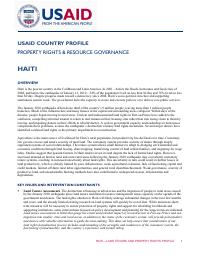
Profil pays : droits de propriété et gouvernance des ressources en Haïti
Résumé — Ce profil pays de l’USAID résume les contraintes relatives aux droits de propriété, au foncier et à la gouvernance des ressources naturelles en Haïti après le séisme de janvier 2010. Il relie les droits fonciers peu clairs à la reconstruction, aux moyens de subsistance ruraux et à la dégradation environnementale.
Constats Clés
- Les droits fonciers peu clairs et non documentés ont freiné la reconstruction après le séisme de janvier 2010.
- Les régimes coutumiers ruraux apportent une certaine sécurité mais peuvent être fragilisés par les déplacements et la demande foncière.
- La faiblesse de la gouvernance, la rareté des terres et les mauvaises pratiques agricoles contribuent à la dégradation.
- Les évaluations foncières sont identifiées comme une base urgente pour les politiques et la planification.
Description Complète
Le profil fournit une base de référence concise pour la politique foncière après le séisme. Il décrit la pauvreté, la faiblesse de la capacité étatique, les régimes coutumiers ruraux, les obstacles urbains à la reconstruction, la perte de documents, les pressions migratoires et la dégradation des ressources, et présente l’évaluation foncière comme une intervention urgente.
Texte Intégral du Document
Texte extrait du document original pour l'indexation.
USAID COUNTRY PROFILE
PROPERTY RIGHTS & RESOURCE GOVERNANCE
HAITI
OVERVIEW
Haiti is the poorest country in the Caribbean and Latin America. In 2001—before the floods, hurricanes and food crisis of
2008, and before the earthquake of January 12, 2010—54% of the population lived on less than $1/day and 78% lived on less
than $2/day. Despite progress made toward a democracy since 2004, Haiti’s socio-political structure and supporting
institutions remain weak. The government lacks the capacity to create and execute policies or to deliver core public services.
The January 2010 earthquake affected one third of the country’s 9 million people, leaving more than 1 million people
homeless. Much of the infrastructure and many houses in the capital and surrounding areas collapsed. Within days of the
disaster, people began moving to rural areas. Unclear and undocumented land rights in Port-au-Prince have added to the
confusion, compelling informal tenants to return to and remain on their housing sites rather than risk losing claim to them by
leaving, and impeding donors in their efforts to rebuild shelter. A void in government capacity and leadership on land issues
compounds these problems, as does the earthquake’s destruction of many land rights documents. Several major donors have
identified confused land rights as the primary impediment to reconstruction.
Agriculture is the main source of livelihood for Haiti’s rural population, but productivity has declined over time. Customary
law governs access and tenure security of rural land. The customary system provides security of tenure through deeply
engrained systems of social relationships. The tenure system allows small farmers to adapt to changing environmental and
economic conditions through land leasing, sharecropping, transferring control of land within families, and migrating for wage
labor. Studies suggest that peasant farmers in Haiti tend to invest in land despite the lack of formal land rights. However,
increased demand on land in rural and semi-rural areas following the January 2010 earthquake may overwhelm customary
tenure systems, resulting in increased uncertainty about land rights. This uncertainty in turn could result in further losses in
land productivity, which is already limited by poor infrastructure, weak agricultural extension, lack of functioning capital and
credit markets, limited off-farm rural labor opportunities, and general rural disenfranchisement. Weak governance, scarcity of
productive land, and unsustainable farming methods have also contributed to widespread erosion, deforestation and
degradation.
KEY ISSUES AND INTERVENTION CONSTRAINTS
Land Tenure Assessments. The destruction of housing in urban areas and the migration of people to rural areas caused
by the January 2010 earthquake place land tenure and natural resource management issues squarely on the agenda of the
government and donors. The land rights situation in Haiti will likely undergo substantial changes in the next few months
and years, and the already limited existing research on land systems will quickly be out of date. While numerous shortterm measures will be necessary to ensure protection of property rights and support for rebuilding livelihoods and
supporting institutions, some interventions focused on policy development and planning for the longer term are indicated.
Land tenure assessments in Haiti that gauge the extent and potential impact of reconstruction in Port-au-Prince and outmigration into smaller cities and rural areas, in addition to the status of the customary system, will provide policymakers
and donors with valuable information to guide decision-making. This data can help ensure that consideration of any
land rights formalization process includes understanding of the strengths and weaknesses of the customary system, the
functioning of land markets, and the country’s experience with formal titling.
HAITI—LAND TENURE AND PROPERY RIGHTS PROFILE
1
Development of Legal Framework. Customary law dominates rural land tenure and land tenure of the poor in urban
and peri-urban settings. Norms in urban informal settlements are constantly changing, especially in the aftermath of the
January 2010 earthquake. Formal laws are fragmentary, out of date, and create costly and often ineffective systems of
land registration and enforcement of rights. In rural areas, women routinely lose land rights when they marry outside
their village and relinquish possession of inherited land. Land institutions for implementation and enforcement were
weak prior to the earthquake and many were rendered inoperative by the disaster. The need to harmonize customary and
formal systems to protect property interests and encourage reconstruction and development has new urgency. Donors
can work with the government to provide leadership for the process and offer technical expertise in the areas of
customary and formal land rights, women’s land rights, land dispute resolution systems, and the development of legal
frameworks governing land and other natural resources, including forests.
Land Distribution. Programs are needed to provide shelter for the homeless, especially in the capital. Donors can
provide technical expertise to assist in the creation of appropriate policies and laws for the reconstruction of house sites
and housing, including provisions to improve and protect land tenure through development and implementation of lowcost land rights formalization.
FOR MORE RECENT LITERATURE:
http://usaidlandtenure.net/haiti
Keywords: Haiti, tenure, agrarian, land law, land reform, property rights, land conflicts, water rights, mineral rights
2
HAITI—LAND TENURE AND PROPERY RIGHTS PROFILE
SUMMARY
Haiti is the poorest country in the Caribbean and Latin America. In 2001––before the floods, hurricanes, and food crisis of
2008 and before the massive destruction caused by the January 2010 earthquake––54% of the population lived on less than
$1 per day and 78% lived on less
BOX 1. MACRO INDICATORS
than $2 per day. Life expectancy
Year
Score
is 53 years.
The January 12, 2010
earthquake affected one-third
of the country’s 9 million
people, leaving more than 1
million people homeless.
Much of the inadequate
infrastructure in the capital
and surrounding areas
collapsed; the offices of the
president, the United Nations,
and dozens of NGOs were
destroyed. Many of the houses
built and purchased by the
millions of people who
migrated to the capital and
surrounding areas over the last
decade were destroyed. Within
days of the disaster, significant
numbers of people began
migrating back to rural areas.
The extent to which survivors
of the earthquake will remain
outside of Port-au-Prince in
rural areas and smaller cities is
not yet known.
Population, total
Population ages 0-14: 15-64: 65+ (% of total)
Population growth (annual %)
Rural population (% of total population)
Population density (people per sq. km)
Literacy rate, adult total (% of people ages 15 and above)
2008
2008
2008
2008
2008
2008
9,780,064
36.7; 58.9; 4.3
1.7
53.2
354.9
..
Land area: Surface area (sq. km)
Arable land (% of land area)
Agricultural land (% of land area)
Permanent cropland (% of land area)
Irrigated land (% of cropland)
Forest area (% of land area)
Nationally protected areas (% of total land area)
2008
2005
2005
2005
2003
2005
2006
27,560; 27,750
28.3
57.7
11.6
8.4
3.8
0.3
2007
1353.6
2007
2005
2005
93.9; 5.1; 1.0
97.1
111.5
2008
2008
2003
6,953,379,268
1.3
27.9; 17.0; 8.4;
55.1
..
2007
..
11.4
Renewable internal freshwater resources per capita
(cubic meters)
Annual freshwater withdrawals, agriculture: domestic:
industry (% of total freshwater withdrawal)
Crop production index (1999-2001 = 100)
Livestock production index (1999-2001 = 100)
GDP (current US$)
GDP growth (annual %)
Agriculture: industry: manufacturing: services, value
added (% of GDP)
Ores and metals exports: imports (% of merchandise
exports: imports)
Aid (% of GNI)
Source: World Bank, 2009
Land rights in urban areas are
largely undocumented. Prior to the earthquake, the majority of residents in Port-au-Prince and other urban areas
lived in informal settlements. The earthquake has pushed several urban land tenure issues to the fore, including:
establishing a system of land claims and dispute resolution as residents attempt to resettle, take possession of
rubble, and re-build; establishing rights to areas of undeveloped land for temporary and transitional housing, as
well as for long-term reconstruction; and clarifying and developing institutional authority for land registration,
land-use planning and dispute resolution. Authorities will have to balance the need to assert authority over land in
the interest of public health and safety with the need to protect vulnerable groups, such as informal tenants, many
of whom may be displaced by efforts to strengthen control over land and land-use planning. Rights to land of
hundreds of thousands of informal tenants in Port-au-Prince, displaced by the earthquake, are currently unclear.
Despite progress made toward a stable democracy since 2004, Haiti’s socio-political structure and supporting
institutions remain weak. Even before the 2010 earthquake, the government largely lacked the capacity to create
and execute policies or to deliver core public services.
Agriculture is the main source of livelihood for Haiti’s rural population, but agricultural productivity has declined.
Farmers lack the needed resources and agricultural inputs. Weak governance of natural resources, scarcity of
productive land and unsustainable farming methods have caused intensive erosion, deforestation, and widespread
land degradation.
Customary law governs access and tenure security of rural land in Haiti. The customary system has provided
security of access to land through deeply engrained and relatively stable systems of personal and social
HAITI—LAND TENURE AND PROPERY RIGHTS PROFILE
3
relationships. The land tenure system, which includes a dynamic mix of ownership, leasing, sharecropping, and
wage labor, has generally been compatible with the development of smallholder agriculture. Studies report that
peasant farmers have been willing to invest to increase land productivity regardless of the tenure type (e.g.,
ownership, leasehold, sharecropping) and without formal land rights. However, the customary system may not be
able to withstand the pressure of the recent environmental disasters, loss of livelihoods and assets, urban-to-rural
migration trends following the earthquake, and increased dependency on productive land. In addition to
recognized barriers to improved land productivity in Haiti—lack of infrastructure, absence of permanent
institutions providing agricultural extension and research, lack of functioning capital and credit markets, limited
off-farm rural labor opportunities, and general rural disenfranchisement—the existing tenure system may need to
be considered.
1. LAND
LAND USE
Haiti is a mountainous country on the island of Hispaniola, characterized by a dense population and acute poverty.
As of 2007 the population of Haiti was 10 million. Fifty-four percent of the population lived on less than $1 per
day and 78% lived on less than $2 per day. Deteriorating living conditions and a lack of basic infrastructure in
rural areas led to rapidly accelerating urbanization in the years leading up to the earthquake. Over one-third of the
country’s population lived in the capital, Port-au-Prince, and its surrounding areas. Despite this, 55% of the
population is rural. The earthquake resulted in out-migration from Port-au-Prince to rural areas. Although the
permanency of these migration trends is not yet clear, thousands of people are expected to seek undeveloped and
underdeveloped rural land on which to live, and to seek shared housing and access to land from extended family
members in rural areas and small cities. This migration could create heightened demand for scarce land and
housing resources in hosting communities, and could increase the incidence of dispute over rights to these
resources (USACE 1999; IDA 2008; World Bank 2009; IDA 2009; ARD 2010).
In 2007 Haiti had a GDP of $6.7 billion. By sector, 25% of GDP was derived from agriculture, 32% from
industry, and 44% from services (2005 data) (World Bank 2009; IDA 2009; Taft-Morales 2007).
Haiti’s total land area is 27,600 square kilometers. Fifty-eight percent of land is agricultural. Forty percent of total
land area is arable and permanent cropland, of which 8.5% is irrigated. Fifty percent of agricultural land is
estimated to have a slope greater than 40%, which exacerbates erosion (USACE 1999; World Bank 2009; FAO
2000).
Forestland constitutes 3.8% of the total land area in Haiti, reduced from 80% at the beginning of the 20th century.
Approximately 81% of Haitian forestland is natural forest area, while 24% is plantation forest area. Nationally
protected areas constitute 0.3% of total land (World Bank 2009; Howard 1998; FAO 2005).
Forty percent of Haiti’s land area has been stripped of its productive soil. About 900,000 cubic meters of topsoil
are lost each year due to deforestation and resulting soil erosion. Rapid population growth combined with land
degradation has resulted in a scarcity of land. Deforestation is occurring at an annual rate of 0.7%. Urban-to-rural
migration following the earthquake may increase pressure on land, water and other natural resources in rural
areas. It is not yet clear what impact this out-migration will have on environmental resources (Howard 1998;
World Bank 2009).
LAND DISTRIBUTION
Most rural land is held by individuals who cultivate small farms for family use. Eighty percent of rural households
have access to land—often a simultaneous and dynamic mix of owned land, leased land, and land sharecropped or
worked as wage labor. A majority of these households hold their land under customary law. Landholdings
average 1.8 hectares per household, usually divided among several plots. Forty percent of households possess less
than 1 hectare of land per household and 40% of households have 1 to 4 hectares of land per household. The
balance of households is at the ends of the spectrum: they either hold large tracts of land or are landless. An
estimated 1% of households have 14 hectares or more of land (Bethell 2002; Howard 1998; World Bank 2005;
Avsi 2009; Sletten and Egset 2004).
4
HAITI—LAND TENURE AND PROPERY RIGHTS PROFILE
Patronage and misuse of the law have allowed elites and corporations to acquire the most productive land in Haiti.
In rural areas, large landowners (grandons) own or operate vast tracts (100 hectares or more) and rent their land
under sharecropping agreements. Adjusted for quality of land, the poorest farmers cultivate 0.54 hectares per
household while the wealthiest farmers cultivate 2.51 hectares per household. The poor tend to farm plots that are
nearly twice as far away from their homestead as those of the wealthier farmers, and thus their farmland is under
less intensive production (Howard 1998; Bethell 2002; De Ferranti et al. 2002; World Bank 1998).
Female-headed households tend to have fewer and smaller land plots than male-headed households (De Ferranti
et al. 2002).
LEGAL FRAMEWORK
Article 36 of Haiti’s Constitution recognizes and guarantees the right to private property. The Constitution
expressly requires agricultural landowners to cultivate their land and protect it against erosion. The Constitution
broadly calls for land division and development under the terms of territorial management plans within the
framework of agrarian reform. Haiti’s Civil Code, sections 425–577, includes provisions applicable to rural land
contracts and enforcement (GOH Constitution 1987; Reynolds and Flores 2009).
BOX 2. LAND TENURE INDICATORS
Score
Millennium Challenge Corporation Scorebook, 2009
— Land Rights and Access (Range 0–1; 1=best)
International Property Rights Index, 2009
— Physical Property Rights Score (Range: 0–10; 0=worst)
World Economic Forum’s Global Competitiveness Index, 2008-2009
— Property Rights (Range: 1–7; 1=poorly defined/not protected by law)
World Economic Forum’s Global Competitiveness Index
— Ease of Access to Loans (Range: 1–7; 1=impossible)
International Fund for Agricultural Development, Rural Poverty Report,
2001
— Gini Concentration of Holdings, 1981-1990 (Range: 0–1; 0=equal
distribution)
International Fund for Agricultural Development, Rural Sector Performance
Assessment, 2007
— Access to Land, 2007 (Range: 1-6; 1=unsatisfactory access)
Food and Agricultural Organization: Holdings by Tenure of Holdings
— Total Number of all Agricultural Holdings, Year
— Total Area (hectares) of all Agricultural Holdings, Year
— Total Number of Holdings Owned by Holder; Year
— Total Area (hectares) of Holdings Owned by Holder; Year
— Total Number of Holdings Rented from Another; Year
— Total Area (hectares) of Holdings Rented from Another; Year
World Bank Group, Doing Business Survey, 2009
— Registering Property-Overall World Ranking (Range: 1–181; 1=Best)
World Bank Group, World Development Indicators, 2009
— Registering Property-Number of Procedures
— Registering Property-Days Required
World Bank Group, World Development Indicators, 1998
— Percentage of Population with Secure Tenure
Heritage Foundation and Wall Street Journal, 2009
— Index of Economic Freedom-Property Rights (Range 0-100; 0=no
private property)
Economic Freedom of the World Index, 2008 (2006 data)
— Legal Structure and Security of Property Rights (Range 0-10;0=lowest
degree of economic freedom)
— Protection of Property Rights (Range 0-10; 0=lowest degree of
protection)
— Regulatory Restrictions of Sale of Real Property (Range 010;0=highest amount of restrictions)
0.415
..
..
..
..
..
..
..
..
..
..
..
154
5
405
..
10
2.59
..
2.86
The Rural Code (Loi of 24 May 1962,
amended 1986) is the primary existing
legislation governing rural land
through 19 separate laws. Topics
covered include: administration of
rural areas; land classification, use
rights and easements; soil protection;
livestock; irrigation and drainage;
forests, including their classification
and protection; land surveying;
evidence of ownership; and land
consolidation. The Rural Code has
limited application to land tenure, use,
and administration (GOH Rural Code
1962; Howard 1998; American Center
2003).
In practice, however, customary law
governs rural land rights and use.
Customary rights are less evident in
urban areas (Smucker et al. 2000;
Howard 1998).
TENURE TYPES
Rural land ownership is generally
governed by customary law and
traditional practice as opposed to
formal law. Land is largely
individualized; rural communities in
Haiti do not have a tradition of
communal land management although
land held by families may remain
undivided (Smucker et al. 2000).
Land rights in urban areas may be
controlled by the central government, municipal governments or private individuals and entities. Most residential
land rights in urban areas are informally held, due in part to the lengthy and costly registration system discussed
below. Land leased from the central government and municipalities will likely play a key role in building new
settlement communities in Port-au-Prince and in other smaller cities. The terms of these leases will be important
HAITI—LAND TENURE AND PROPERY RIGHTS PROFILE
5
to determining the level of resources that both donors and individual families are willing to commit to
reconstruction.
Under the customary system, rural land is acquired through purchase (37%), divided inheritance (23%), undivided
inheritance (15%) and other means. When inherited, land is usually divided among all children of the deceased.
Other forms of acquisition include non-formalized gifts of land, plots controlled for absentee landlords by
managers, and leaseholds on state land. About 10% of Haiti’s agricultural land is possessed by leaseholders and
by squatters on state land (5% of rural households). Under long-standing traditions of reciprocity, smallholders
will rent their land in exchange for cash, produce, or a labor commitment (Howard 1998; Bethell 2002; Smucker
et al. 2000).
In 1804, the Haitian government claimed vast colonial plantations and all other unclaimed lands. Newly-freed
slaves claimed much of the land that was not directly under government control, and this land has since that time
been informally bought, sold, or inherited by subsequent owners (Smucker et al. 2000).
SECURING LAND RIGHTS
Most land in Haiti is acquired and held under principles of customary law as opposed to formal law. Thirty-eight
percent of rural land was obtained by inheritance; an almost identical percentage (37%) by purchase. Under
customary law, kinship groups have an obligation to make land available to all members of the group. Land is
also accessed through other social relationships, such as patron-client and fictional kinship alliances. These
relationships provide for security of access (Smucker et al. 2000).
Approximately 60–65% of rural landholdings lack any type of documentation recognized by formal law, and their
rights are not enforceable in the formal adjudicatory system. What documentation exists is rarely updated
(Smucker et al. 2000; World Bank 2005).
Prior to the 2010 earthquake, approximately 40% of landowners had some documentation of their land rights,
such as legal title or a sales receipt that is recognized under formal law. Updated title was more common in urban
areas. Some land titling occurs in rural irrigated zones or peri-urban areas where rents are high and it is possible to
speculate in land (Bethell 2002; Smucker et al. 2000; World Bank 2005).
Formal registration of rural land is rare. Farmers avoid obtaining formal title due to the high costs associated with
registering land. Distrust of government officials is common, fees and taxes for registered land are high, and
registration creates a risk of diminishment of land area. Studies suggest that lack of formal documentation of land
rights does not impact land productivity. Peasant farmers are as willing to invest in land they access through
leasing and sharecropping arrangements as the land they hold in ownership. Farmers find security in kinship
relationships and other social ties that provide secure access to land (Smucker et al. 2000).
Foreigners can own 1.29 hectares in urban areas and 6.45 hectares in rural areas. Foreigners cannot own more
than one residence in the same district, or own property or buildings near the border with the Dominican Republic.
To own real estate, foreigners must obtain authorisation from the Ministry of Justice (FCO 2008).
Haiti has no systematic national cadastre or registration system, although the Direction Générale des Impôts
(DGI) is the central institution responsible for maintaining and updating registration records that do exist. Some
local areas, such as Port-au-Prince, have their own land registration system. To register rights to a parcel of land
in the capital, one must: (1) obtain authorization to conduct a property survey from the dean of the civil tribunal of
the commune for free; (2) conduct a survey by a public surveyor with a cost; (3) a Notary Public will prepare a
sales agreement, with a fee up to 8% of the sales price if the transferred property is farmland (the seller must pay a
value added tax up to 25% if the property is urban land with buildings); (4) record the sale agreement at the
Direction Générale des Impôts, and (5) the sale agreement is transcribed by hand into a register of the Direction
Générale des Impôts. The registration process takes between 4 and 15 months. In Port-au-Prince the land
registration system is bureaucratic, lengthy, costly and generally not trusted. The dysfunctional nature of this
system contributed to the rapid growth of informal settlements in the capital prior to the earthquake, and
confusion around land rights is—and will continue to be—one of the greatest impediments to reconstruction. The
majority of land transactions in rural areas are not formally registered, and the procedures for rural land
registration are unreported (World Bank 2008, ARD 2010). Other registration data pertaining to land and
6
HAITI—LAND TENURE AND PROPERY RIGHTS PROFILE
buildings exists at the municipal level, and includes property tax rolls and construction permits, as well as notary
data and records of leased state lands (held at both the DGI and municipal levels) (ARD 2010).
INTRA-HOUSEHOLD RIGHTS TO LAND AND GENDER DIFFERENCES
As Box 3 indicates, Haiti’s formal laws
pronounce principles of nondiscrimination.
The 1987 Constitution (Article 18) mandates
the equality of all Haitians. Women achieved
equality under the law in 1982, when a decree
was passed that established the equality of the
sexes, particularly within marriage (GOH
Constitution 1987; De Ferranti 2002).
BOX 3. LAND AND GENDER INDICATORS
Score
OECD: Measuring Gender In(Equality)—Ownership Rights, 2006
— Women’s Access to Land (to acquire and own land) (Range:
0-1; 0=no discrimination)
— Women’s Access to Property other than Land (Range: 0-1;
0=no discrimination)
— Women’s Access to Bank Loans (Range: 0-1; 0=no
discrimination)
FAO: Holders of Land Classified by Sex, 1993
— Percentage of Female Holders of Agricultural Land
0
0
0
..
In practice, the formal law often does not
impact the reality faced by Haitian women. A
majority of couples in Haiti have common law marriages that are not registered with the state. Common law
marriage and cohabitation create insecurity for women because the law does not recognize their inheritance rights
to their husbands’ land (De Ferranti 2002).
Under both formal and customary law, all recognized children have equal rights to the land owned by their
deceased parents, although female heirs tend to receive smaller shares of land. Customary law favors the
possessor of land. Heirs who remain on the land assume control of absentee shares and consolidate adjoining
shares, which can deprive daughters who have married outside of the community of their access to inherited land
(Smucker et al. 2000; Gardella 2006).
Married-out daughters usually lose their shares of land to relatives because unregulated customary practice
restricts selling land to outsiders. Thus, they will not sell their inherited share and will not personally farm it.
Instead, they give the land to a relative (Smucker et al. 2000).
In general, women’s property rights derive from their status as wives, mothers, or wards, and thus women often
lose their land rights when their status within the household changes. The customary laws that are prevalent in
rural areas exclude women from land ownership. Anecdotal evidence suggests that the land rights of women who
are household heads are more secure than the rights of women in households headed by men (De Ferranti et al.
2002).
LAND ADMINISTRATION AND INSTITUTIONS
The Ministry of Agriculture, Natural Resources and Rural Development is responsible for the promotion of
agriculture, rural development and the protection of natural resources (FAO 2000).
Land administration is governed by formal and customary systems. Formal transactions require documents
prepared by notaries and updated surveys. Haiti’s customary system of land rights is based on kinship, family
obligations, personal loans, labor relations and favors. Transactions are generally enforced within these kinship
systems rather than through use of formal procedures and documents (Smucker et al. 2000).
Haiti does not have a national cadastre and lacks a comprehensive, functional system for recording land
ownership. Some areas of highly productive land, such as the irrigated zones of the Artibonite Valley and
Gonaïves Plains, created local cadastres but they have not been maintained and the records are not current
(Smucker et al. 2000). As noted above, the land registration system for Port-au-Prince is bureaucratic and costly,
resulting in the growth of informal, unregistered transactions. The Direction Générale des Impôts (DGI) has been
the government institution responsible for maintaining registration records. However, people do not generally
consider these records to be accurate. Furthermore, the DGI building was damaged in the earthquake and the
status of land records is not known (ARD 2010).
Municipal governments have a vested interest in secure land tenure because they hold legal authority to census
and tax “built properties” via the Contribution Foncière de Propriétés Bâties (CFPB). Rural jurisdictions known as
Conseils d’Administration des Sections Communales (CASECs) also have the authority to census and tax “built
HAITI—LAND TENURE AND PROPERY RIGHTS PROFILE
7
properties,” which has been especially important in the urban and suburban areas on the fringe of Port-au-Prince
(ARD 2010).
LAND MARKETS AND INVESTMENTS
Haiti’s informal land market is active in rural areas. Ninety-five percent of land sales in rural Haiti are conducted
informally to avoid the high costs associated with legally prescribed procedures, which could run as high as 8% of
the total sales price. Customary law favors land transactions within kinship groups, and in some areas land
transactions outside the kinship group are prohibited (Smucker et al. 2000).
Formal land transactions must go through five steps: (1) authorization for a survey from the dean of the
commune; (2) conducting the survey by a commune official; (3) notarization of the transaction; (4) preparing all
documents by the notary, and (5) registering the transferred land (World Bank 2008).
Although mortgages are legal, real estate mortgages involve lengthy procedures and are not always recorded
against the debtor or other creditors (USDOS 2009).
COMPULSORY ACQUISITION OF PRIVATE PROPERTY RIGHTS BY GOVERNMENT
Under the Constitution, property can only be taken for a public purpose and with fair compensation paid. Land
reform is considered to be a public purpose. The Constitution prohibits confiscation of land for political purposes.
An expert must determine the value of the land, and the government must compensate the landowner based on
that valuation (GOH Constitution 1987).
The US Embassy has received complaints that the Haitian government has not compensated some individuals
when their land was expropriated. Determining formal ownership and rights to compensation is complicated by
the unreliability of land records, surveys and titles in Haiti (USDOS 2009).
Compulsory acquisition will likely play a role in reconstruction efforts following the earthquake because of its
importance as a land-use planning tool (e.g., in establishing no-build zones for the health and safety of residents)
and because of its potential use in securing lands for new settlements (ARD 2010).
LAND DISPUTES AND CONFLICTS
There is a strong preference for resolving land disputes through informal means and kinship systems. When the
informal system cannot resolve conflicts over inheritance and rightful ownership, the parties may as a last resort
take the dispute to the formal systems. Haiti’s judiciary has struggled with lack of funding, training, and
infrastructure. Ten of the 14 courts of first instance were destroyed in uprisings in 2004, court records are poorly
maintained, and courts often have limited access to legal texts. Forty percent of the population lacks the
documentation of identity required to appear as a party and proceedings are in French as opposed to Creole, which
is spoken by the less educated segment of the population. Formal proceedings are costly and there is no
systematic system of legal aid. The courts are often viewed as corrupt and highly politicized, and they lack
mechanisms to enforce their rulings (World Bank 2006b; Smucker et al. 2000).
In the aftermath of the earthquake, no centralized government body appears to be asserting authority over land
claims and land dispute resolution. This issue will continue to rise in importance as residents of Port-au-Prince
begin to return to their land and turn their attention to longer-term reconstruction. Community mapping processes,
such as those undertaken in Indonesia following the 2004 tsunami, may help to establish at least some level of
tenure security (ARD 2010).
KEY LAND ISSUES AND GOVERNMENT INTERVENTIONS
In 2007, the GOH (Government of Haiti) released a National Strategy Paper for Growth and Poverty Reduction
that is made up of three pillars, one of which includes promoting agriculture and rural development. The strategy
does not explicitly address land tenure issues (IDA 2009; IDA 2008).
From 1991 to 1996, the National Institute of Agrarian Reform implemented a land reform program in Artibonite
Valley, the primary rice-growing region in Haiti. The program was designed to redistribute disputed land to
landless families. Each recipient was given a half-hectare of land with restrictions on alienation. By 1996, 1600
8
HAITI—LAND TENURE AND PROPERY RIGHTS PROFILE
households had benefitted from the first round of land redistribution. Rice yield reportedly increased by 60% in
the area. There were complaints about corruption and favoritism in the redistribution process but the project
achieved some objectives (Bethell 2002).
DONOR INTERVENTIONS
As of 2008, USAID was working on economic growth initiatives in Haiti, with agricultural economic aid totaling
$18 million in fiscal year 2008. USAID activities focus on soil conservation, watershed management,
reforestation, and market-based interventions in natural resource management in order to formulate
macroeconomic policies that facilitate economic growth (USAID 2008b).
Since 2005, IDA has provided grants to Haiti, including $38 million for rural development, part of which is to be
used in soil improvement and land and water development (IDA 2008, 2009).
The World Bank gave the government a $6 million grant to support combating land degradation, provide
assistance to rural landholders to improve their land use patterns and increase effectiveness of conservation and
rehabilitation of remaining forests. The Bank’s Country Assistance Strategy for FY09–FY13 places high priority
on increasing agricultural productivity and planned a $5 million initiative to address bottlenecks in the Ministry of
Agriculture, improve service delivery approaches to producers and help facilitate disbursement of resources
provided to the sector by a variety of donors (World Bank 2006a; IDA 2009).
GTZ was involved in a project to combat desertification of arable land in Haiti. The term of this project expired in
June 2008 (GTZ 2008).
2. FRESHWATER (LAKES, RIVERS, GROUNDWATER)
RESOURCE QUANTITY, QUALITY, USE AND DISTRIBUTION
Rainfall, ground water, and the Artibonite River contribute to Haiti’s freshwater resources. The country has 12
cubic kilometers of internal renewable water resources and 0.9 cubic kilometers of external renewable water
resources. Water resources are unevenly distributed, with the southwest part of the country possessing freshwater
supply four times as high as the southeast. Rainfall in Haiti is unevenly distributed. Some regions receive up to
3,600 millimeters annually, while others receive only 400 millimeters (FAO 2000; USACE 1999).
Étang Saumâtre is the largest natural lake in Haiti, covering 181 square kilometers. The lake is surrounded by an
inland marsh. Additional ponds and sinkholes can be found in limestone terrain. The Lac de Péligre is a manmade reservoir on the Rivière de l’Artibonite, covering 30 square kilometers. Mangrove swamps are located along
the coast. The most extensive mangrove swamp is located south of Gonaïves and is 32 kilometers long and 5
kilometers wide (USACE 1999).
Only about 7.5% of renewable water resources are utilized in Haiti. The availability of groundwater is variable.
Groundwater is plentiful in the plains and valleys, but varies from plentiful to scarce in mountainous areas.
Underground water is often polluted due to the absence of sanitary sewers in Haiti (Howard 1998; FAO 2000;
USACE 1999; UN 1997).
Erosion has caused the volume of water flowing from 18 springs which serve the Haitian capital to drop by 50%
since 1993 (Collie 2003).
Haiti’s water supply is stressed by the uneven distribution of rainfall and population density. Access to water and
sanitation facilities is limited. Approximately 49% of urban dwellers had access to improved water sources prior
to the 2010 earthquake. The earthquake destroyed many of the delivery systems for water and sanitation in Portau-Prince, leaving survivors with little access to either. Approximately 45% of rural dwellers have access to
improved water sources (USACE 1999; UNESCO 2006).
LEGAL FRAMEWORK
Article 36 of the 1987 Constitution provides that water resources are the domain of the state; the right to property
does not extend to any springs, rivers, or water courses. The Government of Haiti enacted a new framework
HAITI—LAND TENURE AND PROPERY RIGHTS PROFILE
9
governing water resources in 2009; the framework has yet to be implemented and its terms are unknown (GOH
Constitution 1987; IDA 2009).
The Rural Code (1962) addresses irrigation and drainage in rural areas. As a practical matter, water resources in
rural areas are governed by water committees and customary law (GOH Rural Code 1962; IDA 2009).
TENURE ISSUES
Water has been a poorly managed resource in urban and peri-urban areas. In Port-au-Prince, private arrangements
with public officials have allowed three-quarters of the water distributed by the city to go to less than a quarter of
the population (Howard 1998).
Because of the absence of effective water management, Haitian citizens access water where they can. They often
attempt to illegally drill into ground water supplies, and then sell that water to those who need it (UN 1997; Collie
2003).
GOVERNMENT ADMINISTRATION AND INSTITUTIONS
Institutions involved in water management in Haiti are: the Ministry of Public Works, Transport and
Communications, which is responsible for drinking water and sanitation; the Ministry of Agriculture, Natural
Resources and Rural Development, which is responsible for irrigation and drainage; and the Directorate of
Natural Resources, which administers public irrigation systems (FAO 2000).
Haiti has two state-owned water sector enterprises under the Ministry of Public Works, Transportation, and
Communications: Centrale Autonome Métropolitaine d’Eau Potable (CAMEP), responsible for the capital city,
and Service National d’Eau Potable (SNEP), responsible for secondary cities and for rural areas (GOH Ministry
of Public Works 2010).
There are hundreds of water committees, called Comités d’Aprovisionnement en Eau Potable (CAEPs) or, more
recently, Comité d’Approvisionnement en Eau Potable et Assainissement (CAEPA), which indicates the
additional responsibilities for sanitation. The committees are responsible for managing water supplies in rural
areas and small towns. The committees are not federated and the nature and quality of their service varies (GOH
Ministry of Public Works 2010) .
GOVERNMENT REFORMS, INTERVENTIONS AND INVESTMENTS
Under the new Framework Law passed in January 2009, a General Directorate for Water and Sanitation will be
established within the Ministry of Public Works. Four regional water and sanitation authorities are planned to
replace the state water companies, SNEP and CAMEP (IDA 2009).
DONOR INTERVENTIONS AND INVESTMENTS
For fiscal year 2007, the World Bank approved an IDA loan of $5 million for a rural water and sanitation project.
An additional grant of $5 million was approved in 2009 (Cox et al. 2006; IDA 2009).
In 1986, with the financial support of USAID, a pilot integrated watershed management project was conducted to
build dams and plant trees for soil conservation (White and Runge 1995).
3. TREES AND FORESTS
RESOURCE QUANTITY, QUALITY, USE AND DISTRIBUTION
Haiti has a total forest area of 1,000 square kilometers, 3.8% of total land area in 2005. All the country’s forests
are tropical. They are constituted of modified natural forests (81%) and plantation forests (24%). Fifty percent of
forests are used for production, while 4.1% are designated for conservation (FAO 2005).
Most of Haiti’s remaining forests are located in the Macaya and La Visite National Parks and in the Forêt des Pins
Reserve. However, these areas have also been subject to large-scale logging and invasion. There are mangrove
forests on the north coast, in the Rivière de l’Artibonite estuary, in the Grande Cayemite area, and in the Les
10
HAITI—LAND TENURE AND PROPERY RIGHTS PROFILE
Cayes region. Important mangrove swamps are also found on the Île à la Gonâve, primarily on the northern coast
(USACE 1999; Regan 2003; Howard 1998).
Haiti’s forests are characterized by excessive deforestation. Deforestation began in the colonial period, when
forests were cleared for coffee and sugarcane production. Between 1900 and 2000, more than 50% of Haiti’s
remaining natural forests were lost at an annual deforestation rate of 5.7%. During the same period, plantation
forests grew by 5%. Areas of forest that have been converted to agriculture are used for marginally profitable
annual crops, such as maize and beans (White and Runge 1995; Zimmerman 1986; Earthtrends 2003; USAID
2006; Taft-Morales 2007).
From 2000 to 2005, the average annual rate of deforestation was 0.7%. Extensive deforestation is the result of
conversion of forests to agricultural land and illegal harvesting of forests for firewood and charcoal. These actions
are encouraged by poorly defined and insecure property rights, which discourage natural resource management by
limiting the incentives to be gained from it. Deforestation has contributed to soil erosion and inadequate potable
water resources (FAO 2005; Dolisca et al. 2006).
LEGAL FRAMEWORK
The 1987 Constitution recognizes and guarantees private property. However, the Constitution does not define
ownership rights to forest. The Constitution (Article 253) forbids environmental degradation that might upset the
ecological balance. The Constitution also encourages the development of alternative energy sources to protect
forest reserves (GOH Constitution 1987).
The Rural Code of 1962 (Loi du 24 mai 1962 portant Code Rural) governs forest classification and protection.
The Décret of June 26, 1986 (Décret du 26 Juin 1986) modifies the Rural Code to include the composition of a
Council of Rural Administrative Sections (CASER). CASERs are the smallest administrative territorial entity in
Haiti and are responsible for encouraging soil conservation and reforestation (GOH Rural Code 1962; GOH
Amending Decree 1986).
The Law of September 19, 1958 (Loi du 19 septembre 1958) regulates logging in Haiti (GOH Logging Law 1958).
Haitian law contains a provision for the creation of a national system of protected areas, but this has not been
implemented (USAID 2007).
Since 1826, the Haitian government has legislated more than 100 laws and policies aimed at protecting natural
forests and soils. These laws have been ineffective in curbing degradation as they have not provided incentives or
conditions for appropriate land-use decisions (White and Runge 1995).
TENURE ISSUES
GOVERNMENT ADMINISTRATION AND INSTITUTIONS
There is no centralized agency that deals with forest management. The Ministries of Agriculture, Tourism,
Environment, and Planning all attempt to regulate forest resources, with limited success (Regan 2003).
GOVERNMENT REFORMS, INTERVENTIONS AND INVESTMENTS
There has been limited government intervention in forest degradation. The government has hired guards to
prevent farmers from converting forest to farmland, but there are too few guards to be effective. In 2003, the
Minister of Environment hired agents to pass out flyers and pamphlets to peasants in an effort to educate them
about the damages caused by forest degradation. Unfortunately, long-term government intervention in
deforestation has been frustrated by high level government corruption (Regan 2003).
DONOR INTERVENTIONS AND INVESTMENTS
USAID developed an Environmental Threats and Opportunities Assessment for the Government of Haiti that
highlights forest degradation as the primary reason for environmental deterioration. USAID supported a
HAITI—LAND TENURE AND PROPERY RIGHTS PROFILE
11
government program designed to improve management of watersheds and build sustainable forest management
(USAID 2006).
In 1996, the World Bank approved a loan to Haiti for $21.5 million to support the management of forests and
parks in an effort to eliminate deforestation and soil erosion. In 1991, the World Bank loaned Haiti $29 million to
slow the degradation and erosion of the country’s natural resources. The loan was used to strengthen the Ministry
of Agriculture, Natural Resources and Rural Development’s Directorate of Natural Resources and its Forestry and
Environmental Protection Services, and for training in forestry and agroforestry (Del Carill 1996).
4. MINERALS
RESOURCE QUANTITY, QUALITY, USE AND DISTRIBUTION
Haiti has few commercially exploitable mineral resources. The mining industry is largely based on the production
of cement, such as clay and limestone. Haiti also has small amounts of the following: gold, silver, antimony, tin,
lignite, sulfur, coal, nickel, gypsum, limestone, manganese, marble, iron, tungsten, salt, clay, bauxite, and copper.
The country is believed to have calcium carbonate deposits, though these have yet to be explored (Torres 1996;
Haggerty 1989; Mbendi 2010).
Much of the mining industry ceased in Haiti by the 1980s due to lack of profitability. The country’s online
bauxite mine, the Miragoâne mine, closed in 1982 due to declining production and high costs (Haggerty 1989).
As of the late 1980s, mining constituted only 1% of the country’s GDP and provided less than 1% of the country’s
employment. Approximately 4,500 workers participate in artisanal mining (Haggerty 1989; Mbendi 2010; CASM
2009).
LEGAL FRAMEWORK
The 1987 Constitution states the state holds the rights to the country’s subsoil. Property rights do not extend to
mines or quarries. The Decree of October 10, 1974 (Décret du 10 octobre 1974) declares all naturally occurring
minerals, deposits and subterranean resources the property of the Republic of Haiti (GOH 1987; GOH Mineral
Decree 1974).
The Decree of March 2, 1984 (Décret du 2 mars 1984) regulates quarrying operations throughout the country
(GOH 1984).
TENURE ISSUES
Prospecting and mining permits may only be granted to companies that are established and resident in Haiti
(USDOS 2009).
GOVERNMENT ADMINISTRATION AND INSTITUTIONS
The Bureau of Mines and Energy is responsible for managing mineral resources, including granting mineral
exploration and exploitation concessions and permits (USDOS 2009).
The Decree of March 25, 1975 (Décret du 25 mars 1975) created the National Institute of Mineral Resources
(GOH Minerals Decree II 1975).
GOVERNMENT REFORMS, INTERVENTIONS AND INVESTMENTS
Haiti’s mineral sector is small and the government does not appear to have any current plans for investment in the
sector.
DONOR INTERVENTIONS AND INVESTMENTS
In the 1980s, the Inter-American Development Bank (IDB) assisted Haiti in conducting its first geological survey
(Haggerty 1989).
12
HAITI—LAND TENURE AND PROPERY RIGHTS PROFILE
5. DATA SOURCES (SHORT LIST)1
Bethell, Amber. 2002. Land Tenure and Reform in Haiti. http://www.spatial.maine.edu/~onsrud/
Lantenure/Country Report/Haiti.pdf (accessed January 2009).
Howard, Philip. 1998. Environmental scarcities and conflict in Haiti. Report for the Canadian International Development
Agency (CIDA).
IDA and IFC. 2009. Country Assistance Strategy of the Republic of Haiti FY09–FY12. World Bank Report No. 48284-HT.
http://www-wds.worldbank.org/external/ default/WDSContentServer/WDSP/IB/2009/06/22/
000333038_20090622234303/Rendered/PDF/482840CAS0P1061C0Disclosed061191091.pdf (accessed January
2010).
Smucker, Glenn R., Michael Bannister, and Anderson T. White. 2000. Land tenure and the adoption of agricultural
technology in Haiti. Collective Group on International Agricultural Research (CGIAR) Systemwide Program on
Collective Action and Property Rights (CAPRi) Working Paper No. 6. Washington DC: .
USAID. 2008b. Haiti Congressional Budget Justification FY 2008–2009. ?
World Bank. 2005. Haiti–– Diagnostic and proposals for agriculture and rural development policies and strategies.
http://www-wds.worldbank.org/external/default/WDSContentServer/WDSP/IB/2006/07/
19/000090341_20060719153846/Rendered/PDF/367850ENGLISH0150Synthesis01PUBLIC1.pdf (accessed
December 2008).
———. 1998. Haiti: The Challenges of Poverty Reduction. http://www-wds.worldbank.org/external/default/WDSContentServer/WDSP/IB/1999/06/03/000009265_3981005111938/Rendered/INDEX/multi_page.txt (accessed
7 March 2010).
6. DATA SOURCES (COMPLETE LIST)
ACLIS. See American Center for International Labor Solidarity
ARD. See Association for Rural Development.
AVSI. See Association of Volunteers in International Service.
American Center for International Labor Solidarity (ACLIS). 2003. Unequal equation: the labor code and worker rights in
Haiti. http://solidaritycenter.org/files/UnequalEquation.pdf (accessed January 2010).
Association for Rural Development, Inc. (ARD). 2010. The Importance of Land Tenure and Property Rights Issues and
Post-Earthquake Recovery in Haiti. Draft #2 (January 28, 2010).
Association of Volunteers in International Service (AVSI). 2009. Haiti: Buds of hope: Creation of nurseries for the
production of reforestation trees. An Itascabili publication. http://www.avsi.org/documenti/AVSITascabile9
HaitiInglese.pdf (accessed January 2010).
Bethell, Amber. 2002. Land tenure and reform in Haiti. http://www.spatial.maine.edu/~onsrud/Landtenure/CountryReport/
Haiti.pdf (accessed January 2009).
CASM. See Communities and Small Scale Mining.
1
Complete list of references available at URL: http://ltpr.rmportal.net/country-profiles/haiti/references/.
HAITI—LAND TENURE AND PROPERY RIGHTS PROFILE
13
Collie, Tim. 2003. All of Haiti is being destroyed. South Florida Sun-Sentinel, December 7.
Communities and Small Scale Mining (CASM). 2009. ASM Country Profile: Haiti. http://www.artisanalmining.org/
ctrydata.cfm?ctry=HT (accessed January 2010).
Cox, Pamela, Caroline Antsey, Antonella Bassani, and Massimiliano Paolucci, 2006. Interim strategy note for the Republic
of Haiti for the period FY 08–07. Report No. 37720-HT, The World Bank.
De Ferranti, David, Antonella Bassani, Maria Correia, Orsalia, et al. 2002. A review of gender issues in the Dominican
Republic, Haiti and Jamaica. Report No. 21866-LAC, The World Bank.
Del Carill, Mario. 1996. World Bank steps up pace in Haiti with a $21.5 million credit to alleviate poverty and improve
environment. World Bank Press Release, No. 97/1128LAC.
Dolisca, Frito, Joshua McDaniel, Lawrence Teeter, and Curtis Jolly. 2006. Land tenure, population pressure, and
deforestation in Haiti: The case of Forêt des Pins Reserve. Journal of Forest Economics, 13:227–289.
Earthtrends. 2003. Forests, grasslands and drylands: Haiti. Earthtrends Country Profiles.
Economist. 2010. A massive relief effort limps into gear. January 21. http://www.economist.com/opinion/displaystory
.cfm?story_id=15330781 (accessed January 2010).
FAO. See Food and Agriculture Organization.
FCO. See Foreign and Commonwealth Office.
Food and Agriculture Organization. 2000. Aquastat: Haiti. http://www.fao.org/nr/water/aquastat/countries/haiti/print1.stm
(accessed March 2009).
———. 2005. Global Forest Resources Assessment 2005: Progress towards sustainable forest management. http://www.fao
.org/docrep/008/a0400e/a0400e00.htm (accessed January 2010).
Foreign & Commonwealth Office (FCO). 2008. Haiti Country Profile. United Kingdom: .
Gardella, Alexis. 2006. Gender Assessment for USAID/Haiti Country Strategy Statement. DevTech Systems for USAID.
GTZ. See German Technical Corporation.
GOH. See Government of Haiti.
German Technical Corporation. 2008. Combating desertification in the Caribbean/Central America.
Government of Haiti (GOH). 1958. Loi du 19 septembre 1958. http://faolex.fao.org/docs/pdf/hai2855.pdf (accessed
January 2010).
———. 1962. Haiti: Loi du 24 mai 1962 portant Code Rural, Abstract. Le Moniteur, 51. http://faolex.fao.org/faolex.
———. 1974. Décret du 10 octobre 1974. http://www.foprobim.org/haitian_env__laws.htm (accessed January 2010).
———. 1975. Décret du 25 mars 1975. Truncated information available online. http://www.foprobim.org/haitian_env__laws
.htm (accessed January 2010).
———. 1984. Décret du 2 mars 1984. Truncated information available online. http://www.foprobim.org/haitian_env__laws
.htm (accessed January 2010).
———. 1986. Décret du 26 juin 1986 modifiant les dispositions des lois I et II du nouveau code rural. http://faolex.fao.org/
cgi-bin/faolex.exe?rec_id=036138&database=FAOLEX&search_type=link&table=result&lang=eng&format_name
14
HAITI—LAND TENURE AND PROPERY RIGHTS PROFILE
=@ERALL (accessed January 2010).
———. 1987. 1987 Constitution of Haiti. http://pdba.georgetown.edu/constitutions/haiti/haiti1987.html (accessed January
2010).
———. 2010. Ministry of Public Works, Transportation and Communication. Website. http://www.mtptc.gouv.ht/defis/
epa.php (accessed January 2010).
Haggerty, Richard A., ed. 1989. Haiti: A Country Study. http://countrystudies.us/haiti/59.htm Prepared for the Library of
Congress (accessed March 2009).
Howard, Philip. 1998. Environmental scarcities and conflict in Haiti. Report for the Canadian International Development
Agency (CIDA).
IDA. See International Development Association.
IFC. See International Finance Corporation.
International Development Association. 2008. Haiti: Restoring hope, delivering credibility. IDA at Work.
http://siteresources.worldbank.org/IDA/Resources/ida_Haiti_9-07-09.pdf (accessed January 2010).
International Development Association (IDA) and International Finance Corporation (IFC). 2009. Country Assistance
Strategy of the Republic of Haiti FY09–FY12. World Bank Report No. 48284-HT. http://wwwwds.worldbank.org/external/default/WDSContentServer/WDSP/IB/2009/06/22/000333038_20090622234303/
Rendered/PDF/482840CAS0P1061C0Disclosed061191091.pdf (accessed January 2010).
Mbendi Information Services. 2010. Mining in Haiti: Overview. http://www.mbendi.com/indy/ming/am/ht/p0005.htm
(accessed January 2010).
Regan, Jane. 2003. Forest and land in Haiti fading fast. The Miami Herald, August 5.
Reynolds, Thomas H., and Arturo A. Flores. 2009. Foreign law guide: Haiti. http://www.foreignlawguide.com/
(subscription required; accessed February 2009).
Sletten, Paul and Willy Egset. 2004. Poverty in Haiti. Fafo Paper 2004:31. http://www.fafo.no/pub/rapp/755/755.pdf
(accessed 8 March 2010).
Smucker, Glenn R., Michael Bannister, and Anderson T. White. 2000. Land tenure and the adoption of agricultural
technology in Haiti. Working Paper 6, CAPRi, Washington DC
Taft-Morales, Maureen. 2007. Haiti’s development needs and a statistical overview of conditions of poverty. Congressional
Research Service Report for Congress RL34029, Washington DC.
Torres, Yvette E. 1996. The mineral industry of other islands of the Caribbean. USGS Minerals Information. United States
Geological Survey. http://minerals.usgs.gov/minerals/pubs/country/1995/9524095.pdf (accessed January 2010).
.
UN. See United Nations.
UNESCO. See United Nations Educational Scientific and Cultural Organization.
USACE. See United States Army Corps of Engineers.
USAID. See United States Agency for International Development.
USDOS. See United States Department of State.
United Nations (UN). 1997. Natural resource aspects of sustainable development in Haiti. New York: United Nations.
United Nations Educational Scientific and Cultural Organization (UNESCO). 2006. Water, a shared responsibility: The
HAITI—LAND TENURE AND PROPERY RIGHTS PROFILE
15
United Nations World Water Development Report 2. http://www.unesco.org/water/wwap/wwdr/wwdr2/
table_contents.shtml (accessed January 2010).
United States Army Corps of Engineers (USACE). 1999. Water resources assessment of Haiti. http://www.sam.usace
.army.mil/en/wra/Haiti/Haiti%20Water%20Resources%20Assessment%20English.pdf (accessed January 2010).
United States Agency for International Development (USAID). 2002. Urban profile: Haiti. http://pdf.usaid.gov/
pdf_docs/PNADD722.pdf (accessed December 2008).
———. 2006. Haiti Strategy Statement FY 2007–2009. http://pdf.usaid.gov/pdf_docs/PDACK056.pdf, (accessed
December 2008).
———. 2007. Environmental vulnerability in Haiti: Findings and recommendations. http://www.wilsoncenter.org/events/
docs/Haiti_Final.pdf (accessed January 2010).
———. 2008a. Annual Report. http://www.usaid.gov/locations/latin_america_caribbean/country/haiti/index.html (accessed
December 2008).
———. 2008b. Haiti Congressional Budget Justification FY 2008–2009.
United States Department of State (USDOS). 2009. Bureau of Economic, Energy and Business Affairs. 2009 Investment
Climate – Haiti. http://www.state.gov/e/eeb/rls/othr/ics/2009/117840.htm (accessed January 2010).
White, T. A., and C.F. Runge. 1995. Common Property Forest Resource Management. Unasylva 180: .
World Bank. 1998. Haiti: The Challenges of Poverty Reduction. http://www-wds.worldbank.org/external/default/
WDSContentServer/WDSP/IB/1999/06/03/000009265_3981005111938/Rendered/INDEX/multi_page.txt
(accessed 7 March 2010)
World Bank. 2005. Haiti - Diagnostic and proposals for agriculture and rural development policies and strategies.
———. 2006a. Interim Strategy Note for the Republic of Haiti for the period FY07–08.
———. 2006b. Social Reliance and State of Fragility in Haiti: A Country Social Analysis. Report 36069-HT.
http://siteresources.worldbank.org/SOCIALANALYSIS/1104894-1115795935771/20938696/
Haiti_CSA.pdf (accessed 9 March 2010).
———. 2008. Doing Business 2009 Country Profile for Haiti.
———. 2009. World Development Indicators. Washington DC: The World Bank.
http://www-wds.worldbank.org/external/default/WDSContentServer/WDSP/IB/2006/07/19/
000090341_20060719153846/Rendered/PDF/367850ENGLISH0150Synthesis01PUBLIC1.pdf
(accessed December 2008).
Zimmerman, Thomas. 1986. Agroforestry – a last hope for conservation in Haiti? Agroforestry Systems 4(3):255–268.
16
HAITI—LAND TENURE AND PROPERY RIGHTS PROFILE
Comment citer
United States Agency for International Development (USAID), 2010, Profil pays : droits de propriété et gouvernance des ressources en Haïti, https://landwise-production.s3.amazonaws.com/2022/03/USAID_Land-Tenure-Haiti-Profile-2010.pdf