Teks Konple Dokiman an
Teks ki soti nan dokiman orijinal la pou endeksasyon.
2023 Revision 1 (May 2023)
www.unicef.org/appeals/haiti
UNICEFHaiti/2022/Joseph
Humanitarian
Action for
Children
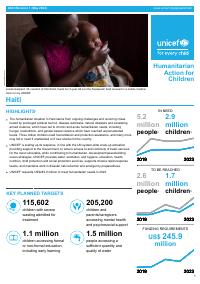
Jesula Gaspard, 30, resident of Cité Soleil, feeds her 2-year old son the therapeutic food received in a mobile medical
clinic run by UNICEF.
Haiti
HIGHLIGHTS1
IN NEED
The humanitarian situation in Haiti stems from ongoing challenges and recurring crises
fueled by prolonged political turmoil, disease outbreaks, natural disasters and escalating
armed violence, which have led to chronic and acute humanitarian needs, including
hunger, malnutrition, and gender-based violence which have reached unprecedented
levels. Three million children need humanitarian and protection assistance, and many more
may fall in need if unattended or if new shocks hit the country.
UNICEF is scaling up its response, in line with the UN system-wide scale-up activation,
providing support to the Government, to ensure access to and continuity of basic services
for the most vulnerable, while contributing to humanitarian, development/peacebuilding
nexus strategies. UNICEF provides water, sanitation, and hygiene, education, health,
nutrition, child protection and social protection services, supports cholera rapid-response
teams, and maintains work in disaster risk reduction and emergency preparedness.
UNICEF requests US$245.9 million to meet humanitarian needs in 2023.
5.2
2.9
million million
people
115,602
205,200
children with severe
wasting admitted for
treatment
children and
parents/caregivers
accessing mental health
and psychosocial support
1.1 million
1.5 million
children accessing formal
or non-formal education,
including early learning
people accessing a
sufficient quantity and
quality of water
children
2019
3
2023
TO BE REACHED
2.6
1.7
million million
people
KEY PLANNED TARGETS
2
4
children
2019
5
2023
FUNDING REQUIREMENTS
US$ 245.9
million
2019
2023
1
�HUMANITARIAN SITUATION AND NEEDS
SECTOR NEEDS
The humanitarian situation in Haiti stems from ongoing challenges and recurring crises that
lead to chronic and acute humanitarian needs. In 2023, over 5.2 million Haitians,6 nearly half
of the population, will need humanitarian assistance and protection. Thousands of other highly
vulnerable people may fall in need shortly if the situation continues to deteriorate or in case of
new shocks. The compounded crises have differentiated impacts on distinct groups and
regions: urban populations entrapped by armed violence; families displaced by violence; food
insecure and marginalized communities outside the capital; and repatriated migrants. The
influence of armed groups has increased, coupled with severe human rights violations.
Attacks on medical and educational assets are rising, including a nine-fold increase in armed
violence against schools7. Access to education and health services for at least 1.5 million
people has been restricted8, while UN agencies and non-governmental organizations have
been targets of violent lootings. In April 2023, a civilian-led vigilante movement emerged,
targeting and publicly executing members of armed groups. Children bear the brunt of the
deteriorating security, economic and social situation, especially those living in violenceaffected areas, and repatriated migrants. At least 128,000 people are internally displaced in
the Port-Au-Prince Metropolitan Area9, of which 38 per cent live in spontaneous sites and 62
per cent in host communities, including many unaccompanied children exposed to abuse,
exploitation and violence.
4.5 million
Catastrophic levels of food insecurity were recorded for the first time in 2022, and a staggering
30 per cent more children are projected to suffer from severe wasting this year, per the 2023
SMART survey. An estimated 115,600 children could be severely wasted in 202310, compared
to 87,500 in 2022. In addition, nearly one in four children in Haiti suffer from chronic
malnutrition (or stunting),11 a condition with long-term developmental and survival
consequences.
people lack access to
safe water16
people in need of
health assistance13
794,000
people in need of
nutrition assistance14
1.2 million
children in need of
protection services15
3.3 million
The crisis is exacerbated by the cholera epidemic that resurfaced in Cité Soleil in October
2022 and has spread across the country. As of May 2023, over 42,350 suspected cases have
been reported, almost half of them among children under the age of 14.12 Access to water is
a major challenge and cause of the spread of cholera. As the disease ravages violenceridden neighbourhoods, cholera and malnutrition pose a double burden that the national
health system is unable to address.
Reconstruction efforts following the 2021 earthquake are limited and Haiti remains extremely
susceptible to natural hazards.
Addressing the complex needs of affected populations will require a multi-sectoral, countrywide approach that goes beyond immediate relief, towards a more comprehensive response
that supports recovery and resilience.
STORY FROM THE FIELD
Virginia Danielle, 13, stayed home from
school one day in March 2023 because of
clashes taking place near her school. As
she studied at home, she was hit by a
stray bullet. Virginia is recovering, but is
experiencing symptoms that resemble
post-traumatic stress disorder.
“When I hear gunshots, I jump up and hit
myself. I'm afraid to stay at home. I am
scared when my mother leaves me
alone,” she says.
UNICEF, with local NGOs, runs childfriendly spaces to provide a safe
environment where children like Virginia
can access the support needed to cope
with the impact of armed violence.
UNICEF/Haiti/2023/Joseph
Read more about this story here
Haritée Tibreuil, 37, adjusts the bandage on her daughter Virginia's wound after she was hit by a stray
bullet in March 2023, in Port-au-Prince.
2
�HUMANITARIAN STRATEGY17
In the current context, UNICEF, in collaboration with Government
and partners, is scaling up the immediate humanitarian response to
save lives, while contributing to build capacities and effective nexus
strategies to be sustained over the mid-long term.
UNICEF is scaling up the humanitarian response while tailoring
interventions to address the differentiated needs of specific
population groups (including those affected by armed violence,
IDPs, repatriated migrants, and other affected populations outside of
the capital). UNICEF is responding to protection, cholera and
malnutrition in areas at risk of systems collapse through increased
support to teachers, doctors and health workers. In urban areas
affected by violence and displacement, UNICEF is assisting IDPs
through mobile teams, supplies, community engagement and social
cohesion. To better address the needs of people trapped in areas
controlled by armed groups, UNICEF is investing in access capacity.
The cholera response includes case area targeted interventions
(CATI), community sensitization and WASH shield response,
preventing waterborne and infectious diseases, and support to
treatment centres. WASH interventions focus on expanding access
to safe drinking water, sanitation and hygiene services through
trucking, household water treatment, rehabilitation of infrastructure,
waste disposal, hygiene promotion and supplies.
UNICEF supports continued access to essential maternal and child
health care services, immunization, and will reinforce health supply
chain management.
UNICEF is adapting its nutrition response based on the findings of
the January 2023 SMART survey by scaling up treatment of severe
wasting and infant and young child feeding practices while
strengthening monitoring and information management.
UNICEF promotes safe access to learning through school supplies,
multiple education pathways, psychosocial support and disaster risk
prevention, and cash grants will be provided to families that enroll
vulnerable children. Education will be a gateway to strengthen social
cohesion and promote peacebuilding.
UNICEF will support the national social protection system to scale
up humanitarian cash transfers towards improving access to basic
goods and services in hard-to-reach communities entrapped by
armed violence. The protection of children exposed to violence,
exploitation and family separation, notably IDPs and migrants, is a
priority, and specialized services and community-based structures
will help identify vulnerable children and provide care and referrals.
Following the declaration of a UN system-wide scale up, UNICEF is
supporting the Government and strengthening national coordination
by co-leading the Education and Nutrition Clusters, the Child
Protection Sub-Cluster and the WASH sector. UNICEF co-leads the
cholera response with the Government, the World Health
Organization and the Pan American Health Organization.
While working with partners to address immediate needs and
prevent that more Haitians fall into humanitarian needs, UNICEF will
contribute to advocacy efforts with key stakeholders for coherent
and comprehensive actions to address the root causes of Haiti’s
crisis.
Additional priorities include contingency planning, positioning
supplies and community mobilization to foster social and
behavioural change. Gender equality and accountability to affected
populations will be mainstreamed. To help prevent sexual
exploitation and abuse, child-friendly awareness-raising material and
reporting channels will be disseminated.
2023 PROGRAMME TARGETS18
Health19
162,400 children vaccinated against measles
652,200 children and women accessing primary
healthcare in UNICEF-supported facilities20
200 new health professionals recruited and deployed in
health institutions
9,000 suspected cases detected, referred to a cholera
treatment center or rehydrated in the community
Nutrition
115,602 children 6-59 months with severe wasting
admitted for treatment21
600,000 children 6-59 months screened for wasting
519,000 primary caregivers of children 0-23 months
receiving infant and young child feeding counselling
4,000 suspected with cholera and severe wasting are
managed according to the national protocol for the
management of cholera cases in children with acute
malnutrition
Child protection, GBViE and PSEA22
99,600 women, girls and boys accessing gender-based
violence risk mitigation, prevention and/or response
interventions
1,543,900 people with safe and accessible channels to
report sexual exploitation and abuse by personnel who
provide assistance to affected populations
205,200 children and parents/caregivers accessing
mental health and psychosocial support
6,480 unaccompanied and separated children provided
with alternative care or reunified
346,571 Children, youth, parents and community
leaders sensitized on recruitment and use of children by
armed groups23
Education
1,120,000 children accessing formal or non-formal
education, including early learning24
382,714 children receiving individual learning
materials25
382,714 children accessing mental health and
psychosocial support in their schools/learning
programmes
Water, sanitation and hygiene26
1,543,900 people accessing a sufficient quantity and
quality of water for drinking and domestic needs
118,000 people accessing appropriate sanitation
services27
1,440,000 people reached with critical WASH supplies28
Social protection
33,840 households reached with UNICEF-funded
humanitarian cash transfers29
Cross-sectoral (SBC, RCCE and AAP)30
4,000,000 people reached through messaging on
prevention and access to services31
30,000 people sharing their concerns and asking
questions through established feedback mechanisms32
Progress against the latest programme targets is available in the humanitarian situation
reports: https://www.unicef.org/appeals/haiti/situation-reports
This appeal is aligned with the revised Core Commitments for Children in Humanitarian
Action, which are based on global standards and norms for humanitarian action.
3
�FUNDING REQUIREMENTS IN 2023
In 2023, UNICEF is requesting US$245.9 million to meet the needs of 2.6 million people in Haiti, including 1.7 million children.
In response to growing humanitarian needs resulting from the significant rise in armed violence and social unrest in recent months, an
additional $30.9 million is needed as compared to the beginning of 2023. Increased funding to support the associated costs of operating in
such a high cost environment is critical to enable UNICEF to provide life-saving assistance to children and vulnerable populations impacted
by the complex emergency gripping Haiti. These resources will allow UNICEF to provide essential primary health and nutrition services and
care to the growing number of children suffering from severe wasting, mitigate the effects of scarce access to water and sanitation including in urban areas - the lack of which has been one of the main causes of the cholera epidemic; care for the growing number of
children and women who are victims of violence, separated children and those in the hands of armed groups . Funding will also enable
UNICEF to ensure safe access and return to school for children deprived of their right to education.
UNICEF will continue investing in nexus strategies, not only to address the immediate needs of Haitians but also to prevent that the
situation of more families and children deteriorate further, and to contribute to the country’s resilience efforts.
13%
OTHER*
24.6%
WASH
9.8%
HEALTH
17.1%
CHILD PROTECTION
Appeal sector
US$245.9
million
18.4%
EDUCATION
Health34
23,981,485
Nutrition35
43,059,989
Child protection36
42,048,720
Education
45,221,328
WASH37
60,518,572
Social protection
14,941,584
38
16,160,407
Cross-sectoral
17.5%
NUTRITION
Revised 2023 HAC
requirement (US$)
Cholera39
-
Total
245,932,085
*This includes costs from other sectors/interventions : Cross-sectoral (6.6%), Social protection
(6.1%), Cholera (0.0%).
Appeal sector
Original 2023 HAC
requirement (US$)
Revised 2023 HAC
requirement (US$)
Funds available
(US$)
Funding gap (US$)
Funding gap (%)
Health40
20,182,941
23,981,485
2,910,542
21,070,943
87.9%
Nutrition41
31,969,890
43,059,989
5,964,469
37,095,520
86.1%
Child protection42
32,933,520
42,048,720
1,470,773
40,577,947
96.5%
Education
30,000,000
45,221,328
2,122,895
43,098,433
95.3%
WASH43
44,473,285
60,518,572
12,285,737
48,232,835
79.7%
Social protection
10,797,155
14,941,584
-
14,941,584
100.0%
Cross-sectoral44
16,471,223
16,160,407
3,168,999
12,991,408
80.4%
45
23,500,000
-
4,445,446
-4,445,446
0%
210,328,014
245,932,085
32,368,861
213,563,224
86.8%
Cholera
Total
Who to contact for further information:
Bruno Maes
Representative, Haiti
T +509 3624 1777
bmaes@unicef.org
Manuel Fontaine
Director, Office of Emergency Programmes (EMOPS)
T +1 212 326 7163
mfontaine@unicef.org
June Kunugi
Director, Public Partnerships Division (PPD)
T +1 212 326 7118
jkunugi@unicef.org
4
�ENDNOTES
1. UNICEF activated its Corporate Emergency Level 3 Scale-up Procedure for Haiti on 20 April 2023 until 14 July 2023, in line with the three-month IASC system-wide scale-up activation. UNICEF Emergency
Procedures are activated to ensure a timely and effective response to all crises. The emergency procedures provide a tailored package of mandatory actions and simplifications required for all offices responding to
Level 3, Level 2 and Level 1 humanitarian situations.
2. Based on the 2023 Humanitarian Needs Overview for Haiti in different programmatic sectors, calculated by the United Nations Office for the Coordination of Humanitarian Affairs (OCHA) and humanitarian
partners, including UNICEF. UNICEF is committed to needs-based targeting, which means covering the unmet needs of children; and will serve as the provider of last resort where it has cluster coordination
responsibilities.
3. In May 2023 UNICEF revised the children in need figure based on the 2023 Humanitarian Needs Overview for Haiti, where children make up 55 per cent of the total people in need. The previous figure
(4,000,000) was the Education Sector need which was calculated during school closures and captured the totality of school-aged children, not taking into account the vulnerability of children (in need) due to lack
of evidence.
4. Based on the single largest sector targets for different age groups: nutrition (600,000 children 6-59 months screened for wasting); education (1,120,000 school-aged children and adolescents >5 years); and
WASH (849,145 persons, only the proportion of the targeted adults population - 55% of the total target)
5. Based on the single largest sector targets for different age groups, namely nutrition (600,000 children 6-59 months screened for wasting)) and education (1,120,000 school-aged children and adolescents >5
years).
6. OCHA, Humanitarian Needs Overview 2023.
7. OCHA, Haiti Humanitarian Response Plan 2023.
8. OCHA, Haiti Humanitarian Needs Overview 2023.
9. IOM, DTM: Dashboard on Displacement in the Port-au-Prince Metropolitan Area — Round 3 (14 February — 16 March 2023).
10. SMART Survey, May 2023
11. OCHA, Haiti Humanitarian Needs Overview 2023.
12. Ministrty of Public Health and Population (MSPP) situation report number 218, 15 May 2023. Suspected cases: 42,351 (46% under 14 years old). Confirmed cases: 2,678 (43% under 14 years old)
13. This figure represents the needs of the Health sector according to the 2023 Humanitarian Needs Overview.
14. According to the SMART survey, published in May 2023.
15. This figure represents the needs of the Child Protection sub-sector according to the 2023 Humanitarian Needs Overview
16. This figure represents the needs of the WASH sector according to the 2023 Humanitarian Needs Overview
17. This appeal is aligned with the revised Core Commitments for Children in Humanitarian Action, which are based on global standards and norms for humanitarian action. UNICEF is committed to supporting
the leadership and coordination of humanitarian response through its leadership or co-leadership of cluster and sector coordination for WASH, Nutrition and Education and the Child Protection Area of
Responsibility. All cluster and sector coordinator costs are included into programme budgets. UNICEF is committed to empowering local responders in humanitarian crises in a variety of ways. The revised Core
Commitments made investing in strengthening the capacities of local actors in the humanitarian response a mandatory benchmark for UNICEF action. A more localized response will improve humanitarian action
and is fundamental to achieving better accountability to affected populations.
18. The programme targets for 2023 are based on the 2023 Humanitarian Needs Overview/Humanitarian Response Plan updates. UNICEF is committed to needs-based targeting, which means covering the
unmet needs of children; and will serve as the provider of last resort where it has cluster coordination responsibilities.
19. The target for the child and maternal health subsector has been agreed within the health sector coordination (led by PAHO and WHO) in the framework of the Humanitarian Needs Overview/Humanitarian
Response Plan process. The calculation is based on the sector needs of children under age 5 plus pregnant and breastfeeding women, corresponding to around 40 per cent of the total health sector figure. It also
takes into account the anticipated operational capacity of UNICEF in 2023. To be noted, in addition to three southern departments affected by the 2021 earthquake, the health sector also targets the vulnerable
populations in the communes of the metropolitan area prone to urban violence, including internally displaced people in various sites.
20. The targets for the 2023 Humanitarian Action for Children appeal for Haiti have been increased from 2022 due to the deteriorating conditions and additional health needs to be addressed in the communes of
the metropolitan area prone to urban violence and cholera. The target includes support to internally displaced people in the various displacement sites and host communities.
21. Target is aligned with HNO/HRP 2023 and SMART survey published in May 2023.
22. This target was revised in May 2023 to reflect 30% of the 2023 HRP GBV target. The additional 41,600 people targeted will be reached with prevention and risk mitigation interventions.
23. This target is specific to Port-au-Prince and Artibonite geographic areas.
24. This target includes people targeted by UNICEF's education sector earthquake response, responses for internally displaced people and migrants and other humanitarian response modalities, including cash
transfers.
25. This target has been adjusted in the May 2023 revision to reflect 60 pe cent of the sectorial target according to HNO/HRP 2023.
26. WASH sectoral targets are heavily impacted by the current growing urban violence. They have been reviewed based on data obtained through sectoral needs assessments within the 2023 Humanitarian
Needs Overview/Humanitarian Response Plan process.
27. This target has been adjusted in the May 2023 revision to align with the HRP target, which focuses on the provision of access to latrines in IDPs sites, instead of the estimated target related to the open
defecation at community level. The latter will be addressed by development interventions on ACAT (CLTS).
28. Includes people assisted with cholera kits through rapid response teams benefitting from "cordon sanitaire" and community response; as well support with hygiene kits in emergency response
29. In partnership with the Ministry of Social Affairs and Labor, UNICEF provides three months of cash assistance (until June 2023) in Haiti. Assistance is provided in coordination with education, nutrition and
child protection interventions, to ensure a holistic approach for children and their families. In addition, 3,600 households will be supported through an education sector cash transfer programme, where the most
vulnerable households will be selected through enrolment of school-aged children affected by the different emergency situations, including displaced victims of urban gang violence. The estimate is based on a
social protection sectoral analysis, considering additional humanitarian cash transfers including, child protection and WASH sector cash transfers.
30. Cross-sectoral target includes accountability to affected populations and social and behavioural change activities and indicators.
31. This target includes all social and behavioural change activities carried out in by different sectors (WASH, child protection, health and nutrition).
32. An accountability to affected populations survey in the field (covering 12 municipalities in the three earthquake-affected departments) is planned before the end of 2023, results will be combined with results
from other feedback and accountability mechanisms established for UNICEF response around the country. Additionally, through the U-Report platform, periodic surveys are being carried out to engage with
adolescents and youth on accountability issues.
33. Humanitarian needs have been assessed with additional and more detailed information collected in the field and corresponding response planning. All sectoral budgets include a portion of the operational
costs (operations, communications and monitoring and evaluation/reporting).
34. The budget and target for the maternal and child health sub-sector have been agreed within the health sector coordination (led by PAHO and WHO) as part of the Overview/Humanitarian Response Plan
process. The 2023 budget and target are increasing due to the social and economic situation in the country and Overview/Humanitarian Response Plan process. The calculation is based on the sectoral needs of
children under five and pregnant and lactating women, which corresponds to approximately 40% of the total health sector figure. The Healh budget also includes US$1,743,768 for cholera response.
35. The nutrition budget and target have been adjusted to the overall sectoral planning agreed in the framework of the 2023 Humanitarian Needs Overview/Humanitarian Response Plan process. The 2023
budget, compared with 2022, includes additiona requirements for the response in the metropolitan area, procurement of supplies for the management of severe wasting and sector coordination.
36. The child protection budget includes: 1) US$1 million for prevention of sexual exploitation and abuse; 2) US$9,037,500 for gender-based violence efforts including full-service provision of prevention, risk
mitigation and response to gender-based violence survivors (legal and medical services plus psychosocial support, estimated at US$300 per beneficiary). Fifty-five per cent of survivors need the full package of
services and 45 per cent benefit from prevention and sensitization sessions only.
37. The WASH budget includes US$14,749,790 for cholera response.
38. The cross-sectoral budget includes costs related to social and behavioural change, risk communication and community engagement, accountability to affected populations and the Humanitarian Country
Team. The cross-sectoral budget includes US$1,632,500 for cholera response.
39. In the May 2023 revision, the Cholera response budget was integrated into the WASH (US$14.7M); Health (US$7.3M) and Cross-sectoral (US$1.6M) budgets.
40. Figures are provisional and subject to change upon finalization of the inter-agency planning documents. Humanitarian needs have been assessed with additional and more detailed information collected in the
field and corresponding response planning. All sectoral budgets include a portion of the operational costs (operations, communications and monitoring and evaluation/reporting).
41. The budget and target for the child and maternal health subsector has been agreed within the health sector coordination (led by PAHO and WHO) in the framework of the Humanitarian Needs
Overview/Humanitarian Response Plan process (preliminary figures for 2023). The calculation is based on the sector needs of children under age 5 plus pregnant and breastfeeding women, corresponding to
around 40 per cent of the total health sector figure.
42. The nutrition budget and target have been adjusted to the overall sectoral planning agreed in the framework of the 2023 Humanitarian Needs Overview/Humanitarian Response Plan process. The 2023
budget, compared with 2022, includes additional additional requirements for the response in the metropolitan area, procurement of supplies for the management of severe wasting and sector coordination.
43. The child protection budget includes: 1) US$1 million for prevention of sexual exploitation and abuse; 2) US$9,037,500 for gender-based violence efforts including full-service provision of prevention, risk
mitigation and response to gender-based violence survivors (legal and medical services plus psychosocial support, estimated at US$300 per beneficiary). Fifty-five per cent of survivors need the full package of
services and 45 per cent benefit from prevention and sensitization sessions only.
44. The cross-sectoral budget includes costs related to social and behavioural change, risk communication and community engagement, accountability to affected populations and the Humanitarian Country
Team.
45. The cholera budget is based on reaching an average of 100 cases per day with WASH and health services, as well as more than 2 million people with messages, based on UNICEF estimates. This ask
includes a proportion of the funding requirements included in the November 2022 Cholera Flash Appeal.
5
�