
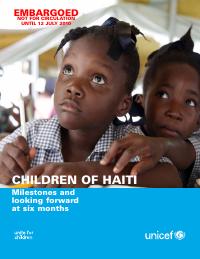
Les enfants d'Haïti: étapes franchies et perspectives à six mois
Résumé — Bilan à six mois de l'UNICEF sur la situation des enfants après le séisme de janvier 2010, sous embargo jusqu'au 12 juillet 2010.
Constats Clés
- Un bilan à six mois, successeur de celui à trois mois : les deux montrent ce qui a changé sur le premier semestre.
- Retient plus de 220 000 vies perdues, 300 000 blessés et 1,6 million de déplacés.
- Relève de fortes baisses des inscriptions scolaires dans les zones touchées, coût à moyen terme pour les enfants.
Description Complète
Bilan à six mois de l'UNICEF sur la situation des enfants après le séisme de janvier 2010, sous embargo jusqu'au 12 juillet 2010. Il fait suite au bilan à trois mois et consigne à la fois les résultats obtenus et les domaines où la réponse n'était pas parvenue, notamment de fortes baisses des inscriptions scolaires dans les zones touchées.
Texte Intégral du Document
Texte extrait du document original pour l'indexation.
Embargoed
Not for Circulation
Until 12 July 2010
CHILDREN OF HAITI
Milestones and
looking forward
at six months
Contents
Foreword 2
Overview and Facts at a Glance 4
Sector Responses
Water, Sanitation and Hygiene 7
Child Protection 10
Education 14
Nutrition 18
Primary Health Care 21
Joining our Efforts for 25
the Future of Haiti’s Children
Funding Analysis 28
Operations 30
UNICEF Partners and 32
Counterparts
Cover photo:
©UNICEF/Roger
LeMoyne/2010.
UNICEF Haiti - Milestones at Six Months 1
Foreword ©UNICEF/Roger LeMoyne/2010.
Milestones Words fail to describe the scale of the devastation caused by the earthquake
that struck Haiti six months ago. The earthquake provoked a unique
emergency, striking its most densely populated centre, claiming more than
and Looking 220,000 lives and forcing 1.6 million into displacement. It flattened the seats
of power, and it also was the single deadliest disaster for the United Nations,
Forward at who lost over 100 staff.
More expressive than the facts and figures of damages and losses incurred
Six Months however, is the potent imagery of children who still talk superstitiously
of le grand serpent—the great snake—that slithered angrily underground,
bumping up against their homes and schools, reducing them to dust and
rubble. Even now streets remain littered with the debris of destroyed
buildings, making it difficult for children to find a visual escape from their
memories of disaster.
UNICEF was blessed none of its staff were among the victims, but all were
directly affected, as many lost close family members or someone they knew
or loved. We owe them a tremendous debt of gratitude and I am humbled by
their exemplary dedication to the cause of children in Haiti, as they spared no
effort to get relief organised from the very first days—when often they were
themselves sleeping in the streets, in tents, in cars and among the displaced.
We are also in debt for the unparalleled show of support UNICEF received
from its partners, donors and supporters. Millions of people responded
and sent contributions to help us help the children and women of Haiti. This
global wave of solidarity also testifies to the strong confidence UNICEF
inspires through its mission for children and its readiness to deliver in the
face of daunting challenges. It also underlines the obligation we have to
direct these resources towards those children that need it the most.
With this responsibility in mind, UNICEF’s response continues to be distinctly
global and unified in nature. Headquarters, regional offices and country
offices around the world have contributed staff, expertise and resources –
and together, we are taking stock of our efforts to meet immediate needs of
children, and ensure the seeds of recovery are planted in fertile soil.
2 UNICEF Haiti - Milestones at Six Months
Some of the milestones at six months are truly remarkable. So far no
increase in malnutrition has been recorded and we have also not seen any
major disease outbreaks despite huge challenges in health and sanitation.
A lot of these results were possible thanks to the strong sense of common
purpose and partnership uniting the Government of Haiti, the United
Nations, the international community and the people of Haiti themselves,
as first responders.
At the same time, the earthquake exposed the divides within society and
the deep-seated vulnerabilities of those who for so long had been invisible
and were on the brink of being forgotten. Indeed, le grand serpent not only
cracked the window, it shattered the walls that separated society, bringing
darker issues and vulnerabilities to light. Beyond the bond of shared
experience therefore, the earthquake led Haitians to confront deeper
issues and inspired a common aspiration for change.
What has emerged is a strong sense of momentum that we need to carry
forward. One example is the nationwide movement for learning, which is
reflected in the Government’s plan for recovery. Also, while the earthquake
certainly exacerbated challenges in child protection, it shed a new light
on the plight of children, rallying people to renew efforts to remove them
from harm’s way and give them a chance to grow up in dignity and with
hope for the future.
With this new momentum there is ground to be optimistic, but our
optimism must be guarded, as for many the situation remains more than
precarious. Children still need our undivided attention and efforts must
continue with the same sense of urgency. Too many children and women
are still living in unacceptable conditions, with too little water and no
access to proper sanitation. Too many infants and children under-five
remain exposed to vaccine-preventable diseases. Too many children are
out of school and vulnerable to physical and sexual violence, exploitation
and child trafficking. Too many youth and adolescents are seeing
opportunities and livelihoods pass them by.
One thing is certain however, not only are Haitians resilient, they are
also proud and hopeful. Surrounded by rubble, people are standing
up—women, mothers, fathers, children—and UNICEF’s role will be to help
Haitians stand up together, to turn their hopes into reality, and to ensure
that children grow up with access to the full range of services they need to
survive and thrive, reaching their full potential to contribute meaningfully
to the development of their nation.
As we stood among the victims of the earthquake on 12 January, we stand
alongside the Haitian people today, with renewed commitment to realising
their dream of a Haiti fit for Children.
Françoise Gruloos-Ackermans
Representative
UNICEF Haiti
UNICEF Haiti - Milestones at Six Months 3
Overview
Six months on, the dramatic destruction However, living conditions remain extremely
caused by the 12 January 2010 earthquake in precarious and challenges remain daunting.
Haiti is still synonymous with unbelievable Sanitation is a major concern, with only one
stress for over three million people1, including latrine for 145 people in spontaneous sites
1.6 million living in 1,342 spontaneous and potentially dire consequences for the
settlements, of which 800,000 are estimated spread of disease. Access to education is
to be children. Over 220,000 people lost their another concern as schools in affected areas
lives, 300,000 were injured and 4,000 lost a have registered sharp drops in enrolment.
limb after being caught in the rubble of what Finally, the earthquake propelled a pre-existing
had once been a home, a school, a place for and protracted protection crisis into a child
work, or a spot for the community to gather protection emergency never before seen.
together.
The six-month mark also coincides with the
Overall, the number of the displaced nearly start of the hurricane season. Preparedness
matches the total population of Manhattan has been among the priorities and UNICEF has
and people have been displaced in pre-positioned emergency supplies in high risk
neighbourhoods that are as densely populated areas to prevent a second disaster. Part of the
as Calcutta. In a country where nearly 46 per effort is also to help people exposed to floods
cent of the population is under eighteen, the and landslides to move to safer ground—but
earthquake also triggered an unprecedented it has proven extremely difficult to find land
emergency for children. The number of and relocation will be a lengthy and complex
children who died in the earthquake will process. A further cross-cutting priority is
probably never be known and today some decentralising UNICEF’s presence. Today
remain affected while many more are at risk. we are present in Léogane and Jacmel, and
roving response teams are being deployed in
Since day one, UNICEF mobilised its resources Gonaïve, Jérémie, Les Cayes and Hinche.
to deliver on its Core Commitments for
Children, speed up provision of life-saving While emergency operations will likely
assistance and support the government in continue for the next eighteen months,
coordinating the response and initiating early UNICEF is simultaneously supporting the
recovery efforts. Today UNICEF is providing Government’s Action Plan for National
safe water to 333,000 people, 62,800 children Recovery and Development for the next three
are benefiting from recreational activities and years, after having played an active role in
psychosocial support, and more than 185,000 the Post-Disaster Needs Assessment (PDNA).
children have received educational materials. The Government’s capacity, which was weak
before the quake, has been dealt a crippling
While this report focuses on UNICEF’s efforts, blow—an estimated 18,000 civil servants were
partnerships under the Cluster Approach among the victims—and capacity development
have also been instrumental to further build efforts will ensure a smooth transition from
on these results, and UNICEF has worked in early recovery to development.
close collaboration with the Government of
Haiti, with our sister UN agencies, and with As we cross the six-months mark, immediate
numerous international and national NGOs support for earthquake affected people
and civil society partners that have all worked remains the priority. Reaching the hardest to
tirelessly to provide support in bringing reach, the poorest of the poor, and the most
services to children— by helping set-up vulnerable both in earthquake affected areas
schools, latrines, water-points and helping and in every district is the medium-term goal.
protect children and keep them healthy. UNICEF plans to deliver on its commitments
and ensure children everywhere in Haiti can
Despite the persistence of large scale realise their rights to survival, education and
internal displacement, there has not been a protection, remain shielded against economic,
deterioration of the humanitarian situation, environmental and social shocks, and grow up
with no epidemics or disease outbreaks and with dignity and hope in the future.
no increase in malnutrition. There has also not
Numbers based on revised estimates from the
1
been a high influx of population movements
Government of Haiti and from the Displacement Tracking
across the border to the Dominican Republic. Matrix, information as of 9 June.
4 UNICEF Haiti - Milestones at Six Months
Facts at a Social, Political and Security Environment
Glance
The political situation remains fragile. Presidential elections have been
scheduled for November but there is potential for delay, which may
cause civil unrest.
The security situation remains calm. There is however a reported
increase in crime, including gender based violence in some camps.
Although communities are resilient, increased levels of unemployment,
loss of property and savings and rising costs of living have put the
population and the economy under added stress.
Humanitarian Situation
Three million people affected.
1.6 million people living in 1,342 spontaneous sites, of which 800,000
are estimated to be children.
661,000 displaced outside of Port-au-Prince, of which 330,000 are
estimated to be children.
Huge Needs for Children
500,000 children have been deemed extremely vulnerable and require
child protection assistance.
90 per cent of schools in earthquake-affected areas were affected,
representing 23 per cent of all schools in the country, while over 1,500
education personnel died in the earthquake.
Only one latrine for 145 people on average in spontaneous sites.
UNICEF Milestones at Six Months
333,000 people reached daily with safe water.
More than 275,000 children immunised against major vaccine-
preventable diseases.
126 outpatient therapeutic feeding programmes and 28 stabilisation
provide life-saving care to malnourished children.
185,000 children reached with basic education materials and 1,297
school tents for 155,000 learners.
62,800 children benefiting from 225 UNICEF-supported Child-Friendly
Spaces.
UNICEF continues to coordinate the Clusters in Nutrition, Education
(co-lead with Save the Children Alliance), Water Sanitation and
Hygiene, and the Child Protection Sub-Cluster, co-leading with the
United Nations Population Fund (UNFPA) in the Gender-Based Violence
Working Group and with the International Organization for Migration
in the Mental Health and Psychosocial Support Group.
Foreshadowing Risks to Come
©UNICEF/Marta Ramoneda/2010.
Spontaneous settlements may become new urban slums if the
situation is left to linger.
The current hurricane season is predicted to be severe. In 2008
hurricanes and tropical storms affected more than 800,000 people.
101,000 persons in 84 assessed sites in Port-au-Prince are estimated
to be vulnerable to rain related hazards such as floods and
landslides. To date, only 7,000 have been moved to safer ground.1
1
OCHA Humanitarian Bulletin, Issue #5, 19 June 2010.
UNICEF Haiti - Milestones at Six Months 5
Some key lessons at six months Partnerships
UNICEF strives to continually innovate, integrate learning and Six months on UNICEF continues to
adapt its response to changing contexts. By its very nature work on a daily basis to bring together
the earthquake in Haiti has also presented us with a unique Ministries, UN agencies, national and
emergency, with new and unique challenges as disaster struck at international NGOs and civil society to
the centre of a country’s capital, collapsed an entire administrative ensure children’s and women’s needs
system and hit all segments of the population as well as the entire can be met.
country. This has required sensitivity to cultural practices and an
In line with its Inter-Agency Standing
adapted strategy for delivery in a dense urban setting, with at
Committee Cluster coordination
the same time careful attention on the push and pull factors of responsibilities, UNICEF in Haiti is
displacement and movement of displaced persons between the coordinating partners in the Education
city and the countryside. Cluster (co-lead with Save the Children
Alliance), in the Nutrition Cluster, and
On the ground, challenges in the provision of safe water in the Water, Sanitation and Hygiene
underlined the importance of early attention to longer-term (WASH) Cluster. UNICEF is also leading
recovery, especially around the resettlement strategy for the the Child Protection Sub-Cluster,
displaced—finding sustainable alternatives to water trucking, co-leading the Gender-Based Violence
such as drilling boreholes, indeed requires confirmation of the Working Group with the United
location of new settlements. Drilling in current locations could Nations Population Fund (UNFPA),
inadvertently stabilise communities in areas unsuitable for long- and co-chairing the Mental Health
term habitation and presents a risk of locking in populations in a and Psychosocial Support Group with
unsafe, unsanitary or simply unsustainable situation. the International Organization for
Migration (IOM). UNICEF also supports
Striking a balance between life-saving humanitarian assistance and activities in the Health Cluster, led
the need for urgent and sometimes basic capacity development of by the World Health Organization,
technical counterparts remains a challenge. Despite pre-existing and is supporting efforts in other key
weak capacity, it was important to ensure the Government of Haiti Clusters including Early Recovery, led
by the United Nations Development
had the basic means to serve its people and lead coordination
Programme.
of the overall humanitarian response has therefore been priority.
Securing the necessary technical, financial and supply inputs— UNICEF meanwhile works closely
sometimes just providing prefab offices for Ministries, as UNICEF with the United Nations Stabilization
did for its counterparts in Education— has been a priority to plug Mission in Haiti (MINUSTAH) and plays
critical gaps and build the Government’s capacity for leadership an active role in the Humanitarian
and coordination. Country Team. UNICEF is also working
directly with over fifty-five international
Working with the non-public sector has also been critical to and national NGO and civil society
bringing interventions to scale. However, provision of free implementing partners.
humanitarian services has, in some cases, disrupted delivery of
routine services and endangered the solvency of pre-existing
health facilities. To support local jobs and economic recovery
UNICEF has maximised opportunities for local procurement.
This emergency also highlighted the importance of maintaining
readiness and ensuring that disaster protocols can be triggered
immediately after a major disaster. Ensuring that emergency
response teams maintain readiness for deployment within
24 hours and for a minimum of three months is essential to
ensuring capacity and providing continuity. Stand-by partners
have been critical in this regard, helping both in fulfilling our Core
Commitments to Children and in the build-up of coordination
capacity in UNICEF-coordinated Clusters.
Staff welfare is also absolutely critical to an effective response.
Taking immediate steps to ensure a functional office and adequate
accommodation for staff should not be underestimated – nor
©UNICEF/Roger LeMoyne/2010.
should the need for special kinds of support to individual staff
members. In the case of Haiti, this challenge was considerable,
since staff were directly and in some cases, severely affected,
losing both loved ones and physical or financial assets.
6 UNICEF Haiti - Milestones at Six Months
Water, Sanitation and Hygiene ©UNICEF/Marta Ramoneda/2010.
When water is scarce and sanitation is disrupted, lacking or non-existent, children are at tremendous risk of life-
threatening diseases, including diarrhoea, cholera, and respiratory infections. Sadly these risks were a day-to-day
reality for 40 per cent of children in Haiti even before the quake. While no surge in disease has been reported so
far, the threat remains acute due to overcrowded living conditions and hazards of the rainy season. Expanding
access to safe water and sanitation is a matter of urgency for child survival and preservation of public health.
Milestones at Six Months Pre-earthquake situation Post earthquake snapshot
The Water, Sanitation and Hygiene More than four out of ten 437 spontaneous
(WASH) Cluster supports the children—1.7 million—with no settlements lack adequate
Government’s agency for water and access to proper sanitation. sanitation, exacerbating
sanitation, the Direction Nationale de pre-existing risks to public
One in five children—861,000—
l’Eau Potable et de l’Assainissement health.
with no access to safe water.
(DINEPA) with implementation of
the emergency response primarily Urban/rural divide: 71 per cent Displaced persons remain
targeting 1.6 million displaced persons of urban residents and only 55 dependent on water trucking,
in spontaneous settlements in affected per cent of rural residents had receiving only five litres of
areas. As Cluster lead, UNICEF access to safe water. water per person per day.
coordinates efforts and provides
financial, technical and supply assistance
to reduce public health risks and
ensure child survival in the midst of the UNICEF and implementing partners have also accelerated latrine
emergency. construction, installing over 9,000 latrines to date out of the
total 11,000 installed by the WASH Cluster. These have helped
Today, some 333,000 people are being improve sanitation for approximately 1.6 million people, meaning
provided with at least five litres of one latrine for every 145 persons, with however stark variations
safe water a day through UNICEF and between sites as some 61 per cent of camps—most of them
partners’ water supply operation, which small—still lack adequate sanitation facilities. Overall, an additional
represents 25 per cent of the overall 5,500 toilets are required to bring the ratio closer to 100:1, a
delivery effort reaching 1.2 million Cluster-agreed standard given the dense urban environment.
people. Ensuring a child gets at least UNICEF has pledged to directly support completion of 4,000 of this
five litres per day means UNICEF and number over the next six months.
partners are delivering an amount of
water every day—1.66 million litres—that At the same time UNICEF has supported training on promotion
would be the equivalent of running the of key hygiene practices, such as hand washing with soap, for
faucet for twenty-two consecutive weeks. some 2,200 hygiene promoters and community mobilisers who
UNICEF Haiti - Milestones at Six Months 7
will in turn disseminate these messages through EXPANdING THE RESPONSE
neighbourhoods, sites and villages across affected
areas. Some 213,240 persons have also benefited from 138,500 people Latrine coverage
UNICEF’s distribution of personal hygiene kits—which One (based on ratio at time of
provide for the basics including soap, sanitary towels, Month intervention)
toothpaste and toothbrushes, detergent, and toilet 1,000 latrines Latrines installed
(all partners)
paper, among others.
500,000 people
UNICEF and partners have also been equipping Three
schools with handwashing points, latrines, water tanks Months
and soaps—so children can put key messages on 5,350 latrines
1,600,000 people
hygiene to practice. Some 20,500 children are currently
SIX
benefiting from UNICEF’s support in 18 schools, and
Months
plans are underway to reach 30 schools by August,
11,000 latrines
and a total 600 others by the end of the year, with a
Note: Numbers reflect results from all partners in the Cluster.
simultaneous focus on child-friendly spaces.
Latrine per person ratio evolved following expansion of
interventions to more sites, and due to dynamic population
Looking forward movements in the neighbourhood of sites.
The goal through the remainder of the year is to
increase the volume of water from five to at least 7.5
litres per day—and to ensure more equitable access Financial Summary
between sites. Increasing options for safe sanitation is
Available for programming
also critical to restore dignity and prevent an upsurge
$15.57 million
in water-borne diseases. Reaching the cluster-wide
target of 16,500 latrines will be important—but an Commitments
even greater challenge is systematic “de-sludging” $10.20 million
and maintenance of existing facilities. Leveraging
private sector resources will be essential to reach scale
and UNICEF will continue to support the operating
costs for fifteen de-sludging trucks, while procuring
two trucks for the Government’s own fleet.
UNICEF’s commitment to increase access to proper
Total
sanitation and hygiene in schools throughout the
$46.83 million
country is another important step. Ensuring safe water,
as well as gender-segregated and age-appropriate
sanitation facilities in schools will also help support
the nationwide movement for learning, along with
partnerships with the World Food Programme (WFP)
for school feeding.
Given the multiplicity of actors, building capacity
Expenditures
of the Government to expand, coordinate and
$21.06 million
regulate the sector remains a cross-cutting priority
at both central and decentralised levels. DINEPA
is being supported with
six embedded staff (two
national, four international) Indicator UNICEF and partners Cluster
working to coordinate the
Earthquake affected people
WASH Cluster and enhance
with access to emergency
information management. 333,000 1.2 million
safe water supply (5 litres per
This technical assistance, as
person per day)
well as financial and supply
assistance, will continue to Latrines installed for people
9,000 11,000
expand for humanitarian living in spontaneous sites
and recovery needs. Hygiene kits distributed 42,449 adult kits 87,300 adult kits
Children with access to WASH
20,500 children (UNICEF programme)
facilities in schools
8 UNICEF Haiti - Milestones at Six Months
Challenges Safe Water, safe practices
Meeting water and sanitation needs of this Learning life saving hygiene
scale in overcrowded urban environments and skills
affected rural areas is truly a unique challenge
requiring a flexible approach. Low output Alcema Wilben, 14 years old lives in Pactes Camp,
and coverage of existing urban water supply in Port au Prince. “We lost everything, that’s why
networks means that repair and urban planning we are living in this crowded camp.”
for extension will be a priority for years to
come. Many sites are also just not suitable for Today Pactes Camp is home to 1,238 people. Since
borehole drilling, making water trucking the the 12 January earthquake, the population has
only viable option for now. Land tenure issues become more susceptible to illness from diseases
also complicate the process of digging wells related to inadequate sanitation, limited water
and pit latrines, as clearance must be secured supply and poor hygiene. Diarrhoeal disease and
with owners. infections transmitted by the faeco-oral route are
the most common illnesses.
Land rights issues also underline the fact
that sustainable options are almost entirely “Before living in the camp I did not know that it
dependent on the implementation of a sound was important to wash my hands after using the
resettlement strategy, currently being confirmed toilet. One day I saw a woman holding up posters
by the Government and humanitarian partners. with pictures explaining that it was important to
Without a durable solution for displaced be clean and wash your hands all the time. When
communities, humanitarian actors risk the meeting was over, I went to ask the lady what
facilitating the entrenchment of new urban the posters were about. She explained that it was
slums. important to be clean otherwise I could get sick.
Now I always wash my hands after using the toilet
Reaching scale, sustaining progress—and and before eating. I wash my body twice, once in
addressing pre-existing disparities in coverage the morning when I wake up and before bed. My
for non-earthquake affected communities can mother couldn’t understand until I explained it to
only be achieved with strong government her, and you know what, now she does the same
capacity. Striking the right balance between thing as me.”
urgent service delivery and the technical and
financial assistance required to build the UNICEF has been improving the health of school-
capacity of DINEPA (especially at decentralised aged children by highlighting hygiene promotion,
levels) remains a challenge. life skills development, water, sanitation and
handwashing facilities for the affected displaced
population.
Alcema and his peers attend a
session on safe hygiene practices in
Pactes Camp. “Washing your hands
is a simple thing that can go a long
way”, Alcema says.
©UNICEF/Marta Ramoneda/2010.
UNICEF Haiti - Milestones at Six Months 9
Child Protection ©UNICEF/Marta Ramoneda/2010.
On the eve of 12 January children in Haiti were already facing tremendous threats of violence, sexual abuse,
trafficking, exploitation and abandonment. Now risks have increased manifold as the earthquake exacerbated a pre-
existing crisis by collapsing an already inadequate and weak system that was failing to protect those most vulnerable.
Children in Haiti are now caught in the midst of a child protection emergency of unprecedented magnitude. UNICEF
and partners were active in Child Protection before the quake—and are now responding with urgency.
Milestones at Six Months Pre-earthquake situation Post earthquake snapshot
The needs of some 500,000 1.2 million children vulnerable 1.5 million children
vulnerable earthquake-affected to violence and abuse. affected by the earthquake,
children are being addressed, with including some 500,000
the immediate objective of restoring 225,000 “restaveks”1 and 2,000 extremely vulnerable
a protective and safe environment for children trafficked externally children.
children. To this end, partners in the through the Dominican
UNICEF-coordinated Child Protection Republic every year2. Heightened risks of
Sub-Cluster have worked closely with violence, sexual abuse,
50,000 children in some 600
government authorities to steadily exploitation and child
residential care centres.
expand the identification, registration trafficking.
and family tracing process for
separated children.
UNICEF is also hosting and providing At the same time, special vigilance is required to ensure that
technical support to a call centre children being moved across international borders are not being
operated by Save the Children that trafficked or exposed to other risks. UNICEF thus encouraged
continues to take calls from frontline and supported national authorities to increase vigilance along
workers reporting cases of separated the borders and at the airport. To date more than 6,000 cases of
children. Cluster partners have more children being moved have been assessed. When assessments
than doubled the number of children confirmed illegal movement, children were reunited with their
registered—from 767 in April to 2,047, families or supported through appropriate and safe alternative
of which 337 have been reunited care solutions.
with their families, while others have Essential to this effort were a series of trainings reaching over
been supported to find appropriate 100 staff from the Brigade de Protection des Mineurs (BPM), the
family-based care options, following a Institut du Bien Etre Social et de Recherches (IBESR), and the
careful assessment.
1
“Restavek” in Creole means “staying with” and is a term used for children sent
to live with other families. The move often lands children in a situation of unpaid
domestic service where they are deprived of their most basic rights.
2
The number of children internally trafficked has not been well documented.
10 UNICEF Haiti - Milestones at Six Months
Ministère des Affaires Sociales et du Travail (MAST) EXPANDING THE RESPONSE
which focused on prevention of child trafficking and
other forms of violence, including practical training 7,425 children
on case management. The sessions also concentrated One
on gender-based violence (GBV), which is a concern Month
in camps—especially at night—and UNICEF worked 33 Spaces
Children in CFS
with partners to develop and disseminate practical 17,750 children
information for frontline workers to ensure survivors Three Number of CFS
can get the right services at the right time. Some sixty Months
78 Spaces
local partners were trained on prevention of gender- 75,000 children
based violence in Port-au-Prince, and efforts have
SIX
been extended in six of the country’s ten departments,
Months
including border areas where trafficking and sexual 325 Spaces
exploitation are particularly problematic. There have
Note: Numbers reflect results from all partners in the Cluster.
also been large-scale efforts to raise awareness on
the situation of children and women, with special
radio messages highlighting risks and appropriate
responses broadcast in Creole reaching some three
million people.
Another element of the effort is the expansion of the Financial Summary
network of child-friendly spaces designed to offer
children and adolescents a safe space to participate
in recreational activities and where they can receive Expenditures
more targeted psychosocial support. More than $7.98 million
62,800 children and youth, of which 37 per cent are
Committed
girls, are benefiting from 225 child-friendly spaces
$5.69 million
supported by UNICEF in and outside of Port-au-Prince.
UNICEF is also empowering youths through life skills Available for programming
activities and efforts to promote HIV/AIDS prevention. $14.01 million
Looking forward
Ensuring separated children are registered, linked
with family tracing services, and reunited with
their families when possible is a shared objective Total
for UNICEF, the Government of Haiti and all $27.68 million
stakeholders in Child Protection. The goal remains to
strengthen government and community-level child
protection mechanisms so that children are better
protected against violence, abuse and exploitation,
especially in displaced camps. Linking families
who have taken in children from close relatives to
livelihood opportunities is another priority as coping
mechanisms are wearing thin.
The rally of attention on
children in Haiti is also a Indicator UNICEF and partners Cluster
chance to address larger Separated and/or unaccompanied 2047
systemic issues affecting children registered (UNICEF and partners)
children in Haiti, and an
Children reunited with their 337
opportunity to develop and
families (UNICEF and partners)
articulate a comprehensive
child protection strategy for Children benefiting from Child- 62,800 children 89,375
the longer term. Friendly Spaces in 220 spaces in 325 spaces
Training on prevention of gender- Development and Over 100 police
based violence and referral dissemination of training and IBESR staff
mechanisms material on referrals trained
1
Based on an average 275 children per Child-Friendly Space
UNICEF Haiti - Milestones at Six Months 11
Challenges Protective Environments
Families are currently facing tremendous A place for children and families
hardships and there is a risk of secondary
separation from parents and caregivers, Child-friendly spaces offer safe and protective
especially for children living in poor and environments for children in the aftermath of the 12
displaced households if the social and economic January earthquake. UNICEF and one of its partners,
situation is left to linger. Separation can the Haiti Out-of-School Youth Livelihood Initiative
heighten the risk of exposure to abuse and (IDEJEN), have created several havens for children in
exploitation that can irrevocably impact their the Haitian capital.
physical, social and cognitive development. The
wellbeing of a generation of children, therefore, Yglesias, 5, and his mother Yolette moved to a camp
is at stake. for displaced people in Place St. Pierre on the evening
of 12 January, after they lost their home in the
As humanitarian operations continue to earthquake. Yolette is a single mother who had small
unfold, reaching scale is the main challenge business selling rice in her old neighbourhood, but
and the absolute priority for the months to now she has no resources to raise her child.
come. Increasing coverage where children are
most vulnerable is an imperative, with more “I cannot afford to buy him a uniform or the school
child-friendly spaces to ensure prevention and supplies that he needs to attend a regular school,”
protection at the community level. Sustained she says. “It was by chance that I met one of the
efforts are needed to expand registration and counselors from IDEJEN while he was encouraging
care for separated children and children already parents in the camp to send their children to the child-
without parental care prior to the earthquake. friendly space, about 200 meters away.”
Another systems-level challenge is that only At the centre, Yglesias and the other children receive
30 per cent of children in Haiti are registered at safe drinking water and one meal a day. “My son
birth. Lack of a birth certificate is almost always is provided with a decent meal. He is taken care of
synonymous with barriers for children to have by trained counsellors who help him deal with his
their basic rights recognised. Extending birth recurrent nightmares about the quake. I just like to
registration for all children, including in hard see him happy and somewhat normal when he is
to reach rural areas, is therefore a priority to around the other children.”
overcome an age-old challenge that has affected
generations of children in Haiti.
“Yglesias is safe and I feel safe
for him”, Yolette says as they both
pause outside the Child-Friendly
Space IDEJEN is running with
UNICEF’s support.
©UNICEF/Marta Ramoneda/2010.
12 UNICEF Haiti - Milestones at Six Months
Before the Earthquake
Focus On Pre-earthquake estimates indicate that 50,000 children were in residential care,
Children some of them with a parent, some with both their parents, and some with no
parents. Children were in fact being placed in these institutions for complex
without socio-economic reasons. UNICEF was working with the Government of Haiti
and other partners to improve standards in these centres and ensure that
Parental Care alternative care options were carefully considered in the best interest of the
child. The most desirable option is having children reunited with their parents,
and we need to support families so they can keep and care for their children.
When this is not possible, other family-based solutions within the child’s
environment (such as staying with other family members or families known
by the child) can be considered in the form of legal guardianship or national
adoption. When alternative care is not possible, a safe inter-country adoption
process may then be the option.
Haiti however is not yet a party to The Hague Convention on the Protection
of Children and Co-Operation in Respect of Inter-Country Adoption (Hague
Adoption Convention), which seeks to protect children against the risks
of illegal, irregular, premature or ill-prepared adoptions abroad. Proper
safeguards are therefore not always in place.
After the Earthquake
The earthquake shed a new light on these challenges, and exacerbated them
manifold. At the same time weak infrastructure was further weakened as
witnessed by the suffering of children in residential care. Under-regulated
options for alternate care and permanent care were severely challenged, while
under-resourced child protection actors were confronted with tremendous
needs.
Seeing the scale of the disaster, people the world over expressed their desire
to adopt a Haitian child. When screening for international adoption had been
completed before the quake, the benefits to speeding up these children’s travel
were clear and the process was fast-tracked. When there was doubt on due
process, caution was an imperative and corrective actions were taken to return
children to their families, to families known by the child or to residential care
centres depending on each case.
Still unknown numbers of children have lost one or both parents. Many of
them have been taken in by extended family, or by families known by the
child. Others are in regulated residential care while tracing and reunification
continues. An inter-agency effort supporting the Government helped register
and reunite children, while a national civil registration process is also being
launched to provide documentation for all children with support from
the Organization of American States (OAS). Registration will scale-up in
spontaneous settlements to identify children taken in by other family members
or families know by the child, in order to formalise their civil status and
address risks of secondary separation. Registration will also include all children
in residential care centres, with teams that will focus on minimum standards of
care and follow up on particular individual cases.
UNICEF is also reinforcing its partnership with the Ministry of Social Affairs
and the Haitian National Police to build their child protection capacity, improve
©UNICEF/Roger LeMoyne/2010.
standards and procedures, improve conditions in residential care centres
and ensure that all alternative care options follow the best interest of the
child. Recently, the Government of Haiti also started a first step in an effort to
upgrade its child protection and inter-country adoption procedures in order to
become party to the Hague Convention. UNICEF will help in every step of this
process.
At all times, the best interest of the child must be the priority.
UNICEF Haiti - Milestones at Six Months 13
Education ©UNICEF/Marta Ramoneda/2010.
There remains an immense thirst for learning in Haiti, with a strong priority placed on children’s education—
which Haitians say, at the six month mark, is second only to the imperative for them to recovering their
livelihoods. However only fifty-five per cent of children went to school before 12 January and even less have
returned to the classroom after the earthquake.
Milestones at Six Months Pre-earthquake situation Post earthquake snapshot
Since January, UNICEF and Save 55 per cent of school-aged Over 2.5 million children
the Children, as Education Cluster children out of school. experienced an interruption
lead agencies, have worked with in their schooling.
20 per cent of children
the Ministry of Education and a in public schools, which 4,992 schools affected, of
range of partners to support an accounted for only 8 per cent which 3,978 were damaged or
estimated 80 per cent of the 4,9921 of all schools. destroyed.
schools affected by the earthquake,
with a combination of site clearance 22,000 schools throughout the 55,793 education personnel
activities, set-up of temporary country. affected.
learning spaces, distribution of basic
materials and support to teachers.
Some 80 per cent of schools in To date, out of the 3,978 schools damaged or destroyed, some
Port-au-Prince and all schools forty per cent have been cleared by communities, while at least
in Petit and Grand Goave and 200 have been cleared by Education Cluster partners, including
Jacmel have reopened, most of MINUSTAH forces, with the effort focused on large public schools.
them in temporary structures. The
Many schools have also registered an alarming drop in enrolment
single greatest impediment to the
in a context where only four in ten children went to school before
reconstruction of schools is rubble
the earthquake. In Léogane, one of the hardest hit areas, less
clearance. The Shelter Cluster
than 50 per cent of children have returned to school compared to
estimates that total quantity of
pre-quake levels. Teachers are also absent as many of them are
rubble is 20 million cubic metres—
among the displaced and lack the means to continue their work.
the equivalent of eight Great
Pyramids—which at the current Due to the breakdown of the Ministry’s information management
rate of removal might take up to six systems, overall estimates of the number of children and teachers
years to clear. back in school remains unavailable. A comprehensive assessment
1
An affected school is either damaged, destroyed or experienced a serious
impediment to reopening (such as the death of key education personnel).
14 UNICEF Haiti - Milestones at Six Months
in affected areas is underway with UNICEF supporting EXPANDING THE RESPONSE
training of inspectors and coordination efforts. A more 1,644
accurate picture of enrollment should be confirmed
within the next weeks. 1,400
Since schools across the country shut down after the
quake and only started to reopen in April, UNICEF
has also helped the Ministry of Education devise an
adapted curriculum for a condensed second semester 150
so that children do not have to repeat their studies.
One Three SIX
UNICEF and partners are training teachers on this Months
Month Months
curriculum and have added a module to increase
SCHOOL TENTS DISTRIBUTED
teacher’s skills in psychosocial support for children.
Some 2,300 teachers and 3,000 education personnel Note: Numbers reflect results from all
partners in the Cluster.
have been trained so far and 30,000 more are planned
over the rest of the year.
SITE Clearance in SCHOOLS
Critical in the effort to re-open schools has been
3,978 schools damaged/destroyed
UNICEF’s distribution of some 1,297 school tents for
225 temporary learning spaces. The number of tents Approximately 1,600 schools cleared by communities
distributed has increased ten-fold since the one-month 200 schools cleared through interagency efforts
mark—and an additional 2,000 are in the pipeline— focused primarily on large public schools.
but these still remain interim measures and are not
adequate replacements to a durable primary school. Financial Summary
With the longer-term in mind, UNICEF is supporting
a team of construction engineers to work with Expenditures
government counterparts to accelerate semi-permanent $13.79 million
and permanent school construction. Committed
$7.00 million
One important component is to make sure schools are Available for programming
equipped with proper water, sanitation and hygiene $35.98 million
facilities for children. UNICEF WASH teams have
improved facilities in 18 schools to date –and have
confirmed an additional 29 schools for completion by
August, with the plan to leverage partnerships to reach
600 priority schools over the next school year, including
working with the World Food Programme on expanding Total
school feeding. $56.77 million
To encourage enrolment and attendance, some
185,616 school-aged children have been provided with
basic educational materials (out of 500,000 learners
supported by the Education Cluster)—while 45,520
pre-schoolers received learning and recreational
materials through the distribution of Early Childhood
Development kits.
Looking forward Indicator UNICEF and partners Cluster
The National Reconstruction and Children provided with
185,616 500,997
Development plan for Haiti places learning materials
a strong emphasis on education Temporary learning spaces 225 1,664 school tents
as the key to empowerment, set up (1,297 tents distributed) distributed
poverty eradication and overall
Children benefiting
transformation of the country.
from early childhood 45,520 53,000
Understanding the power of development opportunities
education, UNICEF is committed Education personnel 2,300 teachers and 3,000 education personnel
to supporting the Government, trained (all UNICEF-supported and focused on psychosocial support,
life skills, disaster risk reduction and the adapted curriculum)
UNICEF Haiti - Milestones at Six Months 15
civil society groups and communities across the
country to achieve the fullest, most inclusive Challenges
and most far-reaching nationwide movement
for learning to date. One of UNICEF’s greatest Accelerating site clearance, identifying
strengths in this respect is its ability to mobilise solutions for relocation of displaced families
stakeholders around a common purpose. UNICEF occupying school grounds, and speeding up
will continue to act as a catalytic convener, school construction to ensure space is available
bringing partners at all levels (community-level; before the next school year are both challenges
national and international) together to plan and and priorities.
realise system reconstruction and expansion for Information management is another challenge,
Haiti. For example UNICEF is providing technical as the Government’s records were lost in the
assistance for the development of the education earthquake and systems for data collection have
sector’s operational plan, leading strongly in the collapsed. Coordination and prioritisation of
area of Early Childhood Development (ECD). interventions has been a difficult as a result, and
It is clear that the only effective way to reach the education system will require development
scale and sustain progress is to develop the of better information systems, which is why
capacity of the Ministry of Education at all UNICEF is supporting the handover of the
levels to coordinate, regulate and leverage the Education Cluster database to the Ministry of
resources of both public and non-public actors Education.
for expansion. UNICEF, UNESCO, the World Bank,
the Inter-American Development Bank, USAID, These efforts are all dependent on the
the European Commission, Canada and other confirmation of a long-term resettlement
development partners harmonise their long- strategy for displaced persons however—
term support and capacity development efforts since rebuilding in the current locations of
through the Education Sector Working Group. In spontaneous settlements could inadvertently
coordination with stakeholders in this forum, entrench communities in areas unsuitable
UNICEF is also providing technical assistance to for long-term habitation and many of the
the Ministry and will be embedding staff within neighbourhoods containing old schools are
government structures in addition to current being re-zoned with the intention of improving
financial and supply assistance aimed to restore the urban planning. Issues of space in the
functionality of district offices and the central level capital - and land tenure in all areas, influence
Ministry (UNICEF provided eight pre-fabricated decision-making.
offices and a variety of supplies and equipment
following the destruction of the Ministry building).
UNICEF will also follow and
seek to support the work of
the newly created Presidential
Commission on Education.
UNICEF’s support to the
Government and communities
will expand over the coming
year and will also address the
need to alleviate the burden of
school fees in a context where
ninety per cent of schools are
fee-based and non-public. This
will also require consolidation
and harmonisation of standards
and curriculums, as well as
effort to improve salaries and
incentives for teachers and
education personnel.
©UNICEF/Roger LeMoyne/2010.
A large crowd of children sing the national anthem before the start of classes,
during morning assembly at a host school in the city of Jacmel.
16 UNICEF Haiti - Milestones at Six Months
Children’s Voices for the Reconstruction
Every child has the right to participate meaningfully in matters that
impact their lives and the development of their communities and
nation. More than just a right however – participation makes good
sense. When children are appreciated as sources of energy, imagination
and vision, young people flourish and so their communities.
Recognising the power of youth to inspire and catalyse change, UNICEF
and partners organised a week-long process of gathering the views
and aspirations of children for the reconstruction and transformation of
Haiti. Over 7,000 children contributed to the process. On the eve of the
celebrations, the First Lady of Haiti, Madame Elisabeth Préval, came to
hear from a group of 100 children on how their concerns, hopes and
dreams could be included in the planning process.
Sixteen year old Christanaille from Port-au-Prince best summarised the
far-reaching aspirations for today’s children in Haiti, saying “I think we
need to listen to children because as we say in Creole, “Timoun jodi a
granmoun demen” [the children of today are the adults of tomorrow].
My dream is the complete change of Haiti…”
Overall, children asserted their right to be heard and emphasised
the importance of education, health care and other social services in
©UNICEF/Roger LeMoyne/2010.
the new Haiti. More than a simple statements however, children also
planned follow-up activities for their clubs, schools, churches, families
and communities – thereby acting as true agents of change.
Some proposals also illustrated simple methods for improving security
in camps, such as putting lights outside latrines so girls can feel safer
at night, and several also provided suggestions on how to encourage
children to go to school.
SCHOOL CONSTRUCTION
Building back better schools for a better future
As the earthquake destroyed or damaged an estimated 3,978 schools, one of UNICEF’s priorities is to
support the reconstruction. There are three different phases:
Temporary schools: So far UNICEF supported the establishment of 225 temporary learning spaces. On
average these schools consists of two large (72m2) and three smaller (42m2) tents for approximately 280
students, which have been placed nearby water and sanitation facilities adapted to children’s need. When
these were unavailable UNICEF outfitted schools with WASH facilities, and some 18 schools have been
supported so far, with more underway.
Semi-permanent: The temporary schools will be transformed into disaster proof semi-permanent
structures. These are built on concrete foundations, with steel tubes to strengthen the tent walls and
steel roof. Two sample schools will be built by mid July and more will come ahead of the next school
year.
Permanent: The child-friendly, permanent disaster proof school buildings will be built on the existing
concrete foundation under a partnership bringing together the Ministry of Education, UNICEF and
partners. A consultation was held with approximately 30 children to receive inputs on what the kind
of school they would like to have, and what their ideal school would look like. The design will also be
accordingly to Haitian culture and tradition, and will be collected through the participation of Haitian
architects contributing through a competition.
UNICEF Haiti - Milestones at Six Months 17
Nutrition ©UNICEF/Marta Ramoneda/2010.
Despite the stress of displacement, the nutrition situation for children remains relatively stable, with levels
of global acute malnutrition below emergency thresholds. However the earthquake compounded an already
critical situation where one in three children under five was chronically malnourished. Preventing any
deterioration remains the priority, alongside efforts to tackle root causes of malnutrition and enhance treatment
at the community level.
Milestones at Six Months Pre-earthquake situation Post earthquake snapshot
Immediately following the Global Acute Malnutrition at No increase in acute
earthquake, UNICEF and the World 4.5 per cent, Severe Acute malnutrition rates reported
Food Programme (WFP) worked Malnutrition at 0.8 per cent. so far, 65,000 children
with international and national NGO estimated to be in need of
partners to avert a deterioration Total food insecure population: nutritional assistance.
of the situation for children by over 1.8 million people.
conducting blanket feeding in A total of 52 per cent of
Exclusive breastfeeding for households were found
earthquake-affected areas in and infants under six months at
outside of Port-au-Prince. At the six to be food insecure in
only 41 per cent. earthquake-affected areas.
month mark, more than 550,000
children under five and pregnant and
lactating women have benefited from
ready-to-eat supplementary foods
severely malnourished children under five in affected areas have
while over 186,000 children aged
received treatment. Severely malnourished children with medical
9 months to 7 years also received
complications are taken care of in 28 in-patient “stabilisation
vitamin A supplementation through
centres”, where they receive special therapeutic food and medical
ongoing immunisation campaigns.
care. Children with no medical complications are referred to one
These efforts have contributed to a of the 126 out-patient therapeutic feeding programmes. In both
stabilisation of the situation—but cases UNICEF supports partners with a combination of nutrition
UNICEF and partners estimate supplies, equipment, financial and technical assistance.
that approximately 65,000 acutely
Some 23,000 mothers and babies are also being helped through
malnourished children still require
a network of 107 “baby-friendly tents” that provide counselling
targeted nutritional assistance,
on proper infant and young child feeding (IYCF), such as exclusive
of which 15,000 are severely
maternal breastfeeding in the first six months. UNICEF and key
malnourished. To date, some 2,000
partners have meanwhile worked closely to identify specific cases
18 UNICEF Haiti - Milestones at Six Months
of infants with no possibility of being breastfed
in order to provide targeted and skilled support EXPanding the Response
for those children. Some 3,000 babies for whom 107
breastfeeding is not possible have been receiving
ready-to-use infant formula (RUIF) through the Baby-Friendly Tents
baby-friendly tents, with guidance on proper use Established
and practices.
23
Overall UNICEF also continues to support the 19
Nutrition Unit of the Ministry of Health as Cluster-
One Three SIX
lead agency and the Nutrition Cluster is targeting
Month Months Months
a total 1,326,920 children and women directly
affected by the earthquake. Three Months 1,700
Looking forward SIX MOnths 23,000
To raise government, NGO and community-level MOTHER-BABY PAIRS SUPPORTED
capacities to prevent and treat malnutrition. Some
Note: Numbers reflect results from all partners in
200 health professionals and 300 community the Cluster. Focus in the first three months was on
workers are being targeted for training on treatment of acute malnutrition. Baby friendly tents
community management of acute malnutrition were then scaled up for prevention of malnutrition
and infant and young child feeding this year. At after the immediate ninety day response.
least 150 baby-friendly tents should be established
in total, targeting some 35,500 mothers and
babies. UNICEF is also exploring opportunities to Financial Summary
promote Haitian-specific complementary foods Expenditures
for children up to 24 months and will link efforts $8.75 million
to the livelihoods and household food security
Committed
initiatives led by partners.
$6.31 million
Available for programming
UNICEF will ensure that infants without parental $22.88 million
care continue receiving appropriate support
including replacement feeding—and will work
in tandem with the Ministry of Health and the
Government’s Child Protection agency to develop
a baby-friendly protection strategy that will take
into account these children’s specific nutritional Total
needs. $37.94 million
As 61 per cent of children under five and 50 per
cent of pregnant women suffered from anaemia
before the earthquake, UNICEF will also address
micronutrient deficiencies through blanket
micronutrient distribution. By the end of the year,
vitamin A supplementation is scheduled to reach
at least 253,000 children aged 9
months to 7 years, and will be
combined with micronutrient Indicator UNICEF and partners Cluster
supplementation for up to
356,250 children aged 6 to 59 Baby-friendly tents 82 107
months and 192,000 pregnant Non-breastfed infants under
and lactating women. 12 months receiving feeding 3,000 (UNICEF and cluster partners)
support
Children under five and
pregnant and lactating
550,000 (UNICEF and cluster partners)
women reached through
blanket feeding
Children with severe acute
malnutrition receiving 2,000 (UNICEF and cluster partners)
treatment in affected areas
UNICEF Haiti - Milestones at Six Months 19
Five-month old Sabrina
and her aunt Beatrice in
one of the Baby Friendly
tents UNICEF supports in
Port-au-Prince.
©UNICEF/Marta Ramoneda/2010.
Sabrina gets a healthy start
Baby tents friendly tents for healthy
Challenges mothers babies
Lack of trained staff, lack of facilities and lack of In the heat of the morning, babies sleep on
harmonised and well-appropriated treatment mattresses under an open tent. Nutrition workers
protocols remain significant constraints, sing: “We are Haitian women, we bring up healthy
underlining the importance of capacity babies. We breastfeed them till they are two years
development and systems-strengthening in the old. We do not give them any other food till they are
nutrition sector as a whole. six months old.”
It is important to realise that once a young The baby tent, run by the NGO Concern with
child becomes undernourished the damage UNICEF support, assists about 300 mothers and
cannot be undone. Unless high prevalence of babies on a rotating basis; ten of the babies have
malnutrition is addressed children will continue lost their mothers and come with female relatives.
to die unnecessarily or suffer diminished
capacity as they grow up. Tackling malnutrition Sabrina Michel, a lively five-month-old baby, was
is therefore a matter of survival and born shortly after the earthquake. Her mother
development for Haiti’s children, and remains passed away two days later. She is now being
one of UNICEF’s main priorities. The challenge brought up by her maternal aunt, Beatrice Terane, a
therefore, is ensuring life-saving support, while single mother with a five-year-old son.
at the same time, ensuring ownership and
sustainability of programmes through capacity Beatrice is thankful that the baby tent provides
development. readily mixed baby formula for Sabrina. Mauviette
Raphael, who is responsible for nutrition in the
camp, remembers that when she first met Sabrina
and her aunt, “she was giving the baby solid food”.
Beatrice lost her home in the earthquake. She
cannot work because she wants to look after
Sabrina. “I cannot think now that I could separate
myself from her”, she says.
20 UNICEF Haiti - Milestones at Six Months
Health ©UNICEF/Marta Ramoneda/2010.
To date epidemic outbreaks have been averted, which is no small victory considering the challenges of sanitation
in overcrowded settlements and the damage caused to an already weak health system. Still, risks to children
remain acute and expansion of immunisation and preventive health care remains a priority. Humanitarian work
today must be coupled with efforts to put the health system back on track for tomorrow.
Milestones at Six Months Pre-earthquake situation Post earthquake snapshot
As a key partner in the WHO- Highest Under-five Mortality 900,000 children
coordinated Health Cluster Rate in the region at 78 deaths face elevated risk of
UNICEF worked to overcome for 1,000 live births. disease associated with
serious logistical challenges to displacement.
Highest Maternal Mortality
provide vaccines and cold chain 22 per cent of health
Rate in the region at 670
materials in support of emergency infrastructure damaged
deaths per 100,000 live births.
immunisations. Sprawling camps or destroyed, 30 out of 49
with shifting populations made for a Only 58 per cent of infants hospitals in the three worst-
complex operation but efforts have immunised against measles. affected regions need to be
now accelerated and over 228,000 rebuilt.
children in 727 camps have been
immunised and have also received
vitamin A supplementation and help treat malaria in 1,000 children, and UNICEF has started
de-worming. In May the Vaccination efforts for the distribution of 400,000 long-lasting insecticide
Week for the Americas reached a treated mosquito nets (LLINs) to 200,000 households for malaria
further 47,600 children under five prevention.
in the border areas and another
campaign is being launched in July Working with implementing partners, UNICEF also focused on
to increase coverage nationwide. emergency health needs for pregnant women, and distributed
24 emergency obstetric kits that help provide life-saving care for
Health needs for some 1,770,000 mothers who run into complications during labour. Each kit has
people are also being covered the necessary drugs and supplies to ensure fifty safe deliveries.
through the distribution of 177 Other kits have been distributed to cover the needs for some
emergency kits that contain essential 11,050 mothers who deliver without complications. Meanwhile,
drugs to combat major killers of services for Prevention of Mother-to-Child Transmission of HIV/
children such as diarrhoea and AIDS (PMTCT) were quickly restored after the earthquake for all
pneumonia. One single kit can also women previously receiving treatment.
UNICEF Haiti - Milestones at Six Months 21
UNICEF also supported the reconstruction of the Expanding the Response
National Nursing School in Port au Prince, which had
been flattened by the earthquake with 80 nursing 275,905
graduates losing their lives in the collapse of the
building. With the installation of five temporary
learning spaces and the distribution of furniture and
basic equipment the school has now reopened to a
104,000
new generation of nursing students.
Looking forward 19,200
One Three SIX
The earthquake literally flattened the Ministry
Month Months Months
of Health, decimated an already weak health
infrastructure, and heavily burdened health Children 7 months
professionals in a country were there were only four - 9 Years Immunised
doctors for 10,000 people. Efforts to reconstruct,
expand and decentralise services will therefore be Note: Numbers reflect results from all partners
needed for years to come. in the Cluster.
Expanding the health sector will require building the
capacity of the Ministry of Health to plan, coordinate
and regulate both public and non-public actors
Financial Summary
and extend coverage in hard to reach areas. Some
of the key targets include re-establishing routine
immunisation activities in partnership with the World
Health Organization, and securing a proper cold- Expenditures
chain throughout the country. $2.86 million
Committed
Another priority is improving maternal health. Up $2.92 million
to 80 per cent of women in Haiti deliver at home Available for programming
and without proper care, risking life-threatening $10.81 million
complications. Partnerships with the Ministry of
Health and the United Nations Population Fund’s
(UNFPA) will be critical in the effort to curb maternal
mortality and a joint programme is underway to
establish at least six clinics in earthquake-affected
areas for emergency obstetric and neonatal care.
Total
Strengthening Prevention of Mother-to-Child
$16.59 million
Transmission of HIV/AIDS (PMTCT) is a further
objective as only 59 per cent of pregnant women
were tested for HIV prior to the earthquake, and less
than one in five of all HIV positive women actually
receive preventative drugs. Supporting the Ministry
of Health to reinforce and revise the national
protocol for PMTCT and expand access to testing,
treatment and paediatric AIDS care will be among
the many critical steps to
keep women and children
alive and healthy in Haiti. Indicator UNICEF and partners
Vaccination for children under 7
41,615 children aged 6 weeks - 8 months
(Measles, Rubella, DTP) and over
186,682 children aged 9 months - 7 years1
8 (DTP)
Households with at least two 400,000 procured,
insecticide treated bednets distribution plan underway
Hospitals with functioning
Six sites identified
neonatal units
1
Through Health Cluster coordination by the World Health Organization and the Ministère de la
Santé Publique et de la Population (MSPP).
22 UNICEF Haiti - Milestones at Six Months
Challenges New life brings hope to Jeanne
Protecting mothers and newborns
Overcoming the devastation caused by the
earthquake remains the main challenge.
from HIV and AIDS
Infrastructure still needs to be rehabilitated, and the
Jeanne (not her real name) looks lovingly at her
cold chain requires strengthening and expansion.
newborn as she carefully covers her cot with a
But the challenge is not just supplies, facilities or
mosquito net. She is sitting in the living room of a
equipment. Supporting health workers to go back to
relative’s home in Port-au-Prince.
work and providing the right incentives and training
for them to care for affected mothers and children For Jeanne, the birth of Marie in May has been
is also critical. Working at the community level is an extraordinary event. When the earthquake
necessary to fill current gaps, remove bottlenecks struck, the 28- year old woman was pregnant
and bring services closer to children and women and receiving antiretroviral (ARV) treatment at a
who went without any care even before the quake. clinic supported by UNICEF. Jeanne had known
Reinforcing the institutional, operational and for years that she was HIV positive. When she
territorial capacity of the Ministry of Health at all spoke to UNICEF in March, she was living in a tent,
levels is an imperative for today and for tomorrow. mourning the loss of her husband, with no job and
no access to treatment.
It is also too early to tell what the impact of the
earthquake has been on HIV/AIDS, but life in “My main concern then was what would happen
precarious camps and fluid population movements to my baby if I stopped taking the antiretroviral
certainly have the potential to escalate risk for medication. I was anxious. I wanted everything
women and children. Before the earthquake to be fine when my baby was born”, she explains.
Haiti had the highest HIV/AIDS prevalence in the Shortly after the disaster, UNICEF restarted its
Caribbean. Today there must be a new sense of support to services to prevent the transmission of
urgency to unite for children and unite against AIDS HIV from mothers to babies and Jeanne continued
in Haiti. receiving treatment.
When she gave birth to Marie, a paediatrician
immediately gave the newborn prophylaxis
treatment to stop the transmission of HIV. Jeanne
now wants to get a chance to rebuild her life to
give her daughter a better future.
HIV can be transmitted from a
mother to her child during
pregnancy, at childbirth, and
through breastfeeding. But
almost all infections in infants
can be avoided by timely
delivery of known, effective
interventions. In Haiti, UNICEF
is working to bring these
services to mothers and infants
so newborns like Marie can be
free from HIV.
©UNICEF/Marta Ramoneda/2010.
UNICEF Haiti - Milestones at Six Months 23
Life in Camps
Daily challenges in the life of earthquake-affected children in Haiti
Up at seven o’clock—but can I go to school?
Sagine lives in the Parc Jean Marie Vincent settlement in Port-au-
Prince. “I wake up at seven o’clock. I brush my teeth and wash the
dishes. And then‚ I don’t do anything”, she says speaking about her
daily life in the settlement. “What I most like to do is write. But at
night there are no lights, so I can’t read or write”
Many children are like Sagine and
©UNICEF/Shehzad Noorani/2010
lack opportunities to go to school
during the day. Many schools have been damaged, many still need
debris clearance, and many times school fees are an insurmountable
barrier for households who have lost everything in the earthquake.
Some have been able to return to school, but solutions are only
temporary. In the early morning this boy in the Pinchinat camp in Jacmel
finds a quiet space between two rows of tents to do his homework before
©UNICEF/Roger LeMoyne/2010 leaving for school, which usually starts at 7:30 and lasts until noon.
Challenges to staying healthy
Mitine, 5, smiles as his older brother, 19-year-old Jameson Julienne, braids his
hair after giving him a bath, in Parc Jean Marie Vincent. Keeping clean to stay
healthy is a daily challenge as water is scarce.
Meanwhile, children gather outside a cooking
stand in Pinchinat Camp. In the early days WFP
and UNICEF provided a daily hot meal to the
people living in the camp to prevent a serious
increase in malnutrition. Today food is a little
easier to come by, but children remain at risk of
becoming malnourished.
©UNICEF/Shehzad Noorani/2010
©UNICEF/Roger LeMoyne/2010
Play and sometimes a second chance for school in the afternoon
In the afternoon children at the Parc Jean Marie Vincent
settlement can take part in sports activities at a Child-Friendly
Space supported by UNICEF. Some schools also organise a
second shift with classes for more children in the afternoons.
But this is only organised in public
schools, which account for only 8
per cent of all schools in Haiti.
©UNICEF/Roger LeMoyne/2010
Camp safety at night
Back in the Pinchinat camp in Jacmel, after sunset adults and children walk
in near-darkness to fetch and bring back water for the household.
The water is safe, but at night, safety in the camp can be a problem.
A generator provides light, but many areas remain poorly lit—placing
children and women at increased risk of gender-based violence.
©UNICEF/Roger LeMoyne/2010
24 UNICEF Haiti - Milestones at Six Months
Joining our efforts for the
future of Haiti’s children
Wè jodi-a, men sonje denmen—live today, but think of tomorrow.
This one Haitian proverb captures the essence of our challenge if we are to stand by our
commitment to children in Haiti for today and for tomorrow. We face an immediate and
compelling emergency, but we also need to budget time now to plan for the future, and
plant the seeds which will lead to the growth of a “Haiti Fit for Children”.
The Government of Haiti, UNICEF and the larger humanitarian community are planting
some quick-germinating seeds for the immediate months ahead. One of these seeds
is emergency preparedness. UNICEF has worked to mitigate the pressing risk of
hurricanes and has supported the interagency efforts to relocate displaced persons
from areas that face rain related hazards –but UNICEF has also taken measures to
ensure readiness to respond to another potential disaster. UNICEF has pre-positioned
critical life-saving supplies to cover the basic needs of approximately 83,000 affected
persons for one month, and an emergency field-support team has been set-up and
maintains readiness to deploy anywhere in the country within 72 hours. In the medium
to longer term, these preparedness efforts will be coupled with support to foster safer,
more resilient communities through disaster risk reduction, mitigation and adaptation
measures.
The seeds of reconstruction and recovery are also being sown– but some require firmer
ground in which to be planted. In order for reconstruction efforts to begin in earnest for
example, a strategy for the resettlement of displaced communities must be confirmed
and implemented. This will enable urban planning, the construction of more durable
infrastructure and the extension of schemes and services. Most importantly, it will
contribute to the restoration of certainty and dignity to the lives of displaced persons,
many of whom continue to live in areas unsuitable for long-term habitation.
Men anpil, chay pa lou—many hands will make the load lighter.
Building a Haiti fit for children will be no small undertaking, but many hands will make
the load lighter. Close partnerships between the Government, the Haitian civil society,
the United Nations and the wider international community need to underwrite every
step of the reconstruction process, with the Government and the people of Haiti in the
driver’s seat.
The Government’s Action Plan for Recovery and Development serves as the over-
arching plan, under which partners align and harmonise their support. The United
Nations’ new Integrated Strategic Framework (ISF) will have pillars that mirror the
priorities expressed in the Government’s plan (institutional, territorial, social and
economic rebuilding). UNICEF, under this effort, will notably be focusing efforts to
define and drive the development of a more solid social protection floor – to protect and
empower both children and vulnerable communities through the whole of the country.
Also aligning to the Action Plan, the World Bank established the Haiti Reconstruction
Fund (HRF) in partnership with the United Nations Development Group (UNDG) and
the Inter-American Development Bank (IDB). The work of the HRF will be guided by the
priorities of the Interim Reconstruction Commission and both will provide a platform to
coordinate, not complicate, and will act as engine for better coherence. The new Interim
Haiti Reconstruction Commission, which is co-chaired by the Prime Minister and United
Nations Special Envoy President Bill Clinton, has also started its work setting priorities
for the longer-term, and will operate based on the paramount principle of national
ownership and national leadership of the reconstruction effort.
UNICEF Haiti - Milestones at Six Months 25
Capacity Development Making sure that all the seeds of change have the resources
they need to grow will be crucial. The recent World Summit on
Recognising the Government of Haiti as the Future of Haiti in Punta Cana reiterated the international
the overarching “duty-bearer” for the community’s commitment to Haiti, first expressed at the March
protection of children’s rights, UNICEF’s International Donor’s Conference (which closed with pledges of
assistance is anchored firmly in national US$ 5.3 billion for the next eighteen months).
systems and linked directly to national
priorities. UNICEF has thus embedded Now it is important to maintain the momentum and ensure
both national and international technical that commitment to Haiti is not just to address short-term
experts inside relevant technical emergency needs- but meaningful recovery and development,
ministries and directly supplements the as it was the pervasive and extreme poverty which explain
cost of some national civil servants. why this quake had such a particularly disastrous impact on
Salaries for key members of the Brigade communities.
de Protection de Mineurs for example,
are being covered– as well as at least 30 Tan ale, li pa tounen – Time goes but does not come back
social workers who conduct individual
The needs are known. The seeds now need to be sown, and
case management for children.
they need to be properly tended.
UNICEF has also played a role in rapidly
In the water and sanitation sector this means confirming a
restoring the operational capacity of
more sustainable strategy for raising access to safe water
central level Ministries, including the
–through the extension of water networks, borehole drilling
Ministry of Education, the Ministry of
and overall water resource management. In nutrition, it means
Health, Social Affairs, the Institut du Bien
not just focusing on treatment of severe acute malnutrition –
Etre Social et de Recherches (IBESR),
but developing the capacity of both government, non-public
the Brigade de Protection des Mineurs
actors and communities themselves to prevent malnutrition
(BPM) and the Direction Nationale de
through improved infant and young child feeding. The risk of
l’Eau et de l’Assainissement (DINEPA).
abuse and exploitation against children remains critical – but
The next step will be extending and
unless we address the need for legislative change in country,
consolidating their reach within all of
(including ratification of the Hague Convention on International
Haiti’s departments.
Adoption, for example), protective services will find they lack a
foundation on which to stand. And if we do not work towards
Monitoring and Evaluation
raising the capacity of the Ministry of Education to coordinate,
regulate and harness the power of the non-public sector, we
UNICEF has also led assessments
will lose the opportunity to rapidly scale-up and sustain access
so that response capacity could be
to learning opportunities for this generation. Most importantly,
targeted where it was needed most,
all our efforts must be linked to fostering more sustainable
and notably conducted a multi-cluster
livelihoods for both urban and rural communities, to ensure
rapid assessment in host communities,
caregivers have a broader range of choices than before—and
supporting also a nationwide survey on
can put their good knowledge into practice.
food security in partnership with WFP
that included indicators on WASH, child
Recognising that the “planting season” is now –UNICEF, with
protection and education.
its special mandate, will work to ensure that children and
youth are empowered to shape their future. Maximising its
To develop better data, including gender-
convening power to bring together national counterparts,
disaggregated data which is often
civil society partners, community groups, members of the
lacking, and geographically specific
international community - as well as children and youth
data, UNICEF is also supporting the
themselves, UNICEF will help this generation seize the
Government to conduct a nationwide
opportunities inherent in the recovery and reconstruction
Multi-Indicator Cluster Survey (MICS),
process. Empowering adolescents to participate in larger
scheduled for the first half of 2011. This
process will ensure that children are not only at the centre
effort will be instrumental to better
of the transformational agenda, but are the most powerful
understand the challenges today, and
agents of change within it, carrying forward the momentum as
will be critical to plan for the years to
tomorrow’s leaders.
come.
26 UNICEF Haiti - Milestones at Six Months
Making a Difference with People
Emergency operations are not only about supplies and distributions. Our main asset to reach and support children
is the knowledge, skills and vision of our staff. Only with people and the proper expertise can we make sure life-
saving assistance reaches those in need, and only with people can we hope to plant the seeds for the longer term
to build a Haiti fit for children.
Christina Torsein, Child Protection Specialist.
“Much of our strength comes from our inter-agency
partnerships for example with our programmes on family
tracing and reunification.
Our days vary between working on the ground making
sure children are provided with the best possible options
for care and assistance to also meeting with government
counterparts and NGO partners to devise the best
strategies to ensure children are protected.
There is a heightened sense of urgency and commitment ©UNICEF/Marta Ramoneda/2010.
amongst all partners, we need to maintain the current
momentum for children’s rights in Haiti.”
Tamara Bélizaire, Transport Unit Manager.
“I started eight days before the quake and from
eight drivers and a few cars, I’m now supervising
38 drivers.
My team’s role is to get staff where they need to be
to serve the children we all work for.
We’ve all gone through tremendous suffering and
grief—one of my drivers for instance lost three of
his children—but we are working tirelessly as we
feel like this is our way to help in the reconstruction
©UNICEF/Marta Ramoneda/2010.
of our country.”
John Wigo, Electrician, MSB - UNICEF Standby Partner
“When I was asked if I wanted to go to Haiti as part of
MSB’s partnership with UNICEF, I said “yes” immediately.
Ten days later I arrived in Port-au-Prince. Basically, I
help UNICEF stay functional. I do electrical installations,
re-wiring of cables, grounding of systems and preventative
maintenance.
It makes me feel good to know I have contributed to
making everyone’s work a bit easier—and I am optimistic
that the children of Haiti will have a better future with the
help of the hard-working people in this mission.” ©UNICEF/Marta Ramoneda/2010.
UNICEF Haiti - Milestones at Six Months 27
Funding Analysis ©UNICEF/Roger LeMoyne/2010
Scenes of devastation from Port-au-Prince, Jacmel, Léogane,
Global Carrefour and other affected areas led to a global wave of
solidarity for the people Haiti. As the earthquake triggered
Solidarity a unique emergency for children, UNICEF appealed in the
early days for a total US$ 222,757,000 to meet immediate
for Haiti’s and pressing needs in the first year. There are also additional
requirements for early recovery, preparedness, and
Children disaster risk reduction totalling US$ 127,243,000. Together,
these requirements amount to US$ 350,000,000 for both
humanitarian action and recovery over a two-year timeframe.
UNICEF National Committees
$173.1 million (71%) Thanks to the tremendous generosity of private donors,
Governments governments, intergovernmental organisations and other
$57.9 million (24%) supporters, UNICEF received a total US$ 243,351,321 from
Other sources1 114 different donor sources, partners and supporters against
$12.4 million (5%) these two appeals, including funds raised by fifty-two UNICEF
Country Offices. UNICEF received more than two thirds of
these funds from individuals, foundations and businesses
through UNICEF’s National Committees.
Top Ten Donors
U.S. Fund for UNICEF $58.8 million
Japan Committee for UNICEF $15.0 million
Government of Canada $14.2 million
Government of the United States $11.5 million
UK Committee for UNICEF $10.7 million
German Committee for UNICEF $10.5 million
Spanish Committee for UNICEF $10.5 million
Total: $243.35 million French Committee for UNICEF $9.8 million
Figures reported are on an
interim basis as of 25 June 2010. Belgian Committee for UNICEF $9.7 million
Netherlands Committee for UNICEF $9.4 million
1
Other sources include intergovernmental donors, inter-organisational
arrangements and UNICEF Country Offices.
28 UNICEF Haiti - Milestones at Six Months
Allocations, commitments and expenditures by sector (in millions US$)
Total Allocation Commitments Expenditures Total (Commitments and
Expenditures)
Water, Sanitation and Hygiene 46.83 10.20 21.06 31.26
Child Protection 27.68 5.69 7.98 13.67
Education 56.77 7.00 13.79 20.79
Nutrition 37.94 6.31 8.75 15.05
Health 16.59 2.92 2.86 5.78
Coordination 6.38 1.00 0.53 1.53
Cross-sectoral 38.46 12.91 15.52 28.44
Total 230.64 46.03 70.49 116.52
Amounts reported on are on an interim basis as of 25 June 2010. Certified statements will be issued for each contribution where
required on an annual basis. Amounts reflect funds available for in-country programming including interventions on the border area
with the Dominican Republic. The figures reported are at the programmable level and exclude recovery cost.
Commitments represent planned expenditures charged against programme budget allotments before actual payment and for which
an obligating document has been issued in accordance with UNICEF’s Financial Regulations and Rules. Coordination includes costs
related to support provided by the Life Line Haiti operation, and support provided by UNICEF’s Regional Office and Headquarters.
Cross-sectoral programme components include operations, logistics, administration, planning monitoring and evaluation and
communications and external relations. Totals in the table may not be exact due to rounding.
Thematic Funds: The vast majority of funds were
71.1 per cent contributed to UNICEF thematically,
meaning UNICEF can target resources
where they are most needed, allowing for
quicker responses and flexibility to adapt
to changing circumstances.
Non-Thematic Funds:
28.9 per cent
Costing our Response in Haiti
UNICEF continuously strives
to ensure women and children
One child living in a spontaneous
$26
are reached efficiently and
that a single dollar goes the
longest possible way.
settlement back in school
(cost of tents for temporary learning spaces including installation
and Student, Teacher School and Recreational kits)
Teams managing the
programmes focus on making
sure funds are targeted
where they will have the
Immunising one child against six
greatest impact. Partners are
also thoroughly investigated
and funding is phased and
major vaccine-preventable diseases
(cost of vaccines, medical supplies and immunisation campaign costs)
$17
dependent on monitoring and
reporting of progress.
While the six months mark
may be too soon to capture
the full picture, UNICEF has
started an exercise to cost
Cost of emergency sanitation
for one child
(cost of materials and installation of one latrine, based on WASH
$2.50
results within the specific Cluster target of 100 persons per latrine ratio)
Haitian context. This is in
order to continuously improve
efficiency as efforts are still Note: figures do not reflect technical assistance and cross-sectoral and operational costs.
being brought to scale.
UNICEF Haiti - Milestones at Six Months 29
Operations
Supplies
$3.9 million
Reaching end users
In stock
Ordered
$0.6 million
$2.1million $3.7 million
$0.6million $0.6 million
$1.6 million
$0.9 million
$0.9 million
$0.9 million
$9.9 million $3 million $2.3 million $3.2 million
$1.6 million
$0.5 million
Education Child Health Nutrition WATER, SANITATION
Protection AND HYGIENE
After one of the walls collapsed and destroyed UNICEF’s warehouse in Port-au-Prince, UNICEF’s Supply
Division in Copenhagen was directly involved in restoring the office’s capacity. Surge support arrived on
January 17 and new mobile storage units with a total warehouse capacity of 2,400 square metres were
installed. Transport capacity was boosted in the early days for large scale distribution operations, and then
scaled down as the nature of efforts changed. The total value of supplies is $35,560,170 as of 25 June and
represents 140 shipments (air and sea) and 4,159.2 metric tons.
Field Presence UNICEF continues to expand
its presence and partnerships
throughout the country. Bases
are already established in
the heavily affected urban
areas of Léogane and Jacmel
Gonaïves – while mobile, roving
Country Office - Headquarters programmatic teams are
Field Base
extending UNICEF’s reach
Hinche
through rural departments,
Mobile Field Antenna
planning programmes for
both earthquake affected
communities and those
Jérémie with severe pre-existing
vulnerabilities. These “mobile
Léogane Port-au-Prince antennas” are comprised of
six programmatic specialists
and seven operations staff
and are managed by a Senior
Les Cayes Jacmel
Field Coordinator and three
geographically focused
The boundaries and names shown and the designations used on this map do not imply official endorsement by the Emergency Specialists.
United Nations. Map produced by OPSCEN. Data Source: Centre de l’Information Géo-Spatiale, Haiti, UNICEF Haiti.
30 UNICEF Haiti - Milestones at Six Months
Security
Today the whole of Haiti is in UN Security Phase III, essential staff for emergency operations only. The UNICEF
Office is operating out of the MINUSTAH LogBase at the Toussaint Louverture International Airport.
Right now, Port-au-Prince is also divided into three zones. A “green zone” covers the east, including the airport
and the neighbourhoods of Pétionville and Tabarre. All areas to the West are considered as a “yellow zone”, and
movement is controlled, with mandatory contact with the UN Department of Safety and Security (UNDSS). There
are finally “red zones” which correspond to the neighbourhoods of Belair and Boston. Both require an armed
military escort for access.
The most common security incident is occurrences of petty theft, although there have been recent incidents
of armed robberies and kidnappings. UNICEF also works closely with UNDSS, MINUSTAH and other agencies,
including WFP and UNDP, as security remains a paramount priority for the organisation.
Operation Life Line Haiti and Global and Regional Support
Responding to children’s needs in the aftermath of the earthquake was made an organisation-wide priority, and
the team in Port-au-Prince received invaluable support from UNICEF New York, our Regional Office in Panama,
and from emergency experts from UNICEF Country Offices around the world. Given the destruction of the
UNICEF Office in Port-au-Prince, a liaison office for operations, administration, financial management and logistics
associated with the relief effort, was immediately established in Santo Domingo, Dominican Republic.
Named “Life-Line Haiti” (LLH), the office also coordinated cross-border activities and emergency clusters within
the Dominican Republic in the first two months, thereby ensuring a coherent response for Haitians on both sides
of the border. In mid-April these “shadow-clusters” were de-activated (due the less than expected numbers of
refugees—ranging between 50,000-100,000 persons). LLH also scaled-down its operational support with the
gradual scale-up of the capacity of the Haiti Country Office to conduct financial transactions in secure facilities
from the MINUSTAH Logistics Base.
Working Conditions
With the collapse of the UNICEF Office in Port-au-Prince,
the tents set up at the MINUSTAH LogBase served both
as work space and sleeping quarters in the first weeks, as
the residences of many staff members were also affected,
damaged or destroyed. Within six weeks, with support from
UNICEF Supply Division, the first working containers started to
arrive and helped improve working conditions. Today UNICEF
is consolidating its temporary base at LogBase and looking at
options for more durable office space in Port-au-Prince.
©UNICEF/Roger LeMoyne/2010
Human Resources
Region Staff Deployed
When the earthquake struck Haiti, UNICEF responded rapidly
New York Headquarters 59
to deploy staff specialised in both operations and programme
Latin America and the Caribbean 52
to support the emergency response for children. In total 326
people have deployed to the UNICEF Haiti Country Office and West and Central Africa 44
the operational support hub Life-Line Haiti in Santo Domingo, East and South Africa 26
Dominican Republic. Of this amount, 275 were UNICEF staff Middle East and North Africa 19
members, sent on mission from 76 different country offices. South Asia 19
There were also 36 deployments from standby-partners. Supply Division - Copenhagen 19
East Asia and Pacific 17
The diversity of nationalities working together is also high,
with 75 different countries represented on the response team. Geneva Headquarters 12
Currently 229 people are on the ground, of which 50 per cent Eastern Europe and Central Asia 8
are Haitian, with gender parity ensured as fifty per cent of staff Total 275
are women. Staff figures only. Table does not include consultants,
stand-by partners and short term missions.
UNICEF Haiti - Milestones at Six Months 31
UNICEF PARTNERS
AND COUNTERPARTS
Government of Haiti NGOs and Civil Society Donors
Ministère de la Santé Publique et de la Action Contre la Faim, Allied Recovery National Committees
Population, Ministère des Affaires Sociales International, ACTED, American Refugee United States Fund for UNICEF, Japan
et du Travail, Ministère de l’Education Committee, Artists for Peace, Association National Committee, UK National
Nationale, Ministère de la Planification et de of Volunteers in International Service, Committee, German National Committee ,
la Coopération Externe, Children’s Nutrition Programme, Comitato Spain National Committee, France National
Direction Nationale de l’Eau et de Internazionale per lo Sviluppo dei Committee, Belgium National Committee,
l’Assainissement, Institut du Bien Etre Popoli, CFM, Comité Olympique Haïtien, Netherlands National Committee, Canada
Social et de Recherches, Police Nationale Concern, Catholic Medical Mission Board, National Committee, Denmark National
d’Haïti - Brigade de Protection des Croix Rouge Française, CRS, GJARE, Committee, Italy National Committee,
Mineurs, Commission Intérimaire pour la Hôpital St. Damien, Fondation Saint Greece National Committee, Republic
Reconstruction d’Haïti. Boniface, Fondasyon Limye Lavi, Fondefh of Korea National Committee, Norway
FOSREF, Foyer Escale, Gheskio, Haven, National Committee, Sweden National
Haiti Participative, Heartland Alliance, Committee, Australia National Committee,
United Nations System International Medical Corps, International Ireland National Committee, Finland
Food and Agriculture Organization (FAO), Rescue Committee, IDEJEN, Inité Jen National Committee, Portugal National
International Organisation for Migration Katédral, InterAid, Institut Abellard, Love Committee, Poland National Committee
(IOM), Office for the Coordination of A Child, Lumière pour Haïti, Médecins du Austria National Committee, Hong Kong
Humanitarian Affairs (OCHA), Office of Monde-Canada, Médecins du Monde- National Committee, Slovenia National
the High Commissioner for Human Rights Suisse, Médecins Sans Frontières- Committee, Switzerland National
(OHCHR), Office of the High Commissioner Hollande, Médecins Sans Frontières-Suisse, Committee, Luxembourg National
on Refugees (UNHCR), Office of the MIRIP, Mouvement ATD-Quart Monde, Committee, Hungary National Committee
Special Envoy for Haiti (OSE), United OutReach International, Plan Haiti, Pesadev, New Zealand National Committee, Slovakia
Nations Department of Safety and Security Pompiers Sans Frontières, Progressio, National Committee, Turkey National
(UNDSS), United Nations Development Relief International, Save the Children, Committee, Andorra National Committee,
Operations Coordination Office (UNDOCO), Scouts d’Haiti, Secours Islamique France, Iceland National Committee, Estonia
United Nations Development Programme Solidarités, Tamise, Tipa Tipa, Tearfund, National Committee, Israel National
(UNDP), United Nations Environment UNESCAD, Vision Nouvelle, World Vision, Committee.
Programme (UNEP), United Nations War Child Canada, Zanmi Lasanté –
Educational, Scientific and Cultural Partners in Health.
Organization (UNESCO), United Nations Governments
Joint Programme on HIV/AIDS (UNAIDS), Canada, United States, Japan, Denmark,
United Nations Development Fund for Surge Capacity Norway, Sweden, France, Finland, Spain
Women (UNIFEM), United Nations Office Standby Partners Russian Federation, Brazil, Belgium
for Project Services (UNOPS), United CANADEM, Ericsson, Global WASH China, Austria, Republic of Korea
Nations Population Fund (UNFPA), United Cluster Rapid Response Team - Action Luxembourg, Czech Republic
Nations Stabilization Mission in Haiti Contre la Faim, CARE International, Oxfam Bulgaria, Kuwait, Liechtenstein
(MINUSTAH), World Food Programme GB, Norwegian Refugee Council, RedR Benin, Bahamas
(WFP), World Health Organization (WHO), Australia, Swedish Civil Contingencies
World Meteorological Organization (WMO). Agency (MSB), Save the Children, Swiss Others
Agency for Development Cooperation United Nations Central Emergency
Response Fund (CERF), UNICEF Global
International Financial (SDC), Télécoms Sans Frontières
(TSF), United Kingdom Department for Thematic Humanitarian Funds (allocated
Institutions International Development (DFID). by UNICEF HQ), Council of Europe
World Bank, Inter-American Development Development Bank, AgFund
Bank, International Monetary Fund. NYSE Foundation, UN Women’s Guild
United Nations Assistance Mission to
Afghanistan (UNAMA).
UNICEF values of all of its partnerships and works with a wide range of community-based organisations, faith-based organisations, non-public actors
and other groups and individuals, and recognizes that many of those could not be mentioned here.
32 UNICEF Haiti - Milestones at Six Months
Acronyms
ARV Anti-Retro Viral Drugs
BPM Brigade de Protection des Mineurs
CONANI National Child Welfare Authority, Dominican Republic
CCCs Core Commitments for Children in Humanitarian Action
CFS Child-Friendly Spaces
DINEPA Direction Nationale de l’Eau Potable et de l’Assainissement
ECD Early Childhood Development
HNP Haitian National Police
HRF Haiti Reconstruction Fund
IBESR Institut du Bien Etre Social et de Recherches
IDB Inter-American Development Bank
ISF Integrated Strategy Framework
IYCF Infant and Young Child Feeding
LLH Life-Line Haiti (UNICEF Dominican Republic Operations Hub)
LLINs Long-Lasting Insecticidal Nets
M&E Monitoring and Evaluation
MAST Ministère des Affaires Sociales et du Travail
MICS Multi-Indicator Cluster Survey
MINUSTAH United Nations Stabilization Mission in Haiti
MSB Swedish Civil Contingencies Agency
MSPP Ministère de la Santé Publique et de la Population
NGO Non-Governmental Organization
OAS Organization of American States
PMTCT Prevention of Mother-To-Child Transmission of HIV/AIDS
RUIF Ready-to-Use Infant Formula
SAM Severe Acute Malnutrition
UNDG United Nations Development Group
UNDP United Nations Development Programme
UNFPA United Nations Population Fund
WASH Water, Sanitation and Hygiene
WFP World Food Programme
WHO World Health Organization
Back cover photo:
©UNICEF/Marta
Ramoneda/2010.
UNICEF Haiti - Milestones at Six Months 33
Timoun jodi a grandmoun demen
The children of today are the adults of tomorrow
For more information on UNICEF programmes in Haiti:
Stephanie Kleschnitzki, Reporting Manager, skleschnitzki@unicef.org
Jeremy Shusterman, Emergency Reporting Specialist, jshusterman@unicef.org
portauprincehaiti@unicef.org
www.unicef.org
www.unicef.org/haiti
© The United Nations Children’s Fund (UNICEF)
July 2010
Comment citer
UNICEF, 2010, Les enfants d'Haïti: étapes franchies et perspectives à six mois, consulté via HaitiDocs, https://www.haitidocs.org/doc/unicef-2010-children-of-haiti-six-months