
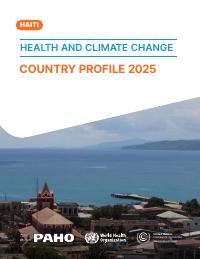
Profil pays santé et changement climatique 2025 : Haïti
Résumé — Profil pays santé et changement climatique 2025 : Haïti. Le document compte 30 pages.
Constats Clés
- Profil pays santé et changement climatique 2025 : Haïti.
- Voir le résumé anglais.
Description Complète
Profil pays santé et changement climatique 2025 : Haïti. Le document compte 30 pages. Voir le résumé anglais pour le détail.
Texte Intégral du Document
Texte extrait du document original pour l'indexation.
HAITI
HEALTH AND CLIMATE CHANGE
COUNTRY PROFILE 2025
United Nations
Framework Convention
on Climate Change
Health and climate change: Country profile 2025 - Haiti
PAHO/DHE/CE/25-0010
© Pan American Health Organization, 2026
Some rights reserved. This work is available under the Creative Commons Attribution-NonCommercial-ShareAlike 3.0
IGO license (CC BY-NC-SA 3.0 IGO).
Under the terms of this license, this work may be copied, redistributed, and adapted for non-commercial purposes,
provided the new work is issued using the same or equivalent Creative Commons license and it is appropriately cited.
In any use of this work, there should be no suggestion that the Pan American Health Organization (PAHO) endorses any
specific organization, product, or service. Use of the PAHO logo is not permitted.
All reasonable precautions have been taken by PAHO to verify the information contained in this publication. However,
the published material is being distributed without warranty of any kind, either expressed or implied. The responsibility
for the interpretation and use of the material lies with the reader. In no event shall PAHO be liable for damages arising
from its use.
Cover photograph: © PAHO/WHO
CONTENTS
Executive summary
v
Key recommendations
vi
Introduction
1
Climate hazards relevant for health
2
Health impacts of climate change
3
Health vulnerability and adaptive capacity
to climate change
13
Measuring progress in the health sector
15
References
20
Acknowledgments
This document was developed in collaboration with the Ministry of Public Health and Population, the Pan American
Health Organization, the United Nations Framework Convention on Climate Change, and the World Health Organization. The
technical contributions of Daniel Buss, Paul Byron, Jimmy Fenelon, Anwar Mendez, Kim Newton-James, Francisco Noel,
Samuel Osorio, Zuhelen Padilla, and Karen Polson-Edwards are gratefully acknowledged.
Financial support for this project was provided by the Green Climate Fund under the Enhancing Climate Change Resilience of
Health Systems in Seven CARICOM States readiness project.
CONTENTS
iii
© PAHO/WHO
iv
HAITI – HEALTH AND CLIMATE CHANGE COUNTRY PROFILE 2025
EXECUTIVE SUMMARY
Caribbean small island developing states remain
on the front lines of the climate crisis, facing a
range of acute and long-term risks, including
more frequent and severe weather events such
as floods, droughts, and cyclones; increased
average temperatures; and rising sea levels. Many
of these countries already have a high burden
of climate-sensitive diseases, which may be
exacerbated by climate change. Limited resources,
geographical vulnerability, and social inequalities
compound these risks, leaving some of the most
at-risk countries under-resourced and unprotected
against escalating climate and pollution threats.
In response, Caribbean leaders continue to call
forcefully for urgent global action to safeguard
populations everywhere, particularly those whose
very existence is under threat.
Since 2019, the Caribbean Action Plan on Health
and Climate Change has guided national and
regional efforts to build climate-resilient health
systems. A new action plan for 2026–2031 is
under development to strengthen accountability
and measurability, aligning with World Health
Organization’s Global Plan of Action on Climate
Change and Health 2023–2030. This will help
countries track progress toward resilient health
systems that can anticipate, withstand, and
adapt to climate threats, while protecting the
most vulnerable.
At the 61st Directing Council of the Pan American
Health Organization (PAHO) in 2024, Member
States approved the Policy for Strengthening
Equity-Oriented Health Sector Action on Climate
Change and Health. This policy, which is structured
around five key lines of action – adaptation,
mitigation, governance, surveillance, and
financing – calls for integrating health priorities into
nationally determined contributions, expanding
climate–health surveillance systems, and mobilizing
sustainable financing with a focus on health equity.
The previous round of PAHO country profiles
was completed in 2021. Since then, new climate
projections, health outcome data, and policy
agreements (including the 2024 equity-oriented
policy) have become available. To strengthen the
evidence base on climate and health, PAHO is
supporting countries to update or develop their
Health and Climate Change Country Profiles to
incorporate the latest data on climate impacts and
health outcomes. These profiles provide a snapshot
of how the climate is impacting public health across
Caribbean nations. They also serve as dynamic
tools for policymakers, health professionals, and
development partners, enabling them to identify
priorities, close information gaps, and accelerate
targeted interventions.
This PAHO Health and Climate Change Country
Profile for Haiti provides a summary of available
evidence on climate hazards, health vulnerabilities,
health impacts, and progress to date in health
sector efforts to strengthen a climate-resilient
health system.
EXECUTIVE SUMMARY
v
KEY RECOMMENDATIONS
A CLIMATE CHANGE AND HEALTH
❶ DEVELOP
STRATEGIC ACTION PLAN FOR HAITI
Haiti needs a comprehensive strategic action plan integrating climate and health considerations
across all relevant sectors. This plan should outline specific goals, strategies, and actions to
enhance health sector resilience. It must establish clear roles and responsibilities, preventing
overlap between the Ministry of Environment and Ministry of Public Health and Population.
Developing this plan requires collaboration between ministries, local communities, nongovernmental
organizations, and international partners. Regular updates and monitoring mechanisms should
ensure its effectiveness and alignment with national policies and international commitments.
COLLABORATION TO CARRY OUT RESEARCH
❷ STRENGTHEN
ON HEALTH AND CLIMATE CHANGE IN HAITI
Enhancing research collaboration is paramount to comprehending and mitigating the health impacts
of climate change in Haiti. This entails cultivating partnerships between Haitian institutions and
international research entities. Securing sustainable funding for interdisciplinary research on climate
change and health, in collaboration with international institutions and through leveraging expertise
and resources, is crucial. Priority areas should encompass the effects of climate change on vectorborne diseases, heat-related illnesses, and food/water security. Concurrently, strengthening
Haiti’s research capacity through training programs, infrastructure development, and data-sharing
initiatives is paramount, with a focus on translating findings into practical interventions and policy
recommendations.
EFFICIENCY AND PERFORMANCE THROUGH
❸ IMPROVE
CAPACITY-BUILDING
Bolstering Haiti’s healthcare system’s efficiency in addressing climate change necessitates
robust capacity-building initiatives. Integrating climate change and health topics into medical
and public health education curricula is crucial. Strengthening institutional frameworks, improving
data management systems, and enhancing access to and the utilization of climate information
are essential. Engaging international experts for knowledge transfer, organizing workshops and
seminars, and developing e-learning platforms for continuous learning will ensure the sustainable
implementation of climate-resilient health strategies.
vi
HAITI – HEALTH AND CLIMATE CHANGE COUNTRY PROFILE 2025
ACCESS TO INTERNATIONAL FINANCING
❹ IMPROVE
FOR ADAPTATION TO CLIMATE CHANGE IN THE
HEALTH SECTOR
To effectively address climate change adaptation in Haiti’s health sector, securing
international financing is imperative. This can be achieved by strengthening
international cooperation and actively engaging with global climate funds. It is essential
to develop the capacity to prepare robust project proposals, navigate complex
application processes, and meet diverse funding-source requirements. Furthermore,
strengthening partnerships with international organizations can leverage additional
resources and expertise.
CLIMATE-RESILIENT AND ENVIRONMENTALLY
❺ BUILD
SUSTAINABLE HEALTHCARE FACILITIES
A comprehensive approach should be implemented to safeguard health infrastructure,
contribute to climate mitigation efforts, and guarantee the continuous delivery of
essential health services during climate-related emergencies. Existing facilities in Haiti
should be retrofitted to withstand extreme weather events, incorporating climateresilient designs in new constructions. Integrating renewable energy sources such
as solar panels will provide a continuous power supply during disasters. Moreover,
adequate ventilation and cooling systems should be included to address rising
temperatures.
THE CLIMATE-VARIABILITY FACTOR
❻ INCLUDE
IN INTEGRATED RISK MANAGEMENT AND EARLY
WARNING SYSTEMS
The integration of climate variability into Haiti’s risk management and early warning
systems is essential for enhancing preparedness. Establishing and maintaining early
warning systems for extreme weather events is imperative, as is ensuring timely,
accurate, and accessible warnings for all population segments, particularly in vulnerable
coastal departments. Enhancing weather forecasting capabilities and developing
climate-informed disease surveillance systems are of the utmost urgency. Collaboration
between meteorological services, health authorities, and disaster management
agencies is crucial for devising comprehensive strategies tailored to Haiti’s unique
climate challenges.
KEY RECOMMENDATIONS
vii
© PAHO/WHO
viii
HAITI – HEALTH AND CLIMATE CHANGE COUNTRY PROFILE 2025
INTRODUCTION
Haiti, a small island developing state (SIDS),
is strategically located in the heart of the Caribbean.
It shares the island of Hispaniola with the Dominican
Republic, with Haiti occupying the western third of the
island. Haiti possesses a unique geographical feature,
with a territorial sea of approximately 30 000 km2,
while its land area spans 27 750 km2. Notably, threequarters of the country’s surface area is characterized
by mountainous terrain and rugged landscapes,
featuring steep slopes that often exceed 40% (1).
Haiti is situated in a region that is prone to cyclones
and frequently experiences natural disasters, including
increasingly severe flooding. These vulnerabilities are
amplified by specific geomorphological factors, such
as uneven terrain, deforestation, and inappropriate
farming and land use practices, which exacerbate
climate-related disasters. Among all the SIDS
and countries in the Western Hemisphere, Haiti is
particularly susceptible to climate change. Climatic
risks, such as floods, droughts, and hurricanes, are
significantly elevated and further intensified by climate
change. Climate change forecasts predict sea level
rise, increasing temperatures, and more frequent and
severe droughts (northern provinces) and hurricanes
(southern provinces) for Haiti. With its coastline
spanning 1771 kilometers and a highly dense population
of almost 12 million, many of whom live along and
derive livelihoods from the coast, sea level rise will
have a negative impact on the availability and quality
of potable water. This will have crippling effects on
coastal communities, which will be displaced due to
flooding and lower recharge or saltwater intrusion into
groundwater sources (2).
Additionally, recurring climatic phenomena, such as
El Niño and La Niña, contribute to these challenges by
causing rainfall shortages, drier climates, and colder,
wetter weather patterns in the Caribbean (1).
The Government of Haiti submitted its updated
nationally determined contribution in 2022. The
country commits to reducing emissions by 32%, of
which 26% is conditional on international support, by
2030 as compared with the reference scenario. The
updated nationally determined contribution places an
emphasis on adaptation and also covers mitigation
measures focusing on energy; waste; and agriculture,
forestry, and other land use (3).
Highest priority climate-sensitive health risks
Health risk
Health impacts of weather-related disasters and emergencies
Heat-related illness
Waterborne diseases
Food security and safety
Vector-borne diseases
Air pollution
Highest priority
✓
✓
✓
Allergies
Mental/psychosocial health
Noncommunicable diseases
Mitigation actions to reduce emissions through sustainable procurement
Mitigation measures to reduce emissions of health facilities
Mitigation measures by coordinating with other sectors
✓
✓
✓
Source: Provided by the Ministry of Public Health and Population, 2024.
INTRODUCTION
1
CLIMATE HAZARDS
RELEVANT FOR HEALTH
Climate-related hazards are already affecting the
health and well-being of populations across the
Caribbean and are projected to intensify in the
coming decades. Among the most significant threats
are tropical cyclones and sea level rise, both of which
can have widespread and long-term consequences
for public health, infrastructure, water and food
systems, and mental health.
Tropical cyclones
Tropical cyclones – including hurricanes and
typhoons – are expected to become more intense
and destructive, posing increased risks to health
and safety. Although it is anticipated that the total
number of tropical cyclones may decrease toward
the end of the century, human-induced warming is
likely to increase their intensity, with wind speeds
predicted to rise by 2–11% under a mid-range
scenario (Representative Concentration Pathway
4.5 [RCP4.5]) or by about 5% with 2 °C of global
warming. Projections also suggest that Category 4
and 5 storms will become more frequent, although
these projections are sensitive to model resolution.
Furthermore, average precipitation rates within
100 km of the cyclone center may increase by
up to 10% per degree of warming, exacerbating
flood risks. These increases in rainfall would be
even more severe if tropical cyclone translation
speeds continued to slow, leading to prolonged
storm impacts over affected areas (5–13). These
changes are expected to heighten the risks of
injuries, waterborne and vector-borne diseases,
displacement, and damage to health infrastructure.
While our understanding of tropical cyclones has
improved significantly through observational data,
theoretical studies, and climate modeling, regionalscale projections remain complex. Therefore, the
figure below presents a synthesis of global trends
to guide preparedness and response strategies in
vulnerable regions.
Potential future changes in tropical cyclones: a global perspective
Increase
Total number
Decrease
Intensity
Frequency of Category 4
and 5 events
Average precipitation
rates near storm center
Sources: Bender MA, Knutson TR, Tuleya RE, Sirutis JJ, Vecchi GA, Garner ST, Knutson TR, Tuleya RE, Sirutis JJ, Vecchi GA, Garner ST, et al. Modeled impact of
anthropogenic warming on the frequency of intense Atlantic hurricanes. Science. 2010;327(5971):454–458. Christensen JH, Krishna Kumar K, Aldrian E, An S-I,
Cavalcanti IFA, de Castro M, et al. Climate phenomena and their relevance for future regional climate change. In: Stocker TF, Qin D, Plattner G-K, Tignor M, Allen SK,
Boschung J, et al., editors. Climate change 2013: the physical science basis. Contribution of Working Group I to the Fifth Assessment Report of the Intergovernmental
Panel on Climate Change. Cambridge: Cambridge University Press; 2013. Knutson TR, Sirutis JJ, Zhao M, Tuleya RE, Bender M, Vecchi GA, et al. Global projections
of intense tropical cyclone activity for the late twenty-first century from dynamical downscaling of CMIP5/RCP4.5 scenarios. J Clim. 2015;28:7203–7224. Kossin JP,
Emanuel KA, Vecchi GA. The poleward migration of the location of tropical cyclone maximum intensity. Nature. 2014;509:349–352. Available from:
https://doi.org/10.1038/nature13278. Kossin JP. A global slowdown of tropical-cyclone translation speed. Nature. 2018;558:104–108. Sobel AH, Camargo SJ, Hall TM,
Lee CY, Tippett MK, Wing AA. Human influence on tropical cyclone intensity. Science. 2016;353:242246. Available from: https://doi.org/10.1126/science.aaf6574.
Walsh KJE, McBride JL, Klotzbach PJ, Balachandran S, Camargo SJ, Holland G, et al. Tropical cyclones and climate change. Wiley Interdiscip Rev Clim Change.
2016;7:65–89. Yoshida K, Sugi M, Mizuta R, Murakami H, Ishii M. Future changes in tropical cyclone activity in high-resolution large-ensemble simulations. Geophys
Res Lett. 2017;44:9910–9917.
2
HAITI – HEALTH AND CLIMATE CHANGE COUNTRY PROFILE 2025
HEALTH IMPACTS OF
CLIMATE CHANGE
Sea level rise
Sea level rise is one of the most significant threats to low-lying areas on small islands and atolls. Research
indicates that global mean sea level rise rates are almost certainly accelerating as a result of climate change.
The relatively long response times to global warming mean that the sea level will continue to rise for a
considerable time after any reduction in emissions.
1.7
Impacts of sea level rise include:
mm/year (±1.3)
Average change in Caribbean sea level
over the period 1993–2010a
Coastal
erosion
Ecosystem
disruption
Higher storm
surges
Population
displacement
Water
contamination
and disruption
Mental
health
with substantial spatial variability across the region
0.5–0.6m
Further rise in the Caribbean by the
end of the centuryb
with variation models and emission scenarios
Notes:
a Information and understanding about tropical cyclones (including hurricane and typhoons) from observations, theory, and climate models have improved in the
last few years. Despite this, robust projections for specific ocean basins or for changes in storm tracks are difficult. As such, presented here is a synthesis of the
expected changes at the global scale.
b Estimates of mean net regional sea level change were evaluated from 21 Coupled Model Intercomparison Project Phase 5 models and include regional
nonscenario components. The range given is for RCP4.5 annual projected change for 2081–2100 compared with 1986–2005.
Sources: Nurse LA, McLean RF, Agard J, Briguglio L, Duvat-Magnan V, Pelesikoti N, et al. 2014: Small islands. In: Barros et al., editors. Climate Change 2014: Impacts,
adaptation, and vulnerability. Part B: regional aspects. Contribution of Working Group II to the Fifth Assessment Report of the Intergovernmental Panel on Climate
Change. Cambridge: Cambridge University Press; 2014. Torres R, Tsimplis MN. Sea-level trends and interannual variability in the Caribbean Sea. J Geophys Res
Oceans. 118:2934–2947.
HEALTH IMPACTS OF CLIMATE CHANGE
3
Heat stress
Climate change is expected to increase annual
temperature (mean, maximum, and minimum), urban
heat islands, and the intensity and frequency of heat
waves, resulting in a larger number of people at risk
of heat-related medical conditions. Heat waves,
that is, prolonged periods of excessive heat, can
pose a particular threat to human, animal, and even
plant health, resulting in loss of life, livelihoods, and
socioeconomic output; reduced labor productivity;
and increases in demand for and the cost of
cooling options. Heat waves also contribute to the
deterioration of the environmental determinants of
health (e.g., air quality, soil, water supply) (Figure 1).
FIGURE 1: Impacts of heat stress
Health impacts
Increased hospitalizations for
cardiovascular diseases, diabetes,
accidents, and can lead to death.
Economic impacts
Increased cooling costs and
reduced labor productivity.
HEAT
STRESS
Environmental impacts
Deterioration of air quality, soil,
and water supply.
Groups in situation of
vulnerability
Older people, children, and those
with pre-existing conditions.
4
HAITI – HEALTH AND CLIMATE CHANGE COUNTRY PROFILE 2025
When observing the effects of temperatures on
the burden of disease, high temperature exposure
consistently presents a greater mortality risk than
low temperature exposure, with death rates that
are substantially higher across all demographics.
The most striking pattern emerges for older persons
(65 and older), with rates of deaths related to high
temperatures having shown a consistent increasing
trend over time since 2003; in contrast, rates of
deaths related to low temperatures for the same
age group have shown a decreasing trend, and,
remarkably, have been lower than the rates of deaths
associated with high temperatures since 2018.
However, mortality related to high temperatures
for all ages combined remained relatively stable
throughout the period, at 2–3 deaths per 100 000,
while low temperature-related death rates for
both age groups (65 and more, and all ages) were
consistently low, with fewer than 1.5 deaths per
100 000. The data show that older populations are
disproportionately more vulnerable to heat-related
mortality (Figure 2).
FIGURE 2: Smoothed death rates attributed to high and low temperatures by age group, Haiti,
1990–2021
— - — High temperature, 65 years of age and older
— High temperature, all ages
— - — Low temperature, 65 years of age and older
— Low temperature, all ages
20
15
Death
rate
000
Death
rateper
per 100
100 000
15
10
10
5
5
0
0
1990
1990
1995
1995
2000
2000
2005
2005
Year
2010
2010
2015
2015
2020
2020
2025
2025
Year
Source: Figure elaborated using data from: Institute for Health Metrics and Evaluation (IHME). Global Burden of Disease 2021. Seattle: IHME, 2024.
In 2021, heat-related mortality in Haiti revealed
contrasting gender patterns across age groups, with
the direction of gender disparity reversing between
young and old populations. For children aged under
5 years, death rates were approximately 28% higher
among boys than among girls, suggesting that young
boys may be more vulnerable to heat-related health
impacts. However, this pattern completely reversed
for older persons, where death rates were about 26%
higher among women aged 65 years and older than
among their male counterparts.
This age-dependent gender reversal in heat
vulnerability highlights the complex interplay between
the biological, social, and behavioral factors that
influence thermal stress mortality across different life
stages in Haiti. Furthermore, heat-related mortality
was extraordinarily high among adults aged 65 and
older, with rates over 10 times higher than those
for children. This pattern suggests that, while heat
poses a modest risk to young children, regardless
of sex, older women represent the most vulnerable
demographic group for heat-related mortality in Haiti.
HEALTH IMPACTS OF CLIMATE CHANGE
5
Figure 3, which shows heat-related mortality
trends in Haiti disaggregated by sex from 1990
to 2021, reveals a clearer picture of the evolving
impact of extreme heat on public health. To avoid
misinterpretation, data for 2010 – which showed
an unusually high mortality value – were excluded
from the analysis. It is important to note that Haiti
experienced a devastating earthquake in January
2010, which may have compromised the quality and
consistency of mortality data reporting, and indirectly
affected health systems and surveillance capacities.
The results show that, contrary to expectations
associated with climate change, heat-attributable
mortality has declined for both sexes. Between
1990 and 2021, among males the reduction was
28.7%, while among females it was 5.4%. Although
death rates were consistently higher among men
than among women throughout the period, the
relative decline was more substantial for men.
This reduction may be linked to a lack of systematic
monitoring, changes in exposure patterns, and/or
shifts in risk factors, rather than an actual decrease
in heat-related health impacts.
These findings highlight the need to strengthen
heat-related health surveillance systems and
emergency response mechanisms, and to ensure
disaggregated data collection to better identify
populations in a situation of vulnerability. Careful
interpretation of time series data is essential
for designing effective, evidence-informed
interventions that protect public health in the
context of a warming climate.
FIGURE 3: Heat-attributable mortality rate by sex in Haiti, 1990–2021 (excluding 2010)
— Male
— Female
Deathrate
rateper
per100
100000
000
Death
5
4
3
2
1
1990
2000
Year
Year
2010
2020
Note: Trends show consistently higher rates in males and a gradual decline for both sexes over time. The year 2010 was removed due to potential data
inconsistencies associated with the earthquake that year.
Source: Figure elaborated using data from: Institute for Health Metrics and Evaluation (IHME). Global Burden of Disease 2021. Seattle: IHME, 2024.
6
HAITI – HEALTH AND CLIMATE CHANGE COUNTRY PROFILE 2025
Infectious and vector-borne diseases
Vector-borne diseases, particularly malaria and
dengue, have emerged as pressing concerns in
Haiti. An intricate relationship exists between these
diseases and Haiti’s climatic patterns (Figure 4).
For instance, malaria exhibits a pronounced
presence in the western region, reaching its peak
during the latter part of the year. Paradoxically,
the very climate changes that pose a threat to
Haiti may lead to a reduction in malaria prevalence
in certain areas, as rising temperatures could
adversely affect mosquito survival. Waterborne
diseases also cast a significant shadow over
Haiti’s public health landscape. Cholera, typhoid,
and various diarrheal diseases pose substantial
threats, with their prevalence closely linked to
rainfall patterns and temperature fluctuations.
Future climate scenarios may potentially alter
the transmission dynamics of these diseases,
necessitating the development of more resilient
water and sanitation infrastructure (5).
FIGURE 4: Spatial–temporal distribution of climate-sensitive diseases in Haiti between 2011 and
2021: (A) high blood pressure, (B) diabetes, (C) cholera, (D) chikungunya, (E) dengue,
(F) diarrhea, (G) malaria, (H) malnutrition, and (I) acute respiratory infections
E
Cholera cases
Diarhea cases
I
Malnutrition cases
H
Malaria cases
G
F
Dengue cases
Chikungunya cases
D
C
Diabetes cases
High blood pressure
(Hypertension) cases
B
Acute respiratory infection cases
A
Source: Diouf I, Sy I, Diakhate M. Assessing climate change impacts on public health in Haiti: a comprehensive study of disease distribution, modeling, and adaptation
strategies. Front Trop Dis. 2024;4:1287499. Available from: https://doi.org/10.3389/fitd.2023.1287499.
HEALTH IMPACTS OF CLIMATE CHANGE
7
During the 2005–2019 period, dengue incidence
was very low. However, a dramatic epidemiological
shift can be observed, starting in 2020, with an
exponential increase that peaks in 2021, at 55.02
cases per 100 000 inhabitants, representing an
increase of more than 6000% compared with the
previous year. Although 2022 shows a reduction to
28.6 cases per 100 000 inhabitants, levels remain
35 times higher than the pre-2020 historical average.
It is essential to strengthen epidemiological and
entomological surveillance and investigate the
determinants of the 2020–2021 outbreak to prevent
future epidemics of a similar magnitude (Figure 5).
FIGURE 5: Dengue incidence by year, Haiti, 2005–2022
■ Annual value
⁓ Smoothed trend
60
Incidence (cases per 100 000 inhabitants)
Incedence (cases per 100 000 inhabitants)
55
50
40
28.6
30
20
15.8
10
0
2.4
0
1.2
0.8
2013
2015
2018
0
2005
2012
0.8
2019
2020
2021
Year
Year
Source: Pan American Health Organization. PLISA: dengue incidence by year, Haiti. Washington, D.C.: PAHO; 2025 [cited 21 October 2025].
Available from: https://www.paho.org/en/arbo-portal/dengue-data-and-analysis/dengue-analysis-country.
8
HAITI – HEALTH AND CLIMATE CHANGE COUNTRY PROFILE 2025
2022
Haiti’s malaria death rate shows extreme volatility,
with dramatic spikes between 1990 and 2021
reaching over 30 deaths per 100 000, namely in 1991,
1994, 1999, and 2010, while the Caribbean region
maintained a relatively stable death rate, generally
staying below 10 deaths per 100 000 throughout
the entire period. The most notable spike for Haiti
occurred around 2010 and was most likely related to
the devastating earthquake that struck the country
(Figure 6). In 2021, malaria death rates revealed
significant age and gender disparities: death rates
among children under 5 years of age were relatively
modest, with minimal gender differences (5.26 deaths
per 100 000 for girls versus 4.36 for boys). However,
death rates among adults aged 70 years or older
were substantially higher, with death rates among
older men being nearly twice as high as those among
older women (17.5 deaths per 100 000 for men
versus 8.98 for women). Overall, malaria death rates
among older persons were three or four times higher
than those among young children, with older men
representing the highest-risk demographic group for
malaria deaths in Haiti.
FIGURE 6: Malaria death rates, Haiti and the Caribbean, 1990–2021
Caribbean
Republic of Haiti
Death
rate per
Death
rate100
per 000
100 000
30
20
10
0
1990
1995
2000
2005
2010
2015
2020
Year
Source: Figure elaborated using data from: Institute for Health Metrics and Evaluation (IHME). Global Burden of Disease 2021. Seattle: IHME, 2024.
HEALTH IMPACTS OF CLIMATE CHANGE
9
Noncommunicable diseases and food and nutrition security
SIDS face distinct challenges that render them
particularly vulnerable to the impacts of climate
change on food and nutrition security, including
having small, and widely dispersed, land masses and
populations; having large rural populations; having
fragile natural environments and a lack of arable land;
being highly vulnerable to climate change, external
economic shocks, and natural disasters; being highly
dependent on food imports; being dependent on
a limited number of economic sectors; and their
distance from global markets. The majority of SIDS
also face a “triple burden” of malnutrition, whereby
undernutrition, micronutrient deficiencies, and
overweight and obesity exist simultaneously within a
population, alongside increasing rates of diet-related
noncommunicable diseases (NCDs).
Figure 7 illustrates the percentage increase in
death rates by cause in Haiti between 2010
and 2021. The data reveal a rise in the death
rates associated with several NCDs, highlighting
growing public health challenges for the country.
Diabetes and kidney diseases show the highest
increase, at 57.7%, possibly reflecting changes
in diet, limited access to preventive care, and a
rise in risk factors such as obesity and physical
inactivity. Cardiovascular diseases follow, with a
32.4% increase, which may be associated with
uncontrolled hypertension, tobacco use, and
other lifestyle-related factors. The rates of deaths
associated with chronic respiratory diseases
(22.6% increase) and substance use disorders
(13.6% increase) also exhibit growth.
These findings point to a rising burden of NCDs
in Haiti, likely driven by structural barriers to
healthcare access, environmental and social
determinants, and shifts in population health
behaviors. While improvements in health data
reporting may partially explain these trends, the
consistent upward pattern across multiple causes
warrants immediate policy attention.
FIGURE 7: Percentage increase in death rates by cause in Haiti between 2010 and 2021
Diabetes and kidney diseases
57.7%
Cardiovascular diseases
32.4%
Chronic respiratory diseases
22.6%
Substance use disorders
13.6%
Neurological disorders
10.6%
Digestive diseases
8.0%
Neoplasms
3.1%
0.3%
Musculoskeletal disorders
0
10
20
30
40
50
Percentage increase
Source: Figure elaborated using data from: Institute for Health Metrics and Evaluation (IHME). Global Burden of Disease 2021. Seattle: IHME, 2024.
10
HAITI – HEALTH AND CLIMATE CHANGE COUNTRY PROFILE 2025
60
Climate change is likely to exacerbate the triple
burden of malnutrition, and the metabolic and
lifestyle risk factors for diet-related NCDs. It is
expected to reduce short- and long-term food
and nutrition security both directly, through its
effects on agriculture and fisheries, and indirectly,
by contributing to underlying risk factors such as
water insecurity, dependency on imported foods,
urbanization and migration, and health service
disruption. These impacts represent a significant
health risk for SIDS, with their particular susceptibility
to climate change impacts and already overburdened
health systems, and this risk is distributed unevenly,
with some population groups being more vulnerable
than others.
Malnutrition poses a persistent challenge in Haiti,
and climate change will introduce new dimensions
to this issue. Shifting rainfall patterns and rising
temperatures may impact food security, indirectly
exacerbating malnutrition. An integrated approach to
climate adaptation is necessary, bridging health and
agricultural concerns. NCDs such as hypertension
and diabetes are consistent health concerns. These
conditions may be affected by the indirect effects of
climate change through various pathways, including
altered food security and increased heat stress (5).
HEALTH IMPACTS OF CLIMATE CHANGE
11
NONCOMMUNICABLE DISEASES IN HAITI
53.9 years
10.2%
50.4 %
8.9%
Healthy life expectancy at birth (2021)1
Adult population that is considered
undernourished (2019–2023,
3-year average)3
Adult population considered obese
(2022)2
Prevalence of diabetes in the adult
population (2021)4
MOTHER AND CHILD HEALTH
48+52K 4+96K 22+78K 3+97K
47.7%
3.7%
Iron deficiency
anemia in women
of reproductive
age (2019)5
Wasting in children
under 5 years
(2017)6
3.4%
21.9%
Stunting in
children under
5 years (2017)6
Overweight rate in
children under 5 years
(2017)6
1
World Health Organization. Healthy life expectancy (HALE) at birth. Geneva: WHO; 2021 [cited 6 August 2024].
Available from: https://data.who.int/countries/332.
2
World Health Organization. Prevalence of obesity among adults, BMI ≥30, crude estimates by country. Geneva: WHO; 2022
[cited 6 August 2024]. Available from: https://www.who.int/data/gho/data/indicators/indicator-details/GHO/prevalence-of-obesity-amongadults-bmi-=-30-(age-standardized-estimate)-(-).
3
Food and Agriculture Organization of the United Nations. FAO Data Explorer: prevalence of undernourishment. Rome: FAO; 2023 [cited
6 August 2024]. Available from: https://dataexplorer.fao.org/vis?fs[0]=Domain%2C1%7CSDG%20Indicators%23SDG_T%23%7CGoal.
4
World Health Organization. Global report on diabetes. Geneva: WHO; 2021. Available from:
https://apps.who.int/iris/bitstream/handle/10665/204871/9789241565257_eng.pdf?sequence=1.
5
World Health Organization. Prevalence of anaemia in women. Geneva: WHO; 2021 [cited 6 August 2024]. Available from:
https://www.who.int/data/gho/data/indicators/indicator-details/GHO/prevalence-of-anaemia-in-women-of-reproductive-age-(-).
6
United Nations Children’s Fund, World Health Organization, World Bank Group. Joint child malnutrition estimates, levels and trends.
Geneva: WHO; 2023 [cited 6 August 2024]. Available from: https://www.who.int/publications/i/item/9789240073791.
12
HAITI – HEALTH AND CLIMATE CHANGE COUNTRY PROFILE 2025
HEALTH VULNERABILITY AND ADAPTIVE
CAPACITY TO CLIMATE CHANGE
Sustainable Development Goal indicators related to health and
climate change
Many of the public health gains we have made in recent decades are at risk due to the direct and indirect
impacts of climate variability and climate change. Sustainable development across sectors can strengthen
health resilience to climate change.
1. NO POVERTY
3. GOOD HEALTH AND WELL-BEING
58.5%
service coverage index2
Share of population living in poverty by the
national poverty line1
6. CLEAN WATER
AND
SANITATION
b Proportion of total
population using at
least basic drinking
water services5
b Proportion of total
population using at
least basic sanitation
services6
54%
a Universal health coverage
3.48%
Current health expenditure
as percentage of gross
domestic product3
56.5
Under-5 mortality rate (per 1000
live births)4
13. STRENGTHEN RESILIENCE
AND ADAPTIVE CAPACITY
TO CLIMATE CHANGE
AND NATURAL DISASTERS
67%
37%
82
c Total number of weather-related
disasters recorded between
2000 and 20247
3.6 MILLION
c Largest total number of persons
affected by a single weatherrelated disaster between 2000
and 20187
a
The index is based on high data availability. Values greater than or equal to 80 are presented as ≥80 as the index does not provide fine resolution at
high values; 80 should not be considered a target.
b
Data for safely managed drinking water and sanitation services are not consistently available for all SIDS at this time; therefore, data on “at least basic
services” have been reported for comparability.
c
Data for Sustainable Development Goal 13.1 are currently not available. Alternative indicators and data sources are presented.
1 World Bank Group. Poverty headcount ratio at national poverty lines (% of population). Washington, D.C.: World Bank; 2012 [cited 6 August 2024].
Available from: https://data.worldbank.org/indicator/SI.POV.NAHC.
2 World Health Organization. UHC service coverage index (SDG 3.8.1). Geneva: WHO; 2021 [cited 2024 Aug 7]. Available from: https://www.who.int/data/
gho/data/indicators/indicator-details/GHO/uhc-index-of-service-coverage.
3 World Health Organization. Current health expenditure (CHE) as percentage of gross domestic product (GDP) (%). Geneva: WHO; 2021 [cited 7 August
2024]. Available from: https://www.who.int/data/gho/data/indicators/indicator-details/GHO/current-health-expenditure-(che)-as-percentage-of-grossdomestic-product-(gdp)-(-).
4 United Nations Children’s Fund. Haiti – key demographics indicators. New York: UNICEF; 2022 [cited 7 August 2024]. Available from: https://data.unicef.
org/country/hti/.
5 World Health Organization. WASH basic drinking-water services, population using at least (%). Geneva: WHO; 2022 [cited 7 August 2024]. Available
from: https://www.who.int/data/gho/data/indicators/indicator-details/GHO/population-using-at-least-basic-drinking-water-services-(-).
6 World Health Organization. WASH basic sanitation services, population using at least (%). Geneva: WHO; 2022 [cited 7 August 2024]. Available from:
https://www.who.int/data/gho/data/indicators/indicator-details/GHO/population-using-at-least-basic-sanitation-services-(-).
7 Public EM-DAT. The international disasters database. Brussels: CRED/UCLouvain; 2024. Available from: https://public.emdat.be/data.
HEALTH VULNERABILITY AND ADAPTIVE CAPACITY TO CLIMATE CHANGE
13
Health workforce
Public health and healthcare professionals require training and capacity-building opportunities, to ensure that
they have the knowledge and tools necessary to build climate-resilient health systems. For example, they
must have an understanding of climate risks to individuals, communities, and healthcare facilities, and of
the approaches that can be taken to protect and promote health given the current and projected impacts of
climate change.
2.37
Medical doctors
4
Nurses and
midwives
Not available
Environmental and
occupational health and
hygiene professionals
Source: World Health Organization. UHC service coverage index. Geneva: WHO; 2024 [cited 6 August 2024]. Available from: https://data.who.int/indicators/
i/3805B1E/9A706FD.
Healthcare facilities
Climate change poses a serious threat to the functioning of healthcare facilities. Extreme weather events
increase the demand for emergency health services but can also damage healthcare facility infrastructure
and disrupt service provision. Increased risks of climate-sensitive diseases will also require greater capacity
from often already strained health services. In SIDS, healthcare facilities are often in low-lying areas subject
to flooding and storm surges, making them particularly vulnerable.
1007
Health centers across
the countrya
a Total density per 10 000 population (2022).
14
HAITI – HEALTH AND CLIMATE CHANGE COUNTRY PROFILE 2025
6.4
Hospital bedsa
MEASURING PROGRESS
IN THE HEALTH SECTOR
The following section looks at progress in the health sector in responding to climate threats based
on country-reported data collected in the 2023 PAHO Climate and Health Country Survey (16).
Key indicators are aligned with those identified in the Caribbean Action Plan on Health and
Climate Change.
Empowerment: progress in leadership and governance
✓ = YES ✗= NO O= UNKNOWN N/A= NOT APPLICABLE
National planning for health and climate change
Has a national health and climate change strategy or plan been developed?a
✓
a In this context, a “national strategy or plan” is a broad term that includes national health and climate strategies, as well as the health component of national
adaptation plans.
Intersectoral collaboration to address climate change
Has the country established a multi-institutional structure to work on climate change
(e.g., national interministerial committee, national coordination mechanism)?
✓
Does a ministry of health representative participate in this multi-institutional
structure on climate change?
✓
MEASURING PROGRESS IN THE HEALTH SECTOR
15
Intersectoral collaboration to address climate change
✓ = YES ✗= NO O= UNKNOWN N/A= NOT APPLICABLE
Is there an agreement in place between the ministry of health and this sector that defines specific roles
and responsibilities in relation to links between health and climate change policy?
Agreement
in place
Sector
Agriculture
✗
Education
✗
Energy
✗
Environment
✗
National meteorological and hydrological services
✗
Social services
✗
Transportation
✗
Urban development and housing
✗
Water, sanitation, and hygiene
✗
Evidence: building the investment case
✓ = YES ✗= NO O= UNKNOWN N/A= NOT APPLICABLE
Vulnerability and adaptation assessments for health
Has an assessment of health vulnerability and impacts of climate change been
conducted at a national level?
✓
Haiti completed a vulnerability and adaptation assessment of the country’s health system in 2023 with the
support of PAHO. The resulting report, titled Evaluation of the vulnerability and adaptation of the health
system and communities to climate change in Haiti, is currently being reviewed by the Ministry of Public
Health and Population and awaits validation.
16
HAITI – HEALTH AND CLIMATE CHANGE COUNTRY PROFILE 2025
Implementation: preparedness for climate risks
✓ = YES ✗= NO O= UNKNOWN N/A= NOT APPLICABLE
Integrated risk monitoring and early warning
Health
surveillance
system exists?
Health
surveillance
system includes
meteorological
information?
Climate-informed
early warning
system in place?
Health sector
response plan
in place?
Airborne and respiratory
illness
✓
✗
✗
✗
Heat-related illness
✗
✗
✗
✗
Injury and mortality from
extreme weather events
✓
✗
✗
✗
Malnutrition and
foodborne diseases
✓
✗
✗
✗
Mental and psychosocial
health
✗
✗
✗
✗
NCDs
✓
✗
✗
✗
Vector-borne diseases
✓
✗
✗
✗
Waterborne diseases
and other water-related
health outcomes
O
✗
✗
✗
Zoonoses
✓
✗
✗
✗
Impacts on healthcare
facilities
✓
✗
✗
✗
Climate-sensitive
diseases and health
outcomes
MEASURING PROGRESS IN THE HEALTH SECTOR
17
Health co-benefits of climate action
HAS THE COUNTRY USED ANY TOOLS TO ASSESS THE HEALTH CO-BENEFITS
OF CLIMATE CHANGE ACTION?
No health co-benefits assessments have been conducted.
The health co-benefits of climate change mitigation refer to the potential
human health benefits that may be gained from implementing policies that
cut greenhouse gas emissions and/or short-lived climate pollutant emissions
and promote low-carbon, sustainable societies. For example, efforts to reduce
greenhouse gas emissions in the transport sector can reduce air pollution
and lead to higher levels of physical activity such as cycling or walking, which
consequently lowers the risks of respiratory diseases, cardiovascular diseases,
diabetes, and obesity. Conversely, some climate mitigation policies may cause
harm to human health or may not maximize potential health gains.
Resources: facilitating access to climate and health finance
International climate finance
✓ = YES ✗= NO O= UNKNOWN N/A= NOT APPLICABLE
Are international funds currently being accessed to support climate change and health work?
✓
If yes, from which sources?
18
Green Climate Fund
✓
Global Environment Facility
✗
Other multilateral donors
✗
Bilateral donor
✗
Other
✗
HAITI – HEALTH AND CLIMATE CHANGE COUNTRY PROFILE 2025
Funding challenges
✓ = YES ✗= NO O= UNKNOWN N/A= NOT APPLICABLE
Greatest challenges faced in accessing international funds
Lack of information on the opportunities
✓
Lack of connection by health actors to climate change processes
✓
Lack of success in submitted applications
✗
Lack of country eligibility
✗
Lack of capacity to prepare country proposals
✗
None (no challenges or challenges were minimal)
✗
MEASURING PROGRESS IN THE HEALTH SECTOR
19
References
1. Haiti Ministry of Environment. Haiti’s updated NDC.
Port-au-Prince: Haiti Ministry of Environment; 2022.
Available from: https://unfccc.int/sites/default/files/
NDC/2022-06/CDN%20Revisee%20Haiti%202022.pdf.
2. United States Agency for International Development.
High-priority country plan, Haiti 2022. Washington,
D.C.: USAID; 2022. Available from: https://www.
globalwaters.org/wherewework/latinamericacaribbean/
haiti.
3. NDC Partnership. Country action, Haiti 2024.
Washington, D.C.: NDC Partnership; 2024. Available
from: https://ndcpartnership.org/country/hti.
4. World Health Organization. WHO health and
climate change survey report. Geneva: WHO; 2021.
Available from: https://www.who.int/publications/i/
item/9789240038509.
5. Bender MS, et al. Modeled impact of anthropogenic
warming on the frequency of intense Atlantic
hurricanes. Science. 2010;327(5971):454–458.
6. Christensen JH, Krishna Kumar K, Aldrian E, An S-I,
Cavalcanti IFA, de Castro M, et al. Climate phenomena
and their relevance for future regional climate change.
In: Stocker TF, Qin D, Plattner G-K, Tignor M, Allen
SK, Boschung J, et al., editors. Climate change
2013: the physical science basis. Contribution of
Working Group I to the Fifth Assessment Report of
the Intergovernmental Panel on Climate Change.
Cambridge: Cambridge University Press; 2013.
7. Knutson TR, Sirutis JJ, Zhao M, Tuleya RE, Bender M,
Vecchi GA, et al. Global projections of intense tropical
cyclone activity for the late twenty-first century from
dynamical downscaling of CMIP5/RCP4.5 scenarios. J
Clim. 2015;28:7203–7224.
9. Kossin JP. A global slowdown of tropical-cyclone
translation speed. Nat. 2018;558:104–108.
10. Sobel AH, Camargo SJ, Hall TM, Lee CY, Tippett MK,
Wing AA. Human influence on tropical cyclone
intensity. Sci. 2016;353:242–246. Available from:
https://doi.org/10.1126/science.aaf6574.
11. Walsh KJE, McBride JL, Klotzbach PJ, et al. Tropical
cyclones and climate change. WIREs Clim Change.
2016;7:65–89.
12. Yoshida K, Sugi M, Mizuta R, Murakami H, Ishii M.
Future changes in tropical cyclone activity in highresolution large-ensemble simulations. Geophys Res
Lett. 2017;44:9910–9917.
13. Torres R, Tsimplis MN. Sea-level trends and
interannual variability in the Caribbean Sea. J Geophys
Res Oceans. 2013;118:2934–2947.
14. Nurse LA, McLean RF, Agard J, Briguglio L,
Duvat‑Magnan V, Pelesikoti N, et al., editors.
Small islands. In: Climate Change 2014: Impacts,
Adaptation, and Vulnerability. Part B: Regional
Aspects. Contribution of Working Group II to the Fifth
Assessment Report of the Intergovernmental Panel
on Climate Change. Cambridge: Cambridge University
Press; 2014. p. 1613–1654.
15. Diouf I, Sy I, Diakhate M. Assessing climate change
impacts on public health in Haiti: a comprehensive
study of disease distribution, modeling, and adaptation
strategies. Front Trop Dis. 2024;4:1287499. Available
from: https://doi.org/10.3389/fitd.2023.1287499.
16. Pan American Health Organization. PAHO Climate
Change and Health Survey 2023. Washington, D.C.:
PAHO; 2023.
8. Kossin JP, Emanuel KA, Vecchi GA. The poleward
migration of the location of tropical cyclone maximum
intensity. Nat. 2014;509:349–352. Available from:
https://doi.org/10.1038/nature13278.
20
HAITI – HEALTH AND CLIMATE CHANGE COUNTRY PROFILE 2025
Haiti’s Health and Climate Change Country Profile 2025 highlights the country’s growing efforts to
understand and address the impacts of climate change on public health. The profile brings together
the latest data and analysis to provide a clear picture of how changing climate patterns are influencing
health outcomes and shaping national priorities.
It showcases the steps that Haiti has taken to assess climate risks, monitor health vulnerabilities, and
begin building more resilient health systems. From tackling climate-sensitive diseases to exploring
adaptation and early warning strategies, the profile emphasizes both progress made and key areas
for action. It also reflects on findings from recent national surveys and assessments, identifying
where support is needed to strengthen health infrastructure, improve training, and integrate climate
considerations into public health planning.
This profile is part of a broader Pan American Health Organization initiative to promote evidence-based
decision-making, support low-carbon development, and enhance regional cooperation. For Haiti, it
aims to serve as a practical tool for policymakers, health professionals, and development partners,
enabling them to prioritize interventions, reduce health risks, and promote well-being in the face of
climate change.
United Nations
Framework Convention
on Climate Change
www.paho.org
Comment citer
Organisation panaméricaine de la Santé (OPS/OMS), Profil pays santé et changement climatique 2025 : Haïti, https://reliefweb.int/attachments/2e91b525-e07a-4552-aa42-8d1d0579cc9c/PAHODHECE250010_eng.pdf