Texte Intégral du Document
Texte extrait du document original pour l'indexation.
PROTECTION OF INTERNALLY
DISPLACED PERSONS IN HAITI
MAY 2024
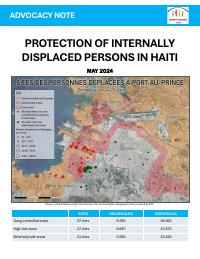
Source: United Nations High Commissioner for Human Rights. Geographic Data provided by IOM.
SITES HOUSEHOLDS INDIVIDUALS
Gang-controlled areas 37 sites 9.390 38.962
High-risk areas 27 sites 6.687 27.872
Relatively safe areas 21 sites 5.905 23.420
ADVOCACY NOTE
2
EXECUTIVE SUMMARY
PROTECTION CLUSTER:
Requests to the Haitian Government
➢ To ensure that internally displaced persons (IDPs), particularly those
living in makeshift sites, have access to humanitarian assistance in
sufficient quantity and quality, respecting human dignity;
➢ To ensure that IDPs are not evicted from sites without due process,
sufficient notice, and consultation, and that they are provided with an
adequate alternative for relocation;
➢ To ensure that the Haitian National Police respect and protect the right
to life and use lethal force only as a last resort when absolutely necessary
to prevent an imminent threat of death or serious injury;
Requests to Humanitarian Donors
➢ To increase funding for national protection actors so that protection
principles are effectively integrated into humanitarian interventions in
and around IDP sites;
➢ To strengthen funding for activities aimed at the prevention, mitigation,
and response to protection risks, including, but not limited to,
humanitarian diplomacy, negotiation for protection, and protection by
presence;
Requests to UN agencies, funds and programs and Non-
Governmental Humanitarian Organizations
➢ To integrate protection principles more significantly into the
humanitarian response for IDPs, especially for survivors of sexual
violence and for children.
➢ To prioritize the response to psychological distress and mental health
issues in general among their intervention priorities.
➢ To contact protection actors, according to standard operating
procedures, when identifying individuals requiring protection case
management.
3
CONTEXT
More than 362,000 people are displaced in Haiti, primarily due to gang violence (96% of
the total number of internally displaced persons (IDPs)). Among these displaced persons, at
least 195,764 are in the West Department, with 90,254 (46%) residing in 85 sites across
the metropolitan area of Port-au-Prince (ZMPP), while the remainder are hosted by families.
1
The protection situation of IDPs, particularly those sheltered in makeshift sites, is extremely
concerning and dire. These sites (schools, churches, public or private buildings) are utterly
unsuitable for accommodating families fleeing violence. The hygiene and sanitation
conditions are deplorable. For instance, 34% of the sites have no latrines, and 66% have
communal latrines that are in poor condition or non-functional. Additionally, IDPs rarely have
access to potable water, which is only available occasionally when water trucks can deliver
it to the sites. Access to food and healthcare is also very difficult.
Overall, gang-violence induced displacement has only increased the protection risks faced
by the Haitian population in their daily lives.
DEMOGRAPHIC DISTRIBUTION BY SEX AND AGE
2
AGE WOMEN MEN
<1 2% 2%
1-5 3% 3%
6-11 4% 4%
12-17 8% 7%
18-59 32% 28%
60+ 3% 3%
1
Source IOM DTM dans les sites à Port-au-Prince, 20 avril 2024 (Haïti — Mise à jour sur le déplacement dans
les sites de la Zone Métropolitaine de Port-au-Prince (20 Avril 2024) | Displacement Tracking Matrix (iom.int)).
2
Source : Matrice de suivi des déplacements (DTM), OIM, 23 avril 2024.
4
RIGHTS OF DISPLACED PEOPLE
The Haitian Constitution guarantees the protection of the fundamental rights of Haitians.
Article 19 specifically stipulates that the State has the imperative obligation to guarantee the
right to life, health, and respect for the human person to all citizens without distinction, in
accordance with the Universal Declaration of Human Rights. Furthermore, Articles 22 and
36 protect the right to decent housing and private property.
The International Covenant on Economic, Social and Cultural Rights (ICESCR) and the
Convention on the Rights of the Child (CRC), ratified by the Haitian State, reinforce the
protection of the rights of displaced persons. In particular, Article 11 of the ICESCR
recognizes the right to an adequate standard of living, including the right to adequate
housing. Similarly, Article 9 (1) of the CRC protects the child's right, including the displaced
child, not to be separated from their family.
WEAKNESS IN MONITORING AND WARNINGS ON PROTECTION RISKS
Among the 85 identified sites in the metropolitan area of Port-au-Prince (ZMPP), only 15 have
partial coverage by a partner working in the field of protection. This lack of presence
undermines the ability of humanitarian actors to collect, alert, and respond quickly to
protection risks. For instance, no data is currently available on the specific needs of elderly
people and those with disabilities in the IDP sites.
More broadly, there is no systematic collection of protection incidents in or around the sites,
which compromises the ability to effectively respond to the protection needs of vulnerable
populations.
PROTECTION RISKS OF INTERNALLY DISPLACED PEOPLE
Gang violence-induced displacements generate multiple, often cumulative, protection
risks. The protection risks identified below by the protection cluster are not exhaustive.
RISK 1 Violations of the physical integrity of IDPs
75% of IDP sites are located in areas controlled by gangs or in high-risk zones where gang
activity is prevalent (see map above). Not only does this hinder humanitarian access to these
sites, but it also poses a significant risk to the physical integrity of individuals residing there.
In recent weeks, the protection cluster has documented several deadly incursions by gangs
into the sites, as well as incidents where IDPs have been killed or injured during shootouts
between gangs and the police.
Recently, protection partners have gathered information indicating that gangs have used
IDPs as "shields" during attacks and infrastructure thefts. For instance, on April 25th and
5
26th, over 27 people were killed, and 30 others injured by the police within the premises of
the seaport, CPS (Caribbean Port Services), while gang members attempted to steal the
contents of merchandise containers stored there. Among the victims were individuals living
at the Saint Joseph Church site in La Saline, who were caught in the crossfire between gangs
and the police.
RISK 2 Heightened risk of sexual violence
Incidents of sexual violence remain a major concern in IDP sites, where women and children
are particularly vulnerable. According to information gathered by the Gender-Based
Violence (GBV) sub-cluster, during the first quarter of 2024, at least 216 cases of sexual
violence were reported in IDP sites in the ZMPP, including the collective rape of children
under 5 years old. Among the primary factors contributing to GBV risks are the lack of space,
inadequate lighting, and the absence of separate latrines and bathing areas for men and
women.
RISK 3 Family separation and non-accompanied children
At least 33% of IDPs living in sites in the ZMPP are children. On these sites, child neglect,
abandonment and the presence of unaccompanied children are growing concerns. In May
2024, child protection partners identified at least 109 unaccompanied and separated
children in IDP sites, including 54 girls. These children are particularly vulnerable to abuse,
exploitation, and trafficking.
RISK 4 Evictions
Many IDP sites are located on private properties owned by religious congregations, in
schools, or public buildings. This situation places them at high risk of eviction. Since January
2024, the protection cluster has recorded at least 23 site evictions.
RISK 5 Mental Health and inflicted distress
The traumas endured by the Haitian population in general, and IDPs in particular, due to
criminal violence and extremely precarious living conditions, are rarely addressed by
humanitarian actors. The full extent of their impact remains largely unknown. Nearly no site
has safe and private spaces to offer psychosocial support. The few partners providing such
services prioritize group activities and are unable to offer more in-depth and individualized
psychological assistance.
RISK 6 Poor access to services
According to the Office for the Coordination of Humanitarian Affairs (OCHA) in Haiti, the
protection sector under the Humanitarian Response Plan 2024 is only funded at a level of
8%, which compromises the ability of protection actors to provide direct assistance services
6
at sites in the ZMPP. Nevertheless, the demographics of these sites indicate that the
populations residing there are extremely vulnerable, and their protection needs are high.
URGENT CALL TO ACTION
1. Rebuilding security in the neighborhoods of origins of IDPs must be a top priority for
authorities, to address the immediate causes of displacement and improve their
situation. Despite the challenges faced by service providers in accessing these gang-
controlled neighborhoods, state authorities, supported by humanitarian partners, have
a duty to protect, respect, and implement the rights of IDPs and ensure they benefit
from living conditions and livelihoods at least equal to those of their original
neighborhoods.
2. It is also necessary to mobilize financial resources to enable protection actors to
increase their intervention capacities in and around displacement sites, to be
informed, refer, and promptly assist victims of protection incidents.
3. Urgent action is needed for the police, particularly tactical units, to sensitize their
personnel and enhance their training on the use of lethal force, especially when gangs
engage displaced persons to commit thefts and other crimes.
4. Humanitarian assistance activities, such as water and food distribution, and cash
assistance, must integrate key protection principles, such as equitable and impartial
access to assistance and services. For this purpose, a mobile protection team should
be established within the inter-cluster humanitarian coordination group for protection
mainstreaming.
5. To reduce the number of cases of sexual violence, it is recommended that
humanitarian actors, where possible, establish gender-separated latrines and bathing
areas on sites, with adequate lighting, sufficient privacy, and the presence of qualified
security personal, trained on the protection of sexual exploitation and abuse. It is also
essential for IDPs, especially women and girls, and people living near sites, to be
informed about the risks of sexual violence and available response services. Efforts to
prevent and respond to these abuses must be strengthened, with an emphasis on
prevention, risk mitigation, response services and access to justice.
6. To prevent potential cases of sexual exploitation and abuse (SEA) and other cases of
sexual violence committed by site managers, protection and camp coordination and
camp management partners (CCCM) must work together to implement PSEA
measures, including organizing training for site management committee members.
7. Information on family reunification services, particularly for unaccompanied children,
must also be available. When family reunification is not possible, it is crucial to
establish referral pathways to competent child protection agencies.
7
ADVOCACY NOTE
8. Psychosocial support must become a priority in humanitarian interventions,
particularly for survivors of violence and gender-based violence. More significant
financial resources must be invested in psychosocial support activities and safe
spaces on sites.
9. Community-based protection mechanisms must be strengthened, including early-
warning systems, information-sharing mechanisms, and consultations with
communities.
10. Finally, IDPs must be consulted in the planning of any relocation project or other
sustainable solutions that impact their lives.