
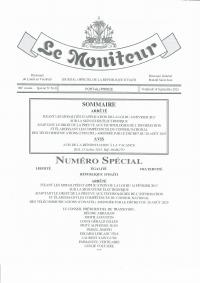
Le Moniteur, 180th year Special No. 58-D, 19 September 2025: arrêté setting the implementing rules for the electronic-signature law of 14 February 2017 as amended by the decree of 20 August 2025
Le Moniteur, 180th year, Special No. 58-D, of Friday 19 September 2025, carrying the arrêté given at the Palais National on 18 September 2025 by the Conseil Présidentiel de Transition, on the report of the Prime Minister and the Ministers of Public Works, Economy and Finance, Justice, and Commerce and Industry. The issue also carries a DGI vacancy notice (DOM/170, 15 July 2025).
The arrêté implements the law of 14 February 2017 on electronic signatures as amended by the decree of 20 August 2025. Chapter I states the object and what an electronic signature is for: guaranteeing a document's integrity, authenticating its author, and evidencing consent.
Chapter II sets three levels and their evidential weight. A Simple Electronic Signature identifies the signatory without particular security and carries weak weight, serving as a beginning of written proof until contested. An Advanced Electronic Signature ties the signature to its author using cryptographic keys and detects any alteration; it is admitted for private deeds, carries more weight than a simple signature, and handwritten signatures captured biometrically may qualify. A Qualified Electronic Signature rests on a qualified certificate created by a qualified device, carries the legal equivalence of a handwritten signature, and before a court counts as perfect literal proof. An electronic public act must meet the qualified-signature criteria and carry a secure verification code naming the platform where authenticity can be checked.
Chapter III sets the technical conditions for a signature-creation device to be deemed secure, including protection of private keys. Chapter IV sets the qualification regime for Trust Service Providers: application to CONATEL, technical requirements, conditions on directors and staff, and the duty to verify the identity and capacity of any person issued an electronic certificate against official documents and to retain copies. A certificate may not be made public without the holder's prior consent, and any change compromising system security must be detectable.
Supplied by the owner as a WhatsApp attachment on 2026-08-22. The Moniteur sweep of 2026-08-21 found no copy on any public site, which is the normal condition for a post-1983 issue: the gazette is digitised to 1983 and not after, so recent issues circulate as single files.
How to cite
Transitional Presidential Council of Haiti (CPT), Le Moniteur, 180th year Special No. 58-D, 19 September 2025: arrêté setting the implementing rules for the electronic-signature law of 14 February 2017 as amended by the decree of 20 August 2025, accessed via HaitiDocs, https://www.haitidocs.org/doc/moniteur-2025-09-19-special-58d-signature-electronique