Texte Intégral du Document
Texte extrait du document original pour l'indexation.
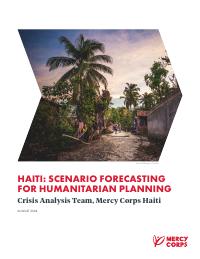
Photo Credit: Mercy Corps ©
HAITI: SCENARIO FORECASTING
FOR HUMANITARIAN PLANNING
Crisis Analysis Team, Mercy Corps Haiti
AUGUST 2024
MERCY CORPS Haiti Scenario Forecasting Report 2024 A 2
Contents
Purpose 3
Executive Summary 3
Background and Rationale 4
Objective 4
Methodology 5
Conflict Development Scenarios 6
Scenario 1 6
Scenario 2 8
Scenario 3 9
Repercussion Scenario 11
Scenario 4 11
List of Figures
Figure 1: Map of main land routes into and out of Port-au-Prince, showing the number of incidents impacting
humanitarian access since March 1, 2024.
Figure 2: Current market functionality, number of IDPs, and population with insufficient food consumption across
Haiti.
Figure 3: Current market functionality and number of IDPs in Port-au-Prince.
Figure 4: Scenario predicting a 25% increase in number of IDPs and a 25% reduction in market functionality
across Haiti.
Figure 5: Scenario predicting a 25% increase in number of IDPs and a 25% reduction in market functionality in
Port-au-Prince.
MERCY CORPS Haiti Scenario Forecasting Report 2024 A 3
Purpose
The purpose of this report is to outline three national-level conflict development scenarios and one repercussion
scenario for the second half of 2024, detailing associated changes in needs, humanitarian access and implications
for internally displaced persons (IDPs). The report concludes with several recommendations for mitigating challenges
faced by humanitarian responders.
Executive Summary
Since February 29, 2024, the rapidly changing national conflict unleashed by the gang coalition known as Viv
Ansanm in Haitian Kreyol has resulted in an unprecedented humanitarian crisis, necessitating an updated scenario
assessment for the remainder of the year 2024.
• The first and likely conflict development scenario sees a progressive enhancement in security due to the
deployment of the Multinational Security Support Team (MSS). The role of the MSS is to help the Haitian National
Police (PNH) secure main routes and zones of the Metropolitan area of Port-au-Prince, currently occupied and
controlled by Viv Ansanm. Securing routes and zones will increase accessibility into Port-au-Prince and allow
for emergency humanitarian assistance in high-risk areas where it has previously been challenging to maintain
support.
• The second and very likely conflict development scenario predicts a temporary escalation in conflict between
the PNH and Viv Ansanm forces, as the latter upscales its offensive and defensive tactics to combat MSS and
PNH operations to dismantle the coalition. This would lead to increased violence in zones of confrontation and
temporarily restricted access for humanitarian workers.
• The third and unlikely conflict development scenario is that Viv Ansanm members will infiltrate the southern
and northern departments of Haiti, blocking access in and out of the capital via main routes. This would bring
humanitarian access to a standstill and further impede vital supply routes for both humanitarian aid and the
local economy.
• The almost certain repercussion scenario predicts that the population of IDPs in Port-au-Prince will continue
to expand as violence escalates between Viv Ansanm and MSS and PNH forces. This would exacerbate
high economic stressors on local markets for host communities, predominately in the southern and northern
departments of the country.
Unless otherwise indicated, all images are the property of Mercy Corps ©
MERCY CORPS Haiti Scenario Forecasting Report 2024 A 4
Scale of likelihood
Very unlikely
The scenario is highly improbable and
would only occur in highly unusual
circumstances.
Unlikely
The scenario is within the realm of
possibility but is not expected.
Moderately likely
The scenario has an equal chance of
occurring or not occurring.
Likely The scenario is expected to occur.
Very likely
The scenario is highly probable and
would only not occur in unusual
circumstances.
Almost certain
The scenario is nearly inevitable based
on current trends and data.
Background and Rationale
The Humanitarian Needs and Response Plan (HNRP) 2024 reports a concerning increase in the number of Haitians
requiring humanitarian assistance, reaching 47% of the 11.7 million population. This represents a 5.8% increase
from 2023 and a 12.1% rise from 2022. Fueled by gang activity, violence has surged since President Moïse’s
assassination in 2021. Haiti now ranks “very high” on the Armed Conflict Location and Event Data (ACLED) risk
index due to its vulnerability to hazards and violence and its weak infrastructure.
In early March 2024, heightened insecurity due to gang violence amid a worsening political crisis disrupted the
capital of Port-au-Prince and exacerbated the humanitarian crisis in Haiti, displacing more than 300,000 people
from gang-controlled zones
1
and placing an estimated 8.5 million people at risk of acute hunger.
2
Insecurity has
further limited humanitarian access, and the turbulence has revealed the severe impediment that the lack of timely,
easily accessible information and analysis poses for response efforts, future planning, and coordination between
peer organizations. In this extremely volatile environment and given the limited governmental and institutional
capacity to analyze, prepare for, and respond to humanitarian needs, there is an urgent need to maintain a
steady flow of accurate information to the humanitarian community. This includes scenario forecasting related to
humanitarian responders and their modes of accessing targeted communities, together with the potential impact of
insecurity on emergency response capacity.
Objective
In response to this pressing need for timely information on humanitarian access, Mercy Corps’s Haiti Crisis Analysis
Team (CAT) has produced an accessibility-focused scenario forecasting report.
1 International Organization for Migration (IOM). 2024. ‘DTM Haiti — Key information on the internal displacement situation in Haiti — Round 7 (June 2024)’. IOM: Haiti.
2 World Food Programme (WFP). 2024. Hunger Map Live: Haiti insight and key trends .
MERCY CORPS Haiti Scenario Forecasting Report 2024 A 5
Methodology
The research conducted for this scenario forecast took place between June and July 2024, with secondary data
collected to support contextual analysis and assess the humanitarian landscape. Further information was gathered
through extensive primary data collection via social media monitoring and an examination of secondary data on
security entry points and supply routes throughout Haiti. Over a dozen key informant interviews (KIIs) were also
carried out with members of the Mercy Corps Haiti (MCH) team as well as peer (I)NGOs and local grassroots
organizations. These KIIs provided key insights into access challenges, entry points, and plausible scenario
forecasting for the situation in Haiti, which can be used to inform decision-making by the MCH team and partners.
“...We need to break down the steps of accessibility to say what
risks are there, what can we accept, from standardized data
collection procedures, and begin to look at how we share these
coordination strategies and data on accessibility amongst other
NGOs working in Haiti.” — Senior UN Staff Member
MERCY CORPS Haiti Scenario Forecasting Report 2024 A 6
Conflict Development Scenarios
Scenario 1
MSS forces help the PNH improve security in the Port-au-Prince region,
improving humanitarian access to gang-controlled zones and the most
vulnerable beneficiary communities.
Current situation: A multinational security support team (MSS) led by Kenya has been deployed to Haiti to
assist the Haitian National Police (PNH) in stabilizing Port-au-Prince, which continues to be severely impacted by
escalating gang violence and political instability. The first 400 Kenyan troops were deployed on June 25, marking
the first wave of 2,500 troops committed to the mission. The mission team is led by Kenyan forces and will be aided
by troops from the Bahamas, Bangladesh, Barbados, Benin, and Chad all of whom have pledged support for the
MSS and are expected to arrive in full by September 2024.
Forecasting: The conflict between Viv Ansanm and PNH forces began to escalate at the beginning of 2024, with
a massive spike in violent incidents between March and April compared to the previous 2023 conflict monitoring
cycle, leveling out in May 2024. Based on this trend, conflict trajectories assume there will be a minimal change in
the situation over the next three months (July to September 2024) and little increase in violent incidents between PNH
and Viv Ansanm. We may therefore deem it likely that MSS forces, working in partnership with the PNH, will weaken
the gang coalition’s hold over communities in Port-au-Prince. The consensus is that MSS and PNH operations will
have a higher impact in gang-controlled zones along Routes Nationales 1 and 2 than within communities like Cité
Soleil and Martissant, where gangs have a tighter grip on supply routes and stronger community ties. The operation
will likely also have a lower impact in Bas Delmas areas (2-30) compared to Delmas 75, Tabarre, and Carrefour
Aéroport, which serve as the main entry points for humanitarian workers to gang-controlled zones. Although the
MSS is predicted to be successful overall, its operations are unlikely to significantly improve humanitarian access
within the first three months of the forces’ initial deployment in July 2024. Indeed, limited improvement in this regard
is to be expected until the six- to nine-month mark.
Guiding assumptions: Through international and local governmental support, the MSS was able to secure $21
million in funding, including a substantial provision of equipment and training on combating gang violence for PNH
forces. With the support of the MSS, the PNH’s capacity to track, respond to, and prevent gang movements will be
greatly reinforced. Furthermore, the MSS’s training will help to foster strategic defensive and offensive procedures
mitigating risk to the PNH and civilians, ultimately lowering civilian casualties. A vital focus of the training is on the
use of parameter control to isolate conflict incidents and enforce greater security measures in surrounding areas.
What to expect
Targeted raids: Launch of targeted operations against known
gang leaders and strongholds, leading to high-profile arrests and
disruption of gang networks.
Increased patrols: Intensifying patrols in critical areas, reducing
gang mobility and influence.
MERCY CORPS Haiti Scenario Forecasting Report 2024 A 7
Aid access and modalities: Heightened security along major supply chain routes will improve access for
humanitarian interventions. However, due to the rapidly changing context of the conflict landscape in Haiti,
humanitarian actors should prepare for all eventualities by exploring alternative routes for acquiring and distributing
humanitarian aid.
Short-term considerations: The deployment of the MSS will strengthen the PNH’s capacity to respond to rusing
instability caused by the gang coalition, Viv Ansanm. More in-depth training geared toward dismantling the gang’s
stronghold in the capital will also enhance the PNH’s ability to implement lasting security measures and improve
public perception of the force within communities currently controlled by gangs.
Long-term considerations: It is important to note that maintaining stability will be impossible unless the MSS
implements long-term and sustainable security measures that can be maintained by the PNH independently. Failure
to do so prior to withdrawal will likely weaken the outcomes of the MSS mission.
Recommendations
(I)NGOs should consider partnering with local grassroots organizations to help secure entry
points and strengthen acceptance within target communities, particularly in areas where reclaiming
territory may take time or where the PNH may struggle to maintain its regained control. In addition,
alternative forms of intervention should be considered and strategizing scenarios drawn up to plan
for the eventuality of a complete blockade of humanitarian aid via the main land routes. These should
include solutions allowing local grassroots organizations, already accepted within their communities,
to take the lead in aid intervention with the financial and logistical support of (I)NGOs.
Figure 1. Map of main land routes in and out of Port-au-Prince, showing the number of incidents
impacting humanitarian access since March 1, 2024. (Source: ACLED 2024/Mercy Corps)
MERCY CORPS Haiti Scenario Forecasting Report 2024 A 8
Scenario 2
A rise in conflict between the PNH, aided by the MSS, and the Viv Ansanm
coalition, which will temporarily and sporadically limit access to controlled
zones where conflict is occurring but which remain accessible to humanitarian
aid workers. An upscale of tactical operations by the PNH is very likely to result
in an intensification of violence against communities in these zones, constricting
movement and access to humanitarian assistance for their residents.
Current situation: As of May 2024, the metropolitan area of Port-au-Prince is experiencing a period of relative
calm. This follows the sharp escalation in violence from February to April of this year, directed at both the PNH
and the Haitian population, during which the main routes of access to affected populations were either restricted
or completely cut off. The present stalemate between the PNH and Viv Ansanm has allowed minimal humanitarian
intervention to resume, predominately in IDP host communities, including the Solino, Lalue, and Tabarre areas.
Despite this improvement, the security situation remains tense and unpredictable, with new accessibility challenges
emerging daily.
Forecasting: Given the historical volatility in Port-au-Prince and recent conflict patterns, the situation is likely to
remain unstable. The current forecast indicates a high probability of intermittent flare-ups of violence, with tension
and unpredictability in the security situation continuing to significantly impact humanitarian operations. Although
a level of access has been restored, the risk of violence and route closures remains high, rendering aid delivery
inconsistent and putting both aid workers and beneficiaries at risk.
Guiding assumptions: The central strategy of the Viv Ansanm gang coalition has historically involved switching
between offense and defense tactics in responding to PNH operations. This cat-and-mouse game has given rise
to sporadic and unpredictable incidents of conflict that are difficult to anticipate. Preparation for rapid response in
target communities is therefore key to addressing humanitarian needs as and when an incident occurs.
Aid access and modalities: Heightened conflict will significantly disrupt humanitarian operations in the gang-
controlled zones of Martissant, Cité Soleil (i.e Brooklyn, Village de Dieu), and the Croix-des-Bouquet regions
(Cannan and Croix-des-Paix). Aid workers in these zones may face restricted access, which will hinder the delivery
of essential services and supplies. An escalation of violence will also have a significant impact on local communities,
rendering them more vulnerable and restricting their movement and ability to access aid.
Short-term considerations: As channels and
networks for accessing and providing humanitarian
aid are constricted, the need for humanitarian
assistance will increase. This forecast presumes a
need for INGOs to implement partnerships with local
NGOs working in IDP camps and gang-controlled
zones where access is more challenging.
Long-term considerations: This forecast assumes
that the violence will slowly decrease as the PNH
regains control of Viv Ansanm territory and opens up
Vehicles destroyed during gang violence in Port-au-Prince, March 2024. © Reuters
MERCY CORPS Haiti Scenario Forecasting Report 2024 A 9
previously inaccessible routes. Nonetheless, given the instability of the socio-political environment, it is recommended
that humanitarian organizations consider and be ready to deploy alternative pathways for providing aid. Long-term
planning should also include support for local community leaders and associations with experience in aid provision
in the event that INGOs are unable to access gang-controlled locations.
Recommendations
Scenario 3
Although unlikely, there is a possibility that the Viv Ansanm gang coalition will
infiltrate the southern and northern departments of Haiti through Routes
Nationales 1 and 2, effectively blocking all access to and from the capital. This
blockade would severely disrupt humanitarian aid delivery and further
exacerbate already the fragile supply routes on which humanitarian operations
and the local economy rely.
Current situation: Since late 2023, the Viv Ansanm gang coalition has made numerous attempts to enter the
southern departments of Haiti through the town of Gressier, located about 12 miles southwest of Port-au-Prince.
In 2024, they made a further bid to access the country’s northwest, this time through the town of Ganthier. The
accompanying violent attacks on small towns surrounding the Routes Nationales 1 and 2 have raised concerns
about potential scenarios if the gangs are successful in infiltrating departments outside of the capital. Given the
centralization of the Haitian economy and infrastructure in Port-au-Prince, violence beyond its bounds poses
multifaceted logistical challenges for importing and exporting goods and resources. The various gangs operating
in the capital currently control routes of the supply chain to and from the country’s north (accessing supplies from
the Dominican Republic) and south, and are in constant conflict with port authorities (Custom Port Services) in
the main fuel terminal of Port-au-Prince, Verreux. As a result, supply routes into and out of the city are no longer
secure or reliable, and this has a detrimental impact on northern and southern provinces, specifically on commerce
conducted by the majority of the Haitian population. This impact has been felt in local market systems throughout
Haiti, while also impeding the ability of humanitarian aid responders to access and distribute their supplies.
Forecasting: Although it remains unlikely that the gang coalition’s forces will be able to enter previously unoccupied
regions of the north and south, the possibility cannot be ruled out and should be factored into humanitarian plans.
In the event that Viv Ansanm does expand its control into the north and south, its primary targets would likely be the
smaller, national airports of Jacmel and Les Cayes, together with the two city’s ports, and the city of Jérémie, located
in the Grande Anse. All of these locations have previously been connected with narcotics and weapons trafficking
by gangs, who use the sites of economic interest minimally and in secrecy to avoid detection. If the gangs were
(I)NGOs should establish robust monitoring mechanisms to track the evolving conflict and its impact
on controlled zones, and increase knowledge sharing between local and international partners
to stay informed about changes in the security landscape. There is also a need to develop and
update contingency plans for restricted access to controlled zones and identify alternative routes
and methods for delivering aid to affected communities. Finally, (I)NGOs are recommended to liaise
with the PNH to secure timely information about potential access restrictions, while advocating for the
protection of humanitarian corridors and safe passage for aid workers and beneficiaries.
MERCY CORPS Haiti Scenario Forecasting Report 2024 A 10
to further secure their control of Routes Nationales
1 and 2, while also taking control of one or more
ports in the south, there could be a blockade of such
a magnitude as to severely impact humanitarian
operations, restricting the flow of essential supplies
and services to and from the capital. Such a blockade
would also significantly disrupt the local economy,
leading to shortages of goods, increased prices, and
heightened economic instability.
Guiding assumptions: Since 2023, and prior
to the formation of the Viv Ansanm gang coalition,
gangs in Haiti have been progressively moving
beyond Port-au-Prince and attacking points in the country’s southwest, seeking to strengthen their hold on national
supply chain routes and expand their areas of control. As of July 2024, several gangs from the neighboring town
of Mariana have sought to restrict movement to and from the south via Route Nationale 2 by staging attacks
on boats entering the harbor in Mariana and on the local community. The onset of large-scale and coordinated
attacks by Viv Ansanm in late February 2024 has made it significantly more difficult for humanitarian organizations
to receive supplies and implement interventions. Access into or around gang-controlled zones has since become
the foremost challenge for humanitarian actors in Haiti. The accompanying disruptions in the supply chain have
revealed the fragility of existing supply routes and the need for a more harmonized humanitarian approach to a
rapidly changing conflict setting. Given the unpredictability of the conflict dynamics in Haiti, alternative strategies
are crucial to prepare and plan for all eventualities and meet the growing humanitarian needs.
Aid access and modalities: As was demonstrated at the start of the crisis in March 2024, restricted access or
complete inaccessibility to these crucial supply chain routes would disrupt humanitarian interventions of all kinds.
Immediate action is therefore required to address the anticipated blockade. Humanitarian organizations and local
authorities should prepare contingency plans and seek alternative routes to mitigate the impact of a reduction in
access.
Short-term considerations: With their response times greatly limited at present by the critical humanitarian
access situation, (I)NGOs will need to work with local grassroots organizations and/or associations to implement
their projects. They should also consider initiatives to stimulate local economies and assist local organizations to buy
and distribute aid within their communities independently. This will reduce security risks for both (I)NGO personnel
and receiving communities.
Recommendations
Pre-position essential supplies and resources in strategic locations outside the blockade area to
ensure continued access to aid. Increase stockpiles of critical supplies within the capital to mitigate
the immediate impact of the blockade. Explore initiatives for strengthening the resilience of local
communities and authorities and building their capacity to manage the blockade. Provide local
organizations with training and resources to enhance their ability to operate under restricted
conditions.
Food delivery in Port-au-Prince, 2010. © Mercy Corps
MERCY CORPS Haiti Scenario Forecasting Report 2024 A 11
Repercussion Scenario
Scenario 4
The IDP population will increase as more individuals in gang-controlled zones
flee conflict. Many IDPs will not return to their previous homes even if the PNH
reclaims control of the zone.
Current situation: An estimated 160,000 individuals displaced from gang-controlled zones of the capital now
reside in other areas of the Port-au-Prince metropolitan area. Beyond its bounds, an additional 578,074 IDPs
have moved further afield and are now dispersed throughout the northern and southern departments of Haiti. The
expanding conflict has left many IDPs stripped of assistance, mainly in high-risk areas surrounding controlled zones.
During Mercy Corps’s key informant interviews with IDPs and representatives of the International Organization for
Migration (IOM), interviewees noted the challenge of finding secure locations where humanitarian assistance could
be delivered. Indeed, residents of IDP camps in the Port-au-Prince metropolitan area said they had so far received
minimal assistance due to the camps’ proximity to gang-controlled zones, which places aid workers delivering
support to communities at significant risk.
Forecasting: With the conflict between Viv Ansanm and the PNH likely to increase following the MSS’s deployment
in July 2024, the next three months will be critical for IDPs in Haiti. Should the conflict expand into areas surrounding
the IDP camps, already displaced individuals may be forced to relocate once again. To be effective, relocation
strategies and humanitarian interventions will need to be flexible and capable of responding to a rapidly evolving
context, which places IDPs in a perpetual state of flux. As the number of IDPs increases, host communities will
find their already strained resources periodically depleted as IDPs move in and out of the area. As a result, local
markets in host communities will continue to experience emergency stressors in an already fragile market economy.
Since May 2024, the inflation rate in Haiti has risen to 28%, while limited imports and exports have led to a
decline in overall GDP since February 2024. The pressure an influx of IDPs would place on the already insufficient
market system will further weaken the financial resilience of host communities and pose a wider challenge for the
humanitarian response. As IDPs continue to flee gang-controlled zones for the Haitian provinces, humanitarian
Figure 2. Current market functionality, number of IDPs, and
population with insufficient food consumption across Haiti.
(Source: WFP 2024/Mercy Corps)
Figure 3. Current market functionality and number of IDPs
in Port-au-Prince. (Source: IOM 2024/Mercy Corps)
MERCY CORPS Haiti Scenario Forecasting Report 2024 A 12
workers’ capacity to track and relocate beneficiaries in need of assistance, as well as provide long-term solutions
for IDPs who do not return, is certain to be greatly restricted.
Guiding assumptions: At the beginning of the crisis in early March 2024, most IDPs fleeing Port-au-Prince and
the surrounding gang-controlled regions were accepted by host families. Only approximately two in ten remained
in sites where residents had formerly fled during a spike in the conflict in 2022. By 2023, the number of IDPs
remaining in these sites rose to six in ten, an increase primarily due to the limited resources of host communities and
resulting decline in social cohesion.
Aid access and modalities: Heightened
insecurity in host localities following the arrival
of IDPs reflects a lack of trust in outsiders coming
from gang-controlled zones and the challenge
of cultivating a harmonious environment
between IDPs and host communities. This can
exacerbate security risks in conflict zones or
unstable areas, placing humanitarian workers
in danger. Increased violence and conflict can
also restrict access to certain areas, complicating
aid delivery. Finally, the continual movement
of IDPs can make it difficult for humanitarian
organizations to locate and provide consistent
aid to target beneficiaries.
Short-term considerations: The sudden
population increase in host communities will
put pressure on local resources, services, and
infrastructure, potentially straining relations
between IDPs and host community members.
CPT Impact: This scenario forecasting analysis takes
into account the probable involvement of the Transitional
Presidential Council (CPT) and newly elected government
officials in scenario planning efforts coordinated with
the MSS and PNH. While recognizing the Haitian
government’s efforts to strengthen national security
measures and effectively reinforce governmental authority
in gang-controlled zones, the report also acknowledges
constraints on the government’s ability to respond rapidly,
both due to insufficient capacity and lack of readily
available resources. A scenario forecast focused on CPT
policies cannot, therefore, yet be determined. Based on the
collaborative efforts of the CPT since July 2024, however,
it is likely to allocate the PNH resources for securing
borders and ports and strengthening regulations on
imported goods. These measures will help to limit weapons
trafficking, which fuels gang violence. Additionally, the
PNH will enhance security efforts to reclaim controlled
territories and secure routes and neighborhoods. These
actions are expected to reduce violence and improve
humanitarian access in gang-controlled zones.
Figure 4. Scenario predicting a 25%
increase in the number of IDPs and a 25%
reduction in market functionality across Haiti.
(Source: WFP 2024/Mercy Corps)
Figure 5. Scenario predicting a 25% increase
in number of IDPs and a 25% reduction
in market functionality in Port-au-Prince.
(Source: IOM 2024/Mercy Corps)
MERCY CORPS Haiti Scenario Forecasting Report 2024 A 13
Overcrowding may lead to a deterioration in living standards, bringing with it associated health risks, poor sanitation,
and competition for basic necessities. The local market economy may also be disrupted by increased demand and
competition for resources. As IDPs move into the southern regions of Haiti, including areas like Sud, Grand’Anse,
and Nippes, they may encounter communities already burdened by previous displacement and natural disasters
such as hurricanes and earthquakes. Increased circulation of IDPs can exacerbate security issues including crime
and violence, further complicating relocation efforts.
Long-term considerations: The surge in IDPs will place humanitarian resources and services under significant
pressure. IDPs’ inability or unwillingness to return to their homes will aggravate long-term displacement challenges,
requiring sustained humanitarian support and potentially feeding into protracted displacement cycles.
Recommendations
Implement programs to support the local economy and boost economic resilience, such as cash-for-
work initiatives, microfinance opportunities, and small business support. Facilitate market access for
IDPs and host community members, ensuring fair competition and the availability of goods. (I)NGOs
are also recommended to form partnerships with local grassroots organizations whose members
include both local leaders and representatives of the IDP population in their areas. This will help to
promote harmonized integration and relocation initiatives and foster acceptance of IDPs within host
communities.
MERCY CORPS Haiti Scenario Forecasting Report 2024 A 14
CONTACT
Crisis Analysis, Haiti
crisisanalysis@mercycorps.org
45 SW Ankeny Street
Portland, Oregon 97204
888.842.0842
mercycorps.org
About Mercy Corps
Mercy Corps is a leading global organization
powered by the belief that a better world is possible.
In disaster, in hardship, in more than 40 countries
around the world, we partner to put bold solutions into
action — helping people triumph over adversity and
build stronger communities from within.
Now, and for the future.
This document is intended for humanitarian
purposes only. Mercy Corps Crisis Analysis
provides impartial analysis that does not
necessarily reflect the opinion of Mercy Corps
as an organisation.