Texte Intégral du Document
Texte extrait du document original pour l'indexation.
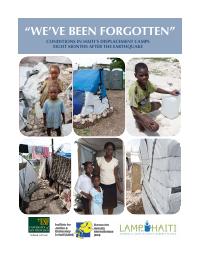
“WE’VE BEEN FORGOTTEN”
CONDITIONS IN HAITI’S DISPLACEMENT CAMPS
EIGHT MONTHS AFTER THE EARTHQUAKE
The LAMP for Haiti Foundation
P.O. Box 39703
Philadelphia, PA 19106 USA
Tel: 267 295 2822
Fax: 267 295 2822
admin@lampforhaiti.org
www.lampforhaiti.org
!
Institute for Justice & Democracy in Haiti (IJDH)
Bureau des Avocats Internationaux (BAI)
Lawyers’ Earthquake Response Network (LERN)
P.O. Box 52115
Boston, MA 02205
Tel: 617 652 0876
info@ijdh.org
www.ijdh.org
University of San Francisco School of Law,
Center for Law and Global Justice
Kendrick Hall, 328
2130 Fulton Street
San Francisco, CA 94117-1080
Tel: 415 422 6304
globaljustice@usfca.edu
http://www.usfca.edu/law/clgj
Copyright © 2010
All rights reserved
Photographs: Phillip Goldsmith (IJDH)
Cover Design: Alexa Lehman (IJDH)
!
“WE’VE BEEN FORGOTTEN”
CONDITIONS IN HAITI’S DISPLACEMENT CAMPS
EIGHT MONTHS AFTER THE EARTHQUAKE
List of Figures.................................................................................................................................
Executive Summary...................................................................................................................1
Introduction.................................................................................................................................2
Methodology..............................................................................................................................3
Survey Results and Discussion...................................................................................................5
1. Right to Adequate Food................................................................................................6
2. Right to Clean Water.....................................................................................................8
3. Right to Dignified Sanitary Environment.....................................................................10
4. Right to Safe and Decent Housing.............................................................................12
5. Right to Humanitarian Assistance...............................................................................14
6. Right to Health and Medical Care.............................................................................16
7. Right to Physical Integrity.............................................................................................18
8. Right to Protection From and During Displacement.................................................20
9. Right to Self-Sufficiency................................................................................................23
10. Right to Education........................................................................................................25
11. Right to Participation....................................................................................................26
Conclusions and Recommendations.....................................................................................27
Appendix A: Acknowledgments............................................................................................30
Appendix B: The Camps and Families, July 2010.................................................................31
1. Place St. Pierre in Pétionville........................................................................................31
2. Acra Camp in Delmas..................................................................................................32
3. Diquini / Adventist University of Haiti Campus in Carrefour.....................................34
4. Champ de Mars in Port-au-Prince..............................................................................36
5. Bouzi and Aux Ambères Camps in Croix-des-Bouquets...........................................38
6. Parc La Couronne in Cité Soleil...................................................................................39
Appendix C: Food in February vs. July 2010.........................................................................41
Appendix D: Water in February vs. July 2010........................................................................41
Appendix E: Housing in February vs. July 2010.....................................................................42
Appendix F: Assistance in February vs. July 2010.................................................................42
Appendix G: Displacement in February vs. July 2010..........................................................43
Appendix H: Income Earned in February vs. July 2010........................................................43
Appendix I: Subjective Perceptions of Progress...................................................................44
!
TABLE OF CONTENTS
!
Figure 1: Main Source of Food..................................................................................................7
Figure 2: Frequency of Skipping Meals by Household Member............................................7
Figure 3: Source of Drinking Water / Frequency of Bottled Water Purchase........................9
Figure 4: Possession of Basic Living Materials........................................................................13
Figure 5: Health and Medical Problems.................................................................................17
Figure 6: Initial and Ongoing Causes of Displacement........................................................21
Figure 7: Current Source of Income / Current Source of Cash Gifts....................................24
!
LIST OF FIGURES
! 1
!
!EXECUTIVE SUMMARY
!
This report presents findings from a five-
month follow-up of 90 Haitian families
displaced by the January 12, 2010
earthquake. The initial survey was
conducted in six displacement camps
in February 2010. The resulting report,
Neglect in the Encampments: Haiti’s
Second-Wave Humanitarian Disaster,
was presented to the Inter-American
Commission on Human Rights in
Washington, D.C. on March 23, 2010.
A second survey conducted in July compared
how living conditions in the camps measured
against human rights standards set forth under
the Haitian Constitution and international law
on the treatment of displaced persons. Fifty-
two of the original families were located and
interviewed, yielding the following evidence of
systematic human rights violations:
!
• Food. 75% of families had someone go an
entire day without eating in the past week
and over 50% indicated that their children
did not eat for an entire day
! Clean Water. 44% of families primarily
drank untreated water
! Sanitary Environment. 27% of families
defecated in a container, a plastic bag, or
on open ground in the camps
! Housing. 78% of families lived without
enclosed shelter
! Health. There were 245 independently
listed health problems among 45 families
! Protection From and During Displacement.
94% of families felt they could not return
home while 48% had been threatened
with forced eviction since the earthquake
! Self-Sufficiency. 37% of families did not
have a single family member with a full-
time job, a part-time job, a cash-for-work
arrangement, or self-employment
!
Our results indicate that aid has slowed and even
stopped in each of the six camps surveyed, making
life far worse for most of the families. This report
makes the following nine recommendations:
1. Quickly disburse aid necessary to achieve
and maintain a life of basic dignity
2. Follow the UN Guiding Principles on Internal
Displacement
3. Promote participation from camp residents
in needs assessment and aid distribution
4. Require that donors be accountable to aid
recipients
5. Coordinate with the Government of Haiti
6. Encourage self-sufficiency through
employment opportunities
7. Source food aid locally to support local
economy
8. Improve and expand provision of sturdy,
safe shelter for camp residents
9. End the policy and practice of forced
evictions
We encourage the Government of Haiti, donor
states and international aid agencies to allocate
more of their resources to meet the basic needs of
Haitians living in camps and adopt a rights-based
approach to relief and reconstruction.
!
!
!
!!"#$%&!'()&%!#*!+),-.-/%0!1&%2&/!3-!4-(5)//-5!364+#76-5!4)*(!(67+#.-(!3-5!+),-.-/%5!367-/%5"#$%&'()('**'"#+',&'-.'(#!/"#0/!/"#
#8#&+#9+-!#%!1&&,2334445('%6'74'.568&3(43(4.58*739.://+;<3=>?;@A:AB:CD?,'8<EFG-'8&HI++0/J/05#0#KE(#-E('#687E(-L&6E8#E8#&1'#K'.(GL(M#*G(N'M#L89#768968O*"#5--!:-,+-7%!&/!%;-!</7#.4.-/%50!"#&%&=5!1-7)/32>#8-!"*.#/&%#(&#/!
'&5#5%-("#;P<Q"#=L(F1#0R"#0/!/"##8#&+#9+-!#%!1&&,2336S915E(O3L(F16N'*3!/TU!#V1'('68L7&'(#:-,+-7%!&/!%;-!</7#.4.-/%5W5#
R#?8#K'.(GL(M#0"#0/!/"#&1'#;8&'(@$-'(6FL8#>E--6**6E8#E8#QG-L8#I6O1&*#6**G'9#L#,('**#('%'L*'#X('-689V68OW#&1'#QL6&6L8#
OEN'(8-'8&"#&1'#68&'(8L&6E8L%#FE--G86&M"#&1'#8E8@OEN'(8-'8&L%#E(OL86YL&6E8*#L89#&1'#-L8M#NE%G8&''(*#E8#&1'#O(EG89"#E7#&1'#
6-,E(&L8F'#E7#('*,'F&68O#68&'(8L&6E8L%#1G-L8#(6O1&*#E.%6OL&6E8*#68#L%%#F6(FG-*&L8F'*"#68#,L(&6FG%L(#8E8@9'(EOL.%'#(6O1&*#L89#&1'#
(6O1&*#E7#&1E*'#-E*&#NG%8'(L.%'5Z#;8&'(@$-'(6FL8#>E--6**6E8#E8#QG-L8#I6O1&*"#?@"AB!1%(-55-5!'*%C!%)!B-54-7%!"*.#/!B&,;%5!
'*(&/,!%;-!<.-(,-/7C!&/!"#&%&"#K'.(GL(M#0"#0/!/"##8#&+#9+-!#%!1&&,2334445F6915E(O3>E-G86FL9E*3[8O%6*130/!/3!!@!/'8O51&-5#
INTRODUCTION!
Eight months after the January 12, 2010
earthquake, over 1.3 million Haitians
continue to live in approximately 1,300
makeshift camps in and around Port-au-
Prince.1 Under the Haitian Constitution
and international law, these displaced
Haitians have individual and collective
rights to a basic standard of living, which
includes adequate shelter, water, food,
sanitation, and health, as well as
employment, education, family unity,
and freedom from discrimination on the
basis of gender or displacement status.
In February 2010, a survey of 90 families chosen
at random from six internally displaced persons
(IDP) camps indicated that residents’ basic
human rights were being violated. The report
concluded, “Almost universally, those surveyed
in the camp stated that the distribution of aid
was totally lacking, incomplete, or seemingly
arbitrary.”2
In July 2010, 52 of the 90 original families were
located and interviewed a second time to
document changes in their living conditions and
family’s circumstances over time. The survey
found that daily life remained a struggle and
their basic rights to housing, food, water, and an
adequate standard of life continued to be
comprehensively violated.
While the Government of Haiti bears the primary
duty to protect the economic and social rights
of its citizens, donor states and relief agencies
must also meet certain standards in carrying out
assistance to Haiti. This obligation arises from
international law but also from the extent of
devastation to the Government’s capacity to
perform many of its core functions; the levels of
assistance being pledged ($5.3 billion for
immediate reconstruction at the March 31, 2010
donors’ conference); and the fact that the
international community now maintains a
significant role in providing basic services in
Haiti.
!
2!
!
At minimum, donor states have a duty to
respect the human rights of all Haitians by
adopting a rights-based approach to
assistance. Moreover, member States of the
Organization of American States (OAS) have
binding human rights obligations while acting in
Haiti under the OAS Charter, the American
Declaration on the Rights and Duties of Man,
and the American Convention on Human
Rights. All those involved in relief efforts have a
duty to ensure their actions inflict no harm by
meeting basic standards for transparency,
accountability, participation, capacity building,
and non-discrimination.
Instead, the July survey confirmed piecemeal
coordination, sluggish aid, and inadequate
protection of displaced Haitians.3 Camp
residents suffer relentless heat during the day
compounded by lack of clean drinking water
and limited access to medical care for chronic
and acute medical conditions. Their tents and
tarps are too small to contain the families, some
of whom have been forced to live apart.
People are not consulted about their needs
and aid has trickled to a halt in most camps.
People cannot find enough to eat and there
are limited opportunities for people to work and
support their families. The recurrent threat of
eviction only adds to stress. Despite the massive
outpouring of international aid, in the words of
one man, “it’s as if we are forgotten.”
!
!
Initial Survey – February 2010
This report is in follow-up to Neglect in the
Encampments: Haiti’s Second-Wave
Humanitarian Disaster, which presented data from
a study conducted six weeks after the January 12
earthquake. In February 2010, the LAMP for Haiti
Task Force4 interviewed 90 family heads5 selected
at random from six internally displaced persons
(IDP) camps in and around Port-au-Prince:
! 22 families in Place St. Pierre in Pétionville
! 23 families in Acra camp in Delmas
! 11 families in Diquini / Adventist University
of Haiti (ADUH) in Carrefour
! 12 families in Champ de Mars in Port-au-
Prince
! 9 families in Bouzi camp in Croix-des-
Bouquets, and
! 13 families in Parc La Couronne in Cité
Soleil.6
One of the study’s chief’objectives was to
measure the international community’s
effectiveness in delivering aid by interviewing a
small cross-section of families living in IDP camps.
The resulting report was presented to the Inter-
American Commission on Human Rights in
Washington, D.C. on March 23, 2010.
Another, more fundamental objective was to give
voice to people whose suffering is compounded
by their exclusion from decision-making, including
about how aid should be distributed. To that end,
the February survey laid the groundwork to follow
the same individuals over time and track changes
in their family’s physical, social, and economic
well-being. The 90 respondents were not viewed
as anonymous subjects but people to whom
short-term and long-term accountability was
owed.
!
Follow-Up Survey – July 2010
From July 12-19, 2010, a second team of investigators7
followed up with the original 90 families. In
preparation for the interviews, the original survey was
redesigned to reflect knowledge gained in February,
evolving facts on the ground in Haiti, and insight from
post-quake surveys administered by other
organizations.8 The July survey sought to obtain the
following information:
• Access to adequate food and drinking water
• Bathing, hygiene and sanitation arrangements
• Shelter and living arrangements
• Adequacy of recent aid distribution efforts
• Health status and access to medical services
• Sense of physical safety and security
• Displacement status, including forced
evictions
• Current and future job prospects, including
cash-for-work programs
• Sense of civic and political participation
• Household composition and cohesion
!
\#]1E-L*#=5#B(67768"#[*^5"#&1'#<6('F&E(#E7#&1'#_$=)#7E(#QL6&6#KEG89L&6E8"#*G,'(N6*'9#!\#QL6&6L8#FE%%'O'#*&G9'8&*#7(E-#&1'#QL6&6L8#[9GFL&6E8#H#
_'L9'(*16,#)(EO(L-#`Q[_)a5#KE(#-E('#687E(-L&6E8#E8#K'.(GL(M#*G(N'M#-'&1E9*"#5--!:-,+-7%!&/!%;-!</7#.4.-/%5"#5*4(#!8E&'#05#
b#XKL-6%MZ#4L*#9'768'9#L*#X'N'(ME8'#41E#('OG%L(%M#*%'',*"#'L&*"#L89#%6N'*#&EO'&1'(#L*#L#7L-6%M#G86D#&1'#,%LF'#41'('#MEG#L('#FG(('8&%M#*&LM68O5Z#
T#;8#%L&'#=L(F1"#&1'#8G-.'(#E7#;<)*#%6N68O#68#&1'#*6c#*'%'F&'9#FE--G8'*#4L*#'*&6-L&'9#L&#!//"///#&E#!R/"///#,'E,%'"#LFFE(968O#&E#&1'#;8&'(8L&6E8L%#
?(OL86YL&6E8#7E(#=6O(L&6E83>L-,#>EE(968L&6E8#L89#>L-,#=L8LO'-'8&#>%G*&'(#QL6&6#`>>>=#>%G*&'(a5#;*#96776FG%&#&E#E.&L68#FG(('8&#'*&6-L&'*#7(E-#&1'#
>>>=#>%G*&'(#*68F'#,G.%6F#LFF'**#&E#6&*#4'.*6&'#6*#%6-6&'95#
U#d6FE%'#)16%%6,*"#[*^5"#;P<Q#+&L77#$&&E(8'M#L89#FEE(968L&E(#E7#&1'#QL6&6#QG-L8#I6O1&*#)(EO(L-#L&#&1'#e86N'(*6&M#E7#+L8#K(L8F6*FE#+F1EE%#E7#_L4#`e+Ka"#
*G,'(N6*'9#&1'#PG%M#68N'*&6OL&6E85#]1'#&'L-#FE8*6*&'9#E7#*'N'8#E7#&1'#E(6O68L%#QL6&6L8#FE%%'O'#*&G9'8&*#7(E-#Q[_)"#&4E#e5+5#L89#QL6&6@.L*'9#L&&E(8'M*"#
E8'#%L4#,(E7'**E("#L89#7EG(#%L4#*&G9'8&*5#dL-'*#L89#('*,'F&6N'#68*&6&G&6E8*#L,,'L(#G89'(#$,,'896c#$2#$Ff8E4%'9O'-'8&*5#
A#KE(#L#FE,M#E7#&1'#PG%M#*G(N'M"#5--!QL6&6#;<)#+G(N'M"#PG%M#0/!/"##8#&+#9+-!#%!1&&,2336S915E(O3L(F16N'*3!\T\!5#
!
METHODOLOGY 3
!
!
!
!
4!
DATA COLLECTION
Forty-three interviews were conducted in-person at the camps. Nine respondents were unavailable
and their interviews were conducted by phone. Each interview team consisted of at least one HELP
student, who read the survey questions to the respondent in Haitian Creole and then translated the
responses into English, and one USF law student or lawyer who recorded the responses in English.
The investigative team obtained permission to enter each camp and interview residents from at least
one member of the camp committees in Place St. Pierre, Acra, Diquini/Adventist University of Haiti,
and Parc La Couronne. At Champ de Mars, the team was unable to locate a camp committee and
permission was obtained from representatives of KOFAVIV, a woman’s organization with a leadership
role in the camp. At Bouzi, permission was obtained from the property owner.
CONSENT
A team of Haitian students attempted to contact all
90 families by telephone to arrange in-person
interviews. Of the 90 original families, just 52 could be
located (57%):
! 11 of 22 who had been in Place St. Pierre (50%)
! 12 of 23 in Acra (52%)
! 8 of 11 in Diquini/Adventist University of Haiti (73%)
! 9 of 12 in Champ de Mars (75%)
! 5 of 9 in Bouzi (56%)
! 7 of 13 in Parc La Couronne (54%).
All participants consented to be interviewed and were told
that they would not be compensated for participating in
the study.
!
DATA ANALYSIS
The survey results were entered into Microsoft
Excel and analyzed by the Inspire Team, a
volunteer group of Boston consultants working
with the Institute for Justice & Democracy in
Haiti (IJDH).9
Despite the limited sample size, the survey
revealed a number of factors contributing to
the families’ ongoing sense of displacement
and disintegration. The degree of loss to
follow-up suggests ongoing disruption caused
by the earthquake and subsequent policy
decisions at national and international levels.!
:#g(6*&L#dM%'8#E7#&1'#;P<Q#+&(L&'OM#L89#$8L%M&6F*#]'L-#L89#+L(L1#=6#IL#<EGO1'(&M#E7#;P<Q#L89#&1'#_L4M'(*h#[L(&1^GLf'#I'*,E8*'#
d'&4E(f#`_[Ida#*G,'(N6*'9#L#&'L-#E7#NE%G8&''(#iE*&E8@.L*'9#L8L%M*&*#L89#FE8*G%&L8&*5#dL-'*#L89#('*,'F&6N'#68*&6&G&6E8*#L,,'L(#68#
$,,'896c#$2#$Ff8E4%'9O-'8&*5#
!
!
Legal Framework of Human Rights
International Law
The Haitian government has ratified the following international human rights instruments bearing
directly on the rights of displaced Haitians: (1) the International Covenant on Civil and Political Rights
(ICCPR); (2) the Convention on the Elimination of all Forms of Discrimination Against Women
(CEDAW); and (3) the Convention on the Rights of the Child (CRC).10 As a member-nation of the
Organization of American States (OAS) Haiti also is bound to uphold the tenets of the American
Convention on Human Rights (ACHR).11 While Haiti is not a signatory to the International Convention
on Economic, Social and Cultural Rights (ICESCR), the following analysis invokes certain provisions to
the ICESCR based on the wide-spread recognition and respect afforded ICESCR conventions by
members of the international community. Likewise, the following analysis draws on the Universal
Declaration of Human Rights (UDHR), which provides one of the bases for international human rights
standards.
Constitution of Haiti
In addition to all of the international and regional human rights instruments, Haiti has enshrined in its
Constitution certain basic human rights, for example, the right of every citizen “to decent housing,
education, food and social security.”12 The Constitution also provides that international treaties or
agreements that have been approved and ratified are self-executing and automatically become
part of the law of the country.13 Accordingly, Haiti’s constitutional protections should be interpreted
consistent with its international human rights obligations.14
Human Rights Norms and Standards for Displaced Persons
Both the Guiding Principles on International Displacement (Guiding Principles),15 published by the
United Nations Office for the Coordination of Humanitarian Affairs, and the Sphere Project's Minimum
Standards in Disaster Response (Sphere Standards)16 are designed to guide governments,
international organizations and other relevant actors in providing assistance and protection to
Internally Displaced Persons. Though neither the Guiding Principles nor the Sphere Standards operate
alone to bind State actors, these canons amplify prevailing international practices and are
increasingly included in restatements of binding international law.
!
!/#QL6&6#(L&676'9#>[<$j#68#!:A!"#;>>)I#68#!::!#`.M#LFF'**6E8a#L89#&1'#>I>#68#!::b5#1--#ed#]('L&M#>E%%'F&6E8#<L&L.L*'*"#+&L&G*#E7#
IL&676FL&6E8*"##8#&+#9+-!#%#1&&,233&('L&6'*5G85E(O3)LO'*3]('L&6'*5L*,cD#69J\H*G.69J$H%L8OJ'85#!!#QL6&6#(L&676'9#&1'#$>QI#68#!:UU51--!1&&,2334445F6915EL*5E(O3iL*6FE*3[8O%6*13iL*6F5]?>51&-5#
!0#!:AU#>E8*&6&G&6E8#E7#QL6&6"#$(&6F%'#00#V1'('68L7&'(#A)/5%&%*%&)/W5#
!R#?35#L&#L(&5#0UT@05#
!\#]1'#C6'88L#>E8N'8&6E8#E8#&1'#_L4#E7#]('L&6'*#7G(&1'(#('^G6('*#&1L&#DVLW#,L(&M#V&E#L8#68&'(8L&6E8L%#&('L&MW#-LM#8EDNEf'#&1'#
,(EN6*6E8*#E7#6&*#68&'(8L%#%L4#L*#SG*&676FL&6E8#7E(#6&*#7L6%G('#&E#,'(7E(-#L#&('L&M5#EC6'88L#>E8N'8&6E8#E8#&1'#_L4#E7#]('L&6'*#i'&4''8#
+&L&'*#L89#;8&'(8L&6E8L%#?(OL86YL&6E8*#E(#i'&4''8#;8&'(8L&6E8L%#?(OL86YL&6E8*#L(&5#kkC;;"#=L(5#0!"#!:AT"#0b#;5_5=5#b\R5#$996&6E8L%%M"#
&1'#ed#iL*6F#)(68F6,%'*#L89#BG69'%68'*#E8#&1'#I6O1&#&E#L#I'-'9M#L89#I',L(L&6E8#('^G6('#&1L&#X+&L&'*#*1L%%#'8*G('#&1L	E-'*&6F#%L4#6*#
FE8*6*&'8.&1#68&'(8L&6E8L%#%'OL%#E.%6OL&6E8*5Z#]1'#iL*6F#)(68F6,%'*#L89#BG69'%68'*#E8#&1'#I6O1&#&E#L#I'-'9M#L89#I',L(L&6E8#7E(#
C6F&6-*#E7#B(E**#C6E%L&6E8*#E7#;8&'(8L&6E8L%#QG-L8#I6O1&*#_L4#L89#+'(6EG*#C6E%L&6E8*#E7#;8&'(8L&6E8L%#QG-L86&L(6L8#_L4"#B5$5#I'*5#
T/3!\U"#e5d5#<EF#$3I[+3T/3!\U#`=L(5#0!"#0//Ta5#
!b#I',E(&#E7#&1'#I',('*'8&L&6N'#E7#&1'#+'F('&L(M@B'8'(L%#E8#&1'#BG6968O#)(68F6,%'*#E8#;8&'(8L%#<6*,%LF'-'8&"#e5d5#[*FE("#b\&1#+'**5"#
$O'89L#;&'-#:`9a"#e5d5#<EF5#[3>d5\3!::A3bR3$995#0#`!::Aa##8#&+#9+-!#%!1&&,2334445('%6'74'.568&3EF1LlE%3,G.369,lO,369,51&-%#
V1'('68L7&'(#F*&3&/,!G(&/7&4+-5W5#
!T#+,1'('#)(ES'F&"#QG-L86&L(6L8#>1L(&'(#L89#=686-G-#+&L89L(9*#68#<6*L*&'(#I'*,E8*'#`0//\a"##8#&+#9+-!#%#
1&&,2334445*,1'(',(ES'F&5E(O3FE8&'8&3N6'430U3A\3%L8O"'8O%6*1#V1'('68L7&'(#14;-(-!1%#/3#(35W5#]1'#+,1'('#)(ES'F.%%#.'#('%'L*68O#
6&*#('N6*'9#QL89.EEf#68#0/!!5#
SURVEY RESULTS AND DISCUSSION 5
!
!
!
6!
Access to food is necessary for survival and therefore
fundamental to an adequate standard of living. Haiti
codifies this basic principle in the above-quoted text of the
Constitution, stating, "[t]he State recognizes the right of
every citizen to decent housing, education, food and
social security."17
Likewise, the UDHR guarantees a human being's right to
food and to freedom from hunger.18 The CRC specifically
asserts the importance of “nutrition” to ensuring the rights
of children to an adequate standard of living. The Guiding
Principles state, "[a]t the minimum, regardless of the
circumstances, and without discrimination, competent
authorities shall provide internally displaced persons with
and ensure safe access to: (a) Essential food and potable
water . . . "19 Similarly, the Sphere Standards demand that
"[p]eople have access to adequate and appropriate food
and non-food items in a manner that ensures their survival,
prevents erosion of assets and upholds their dignity."20
Despite these provisions, on March 8, 2010, Haitian
President, Rene Préval, asked that the international
community stop sending food and water to Haiti for fear
that it would “undermine Haitian national production and
Haitian trade.”21Consistent with this request, our study
confirmed that as of July, food aid largely stopped for the
families surveyed. One person commented that while aid
organizations came to deliver food right after the
earthquake, in the last several months not a single
organization had come with food aid.
Only five families surveyed had received any food aid from
relief agencies or charities in the past 30 days. Forty-four
families bought their own food. Sixteen respondents stated
that they received food from friends or neighbors, while
eight went looking for food.
1. THE RIGHT TO ADEQUATE FOOD
!
!U#>E8*&6&G&6E8H!5*4(#!8E&'#!0#L&#$(&5#005###
!A##1--"#'5O5"#e86N'(*L%#<'F%L(L&6E8#E8#QG-L8#I6O1&*"#$(&6F%'#0b`!a#`*&L&68O"#m[N'(ME8'#1L*#&1'#(6O1&#&E#L#*&L89L(9#E7#%6N68O#L9'^GL&'#7E(#&1'#
1'L%&1#L89#4'%%@.'68O#E7#16-*'%7#L89#E7#16*#7L-6%M"#68F%G968O#7EE9"#F%E&168O"#1EG*68O#L89#-'96FL%#FL('#L89#8'F'**L(M#*EF6L%#*'(N6F'*"#L89#&1'#
(6O1&#&E#*'FG(6&M#68#&1'#'N'8&#E7#G8'-,%EM-'8&"#*6Ff8'**"#96*L.6%6&M"#469E41EE9"#E%9#LO'#E(#E&1'(#%LFf#E7#%6N'%61EE9#68#F6(FG-*&L8F'*#.'ME89#16*#
FE8&(E%ma5#e86N'(*L%#<'F%L(L&6E8#E7#QG-L8#I6O1&*"#B5$5#I'*5#0!U$"#e5d5#B$?I"#R9#+'**5"#!*&#,%'85#-&O5"#e5d5#<EF5#$3A!/#`<'F5#!0"#!:\Aa#
`1'('68L7&'(#I'"Ba5###!:#BG6968O#)(68F6,%'*"#5*4(#!8E&'#!b"#L&#)(68F6,%'#!A5###
0/#+,1'('#+&L89L(9*"#5*4(#!8E&'#!T"#L&#KEE9#+'FG(6&M#+&L89L(9#!5#
0!#1--!"#&%&0!G(-5&3-/%!A#++5!J)(!"#+%!%)!K))3!@&3"#]'%'O(L,1"#=L(5#A"#0/!/"##8#&+#9+-!#%!
1&&,2334445&'%'O(L,15FE5Gf38'4*34E(%98'4*3F'8&(L%L-'(6FLL89&1'FL(6..'L831L6&63U\//A:!3QL6&6@,('*69'8&@FL%%*@7E(@1L%&@&E@7EE9@L6951&-%#
V1'('68L7&'(#"#+%!%)!K))3!@&3W5#=E*&#L69#LO'8F6'*#*EG(F'#&1'6(#7EE9#L69#7(E-#EG&*69'#&1'#.'8'76F6L(M#FEG8&(M5#KE(#'cL-,%'"#,'(#e5+5#%L4"#8'L(%M#
L%%#E7#7EE9#L69#7(E-#&1'#e5+5#BEN'(8-'8*#,(E9GF'9#68#&1'#e5+5#$*#L#('*G%&"#-L8M#L69#LO'8F6'*"#68F%G968O#&1'#e5d5h*#jE(%9#KEE9#)(EO(L--'"#L#
-LSE(#96*&(6.G&E(#E7#e5+5#7EE9#L69"#1L9#&E#,1L*'#EG&#&1'6(#7EE9#96*&(6.G&6E85#1--!)'&'(#<G77M"#L-55)/5!K().!"#&%&0!")M!K))3!@&3!A#/!"#(."#]1'#
$&%L8&6F"#$GO5#R!#0/!/"##8#&+#9+-!#%!1&&,2334445&1'L&%L8&6F5FE-37EE93L(F16N'30/!/3/A3%'**E8*@7(E-@1L6&6@1E4@7EE9@L69@FL8@1L(-3T00b035##
!
Key Findings: Food
94% of families had
someone abstain from
eating an entire day in
the past week (29) or
who reported hunger or
malnutrition as a health
problem (29) (49 total)
46% of families had all
members abstain from
eating an entire day in
the past week (24)
85% of families primarily
obtained food by
purchasing it (44)
55% of families had
materials to cook and
prepare food with (29)
9% of families had
received food relief in
last 30 days (5)
#
!
!
7!Figure 1: Main Source of Food
!
The World Food Program estimates that 2 million Haitians, particularly children, are vulnerable to
malnutrition. Our study found that three out of four respondents stated that someone in their family
had gone a full day without eating in the week prior to being surveyed. Twenty-four said the entire
family went without, 3 said just the household head, 9 said just adults, and 3 said just children. Over
half of the families indicated that their children did not eat for an entire day.22
!
Figure 2: Frequency of Skipping Meals by Household Member
!
#
00#1--#jE(%9#KEE9#)(EO(L--'"#<#(%;N*#O-!&/!"#&%&0!<P%-(/#+!1&%*#%&)/!B-4)(%Q!R#(7;!STUT"##8#&+#9+-!#%!
1&&,2331E-'547,5E(O3*&'%%'8&3O(EG,*3,G.%6F39EFG-'8&*38'4*(EE-347,0!\:\T5,975#
Families consistently stated that they did not have enough food. Many were forced to eat food
with next to no nutritional content. One person ate meals of bread and sugared water. Another
family stated that when they could not find food, they “fill up with water”. One woman was
surveyed in Place St. Pierre at 1:40 p.m.; her children had not eaten yet that day. Dizziness and
stomachaches were reported as a result of not eating. A mother in Bouzi stated she had resorted
to eating and feeding her family mud cakes.
Despite the millions of dollars pledged to help displaced Haitians, our study found that families
living in IDP camps, including children, do not have access to enough food. The right to food is
perhaps a moral issue that we can all relate to. But it is also a fundamental human rights issue that
is being violated. One family in Acra summarized their situation, “Sometimes we have coffee on
Monday and nothing more for the rest of the day. We have no food, only hope.”
!
8!2. THE RIGHT TO CLEAN WATER
Key Findings:
Drinking Water
73% of families paid for
drinking water at least
once a week (38)
50% of families paid for
drinking water every
day (26)
44% of families primarily
drank untreated water
(29)
9% of families had
received drinking water
relief in the last 30 days
!
Clean, safe water for drinking, cooking, and hygiene is
as basic to human survival and human dignity as the
air that we breathe and the food that we eat.23
Additionally, access points should be close enough to
enable regular household use.24 International human
rights law and standards guarantee the right to
potable water and demand that those in need have
regular and ready in access to such water.25
The right to water cannot be understood in isolation; it
is a keystone right upon which other rights, such as the
right to life and the right to a basic standard of living
are built. Indeed, the right to clean, safe water is
important for all people, but, as our data shows, it is
essential to the health of the young and enfeebled.26
Our survey found that potable water was only
available to residents who could pay for it and 61% of
our survey respondents listed purchased bottled water
as their main source of drinking water. This finding
begs the questions: (1) how are families able to
generate sufficient funds to purchase bottled water,
and (2) what other basic necessities are neglected as
a result.
Some of the 39% who did not have access
to bottled water described drinking water from
cisterns or tanks, even though they feared the
water might be contaminated.
These respondents stated that they drank non-potable
water out of necessity, treating the water when they
had the money to buy chlorine tablets or fuel to boil
prior to consumption. Many families complained that
the water they drank made their families sick.
!
0R#BG6968O#)(68F6,%'*"#5*4(#!8E&'#!b#L&#)(68F6,%'#!A5#
0\#+,1'('#+&L89L(9*"#5*4(#!8E&'#!T#L&#jL&'(#+G,,%M#+&L89L(9#!5#0b#1--!,-/-(#++C!e<QI"#416F1#OGL(L8&''*#L%%#,'E,%'#L#(6O1&#&E#L#*&L89L(9#E7#%6N68O#L9'^GL&'#7E(#&1'6(#1'L%&1#L89#4'%%@.'68O5#ed<QI"#5*4(#!8E&'#
!A"#L&#L(&5#1--!#+5)!$(&6F%'#!0#E7#&1'#;>[+>I"#416F1#('FEO86Y'*#X&1'#(6O1&#E7#'N'(ME8'#&E#&1'#'8SEM-'8&#E7#&1'#16O1'*&#L&&L68L.%'#*&L89L(9#E7#
,1M*6FL%#L89#-'8&L%#1'L%&15Z#;>[+>I"#,&5#;;;"#L(&5#A`!a`La"#E,'8'9#7E(#*6O8L&G('#<'F5#!T"#!:TT"#::R#e5d5]5+5#R"#T#`'8&'('9#68&E#7E(F'#PL85#R"#!:UTa#
V1'('68L7&'(#?A<1ABW5#0T#1--!>I>"#$(&6F%'#0\505#e5d5#]('L&M#>E%%'F&6E8"#!!5#>E8N'8&6E8#E8#&1'#I6O1&*#E7#&1'#>16%9#!/"#1&&,233&('L&6'*5G85E(O#`7E%%E4#X<L&L.L*'*Z#
1M,'(%68fn#&1'8#7E%%E4#X+&L&G*#E7#]('L&6'*Z#1M,'(%68fn#&1'8#7E%%E4#X>Q$)][I#;CZ#1M,'(%68fn#&1'8#7E%%E4#X!!5#>E8N'8&6E8#E8#&1'#I6O1&*#E7#&1'#
>16%9Z#1M,'(%68fn#&1'8#7E%%E4#XC6'4#)<KZ#1M,'(%68fa#`%L*&#N6*6&'9#+',5#!b"#0/!/a#V1'('68L7&'(#ABAW5#
!
9!Figure 3: Source of Drinking Water / Frequency of Bottled Water Purchase
!
Families with children faced particular
hardship. A mother of a newborn child
stated that soon after the earthquake she
received tablets to treat water. However,
this aid ceased in March and consequently
she has difficulty buying water to give to her
child. In Acra, the families stated the water
provided by the International Red Cross
made them sick.
Despite the human and public health
implications of this widespread
contamination, aid agencies have failed to
provide adequate means for treating the
water since February. In Champ de Mars,
the families surveyed stated that the water
stations were difficult to access. On the
occasions that the water could be
reached, children suffered diarrhea and
skin infections as a result of drinking it.
The survey results also establish that
independent of the risks posed by
consuming non-potable water, the act of
collecting water itself presents a safety
threat. Thirteen families independently
agreed that women and children should
!
not attempt to collect water without
accompaniment. The added need for
protection poses an added burden since
women and children are traditionally the water
carriers in Haiti. In Parc La Couronne, one family
stated, “[i]t is not safe for women or children to
go collect water alone. They are bothered and
picked on.”
When asked to comment on the state of their
families’ drinking water supplies, survey
participants provided four primary responses:
1. Agencies provided untreated water
2. Clean drinking water had to be
purchased or treated
3. Families did not always have money to
treat or buy water
4. Untreated water made respondents sick
Lack of access to clean, safe water imperils the
basic security of Haitians living in IDP camps
from waterborne parasites to physical assault.
The denial of clean, safe water is a denial of
life, dignity and health. The continued
deprivation of this basic human right warrants
continued attention.
!
!
10!
Key Findings: Toilets
69% of families had
access to latrines or pit
toilets (36)
27% of families used a
container, a plastic
bag, or open camp
ground to defecate
(14)
28% of families owned
toilet paper
57% of families felt that
toilet facilities were
unclean, unsafe, or
overcrowded (30)
69% of families had no
access to separate
toilet facilities for men
and women (31)
48% of families felt it
was unsafe for women
and children to use
the toilet facilities (25)
#
!
3. THE RIGHT TO A DIGNIFIED SANITARY ENVIRONMENT
Sanitation continues to be an urgent health and human
rights concern. When camp residents do not have access to
safe and clean bathrooms and bathing areas, their right to
sanitation, health and an adequate standard of living are
violated.27 The Sphere Standards call for sufficient access to
acceptable hygiene facilities and an environment
uncontaminated by waste.28 The relevant human rights
instruments recognize that basic standards of living correlate
with the health and well-being of displaced populations.
Our survey found that access to and quality of toilet facilities
varied within and among the various camps. Regardless of
the location, the conditions were inadequate. Thirty-four
families used latrines, pit toilets or flush toilets while eleven
used a hole in the ground, a plastic bag, or whatever they
could find in which to defecate.
Because latrines were not regularly
cleaned, many families felt they presented
a risk of infection, particularly to
women, children and the disabled.
At Parc La Couronne, one family indicated that the camp
latrine was emptied only every two to three weeks, and often
reached capacity within the first week after cleaning;
another family stated that people defecated in the showers
for lack of an adequate alternative. At Place St. Pierre, two
families used a ravine. One family surveyed traveled to
another IDP camp where they paid to use the toilet.
#
0UiE&1#&1'#>I>#L89#&1'#BG6968O#)(68F6,%'*#9'F%L('#L#.L*6F#1G-L8#(6O1&#&E#*L86&L&6E85#1--!>I>"#5*4(#!8E&'#0T#L&#L(&5#0\#`X'8N6(E8-'8&L%#
*L86&L&6E8Zan#5--!#+5)!BG6968O#)(68F6,%'*"#5*4(#!8E&'#!b#L&#)(68F6,%'#!A5##
0A1--!+,1'('#+&L89L(9*"#5*4(#!8E&'#!T#L&#>1L,&'(#02#=686-G-#+&L89L(9*#68#jL&'(#+G,,%M"#+L86&L&6E8#L89#QMO6'8'#)(E-E&6E8#bT#`*&L&68O"#
m)'E,%'#L77'F&'9#.M#96*L*&'(*#L('#O'8'(L%%M#-GF1#-E('#*G*F',&6.%'#&E#6%%8'**#L89#9'L&1#7(E-#96*'L*'"#416F1#L('#('%L&'9#&E#L#%L(O'#'c&'8&#&E#
68L9'^GL&'#*L86&L&6E8"#68L9'^GL&'#4L&'(#*G,,%6'*#L89#,EE(#1MO6'8'5ma#
!
11!
Key Findings: Bathing
75% of families had no
access to bathing
facilities (39)
44% of families owned
soap
36% of families were
concerned about the
lack of privacy while
bathing (19)
40% of families felt it
was not safe for
women and children
to bathe (21)
!
One family in Croix-des-Bouquets stated, “there is only one
bathroom facility for the entire community and we often
must wait long periods to use the restroom.” Another family
stated, “sometimes young men try to keep women locked in
the toilet”. Many families also feared that children could fall
inside the latrine holes. Twenty-five respondents did not feel it
was safe for women and children to use the toilets.
A recent report from the International Federation of Red
Cross and Red Crescent Societies concludes that the
sanitation situation “is considerably worse now than it was
before the quake”.29 The report notes that “the numbers of
toilets come nowhere near meeting Sphere Standards.”30
Our independent findings confirm this conclusion. Indeed,
most of the camps we visited provided a few portable toilets
to be shared by hundreds, sometimes thousands, of residents.
Seventy-five percent of the families did not have access to
bathing facilities and several reported skin rashes from
bathing in untreated water. Many reported that unmanaged
waste water, mud and raw waste seeped into the tents at
night. One woman said her family took turns sleeping on the
mattress at night. Another said she had to hold her nose at
night to fall asleep because of the odor.
These conditions run contrary to the basic human rights
provisions and erode dignity. The Haitians we interviewed
were struggling to survive and to preserve some sense of
decency amidst the squalid sanitary conditions of their new
home.!
3. THE RIGHT TO A DIGNIFIED SANITARY ENVIRONMENT (CONT.)
!
0:;8&'(8L&6E8L%#K'9'(L&6E8#E7#&1'#I'9#>(E**#L89#I'9#>('*F'8&#+EF6'&6'*"#K().!1*5%#&/&/,!L&8-5!%)!1*5%#&/#9+-!1)+*%&)/50!V;-!A;#++-/,-!)J!
1#/&%#%&)/"#PG%M#0/!/"##8#&+#9+-!#%1&&,233444567(F5E(O3<EF*3I',E(&*3!::T//@1L6&6@*L86&L&6E8@(',E(&@SG%M@0/!/@[d5,975#
R/?35#
!
12!4. THE RIGHT TO SAFE AND DECENT HOUSING
Key Findings: Housing
21% of families lived in
tents (11)
78% of families lived
under tarps (41)
48% of families owned
bedding materials to
sleep on (25)
13% of families owned
mosquito netting (7)
84% of families “never”
or “almost never” had
access to electricity
9% of families had
received shelter relief
in the last 30 days (5)
#
!
The Haitian Constitution recognizes the right of all Haitians to
“decent housing”,31 which includes adequate infrastructure,
space, privacy, lighting, ventilation, security, and proximity to
work and basic facilities.32 The Guiding Principles and the
Sphere Standards require that family members stay
together33 and that there be separation between individual
shelters. Housing is understood as critical to an adequate
standard of living and emblematic of the fundamental right
to live in security, peace and dignity.34, 35
With over 1.3 million Haitians living in displacement camps,
the right to adequate housing is one of the most imperiled
rights in Haiti. Many of the estimated 1,300 camps are at
constant risk of flooding and landslides during the hurricane
season. As Médecins Sans Frontières/Doctors Without
Borders (MSF/DWB) recently noted, “By far the biggest threat
to people’s living conditions is the failure to provide any
substantial, robust shelter.”36
Despite reports that relief agencies have distributed over
600,000 tarps and nearly 100,000 tents, only 21% of the
families in our survey had a tent and all others lived under
tarps. These makeshift shelters do not withstand Haiti’s high
temperatures and heavy rains. Consequently, residents often
spend their days and nights standing, trapped by the rain
pooling above them and the mud flowing beneath them.
The life span of these tents and tarps, even absent the
adverse weather, is a few short months. As recently as June,
the Shelter Cluster reported that nearly one third of all tents
and tarps might have reached the end of their usefulness.37
#
!The plastic tarps and tents offer minimal protection from the rain and absorb and trap the sun’s
heat. A family in Place St. Pierre stated, “Some of us must sleep on the ground; however when it
rains, the ground inside our home becomes wet and we are unable to sleep. Also, our tarp gets
very hot during the day so the family has nowhere to rest.” Few families had access to electricity
and one resident explained that the lack of such access forces some to attempt connection
directly to the power lines. He recalled that a camp resident had recently died doing this.
!
R!#>E8*&6&G&6E8"#5*4(#!8E&'#!!#L&#L(&5#005#
R0#]1'#>E--6**6E8*#E8#QG-L8#+'&&%'-'8&*#L89#&1'#B%E.L%#+&(L&'OM#7E(#+1'%&'(#&E#&1'#o'L(#0///5#;>[+>I"#F-/-(#+!A)..-/%!:)W!XH!V;-!B&,;%!%)!
@3-N*#%-!")*5&/,!Y@(%!UUYUZ!)J!%;-!A)8-/#/%Z"#ed#9EF5#[3!::030R"#!R#<'F5#!::!#V1'('68L7&'(#F-/-(#+!A)..-/%!:)W!XW5#
RR#BG6968O#)(68F6,%'*"#5*4(#!8E&'#!b#L&#)(68F6,%'*#U50#L89#!A5#R\1--H!-W,WH!e<QI"#5*4(#!8E&'#!A#L&#L(&5#0bn#;>[+>I"#5*4(#!8E&'#0b#L&#L(&5#!!5!n#>I>"#5*4(#!8E&'#0T#L&#L(&5#0Un##/3!BG6968O#)(68F6,%'*"#5*4(#!8E&'#
!b#L&#)(68F6,%'#!A5#
Rb#B'8'(L%#>E--'8&#dE5#\"#5*4(#!8E&'#R05#
RT#=p9'F68*#+L8*#K(E8&6q('*3<EF&E(*#j6&1EG&#iE(9'(*"#<.-(,-/7C!B-54)/5-!@J%-(!V;-!"#&%&!<#(%;N*#O-0!A;)&7-H![95%#7+-5H!@7%&8&%&-5!#/3!
K&/#/7-"#PG%M#A"#0/!/"##8#&+#9+-!#%!;%%40\\MMMW3)7%)(5M&%;)*%9)(3-(5W)(,\4*9+&7#%&)/5\#(%&7+-W7J.]&3^X_`Ua7#%^54-7&#+2(-4)(%5#
RU1--H!-W,WH#;8&'(@$O'8FM#+&L8968O#>E--6&&''"#"#&%&!1;-+%-(!A+*5%-(H!<.-(,-/7C!1;-+%-(!F#4!2!T`!b*/-!STUT"##8#&+#9+-!#%!
1&&,*233*6&'*5OEEO%'5FE-3*6&'3*1'%&'(1L6&60/!/376%'*5#
#
#
!
13!Figure 4: Possession of Basic Living Materials
!
Beyond the structural inadequacies of Haiti's makeshift shelters, these "homes" are inhospitable.
Less than half of the families surveyed had access to bedding materials. Just 29 owned cooking
material, just 23 possessed soap, and only 15 had access to toilet paper. Most of those surveyed
appear to have secured these meager supplies from a combination of relief agencies,
independent purchases, and scavenging.
One family in Place St. Pierre bought their shelter and other materials themselves. While some aid
organizations came to their camp five months ago to distribute aid, this family did not receive
anything because the aid distribution devolved into chaos before the entire crowd could be
served. The respondents added that the men of the family were unavailable on the day of the
distribution, and the women of the family were reticent to go alone for fear of attack. Again and
again, the interviews depicted the failure of those involved in the relief response to safely provide
adequate housing to displaced families.
Despite constitutional guarantees and international
protective norms, none of the respondents lived in security,
peace or dignity; none had “decent housing.”
!
!
14!5. THE RIGHT TO HUMANITARIAN ASSISTANCE
Key Findings: Aid
69% of families felt aid
could be distributed in
a better manner (36)
63% of families felt the
current card-based
distribution system was
unfair or discriminatory
(33)
31% of families
expressed concern
over fighting, theft and
long lines for aid (16)
37% of families had
seen aid organizations
at their camps in the
last 30 days (19)
!
The Guiding Principles require the Haitian government to
"provide internally displaced persons with and ensure safe
access to [humanitarian assistance necessary to the
protection of basic human rights]." Likewise, international
humanitarian organizations are called upon by international
law to take all appropriate measures while providing
assistance to protect the needs and rights of displaced
Haitians.38
Despite these clearly articulated responsibilities, the delivery
of aid remains a consistent problem. Seventy-four percent of
the families surveyed in February had received some form of
aid in the 40 days immediately following the earthquake. By
contrast, barely 19% of the families surveyed in July had
received aid during the comparable 30-day period prior to
being interviewed.
Moreover, with the exception of untreated water and some
food for children, aid was not delivered regularly but rather
arrived in massive drop-offs. One woman in Croix-des-
Bouquets stated, “When they give aid, I stay in line all
morning. Eight to ten hours and then we get aid. Last time we
got aid was May.” Another family in Acra indicated they had
not received aid since March. In Diquini Carrefour, a family
estimated it had been “three or four months” since they had
received relief, suggesting they may not have received
assistance since the previous survey.
The overwhelming majority of families interviewed in July felt
that aid distribution was arbitrary, chaotic, and insufficient to
meet their basic needs. In all the camps but Diquini, families
needed cards to get aid. An Acra respondent summarized
how aid delivery had evolved: “Before, when aid was
distributed, only men could receive the aid because the
people often had to fight for it. Then, only those with cards
could receive aid. Even when cards were given to a woman,
she never received a card because her tent was in the
middle of the camp and cards are typically distributed to the
friends of those distributing them.”
Others in Acra and Croix-des-Bouquets highlighted the fact
that, despite the card system, fighting continued due to
large lines and desperate need for aid. In some cases,
people would come from other camps and the surrounding
community to get or steal supplies.
RA#BG6968O#)(68F6,%'*"#5*4(#!8E&'#!b#L&#)(68F6,%'*#R#L89#0U5#
!
15!
Relief Obtained vs. Relief Needed: Comparing Families’ Responses
“What type of aid have you received?” Medical care and supplies (9
respondents); shelter materials (5); drinking water (5); food (3); cooking supplies
(2); soap or toothbrushes (2).
“What is the most important aid you need?” Housing (36 respondents); food
(29); employment (22); money (14); education (10); water (6); health care (6);
sanitation (4); clothing (4); security (3); household supplies (1); and change in
government (1).
In comparing these lists, two things are striking. First, despite the fact that
international donors have pledged $5.3 billion in aid,39 displaced Haitians still
desperately need food, water, shelter and the basic necessities guaranteed by
international human rights law. Secondly, displaced Haitians are trying to plan
for their own futures, even though the international community has proceeded
In addition to the chronic lack of aid, the systems and procedures for distributing relief
appear to be ineffective. Aid cards are concentrated in too few hands and supplies are
not reaching families in need. Those unable to wait in long lines or unwilling to fight with
others to get supplies are especially disadvantaged. Although 33 respondents indicated
that information about aid was provided in Kreyòl, one family in Diquini stated, “We often
get information about aid organizations that is fake. We go to receive it and it isn’t there.”
!
While the card-based system of aid distribution may have been designed to promote
order, it resulted in severe disparities in access to aid. Families reported that some camp
residents received one or more cards based on their personal connections or their
geographic proximity to card distribution points. At the same time, other families got one
card despite their large size. According to one resident of Croix-des-Bouquets, “[The
process] discriminates against families like ours, which have two or three families living
together in the same tent. We are treated as one large family and our ability to get aid is
limited.”
!
R:#_'*%'M#>%L(f#L89#PLF^G'%68'#>1L(%'*"#L-#3-(5!+))O!%)!-/3!3&54*%-!)8-(!"#&%&!-#(%;N*#O-!#&3"#=6L-6#Q'(L%9"#$GOG*&#R"#0/!/"##8#&+#9+-!#%#
1&&,2334445-6L-61'(L%95FE-30/!/3/A3/03!UbA\bT3%'L9'(*@%EEf@&E@'89@96*,G&'@EN'(51&-%5#
!
!
16!6. THE RIGHT TO HEALTH AND MEDICAL CARE
Key Findings: Health
245 independently listed
health problems among 45
families
94% of families reported
hunger or malnutrition (39)
or had someone abstain
from eating an entire day in
the past week (29) (49 total)
33% of families reported
vaginal and reproductive
problems, including
pregnancy complications
(17)
31% of families reported
stress or depression or
trouble sleeping (16)
Key Findings: Medical Care
21% of families stated they
received no medical care
because it was unavailable
or too costly (11)
17% of families had
received free medical care
or supplies in the last 30 days
(9)
!
The earthquake has exacerbated existing health
problems and created new health concerns, including
mental and physical trauma. A right to health is
universally recognized in the Haitian Constitution40 and
under international law, including the right to those
factors that determine good health, such as access to
potable water and adequate sanitation, a sufficient
supply of safe food, nutrition and housing.41 The
Guiding Principles recognize the right to “essential
medical services” as a part of the right to an adequate
standard of living.42 Women in particular have a right
to access female health care providers and services
including reproductive health and counseling for
victims of sexual and other abuses.43 Any failure to
meet the reproductive, psychological, or physical
medical needs of IDPs is a violation of their right to
health.
Investigators suspect that the respondents
underreported their health conditions. For example,
only 29 families reported “hunger or malnutrition” as a
health problem yet 39 families said that someone in
their family had gone an entire day without eating in
the past week. Similarly, only 16 families reported “stress
or depression” as a health problem yet 41 families
described their living situation as “very bad” or
“terrible” due to heat, overcrowding, mosquitoes, mud,
lack of food, lack of water, lack of income, general
malaise, or some combination thereof. The conflation
of these factors suggests that camp conditions have
deteriorated to the point that unacceptably poor
health has become indistinguishable from daily life.
!
\/#>E8*&6&G&6E8"#5*4(#!8E&'#!!#L&#L(&5#0R5#
\!#+''#e<QI"#5*4(#!8E&'#!A#L&#L(&5#0b#`,(EN6968O#7E(#L#X(6O1&#&E#L#*&L89L(9#E7#%6N68O#L9'^GL&'#7E(#&1'#1'L%&1#L89#4'%%@.'68O#E7#16-*'%7#L89#7L-6%M"#
68F%G968O#-'96FL%#FL('Zan#5--!#+5)!>I>"#5*4(#!8E&'#0T#L&#L(&5#0\#`,(EN6968O#&1L&#F16%9('8#1LN'#&1'#(6O1&#X&E#&1'#'8SEM-'8&#E7#&1'#16O1'*&#
L&&L68L.%'#*&L89L(9#E7#1'L%&1#L89#&E#7LF6%6&6'*#7E(#&1'#&('L&-'8&#E7#6%%8'**#L89#('1L.6%6&L&6E8#E7#1'L%&1Za5#
\0#BG6968O#)(68F6,%'*"#5*4(#!8E&'#!b#L&#)(68F6,%'#!A5#
\R#?3W#L&#)(68F6,%'#!:5#
!
!
17!Figure 5: Health and Medical Problems
!
Thirty-four respondents described how their
poor health affected their life in the camps,
including how lack of money and lack of
medical care affected their ability to obtain
employment and cope emotionally.
A woman in Croix-des-Bouquets summarized
the cascading effects on her family:
“My husband died in the
earthquake. I am the sole
provider and when I get sick
the whole family suffers.”
Overwhelmingly, the families expressed
concern for the future. They did not know
how they would get medical care, pay for
treatment, and “live in peace” as a family.
Health needs are exacerbated in IDP camps
and the failure to meet residents’ needs is a
violation of their right to health and their right
to life.
!
Eight of the 45 respondents reported not
receiving any medical care with one
citing cost, two citing the lack of an
available clinic, and the other five not
giving a reason. To some extent, families
had “choices” in that they could go to
a pay hospital or go without. In Champ
de Mars, one family stated that they
now had to pay for care at the health
center where it used to be free. Another
family in the same camp stated, “the
local police were providing free
medical care for children but stopped
providing this service just this week”.
Access to care appeared infrequent
and unreliable: mobile clinics came
once a week, sometimes once a
month; consultations cost 100 gourdes
(US $2.50); or hospitals were located as
far as 5 kilometers away.
!
18!7. THE RIGHT TO PHYSICAL INTEGRITY
Key Findings: !
Safety and Security!
!
37% of families reported
some security presence
by Haitian police or
foreign military (19)!
!
48% of families felt that
security in their camp
was inadequate (25)!
!
27% of families were
aware of someone
getting physically
attacked or threatened
in their camp (14)!
!
13% of families were
aware of someone
getting sexually
assaulted or threatened
in their camp (7)!
!
21% of families felt their
only reliable source of
protection in the camps
was God (11)!
!
!
In addition to the duty of Haiti’s law enforcement to
keep its people safe from violence, the Guiding
Principles establish a right to security for IDPs.
Displacement must not occur in a way that violates the
security of the displaced, and other principles protect
the life and physical well-being of IDPs from acts of
violence or other actions that threaten their safety.44
Additionally the Sphere Standards call for an
environment that preserves the “security, health, safety,
and well being” of the displaced persons.45!
!
Some security measure was reported at each camp:
local police presence (18 reports), foreign military or
MINUSTAH presence (9 reports), community self-policing
(15 reports), and camp-arranged security (5 reports).
Fourteen respondents had heard of someone being
physically attacked and seven had heard of someone
being sexually assaulted or threatened. Thirty-three
respondents said that people were willing to report
crimes, six said people were not, and 11 did not know.!
!
Feelings were mixed about the adequacy of these
measures: 24 respondents felt they were adequate
while 25 felt they were inadequate. Twelve respondents
stated that they relied on “God” for security: “There is
no security in the camp. There is only God.The
police themselves are bad and take advantage of the
people.” Another stated, “[Only] God – we have no
one. We will have to protect ourselves with rocks.” !
!
When asked why security was inadequate, one
respondent stated, “It is possible for almost
anything bad to happen within the camps”.
Others indicated that police presence was not enough
because police “just look at them and don’t do
anything”, because “you can still be a victim when the
police are around”, and because they felt the police
actually brought thieves into the camp.46
!
!
!
!
\#?3W!L&#)(68F6,%'*#A"#!/"#!!"#!0#L89#!b5#
�#+,1'('#+&L89L(9*"#5*4(#!8E&'#!T#L&#+1'%&'(#L89#+'&&%'-'8&#+&L89L(9#!5#\T#KE(#('F'8ʯE(-L&6E8#E8#&1'#,(E.%'-#E7#*'cGL%#L89#O'89'(@.L*'9#N6E%'8F'#68#&1'#;<)#FL-,*"#5--![*(!c)3&-5!@(-!1%&++!V(-.9+&/,0!"#&%&#/!
>).-/=5!K&,;%!@,#&/5%!B#4-"#PG%M#0/!/"##8#&+#9+-!#%#1&&,2336S915E(O3L(F16N'*3!RRT!5##
#
!
19!
Public bathing was a particular concern to
families in Champ de Mars and Place St.
Pierre, which are surrounded by busy streets
and lack any privacy between
overcrowded tents. !
!
Thirty-six respondents stated
there were no separate bathing
areas for men and women, and
21 stated that it was unsafe for
women and children to bathe.!
!
The subjection of Haitian IDPs to insecure
living conditions makes it difficult, both
physically and psychologically, for them to
rebuild. Camp residents must devote some
portion of their scant resources to simple
survival. The Haitian people are entitled to
protection during this vulnerable period,
which neither the Haitian government nor
the international community is providing.
!
7. THE RIGHT TO PHYSICAL INTEGRITY (CONT.)
When asked whom they would report a
crime to if they were victimized, 35 said
local police, eight said local official or
community leader, two said friend,
neighbor or relative, and four said no
one (eight said “other” and one did not
know). Theft seemed to be a particular
concern among those asked to
elaborate about security measures: it
was reported that people regularly cut
into other people’s tents and stole items
like lights, clothes, washing supplies,
phones, and food. However, one
respondent despaired, “[I would only
report crime] to God. Even if I turn the
criminal into the police, this guilty person
will simply buy their freedom--what is it
worth to turn someone in?”!
!
Entire families, including women and
girls, bathed outside their tents using
buckets of water. !
!
!
20!8. THE RIGHT TO PROTECTION FROM AND DURING DISPLACEMENT
Key Findings: Displacement
58% of families from original
pool of February
respondents could be
located in July (52 of 90)
42% of families were lost to
follow-up between
February and July (38 of 90)
19% of families interviewed
in July were no longer living
in the same camp as
February (10)
81% of families felt they
could not leave their camp
because they did not have
the resources (42)
48% of families had been
threatened with forced
eviction since the
earthquake (25)
94% of families felt they
could not return home (49)
!
The right to housing and shelter encompass the freedom to
choose a residence and freedom of movement.47 Human
rights standards provide that displaced persons should be
provided with the means to return voluntarily to their homes
or places of habitual residence or to resettle voluntarily to
another part of the country. “Special efforts should be made
to ensure full participation of internally displaced persons in
the planning and management of their resettlement and
reintegration.”48
Yet ongoing structural damage in pre-earthquake homes
and lack of resources to relocate left many respondents with
nowhere to go. At the same time, respondents were also
seeing aid withdrawn as a way to pressure them to leave.
Additionally, 48% of families had been threatened with or
subjected to forced eviction. Forced eviction is defined as
the permanent or temporary removal against their will of
individuals, families and/or communities from the homes
and/or lands which they occupy, without the provision of,
and access to, appropriate forms of legal or other
protection.49 This definition includes informal settlements as
well as IDP camps.
Forced evictions are to be carried out: (1) only in the
most exceptional circumstances; (2) after all feasible
alternatives to eviction that address the exceptional
circumstance are explored in consultation with the
affected community; and (3) after due process
protections are afforded the individual, group or
community.50
Forced evictions can constitute a gross violation of other
human rights and are prohibited under international
law.51 Minimal procedural requirements include advance
notice, consent, and provision of an alternate location to
protect IDPs from arbitrary evictions.52
!
\U1--H!-W,W"e<QI"#5*4(#!8E&'#!A#L&#L(&5#!Rn;>>)I#$(&6F%'#!0n#>[<$j#$(&6F%'#!bn#$>QI#$(&6F%'#00n#L89#BG6968O#)(68F6,%'*"#5*4(#!8E&'#!b#L&#)(68F6,%'#
!\5#\A#BG6968O#)(68F6,%'*"#5*4(#!8E&'#!b#L&#)(68F6,%'*#T"#U#L89#0A5#
\:1--!>E--6&&''#E8#[FE8E-6F"#+EF6L%#L89#>G%&G(L%#I6O1&*"#F-/-(#+!A)..-/%!dH!K)(7-3!-8&7%&)/5H!#/3!%;-!(&,;%!%)!#3-N*#%-!;)*5&/,!Y1&P%--/%;!
5-55&)/H!UeedZ"#e5d5#<EF5#[3!::A300"#L88'c#;C#L&#!!R#`!::Ua"#(',(68&'9#68#A).4&+#%&)/!)J!F-/-(#+!A)..-/%5!#/3!F-/-(#+!B-7)..-/3#%&)/5!
@3)4%-3!9C!"*.#/!B&,;%5!V(-#%C!c)3&-5"#e5d5#<EF5#QI;3B[d3!3I'N5T#L&#\b#`0//Ra5##b/?3W!
b!#]1'*'#(6O1&*#68F%G9'"#&/%-(!#+&#"#&1'#(6O1&#&E#%67'"#&1'#(6O1&#&E#1G-L8'#&('L&-'8&"#"#&1'#(6O1&#&E#.'#7(''#7(E-#L(.6&(L(M#E(#L.G*6N'#68&'(7'('8F'#46&1#
&1'#7L-6%M#L89#1E-'"#&1'#(6O1&*#E7#&1'#7L-6%M"#&1'#(6O1&#&E#,(E,'(&M"#L89#7(''9E-#E7#-EN'-'8&#L89#('*69'8F'"#L%%#,(E&'F&'9#G89'(#&1'#$>QI#L89#
;>>)I5#
b0#BG6968O#)(68F6,%'*"#5*4(##8E&'#!b#L&#)(68F6,%'#U5#
#
!
21!
Protection From Displacement
Fifty-one of 52 families said they remained at their current camp because their home was still
damaged. Twenty-two also explained that they had no money for rent and 15 said they had no
resources with which to move. Of the 52 families surveyed, forty-two were still living in the same
camps while 10 had relocated to a friend or neighbor’s home, to a makeshift shelter on privately-
owned land, or to a public place. Twenty-eight people interviewed wanted to return to their pre-
earthquake home, but only one respondent had returned home.54
When asked why they were unable to leave their current location, people gave similar reasons
but in different proportions. Thirty-nine stated that their home was still destroyed, while 35 had no
money for rent and 26 had no resources to move with. Five indicated they would not leave until
they had somewhere permanent to go. One family’s experience was common: “Our house was
still standing after the earthquake, but we heard that the quake wasn't finished, that there would
be aftershocks that might bring our house down. So we moved to the camp for safety originally.
But now we have no money and cannot return to our home because we were renting.”
!
Displaced persons are some of the more vulnerable members of society and thus have a heightened need
for their housing rights to be respected and ensured. Their lack of resources to relocate makes them
vulnerable to displacement. The combination of pressure, open threats and forced evictions faced by IDP
families violates their “rights to life, dignity, liberty and security” under established human rights guidelines.53
!
bR?3W!L&#)(68F6,%'#A5#
b\#;*#,E**6.%'#&1L&#*E-'#E7#&1'#RA#7L-6%6'*#4'#4'('#G8L.%'#&E#('LF1#1L9#('&G(8'9#1E-'5#;&#*1EG%9#.'#8E&'9#&1L&#&1'#,1E8'#8G-.'(*#E7#0U#E7#
&1'-#4'('#EG&#E7#*'(N6F'#E(#1L9#,L**'9#&E#*E-'E8'#'%*'"#,E**6.%M#6896FL&68O#&1L&#&1'M#FEG%9#8E#%E8O'(#L77E(9#&E#-L68&L68#F'%%#,1E8'#FEN'(LO'5#
Figure 6: Initial and Ongoing Causes of Displacement
!
22!
Nearly half of all those surveyed (25) reported that someone had tried to force them to leave
their camp. Some eviction attempts in the camps we surveyed were relatively structured and
transparent. For example, one family in Acra Sud, which is on public land, stated that the
International Organization for Migration (IOM) had given them cards indicating they should
leave but the community had not complied because they were not offered another place to
live. The camp committee at Acra Sud confirmed that they had attempted to block eviction
attempts by IOM and the Haitian government. The committee understood that the government
was trying to move out Acra residents to make room for residents they wanted to relocate from
another camp, Champ de Mars. It appeared that none of the residents had been evicted.
Many attempts at forced eviction have been coercive, even threatening.
! At Croix-des-Bouquets, all four of the families stated they had been asked to leave
because the landowner wanted the land back. The landowner confirmed to investigators
that in April she transported all 200 families living in the camp to other land she owned
because the camp was in a flood zone. A music stage and bench seating was being built
on the land when Investigators toured the site in July. Residents complained that they
were moved to a more remote area and that aid stopped as soon as they moved.
! At Place St. Pierre, five families stated the Pétionville mayor, whose office is across the
street from the camp, had been sending people to shake and tear down tents. One
member of the camp committee stated that the mayor had offered money to any family
to leave the camp. She said that few had taken the offer because it was not enough
money for a family to relocate.
Additionally camp residents perceive that aid withdrawal has become a leverage point to
pressure desperate families to leave.
! At Champ de Mars, one family stated the Haitian police cut electricity to the camp in
April to encourage them to leave. There were also no showers available in the camp of
over 16,000 residents, unlike all the other, smaller camps.
! At Diquini, five families stated that aid had been cut off, though the aid organization tied
to the University, the Adventist Development and Relief Agency (ADRA), had stockpiles of
food they were giving to other camps.
! Two Diquini families had been forced to move because they didn’t know the “right”
people. The Adventist University admitted working with IOM to offer each family a kit of
building supplies if they would agree to relocate. Approximately 500 of the 4,000 families
took the kits and relocated. The University wanted all displaced persons to leave before
school started in the fall.
It is unclear based on our survey results and interviews with camp committees and landowners
whether the procedural requirements under the Guiding Principles and other international law
were followed in these eviction attempts. The fact that evictions had been threatened in all
six camps, however, raises concerns among residents about their future security living in
these camps. It is also clear that their lack of resources to relocate make them
vulnerable to forced displacement.
!
Protection During Displacement
!
!
23!9. THE RIGHT TO SELF-SUFFICIENCY
Key Findings: Employment
37% of families did not
have a full-time job, a
part-time job, a cash-for-
work arrangement, or self-
employment (19)
35% of families estimated
they earned 1000 Haitian
dollars ($25 USD) or less a
month (24)
61% of families felt there
were no work
opportunities available (23
of 38 who answered)
!
Haitians have a human right to work.55 Under the Haitian
Constitution, a citizen not only has the freedom to work but
also has an “obligation to engage in work of his choice to
meet his own and his family’s needs”.56 The right to work is
implicit in having the means to achieve the right to an
adequate standard of living57 yet neither the Haitian
Government nor the international community has been
able to provide this opportunity to them, especially to
those citizens who are IDPs.
Lack of money and work opportunities
was a constant source of stress for
respondents and affects whether they
are able to buy basic necessities.
In March, when President Préval asked the international
community to stop all food and water aid, he also asked
that they move “towards creating jobs so people are paid,
and so they themselves step in to help Haiti.”58 The plan
was to replace food aid with jobs, such as on community
improvement projects clearing rubble and installing
drainage.
Only one out of the 52 families surveyed reported
participating in a cash-for-work program envisioned by the
President. Instead, Haitians in our survey were largely
under-employed. Thirty-nine families reported some form of
employment: full-time jobs (6); part-time jobs (21); self-
employment (11); and cash-for-work programs (1). The
more formal opportunities generally existed well beyond
the camps: teacher, accountant, mechanical engineer,
plumber, truck-driver, dockworker, and construction
worker. By contrast, the more informal income-generating
activities took place just outside the camps: selling coffee,
food and candles and washing clothes. Many described
work as “irregular” and “not dependable”. Thirteen families
did not report any form of employment.
!
bb#]1'#e<QI#$(&6F%'#0R#L89#>[<$j#$(&6F%'#!!#('FEO86Y'#L#(6O1&#&E#4E(f#L89#&1'#7(''#F1E6F'#E7#'-,%EM-'8&5#]1'#;>[+>I#7G(&1'(#*,'F676'*#X&1'#
(6O1&#E7#'N'(ME8'#&E#&1'#E,,E(&G86&M#&E#OL68#16*#%6N68O#.M#4E(f#416F1#1'#7(''%M#F1EE*'*#E(#LFF',&*5Z#;>[+>I"#5*4(#!8E&'#0b"#L&#L(&5#T5!5#;&#L%*E#
('FEO86Y'*#&1'#(6O1&#E7#'N'(ME8'#&E#7LNE(L.%'#4E(f68O#FE896&6E8*#&1L&#'8*G('#L#9'F'8&#%6N68O#7E(#&1'-*'%N'*#L89#&1'6(#7L-6%6'*5#?3W!L&#L(&5#U`La`66a5#
K68L%%M"#&1'#BG6968O#)(68F6,%'*#L(&6FG%L&'#L#(6O1&#&E#L8#L9'^GL&'#*&L89L(9#E7#%6N68O5#1--!BG6968O#)(68F6,%'*"#5*4(##8E&'#!b#L&#)(68F6,%'#!A5!
bT#>E8*&6&G&6E8"#5*4(#!8E&'#!!#L&#L(&5#Rb5#bU#$FF'**#&E#4E(f#6*#FE8*69'('9#L#OL&'4LM#(6O1&#.'FLG*'#L#SE.#7LF6%6&L&'*#LFF'**#&E#-E8'M"#7EE9"#F%'L8#4L&'("#L89#L#*L7'#,%LF'#&E#%6N'5#;7#&1'#
QL6&6L8#BEN'(8-'8*#8E&#'8*G(68O#&1L&#;<)*#L('#,(EN69'9#46&1#.L*6F#8'F'**6&6'*"#6&#*1EG%9#L&#-686-G-#,(EN69'#&1'-#46&1#E,,E(&G86&6'*#&E#
4E(f5#]1'#+,1'('#+&L89L(9*#*G,,E(&#&1'#,(68F6,%'#&1LDFE-'#O'8'(L&6E8#L89#'-,%EM-'8&#L('#8'F'**L(M#7E(#'L(868O#L#%6N68O#4LO'#L89#7EE9#
*'FG(6&M5#+''#+,1'('#+&L89L(9*"#5*4(#!8E&'#!T#L&#KEE9#*'FG(6&M#*&L89L(9#R2#68FE-'#L89#'-,%EM-'8&5#]E#7LF6%6&L&'#&16*"#L8#XG89'(*&L8968O#E7#
%EFL%#1G-L8#('*EG(F'#FL,LF6&6'*"#L#-L(f'&#L89#'FE8E-6F#L8L%M*6*"#L89#L8L%M*6*#E7#9'-L89#L89#*G,,%M#7E(#('%'NL8&#*f6%%*#L89#&(L6868O#8''9*Z#L('#
8''9'95#?3W#
bA#"#+%!%)!K))3!@&3"#5*4(#!8E&'#!A5##
!
24!Figure 7: Current Source of Income / Current Source of Cash Gifts
!
The 39 positive responses only indicate that someone was working in each family, not that enough
was earned to sustain the entire family. Moreover, the urgency of the families’ needs suggests lack
of opportunities to support themselves. One Champ de Mars family stated there were street
cleaning jobs within the camp but even those were hard to get. Only one man interviewed in
Place St. Pierre had been able to obtain a cash-for-work job: it lasted 15 days and was already
over by the time he was interviewed. Several families indicated that agencies took names of
potential workers but never followed up.
The lack of structured work opportunities exacerbates the families’ situation in three ways. First, it
deprives the families of resources to meet their basic needs in the camps or to save to return to
their former homes. Second, it makes the families increasingly dependent on their strained
networks of friends, family and neighbors for financial support. Third, it encourages families to give
up hope. One family in Diquini stated, “cash-for-work is not consistent and therefore we get
discouraged.”
When asked about income plans for the next three months, families gave a mixture of hopeful and
apathetic responses. Many agreed with the statement of a family in Acra, “No plan because of no
opportunities to find a job.” However, others stated simply they would look because they needed
to provide for their families, and many expressed hope they could return to the jobs they had
before the earthquake. Ironically, the lack of employment opportunities is trapping these families
on the very lands they are being urged to leave.
!
!
!
!
25!10. THE RIGHT TO EDUCATION
Between February and July, there was a notable improvement in children’s school attendance. In
February 65% of respondents had at least one child who was not attending school because of the
earthquake. By July 72% of families with school-aged children had sent their child back to school.
Among the 28% who had not, almost all stated lack of money as the reason. One family stated
that the school was still destroyed.
Like the right to health, a child’s right to primary school education is a human right universally
recognized by the Haitian Constitution and international law and standards. The Haitian
Constitution requires compulsory primary school and free classroom facilities and teaching
materials.59 The UDHR, IESCR and CRC also guarantee a child’s right to free and compulsory
primary education.60 The Guiding Principles note the importance of free education to displaced
populations.61
While there was an improvement in school attendance since February, over a quarter of families
with school-aged children were unable to send all their children to school, mostly for lack of
resources. Over 80% of the schools in Port-au-Prince were destroyed in the earthquake and most of
these existing schools are being held in tents, which is unsustainable.
Sending children to school in Haiti was a challenge even before the earthquake. Only 50% of
school-aged children were enrolled in school in 2009.62 The international community and Haitian
government have the opportunity to allocate reconstruction resources to build schools and
improve children’s access to education.
!
28% of families had school-aged children under 18
who did not attend school (13 of 47 families)
!
b:#>E8*&6&G&6E8"#5*4(#!8E&'#!b#L&#L(&*5#00#L89#R05#T/#1--H!-W,WH!e<QI"#5*4(#!8E&'#!A#L&#L(&5#0Tn#;[+>I"#5*4(#!8E&'#0b#L&#L(&5#!R50#`Lan#L89#>I>"#5*4(#!8E&'#0T#L&5#L(&5#0A5#
T!#BG6968O#)(68F6,%'*"#5*4(#!8E&'#!b#L&#)(68F6,%'#0R5#
T0#ed;>[K"#$&#L#O%L8F'2#QL6&62#+&L&6*&6F*"##8#&+#9+-!#%!1&&,2334445G86F'75E(O3687E.MFEG8&(M31L6&6l*&L&6*&6F*51&-%rTU5#KE(#-E('#('F'8&#'*&6-L&'*"#
*''#e5+5#<',&5#E7#+&L&'"#iLFfO(EG89#dE&'2#QL6&6"#PG%M#A"#0/!/"##8#&+#9+-!#%!1&&,2334445*&L&'5OEN3(3,L3'63.O83!:A051&-5#
!
!
26!11. THE RIGHT TO PARTICIPATION
Because IDPs are usually housed in temporary spaces and shelters, the Guiding Principles outline
certain provisions for the manner in which IDP resettlement should take place. Principle 28 states,
“Special efforts should be made to ensure full participation of internally displaced persons in the
planning and management of their resettlement and reintegration.”63 IDPs should be provided
with the means to allow them to return voluntarily, in safety and dignity, to their homes or places of
habitual residence, or to resettle voluntarily to another part of the country.64
The internally displaced that were interviewed repeatedly asserted that they were not involved in
the decision-making regarding their lives in the camps. They were not consulted regarding aid
distribution, what kind of aid was needed, and other fundamental matters affecting their lives. The
Guiding Principles demand that Haitians be consulted on resettlement and reintegration; a system
of resettlement and reintegration that is imposed on Haitians violates their rights. Haitian IDPs must
have a seat at the table and the opportunity to share their wants, needs, and hopes for rebuilding
their lives. Within Sphere’s minimum standards common to all sectors, it is crucial that the people of
all ages within the affected population actively participate in the “assessment, design,
implementation, monitoring and evaluation of the assistance program.”
T\#BG6968O#)(68F6,%'*"#5*4(#!8E&'#!b#L&#)(68F6,%'#0A5#
"#!"#$!!
Political Participation and Sense of Government
Our survey found that some of Haiti’s most vulnerable citizens are being left behind in
rebuilding efforts. Their exclusion from participation or planning in the rebuilding undermines
Haiti’s progress. With the presidential and parliamentary elections approaching, respondents
were asked, “When are the next national elections?” as a measure of their general political
engagement. Just 19 knew the elections were in November; of them, just five could give a
date. The rest did not know or did not care. Ten respondents felt it was “extremely important”
to vote in these elections, 15 felt it was “somewhat important”, and 19 felt it was “not very
important”. One man in Champ de Mars indicated the elections were “not important unless I
am out of the camps”. Another man in Parc La Couronne stated he would want to vote but
“life is so terrible it seems not to matter”.
When asked what the government had done well, 39 of 47 respondents said “nothing”; four
listed something positive the government had done, such as building roads or installing
security; one person stated he was indifferent; and one person declined to answer. One
Acra resident stated, "The government does not take care of us, all of our lives. They do not
care if we eat or die.” A Diquini resident felt there were too many things the government had
done poorly to list. “Everything. They have only distributed water to us but have otherwise
forgotten us.”
!
!
$%!
The investigative team’s most disturbing finding was the lack of access to food and water in
the camps. Three out of four respondents stated that someone in their family had gone a full
day without eating in the week prior to being surveyed; over one-half of the families indicated
that their children did not eat for an entire day.
At the request of the Haitian government, food aid was to be faded out, replaced by more
work opportunities so that camp residents could become self-sufficient. But our survey showed
that while the food aid stopped in April and May, there are few work opportunities to fill the
gap. Only 59% of families had at least one person working, often feeding the entire family.
Sixty-one percent of families felt there were no work opportunities available. By contrast, many
of these respondents had been self-sufficient before the earthquake, but were still unable to
find work in July.
The result is that as aid has stopped and people are forced to buy food and water, those
without income are relying on the generosity of their neighbors or not eating at all. Without the
ability to buy potable water, families are often drinking untreated, non-potable water. It is
clear that life is far worse for most of our respondents in IDP camps than before the
earthquake.
The Haitians we interviewed wondered where all the money coming into the country was
going, because they had not benefitted from any of it. To date only 20% of money pledged
for 2010 has been disbursed and 23% of those funds have been committed. While portions of
those funds may be designated for long-term development or in case of another disaster, the
immediate needs of people in the camps are desperate and must be prioritized.
Disaster-relief non-governmental organizations have also collectively received millions of
dollars in donations for earthquake recovery. Our interviews with residents also lead us to ask
where those resources are being spent. Other than the provision of non-potable water and
portable toilets, there were little signs of resources allocated in the 6 camps we visited.
The lack of sturdy, safe shelter was also troubling. Only one resident we interviewed had
returned to his pre-earthquake home. Everyone else could not return because their home had
been destroyed and/or they did not have the resources to return because they could not
afford the rent. There appeared to be no plans in any of the camps we visited to build
transitional shelters that could protect against the weather. Instead, people’s tents and tarps
were worn and falling apart.
The investigators were astounded at the strength and resilience of the families we had the
privilege to interview. But people’s patience is wearing thin like their tarps. The Haitian
government, Donor States and Aid Agencies must allocate more of their resources to meet
the basic needs of those living in IDP camps.
!
!
CONCLUSION AND RECOMMENDATIONS
!
27!
!
!
!
$&!
1. Quickly disburse the aid necessary to maintain a life of basic dignity
Haitians living in camps, especially children, urgently need better access to food,
potable water, shelter materials, bedding, clean toilets, showers, and medical
services. This should include free food distribution where families have no alternative
means of acquiring adequate food. Increased security and lighting in the camps
must be provided immediately to prevent thefts, assaults and rape.
2. Follow the UN Guiding Principles on Internal Displacement
We encourage the Government of Haiti, Donor States and Aid Agencies to protect
and respect the civil, political, economic, social, and cultural rights of all Haitians
when providing assistance in Haiti. The UN Guiding Principles on Internal
Displacement should be consulted and integrated into all policies and procedures
relating to aid distribution, resettlement and disaster reconstruction.
3. Promote participation from camp residents in needs assessment,
planning, and aid distribution
The camps’ residents know more than anyone else what it is they need yet many
residents reported having no voice in the distribution of aid. We encourage the
Government of Haiti, donor states and aid agencies to formally integrate
consultation with camp residents into their written plans and policies for needs
assessment evaluation and aid distribution.
Aid workers should be encouraged to walk the camps and personally meet with
people, especially mothers and the elderly, infirm and disabled, to assess the needs
to the community. They should also be encouraged to listen to and work with
residents in devising systems for distributing aid. Resources should be allocated to
provide Kreyòl translators and transportation and security for aid workers when
necessary.
4. Require that donors be accountable to aid recipients
Transparency and accountability are central to a rights-based approach, which
must be ensured throughout all stages of aid planning and distribution. We
encourage Donor States and Aid Agencies to provide and publicize effective
mechanisms to allow aid recipients to make complaints, have their complaints
investigated, and receive redress when their rights are violated.
!
!
ADOPTING A RIGHTS-BASED APPROACH TO RELIEF AND RECONSTRUCTION
!
28!
!
!
!
$'!
!
!
5. Coordinate with the Government of Haiti
Donor states and international aid agencies are encouraged to coordinate
among themselves and with the Haitian government to develop a strategy to
address the basic needs of the individuals affected by the earthquake. Working to
build the capacity of the Haitian government is essential to a sustainable solution
and larger
6. Encourage self-sufficiency through employment opportunities
What people wanted most of all was a job. Donor States and Aid Agencies
working in Haiti should encourage the hiring of Haitians whenever possible. But they
must also ensure that their Haitian workers are trained, paid fair wages, and
provided all necessary occupational health and safety protections.
7. Source food aid locally to support local economy
We recommend developing a more flexible approach to food aid for Haiti, such as
including local and regional procurement of food where appropriate. Such an
approach could help make foreign assistance efforts more effective and account-
able, while supporting Haitian farmers and citizens.
8. Improve and expand provision of sturdy, safe shelter for camp residents
Sturdy shelter is critical to protect families from rain, floods and hurricanes, as well
as to keep women and girls safe from break-ins and sexual assault. Donor states
and aid agencies providing shelter assistance are encouraged to coordinate with
the Haitian Government to build sturdy, transitional shelter. Additionally, while
looking for more permanent alternatives, we recommend working with community
leadership to find ways to effectively protect their right to housing and avoid
further displacement.
9. End the policy and practice of forced evictions for camp residents
The Government of Haiti should stop all evictions in internal displacement camps
until it adopts and implements a comprehensive resettlement policy that provides
alternative shelter to those evicted and complies with the Guiding Principles on
Internal Displacement, and Haiti’s obligations under domestic and international
law. Donor states and aid agencies should refrain from any activities that directly
or indirectly encourage or support forced eviction, including the withholding of aid
to encourage residents to move out.
!
29!
!
ADOPTING A RIGHTS-BASED APPROACH TO RELIEF AND RECONSTRUCTION
!
!
!
Report Editors
Nicole Phillips, Esq., Institute for Justice &
Democracy in Haiti (IJDH)/University of San
Francisco (USF) School of Law, Center for Law and
Global Justice/Lawyers’ Earthquake Response
Network (LERN)
Sarah Mi Ra Dougherty, JD/MPH Candidate,
IJDH/LERN
Report Authors
Nicole Phillips, Esq., IJDH/USF School of Law/LERN
Sarah Mi Ra Dougherty, JD/MPH Candidate,
IJDH/LERN
Regine Theodat, Esq., LAMP for Haiti Foundation
Darya Larizadeh, JD Candidate, USF School of
Law, Center for Law and Global Justice (CLGJ)
Elizabeth A. Leone, JD Candidate, USF School of
Law, CLGJ
Benjamin Lewis, JD Candidate, USF School of Law,
CLGJ
Ryan Smith, JD Candidate, USF School of Law,
CLGJ
Survey Design and Data Analysis
Sarah Mi Ra Dougherty, JD/MPH Candidate, IJDH/
LERN
Thomas M. Griffin, Esq., LAMP for Haiti Foundation
Krista Nylen, IJDH Strategy and Analytics Team
Robert Hale, IJDH Strategy and Analytics Team
Melissa Gavin, IJDH Strategy and Analytics Team
Rebecca Heide, IJDH Strategy and Analytics Team
B. Witkind Davis, DO Candidate, University of New
England College of Osteopathic Medicine
Chancelor Pele, JD Candidate, USF School of Law
!
!
!
!
Additional Research, Writing and Consulting
Thomas M. Griffin, Esq., LAMP for Haiti Foundation
Alexa Lehman, University of Minnesota/IJDH
Ted Oswald, JD Candidate, Drexel University Earle
Mack School of Law/LAMP for Haiti Foundation
Casie Copeland, Esq.
Will Rutland, Esq., Ti Bwat Nou/A Place for Help
Andrew Boyle, JD
Nadia Alexis, BA, Union College
Justina LaSalle, JD Candidate, Loyola University
College of Law
Paul Malachi Penchalapadu, MS, Harvard School of
Public Health
Investigative Team: USF School of Law /LAMP
for Haiti Foundation
Nicole Phillips, Esq., IJDH/USF/LERN
Dolores Donovan, Law Professor, USF School of Law,
CLGJ
Regine Theodat, Esq., LAMP for Haiti Foundation
Darya Larizadeh, JD Candidate, USF School of Law,
CJGL
Elizabeth A.Leone, JD Candidate, USF School of Law,
CJGL
Benjamin Lewis, JD Candidate, USF School of Law,
CJGL
Ryan Smith, JD Candidate, USF School of Law, CJGL
Investigative Team: Haitian Education &
Leadership Program (HELP)
Cleefton Belizaire, Ecole Superieur d’Infotronique
d’Haïti
Jude Altema, Université d’Etat d’Haïti
Marie Michele Montout, Univesite Quisqueya
Polidor Samuel Accius, Univesité Quisqueya
Pierre Claude Dumeus, Université Quisqueya
Indieu Jules, Ecole Superieur d’Infotronique d’Haïti
Dimitri Cayard, Univesité Quisqueya
!
!
APPENDIX A: ACKNOWLEDGEMENTS!30!
!
!
!
The investigative team visited Place St. Pierre, a traditional public park in Pétionville with narrow
cement walkways and several upscale hotels, restaurants and shops nearby. Approximately 10,000
individuals were living in the camp, or 1,727 families.1 Nine of the original 22 families were
interviewed.
! Shelter. The families lived in makeshift tarp structures because they had not received tents
from relief agencies. The families lacked bedding materials and had no place to rest or
relax. Their shelters grew unbearably hot during the day and leaked when it rained, forcing
them to sleep on the mud at night.
! Food. Eight of the families had someone who went at least one day without eating in the
past week. An international agency had provided food until March or April but the relief
had stopped. The families reported that some camp residents were dying of malnutrition
! Water and Sanitation. Most families drank non-potable water provided by the Haitian Red
Cross because they could not afford bottled water or chlorine tablets. Toilet facilities were
maintained by MSF but so dirty that people preferred to relieve themselves in a ravine near
the camp. Families bathed in the open, heavily trafficked areas in front of their shelters.
! Aid Provision. Just two families had received aid in the last 30 days: bottled water from Yéle
Haiti to commemorate the six-month anniversary of the earthquake. Families reported
purchasing all shelter, food, and household necessities themselves. Past aid distribution
efforts had been chaotic and marked by nepotism and food-for-sex. Families
recommended that future aid be distributed directly to families in a tent-by-tent fashion.
APPENDIX B: THE CAMPS AND FAMILIES, JULY 2010!
1. Place St. Pierre in Pétionville
!
Family Profile: The Julien Rosenel Family
Julien makes food to sell and her husband is a plumber. Before the earthquake, they
were self-sufficient and could afford to take care of their four children, aged eight to
20. Now they depend on others and only get by on the money and food sent by
friends and family members. The children are tired and weak from hunger and
someone in the family goes without food almost every day. They urgently need food,
school, clothes and shoes.
The Rosenels have two beds for six people. Like others, the family feels the toilets make
people sick from bacteria and prefers to use the ravine. The family bathes in large
wash basin placed in the dirt in front of their shelter and often cannot afford soap.
There is little privacy in the crowded camp for anyone. Both Julien and her husband
suffer from depression and don’t see any future for themselves. They say their "hands
are empty”, indicating they have nothing.!
"!!!#$$!%&%'$()*&+!,-)*.(),-!(/,!)(0,+!1/&.!)2,!3+),/+()*&+($!4/5(+*6()*&+!1&/!7*5/()*&+89(.%!9&&/:*+()*&+!(+:!9(.%!7(+(5,.,+)!9$'-),/!
;(*)*<!=*-%$(>,.,+)!?/(>0*+5!7()/*@<!#'5'-)!"A<!BA"AC!#D(*$(E$,!()F!2))%F885/&'%-C5&&5$,C>&.85/&'%8>>>.2(*)*8G,E8:*-%$(>,.,+)H)/(>0*+5H
.()/*@IJ:&+,KLBM5/&'%LBM>>>.2(*)*LNMC!;,/,*+!(1),/!#'5'-)!"A<!BA"A!9997!9$'-),/!O,%&/)C!
!
31!
!
!
!
• Health and Medical Care. All nine families suffered health problems, most notably
hunger and malnutrition, fever, body aches, stress and depression, and difficulty
sleeping. Only three respondents reported having been to a hospital to address their
physical or mental health problems.
! Safety. Security seemed to be less of a concern at Place St. Pierre, which was located
across the street from the local police station. Interviewers also observed at least one large
light illuminating the camp at night. However, one respondent had been physically
attacked and another respondent’s sister had been sexually harassed within camp
grounds.
! Displacement Status. Several families reported that the Pétionville mayor, Claire Lydie
Parent, had been sending people from her office to pressure residents to leave the camp.
They had been offered money to relocate but had refused because the amount was
inadequate. They also speculated that the mayor had been withholding permission for aid
organizations to operate in the camp.
! Future Plans. Eight families felt they could not return to their former home because it had
been destroyed in the earthquake.Six families were sending their children to school but the
other three could not afford to.
!
2. Acra Camp in Delmas
!
Family Profile: The Joseph Uline Family
Mr. Uline and his wife live with eleven people, including four children and extended
family. Mrs. Uline, the family’s sole provider, sells coffee to passersby but business is
dwindling. The family purchased their tent after a thief stole their original one. They
eat what they can and buy their own drinking water. Although they bathe in their
tent, Ms. Uline stated, “It’s like animals. We need a safe place to regularly wash.”
The local health center offers no consultations and the family often use traditional
medicines. The family has not received besides the non-potable Red Cross water in
the last month.
The family urgently needs food, water, clean toilets and education for their
children, who do not attend school. Mr. Uline said that everything has gotten worse
since February and there is less and less aid from NGOs. Mr. Uline hoped elections
would show that the “government does not help, or get out the information that life
gets worse for them everyday.” Mrs. Uline said that if nothing is done within the next
six months they will die. !
32!
!
!
!
The Acra camp is located on a large hill in the Delmas 33 neighborhood of Port-Au-Prince.
“Acra Nod” contains approximately 24,000 people and is on public land. “Acra Sud”
contains approximately 7,500 people and is on private land owned by the Acra family.2 Unlike
February, there is now local organized camp leadership. Each section is run by its own committee
which sends delegates to a camp-wide commission. Twelve of the original 23 families were
interviewed.
! Shelter. Six families had received tarps from relief agencies and the rest purchased their
own shelter materials. Families took turns sleeping on bedding or the muddy floor. The rain,
heat, and insects made them miserable. There was no access to electricity but some
residents tapped into the local utilities. Recently one man had died doing so.
! Food. Eight families said that within the past week, at least one person had gone without
eating; four said the entire family had not eaten. Nearly all had to purchase their own food.
One mother said, “the children cannot go without food.”
! Water and Sanitation. Ten families purchased their own drinking water. Although non-
potable water was delivered to the camp, half had never received any and the others
used it to wash and bathe. The heat and filth required frequent bathing but exposure to
unclean water caused skin infections. Women in particular felt exposed while bathing in
public. Latrines were small and dirty and considered unsafe for children. Many residents
simply defecated into plastic bags.
! Aid Provision. Most families had not received any aid since May but described a time when
an aid truck come and dumped supplies on top of the hill separating both sides of the
camp. As a result, a fight broke out between residents of Acra Nod and Acra Sud over the
aid.
! Health and Medical Care. Seven families reported health problems: aches, fever, colds,
headaches, and hunger. Nearly all reported undernourishment, poor sanitation, and stress
from trying to cope. Most families had received access to medical care through mobile
clinics or health centers.
! Displacement Status. Even though a MINUSTAH station is located down the road, there is no
security presence in the camp. Several residents complained of thieves stealing from their
tents at night. The residents knew they would need to live at Acra for a long time but were
aware it was private land. Investigators felt the organization and activity among residents
seemed geared toward forming the camp into a semi-permanent community. Families
wanted more paying work. The few who were employed shared their resources among the
families.
!
B#'5'-)!"A<!BA"A!9997!9$'-),/!O,%&/)C!
33!
!
!
!
3. Diquini / Adventist University of Haiti Campus in Carrefour
The camp is located on
the grounds of the
Adventist University of Haiti
(ADUH) in the Diquini
neighborhood of
Carrefour. There are
approximately 14,000
displaced residents living
in the camp, or 3,500
families.3 Six of the 11
original families were
interviewed.
Family Profile: The Silvie Versaint Family
Silvie Versaint was pregnant with her first child when the earthquake hit. Her husband,
Kesner, taught at a local Port-au-Prince school and was able to provide a middle-class
living. They lost everything and now have no way to support themselves. In April, her
family was moved to a lower part of the camp near the latrines. When it rains, the
school diverts the water so that it floods this area of the camp as opposed to other
areas of the camp. For-profit school services are now run where the family used to live.
Camp officials have told her family they will have to move again and Silivie has a
constant fear of being evicted.
ADRA stopped providing water aid in March. Since the family has a newborn child,
they purchase drinking water instead of walking 20-minutes to the school’s potable
water source. Silive also walks back to her former home with her landlord’s permission
to shower and use the toilet. Silvie’s husband has lung problems and depression; Silvie
has knee pain and her son has constantly dry, itchy eyes. However, they do not have
money to see a doctor. Her husband is working intermittently because jobs are scarce.
The family has no future plans but would like to make enough money to rent their own
home again. !
N!#'5'-)!"A<!BA"A!9997!9$'-),/!O,%&/)C
!
34!
!
!
!
Camp Management and Safety. The Adventist Development Relief Agency (ADRA), an
American aid organization, runs the camp. However, residents distrusted both ADRA and
ADUH officials because they felt pressured to leave the camp. In February the residents
lived in a clearing the size of several soccer fields. Today, UNICEF classroom tents occupy the area
and residents have been displaced to smaller, more remote sites scattered throughout the camp.
Although there was an organized security presence at the camp, residents felt tension with the
authorities. Nevertheless they addressed their problems to the camp’s committee because police
would not enter the camp without the committee's permission.
! Shelter. All the families
purchased their own
basic shelter, bedding,
and household materials
or received them from
family and friends. They
did not receive any of
these items from relief
organizations.
! Food and Aid. Food relief
stopped two or three
months after the
earthquake. The Center
for International Studies
and Cooperation (CECI)
began distributing food
in April but had stopped
as of July, citing ADRA’s
responsibility for the camp. The families believed ADRA maintained food stores on site but
withheld aid to force residents to leave. Several families indicated that access to shelter
and aid depended upon who one "knew" within the camp administration.
! Health and Medical Care. All six families reported health problems, including fever, hunger
and malnutrition, diarrhea, body aches, and breathing problems.
! Displacement Status. Many families had been relocated against their will and felt they
would be ultimately forced to leave. ADUH officials told the investigative team that each
family had been offered a housing kit if they would agree to relocate: 13 pieces of
plywood, three sacks of cement and two to three gallons of paint. Approximately 500
families relocated but the rest declined because they had nowhere else to go. The
University was frustrated that thousands of displaced families remained on their campus
and hoped they would leave before classes started in the fall.
! Future Plans. Despite living within ADUH grounds, none of the families sent their children to
attend the school, noting the prohibitive cost of tuition and the fact that ADUH officials had
not offered any scholarships to camp children.
!
!
35!
!
!
!
4. Champ de Mars in Port-au-Prince
!
Family Profile: The Wildone Saint Joseph Family
Wildone Saint Joseph used to support his wife, seven daughters, two sons, and six
grandchildren by working at a vegetable oil manufacturer. Wildone lost his home and his
job in the earthquake. Now the family supports itself by selling its belongings and
borrowing money from friends. The extended family has had to separate into two
different areas of the camp but 13 people still live in one shelter space.
The family purchases all its food and if there is no money, the children do not eat that
day. They get water from a nearby cistern but have never received potable water from
the government or relief organizations. They bathe outside their shelter but consider it
unsafe for women and children because of a lack of privacy and the unsanitary
conditions.
The Saint Joseph family has many health problems that require them to visit the hospital
every day. In addition to hunger and malnutrition, the children often get fevers and
colds, while Wildone suffers from heart problems and hypertension. The family’s living
situation has worsened since February and they urgently need money, food, clothes, and
housing.!
36!
!
!
!
Champ de Mars is located on a large public plaza in downtown Port-au-Prince next
to the now-destroyed National Palace. Busy boulevards intersect the crowded,
chaotic and noisy camp. Across the street, the upscale Plaza Hotel accommodates relief
agency workers and reporters. Approximately 16,105 individuals, or 3,897 families, live in
the camp.4 Eight of the 12 original families were interviewed.
! Camp Management. There is no camp management or relief agency affiliated with the
camp.5 Several residents noted that even though MINUSTAH and the Haitian National Police
ostensibly patrol the camp, they fend for themselves. Days before the interviews, a 13 year-
old was gang-raped in the camp.
! Shelter. Most families continued to live under tarps. One family cobbled together an
enclosure made of scavenged wood and tin scraps which leaked when it rained. No one
had received shelter materials from aid organizations or the government; materials were
purchased outright, scavenged from the street or brought from destroyed homes. Just half
had bedding materials and all reported exposure to rain and mud while they slept. Six
families never had access to electricity.
! Food and Water. All families purchased their own food and most had gone at least a whole
day without food in the previous week. None had received any food relief in the past 30
days. Families relied on a combination of bottled water and non-potable cistern water for
drinking.
! Sanitation. Action Contre Faim and Service Metropolitain de Collecte des Residus Solides
maintained portable latrines throughout the camp but they were overfilled with excrement.
Residents felt they were unsafe for children and noted that young men had also locked
women inside the latrines. Investigators also observed residents defecating just outside
shelters on the street. Two or more times daily, families bathed with buckets to clean off the
dirt, dust, and bacteria that permeate the camp.
! Health and Medical Care. Families suffered from hunger and malnutrition, aches and pains,
fevers, colds and the flu. Most reported receiving medical care at nearby General Hospital
or from clinics run by Médecins Sans Frontières. Past care was free but now they had to pay
or go without.
! Future Plans. None of the families had full-time work and most were trying to make ends
meet by working outside the camp or selling goods in the street.
P!!!"#!
Q!!9997!9$'-),/!;(*)*!$%&'()*($&+,-./0.11%2/$)3.4<!R'$S!T<!BA"AC
!
37!
!
!
!
5. Bouzi and Aux Ambères Camps in Croix-des-Bouquets
!
Family Profile: The Marie Chery Family
Marie is 47 year old woman who lives in Aux Ambères with her three daughters. She used to live
on the soccer field in Bouzi but was forced to relocate on April: “Only the most desperate
families [from that camp] came here.” Marie and her family live in a large tent and owns a floor
mat, a few things for cooking, and two small beds. The wind tears at the tarps, causing them to
leak when it rains. Mud seeps in and the sun makes the tent unbearably hot during the day.
Marie used to support her family by selling clothing. Now she and her daughters often go
without eating. When there is money she feeds her family soup; otherwise, they go looking for
food. The family drinks untreated Red Cross water when have no money to buy clean water and
bathe outside the tent. Marie states, “There is no privacy, we always wear some clothes. It’s not
good.” The family used to get medical care at Bouzi but now relies on traditional medicine. She
says that they sometimes have stomach and digestive problems.
Marie got her tarp and cooking materials from World Vision, although some people got nothing
and she had to buy the poles herself. Most other supplies she gets herself. She knows she could
provide for her family if she could start selling clothes again but now she earns one Haitian dollar
on a good month. Since the family relocated, they receive much less aid and things have
gotten worse. She is afraid many people are starting to have psychological problems. She says
of the future, things “may improve or get worse.” !
After the earthquake, thousands of Haitians fled to Croix-des-Bouquets, a large rural town outside
Port-au-Prince. The Bouzi camp was erected on a soccer field next to a collapsed school, both of
which are owned by a Haitian-American couple, Mr. and Mrs. Colins. Residents were evacuated
due to flood concerns and resettled onto more remote parcels of land. Five of the original nine
families were interviewed. Two now live in Aux Ambères, another camp owned by Mrs. Colins.
! Displacement Status. Many of the camps were smaller and more scattered. They lacked
the organizational sophistication that has developed at other camps and people had been
forced to relocate by private landowners.
! Shelter. Tents were very far apart and residents had a lot of space. People had acquired
basic tent and tarp shelters, an improvement from February’s pinned-up sheets. However,
items were being stolen at night through holes cut in the tents. This caused the shelters to
leak even more in the rain.
! Food. Respondents were particularly concerned about their immediate survival and did not
know where their next meal was coming from. A mother and her family of daughters
routinely went looking for food. Another was ashamed to admit she had resorted to eating
and feeding her family mud cakes.
! Water and Sanitation. Non-potable water was still delivered to both camps but residents
faced challenges obtaining clean drinking water. The Aux Ambères water site was far away
and one mother did not feel comfortable sending her children to fetch water. The families
did not know if a ground-water well installed by Life Outreach International was safe to
drink from. Both camps appeared to have access to latrines which were regularly cleaned
by Jedco. Even though there were fewer residents and more space between tents, lack of
privacy for bathing was still a concern.
38!
!
!
!
6. Parc La Couronne in Cité Soleil
!
Family Profile: The Joseph Antony Denis Family
Joseph lived with his wife Marie, their two children and Joseph’s brother in nearby
Sarthe. Since their home was destroyed, all they own are a tarp, some cooking
utensils and one makeshift chair. The family has to purchase food with the 200 Haitian
dollars (US$25) Joseph earns each month. When they don’t have money, they simply
do not eat – this is a regular occurrence for them. They are also unable to purchase
clean water and rely on untreated water from the camp cistern.
The family does not use the latrines at night. Although there are separate bathing
facilities, this area is also used as a toilet. The family reports a multitude of health
problems including heart issues, eye problems, headaches, stress and depression,
diarrhea, asthma, fever and flu, as well as hunger and malnutrition. They have
access to a Red Cross mobile clinic but no money to pay for health services.
Joseph is currently looking for more work but has been unable to find any. Food and
a house are their biggest priorities. Marie would like to see the government take
responsibility by at least providing her children a proper tent. The family notes that
their situation has worsened in the past six months – they have not received aid since
February. The family would like to relocate to the countryside but they have no
means to move from the camp.!
!
39!
!
!
!
Parc La Couronne is situated on a soccer field next to La Couronne soda factory
in Cité Soleil.The camp is run by an organized committee of male residents who
meet to discuss issues in a large tent near the entrance. Approximately 5,749 people, or
1,900 families, live in the camp.6 Seven of the original 13 families were interviewed.
! Shelter. None of families had a tent, only makeshift tarp structures. These materials were
largely provided by the Red Cross. Although most been able to procure essentials like soap
and toilet paper, only a few had bedding materials. One family had spent a large part of its
meager income on renting a room in a nearby home for nights when it rained, an option
unavailable to the others.
! Food. Only one family had received food aid in the past 30 days. Six of the families reported
that someone had gone an entire day without eating in the past week. Another family had
borrowed money for food and had been threatened with police action if they did not pay
the money back.
! Water and Sanitation. The camp kept a large water bladder filled for use but families noted
it was not safe to drink from: potable water had to be purchased and those who could not
afford it drank untreated water and got sick. Latrines were maintained twice a month by the
Red Cross and filled up after a week of use. Residents stated the latrines were extremely
dirty and the stench was overwhelming. They felt they children might fall in, especially
because of lack of lighting. Women and children were prone to infections because of the
unsanitary condition. Bathing facilities were available but not free.
! Aid Provision. Families appeared unsure whether camp committee members were
responsible for the infrequency of aid being distributed by the Haitian Red Cross. Food
cards were issued but distribution was uneven, arbitrary, and inadequate.
! Health and Medical Care. All but one family reported serious health issues, including hunger
and malnutrition, stress and depression, diarrhea, aches and pains, vaginal and
reproductive health issues, heart problems, fevers and flu. Most residents had access to
mobile health clinics.
! Safety. Unlike most other camps, Parc La Couronne was enclosed by a high stone wall.
Security consisted of camp committee members working with the Haitian National Police.
One family reported that the camp committee caught a resident in the act of raping an 8
year-old girl. The man was handed over to the police and remains incarcerated. Despite
this, families reported that security was ineffective at night and items were regularly stolen
out of tents.
! Displacement Status. All families reported their former homes were damaged or destroyed
in the earthquake and they did not have money to relocate. One family moved out of a
home that they were renting because of the aftershocks. However, they lost their income
and had no rent money to move back in.
!
T!#'5'-)!"A<!BA"A!9997!9$'-),/!O,%&/)C!
!
40!
!
!
!
Institute for
Justice and
Democracy
in Haiti
* * * *
Appendix C: Food in February vs. July 2010
Food relief has decreased substantially and 75% of households have at least one family
member who abstains from eating for an entire day
What is your family’s main source of food
1
?
* *
Did someone in your household go a day
without eating in the past week (July)?
*
*
Notes: Sample size for February survey: 90; Sample size for July survey: 52;
1
July answers can have more than one answer
How many people require urgent food
relief (Feb)?
* *
Institute for
Justice and
Democracy
in Haiti
Appendix D: Water in February vs. July 2010
Since February, more people must buy drinking water and
water relief from aid organizations has decreased
% of respondents who purchase
the majority of their drinking water
February July
% receiving any water from relief
organizations
The most common method of obtaining water continues to be individual
purchase, while respondents are receiving less from relief organizations
February July
Notes: Sample size for February survey: 90; Sample size for July survey: 52
41!
!
!
!
Institute for
Justice and
Democracy
in Haiti
Appendix E: Housing in February vs. July 2010
As of July, all but 1 of the families
contacted had either a tent or tarp…
February July
…but most families have
makeshift tarps, not tents
% of families living in open air
Have Tarp Have Tent
In February, 15% of household lived completely exposed to the elements…
In July, 77% still need enclosed shelter to protect them from the sun and rain…
98% of families now have some type of shelter but most still don’t have tents, which was
identified as one of the highest needs in February
% of respondents
Notes: Sample size for February survey: 90; Sample size for July survey: 52
Institute for
Justice and
Democracy
in Haiti
Appendix F: Assistance in February vs. July 2010
As of July, respondents still did not feel
they had received adequate support…
*
*
*
*
Could Aid be better
distributed?
Over the last 30 days, have any aid
organizations come to your site?
…at the same time, aid organizations have decreased
their presence within camps
Respondents are getting less support from relief organizations,
Including basic necessities such as shelter, food and water
[ Over the last ~30 days] have you
received any type of aid?
February July
Yes Yes
42!
!
!
!
!
!
!
!
!
!
!
!
!
!
!
!
!
!
!
!
!
!
!
!
!
!
!
!
!
!
!
!
!
!
!
!
!
!
!
!
!
!
!
!
!
!
!
!
!
!
!
!
!
Institute for
Justice and
Democracy
in Haiti
Appendix G: Displacement in February vs. July 2010
* * * * * * * * *
81% of respondents still live in the same camps as February…
Of those who left, only one has returned to the land they previously owned
*
*
*
*
Are you living at
the same camp?
If you have moved since February, where do you live now?
Notes: Sample size for
February survey: 90;
Sample size for July
survey: 52
Institute for
Justice and
Democracy
in Haiti
Appendix H: Income Earned in February vs. July 2010
In Feb, 87% of
families with income
data reported less
than $2.5USD / day
As of July, 56% of
families with income
data reported less
than $2.5USD / day
Feb July
Distribution of Earnings Per Day
Less than $2.5USD
Greater than or equal to $2.5USD
$0 USD
$2.50 USD a day amounts to:
1 family member earning
minimum wage to support an
average family size of 6
% of families
Responses of families with income information suggest that income has increased, but
most families in camps are still living below the Haitian poverty level
Note: Total July sample size = 43 (Total Feb sample size = 51
(38 did not have income data available). Feb and July
respondents do not represent the same population (as denoted
by the differences in color scheme). 2.5USD = 20 haitian dollars
= 100 hatitan gourdes.
N=51 N=43
75%
12%
14%
16%
40%
44%
Median earnings
per day
$0 USD $1.80 USD
43!
!
!
!
!
APPENDIX I: SUBJECTIVE MEASURES OF CHANGE!44!
!
Since February, respondents do not feel their lives have improved. Instead, there is despair
in the camps and a continued sense of downward progression. More families purchase
food and fewer receive food aid. Additionally, nearly one of ten families have been
displaced from their February locations.
“It has gotten harder.
It has gotten worse.
There is no aid.”
Although some July respondents felt neutral or positive about the future, the
overwhelming majority indicated that life had gotten progressively worse since the
earthquake: “[it] continues to cause problems to the family, [we] don’t live in peace.”
Respondents cited the living conditions, lack of employment, lack of education for
children, forced displacement and lack of resources. Rumors and threats of forced
eviction in the camps have increased dramatically. Respondents also reported that
monitors were now coming to the tents to ask them how many people were inside.
Aid distribution and upkeep in facilities has been severely curtailed, almost becoming
nonexistent. Access to clean water for drinking and food is becoming more difficult,
“hunger and malnutrition is the main problem […] [we] are weak […we] have depression
[…] things are getting more difficult.” The restroom facilities available for camp dwellers
are not kept clean and accessible, “there are lines everywhere to use the toilets [and any]
aid [given].” There are no prospects for jobs and the added pressures of lack of aid, no
jobs and no prospects for a future create an atmosphere of hopelessness, “[our] problems
multiply.”
The accumulated months without work and aid have depleted already scarce savings:
“[we] have less money and no means to make more.” When asked about their plans for
the next six months, respondents gave answers which reflected a sense of hopelessness in
the camps. One woman described her feelings about how her children will not go to
school when it starts in fall because she has no money. The majority of the camp dwellers
stated that without a change they didn’t see much hope in the next six months. The
hopelessness cultivates abandonment, as the camp dwellers feel forgotten, “things are
worse now because the international community has forgotten about us.”
APPENDIX I: SUBJECTIVE PERCEPTIONS OF PROGRESS!