Texte Intégral du Document
Texte extrait du document original pour l'indexation.
[page 1]
8
N c s = =
S : | "4 af À É
8 | pa #@ [ sé = EE
“a YX res ee BTE ne a — _
a l 1 LS 100 ANATRPRNEL, IPRa 7 PRE Æ. EE — = —
NN Far » nm "7 à FRE ie y 7 ARE ne Mr
NX Perou s E JE Sn _, |
«1 re. (A g 4 »
_— OÙ Rs EL En.
£< >» fl - — \ LA ..
8 L mn. : a A >
3
a)
2
8
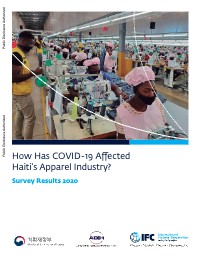
* How Has COVID-19 Affected
+ 41
Haiti s Apparel Industry?
Survey Results 2020
JT \ International :
Ministry of Economy and Finance ASSOGATONDESNOUSTAIES D'HAM Creating Markets, Creating Opportunities
[page 2]
How Has COVID-19 Affected
Haiti's Apparel Industry?
Survey Results 2020
[page 3]
Copyright and Disclaimer Notice
© International Finance Corporation 2020. All rights reserved.
2121 Pennsylvania Avenue, N.W.
Washington, D.C. 20433
Internet: www.ifc.org
The material in this work is copyrighted. Copying and/or transmitting portions or all of this work without permission may
be a violation of applicable law. IFC does not guarantee the accuracy, reliability, or completeness of the content included in
this work or the conclusions or judgments described herein. It accepts no responsibility or liability for any omissions or errors
(including, without limitation, typographical errors and technical errors) in the content.
International
& IFC | Finance Corporation
WORLD BANK GROUP
About IFC
IFC—a member of the World Bank Group—is the largest global development institution focused on the private sector
in emerging markets. We work in more than 100 countries, using our capital, expertise, and influence to create markets
and opportunities in developing countries. In fiscal year 2020, we invested $22 billion in private companies and financial
institutions in developing countries, leveraging the power of the private sector to end extreme poverty and boost shared
prosperity. For more information, visit www.ifc.org.
<27
ASSOGANON DES INOUSTRIES D'HAMI
About ADIH
The Association of Industries of Haïti (ADIH) is a non-profit employers’ association that brings together companies mainly
engaged in industrial activities, whose mission is to promote and develop the Haitian industrial sector on a competitive
basis at the global level. Founded in 1980 and officially recognized by the Government of Haiti (GoH) as a public interest
institution since January 5, 1989, ADIH is one of the most respected institutions in Haiti. ADIH seeks to enhance, support,
and develop the manufacturing and service industries for both export and domestic markets. It is committed promotion
a climate of sustainable social peace, high labor productivity, and policies and practices that protect the environment. For
more information, www.adih.ht.
= THE FACILITY
SERVICES
About the Facility for Investment Climate Advisory Services (FIAS)
Through the FIAS program, the World Bank Group and donor partners facilitate investment climate reforms in developing
countries to foster open, productive, and competitive markets and to unlock sustainable private investments in sectors
that contribute to growth and poverty reduction. The FIAS program is managed by the Equitable Growth, Finance &
Institutions Practice Group of the World Bank Group and implemented by IFC Advisory teams. For more information, visit
www.worldbank.org/fias.
Cover photo: S & H Global
[page 4]
Contents Acknowledgments 2
Executive Summary 4
Purpose of the Survey 8
Profile of Haitian Apparel Manufacturers before the COVID-19 Pandemic 10
Effects of COVID-19 on Haitian Apparel Manufacturers 14
Lost Production Days 16
Cancelled or Reduced Orders 17
Lost Revenues 17
Lost Jobs 18
Profile of Firms after Reopening 20
Production Capacity 21
Efforts by Buvers to Assist Producers 24
Requests for Assistance 26
Surveyed Firms' Recommendations to the ADIH Textile Committee 30
Annex A The Questionnaire 32
[page 5]
Fig ures Figure ES.1 Top five challenges identified by Haitian apparel manufacturers 5
Figure ES.2 Employment in Haïiti's apparel sector in March and April 2020,
by type of firm 6
Figure ES.3 Revenue losses projected by Haitian apparel manufacturers for
2020 (percent of firms) 6
Figure 1 Main challenges identified by Haitian apparel manufacturers 15
Figure 2 Share and value of Haïitian apparel producers’ orders cancelled
or reduced by mid-June 17
Figure 3 Revenue losses projected by Haitian apparel manufacturers for
2020 (percent of firms) 17
Figure 4 Employment in Haiti's apparel sector in March and April 2020,
by type of firm 18
Figure 5 Types of products produced and orders received by Haitian
apparel manufacturers after reopening following closure caused
by COVID-19 21
Figure 6 Reduction in production capacity reported by Haïitian apparel
manufacturers in May-June 2020 21
[page 6]
Tables Table 1 Type of location of Haïitian apparel manufacturers surveyed 1
Table 2 Source of capital of Haitian apparel manufacturers surveyed,
by type of location 1
Table 3 Jobs in Haïiti's apparel sector, by firm size and type of location 12
Table 4 Production by Haïitian apparel manufacturers surveyed between
May and June 2020, by type of product 13
Tables Reported number of Haitian apparel manufacturers’ buyers, per firm 13
Table 6 Production days lost by Haïitian apparel manufacturers surveyed as
a result of factory closures 16
Table 7 Capacity of Haitian apparel manufacturers surveyed to produce
personal protective equipment and other products 22
Table 8 Monthly capacity of Haïitian apparel manufacturers surveyed
to produce personal protective equipment products, by type of
product (thousands of units, except where otherwise indicated) 23
Table 9 Number of Haïitian apparel manufacturers producing personal
protective equipment, by type of garment 23
Table 10 Requests by Haitian apparel manufacturers for assistance 27
Table 11 Requests by Haitian apparel manufacturers for assistance in
training workers to repair equipment, by type of machinery 29
Table 12 Requests by Haïitian apparel manufacturers for assistance in training
workers in order to increase productivity, by type of worker 29
[page 7]
Pr me on Cu me ue Me M ie ne UE UD Me Me ED Le me Me D à de © ut ue ie À + ne ns re ne ee ne ù e Fe Me vù 4
7 Que ne eg ee me er ie er me © © ve © © 0e en me © 0 © me on ie um mie ee le de um he cos MS de he ue
rem qe nr ee Re ee De Me ne ven de amer v es ne Se de mr me ire ir 7 ME MEN ME mp eme mu de nf
Von Fe le Ge je Me ot ee de Paume Et me me Eee 7 un die dote ie ide pe Mie Que mue we à ur Vue We Com Me Um Mur +
ver me me me er Ce re de Mi ner ere re Se Me mt D ee ce me ME ue De mt où ee ue AU we + mu 0 # UES
mme mue Poe ne ue Me Me Me ee ee ee où nt ie Me 0 de Me © 0 Poe Be Ole An de pin We Mere MU ie We le in vale dd mn à
0, ee Mb ee ne me mr y ue y me pneu et wi Ce rep mr me ne me mn he nn ee en — Coms C7 En és
van he mr Rver ee Me me ee ir en ve ee me Se de De Me me Me ie Qué Me ee Me ve Me ee re de he on age en En +
un me me ee me Me me Le ee mr ee Sue me de me Code meme ee De ue ee De mn eu ee © ns Ve mE ee Wat vus
ven ee ete eme ie ere cé te Ce me CEE Vie ee de me mue me dom 9 à eue ane Me é pue ne he ee à Gide née pue
en De eme Me Gene de Me mr ee le lee ce de Me de re 7 ee hp en à ee Coe que que ee à en + un die en eve is die
Ve de te ne ie ee on mt Ce de 0e Gé he Fe ue dm M © + ve er me me € 76e Mme UE Mme le Me ee Moe D de > ME re y +
ne ee de en ee me mr ie Ge de eu Ge ete lue m EE ie où 0 Vie pe ne Mine ll Do ee # mm y UE à € ne ue M0 Me ie um (4
+ ne mn nn ue me un mr + en + er De me Ge Me ie De ue De me De Ce Me pa fe MEN ee à ie er ee Et ne eee le ne np 4
ee ne on he ne mn Re Ur QUO Que eng mer à © © Mme ie ne mue op © à Me ie mg dog le EME D © de æ ie UE me se le à
tn he D ee Mme Meme me ++ dé me me me me de Me de MS eue de me Se id ee MS À à Some + M me me me à
ne + ee ue he mon né de Me ne Me me © 0 déte on me Me Me ne de © pee 0 ur Be te he mn = he UE ee he Mie pan ré es
+ me me em mi mr ee ee Ubu Que min PE Où de nt Vo me ne ep he me Me Me Un ue Mo dr eue eo e eur de me +
nr eee le ve 0e le M eee ee Me mé Me À D eee de de Se dE ee Phare de Meme de Var De We
CN Ver mt GUY one Co er de Er ve de Me Du ee Ce ve lu ve tee mom ee ne Me Mu Me Be dé ue 6 bete de à
+ er me en ne Ce ie le À ve © Ge Er Cr r Mr Due me es mu de à € Ce du de See Sn de de du ue +
eee mt me te Ce ee ur De En me à Ge © D er Mie De Me Ge © e ie ir ne me Min ei Eee + ne ee En ve +
ne fe me mo ne Ge mue Pr VE D Ce ee le En © nee Où 0 We de de Br fe Me © € we me de She En x à + Me De de de ur
een © Me ee Me Me me Me me ge ep me qe de me 4 ne De Se dé DE DE Me mie me Me èr We Me ee Pr à ee — Me
TT eee ne me Ce Me ne dE ME Me Me te Me D à ge je EE De Me We mo Me ne en à dE me Meme pe à p
rer ne ee ve eue + ie in me Me © ue ue ee ie né mie En Me ie le he ne 0 de Mie de Une æ de Eee ee — le 4
me me ee me Mme MY © ee ue CN ne ee ME D me me = de + 6 D + Me de de merde me mere me
SR LT TT TT ET
nn te te Or te nl me me ne ue me Mie ee de eme ee ee me UE ee mt me Mn de we + Me me De À ee de De es me © ; vté
ce me ne ue me ot Ge he je ee le Te me me ue MN S de © ee Me Me Be © » ee we Me ÉD ee ee me ee en US
ne Me ee ie te te le me me Vue bemese me rer ete ere eee mr me me ve ee à ee ee
re me meme rue eee ue y Ce me De che Dh me pau de me er © + De Me En er Dh ie 6 de de en © ne à
rene me eme up ee me er © ne ue ne mr Ge Me me ee pe le UE Eu Cu on Me Mes ÉD eee æ Corte me Me
TÉVeREGR de me me EE 8 Ce MS Coms le me mie te Que EP 0 Me me Ge De op MY © € o ee de 0 de de Ed ele de de à
ere me mn more me mn nn me de me De me bn APCE Se de me Me MD ep ED © ve Se ù ne me Me de + ce me de
ee ce tree re Meme te hé er en me me Me me Mie me Me + é ie ME MS ds din de we à à ne De ne ee « ur
RSS en De Tr do tu ce vtr mine She dé der dep Sp me mu de nat M de 0 eu me Me en de Mn de de
“Vue ue me mn pe 0 Me ne me ne ue Ce de ur ne Me ee en re de ee EE Me ee Nù Le à te De mn à D Bin me À ES
eee me me où nn ee Ce Mme Crete En 7 me En À © Me e he eue ue er me pére WE me me lé. me À à
Een re ee me te GE Me du me DE ue ue mé me Me En ue de Me ee Me qe en de de Dre die M Die à ee due
Tr, er me ne MP Me ee me ue ru D dE pe Me My Me Pa © © De de Ge ee ee Me Eh Be mn Mme ce de wie à à
rer ne ee ee Me me D Ne ee Me Ge fe ME Die ef ee moe Me à En ee © te De à ee pe Con ee que be où y
ne or ET me de Ne M M ME mme ee ue Me ee D A Ve UE EU WE Es ee à lun MS Mn en à pe EE nd ee Bo Dee
PR RE ee EE ne ee ue © Eu Ch ue MT 7 Me Me We DS Me de er ee ee eh EE me © e à + ee we @
Ven Me Ge ee Mu PE où me Me me pme me ie 0 0 he er ep Cr 4 en MEME Ep Ne te eue ee ie ep ph me Que @ ee -W ®
ee dune 6 CN em Sn CU Ce me Ce Ce le le er Ce Ve he Me Me + MY ÉERET EE MES de de Ve de qu he Br ot
ee + me me Ge Ce ne me nl Qt nn we pe r Er - 7 —….
rs. «
us
ve
—. em +
0
CLTA
er. me
nn mu
…..
PRIT Te Et meme Lee eee De Ge MU ee Le + > De ot Me US ee me Pen À © Cuer M UC en te te 1 de 1m
Te meer eme eme ne De et D TS M de Et ée M RS ut Ut En in Mn Ve we Poe Me im Wie er UNE Ve MMS Ce
Pme nr et er me 0e Ce me due le ne me ue En MU PE De te ME M DE À Cr Eee Me pee un me à De à Beer n
FL eme ur ue de de me + ee ee ne ne en Po y Te Me ot Ce YU VS + dé hr ie mp Le ee es à
ON ne Pre Ce © 7e de me ME Se me ve Mr mer B ee EE ln ee Mie À © ve me her Pre SS à
TR ne ne mg ms ne ne me Ge ee en ee fe ee er En ne Me © EU Me Se Mn mie Ne Me Ph Œe ne Eu
RTS Te MP eh te ne 7 en D 0 De y Me ee me ve 0 Cor Me DE US «+ Me Me De Meme ME me EN
PR ne ee me Me CE M on Ce MS ee ne Me Me Me À ee De pb et nie en me he eV ee MU» Me à ee ae,
nr rer une me + he De dé De De ee dur ne ND YO PUS ep Br he © où we le de Me me Mr Ce me Ph
DR RS ne 7 en en me de re mn me De ee Me En me Mo MO TLSE Ste) de me «+ vd de UC WE ù
ER en le le ee ee Eee er M Ge Me ne ne de Se Se de eV le te mn de ne de AS Ve te em € à
re mere mr en me ne me Er te Me mr de me ne he Me me ee M eo me Ph BE ee © + Me ne Sr Me ne Me fee die
enr ST nn ne EE on Au me Me me où nn Et de de Me mé Tr me + le Me de me me me Ep ME ep NE De Me me Se À
CR et De ne ne me Ce De ee me Ge We ME le Gate M Vén e ù æ N © Mie UNE AE Me Me De © » dt su de Me
TT RE Eee ne Se © RP er © me le + ue le ep © v mé he ie Me re he Me me he + de de ee Se de
Re UD ne nt Ge mie lie ue me 4 ee le OU Ge ne eee 0 ve ne Mi ir Ve he GS en ed de mie he -
eme er 0 ee me Me CV Ce Me de me Me + + mie de he Œù Un de ve nee Ce © à ET Me De
ne ue eu tn me due cle ie nn im mu vs = de Ve nm Che en pe ne me De Me me Me Me me mp We Vlr de em
Pre r ut tee Pme me me der AE er de ere MNT MY de Me din ù m4 mé die Cle à uen,
SET RS Po Ce Ge er Ge En Ce D US Ce ve Mr de + de de Serre Me Mme me D ES y Me y Me
PR Re ne ne te ne he ee em de dm Mr Te de CD Pr De DE ES > Mn De De de © EE de à Cie
Tr ne ee D My mn me he Ne Me + + ne De ie 0 CE me De mr me cree mr De le De de ue de
ER DS ne ee he que te 0 7 PE ED ie le ne où à 0 le En Un bee Be M DE D 7e 0 de Elle Qi Mie Me ee que Me QU
PR er ve en de se ee en me ve Cu es eme ee dite de ue à à © © de mr de me M Ce Eu © + De Sr De NS ver Ve
MP Por r er me Con m ne je y de Come oder fe Me Me © © me Me de dr «ee me MY En De Ce de he un
Re eme ee 19 À 0 M De ne Me Pme mé nt de qu Bu me Role See do Se de So Le er Éme we Me we ee ue
PR enr vrmr me me de ie eme 0 eme Me À pu ut Pnée 0 RS ME VE de ne e-R MD EU Mie dE
Re ete Bo De Be YU mn Fe me ne 0 Ve me me Le de Me à en me pme Mù dr Ve © PE Se CSS
PR en ne ne Ge ne nn me ee ne mme me De Me A Se ny dm ME SE Me Me Me re Ge Me EU Ve Lee M On
Re ne ne ds 4 TS Me eue me ne De Meme PE + ee MD De © > D ue me Me O vOS Me Se re D Mme Le De Vo
PR mn ne fe ce pute me Me fe me ue er le me de Ve DD US De De À + Me Me de a mY VS 7-E
TR TT mt moe ue Fe le le eue nu Me ue ee Me ee Pie ee me ee SE me me MS Me Me © © nr > Se +
Ce le ee ie ou qe te 7 de UD de ee Me ee ne 4 “oi ve ve dote me ue cher ee eu ne Me 6 te ee à ww à en
MOTS En De ir me em Mg Mile RO NN Me De WU me 4e me Me En Cle MD dome © Poe ME ae née nv -E Be Se M à De
me mr nt + me te fe y ile ue Me Ge se M Mie eue cle Mo -me- e ue ere Up oi im We à Vie Me
ee up dm — nn one mn et ne die Me te = pe de ue mr De We né ee © te @ à er ne mr Te Crme ve mp
OR A ee ce Él e ne pe Ge D ee Ce te 0 her Me am eh ee ue Mie D née ph de SE Me Me ed à à re
. nm me un de Me me ne Éd de me we + Ge Un donnee me y ie Up mes SD me de Me me Mr MS e
En ce D ou © me ae Te Te nt 0 me ie Me Ge me mou me de te de de fe je Me Me De une à hé + pre de à à © à
PRET nn © ie me le le ut ne Pr du de. dome me Ci de de My mme Mb DRE mue Ge e
ee ee ie te © de ne D te Me D + Fe ue le ee UE ie ED Side D. ee me + ee en Ce Er es
CR ee ee ne ne ue mn nt me Me ne ie me M4 Ge CURE 7 Me ee Mér ie ne Mes Me © 7 ou UE MY Le €
re Rens ee db me er dr me ne Ve de D Me My me © © DD Se De Min Me ere + Me-e Me à Y Ut © © + Me my Er DR
VB orne ne mn me De me me 0e MY Er D Se La RL L —-
nn Pen D ee Se en Em ve de ee le À 9 4 Le te M De Se Se Din OU Ge ee ee Ve ee fe en me à de ie
De DA vu ue De me me ee ne Re et ee ee mn me me en Me C9 En de PE Rp Be Que du pre le we à M © æ he me
me me en mm qu ee de Ce 9 de ie Me Mie ne ee die de trés de D De © à fe Me Me Se ui 7 ee ER
= me Che Cle mue Er Po de Ge he Mn De ne née De 0 D de Preuve ee Me le ME-Sù A
Ver mr enr ee en Eu D un NT 7 Me ie © + M un Ge md me Mie me ce er ue où we te te ue le Cle ee à ne déte
DT ee nm + + © re ne Se me ee dr ve de te dr me de ee ee ee es y ne de dv y €
Tome eme le de de ue eu te Me eut My ne Me Me we Sie © de me où à @ie ie rer, en de db Ve dt le de 4 ee œ y
CSN CE ee ue de à me me ne de ce de me Dee En der ne ie Go de Se me de db ere Én dite à à Me ee di
ne — 2 © à in ii Mn MT) ee
[page 8]
This report presents the main conclusions of a survey of apparel producers in Haiti conducted between
May and June 2020 to shed light on how COVID-19 is affecting the industry in Haïti and to help decision
makers navigate the crisis. The survey was conceived by l'Association des Industries d'Haïti (ADIH) and the
International Finance Corporation (IFC) of the World Bank Group. The report was prepared by Pedro Andres
Amo, Ernesto Franco Temple, Martine Deverson, Daniela Yacaman, and Ji Woon Park, with the support of
ADIH staff, especially ADIH's former president, Georges Sassine; executive director, Marie-Louise Russo; and
administrative assistant Alexandra Erau. Barbara Karni edited the report, Carolina Gonzalez Ruiz provided
invaluable support on logistics and publication planning, and Ambidiestra prepared the report layout and
design for printing.
The export-oriented apparel industry is a major source of formal jobs in Haïti, employing nearly 53,000 people
in 2019. The sector's exports, which doubled since 2009, accounted for 85 percent of Haiïti's exports of goods in
2018. There is still room to grow, as the quotas for duty-free import into the United States have remained largely
underutilized, and the Caribbean Basin Trade Partnership Act (CBTPA) is likely to be renewed before the end of 2020.
The unprecedented global economic crisis caused by the COVID-19 pandemic has very negatively affected Haïti's
garment sector, jeopardizing its viability in the medium term. The government ordered a month-long shutdown
of the industry in March as part of its measures to guarantee the safety and health of all in the industry, allowing
it to reopen a month later only under strict sanitary conditions that helped ensure the safety of the sector's
workers. Production had to be organized by rotation to limit personal contact, reducing plant output capacity
and financial sustainability. The situation worsened as raw materials became increasingly difficult to source and
orders from the United States were drastically reduced and very few new orders were received.
Firms are navigating structural shifts in the sector caused by COVID-19. A key factor is what types of apparel
products from Haiti will be in demand moving forward. With supply chain disruptions and increased lead
times, especially from China, executives are increasingly looking closer to home for their sourcing needs, as
the crisis reinforces a near-shoring trend that began before the pandemic. Firms producing apparel can easily
shift to washable personal protective equipment (PPE) to help meet the increasing global demand for masks,
coveralls, surgical gowns, aprons, surgical caps, blouses, scrubs, and plastic PPE.
We are grateful to the 33 members of the ADIH who took the time to answer the survey questionnaire.
We would also like to thank Anouk Pechevy, Claudine François, Finn Holm-Olsen, Jennifer Fievre, Maria
Soledad Requejo, and Mariana Vijil for comments on the questionnaire and an earlier version of the report.
We appreciate comments by the report reviewers of the ADIH Textile Committee who participated in the
validation meeting on July 14, 2020: Clifford Apaid, Fernando Capellan, Joseph Blumberg, Carine Felix, Dayana
A. Villedrouin, Gina Coles, Mario Giovanni Jules, Nathalie Hermantin, Christian Aimé, Tammy Moon, Jason Lee,
Minchul Hwang, Rachelle Jean, Lulu Yu, Hans-Josemy Fonrose and Tessa Jacques Antoine from CFI.
This initiative benefited from support from IFC funding, the Facility for Investment Climate Advisory Services
(FIAS), and the Korea-IFC Partnership Program (KIPP).
Wilhelm Lemke Judith Green
President Country Manager, Caribbean Region
Association des Industries d'Haïti (ADIH) International Finance Corporation
| How Has COVID-19 Affected Haiti's Apparel Industry? | 3 |
[page 9]
fie TT TETE Q. — — ere xs AS 5 r
RS Re reel, = + ++ MO FE SALES
à = ss A LT pe opt OI re ns Sert wi es =
mr > _ 2 | ie ER ARTE RES S Rs RE EEL Re En à RT | ETA
LR ot fr 7 Rs TS : STE ES EL Se PARLES = ES - 3
rar =. = POS = x SRE 7 RES == = nt TERYLLR,— 4 En
FT > x pa Te ds À : me x . OCDE, 7 —— et = © Lot RER a
4 DD ET EEE QUES ? 5 RE A SES ESS = mr En SR der
e —- RE D: Des . LAS ESS RS RE rs
PSS RS. ex LASER: ‘« < Re RS —— Se
ST DÉS PR É e x : vs DT ÉS See
,{ SA EE ES SE Ar, S = Sr TETE secte RS
= — = | SERRE er DRE. es rasta + TS FE D: — 4 PERTE CÈrs =
EE Te À S RSS LE ER S ARS Se SR =
ROLE RS te er = DS RE ARR REC
= *“ EN 2784 APE RTE ENT ES "+ D CE ME, CRT SE : « — Ko RRNT. PRESSE
pe = AT NT PER TRE ST" RE Een es ce - NES ET: ER NOR EE RTS =
= | ETS Lors > —e. = OT | < EEE ) Ra re ter RÉEL EE
= = = MERS DE nt 1e PRET El. S : D LES ET | HMS - 27
TC =. Dee RES = = = : 7] CESR SAONE SNENEES
RIRES ES : Le X rca ee rs = Te EN NÉS SEE
= TI = L SRE TS = Ne — ER ee RTS à > TT e ESrEe
un A CE ES + :S ETES = cr eo a LR 4 Ç = PRES
EE AO Te LE TRS PARC EE TRE AGEE | Enr
== = pe er Sert SET A re REX EE \ Se Ta Ë ESS:
A, — | NET enr ates RSR ÉD À ES Ro HE * SZ
RS === RE + RE ee ER. — INRA ETS : =
= Et _ a RES CRE Bee De bed, €
== me, = à RTE ea c ne Le ARS 6 ET vs, —" RS
D EL eee = RARE LRRRREEE "0 x, SDS ETS
== ee TE ns Pie en L : ETS EIRE ne. ee TS
à LA RAT ES, = STE LUE
z = Rene ee. à e = a ne TS
L RS, TE T— PET RLe, pe
> ee ©: RC. D == Tr |
É Ee SEP =... — Pr
Ë « ET RTE a, 7 Es
D Er Rss PRE re pre = - ,
: PAS EUR Re œ ee 7 .
: Re RE LEE PI +: %- =
Te DR jé RE = a SET, ER au RU RSR RSR PRESS sr
æ —: : RE 7 SRE EE Mes RTE ES
EN Te EE ER Se _ ARR A
RE = RÉ ARRS LUE RE + 2
— PRES ES. Lee KT ESS TSI Fpet MR ns &,
re ee : 2: SE — Eee RITES 2e Sn LS A ES
is 2 Sr RTS re = ee 2 0e ee DR RES TE SN
RSR ES “ce p— = : RIRE STE ee = 4 LÉ RTRRES TL STE Fe
= ET ÈS a SAC URI DR re ’
ee: : RS R— — SRE RES Pr Ve DES Em £
ÆR ::: RP ER EI T ESS SETe ESS = —— DRE. De Pr RES RS el
; RE RÉRRRTI OISE RER = = RSR ere LR ENS dE RE ETES.
SR es MÉCE TRE ETES Cr > RS, > en, 2 LÉTRR RESTE ER 4 PERLES
Se Rene ©: -S— de RSS ESP ESS Nr se ee
Re re RSR dre TES = CHER EEE SR ZE ÉTARSE DST ts
RES À SR IE — 7e D o DES; rer
2, ES TaR, Ee PSE TE RE — = Tes 7 a LES En ra) Dors hs
ut EE at RL TN hr STE rat espere RE RE RS PE À b Er
EE LEE re RL ST ILE re RL Ve RS = COS ARS RER ESS PET
ET RE Trees RE LES DR RES, ST HRIANSS ES TU ù TR LORS Ten
PRET SES ARENA R TR PAT L ET ET RES 2 S Es TS OS SE
> CRI EEE PESTE ET SE D HT — : - > is e RE 2 na Li MR EURE
= Es ee RSS Sets Te SERRE
re TRS à ee. = RS Ne
TS Re RAR SALT A D SS ARR ne SE os Z
M nn EE TS PAT RTE ES Res" RE TS =22;; AL
PR S: - REPOSER = = SR Aer HQE Er ë
PAPER PRISE RT TE Eve le III TROT RTE ETES = EE 2 See, g CARRE œ
ss S “4 Re RRQ ES res RS
ENS te, Es + + + = = RE CLEO AT RL
2 € rs nes Les Se ER N'ES
PRET TT RS ZE PT EEE PRÉ TRE ER RE TEE EEE RE ERA LT
PEER CN jo LS Re — > — 5 EE PRE
AE DELLORE, rs DR rs PET PRE ss RSS PR
à = :. ES Se — = = ns
RARE RES RIT tin es —. EE Q — pentes, JS
CE RÉ TESS Rte RS LENS LE re — A rETEEX, RCA
ere Er “e °°: ee RE Se PTT IEEE = — res: ee
TS =: X ns, PE PR RS ÉRRNPRTTRS ESS er
=, de RE —. PT re LT RSS nes seu
ER + + : se RP Te = = — > —:<e
AT PES PE Tee RSI SE re ES Re —— RE LEE
RS ne rare RSS Pre es El PER ESS A LEE — ESS
‘« M te <= &, Jen, EL EST ES ER E Re
À SCA ré Pete, 2 ER PTT ELLES T ES 7 | LITE 5 STI RC Er,
Sr LT 241% ( TELE EE DEEE RTE VS AE ARE ESS ZE
5 WC ES RE Le la RS RES DRE
ES Praz e à = = + + RATIO re
ASS RES Ion EEE Sn T ge EEE ETES ErS RAS ET PEL LS LIT ST En ES
l VERS LE D | RE PETITS ETS ue
= ACL SP SORTE
[page 10]
In May and June 2020, the Industrial Association of Haïitian (l'Association des Industries
d'Haïti [ADIH]), in collaboration with the International Finance Corporation (IFC),
conducted a survey to collect information on the impact on, challenges facing,
and opportunities for the export-oriented garment sector in Haïti arising from the
COVID-19 pandemic. Thirty-three firms from the West and the North of the country
that produce apparel products responded to the survey. Haitian apparel manufacturers
surveyed included both foreign-born and domestic companies. The participating firms
collectively employed more than 50,000 workers in March 2020, 94 percent of all
workers employed by ADIH members. Eighty-two percent of respondents operated in
a public industrial park or private free trade zone, and 70 percent were established with
foreign capital. Before the pandemic, these firms produced an average of 1.6 million
pieces of garment a month, 83 percent of all pieces made with knit-only materials.
According to the ADIH, seven firms produced personal protective equipment (PPE),
including gowns, scrubs, and coveralls with hoods.
The most pressing challenges respondents identified included uncertainty about global
demand, government restrictions (which prevented factories from working at full
capacity until July 28), lack of working capital, and difficulty accessing raw materials
(figure ESA). Only 10 firms identified export restrictions as a key challenge. Among
them, eight had had more than 20 percent of their orders cancelled.
CHALLENGES ..
Figure ES.1
Uncertainty regarding global demand 91 Top five challenges
identified by
Government mandate to reduce workers 82 Haïtian apparel
manufacturers
Reduction of production capacity due to 82
COVID-19 measures
Lack of working capital 79
Difficulty accesing raw materials 61
o 20 40 60 80 100
Percent of respondents
| How Has COVID-19 Affected Haiti's Apparel Industry? | 5 |
[page 11]
Employment by ADIH members plummeted between March and April 2020, falling by
almost a third (figure ES.2).
LU EMPLOYMENT m March 2020 B April 2020
Figure ES.2
i iti” 60.000
Employment in Haiti's 53.323
apparel sector in
March and April 2020, Es
by type of location 40.000 36.795
29.087
30.000 23.315
20.000 18-637
9.780
10.000 5.599
1.700
[e]
Public industrial Private free Outside free Total
parks zones and zones and
industrial parks industrial parks
Source: Data for March 2020 were collected from firms that receive government subsidies. Data
for April 2020 were collected by ADIH from its members.
Seventy-six percent of respondents expected at least a 30 percent loss in revenues in
2020 as result of the pandemic (figure ES.3). Twenty-eight respondents (84 percent)
reported a total of 723 production days lost between March 20 and April 20.
nu EXPECTED REVENUE LOSSES
Figure ES.3
Revenue losses 30% or less losses .
projected by Haitian CORRE ESS ESS EEE 24%
apparel manufacturers 30% - 60% losses
for 2020 (percent of LEE...
More than 60% losses
firms) 000000060000000000000000000000000000000! 24%
| 6 |
[page 12]
At the time of the survey, in May-June 2020, only 22 percent of respondents were
producing at least 6o percent of their previous capacity. All but one firm reported
reductions in and cancellations of orders; and 52 percent of all firms saw reductions
or cancellations of more than 50 percent.
Twenty-eight firms (85 percent of respondents) reported that they could produce
PPE, although only 20 had received orders for this type of products. Twenty-four
firms reported being able to produce masks; 5 could produce gowns, 10 scrubs, and 2
coveralls with hoods. PPE production capacity appears to be underutilized, with only
67 percent and 39 percent of capacity used to produce masks and gowns, respectively.
According to respondents, orders for masks and other PPE could help save these
companies; exports should therefore not be subject to any restrictions.
Firms reported the need for several types of assistance. In terms of financial assistance,
they need working capital financing (n respondents) and both short-term (8) and long-
term credit (7). Other requests include support for market intelligence and assistance
marketing and selling PPE, regular meetings with ADIH and increased support to
operations, including authorization to export masks, assistance in shipping products
abroad, and help attracting more international investors. Firms also identified their
desire for assistance in building the capacity of workers to repair equipment and in
training supervisors, sewing operators, quality controllers, and auditors.
| How Has COVID-19 Affected Haiti's Apparel Industry? | 7 |
[page 13]
Ney D, — \
EE +
RE 2 nn ne 4 EE
PURPOSE = —
AT —
Se — ——— Jen —+—
- _- - = =
=
On March 19, 2020, Eee (n Re. .
Haiti ordered the 2 [u ETS = =
mandatory closure of = _
Il factories, in order ti
MM sprecdof EP. æ
COVID-19. -
Photo: Santo du Jour Free Zone
[page 14]
On March 19, 2020, the government of Haiti ordered The survey aimed to measure the impacts
the mandatory closure of all factories, in order to of the COVID 19 pandemic on Haiïti's export-
contain the spread of COVID-19. The next day, oriented garment sector, including the impact of
factories closed. On March 25, the government cancellations and reductions of orders and the
closed the border with the Dominican Republic challenges facing firms when reopening. It also
for the transit of people (merchandise traffic was sought to identify (a) opportunities based on
permitted throughout the shutdown). On July 1, it firms’ capacity to produce personal protective
reopened the border and resumed international air equipment (PPE) and (b) areas of needed support
traffic. Between March 31 and April 20, the authorities for the sector, including technical and financial
progressively allowed factory operations to reopen, assistance, worker training, and better services.
but they imposed restrictions to slow the spread of
COVID 19, limiting the number of workers in a factory
to less than 30 percent of capacity, for example. On
July 28, the government lifted the state of emergency,
allowing production but retaining some safety
requirements.
| How Has COVID-19 Affected Haiti's Apparel Industry? | 9 |
[page 15]
SA. D
PROFILE OF KI
HAITIAN APPARELRM
MANUFACTURERSESS
BEFORE THE SE.
COVID-19 PANDEMIC
Lan oo ne es Te
PS À, LE HSE RE | FENTE Fee
re #7 ART MEN Lime 7
Se ASE Se) 7. ©
\* f f Ÿ , = > : PR +
Ps | LÉ 4 NX Po a ! d L
Photo: S & H Global f __ Ke
| w |
[page 16]
Eighty-two percent of the firms surveyed are located inside industrial parks or free
trade zones, which are physical areas benefiting from tax exemptions (table 1). Seventy
percent were funded by foreign capital (table 2). Haïitian apparel manufacturers include
both, foreign-born and domestic companies.
LOCATION LE
Table 1
Type of location
of Haïitian apparel
Location Number of firms Percent of total manufacturers
Public industrial park 12 36 surveyed
Private free zone or industrial park 15 45
Outside free zone or industrial park 6 18
Total 33 100
SOURCE OF CAPITAL "
Table 2
Source of capital
Domestic Foreigner of Haitian apparel
, Number Percent Number Percent manufacturers
Location of firm offirms oftotal offirms oftotal surveyed, by type
of location
Public industrial park 2 16.7 10 833
Private free zone or industrial park 2 13.3 13 86.7
Outside free zone or industrial park 6 100 o o
Total 10 30.3 23 69.7
Source: World Bank Group Country Private Sector Diagnostic Mission, January 2020.
| How Has COVID-19 Affected Haiti's Apparel Industry? | n |
[page 17]
The 33 firms surveyed represent 87 percent of ADIH membership and employed
94 percent of all formal sector workers in the sector declared to ADIH. The sample
included 6 large firms (2,000 employees or more), 20 medium-size firms (500-2,000
employees), and 7 small firms (less than 500 employees). The largest firms are located
mostly in public industrial parks (table 3).
ne JOBS
Table 3
Jobs in Haïti's apparel mie
sector, by firm size
and type of location ot 500 - MOLS
yp Item than 2,000 than Total
500 , 2,000
Public industrial parks o 10,632 16,957 27,589
Private free zones and industrial parks 1,308 11,945 3,936 17,189
Outside free zones and industrial parks 943 4,656 o 5,599
Total 2,251 27,233 20,893 50,377
Percent of ADIH membership 97 90 100 94
ne, a pu Lee = À «
m er Re nd. —
dés 2 L & a RSR. nu
Photo: Digneron - LISE PCR ONE ONNRL à >) *à en Le —
Manufacturing S.A. ra 7 = 1 PV. eu CN. IS DES MER 2 2]
—— J F en | c t / ==.
De © À #!
SE Be à = u… = à
RE DE x SE
7/1 taie TR: ÆÆ À
#1) x 7 ! à , TR D
r- . . Nbr ser |
| 12 |
[page 18]
Before the pandemic, almost half of the firms surveyed were using knit fabrics, 21 percent
were using woven fabric, and 30 percent were using both. According to the ADIH, seven
firms were active in the production of PPE and 6 specialized in large-scale production of
t-shirts. Eighty-three percent of all units were produced by firms using only knit fabric.
The average number of units per month per firm was about 1.6 million (table 4).
PRODUCTION .
Table 4
Number of units produced per month Production by Haitian
apparel manufacturers
Number Number Percent surveyed between
Item of firms of pieces of total Total May and June 2020, by
producing produced production
type of product
Knit 16 40,742,400 83 2,546,400
Woven? 6 1,719,000 4 286,500
Both knit and woven® 9 6,473,000 13 719,222
Total 31 48,934,400 100 1,578,529
2. Two firms did not specify the quantities produced per month. They are excluded from the table.
Respondents collectively identified 44 buyers. About half of respondents had only one
buyer; almost a third had four or more buyers (table 5).
BUYERS ..
= f = Tables
Number o Number
buyers per firm of firms Rep orted number
of Haïitian apparel
1 14 manufacturers' buyers,
2 | 5 per firm
3 | 4
4 or more | 9
Note: One firm did not respond and one provided invalid information.
| How Has COVID-19 Affected Haiti's Apparel Industry? | 13 |
[page 19]
EFFECTS OF 7°
COVID-19 ON | mans Plis Kalite! | (a
HAITIAN APPAREL : Re
=MANUFACTURERS Se.
De ts de as
_ ] , : CL
0" S &. H Global f -
| 14 | | [1 |
[page 20]
Surveyed firms reported five main challenges (figure 1):
- uncertainty about global demand
- government restrictions on the number of workers in factories
- reduction of production capacity because of COVID-19 measures
- lack of working capital
- difficult accessing raw materials.
Figure 1
x () Main challenges
identified by
(À) Haitian apparel
© manufacturers
|
nn ()
nr)
nn
_ nÔ
_ «mg
x ©)
= _(-)
= _(:}
10
. . e e e e
| How Has COVID-19 Affected Haiti's Apparel Industry? | 15 |
[page 21]
Other key challenges included difficulty accessing markets and the poor condition of
public transportation. Ten firms highlighted export restrictions as a priority challenge.
Among these firms, 8 had had more than 20 percent of their orders cancelled. Export
authorizations and procedures have become difficult to manage since the ban on the
export of masks, announced by the Customs Department on April 22, and the closure of
the border with the Dominican Republic on March 25.
Eighty-five percent of respondents planned to continue operations over the next six
months. Among these firms, 22 (79 percent) planned to employ more than 60 percent of
the workers they employed in early March; 3 (n percent) planned to employ less than 30
percent. If conditions remain unchanged, 42 percent of surveyed firms did not exclude the
possibility of temporarily closing their plants.
+
Lost Production Days
Twenty-eight of the surveyed firms (85 percent) reported reopening after closing.
Together, they reported losing 723 production days (table 6).
nu DAYS LOST
Table 6
Production days lost Number of firms
by Haïtian apparel
manufacturers
surveyed as a result
of factory closures
March 31 13 13 1 o 161
April 3 4 4 o o 108
April 10 5 4 o 1 85
April 20 T 9 1 o 369
Total 33 30 2 1 723
Note: Authorities allowed factories to reopen in phases, on the dates shown in the table. Two
firms did not specify the date of resumption of operations.
| 16 |
[page 22]
All but one firm reported having had orders cancelled or reduced. Among these firms,
52 percent experienced reductions or cancellations of more than 50 percent (figure 2).
ORDERS m Less than 20% m 20% - 50% m More than 50% ne
Number 35 Figure 2
offirms 30 Share and value
LL
25 3 B of Haïitian apparel
20 14 producers' orders
15 nm cancelled or reduced
10 Ë ë by mid-June
5 7 6
o 5 5 3
Volume (pieces) Value (dollars) Volume (pieces) Value (dollars)
Cancellation of orders Reduction of orders
Lost Revenues
Seventy-six percent of respondents forecast that they would lose more than 30 percent
of their revenues in 2020; eight firms (24 percent) expected revenue losses of more
than 60 percent (figure 3).
EXPECTED REVENUE LOSSES nu
Figure 3
30% or less losses
és... EPA Revenue losses
projected by Haïtian
50% 7 50% losses apparel manufacturers
More than 60% losses © for 2020 (percent of
| How Has COVID-19 Affected Haiti's Apparel Industry? | 17 |
[page 23]
Employment at the 38 ADIH members declined by 31 percent between March and
April 2020, according to ADIH reports (figure 4). Small firms and private facilities
outside public parks and private free zones were the most affected, with declines in
employment of 59 percent and 70 percent, respectively.
Le EMPLOYMENT m March 2020 m April 2020
Figure 4
Employment in Haiti's Number 60.000
pe : of workers 53-323
apparel sector in
employed 50000
March and April 2020,
by type of location 40.000 36.795
29.087
30.000 23.315
20.000 18.637
9.780
10.000 5-599
1.700
[e]
Public industrial Private free Outside free Total
parks zones and zones and
industrial parks industrial parks
Source: Data for March 2020 were collected from firms that receive government subsidies. Data
for April 2020 were collected by ADIH from its members.
| 18 |
[page 24]
ÿ qu | NA LAU A |
FL | 1 | {| ll 11 * » a _ 207)
: Aa PPS SSD =" ACER
à A L 4 Tr : 2h 4 #1 > f 4 TIME
Li. RCA ETS | a NS
Photo: Palm Appare Û KE } 14] lu gr d d li di à
| How Has COVID-19 Affected Haiti's Apparel Industry? | 19 |
[page 25]
dé ré r
| PF + p' . 2 4
ILE | | ATANSYON KAB Rs —
TT LR TÈT OU KA FRAPE ] . DS
AFTER FPE
L RTS Le
[page 26]
+ +
Production Capacity
At the time of the survey, one firm remained closed. The remaining 32 firms were
fulfilling existing orders, new orders, or both (figure 5).
TYPES OF PRODUCT m Existing order m New order D
Number 3° Figure s
of firms Types of products
25 5 produced and orders
received by Haïitian
22
29 apparel manufacturers
LL
K 6 ù after reopening
following closure
10 2 caused by COVID-19
8
5
ES
o 2
Knit Woven Mask Scrubs Gown Coverall with
hood
Material Type of Product
More than half of firms (56 percent [18 firms]) were producing at less than 30 percent of
their capacity after resuming operations (figure 6).
PRODUCTION CAPACITY
: Les ten 102 css
9% En e Figure 6
Reduction in
EEE >> production capacity
Above 60%
SE reported by Haitian
10% - 30% apparel manufacturers
. De » DR), 22% in May-June 2020
30% - 60%
| How Has COVID-19 Affected Haiti's Apparel Industry? | 21 |
[page 27]
The data collected from the 31 firms that responded suggest that potential production
capacity is 37.8 million units a month—59 percent PPE and 41 percent other garments
(table 7).
nu APPAREL PRODUCTION CAPACITY
Table 7
Capacity of Haïitian
apparel manufacturers
surveyed to produce
personal protective
equipment and other
Current
products production
of personal
protective
equipment (PPE) 19 | 12,648 50 658 1,424 | 14,779 800 | 15,579
Producing PPE
but cannot give
capacity 1 na. na. na. na. na. na. na.
Has capacity to
produce PPE but
is not producing it 7 6,290 2| 1,050 65 | 7,407 600 | 8,007
Has capacity to
produce PPE but
cannot specify
how much and is
not producing it 1 o o o o o o o
Not interested in
producing PPE 3 na. na. na. na. na. 14,256 | 14,256
Total 31 | 18,938 52| 1,708 1,489 | 22,186 | 15,656 | 37,842
Note: n.a. Not applicable.
| 22 |
[page 28]
At the time of the survey, the producers who declared that they had capacity to produce
PPE were using two-thirds of their capacity (table 8). Of the 26 firms that specified
the types of PPE they could produce, 23 reported being able to produce masks, 5 could
produce gowns, 10 scrubs, and 2 coveralls with hoods.
MONTHLY CAPACITY “
Table 8
Monthly capacity
of Haïitian apparel
i Masks | Scrub| Gown | Coverall
Type of capacity Total manufacturers
| surveyed to produce
Current production 12,648 1,424 658 50 14,779 personal protective
Capacity to produce additional equipment products,
units 6,290 65 1,050 2 7,407 by type of product
Total potential capacity 18,938 1,489 1,708 52, 22,186 (thousands of
Current production as percent units, except where
of total potential capacity 67 96 39 96 67 otherwise indicated)
Only 20 firms reported producing PPE (table 9). Respondents did not provide information
on production of surgical caps, shoe covers, and plastic face shields. A plastics
manufacturer in Haiti (not part of the survey) has reportedly begun producing face
shields, disposable boot covers, head caps, and gowns.
PPE PRODUCERS
Table 9
Number of Number of Haïtian
Type of product (PPE) producers f
apparel manufacturers
Masks only 1 producing personal
Masks and scrubs | 4 protective equipment,
Masks, gowns, and scrubs | 1 by type of product
Masks and gowns | 1
Masks, coveralls, gowns and scrubs | 1
Scrubs only | 2
Total number of firms producing PPE | 20
Note: All of these firms were also producing other garments.
| How Has COVID-19 Affected Haiti's Apparel Industry? | 23 |
[page 29]
All respondents reported having enough resources and materials to comply with the
obligations established by the authorities. These requirements include PPE for workers,
handwashing stations, a chlorine carpet to disinfect shoes soles at the factory entrance,
1.5 meters between workers, and regular maintenance of facilities. Some respondents
also reported taking additional measures, including the following:
+ temperature screening at the entrance
- safe entry management
- sanitization of equipment and hands (with disinfectant, paper, alcohol-based sanitizer
gel, soap)
+ medical assistance and regular checking for respiratory symptoms
* plan to evacuate confirmed cases.
+
Efforts by Buyers to Assist Producers
Some respondents reported that buyers had offered them alternatives to simply
cancelling their orders:
10 firms reported that buyers replaced their existing orders with different ones.
+3 firms were asked to complete their orders, 2 of them obtained extensions of their
delivery deadlines.
*2 firms reported that buyers had authorized them to use the raw materials they had
purchased to meet the buyers’ orders for other uses.
1 firm reported that its buyers temporarily suspended their orders.
°1 firm reported having been given permission from a buyer to purchase fabric from
other suppliers.
One firm reported that it did not require mitigation measures, as its business did not
suffer significant losses from the crisis.
| 24 |
[page 30]
1
All respondents L
reported having
enough resources
and materials :
to comply with
the obligations ï
established by the i
authorities. | / fl
| re v
set,
L æ
à _ | ___—, ‘ f
= È 1
D = A Æ ,
AT — #64 KT =
? Les x” : ‘
oi. Vo CE.
À / A at
… Pr
#1 * AN
À 2 ” J "
Dr,
. ” e
NL 4
F ; mt ”
|! a 22 il #
(© Photo: S & H Global." dé D: Se
Su, A *. 16\ 25" É
D” n° 4 r A ? 2 va 1
| How Has COVID-19 Affected Haiti's Apparel Industry? | 25 |
[page 31]
ASSISTANCE -
PTE > ! ne | son, +
« L LT ER 7 - . P CC —
A St Re DD up Vs PE Er
he ; ALTER me EN Et © D NS eus
PU. à Toys cel EN
APS, (EN ü #2 ar - LL: LANCE LR) 1
À À k: “is \l a FE "A U IÉ À 7 L + br Fe ns 7
LA! . F à , | ie ns NEA 7. /
| PONS UE
| D: A { ‘1 1 | 2 Dés < ë 1 A1 4 É— =
; Eaue LRER PE b À v TRS ' Se - 4 a is out th
(PF VERS 5 à ee. - ‘à : 2e KES y,
EST VASE & Û 4 D: SR,
É PSS MEET à MS æ *ù 7
\ Re Me £ Lonanav L'ET. <
TS | *
EU (S4}:Pho D: The Will Bes Haitia S.A. ù S
HA le ter es nu ; \ N
LRRENS LAPS DU EN AS NS RARE EE ES LS, L
[page 32]
The surveyed firms identified various needs for technical and financial assistance (table 10).
REQUESTS FOR ASSISTANCE ..
Table 10
Requests by Haïtian
apparel manufacturers
. Number of requests from Number of PP . f
Type of bois producers of personal requests from for assistance
requeste protective equipment (PPE) other producers
Technical assistance
PPE design | 1 | o
PPE manufacturing | 1 | o
PPE marketing and sale | 3 | 2
Market intelligence | 3 | 3
Financial assistance | |
Working capital | 8 | 3
Investment capital | 2 | 1
Short-term credit | 2 | 6
Long-term credit | 4 | 3
Three firms requested assistance in obtaining PPE export permits and authorization,
and one firm asked for support in implementing COVID-19 protocols in the
communities of Ouanaminthe through education and social activities. Seventeen firms
expressed interest in participating in a two-hour webinar that could include training
and other relevant information.
The Dominican Republic is a major source of equipment and materials. The closure of
the border between the two countries in March therefore affected the preventive and
scheduled maintenance of equipment.
The surveyed firms requested assistance in training workers to repair equipment,
especially air compressors, matter plotters, electronic motors, sewing machines, and
embroidery machines (table 1).
| How Has COVID-19 Affected Haiti's Apparel Industry? | 27 |
[page 33]
With the Dominican Republic under shutdown, mostof.
Haïitian supply chain are under lock-down too. This’also
affects Haitian preventive maintenance, scheduled
maintenance, and even dealing with breakdowns, as
the Dominican Republic is the one of the main source
of this type of service for the Haïitian Industry.
à L.d
— + _— TS | Le
dm A UT 4 im \ : e dés F di. * ; ss Lier CRUE e
pes J = *\s= > 4 (4
"eu = — > ? * y |
r 4 Eur . | # 7 xÉ | D - | —— Qu #1
: Né | ÿ h © , TT
« a _ LL Po _ _ * |
“1 h -e er” pr à À & — L
4 ue b pr —* + _:
‘ À . … ul 2.
‘ “af ’ « th E ,
à Le $ ä x » -
=, . l Lu Es
x Re n
Photo: S & H Global se
nn.
Sr « h =, | ï % ; %
| 28 |
[page 34]
REQUEST FOR TRAINING IN EQUIPMENT REPAIR ..
Table 11
Type of Number of firms Requests by Haïtian
machinery requesting assistance apparel manufacturers
for assistance in
Air compressor 8 training workers to
Marker plotter | 6 repair equipment, by
Sewing machines | 5 type of machinery
Electronic motors | 5
Embroidery machines | 4
Specialized printing | 3
Desk printer | 1
Power generator (other) | 1
Maintenance (other) | 1
The surveyed firms also requested assistance in training for different types of workers.
There were 46 requests in total. Their top requests were training for supervisors,
sewing machine operators, quality controllers, and auditors (table 12).
TRAINING REQUESTS BY PROFILE
Table 12
Requests by Haïtian
a pl apparel manufacturers
training requesting for assistance in
assistance training workers in
order to increase
Training of trainers and supervisors 16 productivity, by type
Training of sewing operators | 9 of training
Training of quality controllers and auditors | 8
Training of special sewing operation | 6
Training in mask production | 4
Training in PPE production | 2
Training of cutting-room controllers | 1
| How Has COVID-19 Affected Haiti's Apparel Industry? | 29 |
[page 35]
SURVEYED FIRMS'
RECOMMENDATIONS
TO THE ADIH
TEXTILE COMMITTEE
[page 36]
Ten of the surveyed firms made specific suggestions for consideration by the ADIH Textile Committee:
Conduct regular meetings with apparel Make Haiti more business friendly and inviting to
manufacturers, rather than only during a crisis. international investors and buvyers, by improving
Meeting regularly would help firms act proactively infrastructure, security, transparency, and
and ensure that all firms are aligned with ADIH and governance. Such efforts would help prevent
the government in fighting COVID-19. buyers that used to source from Haïti from shifting
to more stable manufacturing destinations and
[ 2] help Haiti attract investors who are leaving China.
Support firms’ operations. Firms are facing [5
substantial losses as a result of closure, reduction or
cancellation of orders, and lack of clarity on when Improve safety and government requirements:
business will get back on track. Suggestions include - Optimize space. Decreasing the distance
the following: between operators to one meter if barriers are
- Authorize all firms to export masks and other placed between them would allow factories to
PPE so that they can respond to inquiries they are employ more workers.
receiving. + Extend the suspension period by another 60 days
+ Recognize that mask production is not the only to prevent factories from operating and provide
way for firms to surmount their difficulties. Mask a direct subsistence subsidy to workers while
production does not appear to be profitable for all factories are closed.
firms, although it makes a valuable contribution to - Raise the restriction limiting the number of
the survival of workers and firms. Alternatives need workers in a factory from less than 30 percent of
to be sought. capacity to at least 6o percent.
- Do not revise the minimum wage this year. - Extend the validity of the Quitus (the compliance
* Provide government grants to factories to maintain document firms must obtain before they can
operations and jobs. export) beyond the current one to three months.
(In other countries, such a certification is usually
Ô valid for one full year.)
Meet human resource and training needs in English Ô
and/or Spanish speaking, reading, and writing;
computer skills; import/export or accounting-related Help factories ship products abroad. Improve trade
experience; and medicine (doctors and nurses). and logistics service provision and infrastructure
for companies to export efficiently.
| How Has COVID-19 Affected Haiti's Apparel Industry? | 31 |
[page 37]
ANNEX A:
TN x
ADIH Textile and Apparel Survey
are neo May 12, 2020
COVID-19 AND POST COVID-19
Losses, New challenges and Opportunities for the Apparel Industry in Haïti
The health prevention measures adopted against the spread of the COVID-19 virus have hit the Textile and
Apparel Sector very hard. New opportunities are emerging, offering solutions to protect the Haïitian industry
and enabling it to get through the difficulties and uncertainties of this crisis. The purpose of this survey is
to collect the necessary data so that the Textile and Clothing Committee of our association can establish a
clear and precise roadmap to meet the new challenges we had already discussed during the past month. The
treatment of your answers to this questionnaire will be confidential and will respect the principles of equity
of ADIH. The final report will be presented and validated during a meeting to which all ADIH members will be
invited. As a reminder, ADH/'S last similar exercise took place in 2017 and the data do not reflect the current
profile of our members. We are expecting your response by May 16, 2020. Thanks for your collaboration.
| 32 |
[page 38]
Name of the member:
Name of the contact person Phone E-mail
Before the CODIV-19 crisis
Us. What was the production of your plant? UE ]Knit [_] Woven [_]Both
[2.]) What was the capacity of your plant? number of units per month
(3. Who were your principal buyers?
Buyers name Percentage of your total order #
Buyers name Percentage of your total order #
Buyers name Percentage of your total order #
Buyers name Percentage of your total order #
After the March 19 Decision of GOH to shutdown factories and to reopen them
[ 4.) Did you reopen after March 19, 2020? [| Yes [_]No [| Ifves, when?
[5] What production capacity are you working with today? (in percentage of your normal capacity)
Less than 10% | ] Between 10% and 30% | ] Between 30% and 60% | |] Above 60% | ]
6.) What are you producing now?
Existing orders: | | Knit [_] Woven
New orders: E_] Knit [_] Woven [_]Masks
[_] Coverall with hood [_]Gown [_] Scrubs (blouse and pants)
[_ ]Surgical cap [_] Shoe cover [_ | Plastic face shield [_] Other
Q What is your capacity to produce (number of units per month)?
[_]Masks [| Coverall with hood [_]Gown [_] Scrubs (blouse & pants)
[_]Surgical cap [_] Shoe cover [_ | Plastic face shield
[8] Will you register losses for this year because of the COVID-19 crisis?
a. Cancellation of orders:
In volume: Lessthan 20%! ] Between 20% and 50% | | More than 50% | ]
In $: Less than 20% | ] Between 20% and 50% | | More than 50% | ]
How many brands cancel their order? over a total of
b. Reduction of orders:
In volume: Lessthan 20%! | Between 20% and 50% | | More than 50% | ]
In $: Less than 20%! ] Between 20% and 50% | | More than 50% | ]
How many brands reduce their order? over a total of
| How Has COVID-19 Affected Haiti's Apparel Industry? | 33 |
[page 39]
lo.) Do you receive new orders? From existing brands | ] and/or from new brands | |
a. Type ofnew orders: Garment | |] Masks | ] Gown!| ] Coverall with hood | ]
Scrubs (blouse& pants) | ] Surgical cap | ] Shoe cover | ] Plastic face shield [ ]
b. New orders for when:
Fall season 2020 | ] Winter season 2020 | ] Both seasons | ]
© What measures have your buyers offered to mitigate the impact on your factory?
a. Replacement orders By existing brands | | By new brands | |
Type of products: Masks |] PPEs | ] Others! |
b. Free use of their raw materials for other clients |]
c. Other measures
Un.) What are the most important challenges you are facing?
Put a number in the square to show your priority: High Priority is 1; Low Priority is 2; No priority is o.
a. Difficulty accessing raw materials C]
b. Lack of working capital []
c. Access to market []
d. Uncertainty in global demand C]
e. Need of new facilities and/or equipment for new orders C]
f. Need of workers’ training for new orders []
g. Conditions of public transportation available for workers CU]
h. Due to new government regulation:
h1 Workers and staff reduction
30% or Less! | Between 30% and 60% | ] More than 60% | |
h.2 Economic performance in terms of reduction of your regular production:
30% or Less! | Between 30% and 60% | | More than 60% | ]
h.3 Export restrictions | ]
h.4 Haïtian public procurement procedures
i. Other challenges =
[12 Do you plan to ask the Ministry of Labor to temporary close your operation?
For 15 days! ] For 30 days [ ] For 60 days | ]
[13.) Will you be able to continue your operation during the next 6 months? Yes |] No! |
If ves, it will be with 100% of my employees | ] 60% ofthem! | 30% or less | |
| 34 |
[page 40]
Fa What is the estimation of your revenues lost for this year?
30% | | Between 30% and 60% | ] More than 60% | |
© Do you have enough resources and materials to comply with the
guidelines for protection against CODIV-19? Yes | ] No! | 1fYes, please check, boxes below:
PPESs for workers [ ] Hands washing stations | ] Chlorine carpet at the entrance | ]
Industrial space to accommodate social distance (1.50 meters) | ] Regular maintenance of facilities | ]
Other
@ Do you require any assistance?
© Technical: PPEs design| ] PPES confection | ] PPES marketing and sale | ]
Market intelligence | ] Other
@ Financial: Working capital | ] Investment capital | ]
Short term credit |] Long term credit [ ] Other
© Other type of assistance
Workers Training
@ Do you have equipment or machinery that you cannot find repair services for and that you think
a service provider could potentially help with, in terms of training workers in equipment repair?
Sewing machines! ] Electronic motors! | Air compressor | ] Desk printer | ]
Marker plotter | ] Embroidery machines! ] Specialized printing [ ] Other
© Which skills do you think are missing and could help you to produce more efficiently with better
quality, lower your operating costs, and create a better work environment?
Training sewing operators |] Trainers, supervisors [| Quality controllers and auditors | ]
Special sewing operation training | ] Cutting room controllers | |] Producing masks | ]
Producing PPEs [ | Other
@ Are you interesting in participating in a Webinar?
2hours | ] More than 2hours | ] Not interested | |
@ Please give your recommendations to the Textile and Apparel Committee of ADIH
| How Has COVID-19 Affected Haiti's Apparel Industry? | 35 |
[page 41]
4 «3 = .
_ g 2. : | * :
! 4 = 2 |
F p Ps à s . ee LL.
. s
3-11 = AR Te —
| vs... «|
12 1 + Er
Le 0 | | 3 S : à, ä
er i sÿ
AL: À
. _#
Photo: UTE/Ministnyof Economysand re, Haïti
W PTS
| 36 |
[page 42]
International
IF Finance Corporation
‘WORLD BANK GROUP
Creating Markets, Creating Opportunities
2121 Pennsylvania Avenue, N.W.
Washington, D.C. 20433
www.ifc.org
December, 2020