
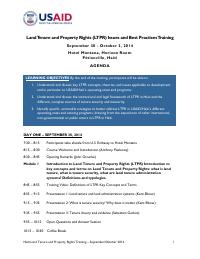
Programme de formation sur les droits fonciers et de propriete en Haiti, septembre-octobre 2014
Résumé — Ce programme documente une formation USAID/Haiti de 2014 sur les enjeux et bonnes pratiques relatifs aux droits fonciers et de propriete.
Constats Clés
- Ajoute des preuves specifiques a Haiti issues de la recherche Haiti plus large de Land Portal.
- Appuie la recherche sur l'administration fonciere, les droits fonciers, le cadastre, la reconstruction du logement, l'information territoriale, l'amenagement rural ou les programmes de droits de propriete.
- Les metadonnees ont ete redigees manuellement a partir des PDF locaux et des notices sources recuperees.
Description Complète
Le programme presente une formation de trois jours a Petionville sur les droits fonciers et de propriete. Il couvre les concepts LTPR, la securite fonciere, les systemes d'administration fonciere, la gouvernance democratique, la securite alimentaire, la reconstruction, les infrastructures, le logement, la gestion des risques de catastrophe et le cadre juridique et institutionnel haitien.
Texte Intégral du Document
Texte extrait du document original pour l'indexation.
Land Tenure and Property Rights (LTPR) Issues and Best Practices Training
September 30 - October 2, 2014
Hotel Montana, Horizon Room
Pétionville, Haiti
AGENDA
LEARNING OBJECTIVES By the end of the training, participants will be able to:
1. Understand and discuss key LTPR concepts, theories, and issues applicable to development
and in particular to USAID/Haiti’s operating areas and programs;
2. Understand and discuss the institutional and legal framework of LTPR in Haiti and the
different, complex sources of tenure security and insecurity;
3. Identify specific, actionable strategies to better address LTPR in USAID/Haiti’s different
operating areas and existing programs, drawing from the experience of other international,
non-governmental or public actors in LTPR in Haiti.
DAY ONE – SEPTEMBER 30, 2014
7:30 – 8:15
Participants take shuttle from U.S. Embassy to Hotel Montana
8:15 – 8:30
Course Welcome and Introduction (Anthony Piaskowy)
8:30 – 8:45
Opening Remarks (John Groarke)
Module 1
Introduction to Land Tenure and Property Rights (LTPR) Introduction to
key concepts and terms on Land Tenure and Property Rights: what is land
tenure, what is tenure security, what are land tenure administration
systems? Definitions and typologies.
8:45 – 8:55
Training Video: Definitions of LTPR Key Concepts and Terms
8:55 – 9:15
Presentation 1: Land tenure and land administration systems (Kent Elbow)
9:15 – 9:35
Presentation 2: What is tenure security? Why does it matter (Kent Elbow)
9:35 – 9:55
Presentation 3: Tenure theory and evidence (Sebastien Gachot)
9:55 – 10:15
Open Questions and Answer Session
10:15 – 10:30
Coffee Break
Haiti Land Tenure and Property Rights Training – September/October 2014
1
10:30 – 11:00 Small Group Exercise: Is tenure secure or insecure in urban and rural Haiti? What are
the primary sources of security and insecurity?
Module 2
LTPR Issues During the Project Cycle: Democracy and Governance
11:00 – 11:30 Presentation: Project lifecycle in DG projects, LTPR issues and consequences
(Kent Elbow)
11:30 – 12:00 Facilitated Discussion: What are the primary constraints to effective democratic
governance in Haiti stemming from land tenure issues? (Kent Elbow)
12:00 – 12:30 Lunch
Module 3
LTPR Issues During the Project Cycle – Food Security Projects
12:30 – 12:40 Training Video: Tenure and Food Security
12:40 – 1:10
Presentation: Project lifecycle in food security projects, LTPR issues and consequences
(Kent Elbow)
1:10 – 1:50
Small Group Exercise: What are the key tenure aspects to be appraised and addressed
in projects focusing on food security? How can they be addressed?
1:50 – 2:10
Coffee break
Module 4
LTPR Issues During the Project Cycle – Reconstruction, Infrastructure,
Housing and Disaster Risk Management
2:10 – 2:40
Presentation: Project lifecycle in housing and infrastructure projects, LTPR issues and
consequences (Jane Charles Voltaire/Habitat for Humanity and Johnson
Nazaire/UNOPS)
2:40 – 3:15
Small Group Exercise: How well were land tenure issues appraised and addressed in the
development and implementation of recent Haiti reconstruction, infrastructure and
housing projects?
3:15 – 3:30
Day One Wrap Up (Anthony Piaskowy)
3:30 – 4:30
Participants take shuttle back to U.S. Embassy
Haiti Land Tenure and Property Rights Training – September/October 2014
2
DAY TWO – OCTOBER 1, 2014
7:30 – 8:15
Participants take shuttle from U.S. Embassy to Hotel Montana
8:15 – 8:30
Recap of Day one; review agenda for Day Two (Anthony Piaskowy)
Module 5
Land Property Rights and Tenure Security in Haiti – Legal, Social and
Economic Perspectives
8:30 – 9:00
Presentation 1: Land rights and access to land in Haiti from a legal-historical perspective
(Veronique Dorner)
9:00 – 9:30
Presentation 2: The social dynamics of land tenure in Haiti and implications for tenure
security (Veronique Dorner)
9:30 – 10:00
Small Group Exercise: what are the primary social drivers for land tenure insecurity in
urban and rural Haiti? When developing interventions, what are the key social questions
to ask and why? What are the social risks to successful project implementation?
10:00 – 10:15 Coffee break
Module 6
The Legal and Institutional Framework for Land Administration in Haiti:
Actors and Initiatives
10:15 – 10:45 Presentation 1: Institutional Framework for Land Governance in Haiti and needed
reforms: overview of the different actors in Haitian land administration (Gabriela Vaz
Rodrigues)
10:45 – 11:15
Presentation 2: Allocation and Management of State Lands Directorate General for
Taxes (Andral Joseph - DGI)
11:15 – 11:35
Presentation 3: New Vision for Management of the Haitian Property Cadaster (Fritz
Gerard Chery - ONACA)
11:35 – 11:55
Presentation 4: Mapping and Land Information Management in Haiti (Boby Piard CNIGS)
11:55 – 12:45 Lunch and Guided Group Discussion
12:45 – 1:15
Presentation 5: Building the Parcel-based Land Tenure Database: the Land Tenure
Security Project in Rural Areas and the Urban Pilot Project coordinated by CIAT (Pierre
Andre Guerrier - CIAT).
1:15 – 1:45
Presentation 6: Linking land tenure security to Haiti’s development: current thinking on
a land policy for the future (Michele Oriol - CIAT)
1:45 – 2:15
Small Group Exercise: Institutional mapping of land tenure actors and agencies
2:15 – 2:30
Coffee break
Haiti Land Tenure and Property Rights Training – September/October 2014
3
Module 7
Principles and tools for creating tenure security - International best
practices: how do projects address LTPR issues in different sectors in similar
contexts as Haiti?
2:30 – 3:00
Presentation: The need for case-by-case solutions: lessons learned from land tenure
regularization and land tenure certification programs in countries with characteristics
similar to Haiti (Kent Elbow)
3:00 – 3:20
Facilitated Discussion: What practices should be used in Haiti to address land tenure
insecurity and improve land administration? (Kent Elbow)
3:20 – 3:30
Day Two Wrap Up (Anthony Piaskowy)
3:30 – 4:30
Participants take shuttle back to U.S. Embassy
Haiti Land Tenure and Property Rights Training – September/October 2014
4
DAY THREE – OCTOBER 2, 2014
7:30 – 8:15
Participants take shuttle from U.S. Embassy to Hotel Montana
8:15 – 8:30
Recap of Day Two; review agenda for Day Three (Anthony Piaskowy)
Module 8
Strategies and Programming Options Part 1
8:30 – 8:35
Training Video: Principles and Tools for Creating Tenure Security
8:35 – 9:05
Presentation 1: USAID principles and tools and other tools developed to assess
governance on Land Tenure (e.g. USAID, World Bank LGAF, FAO tools) (Anthony
Piaskowy, Kent Elbow and Gabriela Vaz Rodrigues)
9:05 – 9:25
Presentation 2: Introduction to USAID Land Tenure and Property Rights Division’s
resources and services (Anthony Piaskowy)
9:25 – 9:45
Discussion
9:45 – 10:00
Coffee break
Break-out into working groups (one per operating unit) and discussion of questions
10:00 – 10:20 Introduction to working group sessions and overview of objectives (Anthony Piaskowy)
10:20 – 10:50
Question 1: What are the key LTPR challenges faced by USAID Mission programs?
10:50 – 11:20 Question 2: In which areas should USAID engage to solve issues and take advantage of
opportunities?
11:20 – 11:50 Question 3: How to better engage?
11:50 – 12:00 Wrap up of working groups; introduction to presentations (Anthony Piaskowy)
12:00 – 12:30 Lunch
Presentations of Results of Discussion by Each Working Group
12:30 – 12:50 Working Group Presentation 1: Agriculture/food security and Economic Growth
12:50 – 1:10
Working Group Presentation 2: Housing and infrastructure
1:10 – 1:30
Working Group Presentation 3: Democracy and governance
Module 9
Strategies and Programming Options Part 2
1:30 – 2:15
Working Session: Prioritization of key issues and their justification (Anthony Piaskowy)
2:15 – 3:00
Working Session (in plenary): Action points to further develop and implement a
strategic plan for addressing LTPR; development of a timeline (Anthony Piaskowy)
3:00 – 3:15
Wrap-up, conclusions and next steps (Anthony Piaskowy)
3:15 – 3:30
Awarding of certificates and adjournment (Anthony Piaskowy)
Haiti Land Tenure and Property Rights Training – September/October 2014
5
Comment citer
USAID; Haiti Property Law Working Group; Land Portal, Programme de formation sur les droits fonciers et de propriete en Haiti, septembre-octobre 2014, https://landportal.org/sites/default/files/imported_files/landlinks_1281.pdf