Teks Konple Dokiman an
Teks ki soti nan dokiman orijinal la pou endeksasyon.
The Weaponization of Sexual Violence in
Haiti: Impunity, Gangs, and Resistance
Sep 23 -Written By Guest Author(s)
Author: Dr. Lovesun Parent
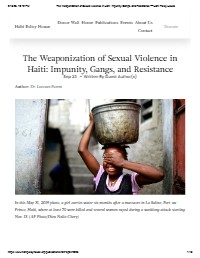
In this May 31, 2019 photo, a girl carries water six months after a massacre in La Saline, Port-au-
Prince, Haiti, where at least 70 were killed and several women raped during a weeklong attack starting
Nov. 13. (AP Photo/Dieu Nalio Chery)
Haïti Policy House
Donor Wall Home Publications Events About Us
Contact
Donate
2/16/26, 10:12 PM The Weaponization of Sexual Violence in Haiti: Impunity, Gangs, and Resistance — Haïti Policy House
https://www.haitipolicyhouse.org/publications/haiti-sgbv-2025 1/15
Sexual and Gender-based Violence as a Weapon of Control
Colonial Legacies and Normalization
Institutional Collapse and Global Complicity
Survivor Agency and the Path Forward
Executive Summary
Sexual violence in Haiti is not new, but its scale and brutality have reached devastating
new levels. Once employed by paramilitary regimes as a method of political repression,
sexual and gender-based violence (SGBV) has now become a systematic tool of control
used by non-state armed groups (NSAGs) operating in a context of near-total state
collapse. Today, rape is not only a weapon of terror but also a means of enforcing
territorial dominance, silencing dissent, and restricting access to humanitarian assistance.
The rise in conflict-related sexual violence reflects a crisis shaped by both historical
legacies and contemporary political failures. From the colonial exploitation of enslaved
women to the Tonton Macoutes under the Duvalier regime, women’s bodies have long
been sites of domination and punishment. These patterns of violence were further
entrenched by a justice system plagued by impunity and the chronic underfunding of
public health and legal services. In 2024, more than 6,500 cases of gender-based violence
were reported, with women and girls comprising the majority of the victims. These
figures likely understate the full scale of the crisis, as survivors often remain silent due to
fear, stigma, and lack of police presence in gang-controlled zones.
“This article asks, how has sexual and gender-based violence (SGBV) in Haiti evolved
from a tool of state repression to a strategy of territorial control by armed groups, and
2/16/26, 10:12 PM The Weaponization of Sexual Violence in Haiti: Impunity, Gangs, and Resistance — Haïti Policy House
https://www.haitipolicyhouse.org/publications/haiti-sgbv-2025 2/15
what are the implications for survivor-centered justice and international
accountability?”
In exploring this question, the article traces the historical trajectory of SGBV in Haiti,
analyzes the structural and political conditions that fuel its escalation, and highlights the
work of Haitian grassroots movements that are on the front lines of response and
resistance.
Historical Roots: Colonialism, Repression, and the Normalization of SGBV
Key moments showing how gender-based violence became embedded in Haiti’s political and
social history.
1492–1804
Colonial Rule
Enslaved women faced rape and forced reproduction as systemic control.
1957–1986
Duvalier & Tonton Macoutes
Paramilitary forces used sexual violence to punish dissent.
1991–1994
Coup Era
Rape deployed as a weapon to intimidate Lavalas supporters.
2005
Legal Reform
Rape recognized as a crime, though enforcement remains weak.
2004–2017
UN Peacekeepers
Reports of sexual exploitation and abandoned children.
2010–2012
2/16/26, 10:12 PM The Weaponization of Sexual Violence in Haiti: Impunity, Gangs, and Resistance — Haïti Policy House
https://www.haitipolicyhouse.org/publications/haiti-sgbv-2025 3/15
Earthquake Camps
Insecure camps saw spikes in rape and exploitation.
2018–2020
Urban Massacres
Rape used in La Saline and Bel-Air attacks during turf wars.
2021–Present
State Collapse
Gangs weaponize SGBV to govern and control neighborhoods.
Sexual and gender-based violence in Haiti cannot be understood apart from the country’s
foundational experiences of colonialism, racial capitalism, and state repression. Haitian
women, especially those of African or Afro-descendant heritage, have been victims of
gender-based violence since the beginning of slavery under French and Spanish rule.
Enslaved women were subjected to rape, forced reproduction, and systemic exploitation
in a plantation economy that dehumanized them as both laborers and breeders. Colonial
sexual violence served not only to discipline enslaved populations but also to reinforce a
power structure that associated whiteness, masculinity, and power with the right to
dominate.
This legacy of gendered violence was carried forward through successive regimes, most
infamously under the dictatorship of François “Papa Doc” Duvalier and his paramilitary
force, the Tonton Macoutes. Established in 1959, the Tonton Macoutes employed sexual
violence, including rape and public humiliation, to penalize perceived political dissent
and instill fear within communities. Women connected to activists or opposition figures
were often specifically targeted to assert control over both the family unit and the
political resistance. Though the regime ended in 1986, its tactics and culture of impunity
continue to echo in the practices of modern gangs.
The post-Duvalier era brought new forms of political instability that further entrenched
sexual violence as a tactic of repression. After the 1991 military coup that ousted President
Jean-Bertrand Aristide, paramilitary groups, including numerous former Macoutes,
perpetrated systematic sexual violence and intimidation against women in communities
supportive of the Lavalas political movement. A 1994 Human Rights Watch report
2/16/26, 10:12 PM The Weaponization of Sexual Violence in Haiti: Impunity, Gangs, and Resistance — Haïti Policy House
https://www.haitipolicyhouse.org/publications/haiti-sgbv-2025 4/15
documented the use of rape as a “weapon of terror,” often coupled with interrogations
about women’s political affiliations. These assaults were not random; they were targeted,
strategic acts intended to fracture movements and suppress dissent.
In the aftermath of the 2010 earthquake, thousands of women and girls were displaced
into makeshift camps lacking adequate protection. Reports of rape, transactional sex, and
exploitation emerged within weeks, occasionally perpetrated by fellow camp residents
and, in certain instances, aid workers. The lack of security in these camps mirrored the
broader failure of the international community to prioritize gender-based protections in
humanitarian response. According to Doctors Without Borders, more than 250 cases of
sexual violence were documented in just a few months following the disaster.
To be clear, the abuse was not isolated to Haitian actors. From 2004 to 2017, the United
Nations Stabilization Mission in Haiti (MINUSTAH) became a source of further harm.
United Nations (UN) peacekeepers were accused of sexually exploiting Haitian women
and girls, fathering children they later abandoned. These actions exacerbated the trauma
of previous violations and reinforced the perception that foreign intervention, even
under the guise of protection, could perpetuate the very abuses it claimed to end. Despite
growing awareness, few perpetrators were held accountable, and survivors were left with
little recourse, deepening the normalization of SGBV as a fact of Haitian life.
The historical factors of colonial violence, dictatorial repression, political exploitation,
and humanitarian neglect have normalized sexual violence in both private and public
spheres, not limited to Haiti. This normalization exemplifies what UN Secretary-General
António Guterres refers to as a global “age of impunity,” wherein states and actors "violate
international law" and neglect the fundamental rights of their citizens, fostering
conditions where violations such as sexual violence remain unaddressed. These same
forces have established the foundation for the contemporary use of sexual violence by
armed groups in Haiti, not merely as a random act of brutality, but as a deliberate
strategy of territorial dominance and social control. It is imperative to confront this past
to resolve the current crisis. Comprehending this legacy is not merely a matter of
historical reflection; it is a necessary step in the process of dismantling the systems that
allow sexual violence to function as both a tool of oppression and a currency of power in
the present day.
2/16/26, 10:12 PM The Weaponization of Sexual Violence in Haiti: Impunity, Gangs, and Resistance — Haïti Policy House
https://www.haitipolicyhouse.org/publications/haiti-sgbv-2025 5/15
Analysis
Weapon of Power and Control: The Role of Armed Groups and State Collapse
The United Nations reports that the utilization of sexual violence in Haiti today is not an
accident but a deliberate strategy implemented by armed groups to establish control over
territories, subjugate populations, and enforce compliance in the absence of state
governance. With the assassination of President Jovenel Moïse in 2021 and the subsequent
collapse of effective national leadership, Haiti has entered a new phase of lawlessness.
Heavily armed criminal groups, including the G9 coalition led by former police officer
Jimmy “Barbecue” Chérizier, now control over 80 percent of Port-au-Prince. Their use of
rape, gang rape, and sexual slavery has become an institutionalized method of
domination.
In Haiti, the armed groups, which are commonly referred to as gangs, frequently deploy
sexual violence during turf wars and territorial raids, using it not only as a punishment
but as a tactic of terror designed to forcibly displace communities. Women and girls are
often targeted in their homes during gang incursions or kidnapped from the street and
raped in retaliation for perceived allegiance to rival factions. In some documented cases,
gang members deliberately rape women and girls in front of family members,
weaponizing humiliation as a tool of psychological warfare.
The control exerted by these armed groups extends beyond physical violence. In
displacement settings, often informal camps set up in schools or temporary shelters,
women face heightened exposure to sexual exploitation due to a complete lack of
protection infrastructure. UN Women reports that in camps assessed in 2024, fewer than
10 percent of women had access to health services. Some were coerced into sex work in
exchange for food, shelter, or relative safety. In these spaces, rape is often used as a means
to control access to humanitarian assistance, reinforcing a system where sexual violence
becomes transactional and normalized.
What distinguishes the current phase of SGBV in Haiti is not only its frequency but also
its calculated use as a means of governance by armed groups operating in a political
vacuum. The formation of gang alliances such as G9 and G-Pèp has turned sexual
violence into an operational weapon. In multiple documented attacks, including those in
2/16/26, 10:12 PM The Weaponization of Sexual Violence in Haiti: Impunity, Gangs, and Resistance — Haïti Policy House
https://www.haitipolicyhouse.org/publications/haiti-sgbv-2025 6/15
La Saline (2018), Bel-Air (2019), and Cité Soleil (2020), rape was employed alongside mass
killings and arson. Between May and July 2020, at least 18 women were raped in a
coordinated assault by G9-affiliated gangs during an effort to consolidate control in Cité
Soleil. These actions were not spontaneous but rather calculated attempts to instill fear,
weaken community solidarity, and assert dominance.
The collapse of Haiti’s legal and security institutions has only deepened this crisis. The
Haitian National Police (HNP), outnumbered and under-resourced, is unable to protect
civilians or pursue justice. With only 15,500 officers for a population of over 11 million,
Haiti’s police-to-population ratio is among the lowest in the region. Moreover, the Port-
au-Prince Juvenile Court has been nonoperational since 2019, denying minors, many of
whom are survivors or perpetrators of gang-related violence, access to legal recourse.
In this climate of impunity, many survivors choose silence. In areas controlled by NSAGs,
reporting sexual violence can invite further harm. As one teenage survivor told Amnesty
International, “There is no police… the only chief in town are the gang members.” In
these areas, sexual violence has become so commonplace that it is no longer seen as an
unusual occurrence but rather as a regular part of life under gang control.
This section of Haiti’s SGBV crisis reveals a more profound truth: sexual violence has
become a form of governance. In the vacuum left by the state, NSAGs have created their
own rules, in which women’s bodies are used as leverage, currency, and conquest. Until
there is a comprehensive strategy that dismantles both the culture of impunity and the
gendered logic of control, these patterns will persist.
Structural Failures and International Complicity
The SGBV crisis in Haiti is not merely the result of individual acts or NSAG dynamics. It
is also the product of profound domestic and international structural failures that have
eroded systems of protection and accountability. Weak institutions, under-resourced legal
frameworks, and uneven international engagement have allowed sexual violence to
flourish with near-total impunity. From a legal framework perspective, Haiti did not
legally recognize rape as a criminal offense until 2005. Before this, sexual assault was
treated as a moral transgression rather than a prosecutable crime, reflecting broader
societal patterns of victim-blaming and gender discrimination. Even after legal reform,
2/16/26, 10:12 PM The Weaponization of Sexual Violence in Haiti: Impunity, Gangs, and Resistance — Haïti Policy House
https://www.haitipolicyhouse.org/publications/haiti-sgbv-2025 7/15
enforcement remains inconsistent due to gaps in policing, forensic capacity, and judicial
independence. Survivors often face a justice system that is dismissive, retraumatizing, or
inaccessible. With judicial strikes paralyzing courts nationwide, survivors of all ages are
effectively locked out of formal recourse.
International responses to this crisis have often been insufficient, delayed, and sometimes
even harmful. MINUSTAH, which was deployed from 2004 to 2017, left a legacy of sexual
exploitation and abuse. UN peacekeepers were accused of fathering hundreds of children
with Haitian women and girls, then abandoning them without support. Investigations
into these abuses were limited, and survivors were largely denied justice or reparations.
This failure tarnished the credibility of international protection mechanisms and
deepened local distrust of foreign actors.
More recent international interventions have similarly failed to address the gendered
dimensions of the crisis. While the United States, Canada, and CARICOM countries have
pledged support for the Kenyan-led Multinational Security Support (MSS) mission, there
are concerns that this deployment lacks robust gender safeguards. As one civil society
leader noted, “If gangs lose control of certain neighborhoods, it may actually leave some
women and girls more vulnerable-not less—if no alternative protections are in place.”
Despite calls from UN Women and others to embed a strong gender component in the
MSS, implementation remains unclear.
Global donors and humanitarian agencies have also struggled to align their funding with
on-the-ground needs. International NGOs receive a disproportionate share of funding
compared to Haitian women's organizations, even though these groups offer essential
services such as medical care, trauma counseling, shelter, and legal aid. A 2024 UNFPA
mapping assessment found that only a third of women-led service providers in Haiti had
sustained funding for emergency relief or dignity kits. Without long-term support, these
community-based groups risk collapse just as needs are peaking.
Finally, deportation policies by neighboring countries exacerbate vulnerability. The
United States and the Dominican Republic have continued forced returns of Haitian
migrants, including women and children, into a context where SGBV is widespread and
protective infrastructure is nonexistent. The U.S. Department of Homeland Security
announced plans to terminate Temporary Protected Status (TPS) for Haitians, setting more
2/16/26, 10:12 PM The Weaponization of Sexual Violence in Haiti: Impunity, Gangs, and Resistance — Haïti Policy House
https://www.haitipolicyhouse.org/publications/haiti-sgbv-2025 8/15
than 500,000 people up for potential deportation. Although a federal judge has
temporarily blocked the policy, the threat remains. These deportations undermine human
rights commitments and reflect a troubling externalization of the crisis, treating SGBV in
Haiti as a domestic issue, rather than one shaped by global power dynamics, racialized
neglect, and decades of international policy failures.
Taken together, these structural failures and international blind spots have contributed to
an environment where sexual violence is not just possible, but it is predictable.
Combating this crisis will require more than tactical policing. It will demand systemic
change: funding survivor-led efforts, centering Haitian expertise, and rebuilding the state
with justice, not just security, in mind.
Survivor Resistance and Local Response
In the face of overwhelming violence, displacement, and neglect, Haitian women and
girls are not merely victims; they are leaders, organizers, and first responders. Their
efforts counter the failures of the state and international community by serving as a
model for locally grounded, survivor-centered responses. Despite chronic underfunding
and insecurity, these organizations continue to provide vital services, including
psychosocial counseling, medical referrals, and emergency shelter. A 2024 UNFPA and
GBV Sub-Cluster mapping identified 24 women’s rights groups actively supporting
survivors across Haiti, often in areas where international NGOs and UN agencies cannot
safely operate. Many of these initiatives are community-based, informal networks formed
by women who themselves have experienced or witnessed violence. Their deep local
knowledge and trust make them uniquely positioned to respond quickly and sensitively.
This resistance is not new. Haitian women’s organizations have long been central to
national movements for justice and democracy. They fought to criminalize rape in 2005,
campaigned for the creation of the Ministry of Women’s Affairs and Women’s Rights
(MCFDF), and secured a constitutional quota mandating 30% representation of women in
public office. During the post-earthquake crisis in 2010, women-led coalitions provided
essential services in displacement camps and documented cases of sexual violence that
national and international institutions otherwise ignored. That legacy of advocacy and
mutual aid continues today, even under life-threatening conditions.
2/16/26, 10:12 PM The Weaponization of Sexual Violence in Haiti: Impunity, Gangs, and Resistance — Haïti Policy House
https://www.haitipolicyhouse.org/publications/haiti-sgbv-2025 9/15
Yet the risks for those providing services to survivors are immense. Many Haitian
women’s rights defenders operate in gang-controlled areas, with limited security
protection. Some have received direct threats for speaking out, while others have been
forced to relocate for their safety. One organization in Port-au-Prince described using
“mobile safe spaces” to move discreetly between sites and avoid drawing attention from
gangs. Others have trained survivors to serve as peer advocates, distributing information
about GBV services in informal networks and building support from within the
community itself.
Mental health care remains one of the most critical and underfunded areas. Nearly 70
percent of displaced women and girls in a 2024 UN Women assessment reported
psychological distress, yet only 10 percent had access to any form of health service.
Haitian women’s organizations have responded by integrating trauma-informed care into
their programming, often relying on volunteer psychologists, traditional healing
practices, or informal support groups led by survivors. These initiatives offer rare spaces
of collective healing in an environment saturated with violence and fear.
Women’s economic empowerment is also emerging as a critical pathway to protection. In
displacement camps where nearly 90 percent of women report having no income, many
women’s groups are running microenterprise trainings, vocational workshops, and cash
assistance programs to reduce the vulnerabilities that can lead to survival sex or coercion.
Still, these efforts are limited in scale due to restricted funding and a lack of international
support for women-led humanitarian responses.
Too often, Haitian women are portrayed only as passive recipients of aid. This framing
erases the reality that they are among the most active and effective responders to the
SGBV crisis. As one local advocate put it: “We’re not just collecting data or handing out
kits. We’re trying to protect our sisters, our neighbors, our daughters, from being broken
by this violence.” The international community must go beyond token consultations and
shift funding, decision-making power, and recognition to these frontline actors.
Recommendations: Rethinking Protection and Justice
The scale and systematic nature of SGBV in Haiti demand more than emergency
responses. What is needed is a total reimagining of how protection and justice are
2/16/26, 10:12 PM The Weaponization of Sexual Violence in Haiti: Impunity, Gangs, and Resistance — Haïti Policy House
https://www.haitipolicyhouse.org/publications/haiti-sgbv-2025 10/15
defined, delivered, and sustained, especially in contexts of chronic fragility and
displacement. To do so requires grappling with the historical roots of this crisis, the
limitations of current interventions, and the transformative possibilities emerging from
Haitian-led resistance.
•First, protection must be understood as more than the physical presence of armed
actors. For many Haitian women and girls, so-called “security forces” have
historically been complicit in harm, from the Tonton Macoutes and military attachés
to abusive UN peacekeepers and corrupt local police. Protection, then, must be
redefined to prioritize trust, autonomy, and consistent access to rights-based
services: housing, healthcare, legal redress, and safe mobility.
•Second, justice cannot be limited to prosecution, particularly when the judicial
system is barely functional. Survivors consistently cite fear of retaliation, lack of
police presence, and social stigma as reasons they do not report assaults. Even when
perpetrators are known, they often act with impunity, protected by gang alliances or
political patronage. A survivor-centered justice model must prioritize healing, truth-
telling, community accountability, and social reintegration; measures that Haitian
women’s organizations are already implementing.
•Third, donor strategies must shift from episodic emergency aid to sustained
investment in Haitian civil society. Local women-led organizations have
demonstrated unmatched reach and cultural fluency in supporting survivors, yet
they are persistently sidelined by large INGOs and bypassed in direct funding.
Multi-year, flexible funding should be the norm for frontline actors doing this work
under the most extreme conditions.
•Fourth, gender must be embedded as a core principle in all humanitarian and
political responses. As of August 2025, Haiti’s Transitional Presidential Council
includes only one non-voting woman representative, despite women bearing the
brunt of the crisis and leading grassroots responses. Inclusion must go beyond
optics. It must mean women are resourced, respected, and central to decision-
making in state rebuilding, international negotiations, and displacement
management.
•Fifth, international security missions such as the MSS must learn from past failures.
Any foreign presence must operate under strong human rights safeguards, with
2/16/26, 10:12 PM The Weaponization of Sexual Violence in Haiti: Impunity, Gangs, and Resistance — Haïti Policy House
https://www.haitipolicyhouse.org/publications/haiti-sgbv-2025 11/15
built-in GBV prevention and response protocols. International partners must avoid
replicating harmful models of militarized aid or imposing externally defined
solutions that overlook Haiti’s complex gendered realities.
•Sixth, diaspora engagement must be recognized as a strategic and underutilized
dimension of protection and justice. The Haitian diaspora has long contributed to
national development through remittances, advocacy, and service delivery, but these
efforts remain largely informal and disconnected from donor strategies. Diaspora
networks, especially those led by women, can amplify survivor voices, mobilize
resources, and bridge the gap between grassroots actors and international
institutions. Yet, as documented in prior research, development donors have largely
failed to establish formal mechanisms for engaging diaspora stakeholders in crisis
response. Incorporating the diaspora as active partners, not just philanthropic
bystanders, could enhance accountability, sustainability, and cultural relevance in
SGBV programming.
•Finally, global actors must confront their own complicity. The normalization of
SGBV in Haiti is not only a local or cultural issue; it's a political one, influenced by
centuries of colonial rule, predatory debt, failed interventions, and racialized
neglect. Reimagining justice for Haitian survivors must begin with listening to
them, trusting their expertise, and supporting their vision for a country where
violence is no longer the cost of survival.
Conclusion
The rise of sexual and gender-based violence in Haiti is not an isolated phenomenon; it is
the culmination of deep historical injustices, compounded by state collapse, international
neglect, and structural inequality. From the Duvalier dictatorship to post-earthquake
displacement camps, from gang rule to failed international missions, Haitian women and
girls have borne the brunt of violence without adequate protection, justice, or redress.
This article has shown how SGBV has evolved from a political weapon to a widespread
tactic of territorial control and economic coercion, weaponized both by armed groups
and systemic failure.
2/16/26, 10:12 PM The Weaponization of Sexual Violence in Haiti: Impunity, Gangs, and Resistance — Haïti Policy House
https://www.haitipolicyhouse.org/publications/haiti-sgbv-2025 12/15
Yet amid the devastation, Haitian women have never stopped resisting. They lead
community-based shelters, run psychosocial support programs, document abuses, and
advocate for legal reform, often with little to no external support. Their work illustrates
not only what must change but also what is already working.
To address this crisis, several urgent shifts are needed:
•Redefine protection as survivor-centered, community-led, and rooted in long-term
safety and dignity, not just a militarized presence.
•Reimagine justice beyond courtrooms to include healing, truth-telling, and
accountability mechanisms that reflect Haitian realities.
•Center Haitian leadership by investing directly in women-led organizations with
flexible, multi-year support.
•Embed gender in all responses, ensuring Haitian women are not symbolic
participants, but power-holders in political transitions, security operations, and
recovery efforts.
•Confront international complicity, acknowledging how colonialism, structural
racism, and failed interventions have reinforced conditions of gendered violence in
Haiti.
The question is no longer whether SGBV in Haiti can be addressed. It is whether we will
finally center the solutions that Haitian women have always known and fought for with
everything they have.
The Author
2/16/26, 10:12 PM The Weaponization of Sexual Violence in Haiti: Impunity, Gangs, and Resistance — Haïti Policy House
https://www.haitipolicyhouse.org/publications/haiti-sgbv-2025 13/15
Dr. Lovesun Parent
Dr. Lovesun Parent is a longtime
advocate for justice, equity, and the
rights of women and marginalized
communities. For nearly 20 years, she
has led programs around the world that
support survivors of violence,
strengthen local leadership, and ensure
communities have what they need to
thrive. Her academic work focuses on
engaging diasporas to drive meaningful
change in global development. Dr.
Parent is the Executive Director of
Libraries Without Borders US, where
she helps expand access to books, the
internet, and learning programs in
underserved communities.
Haiti Policy House is a not-for-profit institution focusing on Haitian public policy issues. Its research is
nonpartisan. Haiti Policy House does not take specific policy positions. Accordingly, all views,
positions, and conclusions expressed in this publication should be understood to be solely those of the
author(s).
© 2025 by Haiti Policy House. All rights reserved.
Help fund research that makes a difference for Haiti
2/16/26, 10:12 PM The Weaponization of Sexual Violence in Haiti: Impunity, Gangs, and Resistance — Haïti Policy House
https://www.haitipolicyhouse.org/publications/haiti-sgbv-2025 14/15
Haïti Policy House, Inc.
1100 13th Street NW PMB 0803
Suite 800
Washington D.C. 20005
$50.00
$100.00
$250.00
$365.00
$500.00
Custom Amount
One-Time Donation
Total $50.00
Donate
Financial Forensics for
Credible Elections in
Haiti
Before and After:
Mapping the Impact of
Gang Violence on
Port‑au‑Prince
2/16/26, 10:12 PM The Weaponization of Sexual Violence in Haiti: Impunity, Gangs, and Resistance — Haïti Policy House
https://www.haitipolicyhouse.org/publications/haiti-sgbv-2025 15/15