Texte Intégral du Document
Texte extrait du document original pour l'indexation.
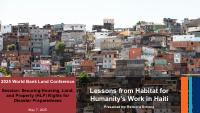
2025 World Bank Land Conference
Session: Securing Housing, Land,
and Property (HLP) Rights for
Disaster Preparedness
May 7, 2025
Lessons from Habitat for
Humanity’s Work in Haiti
Presented by: Rebecca Ochong
�Context:
• Haiti suffers from geographic vulnerability to hurricanes,
droughts, and earthquakes. Germanwatch Global Climate Risk
Index ranked Haiti 3rd in 2021.
• The latest disasters include the 2010 earthquake in central Haiti
with over 220,000 people killed and 1.5 million homeless,
Hurricane Matthew in 2016 with more than 500 people dead
and 1.4 million people in need of humanitarian assistance and
the 2021 earthquake in the south where 2,200 people lost their
lives.
• Habitat for Humanity began working in Haiti in 1984 and has
since served over 70,000 families through a variety of housing
solutions.
We build strength, stability and self-reliance through shelter.
We build strength, stability and self-reliance through shelter.
2
�Transition to Recovery – Land as barrier
Complex legal framework
• Land transactions are complex and costly.
• Legal counsel is not accessible to everyone.
• Roles of some actors are not well-delineated/duplication.
• Informal practices are not aligned with formal system.
• Prevalence of manual processes.
Low Institutional Capacity
• Lack of a functional land information / management system (No e-cadastre).
• Lack of official and geo-referenced land documentation.
• Weakness of the law, justice and control systems.
We build strength, stability and self-reliance through shelter.
We build strength, stability and self-reliance through shelter.
3
�Haiti Property Law Working Group - HPLWG
• Launched by Habitat in 2011
• Stakeholders: lawyers, notaries, gov’t ministries,
international orgs
• Goals: Clarify legal procedures, improve access to
land documentation
Practical tools and reforms
• Produced guidance documents on land tenure
pathways
• Trainings for legal professionals and community
leaders
• Helped streamline processes for informal and formal
settlements.
We build strength, stability and self-reliance through shelter.
We build strength, stability and self-reliance through shelter.
4
�Leveraging Land in Haiti project
• Support building, together with the authorities, a more
efficient, transparent, and accessible land tenure system
with a gender approach.
• Train development practitioners, researchers, decisionmakers, community leaders and private enterprises on
land tenure system tools and best practices.
• Register or incorporate 22,500 occupants of public land
into an official data base paired with a land-based
revenue mobilization.
• Increase the number of households with increased
tenure security by 12,000 in the target municipalities.
Innovation through technology.
People centered results.
Property rights.
We build strength, stability and self-reliance through shelter.
We build strength, stability and self-reliance through shelter.
5
�Project Accomplishments
• Increased entries by 34,556 into two
municipalities property tax Databases
(154% of original 12k goal).
• 2,504 cadastral land surveys
performed by Gov. Tax Authority.
• 23,238 residents received basic
information on land security.
• 1,277 residents trained on land tenure
regularization process.
We build strength, stability and self-reliance through shelter.
We build strength, stability and self-reliance through shelter.
6
�Project Accomplishments
●
Government staff trained in Field
Data Collection / Analysis and legal
tenure regularization process.
●
Completed physical demarcation for
97 kilometers of roadway in Canaan
●
New technology handed to
government institutions involved, such
as satellite imagery, hardware,
software.
Adeleine received legal documentation on her property by Jérémy Justin, Regional
Director of Land Domain in Haiti.
We build strength, stability and self-reliance through shelter.
We build strength, stability and self-reliance through shelter.
7
�Key Lessons
•
HLP issues must be addressed early
• Tenure clarity = faster, more
equitable recovery
• Local partnerships are essential
• HLP reforms can serve both
emergency and long-term
development goals
We build strength, stability and self-reliance through shelter.
We build strength, stability and self-reliance through shelter.
8
�Thank you!
Questions/Comments
�