
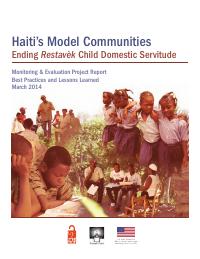
Communautés modèles d'Haïti: mettre fin à la servitude domestique des enfants restavèk. Rapport de suivi et d'évaluation
Résumé — Rapport de suivi et d'évaluation d'une approche par communautés modèles visant à mettre fin au placement des restavèk, financée par le bureau du Département d'État américain chargé de la traite.
Constats Clés
- Rend compte des leçons tirées par un maître d'œuvre haïtien, Fondasyon Limyè Lavi, créé en 1992.
- Financé par le bureau du Département d'État américain chargé de surveiller et combattre la traite des personnes : les exigences du bailleur façonnent donc ce qui est mesuré.
Description Complète
Rapport de suivi et d'évaluation d'une approche par communautés modèles visant à mettre fin au placement des restavèk, financée par le bureau du Département d'État américain chargé de la traite. Il présente les bonnes pratiques et enseignements tirés par un opérateur haïtien plutôt que des prescriptions extérieures.
Texte Intégral du Document
Texte extrait du document original pour l'indexation.
Haiti’s Model Communities
Ending Restavèk Child Domestic Servitude
Monitoring & Evaluation Project Report
Best Practices and Lessons Learned
March 2014
U.S. State Department
Office to Monitor and Combat
Trafficking in Persons (J/TIP)
Free the Slaves liberates slaves, helps them rebuild their lives, and
transforms the social, economic and political forces that allow slavery
to persist. We support community-driven interventions in partnership
with local groups that help people to sustainable freedom and
dismantle a region’s system of slavery. We convince governments,
international development organizations and businesses to implement
key changes required for global eradication. We document and
disseminate leading-edge practices to help the anti-slavery movement
work more effectively. We raise awareness and promote action by
opinion leaders, decision makers and the public. Free the Slaves is
showing the world that ending slavery is possible.
Fondasyon Limyè Lavi (FLL) is a Haitian foundation established in
1992. FLL operates in the following areas: child protection, formal
and alternative education, advocacy and organizational capacity
building. We work primarily in the most remote and marginalized rural
communities in the country to combat child domestic servitude known
as restavèk. One of the priorities of the Foundation is to support the
poor to become “Model Communities” where families, community
leaders and members who live there develop strategies to improve
their socioeconomic conditions and protect and defend the rights of
the child.
This report is made possible by the generous support of the American
people through the United States Department of State Office to
Monitor and Combat Trafficking in Persons (J/TIP). The contents are
the responsibility of Free the Slaves and do not necessarily reflect the
U.S. State Department views of the Department of State or the United States Government.
Office to Monitor and Combat
Trafficking in Persons (J/TIP)
A 12-minute mini-documentary video (in English and Haitian
Creole) has been produced to showcase the Model Communities
approach in action. It is available for online viewing at
www.freetheslaves.net/haiti.
Table of Contents
6 Executive Summary
8 Introduction
8 Restavèk in Haiti
9 Haitian Law and Protection Mechanisms for Restavèk
10 Partnership between Free the Slaves and Fondasyon Limyè Lavi to Address Restavèk
11 Model Communities Approach
14 Evaluation Methods
16 Evaluation Results
16 Children Retrieved from Restavèk
17 Effectiveness and Impact of Project Components
22 Sustainability
24 Efficiency
25 Lessons Learned
29 Conclusion
30 Endnotes
Acronyms
CPC Child Protection Committee
ESK Edikasyon se yon Konvèsasyon – “Education is a
Conversation” participatory learning method
ESK-DT Child Rights Series of the ESK methodology
ESK-SR Reproductive Health Series of the ESK methodology
FLL Fondasyon Limyè Lavi
FTS Free the Slaves
HIV Human Immunodeficiency Virus
ILO International Labor Organization
M&E Monitoring and Evaluation
STD Sexually Transmitted Disease
4 Haiti’s Model Communities Project Report March 2014
Acknowledgements
This report is based on a project evaluation led by Laurie
Richardson in collaboration with Cara Kennedy and members
of Fondasyon Limyè Lavi (FLL) and Free the Slaves (FTS).
Contributors to the report are Sujata Bijou, Christy Gillmore,
Smith Maximé and Karen Stauss. We thank other members
of the Model Communities team including Guerda Constant
and Muriel Chaperon of FLL; former FTS staffer Zorba Leslie,
and the staff of Beyond Borders. This report was edited by
Terry FitzPatrick and designed by Alison Mitchell. French
translation by Linda Gueye. Photos by Terry FitzPatrick and
Zorba Leslie. Cover illustration by Ben Bertucci. We especially
thank the residents of the project communities, recognizing
the resilience and courage of their children, and the activists
devoted to ending restavèk in Haiti.
© Copyright 2014 Free the Slaves
March 2014 Project Report Haiti’s Model Communities 5
• A reproductive health participatory learning communities of origin. It also contributed
module was included in the project because strongly to the reintegration of children who
family size and parental health can affect whether have returned from restavèk by serving 53
children are sent into restavèk. The intervention percent of the returnees in the communities
increased knowledge among approximately 500 assessed.
participants about reproductive health, including
• Returned children reported overwhelmingly that
how to prevent pregnancy and STDs; created
they feel happier to be home with their families,
a shift among participants toward attitudes
feel freedom that they didn’t experience when
favorable of family planning and prevention of
they were in restavèk, and are glad to be in
STDs; and helped change behavior, including
school. Children enjoy positive relationships
increased use of birth control.
with peers and siblings.
• An accelerated education component provided
• Parents are facing difficulties in providing for
a complete year of nearly-free education
returned children as a result of underproductive
to an average of 148 children each year,
farmland and little to no work opportunities.
helping to retain at-risk children in their
Lessons Learned and Recommendations
The outcomes attained during this project demonstrate program effectiveness. Lessons learned during the
project and evaluation point to the need to refine components of the Model Communities approach.
Standardize the use of social mapping and participatory wealth ranking exercises
Community-Based Assessment for use at baseline, follow-up and end-line, incorporating slight adjustments. Use
the data to conduct follow-up verification, to constitute caseloads for tracking, and
to target project activities.
Ensure that the risk of overly directive facilitation is properly managed in order
Education is a to maximize participation by all community members. Simplify monitoring and
Conversation (ESK) evaluation for ESK.
Ensure that real or perceived barriers to access to birth control are addressed,
Reproductive Health including resistance from religious leaders and spousal partners.
Child Protection Committees Ensure that returnee households have access to adequate psychosocial support.
Increase education investments at the design stage to boost quality and success
rates. Continue to reinforce the standard of non-violent discipline within classes.
Accelerated Education Enhance relevance by incorporating hands-on life skills. Seek to deliver all classes
in the morning.
Ensure that the stated and intended focus, targets and materials for grassroots
Advocacy
advocacy align with core concerns and capacity of affected communities.
Ensure that all future Model Communities projects include livelihoods programming
Livelihoods targeting the most vulnerable—including households that retrieve children.
Define a timeline and criteria for exiting project communities. Focus overall M&E
M & E, Exit Strategy on learning first, with key accountability points second.
March 2014 Project Report Haiti’s Model Communities 7
Introduction
Restavèk in Haiti
Restavèk is a traditional system in which children are forced to do age-inappropriate chores; not sent to
sent from home to live and work elsewhere, most school; and treated as inferior to the children of the
often from impoverished rural families to wealthier “host” or receiving family.
urban families seeking a domestic servant. In
many cases, restavèk becomes child trafficking The Haitian government has estimated that 150,000
and forced labor, meeting international criteria for children have been living in restavèk servitude.
slavery:2 many restavèk children are completely The Pan American Development Foundation has
controlled through violence and exploited by estimated the figure of urban restavèks to be
members of the households where they work. Often 225,000, two-thirds of them girls.3 The National
far from home, isolated and excluded within their Coalition for Haitian rights has estimated the
own environments, children in restavèk slavery have number of urban and rural restavèks nationwide to
no viable options, are under physical control, and be 300,000.
thus cannot walk away. Restavèk slaves are abused
physically, verbally, emotionally and sexually; The U.S. Labor Department conducted a qualitative
study including current and former restavèk children,
in both sending families and receiving families,
to understand the root causes and factors that
maintain the restavèk system.4 Sending families
cited poverty or inability to look after their children
as the principal drivers of their decision to send
their children away, conditions which they reported
often resulted from the death of one parent,
parental unemployment due to injury or disability,
familial discord and/or the consequences of the
2010 earthquake. Receiving families cited the
need for inexpensive domestic labor to manage the
household of relatively large families, as well as
their intention to offer a goodwill gesture to provide
children with a much needed home.
8 Haiti’s Model Communities Project Report March 2014
Haitian Law and Protection Mechanisms for Restavèk
Haiti is party to the Universal Declaration on Human which prohibits servitude, forced or compulsory
Rights 5 and the Convention on the Rights of the labor, and the use of children in criminal activities
Child.6 Haiti has also ratified the International or armed conflict. The act also criminalizes child
Labor Organization (ILO) Convention Concerning the trafficking and the recruitment of children for
Prohibition and Immediate Action for the Elimination sexual exploitation, such as pornography, and for
of the Worst Forms of Child Labor7 (Convention 182), illicit activities. However, there are no penalties
and the ILO Minimum Age Convention8 (Convention established for committing abuse and violence
138). Each of these conventions prohibits child against children through any of the crimes discussed
slavery and servitude and provides for children to in the act. It should be noted that the first article
have the right to education and the right to be free in the act annuls Chapter 9 of the Haitian Labor
10
from degrading and inhumane treatment. Code, which contained specific stipulations guiding
the treatment, rights and privileges of a child working
In accordance with these international conventions, in domestic service. The intent was to make illegal
in 2003 Haiti passed the Act on the Prohibition any child domestic service, but as a result, there
and Elimination of All Forms of Abuse, Violence, Ill- are no longer minimum guidelines for what a child
9
treatment or Inhumane Treatment against Children, deserves when working in domestic service.
March 2014 Project Report Haiti’s Model Communities 9
Despite the existence of these measures, which working group on restavèk (Table Sectorielle Sur
should assure the eradication of restavèk and the Les Enfants en Domesticité) launched a process
protection of all children, the restavèk practice to develop a national plan to eradicate restavèk in
continues largely unchecked. The continued Haiti by 2030. This plan will extend over 15 years
lack of legislation prohibiting all forms of human and is aligned with the national strategic plan
trafficking, as well as a lack of formal protections for Haiti’s development. The working group has
for trafficking victims, remain serious problems. completed a draft of the national plan. In addition,
An anti-trafficking bill has been introduced, but the creation of an inter-ministerial group to address
has not passed the Haitian parliament. However, human trafficking and officials’ stated commitment
there are indications of the government of Haiti’s to passage and implementation of anti-trafficking
commitment to building upon existing efforts. The legislation may lead to improved results in the
Haitian Ministry of Social Affairs and Labor-led future.
Partnership between Free the Slaves and
Fondasyon Limyè Lavi to Address Restavèk
In 2011, FTS began a three-year project in reduces the sending of children into the restavèk
partnership with FLL entitled “Freedom for Haiti’s system and increases reintegration of former
Children: Community Action to End Slavery Locally restavèk children.
and Nationally,” funded by the U.S. State Department
Office to Monitor and Combat Trafficking in Persons Objective 2: Document and promote an effective,
(J/TIP). The FTS-FLL project supports broader and grassroots-based model for community resistance
longer-term FLL child protection programming to pilot and response to restavèk slavery in local, national
the Model Communities methodology in Haiti, an and international forums.
effort involving 12 communities in two communes.
The FTS-FLL partnership activities evaluated in this Objective 3: Strengthen advocacy for passage
11
report were implemented in six rural communities of an effective legislative framework to combat
around Jacmel, with work in three of them reflecting restavèk slavery by perspectives and priorities from
a continuation of efforts initiated in previous communities and individuals most affected by the
years (May 2009 to May 2011) under an earlier restavèk system.
12
J/TIP grant.
Free the Slaves conducted an evaluation of the
The goal of the FTS-FLL project was to “prevent most recent three-year period of the “Freedom for
and reverse the flow of children from Haitian Haiti’s Children” project. This report is intended to
source communities into restavèk slavery through disseminate the findings of that evaluation, highlight
an approach that recognizes and reinforces the the best practices that emerged through the project,
strength of those most severely affected—restavèk provide recommendations for other organizations
children and their families and communities.” The wishing to adopt the project strategies and develop
project was structured around three objectives: programs that address the root causes of restavèk.
Objective 1: Develop, test, and refine an effective
grassroots-based model for source community
resistance and response to restavèk slavery that
10 Haiti’s Model Communities Project Report March 2014
Model
Communities
Approach
The program design that undergirds the “Freedom for and experience in the fight to end child slavery laid
Haiti’s Children” project is the Model Communities the groundwork for the development of this holistic
approach—a holistic model for community approach and for FLL’s collaboration with partners
development that is one of the first of its kind in FTS and Beyond Borders in its implementation.
Haiti. The Model Communities approach is based
on an analysis of risk factors that contribute The evaluation reported here takes into account the
to sending of children into restavèk, as well as three-year project period immediately preceding it, and
community and family support that is necessary to each of the project strategies conducted within that
prevent this phenomenon and help families retrieve period. To initiate the project, baseline assessments
restavèk children. The approach emerged from the were conducted to orient the subsequent strategies
long-standing involvement of FLL in the Campaign and provide comparison with follow-up data.
to End Child Servitude (Kanpay pou Elimine Sistèm Awareness-raising and capacity-building strategies
Restavèk) and the organization’s experience in were designed to spark community engagement
organizing networks of grassroots child rights and organizing around child rights, including support
organizations both in Port-au-Prince and in the for the reintegration of children who had been sent
Southeast department of Haiti. FLL’s positioning into servitude. The primary strategies for community
organizing, awareness raising, capacity building, and
participatory community-based evaluation included
the following:
Community-Based Assessment: Household surveys,
social mapping and participatory wealth ranking
community assessment exercises. These
methods were designed to provide project staff
and community members baseline information
regarding core indicators of the flow of children into
and out of servitude, the extent of their effective
access to education, and the general economic
wellbeing of the most vulnerable households.
Social mapping and participatory wealth ranking
exercises were conducted and the resulting data
was quickly tabulated and reported. Field workers
were also trained and conducted more than 1,000
household surveys. However, the team was unable
to analyze the resulting survey data due to technical
March 2014 Project Report Haiti’s Model Communities 11
behavior in the treatment of children. A pool of
local volunteers was trained to facilitate the child
rights curriculum via small groups meeting in their
community throughout a six-month period. An
attempt was made to target parents from households
identified in social mapping and participatory wealth
ranking as having children in restavèk or being
vulnerable. A total of 525 community members
participated in ESK-DT child rights, exceeding project
projections. The reproductive health and family
planning curriculum (ESK-SR) was used in the same
fashion, reaching 500 community members, nearly
twice the number projected in project planning.
Child Protection Committees (CPCs): Groups
complications. As a result, follow-up data collection
of community members trained and motivated to
at the end of the project period was conducted using
provide support to the most vulnerable families,
only social mapping and participatory wealth ranking
to promote child protection and to intervene in
processes, and not household surveys. All available
specific cases to prevent children being sent away
data was analyzed as part of the broader project
or to encourage return and reintegration. To ensure
evaluation process.
sustainability of gains in child protection, during
the project period, CPCs were established where
they did not yet exist and strengthened where
Open Space Technology: A highly scalable and
they did. Approximately 10 members of a central
adaptable meeting approach that encourages and
committee from each community shared knowledge
enables self-organizing discussions related to a
and strategies with the broader membership and
particular theme, allowing participants to suggest
community, undergoing training and participating
their own specific subtopics and group themselves
in exchange visits with members of CPCs in
according to their interests and passions. FLL has
other communities. The broader CPC membership
been using open space technology for the past 10
averaged 55 members (47 percent of whom were
years and organized multiple open space dialogues
in each community as a way of involving community
members and gathering community input at each
critical stage of the project.
Education is a Conversation (referred to by
Haitian Creole acronym ESK): A participatory
dialogue-based learning method that uses illustrated
story books to guide participants in a process of
discovery and transformation. Two ESK curricula
were used in the current project—one that focuses
on children’s rights (ESK-DT) and another that
focuses on reproductive health and family planning
(ESK-SR).
The children’s rights curriculum (ESK-DT) has been
found to increase compassion toward children
who have been in restavèk, and lead to improved
12 Haiti’s Model Communities Project Report March 2014
women) in each community. The CPC membership
included a cross-section of the community. However,
parents whose children had been sent away were
sometimes targeted for participation in ESK and
thus could be more likely to join the CPCs upon
completion of ESK.
Accelerated Education: A curriculum developed by
the Haitian Ministry of Education designed to equip
students over the average age for primary school
enrollments with the knowledge and skills necessary
to transfer to secondary school. This program allows
overage children to complete the standard, six-year
primary school curriculum in three years. The inability
to provide for a child’s education was one of the
most oft-cited reasons by evaluation participants for
sending children away or being reluctant to retrieve
them. Given past research showing that overage
children are particularly at risk, efforts to increase
their access to education were targeted through
providing accelerated education to an average of
seven classrooms and 148 children each school
toward government on behalf of their own priorities—
year, consisting of children either returned from or
whether on national legislation, local services or
at risk of being sent into restavèk.
any other matters of concern; b) to influence the
quality of advocacy for an anti-trafficking bill that has
not passed the Haitian parliament by having such
Advocacy: The fundamental aims of grassroots
advocacy informed by the perspectives of grassroots
advocacy activities were: a) to help communities
communities. Another advocacy component of the
understand their potential role in formulating
final part of the project related to promoting cost-
positions on matters relevant to them and advocating
effective and replicable elements of the Model
Communities approach as a strategy for addressing
restavèk.
Livelihoods: The importance of a livelihoods
intervention to address the economic risk factors for
the sending of children into restavèk was recognized
at the beginning of the project. The J/TIP funding
was not sufficient to address this need, and the
partners planned to identify other sources of funding
to implement this program component. However,
they were unable to identify those resources. In year
three of the project period, due to cost savings in
other areas, FTS redirected a portion of J/TIP grant
funding to FLL to enable the hiring of a livelihoods
expert. The expert has trained communities in how
to set up savings and loan initiatives that are now in
the early stages of implementation.
March 2014 Project Report Haiti’s Model Communities 13
Evaluation
Methods
An internal evaluation of the project was managed Core fieldwork was conducted between November
by two international consultants: the lead with 6 and November 9, 2013, with visits to five of
expertise in monitoring and evaluation (M&E) and the six project communities: Sous Platon, Bas
project management, and the second with a Ph.D. in Jeffré, Gou/Denard, Marre, and Menaud. The field
psychology and specific expertise in mental health teams consisted of five external agents with prior
issues faced by children coming out of restavèk. The experience in conducting field interviews on the
international consultants were not directly engaged subject of restavèk and six members of the FLL Model
in field-based data collection, but developed the Communities team. After the last field exercise,
methodology and tools, trained field teams, and the lead consultant conducted final interviews and
conducted the data analysis. The FTS director of queries of staff from FLL and Beyond Borders.
monitoring and evaluation provided feedback on
overall evaluation methodology and field instruments, The general framework and tailored questions that
and provided support for issues related to sampling were used to guide the evaluation are described in
and processing of data from pre- and post-tests. Table 1.
Table 1: M&E General Framework and Tailored Questions
• To what extent are the needs and priorities of children in restavèk or at risk of being sent into
Relevance restavèk addressed?
• Are some elements of the project more relevant to these key stakeholders than others?
• To what extent have project outcomes and objectives been achieved? What factors significantly
helped or hindered? Were there particular project components that contributed more than
others? How were risks managed?
Effectiveness • To what extent has the project contributed to the level of community organization and to what
extent did that organization contribute to project effectiveness?
• Was there a change in knowledge and attitudes of community members toward engaging the
government to fulfill its responsibilities?
• Has the project enabled progress toward preventing and reversing the flow of children from
Haitian source communities into restavèk? How many children from target communities were
enslaved at the beginning of the grant, how many were retrieved; how many of those retrieved
Impact were kept in school; how many at-risk children were sent into restavèk and how many were
retained, and in school, during this period?
• What significant changes has the project brought about in the lives of the beneficiaries
intended or unintended, positive or negative? Did some project components contribute more
than others to these changes?
14 Haiti’s Model Communities Project Report March 2014
• Was sustainability adequately addressed in the project design and was management
responsive to any issues arising during implementation?
• What is the projected level of sustainable benefit? Have key project processes, structures and
tools, been mastered by local actors and can they be expected to operate/be used after the
project ends?
Sustainability • What is the projected sustainability of emerging impact? Have underlying causes been
addressed, have norms or policies undergone sustainable shifts? Will children returned likely
remain? Does the lack of a strong livelihoods component hamper long-term sustainability or
even have a negative impact (does it make children more vulnerable?)
• Is there capacity and commitment at FLL to continue to manage such interventions and to
attract additional partners?
• Was the project implemented in a cost-efficient manner, giving value for money, compared to
Efficiency alternatives?
• Were the logical framework and the work plans followed and used as an implementation tool?
A mixed-methods approach to data collection households whose children were not in restavèk,
across the five communities included semi- participants in ESK groups, and members of CPCs.
structured interviews and focus groups with Finally, a brief transect survey was conducted with a
parents of children formerly in restavèk, parents convenience sample of community members.
of children currently in restavèk, and children who
had been retrieved from restavèk. Semi-structured The sample sizes for each data collection method
interviews were conducted with teachers in the are provided in Table 2.
accelerated education program, and focus groups
were conducted with groups of parents in vulnerable
Table 2: Sample Sizes for Data Collection Methods
Target Group Focus Groups Semi-Structured Interview
(#Groups, # Total Participants) Total (#Female, #Male)
Parents of Children Formerly In Restavèk 3 groups, 31 participants 8 (4F, 4M)
Parents of Children Currently In Restavèk 4 groups, 26 participants 4 (3F, 1M)
Children Retrieved From Restavèk 11 (7F, 4M)
16 participants
Accelerated Education Teachers/Administrators
(7 administrators, 9 teachers)
Parents in Vulnerable Households Whose
5 groups, 73 participants
Children Are Not in Restavèk
ESK-SR Participants 3 groups, 33 participants
CPC Members 5 groups, 81 participants
March 2014 Project Report Haiti’s Model Communities 15
Evaluation
Results
Children Retrieved from Restavèk
The project has enabled progress toward the been overwhelmingly positive. The children’s rights
prevention and reversal of the flow of children curriculum from ESK, the child protection committees
from participating communities into restavèk. and the provision of support for education (including
Numerous significant positive changes in the lives but not limited to the accelerated education
of beneficiaries can be attributed at least partially program) were seen as the primary contributors to
to the project. They are described in this section of core project impacts. Due to the limits of existing
the report, by strategy. project data and the constraints of the evaluation,
it was not possible to quantify the number of at-risk
An estimated 27 percent of children initially children that were sent into restavèk or the number
identified as being in restavèk from communities for that were prevented from being sent into restavèk
which baseline data was available are now back at during the period. However, anecdotal evidence
13
home (see Table 3). indicates that the sending of children into servitude
has decreased, and that project strategies have
Returned children and their parents who were contributed to the prevention of sending children
interviewed report that the reintegration process has away. The reintegration is described in primarily
Table 3: Retrieval of Children
Population of Children Estimated # in Total # of
Community
at End Line14 Restavèk at Baseline Retrievals Reported
Sous Platon 365 30 4
Bas Jeffré 444 40 20
Haut Jeffré 335 35 5
Marre 607 < 100 15
Gou/Denard 579 combined 11
Menaud 15 574 0 0
16
Total 2,904 205 55
16 Haiti’s Model Communities Project Report March 2014
positive terms by both parents and children, with in no better economic situation, and in many cases
all expressing happiness about their reunion their situations have degraded through decreased
and the child’s freedom from harm and abuse, agricultural production and limited revenue-
attendance in school and relationships with peers generating opportunities, leading many to express
and siblings. It is necessary to point out, however, significant concerns about being able to provide for
that families who sent their children away are largely their children.
Effectiveness and Impact of Project Components
Community-Based Assessment was effectively achieved Open Space Technology: The effectiveness of
primarily through social mapping and, to a lesser open space as a strategy to empower community
extent, participatory wealth ranking, as it was members to form consensus solutions to restavèk
found that the volume of data provided through the could not be formally evaluated. Most activities had
detailed household survey census overwhelmed not yet been completed, documentation of those
project capacities and therefore had to be finally set held was limited, and attribution of effect would
aside. Baseline and follow-up social mapping and have been difficult. However, anecdotal reports from
participatory wealth ranking yielded most of the core community members and FLL staff indicate that this
data needed for targeting interventions and tracking strategy was viewed positively both by staff and by
change; however, resulting baseline data was not participants, contributed to overall understanding
used as efficiently as possible, and could not be of the project and of the CPCs, and contributed to
accessed for some communities, which reduced its community consensus regarding the importance of
overall contribution to project effectiveness. protecting children from restavèk.
Table 4: ESK-DT Pre- and Post-Test Data
% Desirable % Desirable Improvement
Questionnaire Statement Response Response From Pre- to
at Pre-Test at Post-Test Post-Test
My child is mine and I can treat him/her as I wish. 48% 69% 21 points
(Question investigates parental attitudes.)
I treat my child as I wish. 42% 71% 29 points
(Question investigates actual parental behavior.)
If a parent is mistreating his or her child, it is none
of my business; If a parent is mistreating someone 64% 72% 8 points
else’s child, it is none of my business.
I speak to other parents when they are
94% 98% 4 points
mistreating children.
Children should obey adults without question. 22% 49% 27 points
March 2014 Project Report Haiti’s Model Communities 17
Education is a Conversation Child Rights (ESK-DT): ESK-DT stimulated retrievals from restavèk in all
Use of ESK-DT was found to be very effective at communities where there were restavèks to retrieve.
shifting norms by changing awareness, knowledge, It also played a role in prevention. As one parent
attitudes, and—in many cases—behaviors in from Marre explained: “[The children] told me
relation to child rights in general and the practice they weren’t well...but I didn’t have the means to
of restavèk more specifically. An analysis of pre- and go get them. News of them, plus the ESK books,
post-test questionnaire data from ESK participants encouraged me to go get them.”
17
indicates that desirable attitudes toward treatment
of one’s own child improved by 21 percentage points Impacts attributed to this program component
include the prevention of some children from being
sent into restavèk and the return of others from
restavèk, which has spared them from neglect and
“If it weren’t for ESK, abuse and is seen in some cases to have saved their
lives. A parent from Gou/Denard after retrieving her
I could have lost my
child shared: “If it weren’t for ESK, I could have lost
my children. If I hadn’t gone to get them they would
have died, Limyè Lavi saved my children. Because of
children.” Limyè Lavi they are alive today.”
The ESK-DT methodology is especially well suited
to work in rural communities with high levels of
illiteracy. By enabling the emergence of child rights
(See Table 4). Desirable reported behavior
leaders, ESK-DT effectively laid the groundwork
improved by 29 percentage points. Attitudes toward
for the establishment of the CPC. It led to better
intervention in the face of mistreatment of the
reported treatment of children at home and in the
children of others showed more limited improvement,
community, and is reported to have had a related
improving 8 percentage points on average for the
effect of increasing dialogue generally, contributing
two questions analyzed. A question regarding
to a strengthened social fabric.
whether or not children should obey adults without
question found a desirable shift of 27 percentage
points. The same question asked on the transect
survey elicited desirable responses from only 12
percent (three of 25) of those respondents who had
not participated in ESK-DT, which could be seen as
a comparison group, albeit small.
The findings specifically related to changes in
behavior were also illustrated by the following
quotes:
“I used to beat my children a lot; I don’t do that
anymore. Now, I talk to them instead of beating
them.” (Marre ESK participant.)
“I used to beat my child a lot, but when I participated
in this training I came to see that I shouldn’t act like
that anymore.” (Bas Jeffré ESK participant.)
18 Haiti’s Model Communities Project Report March 2014
Education is a Conversation Reproductive Health regarding family planning included resistance from
(ESK-SR): ESK-SR successfully reached more than partners and religious leaders, as well as lack of
the projected number of participants, and the easy access to effective birth control methods.
methodology was well adapted to the participants Increased coverage as well as time to allow
and the context. Available data indicate that conversations to progress and catalyze change may
its effects were greatest in enabling shifts in be needed.
knowledge, attitude and perceived capacity
among participants, and relatively less effective Using most significant change18 evaluation
in empowering changes in their behavior. Impacts methodology, groups reported the most significant
attributed to ESK-SR include increased knowledge changes they experienced as a result of participating
among participants about reproductive health, in ESK-SR. Eleven groups highlighted changes
including how to prevent pregnancy and STDs; a specifically related to HIV/STDs, four groups focused
shift among participants toward attitudes favorable specifically on reproduction or birth control, and
of family planning and prevention of STDs; a sense seven used more general, overarching language.
of increased capacity to discuss these issues Table 5 presents a compilation of the community-
with others; and, to a lesser degree, reports of level consensus statements for most significant
changed behavior including increased use of birth changes produced by the ESK-SR programming,
control and more open care-seeking when needed. which were captured approximately six months after
Reported barriers to converting new knowledge, completion of the dialogue sessions.
attitudes and capacity into changed behavior
Table 5: Number of Groups Indicating Various Consensus-Level
Most Significant Changes Reported by ESK-SR Participants
Number of ESK-SR
Groups Who Came
Most Significant Changes to Consensus on the
Given Most Significant
Change
Know more about health and reproduction 1
Know more about STDs, about how to prevent STDs 2
Knowledge
Know what water to wash with to avoid infection 1
Learned I should seek help if my genitals give off a strong smell 1
Know more about reproduction/having children 1
It’s important to raise awareness in the community
2
re: how to prevent STDs
Attitude
Family planning is not a bad thing, it’s good 1
Can speak more knowledgeably with others / teach them about
reproductive health 5
Able to counsel youth about sex 1
Capacity Can help others prevent STDs 3
Can speak with or educate others about how to stay healthy 2
Can use my knowledge to help others better understand
what to consider when thinking about having kids 1
Have a method to control the number of children I have 1
Behavior Nothing reported 0
March 2014 Project Report Haiti’s Model Communities 19
Child Protection Committees (CPC): The project has CPC members provided encouragement, advice,
effectively enabled the emergence of a CPC in school referrals, and—in some cases—small
each target community. They are actively engaged financial contributions, all of which contributed to
in efforts to prevent the sending of children into the quality of the reintegration of returned children.
restavèk, to support returned children’s reintegration Speaking about reintegration, a CPC member from
and to promote overall child welfare. Menaud noted: “These kids are now well integrated
into the community because the community
An example of this was shared by a member of the welcomes them. The CPC works with the community
CPC in Menaud: “One father had two children in to prepare them, to ensure that they understand
restavèk and he was going to send a third. Because that all human beings are equal, because they used
of the awareness raising that CPC members did to to humiliate these children.”
prevent him from sending the third away, not only did
he not send the third, but he retrieved the two that The evaluation revealed that the capacity of CPCs
were away.” to address the depth and breadth of the needs of
the most vulnerable families remains limited, and
CPC members showed a strong consensus around the importance of strengthening CPC capacity to
a clear child protection role for their groups, which continue to support families considering retrieval
enjoy fairly strong recognition among the general was indicated by a drop in retrievals soon after
public. In Marre, a parent pointed out the vigilance the completion of ESK sessions. The evaluation
and attention that the CPC demonstrates: “I have also indicated the importance of ensuring that CPC
a child who went away for the vacation period and discourse and strategy remain focused on helping
a CPC member came by to ask for the child. That families to better understand the potential risks
shows me that they are checking up on all kids in of sending their child away, and the reality of the
the community.” conditions of restavèk, so that parents can make
an informed but not unduly influenced decision
when considering sending and/or retrieving their
children. It is important for the CPC approach to be
one of enabling a retrieval or retention through a
combination of awareness raising and the resolution
of other practical barriers (logistical, economic, etc.).
Otherwise, there is a risk that the CPC could become
too prescriptive or attempt to pressure families into
retaining or retrieving children.
Accelerated Education: Programming contributed to
the prevention of restavèk by providing education
to an average of 148 overage children during each
project year, thus helping to retain at-risk children in
their communities of origin, and leading to both a
perceived reduction in delinquency in the community
and a greater likelihood that pupils can take care
of themselves as adults. Children taking part in
accelerated education might not have been be able
to attend school otherwise, due to the discrepancy
between their age and their grade level. As a result
of the program, they were able to complete their
primary school more quickly. Without access to
education for their children, parents are more likely
to feel little choice but to send them into restavèk.
20 Haiti’s Model Communities Project Report March 2014
Beyond providing material support, community will help to ensure that children can maximize this
members recognized the importance of accelerated educational opportunity and overcome barriers.
education in helping children to know their own Additional constraints to better success that need
worth: “The child used to sit at home. We couldn’t to be addressed include improvement of the quality
pay for school, so [accelerated education is] a great of the learning spaces and adequate and timely
support. I see how it’s a support for all of the other provision of materials.
children in the community; they want all children to
feel that they have worth.” (Gou/Denard parent of
Advocacy: Given that most of the relevant advocacy
returned child.)
activities had not taken place at the time of the
evaluation, it would be premature to draw conclusions
Accelerated education is also contributing strongly
on their effectiveness. However, it can be said that
to the reintegration of children who have returned
CPC members illustrated an awareness of advocacy
from restavèk by serving 53 percent of the
channels, and that both CPC members and a number
returnees in communities assessed in the
of parents formulated advocacy demands focused
evaluation. 19 The interface between accelerated
primarily on increasing investment from both the
education programming and the work of the CPCs
government and non-governmental organizations
was strong, with the latter engaged in outreach,
into the creation of sustainable livelihoods (farming,
referrals and supporting access to accelerated
commerce and other small businesses) and
education for the most vulnerable, as well as
accessible education.
tracking dropouts. The overall retention rate in the
accelerated education program was 80 percent and
the pass rate was 55 percent, which are relatively Livelihoods: Efforts to pilot livelihoods activities,
high for the rural Haitian context. Asked whether which began in year three, had not yet reached
accelerated education classes were seen to be the project’s principal intended beneficiaries—
inferior to mainstream classes, stakeholders were households with children formerly or currently in
unanimous in stating that recent exam results restavèk—because the chosen activities were
have made it so popular that some parents now primarily designed for and targeted to CPC members.
express a preference for accelerated education over Though interventions were limited and had not yet
traditional classes. “Many parents didn’t believe had sufficient implementation time, CPC members
in this program at first because they didn’t believe who participated in livelihoods training and savings
the child would be ready for exams in three years. and loan activities were enthusiastic and could
Now they see it is serious because of the results on already cite practical economic benefits as a result
exams.” (Marre resident.) of increased access to small loans to invest in
education, farming or commercial activities. As
There are disparities in the retention and pass one beneficiary in Marre noted: “The [livelihoods]
rates across different schools, however, with activities were well done and are bearing fruit. We
the completion rate for one cohort as low as 10 are pooling our savings via the savings and loan.
percent. These disparities point to the need for We are storing corn and beans. We are lending
more concentrated efforts in some areas to ensure money to people for petty commerce. We have an
sufficient and equitable quality is being provided. almond business to make more money.” Haitian
Efforts would include increased training for teachers, stakeholders who participated in the evaluation
who expressed this need: “The training should be widely noted the need for sustainable livelihoods for
continuous. We have not yet mastered the curriculum the most vulnerable as a central priority.
and need more training in lesson preparation.” (Bas
Jeffré teacher.) “We feel we still need more training
and better techniques to make sure that kids stay in
school.” (Sous Platon teacher.)
Case management procedures that can quickly
identify challenges to attendance and completion
March 2014 Project Report Haiti’s Model Communities 21
Children’s Voices: Whether the result of ESK, the and my other favorite thing is living with my mom
CPCs, accelerated education, a broader shift in and dad.” (Bas Jeffre child.)
community norms, or a combination of these, children
expressed some of the clearest and most poignant Children for the most part enjoy positive relationships
benefits of the change in knowledge, attitudes with their peers and siblings, and many commented
and behaviors that their parents demonstrated. on how they share everything with siblings—an
Children reported overwhelmingly that they felt experience that had been lacking while in restavèk.
happier with their families, felt freedom that they “If they buy a piece of bread they share with me
didn’t experience when they were in restavèk, and equally. We do each other’s hair; we go get water
were glad to be in school. “My favorite thing is together; we cook together. When we bathe, we
going to school so that I can become something, scrub each other’s backs.” (Gou/Denard child.)
Sustainability
High levels of community participation, a prerequisite • Stories from the ESK series continue to be
to community-level sustainability, were built in to the told by community members when asked their
project design. Core tools such as open space and thoughts about children’s rights or reproductive
ESK were projected to engage a significant portion health.
of the population in a process of sustainable norms
• A sizeable core of CPC members can be
change, using relatively simple-to-deliver and highly
expected to sustain basic child protection
cost-efficient methodologies, thus increasing the
activities without significant investment.
potential for future roll-out. A community-based
child protection structure was included, to serve
Individual impacts that are expected to be sustained
as an ongoing conduit for child rights activism and
include the benefits of accelerated education
reintegration of children returned from restavèk.
for child participants; the impact of savings and
Accelerated education programming was utilized
loan activities; the changes in knowledge and
to cement the reintegration process for overage
attitudes brought about by ESK (including increased
returnees. A grassroots advocacy component was
awareness of the risks of restavèk and decreased
carried out to transform the community members’
social acceptability of sending children into restavèk;
view of their role in advocacy, ensuring that broader
improved attitudes toward family planning and care
advocacy initiatives such as passage of a national
for STDs and for people living with HIV; and increased
anti-trafficking bill were informed by the perspectives
awareness of the risks of unprotected sex); and
of rural community members (voices which otherwise
benefits accruing from the generally improved social
appear not to have been solicited). Further advocacy
fabric in participating communities.
promoting support for and replication of the Model
Communities approach was also included.
Relatively small investments that could lead to
greater sustainability include the following:
Based on this evaluation’s findings, operational
sustainability of core tools, processes and structures
• Training community members as open space
are expected to be sustained, at least partially. To
facilitators.
highlight a few ways in which this is expected to
occur: • Providing small stipends for the already-trained
ESK facilitators and a new set of illustrated
• A pool of local ESK facilitators exists in each of books in each community.
the communities, as do the ESK-DT and ESK-SR
• Training of community members to conduct
series materials.
social mapping and participatory wealth ranking.
22 Haiti’s Model Communities Project Report March 2014
Accelerated education programming is not intended
to be operationally sustainable.
There is potential for challenges to the sustainability
of retrieval and prevention success rates because
parents are facing difficulties in providing for
returned children. The children themselves
expressed tolerance for economic hardships they
face, noting that being with their family, having the
freedom to go to school, playing with friends and
enjoying the love of their parents and siblings is
a dramatic change and improvement from the
situations they faced while in restavèk. In the words
of a child from Marre: “I’m more comfortable with
my mom, even if she doesn’t have food for us. I feel
better, because they do everything they can so that
member from Menaud explained: “One of the biggest
I can go to school, and our mom takes care of us
difficulties we are facing is that when the children
better, even if we sometimes go two days without
return, the parents think that the CPC will take care
eating. Where we used to be, they didn’t take care
of them, because they don’t have the means to do
of us.” The parent of a returned child from Bas
that. There are parents who consider the child who
Jeffre shared her own child’s willingness to focus on
has returned to be an additional burden—another
the positive, as well: “My child says she’s hungry,
child to send to school and to take care of.”
but I don’t have anything to give her. But in times
like that, she says: ‘Mom, I’m hungry, but I’m not
Economic challenges remain significant for most,
being beaten.’”
and dire for some, and do lead to a concern that
parents will eventually find the challenges too great
However, parents openly expressed their own
and will send their children away again.
difficulty in sending their children to school hungry
and not seeing how they will be able to provide for
them, as a result of underproductive farmland land
and little to no work opportunities. “[The Model
Communities program partners] pay for school,
it’s true, but when they [the children] get up in the
morning you don’t have anything to give them; you
don’t have shoes to give them to wear. They learn,
but sometimes the teachers tell you the child sleeps
in school, and we understand that. If the child goes
to school without eating, it’s normal for him to be
like that.” (Bas Jeffre parent of returned child.)
There is evidence that some parents who have
retrieved their children are hopeful that recovering
one or more children should or will allow them to
receive support to care for those children. But
available support is extremely limited. A CPC
March 2014 Project Report Haiti’s Model Communities 23
Efficiency
A number of core project components were highly Taking all project components and expenses
20
cost-efficient. These included open space, the ESK into account, overall cost-effectiveness could be
children’s rights and reproductive health curricula, improved by: a) a reduction in personnel costs; and,
and the child protection committees, which to a lesser extent, b) streamlining of data collection
constitute substantial components of the Model procedures. It should be noted that the communities
Communities approach. participating in this project are relatively isolated and
personnel costs may have been higher as a result
Accelerated education programming, while financially of significant time devoted to travel for activities.
efficient, could be made more so through increased Alternative or adjusted packages of programming
investment to boost the quality of instruction and should be explored to maximize the use of the most
the provision of small subsidies to families to cost-effective elements with highest impact.
cover school costs, thereby improving retention
and success rates. This would also increase the
efficiency of the educational investment that is
made by the households themselves.
24 Haiti’s Model Communities Project Report March 2014
Lessons
Learned
The project team is not aware of any similar models • The full child rights ESK curriculum,
with which to compare the Model Communities followed by the formation of child protection
approach in order to evaluate its effectiveness. committees.
Given the vast array of factors that drive and maintain
• Capacity building for child protection
the restavèk practice, we expect that the outcomes
committees to conduct case management
attained during this project (a 27% retrieval rate;
home visits, provide psychosocial support
very positive reintegration experiences for returned
and update social maps periodically.
children; demonstrated changes in attitudes,
knowledge and behavior regarding the practice of • Enhanced delivery of accelerated education
restavèk and the treatment of children) indicate and subsidies to families to cover school
program effectiveness. However, the fact that a costs. Further investments into the quality
majority of parents did not retrieve their children of the accelerated education programming
from restavèk and that some who did, did not retrieve are suggested, including increased teacher
all of them, points to the need to continue to derive training and achievement of minimum quality
lessons from and refine the Model Communities standards for learning spaces.
approach to attain greater effectiveness.
For even greater impact toward preventing and
While a number of interventions were determined reversing restavèk, the approach will require other
to be highly cost-effective, which relates to adjustments. One key recommendation would be
sustainability, the Model Communities approach a more robust livelihoods component designed to
could potentially be made more cost-effective by reach the key target group (i.e. the most vulnerable
concentrating more narrowly on a smaller menu households)—whether implemented within a specific
of deliverables without spending large sums on project or delivered alongside by a coordinating
delivery costs. This would involve the following five organization. As livelihoods programming is
components: a specialized field with potential for negative
outcomes, it may be in most organizations’
• A simplified baseline and follow-up best interest to partner with an institution
assessment using social mapping and with a high degree of skill and experience in
participatory wealth ranking. livelihoods support. Care should be taken that
livelihoods support is not seen as a reward for
• Open space community meetings to
retrieval, nor for it to inadvertently encourage the
launch the project and encourage periodic
practice of sending children into restavèk. The
community dialogue.
Chemen Lavi Miyò program in Haiti, designed and
March 2014 Project Report Haiti’s Model Communities 25
• Simplify monitoring and evaluation for ESK.
delivered by Fonkoze, is one example of a program
Given existing evidence of the effectiveness
that has taken such considerations into account and
of ESK as a methodology, the use of pre- and
is attentive to the particular challenges of working
post-questionnaires may be unnecessary. The
with the most economically vulnerable. use of consensus most significant change
evaluation methodology could be retained as
Other key recommendations based on the lessons a means for participants to socialize emerging
learned during this project period for each of the results and for implementers to gather stories
Model Communities program components: for accountability to donors. Alternately, tools
could be developed to track actual shifts in
behavior in the post-ESK period and to probe
ongoing obstacles to behavior change.
Community-Based Assessment
• Standardize the utilization of social mapping
and participatory wealth ranking at baseline,
Child Protection Committees
• Ensure that returnee households have access
follow-up and end-line, incorporating slight
to adequate psychosocial support. Anecdotal
adjustments. It is important that social
information indicates that returnees in the
mapping and participatory wealth ranking evaluated program appear generally well
exercises follow a standard protocol. Once adjusted. However, the evaluation interviews
collected, data should be quickly transferred did not directly ask about their experience in
and analyzed based on vulnerability indicators. restavèk. What emerged spontaneously in the
Once data is extracted and cleaned, take a interviews about what children experienced
high-quality digital photo of the social map indicates that both they and their parents are
and return the original to the community (or likely to benefit from psychosocial support.
replicate, if preferred) and hold a session with In addition to helping children heal from
the community to discuss core data findings. their experiences, such support would help
parents understand what children may have
• Use data generated by social mapping and experienced, how it may manifest in their
participatory wealth ranking exercises to feelings and behaviors once home, and what
conduct follow-up verification, to constitute skills they can use to manage children’s
caseloads for tracking, and to target project reactions if and when they arise. Psychosocial
activities (e.g. accelerated education, ESK, training should be given to as many CPC
CPC home visits, livelihoods support). Conduct members as possible, and they should be
verification of key indicators of vulnerability via mentored to organize leisure activities for
a second source, such as a home visit to the the children. However, CPC members cannot
vulnerable household. Indicate updates on (or substitute for a trained psychologist and a
alongside) social mapping. plan to access such support when needed
should be included at the design phase.
• Conduct a new social mapping and participatory
wealth ranking exercise every three years, or Accelerated Education:
possibly on shorter cycles if rapid change has • Increase investments for accelerated
occurred. education programming at the design stage in
order to boost quality and success rates.
ESK – Education is a Conversation
Infrastructure that meets minimal quality
• Manage the risk of overly-directive ESK
standards should be either identified
facilitation. Deepen discussions with others
using ESK (including FLL and Beyond Borders) and secured in the design phase, or built
to compare approaches and results in training into budgeting as a contingency or a new
and monitoring of ESK facilitators, with a view partnership, so that the physical space
to ensuring that ESK sessions are effectively in which classes take place is conducive
a safe space for open dialogue and sharing of to learning. (Consider the potential of
21
experiences.
26 Haiti’s Model Communities Project Report March 2014
leveraging additional partnerships at the
design phase in support of infrastructure
improvements and school breakfast/lunch
programming.) Provide sufficient training,
support and supervision for accelerated
education teachers to increase the quality
of instruction. Higher levels of training
could be seen as a perk, and performance
bonuses (whether monetary or not) could
be offered for evidence of consistent good
practice.
Ensure adequate quantities of books to
cover all pupils.
Ensure adequate financing for a full
bell curve of programming in each
participating community (four - five years),
so that repeaters can be accommodated.
• Continue to reinforce the standard of non-
violent discipline within accelerated education
classes by ensuring that all teachers sign
a standard code of conduct, by increasing
training and coaching in non-violent classroom
discipline, by including accelerated education
personnel in ESK-DT dialogues and by
Reproductive Health Services
increasing training in psychosocial support.
• Ensure that real or perceived barriers to
• Seek to further enhance the relevance of access to birth control are addressed, whether
accelerated education programming by via efforts built into the project or delivered
incorporating hands-on life skills. Budget and alongside by others. In particular, attention
plan from the outset to effectively ensure the should be given in communities where
implementation of school gardens in linkage access is determined to be a problem. In new
with livelihoods efforts. Explore the potential communities, contact should be made with
to introduce elements of sexual education existing health care facilities or providers at or
(even if after school) with the support of prior to launch.
ESK-SR graduates and CPC members.
• Seek to deliver all accelerated education Advocacy
classes in the morning. Doing so will help • Ensure that the focus, targets, and materials
guarantee sufficient class time in the face for advocacy align with the core concerns and
of afternoon rains and impending darkness, capacity of the affected communities.
and it will prevent any sense of stigmatization
Pursue community-identified priorities such
that could arise from differentiated treatment.
as increased support for education, access
This may involve planning at design stage for
to productive inputs and microcredit,
additional investments in sufficient space and
access to technical support via agricultural
teachers (i.e. teacher training).
extension agents and experts in small
business support, and support for access
to markets via improved penetration routes.
March 2014 Project Report Haiti’s Model Communities 27
Invest in efforts to develop effective strategies Defining an Exit Strategy
for leveraging needed external investments • Define a timeline and criteria for project
into participating communities—whether exit from target communities. Ensure that a
from the Haitian government, the Haitian projected arc of investment and criteria for exit
private sector, national or international are taken into account during the design phase
NGOs/agencies, the Haitian diaspora, or the and discussed transparently with participating
international public. communities during launch and annually
thereafter.
Establish linkages with local and
departmental level civil protection agents,
with a view to attracting support to boost Focusing Monitoring and Evaluation
the resiliency of participating communities. • Focus overall M&E on learning first and a few
key accountability points second. Consider
use of an annual learning question at each
Livelihoods
level, keep the M&E plan simple and relevant,
• Ensure that Model Communities programming
includes delivery of livelihoods programming only tracking data that will be used. Ensure
that is targeted to the most vulnerable— that all field instruments are in Haitian Creole
including households that retrieve children. to give the best chance for transmission of
Increasing and targeting activities to the most accurate and rich data. Ensure quality control
vulnerable was the top priority of the project’s by reviewing the data together as a team in
beneficiaries and a key recommendation relative real time.
made by all Haitian stakeholders. Care should
be taken that livelihood activities do not
create inadvertent negative consequences.
Organizations that specialize in livelihoods
programming should be consulted.
28 Haiti’s Model Communities Project Report March 2014
Conclusion
The results of this evaluation reveal the potency and effectiveness
of a community-based program involving highly participatory
awareness-raising and capacity-building strategies for addressing a
problem as deeply-rooted and devastating as restavèk in Haiti.
The best practices highlighted in this report point to effective,
sustainable, and scalable approaches for addressing some of the
facets driving the sending of children into restavèk and for supporting
their return and reintegration. The lessons learned provide a road
map for other organizations to adapt and adopt these approaches
for use in other affected communities.
It is the project team’s sincere hope that readers of this report will
do just that.
March 2014 Project Report Haiti’s Model Communities 29
End Notes
1. The official Haitian government estimate of children living in restavèk is
150,000 (available at http://www.fafo.no/ais/other/haiti/childlabour/EEDH_
Report_final_french.pdf). In the largest field survey of human rights violations
in Haiti, conducted in 2007-2008, the Pan American Development Foundation
estimated more than 225,000 children, two-thirds of them girls, were living in
urban restavèk slavery. As restavèk is not an exclusively urban phenomenon,
total prevalence of restavèk has also been estimated by the National Coalition
for Haitian Rights to be closer to 300,000 children nationwide (source:
Restavèk no more: Eliminating child slavery in Haiti, published 2002).
2. Bales, K. (1999). Disposable people: New slavery in the global economy.
Berkeley, CA: University of California Press
3. Pan American Development Foundation defined restavèk as “an unpaid child
servant living and working away from home, who is treated in a manner distinctly
different from children born to the household.” Because in all cases of restavèk
the distinctly different treatment involves abuse, exploitation, neglect, and/or
humiliation, this definition is used for the purposes of FTS work.
4. Allen Cooper, Pablo Diego-Rosell & Christelle Gogue, Child Labor in Domestic
Service (restavèks) in Port-au-Prince, Haiti (2012), at www.dol.gov/ilab/
programs/ocft/PDF/2012RestavekHaiti.pdf.
5. The Universal Declaration of Human Rights, available at http://www.un.org/en/
documents/udhr/.
6. Convention on the Rights of the Child, available at http://www.ohchr.org/en/
professionalinterest/pages/crc.aspx
7. Convention Concerning The Prohibition And Immediate Action For The Elimination
Of The Worst Forms Of Child Labour, Convention 182, available at http://www.
ilo.org/public/english/standards/relm/ilc/ilc87/com-chic.htm
8. Convention concerning Minimum Age for Admission to Employment, Convention
138, available at http://www.ilo.org/dyn/normlex/en/f?p=NORMLEXPUB:121
00:0::NO::P12100_ILO_CODE:C138.
9. Loi Relative À L’interdiction Et À L’élimination De Toutes Formes D’abus, De
Violences, De Mauvais Traitements Ou Traitements Inhumains Contre Les
Enfants, Le Moniteur N° 41 enacted June 5, 2003. Available at http://www.
hsph.harvard.edu/population/trafficking/haiti.traf.03.doc
10. Haitian labor code, available at: http://www.ilo.org/dyn/natlex/docs/
WEBTEXT/135/64790/F61HTI01.htm.
11. The work on La Gonâve (Mòn Ramye), one of the model communities supported
under the original J/TIP grant which is no longer receiving support, was not
included in field work, although it is included in the accelerated education
statistics in this report.
30 Haiti’s Model Communities Project Report March 2014
12. FLL receives additional support for work in these six communities and in the
remaining six communities that are a part of the Model Communities project
through a partnership with the U.S.-based organization Beyond Borders.
13. A reliable calculation of the percentage of reduction in the prevalence of
children in restavèk is not possible given inconsistencies in triangulated data.
Baseline data for three of the communities (Marre, Gou/Denard, and Menaud)
was not accessible, rendering pre-post calculation for those communities
impossible. For Sous Platon, Bas Jeffré, and Haut Jeffré, a comparison of
social mapping data from baseline to follow up shows a 70% drop of children
presumed to be in restavèk; however there is only evidence for a 27% net
reintegration rate based on documented cases.
14. Measured by social mapping.
15. Although the number of restavèks at baseline was zero, and therefore no
retrievals, there was a desire by FLL to continue working in Menaud to assist
vulnerable families. This has been noted by the project team as a lesson
learned.
16. Note: This total does not include children retrieved from La Gonâve (Mòn
Ramye) since that community was not included in the evaluation.
17. Desirable responses refer to the desired target response to an item designed
to measure the effectiveness of a concept addressed within ESK.
18. The “Most Significant Change” Technique: A guide to its use. Available at http://
www.mande.co.uk/docs/MSCGuide.pdf.
19. Project staff indicated that the remainder of the returned children were in
traditional classes. However, the evaluation found evidence that at least one
returnee had not been enrolled in classes and that one had dropped out at the
highest grade level.
20. The analysis of financial efficiency is complicated by the fact that J/TIP funds
are effectively being supplemented by additional investments into some of the
same communities via a FLL-Beyond Borders partnership.
21. The Beyond Borders child protection programming in urban areas uses an
approach where a small core of community members are themselves brought
through the three-month dialogue program before facilitating sessions, as it
was judged that the improved results justified the additional investment in
time and money.
March 2014 Project Report Haiti’s Model Communities 31
Learn More
Free the Slaves
freetheslaves.net
ftsblog.net
facebook.com/freetheslaves
@freetheslaves
Fondasyon Limyè Lavi
fondationlimyelavi.net
fondasyonlimyelavi@gmail.com
U.S. State Department Office to Monitor and
Combat Trafficking in Persons (J/TIP)
state.gov/j/tip/index.htm
Comment citer
Fondasyon Limyè Lavi (FLL); US Department of State, 2014, Communautés modèles d'Haïti: mettre fin à la servitude domestique des enfants restavèk. Rapport de suivi et d'évaluation, consulté via HaitiDocs, https://www.haitidocs.org/doc/fll-2014-model-communities-ending-restavek-evaluation