Description Complète
Moniteur saisonnier de FEWS NET pour Haïti, mars 2026, daté du March 26, 2026. Les pluies du 21 février au 20 mars ont été moyennes à supérieures à la moyenne sur Haïti, avec des excédents de plus de 200 mm dans le Centre. L'augmentation des pluies a amélioré l'humidité du sol et soutenu les activités agricoles, les conditions de végétation étaient majoritairement supérieures à la moyenne avec des zones localisées inférieures, et le démarrage des semis a été moyen. Le moniteur suit la saison en cours : cumuls pluviométriques rapportés à la moyenne de long terme, état de la végétation à partir du NDVI satellitaire, et ce que les deux impliquent pour les semis, le développement des cultures et la récolte. La date de couverture clôt la fenêtre de 30 jours couverte.
Texte Intégral du Document
Texte extrait du document original pour l'indexation.
Haiti - Seasonal Monitor
March 26, 2026
Average start of sowing season in Haiti
Key Messages
Figure 1
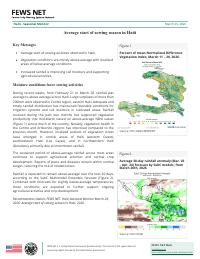
Average start of sowing activities observed in Haiti.
Vegetation conditions are mostly above-average with localized
areas of below-average conditions.
Percent of mean Normalized Difference
Vegetation Index, March 11 – 20, 2026.
Increased rainfall is improving soil moisture and supporting
agricultural activities.
Moisture conditions favor sowing activities
During recent weeks, from February 21 to March 20, rainfall was
average to above average across Haiti. Large surpluses of more than
200mm were observed in Centre region, eastern Haiti. Adequate and
timely rainfall distribution has maintained favorable conditions for
irrigation systems and soil moisture in cultivated areas. Rainfall
received during the past two months has supported vegetation
productivity into mid-March based on above-average NDVI values
(Figure 1) across much of the country. Notably, vegetation health in
the Centre and Artibonite regions has improved compared to the
previous month. However, localized pockets of vegetation stress
have emerged in central areas of Haiti (western Ouest),
southwestern Haiti (Les Cayes), and in northwestern Haiti
(Gonaïves), primarily due to intermittent rainfall.
The sustained period of above-average rainfall across most areas
continues to support agricultural activities and normal crop
development. Reports of pests and diseases remain within normal
ranges, reducing the risk of related losses.
Source: CHC-USGS/FEWSNET
Figure 2
Average 30-day rainfall anomaly (Mar. 26
– Apr. 24) forecast by SubC models, from
March 26th, 2026.
Rainfall is expected to remain above-average over the next 30 days,
according to the SubC Multimodel Ensemble forecast (Figure 2).
Combined with forecasts for slightly below-average temperatures,
these conditions are expected to further support ongoing
agricultural activities and crop development.
Recommended citation: FEWS NET. Haiti Seasonal Monitor March 26,
2026: Average start of sowing season in Haiti, 2026.
Source: CHC/UCSB
FEWS NET is a United States Government-funded activity. The content of this report does not
necessarily reflect the view of the United States Government.
FEWS NET Haiti
haiti@fews.net
fews.net/latin-america-and-caribbean/haiti
Seasonal Monitor
March 26, 2026
Seasonal Monitor
FEWS NET’s Seasonal Monitor reports are produced for Central America and the Caribbean, West Africa, East Africa, Central Asia, and Somalia every 10-to-30 days during the region’s
respective rainy season(s). Seasonal Monitors report updates on weather events (e.g., rainfall patterns) and associated impacts on ground conditions (e.g., cropping conditions,
pasture and water availability), as well as the short-term rainfall forecast. Find more remote sensing information here.
Famine Early Warning Systems Network
2