
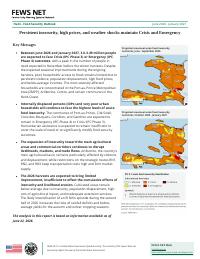
Perspectives sur la sécurité alimentaire : l'insécurité persistante, les prix élevés et les chocs climatiques maintiennent la Crise et l'Urgence, juin 2026 à janvier 2027
Résumé — Les perspectives complètes de FEWS NET pour juin 2026 à janvier 2027 prévoient que 3,0 à 3,49 millions de personnes connaîtront une situation de Crise (Phase 3 de l'IPC) ou d'Urgence (Phase 4), avec un pic en novembre avant les récoltes d'hiver. Les améliorations saisonnières liées aux récoltes en cours ne rétablissent pas l'accès des ménages pauvres à la nourriture, contraint par la violence, les déplacements, les prix alimentaires élevés et des revenus inférieurs à la moyenne. Les ménages les plus touchés se concentrent dans la zone métropolitaine de Port-au-Prince, l'Artibonite, le Centre et certaines communes du Nord-Ouest ; Port-au-Prince, Cité Soleil, Croix-des-Bouquets, Cornillon et Ganthier devraient rester en Urgence ou en Crise. L'aide humanitaire devrait rester insuffisante pour modifier les résultats. L'Artibonite, principal bassin agricole du pays, demeure particulièrement affecté par la violence et les déplacements.
Constats Clés
- 3,0 à 3,49 millions de personnes attendues en Crise (Phase 3 de l'IPC) ou en Urgence (Phase 4) entre juin 2026 et janvier 2027.
- Le pic des besoins est attendu en novembre 2026, avant les récoltes d'hiver.
- Port-au-Prince, Cité Soleil, Croix-des-Bouquets, Cornillon et Ganthier devraient rester en Urgence ou en Crise.
- Les personnes déplacées et les ménages urbains très pauvres connaissent les niveaux les plus élevés d'insécurité alimentaire aiguë.
- L'aide humanitaire devrait rester insuffisante pour modifier les résultats.
Texte Intégral du Document
Texte extrait du document original pour l'indexation.
Haiti - Food Security Outlook
June 2026 - January 2027
Persistent insecurity, high prices, and weather shocks maintain Crisis and Emergency
Key Messages
Between June 2026 and January 2027, 3.0-3.49 million people
are expected to face Crisis (IPC Phase 3) or Emergency (IPC
Phase 4) outcomes, with a peak in the number of people in
need expected in November before the winter harvests. Despite
the expected seasonal improvements during the ongoing
harvests, poor households' access to food remains limited due to
persistent violence, population displacement, high food prices,
and below-average incomes. The most severely affected
households are concentrated in the Port-au-Prince Metropolitan
Area (ZMPP), Artibonite, Centre, and certain communes in the
Nord-Ouest.
Internally displaced persons (IDPs) and very poor urban
households will continue to face the highest levels of acute
food insecurity. The communes of Port-au-Prince, Cité Soleil,
Croix-des-Bouquets, Cornillon, and Ganthier are expected to
remain in Emergency (IPC Phase 4) or Crisis (IPC Phase 3).
Humanitarian assistance is expected to remain insufficient to
cover the scale of need or to significantly modify food security
outcomes.
The expansion of insecurity toward the main agricultural
areas and commercial corridors continues to disrupt
livelihoods, markets, and trade flows. Artibonite, the country's
main agricultural basin, remains particularly affected by violence
and displacement, while restrictions on the strategic routes RN1,
RN2, and RN3 keep transportation costs high and limit market
supply.
The 2026 harvests are expected to bring limited
improvement, insufficient to offset the cumulative effects of
insecurity and livelihood erosion. Cultivated areas remain
below average due to insecurity, population displacement, high
cost of agricultural inputs, and inadequate extension services.
The likely intensification of an El Niño episode during the second
half of 2026 increases the risks of rainfall deficits and belowaverage yields for the autumn and winter cropping seasons.
The analysis in this report is based on information available as of
June 22, 2026.
FEWS NET is a United States Government-funded activity. The content of this report does not
necessarily reflect the view of the United States Government.
FEWS NET Haiti
haiti@fews.net
fews.net/latin-america-and-caribbean/haiti
Food Security Outlook
June 2026 - January 2027
Food security context
Insecurity and economic deterioration continue to erode household livelihoods across the country. Haiti
remains heavily dependent on food imports, which account for nearly half of the national food supply and more than
70 percent of cereal availability, while agriculture contributes approximately one-fifth of GDP and constitutes an
essential source of income and food for the majority of rural households. The expansion of armed groups,
movement restrictions on major road corridors, and insecurity in several production areas limit producers' access to
land, inputs, labor, and markets. These constraints reduce cultivated areas, yields, and agricultural income, while
supply chain disruptions and high transportation costs maintain elevated food prices. In a context marked by several
years of security crisis, economic slowdown, high inflation, and recurrent weather shocks, the capacity of households
to cope with shocks, rebuild their livelihoods, and sustainably meet their basic food needs remains severely reduced.
Despite the intensification of security operations since 2024, armed groups continue to control a large part of the
Port-au-Prince Metropolitan Area (ZMPP) and several strategic corridors linking the capital to the rest of the
country. Movement restrictions, illegal levies on road axes, and market disruptions increase transportation costs,
limit commercial exchanges, and reduce income-earning opportunities, particularly in the informal sector on which
many poor urban households depend. The political transition following the expiration of the mandate of the
Transitional Presidential Council (CPT) on February 7, 2026 consolidated executive authority under the leadership
of the prime minister, with priorities including restoration of security and organization of elections. However, the
state's capacity for action remains limited in areas under armed groups' influence, hindering economic recovery,
restricting humanitarian access, and compromising the provision of essential services.
Forced displacement is reaching historic high levels and intensifying humanitarian needs. According to
the International Organization for Migration, approximately 1.47 million people are internally displaced,
representing more than 12 percent of the national population, of which more than 234,000 are in sites where access
to food, safe drinking water, health care, and livelihoods remain very limited. A significant proportion of the
displaced have experienced multiple successive displacement episodes, which progressively erode their
assets, support networks, and coping capacities. Although 84 percent of the displaced are still hosted by host
families, this situation is placing increasing pressure on the resources of host households.
High prices continue to limit food access despite a relative slowdown in inflation. After seven consecutive years
of economic contraction, including a 2.7 percent decline in GDP in 2024/25, the economy remains weakened.
According to Institut Haïtiende Statistique et d'Informatique (IHSI), annual inflation rose to 21.0 percent in April
2026 after 20.6 percent in March, while the general price index increased by 3.4 percent over one month. This
acceleration is primarily linked to the April increase in fuel prices (37 percent for diesel and 29 percent for gasoline)
and tensions in international oil markets. The Banque de la République d'Haïti (BRH) analyses also indicate that
insecurity and supply chain disruptions remain major factors in the increase in prices. Despite the relative stability of
the exchange rate and the maintenance of high remittance levels, food prices remain well above their five-year
average, reducing the purchasing power of poor households that are heavily dependent on markets.
Agricultural production remains below average due to the combined effects of insecurity, high costs, and
weather shocks. In several areas of Artibonite, Centre, and Ouest, insecurity has limited access to
agricultural land,
irrigation infrastructure, and markets. The spring agricultural season, which typically accounts for nearly 60 percent
of annual agricultural production, remains essential to national food availability. However, population displacement,
abandonment of agricultural land, and the high cost of inputs have reduced cultivated areas to below-average levels.
The lack of technical support, insufficient extension services, and limited access to agricultural advice also reduce
producers' capacity to improve productivity and adapt to weather shocks. Poor households’ agricultural and nonagricultural income remains below average, while insecurity continues to disrupt informal trade in the ZMPP. For
many displaced and very poor households, livelihood disruption increases dependence on humanitarian assistance
to meet essential food needs.
Learn more
Follow these links for additional information:
Famine Early Warning Systems Network
2
Food Security Outlook
June 2026 - January 2027
Latest Haiti Food Security Outlook Report: February 2026 – September 2026
Latest Haiti Food Security Outlook Update: April – September 2026
Haiti Key Messages Update: May 2026
Overview of FEWS NET’s scenario development methodology
FEWS NET’s approach to estimating the population in need
Overview of the IPC and IPC-compatible analysis
FEWS NET’s approach to humanitarian food assistance analysis
Current anomalies in food security conditions in June 2026
Insecurity continues to worsen and remains the primary driver
of food security deterioration. According to data from ACLED,
519 violent events and 1,394 deaths were recorded between
January and May 2026. Although these figures may be
underestimated, they remain lower than those observed during the
same period in 2025 and lower than the three-year average for the
January to May 2023-2025 period, yet they remain high and
continue to have significant effects on population displacement,
market functioning, and livelihoods. Ouest remains the epicenter of
the crisis, accounting for 66 percent of violent events and 63
percent of deaths. However, the most concerning development is
the expansion of violence toward Artibonite, with concentration in
Dessalines, Saint-Marc, and Gonaïves. Centre also remains affected,
particularly around Mirebalais and Lascahobas.
Figure 1
Function of markets and main
commercial routes in zones affected by
insecurity, January 2025-June 2026
Internal displacements remain at unprecedented
levels. According to a report from the International Organization
for Migration (IOM) published in May 2026, nearly 1.47 million
Source: FEWS NET
people are internally displaced, representing more than 12 percent
of the national population, compared to less than 160,000 at the
beginning of 2023. Between January and May 2026 (from the 12th to the 13th IOM monitoring cycle), the ZMPP
recorded an increase of 6 percent in the number of displaced persons and now has more than 300,000 displaced
people, while Artibonite experienced an increase of 5 percent. Food constitutes the priority need most frequently
reported by displaced persons (73 percent). Furthermore, the number of displacement sites increased from 229 to
262, while forced returns of migrants from the Dominican Republic, in a context of tightening migration policies,
intensification of repatriation operations, and persistent concerns raised by several organizations regarding respect
for the rights of Haitian migrants, continue to increase humanitarian needs and pressure on host communities.
Market access remains atypically disrupted despite food availability generally being close to typical
levels. The main departmental markets continue to be supplied due to the maintenance of imports, the functioning
of the Port-au-Prince port, the increased use of secondary ports, and cross-border trade with the Dominican
Republic. However, persistent insecurity on the strategic corridors connecting Port-au-Prince to the rest of the
country continues to disrupt commercial flows, increase transportation costs, and limit households' physical and
economic access to markets. National roads RN1, RN2, and RN3 remain subject to movement restrictions, informal
payments, and high risks for transporters (Figure 1). At the same time, the reorganization of commercial circuits,
linked notably to the persistent dysfunction of the Croix-des-Bossales market and the partial displacement of
activities toward Delmas, Pétion-Ville, and other secondary centers, reduces poor households' access to traditionally
Famine Early Warning Systems Network
3
Food Security Outlook
June 2026 - January 2027
less expensive sources of supply and weakens the livelihoods of many small traders. Although certain alternative
corridors and commercial hubs remain functional, they only partially compensate for the disruptions to the main
goods redistribution system.
General inflation and food prices remain atypically high despite relative stability in the HTG/USD exchange
rate. Although inflationary pressures have eased compared to 2024 and early 2025, prices for many food
commodities remain well above their five-year average. After slowing in the first quarter of 2026, annual inflation
resumed its upward trend, reaching 21.0 percent in April, up from 20.6 percent in March, according to IHSI, while the
general price index increased by 3.4 percent month-on-month. According to BRH, insecurity, logistical disruptions,
rising fuel prices, and import costs continue to drive inflation, sharply reducing the purchasing power of poor
households.
Transportation costs remain atypically high. The increase in domestic prices of petroleum products that came
into effect on April 2, 2026 sharply increased transportation costs for people and goods. Although prices were
subsequently adjusted downward, those for gasoline, diesel, and kerosene remain approximately 25, 16, and 28
percent higher than their March 2026 levels. These costs continue to impact food prices, limiting poor households'
economic access to markets.
Conditions are more favorable than in 2025, but anomalies persist. Rainfall recorded since the beginning of the
spring season has improved vegetation conditions in several agricultural areas. However, its distribution remains
irregular, with localized deficits in some parts of the Nord-Ouest, the Sud, and the southern peninsula, as well
as episodes of heavy rainfall causing localized flooding and crop losses. The rainfall deficits observed between
late April and May occurred during a critical crop growth phase and could reduce yields. Cultivated areas remain
below average, while the lack of technical support limits the adoption of improved agricultural practices and
producers' capacity to manage weather risks.
Humanitarian food assistance
Food assistance is necessary for households most affected by the current security and political crisis, but its coverage
remains limited. From January to March 2026, Food Security Cluster (FSC) partners assisted approximately 1.05
million people, including more than 976,000 through emergency food assistance, representing 31 percent of the
FSC's priority population of 3.2 million, according to the Humanitarian Response Plan. This assistance was provided
primarily through food distributions, cash transfers, and vouchers. However, its implementation remains heavily
constrained by insecurity, access restrictions, logistical disruptions, and funding shortfalls, particularly in the ZMPP,
Artibonite, and areas hosting displaced persons.
Assistance coverage remains below the IPC threshold for a significant effect on acute food insecurity outcomes.
Although some households, particularly in certain displacement sites, temporarily receive assistance that covers at
least 25 percent of their caloric needs, these interventions remain too limited in geographic coverage and duration to
alter zone classifications. Assistance nevertheless helps temporarily reduce food consumption deficits among
beneficiary households and limits the use of certain negative coping strategies. In the absence of assistance, food
consumption deficits would likely be greater, particularly among IDPs and the poorest households.
Famine Early Warning Systems Network
4
Food Security Outlook
June 2026 - January 2027
Current acute food insecurity outcomes in June 2026
Insecurity continues to spread beyond the most directly affected
areas, affecting livelihoods and food access throughout the country.
The resulting socioeconomic disruptions (notably low incomes),
atypically high food prices, the decrease in agricultural production,
and persistent political instability continue to reduce the purchasing
power and coping capacities of poor households. In most
agroecological zones classified as Crisis (IPC Phase 3), an
intensification of firewood sales (underpinned by increased illegal tree
cutting) and, by extension, charcoal production is observed. In
addition, a significant increase in migration to the Dominican
Republic, Mexico, Chile, and Brazil has also been observed. This
finding is particularly notable in the Nord and Nord-Est departments,
where the scarcity of agricultural labor is compromising agricultural
activities.
For the ZMPP, the most affected are IDPs living in sites where
Emergency (IPC Phase 4) food insecurity prevails, due to the loss of
their livelihoods, lack of income-earning opportunities, and recurrent
cycles of displacement resulting from the security crisis in the city
center. At the same time, the risks of acute malnutrition are
increasing, particularly among children under five and IDPs, due to
precarious living conditions and limited access to food.
In the Ouest, Centre, and Artibonite departments plagued by
armed violence, household livelihoods continue to deteriorate.
Armed groups control several production areas and road corridors,
hindering the movement of people and local commodities. Faced with the deterioration of their food conditions,
households are forced to adopt negative coping strategies such as begging, asset sales, and sending children to eat
elsewhere. The communes of Port-au-Prince, Cité Soleil, Croix-des-Bouquets, Cornillon, and Ganthier, where violence,
the decrease in daily income, and high prices severely limit food access, are classified in Emergency (IPC Phase 4),
while the rest of the ZMPP remains in Crisis (IPC Phase 3).
In the Nord-Ouest, Crisis (IPC Phase 3) outcomes are widespread, with pockets of households facing more
severe localized outcomes in the communes of Baie-de-Henne and Bombardopolis. Poor household livelihoods
are disrupted due to a significant lack of income-generating activities. Agricultural activity is nearly at a standstill due
to poor temporal distribution of rainfall, despite cumulative rainfall totals close to typical levels. This irregularity has
disrupted planting and the development of spring crops in several areas. Moreover, insecurity along National Route
5, which connects Artibonite and the Nord-Ouest, is disrupting public transportation and the movement of goods
from Port-au-Prince and Gonaïves. This poses a serious problem for the market supply of basic food products and
fuel. High inflation is affecting the area in a context of significantly below-average income, which is resulting in a
sharp deterioration in the poor households’ purchasing power. Some areas are classified as Stressed (IPC Phase 2)
due to the continuation of port activities in Port-de-Paix and Saint-Louis-du-Nord.
In the Grand Sud, income-generating activities have been near normal due to spring agricultural activities,
whose early harvests are about to begin, and the availability of certain local commodities (maize, beans, breadfruit,
mango) that are unable to reach markets in the metropolitan area due to the blockage of national road RN2. This
situation is causing a decrease in prices of these products in regional markets, thereby improving access for certain
household groups. Nevertheless, the situation remains highly volatile in areas vulnerable to food insecurity and
natural disasters, particularly Grand'Anse and the southern coast, where livelihoods are under pressure due to the
reception of IDPs. The Grand Sud is receiving the largest flow of IDPs, and is therefore experiencing the mos
t
significant impacts on available livelihoods. Although the region is classified in Crisis (IPC Phase 3), certain communes
Famine Early Warning Systems Network
5
Food Security Outlook
June 2026 - January 2027
(arrondissement of Les Cayes in the Sud and Miragoâne in the Nippes) are classified in Stressed (IPC Phase 2).
However, there are pockets of households classified in Emergency (IPC Phase 4), particularly in the communes of
Gran Boukan and Arnaud (Nippes), Tiburon (southern coast), Les Irois (Grand'Anse), and Belle-Anse (Sud-Est), where
the livelihoods of poor households have deteriorated due to the residual effects of previous shocks (Hurricane
Melissa), the absence of external support, and the decline in income related to the security crisis on national road
RN2.
Key assumptions on atypical food security conditions supporting the most likely scenario through January
2027
The continued expansion and consolidation of gang presence in the main agricultural areas and along
commercial corridors is expected to continue limiting household access to food and income through the
end of 2026. Armed groups are expected to maintain or strengthen their presence in several communes in
Artibonite, Centre, Ouest, and the ZMPP, particularly along the RN1, RN2, and RN3 corridors. Insecurity is
expected to continue disrupting agricultural activities by limiting access to land, reducing the availability of
agricultural labor, and constraining the transport of inputs and harvests. In Artibonite and Centre, these
disruptions are expected to limit cultivated areas and reduce income from agricultural production and
marketing.
Roadblocks, extortion, and security risks are expected to maintain high transportation costs and slow
market supply, reducing food availability and the purchasing power of poor market-dependent households.
Population displacements and continued economic disruptions are also expected to limit displaced households
living in sites from accessing typical income sources and strengthen their dependence on markets and
humanitarian assistance.
Security improvements are expected to remain limited and temporary, without lasting stabilization of
livelihoods and humanitarian access. Despite the gradual deployment of a gang suppression force, security
gains are expected to remain localized and temporary. Sporadic improvements could temporarily facilitate
mobility and commercial flows on certain routes, but population displacements, access restrictions, and
livelihood disruptions are expected to persist. Poor urban households, IDPs, and agricultural households in
affected areas will continue to face limited access to income and food.
The HTG/USD exchange rate is expected to remain relatively stable due to BRH interventions and
remittances above the five-year average, although depreciation pressures remain possible in the event of
security deterioration above projections or a slowdown in remittances.
Food inflation is expected to remain high at over 20 percent, and above the five-year average, driven by
the increase in transportation costs, fuel, and agricultural inputs, as well as by persistent disruptions to supply
chains.
El Niño conditions pose a significant risk to agricultural prospects and rural livelihoods at the end of
2026 and the beginning of 2027. According to the Climate Prediction Center (CPC) from the National Oceanic
and Atmospheric Administration (NOAA), El Niño conditions are already present and expected to strengthen
through the winter of 2026/27 in the Northern Hemisphere. According to the International Research Institute
for Climate and Society (IRI) at Columbia University, El Niño episodes typically peak between October and
February in Haiti, marked by above-average temperatures and an increased risk of rainfall deficits during the fall
and winter cropping seasons.
Spring, fall, and winter agricultural seasons are expected to remain below average due to persistent
insecurity, population displacement, limited access to agricultural inputs, and the increase in fertilizer and fuel
prices. In Artibonite and certain areas of Centre, reduced access to land and labor is expected to limit cultivated
areas, yields, and rural household incomes.
Fuel, maritime freight, and fertilizer prices are expected to continue exerting upward pressure on
transportation, marketing, and agricultural production costs, in a context of global market volatility. As
Famine Early Warning Systems Network
6
Food Security Outlook
June 2026 - January 2027
a result, logistical costs and supply lead times are expected to remain above last year’s and average levels.
However, a gradual stabilization of global energy and input prices could provide some relief from cost pressures
by November.
Prices of local and imported staple foods are expected to remain above average despite seasonal
improvements in supply. Although prices of local products (maize, beans) are following their typical seasonal
downward trend after the spring harvests, particularly in production areas and regional markets, these
decreases are expected to remain limited due to below-average production, high transportation costs, and
persistent disruptions to trade flows. Prices are expected to remain above average, particularly in Ouest, Center,
and Artibonite.
Poor household incomes are expected to remain below the five-year average in both urban and rural
areas. In urban areas, informal activities and small-scale trade are expected to remain disrupted by insecurity,
mobility restrictions, and the contraction of certain economic activities. However, the maintenance of current
minimum wage levels following the adjustments made in May 2026, as well as high private transfers, particularly
migrant remittances, are expected to partially mitigate income declines and support household access to food
in certain areas.
Although a seasonal improvement in food consumption and agricultural income from the spring
harvests (June to August 2026) is expected in several rural areas, these gains will remain limited in areas
affected by insecurity, displacement, and market disruptions. Starting in September, the current situation in
these areas will be aggravated by the progressive depletion of stocks, leading to a gradual deterioration of food
conditions for poor households. This development is expected to increase the risks of acute malnutrition and
maintain high humanitarian food assistance needs.
Humanitarian food assistance
From June 2026 to January 2027, humanitarian food assistance is expected to remain insufficient to cover
growing needs. Despite the continuation of WFP and partner interventions, significant funding constraints for
the 2026 Humanitarian Response Plan, combined with access difficulties and population displacements, are
expected to limit the coverage, frequency, and impact of distributions. Assistance is expected to remain
primarily concentrated on IDPs in the ZMPP and households most affected by insecurity or other shocks, while
generally covering less than 20 percent of monthly caloric needs, which is insufficient to change IPC
classifications.
Projected acute food insecurity outcomes through January 2027
The persistence of insecurity, population displacements, high food prices, and below-average incomes will continue
to restrict poor households' access to food and livelihoods. The expected levels of humanitarian assistance remain
insufficient to significantly offset the effects of these constraints.
Spring harvests are expected to temporarily improve food access between June and August due to increased
own consumption, harvest income, and agricultural labor opportunities. However, the benefits of this improvement
are expected to remain limited by below-average cultivated areas, constraints on access to agricultural land in certain
areas of Artibonite, Centre, and Ouest, as well as by ongoing disruptions to markets and trade flows related to
insecurity. Acute malnutrition is expected to experience limited seasonal improvement between June and
August. However, this improvement is expected to remain modest in areas affected by insecurity and displacement.
Starting in September, risks of acute malnutrition are expected to increase progressively as food access deteriorates,
particularly among IDPs, poor urban households, and populations living in areas under strong influence of armed
groups.
Famine Early Warning Systems Network
7
Food Security Outlook
June 2026 - January 2027
Starting in September, food security conditions are expected to gradually deteriorate, as stocks from the
spring harvests are depleted and households become increasingly dependent on markets. Food prices are expected
to remain above the five-year average while agricultural and non-agricultural income-earning opportunities will
remain limited. The anticipated effects of El Niño, including above-average temperatures and irregular distribution of
rainfall, could also limit the performance of autumn and winter agricultural seasons in several regions.
The ZMPP is expected to continue recording the most severe outcomes in the country. The communes of Portau-Prince, Cité Soleil, Croix-des-Bouquets, Cornillon, and Ganthier are expected to remain in Emergency (IPC Phase 4)
or have pockets of households in Emergency (IPC Phase 4) throughout the projection period. IDPs, poor urban
households, and those who have lost their livelihoods are expected to continue facing significant food consumption
deficits and sustained reliance on negative coping strategies. The rest of the ZMPP is expected to remain in Crisis (IPC
Phase 3).
The majority of other areas of the country are expected to remain in Crisis (IPC Phase 3), with seasonal
improvements insufficient to support sustainable livelihood recovery. Pockets of households are expected to
experience more severe food security outcomes in certain communes in the Nord-Ouest, notably Baie-de-Henne and
Bombardopolis, as well as in certain localities in the Grand Sud, notably Belle-Anse, Les Irois, Tiburon, Grand-Boucan,
and Arnaud. These households will continue to face incomes well below average, in addition to the cumulative effects
of insecurity, weather shocks, and commercial disruptions.
The improvements expected at the end of the year are likely to be insufficient to significantly modify the
scale of humanitarian needs. Although the autumn and winter harvests as well as the seasonal increase in
remittances contribute to temporarily improving the food consumption of some households, the cumulative effects
of several years of insecurity, repeated displacements, losses of productive assets, and erosion of purchasing power
will continue to limit recovery capacities. Consequently, a significant proportion of the population is expected to
remain facing food consumption deficits or to sustain reliance on negative coping strategies through January 2027.
Annex 1: Key sources of evidence used in this analysis
Evidence
Source
Data
format
Livelihood zone profiles
FEWS NET
Qualitative
Typical sources of food and income by
livelihood zone
Monetary Policy Report,
January–March 2026
BRH
Qualitative/
Quantitative
Inflation, exchange rates, money supply, and
their impacts on purchasing power and food
prices
Food Security Cluster food
assistance distribution plans,
including an analysis of
historical trends
FSC
Qualitative/
Quantitative
Geographic and temporal coverage of food
assistance, number of beneficiaries, and
trends in humanitarian assistance coverage
Haiti — Emergency Tracking
93.2 — Update on
displacement related to
armed clashes in Cité Soleil
(May 10–22, 2026)
IOM
Qualitative/
Quantitative
Number of IDPs, causes of displacement,
areas of concentration, and impacts on
livelihoods and access to food
Conflict analyses
ACLED
Qualitative/
Quantitative
Number of violent incidents, affected areas,
conflict trends, and their impacts on market
access, production, and population
displacement
Famine Early Warning Systems Network
Food security element of analysis
8
Food Security Outlook
June 2026 - January 2027
Data
format
Evidence
Source
Key informant interviews,
including FEWS NET price
monitors, community leaders,
and others
FEWS NET
Qualitative/
Quantitative
Field information on prices, food availability,
coping strategies, local perceptions, and
market trends
Consumer Price Index (CPI)
IHSI
Quantitative
Information on inflation rates for food and
non-food products, including locally produced
and imported goods
Humanitarian reports and
bulletins
OCHA
Qualitative/
Quantitative
Monitoring of the humanitarian situation,
sectoral coverage, assistance funding, priority
intervention areas, and intersectoral
coordination
Climate forecast
NOAA/IRI/OMM
Qualitative/
Quantitative
Seasonal rainfall and temperature forecasts, El
Niño/La Niña probabilities, and agroclimatic
risks likely to affect agricultural production,
seasonal income, and local food availability
Famine Early Warning Systems Network
Food security element of analysis
9
Food Security Outlook
June 2026 - January 2027
Annex 2: FEWS NET’s analytical approach explained
Early warning of acute food insecurity outcomes requires forecasting months in advance to provide decision-makers with
sufficient time to budget, plan, and respond to expected humanitarian crises. However, due to the complex and variable
factors that influence acute food insecurity, definitive predictions are impossible. Scenario Development is a methodology
that allows FEWS NET to meet decision-makers’ needs by developing a “most likely” scenario of the future.
FEWS NET’s scenario development process applies the Disaster Risk Reduction framework and a livelihoods-based lens to
assess acute food insecurity outcomes. A household’s risk of acute food insecurity depends not only on hazards (such as
drought) but also the household’s vulnerability to these hazards (e.g., the level of dependence on rainfed crop production
for food and income) and coping capacity (which considers both the household’s ability to cope with a given hazard and the
use of negative coping strategies that harm future capacity). To evaluate these factors, FEWS NET bases this analysis on a
strong foundational understanding of local livelihoods. FEWS NET’s scenario development process also accounts for the
Sustainable Livelihoods Framework; the Four Dimensions of Food Security; and UNICEF’s Nutrition Conceptual Framework,
and is closely aligned with the Integrated Food Security Phase Classification (IPC) analytical framework.
How does FEWS NET analyze current acute food insecurity outcomes? FEWS NET assesses the extent to which
households can meet their minimum caloric needs. This analysis converges evidence of current food security
conditions with available direct evidence of household-level food consumption and livelihood change. FEWS NET also
considers available area-level evidence of nutritional status and mortality, focusing on whether these reflect the
physiological impacts of acute food insecurity. FEWS NET uses the globally recognized five-phase Integrated Food
Security Phase Classification (IPC) scale to classify current acute food insecurity outcomes, and the analysis is IPCcompatible. In addition, FEWS NET applies the “!” symbol to designate areas where the mapped IPC Phase would
likely be at least one IPC Phase worse without the effects of ongoing humanitarian food assistance.
How does FEWS NET develop key assumptions underpinning the most likely scenario? A key step in FEWS NET’s
scenario development process is the development of evidence-based assumptions about factors that affect food
security. These include hazards and anomalies in food security conditions that will impact the evolution of household
food and income during the projection period, as well as factors that may affect nutritional status. FEWS NET also
develops assumptions about factors expected to behave normally. Together, these assumptions form the foundation
of the “most likely” scenario.
How does FEWS NET analyze projected acute food insecurity outcomes? Using the key assumptions that underpin
the “most likely” scenario, FEWS NET projects acute food insecurity outcomes by assessing the evolution of households’
ability to meet their minimum caloric needs over time. FEWS NET converges expectations of the likely trajectory of
household-level food consumption and livelihood change with area-level nutritional status and mortality. FEWS NET
then classifies acute food insecurity outcomes using the IPC scale. Lastly, FEWS NET applies the “!” symbol to designate
any areas where the mapped IPC Phase would likely be at least one IPC Phase worse without the effects of planned –
and likely to be funded and delivered – food assistance.
How does FEWS NET analyze humanitarian food assistance? Humanitarian food assistance – defined as
emergency food assistance (in-kind, cash, or voucher) – may play a key role in mitigating the severity of acute food
insecurity outcomes. FEWS NET analysts always incorporate available information on food assistance,
with the caveat
that such information can vary significantly across geographies and over time. In line with IPC protocols, FEWS NET
uses the best available information to assess where food assistance is “significant” (defined by at least 25 percent of
households in a given area receiving at least 25 percent of their caloric requirements through food assistance). In
addition, FEWS NET conducts deeper analysis of the likely impacts of food assistance on the severity of outcomes, as
detailed in FEWS NET’s guidance on Integrating Humanitarian Food Assistance into Scenario Development.
Famine Early Warning Systems Network
10
Food Security Outlook
June 2026 - January 2027
Annex 3: Seasonal calendar
Source: FEWS NET
Annex 4: Events that would likely change projected acute food insecurity outcomes
While FEWS NET’s projections are considered the “most likely” scenario, there is always a degree of uncertainty in the
assumptions that underpin the scenario. This means food security conditions and their impacts on acute food security may
evolve differently than projected. FEWS NET issues monthly updates to its projections, but decision-makers need advance
information about this uncertainty and an explanation of why things may turn out differently than projected. As such, the
final step in FEWS NET’s scenario development process is to briefly identify key events that would result in a credible
alternative scenario and significantly change the projected outcomes. FEWS NET only considers scenarios that have a
reasonable chance of occurrence.
National
Major security deterioration or rapid expansion of territorial control by armed groups
Likely impact on acute food insecurity outcomes: A greater than expected deterioration of the security situation
in the ZMPP, Artibonite, or Centre would lead to an increase in population displacements, more severe disruptions to
markets and trade flows, as well as a further reduction in income-earning opportunities. Humanitarian access could
be further restricted, limiting the coverage of food and nutrition assistance. In the main agricultural areas, land
abandonment, difficulties accessing inputs, and the reduction of agricultural labor would further compromise
production. In urban areas, the contraction of informal economic activities and the increase in transportation costs
would accentuate food consumption deficits. In this scenario, the number of people facing Crisis (IPC Phase 3) or
Emergency (IPC Phase 4) outcomes would exceed currently projected levels, with a risk of geographic expansion of
areas in Emergency, particularly in Artibonite, Centre, Nord-Ouest, and certain parts of the Grand Sud.
Significant rainfall deficits linked to El Niño conditions more severe than expected
Likely impact on acute food insecurity outcomes: A more intense than expected El Niño episode could lead to
significant rainfall deficits during the fall and winter 2026/27 agricultural seasons, further reducing agricultural yields
in several areas of the country. In addition to the expected decrease in precipitation, atypically high temperatures
would accelerate evaporation and soil moisture loss, particularly in rain-dependent areas. These conditions would
worsen crop water stress, limit vegetative development, and could compromise production prospects, especially if
rainfall deficits coincide with critical periods of planting, flowering, or grain filling. This situation would limit income
from agricultural activities, reduce local food availability, and increase household dependence on markets. Prices of
local products, particularly maize, beans, and certain tubers, could increase more rapidly than expected, accentuating
the erosion of poor households' purchasing power.
Famine Early Warning Systems Network
11
Food Security Outlook
June 2026 - January 2027
In this scenario, households already weakened by insecurity, displacement, and low incomes would be forced to
intensify negative coping strategies. Agricultural areas in the Nord-Ouest, Artibonite, Centre, as well as certain parts
of the Grand-Sud would be particularly exposed to a worsening of food consumption deficits and an increase in the
number of households in Emergency (IPC Phase 4).
Direct impact of a major hurricane or succession of tropical storms on Haiti during the 2026 hurricane season
Likely impact on acute food insecurity outcomes: A major hurricane or multiple tropical storms directly affecting
Haiti could cause flooding, landslides, and significant damage to infrastructure, crops, and livelihoods. Crop losses,
livestock mortality, destruction of food stocks, and damage to irrigation systems would reduce food availability and
income for agricultural households. Damage to roads, markets, ports, and transportation infrastructure could further
disrupt trade flows and market supply, leading to localized increases in food prices. Populations living in coastal
areas, floodplains, and degraded watersheds would be particularly exposed to population displacement and
temporary loss of their livelihoods.
In this scenario, humanitarian assistance needs would increase rapidly in the affected areas. Poor households
affected by crop losses, damage to productive assets, and market disruptions could face larger food consumption
deficits than expected. The number of people in Crisis (IPC Phase 3) and Emergency (IPC Phase 4) could then exceed
projected levels, particularly in the Grand Sud, the Sud-Est, Artibonite, Nord, and certain coastal areas particularly
vulnerable to cyclonic hazards.
Annex 5: A closer look at domestic maritime transport and its impacts on food security outcomes
National maritime transport constitutes an increasingly important adaptation mechanism in the Haitian food system.
Given the country's heavy dependence on food imports, particularly for rice, wheat flour, vegetable oils, sugar, and
other staple products, ports constitute the main entry points for commodities consumed by households. Historically,
the Port-au-Prince port handled a large portion of national imports and served as a redistribution center to other
regions of the country. However, persistent insecurity in the ZMPP and on the main land routes has profoundly
modified trade flows. The logistics sector reports that access to the international port of Port-au-Prince remains
heavily restricted by insecurity, while numerous routes between departments are controlled or blocked by armed
groups, making land transport unpredictable, costly, and dangerous.
In response to these constraints, commercial and humanitarian actors are increasingly resorting to coastal shipping
and secondary ports, notably Cap-Haïtien, Miragoâne, Saint-Marc, Gonaïves, and Petit-Goâve (Figure 2). These routes
allow for partial circumvention of road corridors affected by insecurity and maintain flows of goods to markets
located outside the ZMPP.
This reorganization contributes to maintaining the functioning of markets in several regions of the country. Although
commercial circuits remain disrupted, food availability has not collapsed countrywide. The main advantage of
maritime transport is its relative security compared to the most exposed road corridors. Armed groups impose
roadblocks, informal payments, diversions, and passage restrictions on several strategic land routes, increasing
transport costs, reducing the predictability of deliveries, and limiting the flow of agricultural products. In contrast,
maritime routes remain more difficult to control continuously, and armed groups have not succeeded in establishing
an extortion system along national maritime routes.
This relative security nevertheless comes at a cost. The increased use of secondary ports and maritime
transshipment raises expenses for fuel, handling, storage, private security, and final redistribution to domestic
markets. Secondary port infrastructure generally has more limited capacity than that of Port-au-Prince, particularly
for warehousing, handling large volumes, and logistical coordination. The logistics sector emphasizes that
transportation services, both maritime and land-based, are becoming increasingly difficult to operate due to securityrelated access constraints, resulting in a significant increase in operational costs.
Impacts on income vary by zone and livelihood group. In several agricultural regions, notably Artibonite, Centre,
Nord-Ouest, and Grand Sud, transportation difficulties limit the flow of products to main consumption centers,
reducing income from crop sales. Traders, transporters, handlers, drivers, and other informal-sector workers also
Famine Early Warning Systems Network
12
Food Security Outlook
June 2026 - January 2027
face higher operating costs and reduced margins. Although increased reliance on maritime transport creates
economic opportunities for some households and workers already involved in port activities, transportation,
handling, or related services, these opportunities remain localized and do not offset the income losses suffered by
the many actors dependent on road corridors, whose skills, activities, or location do not always allow for
reorientation toward maritime activities.
National maritime transport constitutes an important, but partial, source of resilience for communities, workers, and
households. Reducing exclusive dependence on routes threatened or controlled by armed groups allows the
preservation of a portion of commercial flows between production basins, secondary ports, and consumption
markets, while limiting the risk of major stock disruptions. This resilience remains costly, however, and does not fully
offset the disorganization of road corridors, the weakness of secondary infrastructure, the decline in purchasing
power, and income losses.
In the most likely scenario, national maritime routes are expected to continue to play a determining role in food
supply and market functioning outside of Port-au-Prince. Areas benefiting from relatively direct access to secondary
ports, particularly in the Nord and certain parts of the Grand Sud, are expected to continue to absorb commercial
disruptions more effectively than landlocked areas or those heavily dependent on road corridors affected by
insecurity. However, as long as insecurity continues to disrupt the main land routes and strategic infrastructure,
logistical costs are expected to remain above average, food prices are expected to remain high, and the incomes of
many poor households are expected to remain under pressure. Combined with persistent insecurity, population
displacement, and weak livelihoods, these factors will continue to maintain Crisis (IPC Phase 3) outcomes in much of
the country and Emergency (IPC Phase 4) outcomes in certain parts of the ZMPP and among IDP populations.
Table 1. Principales alternatives de transport maritime pour contourner la violence des gangs en Haïti
Origin
Port-au-Prince/Lafito
Gonaïves
Saint-Marc
Cap-Haïtien
Miragoâne
Port-de-paix
Destination
Relevance of flow
Type of products
Miragoâne
Heavy
Imported
Gonaïves
Medium
Imported
Saint-Marc
Medium
Imported
Jérémie
Low
Imported
Port-au-Prince/Lafito
Heavy
Agricultural
Cap-Haïtien
Medium
Agricultural
Miragoâne
Low
Agricultural
Gonaïves
Medium
Agricultural
Miragoâne
Low
Agricultural
Gonaïves
Medium
Imported
Port-au-Prince/Lafito
Low
Imported
Port-de-paix
Low
Imported
Port-au-Prince/Lafito
Heavy
Agricultural
Jérémie
Medium
Agricultural
Saint-Marc
Low
Agricultural
Cap-Haïtien
Heavy
Agricultural
Famine Early Warning Systems Network
13
Food Security Outlook
June 2026 - January 2027
Recommended citation: FEWS NET. Haiti Food Security Outlook June 2026 - January 2027: Persistent insecurity, high prices,
and weather shocks maintain Crisis and Emergency, 2026.
*
FEWS NET classification is IPC-compatible with limited exceptions. IPC-compatible analysis follows key IPC protocols but does not necessarily reflect the consensus of national food security
partners. As of IPC 3.0, the IPC no longer assesses the impact of food assistance on classification and thus no longer maps the (!). However, FEWS NET continues to produce food security
maps inclusive of the (!) as well as maps compatible with IPC 3.0/3.1, which include the mapping of food security assistance bags. In rare cases, FEWS NET classification is IPC-aligned but
not IPC-compatible. IPC-aligned analysis is evidence-based but some types of evidence required for IPC-compatibility were not available.
Food Security Outlook
To project food security outcomes, FEWS NET develops a set of assumptions about likely events, their effects, and the probable responses of various actors. FEWS NET analyzes these
assumptions in the context of current conditions and local livelihoods to arrive at a most likely scenario for the coming eight months. Learn more here.
Famine Early Warning Systems Network
14
Comment citer
Famine Early Warning Systems Network (FEWS NET), Perspectives sur la sécurité alimentaire : l'insécurité persistante, les prix élevés et les chocs climatiques maintiennent la Crise et l'Urgence, juin 2026 à janvier 2027, https://reliefweb.int/node/4223637