Deskripsyon Konple
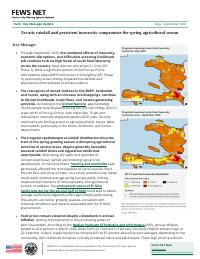
FEWS NET fè konnen ke, jiska septanm 2026, efè konbine ensekirite, deranjman ekonomik ak difikilte pou aksede ak mwayen lavi ap kontinye lakoz gwo ensekirite alimantè grav, pifò distri nan Kriz (Faz 3 IPC) epi yon pati enpòtan zòn metwopoliten Pòtoprens nan Ijans (Faz 4 IPC), patikilyèman zòn k ap resevwa menaj deplase ak popilasyon ki pi ekspoze ak vyolans ame. Rekoudesans vyolans ame nan ZMPP, Latibonit ak Sant, ansanm ak ogmantasyon kidnapin, kontinye deranje mwayen lavi, flo komèsyal ak aktivite k ap jenere revni ; dapre Nasyonzini, anviwon 30 000 moun te deplase nan premye kenzèn me 2026 nan zòn nan nò Pòtoprens, ak plis pase 70% k ap deplase nan sit deplase, epi kontrent sekirite limite aksè ak tè agrikòl, entran, men-dèv ak mache nan Lwès, Latibonit ak Sant.
Lapli espasyo-tanporèl iregilye depi kòmansman kanpay prentan an ap deranje devlopman rekòt malgre total sezonye globalman favorab, ak altènans peryòd sèk ak gwo lapli ; inondasyon ak glisman tè nan Nòdwès frape Sen-Lwi-di-Nò, Pòdepè ak Ansafolè, epi posib pèt rekòt montre rannman prentan anba mwayèn. Yon retou antisipe kondisyon El Niño nan dezyèm semès 2026 ka pote lapli anba mwayèn epi nwi rannman otòn ak ivè. Pri manje rete wo malgre ralanti enflasyon: enflasyon anyèl bese a 20,6% an mas 2026 (soti 22,1% an fevriye) men enflasyon manje rete wo a 22,9%, epi an avril pri pwodwi de baz yo te 63-87% pi wo pase mwayèn senkanyèl, ak ogmantasyon kontinyèl mayi ak pwa nwa lokal ; pri wo yo reflete depans transpò, peman ki pa ofisyèl sou koridò wout, deranjman komèsyal ak ogmantasyon gazolin. Byenke salè minimòm nan te leve nan 6 me, ajisteman an pa konpanse ewozyon pouvwa dacha.
Teks Konple Dokiman an
Teks ki soti nan dokiman orijinal la pou endeksasyon.
Erratic rainfall and persistent insecurity compromise the spring agricultural season
Key Messages
Haiti - Key Message Update May - September 2026
Through September 2026, the combined effects of insecurity,
economic disruptions, and difficulties accessing livelihoods
will continue to drive high levels of acute food insecurity
across the country. Most districts will remain in Crisis (IPC
Phase 3), while a significant portion of the Port-au-Prince
metropolitan area (ZMPP) will remain in Emergency (IPC Phase
4), particularly areas hosting displaced households and
populations most exposed to armed violence.
The resurgence of armed violence in the ZMPP, Artibonite,
and Centre, along with an increase in kidnappings, continue
to disrupt livelihoods, trade flows, and income-generating
activities. According to the United Nations, approximately
30,000 people were displaced during the first half of May 2026 in
areas north of Port-au-Prince, with more than 70 percent
relocating to internally displaced persons (IDP) sites. Security
constraints are limiting access to agricultural land, inputs, labor,
and markets, particularly in the Ouest, Artibonite, and Centre
departments.
The irregular spatiotemporal rainfall distribution since the
start of the spring growing season is disrupting agricultural
activities in several areas, despite generally favorable
seasonal rainfall totals and vegetation conditions
countrywide. Alternating dry spells and episodes of
concentrated heavy rainfall are hindering typical crop
development. In the Nord-Ouest, flooding and landslides have
particularly affected the municipalities of Saint-Louis-du-Nord,
Port-de-Paix, and Anse-à-Foleur. As a result, potential crop losses
could result in below-average spring harvest yields, limiting
seasonal improvements in food availability and agricultural
income. In addition, the anticipated return of El Niño
conditions during the second half of 2026 could lead to below-
average rainfall and negatively affect agricultural yields during
the autumn and winter growing seasons, consistent with
historical conditions and impacts associated with the El Niño
phenomenon.
Food prices remain elevated despite a slowdown in annual
inflation, limiting improvements in the purchasing power of
poor households. According to the Haitian Institute of Statistics and Informatics (IHSI), annual inflation
slowed to 20.6 percent in March 2026, down from 22.1 percent in February, but food inflation remains high at
22.9 percent. In April, staple food prices remained 63 to 87 percent above five-year averages, depending on the
commodity, with continued increases in locally produced maize and black beans. These high prices are driven
FEWS NET is a United States Government-funded activity. The content of this report does not
necessarily reflect the view of the United States Government.
FEWS NET Haiti
haiti@fews.net
fews.net/latin-america-and-caribbean/haiti
Recommended citation: FEWS NET. Haiti Key Message Update May - September 2026: Erratic rainfall and persistent
insecurity compromise the spring agricultural season, 2026.
Key Message Update
This Key Message Update provides a high-level analysis of current acute food insecurity conditions and any changes to FEWS NET's latest projection of acute food insecurity outcomes
in the specified geography. Learn more here.
by transportation costs, unofficial payments imposed along road corridors, trade disruptions, and rising fuel
prices. Although the minimum wage was increased on May 6, the adjustment does not offset the erosion of
purchasing power caused by higher food prices and essential service costs. Tensions in the Middle East remain
an inflationary risk through their potential effects on oil prices and transportation costs in Haiti.
*
FEWS NET classification is IPC-compatible with limited exceptions. IPC-compatible analysis follows key IPC protocols but does not necessarily reflect the consensus of national food security
partners. As of IPC 3.0, the IPC no longer assesses the impact of food assistance on classification and thus no longer maps the (!). However, FEWS NET continues to produce food security
maps inclusive of the (!) as well as maps compatible with IPC 3.0/3.1, which include the mapping of food security assistance bags. In rare cases, FEWS NET classification is IPC-aligned but
not IPC-compatible. IPC-aligned analysis is evidence-based but some types of evidence required for IPC-compatibility were not available.
Key Message Update May - September 2026
Famine Early Warning Systems Network
2