Texte Intégral du Document
Texte extrait du document original pour l'indexation.
Gas prices and insecurity worsen food access in Haiti
Key Messages
This report provides an update to the February to September 2026
Food Security Outlook and March 2026 Key Message Update. The analysis is based on information available as of
April 15, 2026.
Haiti - Food Security Outlook Update April - September 2026
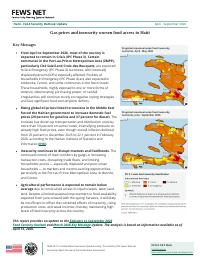
From April to September 2026, most of the country is
expected to remain in Crisis (IPC Phase 3). Certain
communes in the Port-au-Prince Metropolitan Area (ZMPP),
particularly Cité Soleil and Croix-des-Bouquets, are expected
to face Emergency (IPC Phase 4) outcomes, with internally
displaced persons (IDPs) especially affected. Pockets of
households in Emergency (IPC Phase 4) are also expected in
Artibonite, Centre, and some communes in the Nord-Ouest.
These households, highly exposed to one or more forms of
violence, deteriorating purchasing power, or rainfall
irregularities, will continue to rely on negative coping strategies
and face significant food consumption deficits.
Rising global oil prices linked to tensions in the Middle East
forced the Haitian government to increase domestic fuel
prices (29 percent for gasoline and 37 percent for diesel). The
increase has driven up transportation and distribution costs by
more than 50 percent on some routes, intensifying pressure on
already high food prices, even though overall inflation declined
from 25 percent in December 2025 to 22.1 percent in February
2026, according to the Haitian Institute of Statistics and
Informatics (IHSI).
Insecurity continues to disrupt markets and livelihoods. The
continued control of road corridors by gangs is increasing
transaction costs, disrupting trade flows, and limiting
households’ access — especially displaced and poor urban
households — to markets and income-earning opportunities,
particularly in the Port-au-Prince Metropolitan Area, Artibonite,
and Centre.
Agricultural performance is expected to remain below
average due to constrained access to inputs (seeds, labor) and
land. Despite a limited seasonal improvement in food availability
expected from June onward with the spring harvests, it will likely
be insufficient to offset the combined effects of insecurity, rising
production costs, and weak incomes, thereby maintaining high
levels of food insecurity across the country.
FEWS NET is a United States Government-funded activity. The content of this report does not
necessarily reflect the view of the United States Government.
FEWS NET Haiti
haiti@fews.net
fews.net/latin-america-and-caribbean/haiti
Current anomalies in food security conditions as of April 2026
Insecurity remains one of the main drivers of food insecurity in
Haiti (Figure 1), particularly in the ZMPP, Lower Artibonite, and
Centre. Despite ongoing security operations and the deployment of
anti-gang forces, gangs continue to maintain and expand their
control over strategic routes, especially National Road 1 (RN1),
imposing movement restrictions, illegal payments, and heightened
risks for transporters.
Recent attacks confirm a worsening of violence, particularly in
Centre and Artibonite. Incidents in Jean-Denis, Pont Sondé, and
Pont Benoît, which caused around 70 civilian deaths and dozens of
injuries, illustrate an intensification of violence, accompanied by
new displacement waves and greater disruption of livelihoods.
The geographic expansion of armed gangs is spreading into
new areas, including strategic agricultural zones, with
incursions reported in the Sud-Est (Seguin and Marigot). This
dynamic reflects a strategy aimed at strengthening control over
secondary roads and production basins, further constraining
economic and agricultural activities.
The entrenchment of a conflict economy is reinforcing constraints on market access and livelihoods. Gang control
over trade routes and production zones continues to be a key driver of acute food insecurity, while the recent
increase in fuel prices is expected to further raise transport costs and potentially informal road tolls, worsening
market access difficulties and worsening food security conditions.
The number of internally displaced persons (IDPs) remains extremely high (more than 1.45 million), with
particularly precarious living conditions in displacement sites. Pressure on host households in rural areas is
increasing nutritional risks, especially for children. According to the International Organization for Migration
(IOM), a new wave of displacement involving approximately 5,291 people (1,359 households) was recorded in
Artibonite following violence at the end of March. Among these households, 81 percent were hosted by
families, while 19 percent settled in displacement sites, further straining already limited resources. Around
52 percent of displaced persons are concentrated in Dessalines commune, intensifying pressure on basic
services, local markets, and rural food systems.
Market function remains generally active but highly disrupted. Tensions in the Middle East contributed to rising
international oil prices, leading to increases in domestic fuel prices on April 2 (37 percent for diesel and 29
percent for gasoline). Trade flows remain irregular due to armed control of key corridors (RN1, RN2, RN3) and
high transportation costs for food commodities. This dynamic has also resulted in a significant increase in public
transportation costs. Thus, despite slowing overall inflation (22.1 percent in February 2026), food prices remain far
above the five-year average, severely limiting poor households’ access to food.
Poor household incomes remain below average, both in nominal terms and due to the high prices of goods and
services. In urban areas, informal activities (small trade, daily labor) are heavily affected by insecurity. In rural areas,
declining agricultural incomes, combined with high input costs and limited market access, are maintaining strong
market dependence in a context of continuously deteriorating purchasing power and annual inflation above 20
percent.
Figure 1
Factors limiting food access in Haiti
(April 2026)
Source: FEWS NET
Food Security Outlook Update April - September 2026
Famine Early Warning Systems Network
2
Humanitarian food assistance
The 2026 Humanitarian Response Plan, targeting around 4.2 million people with a budget of 880 million USD,
remains severely underfunded, particularly since the beginning of the year. Assistance continues to be irregular and
provided for only short time periods, while the value of transfers or food rations remains below monthly food needs.
These factors hinder the ability of humanitarian actors to scale up and regularize assistance, while also limiting the
impacts on food consumption gaps due to rising prices.
According to reports from UNICEF and humanitarian partners, the nutrition response remains constrained, with
increasing needs among children under five and insufficient coverage of screening and treatment services. In this
context, food and nutrition assistance continues to have only a limited impact in mitigating food security outcomes,
particularly in areas most affected by insecurity and internal displacement. Major actors, especially the WFP and its
partners, continue to provide assistance through food distributions, hot meals, and cash/voucher transfers. However,
interventions remain targeted and sporadic and are still largely insufficient given the millions of people facing acute
food insecurity.
Updates to key assumptions about atypical food security conditions through September 2026
Most of the assumptions that underpinned FEWS NET’s analysis of the most likely scenario for the Haiti Food
Security Outlook from February to September 2026 remain valid; however, the following updates have been made
to incorporate new evidence:
Projected acute food insecurity outcomes through September 2026
From April to September 2026, most of the country is expected to remain in Crisis (IPC Phase 3). Certain
communes in the ZMPP, particularly Cité Soleil and Croix-des-Bouquets, are expected to be classified in
Emergency (IPC Phase 4). In addition, households living in IDP sites within the ZMPP are also expected to face
Emergency outcomes. Outside the ZMPP, pockets of households in Emergency (IPC Phase 4) are expected in
Artibonite, Centre, and some communes in the Nord-Ouest.
According to U.S. Geological Survey forecasts, rainfall during the first rainy season (April-June) is expected to be
generally near average. However, rainfall is expected to gradually decline, becoming below average toward the
end of June. For the autumn agricultural season, below-average rainfall combined with above-average
temperatures are expected to slow planting, crop growth, and development, resulting in lower yields.
Food prices are expected to face upward pressure due to the ongoing energy shock. Rising international
oil prices driven by tensions in the Middle East are expected to increase domestic fuel prices, further raising
transportation and distribution costs and, consequently, food prices, despite the slowdown in overall inflation.
The relative stability of imported food prices is becoming less likely to persist. Although supplies of
imported staple products (rice, wheat flour, vegetable oil) are expected to remain generally stable, prices are
increasingly exposed to external shocks, particularly through transport, insurance, and distribution costs. The
transmission of the fuel price shock is expected to keep prices of both imported and locally produced foods
above the five-year average, with additional pressure during the lean season.
The direct impact of rising fertilizer prices remains limited at the national level but significant for
certain agricultural systems. Fertilizer use in Haiti remains very low (around 3.8 kilograms/hectare) compared
with the Latin America and Caribbean average (approximately 100 kilograms/hectare), which limits the direct
impact of price increases at the national level. However, these increases are expected to more significantly
affect irrigated areas and peri-urban farming systems where input use is higher. In these areas, rising fertilizer
costs could reduce input use, increase production costs, and limit yields, contributing to below-average
agricultural performance.
Food Security Outlook Update April - September 2026
Famine Early Warning Systems Network
3
During the lean season (April-May), dependence on markets is expected to remain high across the country. Rising
international oil prices have increased transportation and distribution costs, sustaining higher food prices and
further reducing the purchasing power of poor households. In this context, poor households are expected to
continue relying on negative coping strategies such as begging, engaging in illegal and/or precarious activities, and
selling productive assets, including seed stocks, among others. Global acute malnutrition is expected to reach its
seasonal peak between April and May at above-normal levels, particularly in the ZMPP, Artibonite, and Centre, with
a parallel increase in mortality risk. Populations in areas most affected by displacement and insecurity are likely to
face the highest risk of malnutrition.
From June through September 2026, a partial seasonal improvement is expected with the spring harvests,
temporarily supporting food availability and agricultural incomes. However, this improvement is expected to remain
limited due to constraints on access to inputs, insecurity, and rainfall variability. As a result, most areas are expected
to remain in Crisis (IPC Phase 3), while Emergency (IPC Phase 4) outcomes are expected to persist in the ZMPP and
in some areas under strong armed group influence. Food consumption is expected to improve temporarily without
allowing for meaningful livelihood recovery, and malnutrition is expected to remain above normal, especially in areas
with high concentrations of displaced populations.
ZMPP: Very poor urban households and IDPs are expected to continue facing significant food consumption
deficits due to persistent violence, restricted access to markets and income-generating activities, and rising transport
and food costs. Certain communes, particularly Cité Soleil and Croix-des-Bouquets, are expected to remain in
Emergency (IPC Phase 4), with increased reliance on negative coping strategies.
Lower Artibonite and Centre corridors: In these areas affected by the spread of insecurity, disruptions to markets,
agricultural activities, and trade flows are expected to keep most households in Crisis (IPC Phase 3). Pockets of
households in Emergency (IPC Phase 4) are expected to persist, particularly in isolated areas or those recently
affected by displacement, where access to income and markets remains severely restricted.
Grand Sud: Despite relatively lower levels of insecurity, poor households are expected to remain in Crisis (IPC Phase
3) due to weak agricultural and non-agricultural incomes and high food prices. The combined effects of elevated
transportation costs and below-average agricultural performance are expected to limit significant improvements in
food consumption.
Nord-Ouest: In some communes of the Nord-Ouest, households are expected to continue facing structural
constraints to food access linked to weak agricultural production, limited income-earning opportunities, and high
prices, maintaining Crisis (IPC Phase 3) outcomes, with some pockets of households facing even more difficult
living conditions.
Food Security Outlook Update April - September 2026
Famine Early Warning Systems Network
4
Annex 1: Updates to events that would likely change projected acute food insecurity outcomes
While FEWS NET’s projections are considered the “most likely” scenario, there is always a degree of uncertainty in the
assumptions that underpin the scenario. This means food security conditions and their impacts on acute food security may
evolve differently than projected. FEWS NET issues monthly updates to its projections, but decision makers need advance
information about this uncertainty and an explanation of why things may turn out differently than projected. As such, the
final step in FEWS NET’s scenario development process is to briefly identify key events that would result in a credible
alternative scenario and significantly change the projected outcomes. FEWS NET only considers scenarios that have a
reasonable chance of occurrence.
National
Escalation of conflict in the Middle East
Likely impact on acute food insecurity outcomes: A worsening of the conflict in the Middle East, in the absence of
an agreement between the parties, could lead to a prolonged and more volatile increase in international oil prices.
Haiti is highly dependent on fuel imports, and escalating conflict would increase the likelihood of further domestic
fuel price hikes beyond the recent adjustments, with cumulative effects on transportation and distribution costs.
This dynamic would exert sustained inflationary pressure on food prices, particularly in areas highly dependent on
markets. The continued rise in logistical costs, combined with internal security constraints, would further disrupt
trade flows and increasingly limit the regular supply of markets.
In addition, the prolonged increase in agricultural input costs (fertilizer, transport) could reduce cultivated areas and
crop yields, undermining not only the spring agricultural season but also medium-term agricultural prospects. Since
the government’s capacity to mitigate these shocks through subsidies is limited, a growing share of the costs would
transmit to consumers.
Under this scenario, the purchasing power of poor households — particularly urban households, displaced
populations, and households in isolated areas — would continue to deteriorate, leading to worsening food
consumption deficits. This could result in an increase in the number of households facing Emergency (IPC Phase 4)
outcomes and a geographic expansion of affected areas, particularly in the ZMPP, Artibonite, Centre, and parts of the
Grand Sud.
Food Security Outlook Update April - September 2026
Famine Early Warning Systems Network
5
Annex 2: Updates to key sources of evidence used in this analysis
Many of the key sources of evidence utilized for FEWS NET’s February to September 2026 Food Security Outlook
remain the same; however, new and additional sources of evidence are listed below.
Evidence Source Data format Food security element of analysis
Climate condition models NOAA Qualitative
and
quantitative
ENSO probabilities, rainfall, and
sea surface temperatures
Monetary policy note, October–December 2025 BRH Qualitative
and
quantitative
Inflation, exchange rates, money
supply, and their impacts on
purchasing power and food
prices
Haiti — Emergency Tracking 88.2 — Update on
displacement related to armed attacks in Petite
Rivière de l’Artibonite and Dessalines (March 28 –
April 6, 2026)
IOM Qualitative
and
quantitative
Number of IDPs, causes of
displacement, areas of
concentration, and impacts on
livelihoods and food access
Consumer Price Index (CPI) IHSI Quantitatives Information on inflation rates for
food and non-food products,
including local and imported
goods
Food Security Outlook Update April - September 2026
Famine Early Warning Systems Network
6
Annex 3: Seasonal calendar
Recommended citation: FEWS NET. Haiti Food Security Outlook Update
April - September 2026: Gas prices and insecurity worsen food access in
Haiti, 2026.
Food Security Outlook Update
This Food Security Outlook Update provides an analysis of current acute food insecurity conditions and any changes to FEWS NET's latest projection of acute food insecurity outcomes
in the specified geography over the next six months. Learn more here.
Source: FEWS NET
*
FEWS NET classification is IPC-compatible with limited exceptions. IPC-compatible analysis follows key IPC protocols but does not necessarily reflect the consensus of national food security
partners. As of IPC 3.0, the IPC no longer assesses the impact of food assistance on classification and thus no longer maps the (!). However, FEWS NET continues to produce food security
maps inclusive of the (!) as well as maps compatible with IPC 3.0/3.1, which include the mapping of food security assistance bags. In rare cases, FEWS NET classification is IPC-aligned but
not IPC-compatible. IPC-aligned analysis is evidence-based but some types of evidence required for IPC-compatibility were not available.
Food Security Outlook Update April - September 2026
Famine Early Warning Systems Network
7