Teks Konple Dokiman an
Teks ki soti nan dokiman orijinal la pou endeksasyon.
Sociopolitical crisis and insecurity limit food access despite decelerating inflation
Key Messages
The analysis in this report is based on information available as
of February 15, 2026.
Haiti - Food Security Outlook February - September 2026
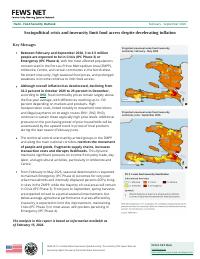
Between February and September 2026, 3 to 3.5 million
people are expected to be in Crisis (IPC Phase 3) or
Emergency (IPC Phase 4), with the most affected populations
concentrated in the Port-au-Prince Metropolitan Area (ZMPP),
Artibonite, Centre, and certain communes in the North-West.
Persistent insecurity, high seasonal food prices, and prolonged
weakness in income continue to limit food access.
Although overall inflation has decelerated, declining from
32.2 percent in October 2025 to 25 percent in December,
according to IHSI, food commodity prices remain largely above
the five-year average, with differences reaching up to 130
percent depending on markets and products. High
transportation costs, linked notably to movement restrictions
and illegal payments on strategic routes (RN1, RN2, RN3),
continue to sustain these atypically high price levels. Additional
pressure on the purchasing power of poor households will be
accentuated by the upward trend in prices of local products
during the lean season (February-June).
The territorial control exercised by armed groups in the ZMPP
and along the main national corridors restricts the movement
of people and goods, fragments supply chains, increases
transaction costs and disrupts livelihoods. This dynamic
maintains significant pressure on income from petty trade, day
labor, and agricultural activities, particularly in Artibonite and
Centre.
From February to May 2026, seasonal deterioration is expected
to maintain Emergency (IPC Phase 4) outcomes for very poor
urban households and internally displaced persons (IDPs) living
in sites in the ZMPP, while the majority of rural areas will remain
in Crisis (IPC Phase 3). From June to September, spring harvests
are expected to lead to a partial seasonal improvement, but
below-average agricultural performance in areas affected by
insecurity is expected to limit this improvement, maintaining
Crisis (IPC Phase 3) in most areas, with pockets persisting in
Emergency (IPC Phase 4).
FEWS NET is a United States Government-funded activity. The content of this report does not
necessarily reflect the view of the United States Government.
FEWS NET Haiti
haiti@fews.net
fews.net/latin-america-and-caribbean/haiti
Food Security Context
Insecurity remains one of the principal determining factors of food insecurity in Haiti. Despite the
intensification of law enforcement interventions against armed gangs, violence remains heavily concentrated in
the Ouest Department, particularly in the ZMPP, where armed gangs still control nearly 90 percent of the territory.
This domination has profoundly disrupted the urban economy, particularly informal sector activities, notably small-
scale commerce, street vending, and daily wage labor, which constitute the primary source of income for more than
90 percent of poor urban households. In parallel, the installation of checkpoints on major national routes linking
Port-au-Prince to the north, center, and south of the country has resulted in the imposition of illegal payments,
disrupting the movement of people and goods, as well as market supply. The mandatory passage fees imposed on
users compromise the supply of markets in the capital and the rest of the country with local and imported
goods and petroleum products.
According to the latest situation report from International Organization for Migration (IOM), approximately 1.45
million people (12 percent of the population) are displaced, of which nearly 212,000 live on sites where living
conditions, including food, access to livelihoods, water, and health services, are very precarious. Recent flows of
displaced persons are also observed, resulting from clashes in Artibonite (7,000 people) in December and in the
capital (nearly 6,000 people) since January 8. Approximately 85 percent of displaced persons are hosted by host
families, often in rural areas, which increases pressure on already limited resources and affects the livelihoods of
host households. Furthermore, UNICEF notes an increasing number of children among displaced persons. The
number of displaced children increases from 551,000 in December 2024 to more than 740,000 in December
2025, representing an increase of 36 percent.
The country has experienced seven consecutive years of economic contraction between 2019 and 2025. The
GDP, having already recorded a decrease of 4.2 percent during the 2023/24 fiscal year, is contracting again in 2024/
25 by 2.7 percent, given the current context of sociopolitical and security crisis, as well as the slowdown in various
activity sectors. Despite a slowdown in the pace of inflation observed since October 2025, the general price level
remains high, with annual food inflation exceeding 26 percent in December 2025. Moreover, although prices of
imported products have been relatively stable for three years, they continue to remain above the five-year average,
which keeps household purchasing power under pressure and limits households’ access to markets, the main source
of food supply.
Agriculture, although secondary to imports, remains an essential source of income and food for rural households.
National agricultural production is also affected by insecurity, access constraints to inputs, and weak
investments. In certain key areas, such as Liancourt, Verrettes, and Petite Rivière de l'Artibonite, gangs control
irrigation systems and impose illegal payments for access to water. Spring constitutes the main agricultural season
among the three (spring, fall and winter), as it contributes 60 percent to national production. However, the
abandonment of arable land, particularly in the Artibonite, Centre, and Ouest departments, and below-
average rainfall recorded during the first half of 2025, have contributed to a below-average agricultural
production, a trend observed since 2022/23.
The incomes of poor households are decreasing. The decrease in income from the sale of agricultural products in
2025 is due to limited market access and the high cost of inputs. Agricultural labor is contracting, with demand below
average, resulting in wages stagnating at below-average rates. Non-agricultural activities are also declining due to
insecurity and weak demand.
In the ZMPP, the typical source of income for the poor, petty trade, is also declining, suffering the full brunt of
the consequences of insecurity. In displacement camps, the income configuration does not differ significantly
from that of non-displaced households. IDPs can only meet their basic food needs with immediate emergency
food assistance, and not through livelihood activities.
Learn more
The following links provide additional information:
Food Security Outlook February - September 2026
Famine Early Warning Systems Network
2
Current anomalies in food security conditions as of February 2026
The mandate of the Transitional Presidential Council ended on
February 7, 2026, complicating the planning and implementation of
economic and humanitarian activities in a context marked by
persistent insecurity, displacement, market disruptions, and
irregular agroclimatic conditions.
Insecurity remains high in the ZMPP, Bas-Artibonite, and
Centre, despite the intensification of law enforcement
operations. The majority of violent incidents remain concentrated
in the Ouest Department, where armed groups maintain control
over vast portions of the territory. According to the Armed
Conflict Location and Event Data Project (ACLED), 1,750 violent
events were recorded in 2025 (or 146 cases per month), of which
more than 72 percent were in Ouest, compared to 13 percent in
Artibonite and nearly 6 percent in Centre. Despite a relative
decrease in incidents in January-February 2026, the main routes
connecting the capital to other departments remain under armed
influence, with illegal fees and increased risks for transporters
and delays, which persistently disrupt commercial flows and
access to livelihoods.
The situation of the 1.45 million IDPs (approximately 12 percent of the national population) remains
concerning. More than 212,000 are living in precarious conditions, with limited access to food, water, sanitation,
and healthcare. The majority of displaced persons (approximately 85 percent) are hosted by host families, often in
rural areas, which is atypical compared to more localized crises, and increases pressure on already limited resources.
In Artibonite and the capital, recent displacements are maintaining elevated needs and increased nutritional
risks, particularly among a growing proportion of displaced children.
The analysis of market and corridor functioning (Figure 1) shows significant access anomalies. Several departmental
markets (Hinche, Jérémie, Les Cayes, Fond-des-Nègres, Ouanaminthe and, to a certain extent, Gonaïves) remain
operational, but their supply depends on heavily disrupted flows. The prolonged closure of the Croix-des-Bossales
market has shifted trade toward Pétion-Ville and Delmas. Armed control of key national roads (RN1, RN2)
increases transportation costs and the volatility of supply. Secondary and cross-border corridors (Cap-
Haïtien–Ouanaminthe, Grand Sud) remain relatively more functional, without compensating for the disruption of the
national redistribution system, maintaining upward pressure on prices and food access for poor households.
Between late December 2025 and January 2026, above-average cumulative rainfall was observed, with marked
intra-seasonal variability. These irregular conditions, combined with the residual effects of Hurricane Melissa in
October 2025, are contributing to below-average fall and winter harvests in several areas.
Haiti Food Security Outlook Report: October 2025 – May 2026
Latest Food Security Outlook Update for Haiti: December – May 2026
Haiti Key Messages Update: January 2026
Overview of FEWS NET’s scenario development methodology
FEWS NET’s approach to estimating the population in need
Overview of the IPC and IPC-compatible analysis
FEWS NET’s approach to humanitarian food assistance analysis
Figure 1
Market function and route accessibility,
February 2026
Source: FEWS NET
Food Security Outlook February - September 2026
Famine Early Warning Systems Network
3
Economic anomalies persist, with a seventh year of contraction and a GDP decline of 2.7 percent in 2025. Although
some macroeconomic indicators show relative stabilization (such as a decrease in inflation between October and
January 2026, exchange rate stability, and the absence of monetary financing in 2025), this reflects a slowdown in
deterioration rather than a return to typical conditions. Although overall inflation decelerated, falling from 32.2
percent in October 2025 to 25 percent in December, according to IHSI, food prices remain largely above the five-
year average, reaching up to 130 percent above average depending on markets and products. The increased
dependence on diaspora remittances (estimated by the Bank of the Republic of Haiti at 4.4 billion USD for fiscal
year 2024/25) also reveals the weakness of domestic income and the high sensitivity of households to any disruption
in external financial flows.
The incomes of poor households continue to decrease. In rural areas, the reduction in agricultural sales and work
opportunities, combined with high input costs and difficulties accessing markets, limit agricultural incomes.
According to a REACH report in 2025, in the ZMPP, incomes are mainly from petty trade (43 percent) and daily labor
(22 percent), and are insufficient to cover food expenditures in a context of high prices.
According to the Nutrition Cluster, among 496,546 children under five years of age screened through
December 2025, nearly 30 percent suffer from acute malnutrition. In the Ouest Department, this proportion
reaches 44 percent. However, these results must be interpreted with caution: they are based solely on children who
were screened and do not include those who were not screened or who did not have access to health services,
therefore do not necessarily reflect the situation of the entire population.
Humanitarian food assistance
Between January and November 2025, according to the Food Security Cluster, emergency food assistance reached
approximately 2 million people, primarily through in-kind distributions and cash transfers/vouchers. Assistance
remained irregular and short-term, and the value of transfers did not keep pace with the increase in prices,
limiting its impact on consumption. Overall, assistance covers less than 25 percent of essential needs.
The nutrition response remains limited: screening and services cover approximately 47.5 percent of the at-risk
population, in a context of insecurity and restricted access. These limitations are aggravated by marked
underfunding: according to the UN, 24 percent of the humanitarian response plan was funded in 2025; however, as
of early February 2026, the appeal was funded at less than 4 percent.
Food Security Outlook February - September 2026
Famine Early Warning Systems Network
4
Current acute food insecurity outcomes as of February 2026
Food insecurity is widespread, with Crisis (IPC Phase 3) and
Emergency (IPC Phase 4) levels ongoing. IDPs living in sites in the
ZMPP remain in Emergency (IPC Phase 4), due to the loss of their
livelihoods and lack of income opportunities. Household coping
strategies continue to deteriorate; households resort to begging,
asset sales, and child labor. The communes of Port-au-Prince, Cité
Soleil, Croix-des-Bouquets, Cornillon, and Ganthier, where
violence, the decrease in daily income, and high prices severely
limit food access, are classified in Emergency (IPC Phase 4), while
the rest of the ZMPP remains in Crisis (IPC Phase 3).
The analysis of the cost of the minimum caloric basket in reference
markets between 2020 and 2025 (Figure 2) highlights a major
inflationary shock in 2022-2023, followed by partial stabilization in
2024-2025, without a return to pre-crisis levels. It should be noted that
the price levels of 2022-2023 were determined by a combination of
international shocks and internal instability due to increased
insecurity, political uncertainty, and a reduction in domestic
production.
In the ZMPP, market functioning remains severely disrupted by
insecurity. Markets constitute the primary source of food supply, and
more than 80 percent of households purchase their food with cash, a
proportion reaching 95 percent in Carrefour and 93 percent in Port-
au-Prince. The closure of Croix-des-Bossales and the relocation of
wholesalers to Delmas and Pétion-Ville have altered trade flows.
Prices of basic commodities remain high. In December 2025, the minimum cost of the food basket reached 12,000 to
14,000 HTG in the ZMPP (14,000 to 16,000 at the national level), significantly higher than the five-year average.
The WFP standard basket exceeds 25,000 HTG per month for a household of five people. According to the MSNA
2025, the median food expenditure of poor households is insufficient, amounting to 10,000 HTG per month,
representing only 71 to 83 percent of minimum caloric needs. It is even lower in Croix-des-Bouquets (3,000 HTG) and
in Cité Soleil (less than 6,000 HTG), reflecting significant consumption deficits.
At the national level, the cost of the food basket increased from approximately 6,610 HTG in 2020 to a peak of
more than 16,000 HTG in 2023, representing an increase of more than 140 percent, before declining in 2025 (down
29 percent compared to 2024). Despite this recent decrease, current levels remain significantly higher than
those observed before 2022. In several key markets, the cost remains above the five-year average, notably
Ouanaminthe (32 percent), Jacmel (28 percent), and Port-au-Prince (23 percent). Persistent structural constraints,
including logistical disruptions and high transportation costs, are linked to insecurity and heavy dependence on
imports. Despite a cyclical improvement in 2025, the purchasing power of poor households remains severely
eroded, particularly in urban centers where market dependence is highest, which continues to limit economic access
to food and sustain Crisis (IPC Phase 3) and Emergency (IPC Phase 4) food insecurity outcomes.
The majority of the country is in Crisis (IPC Phase 3), having recorded poor autumn and winter harvests
leading to income losses for the poor, with pockets of Emergency (IPC Phase 4) in the Northwest, particularly in
the communes of Baie-de-Henne, Bombardopolis, La Tortue, Môle-Saint-Nicolas, and Jean-Rabel. Also, in Artibonite
and Centre, the expansion of armed groups is disrupting access to markets and strategic routes (RN1, RN3)
leading to supply disruptions in Saint-Marc, Gonaïves and Mirebalais, with pockets in La Chapelle, Petite Rivière de
l'Artibonite, Liancourt, Mirebalais, Saut-d'Eau and Lascahobas.
Food Security Outlook February - September 2026
Famine Early Warning Systems Network
5
Off-farm income is declining, pushing households to adopt negative coping strategies, such as selling non-productive
or household assets to purchase food, reducing non-food expenditures, selling non-productive animals more than
typical due to lack of food or money, and internal migration. At the same time, a significant percentage is engaging in
more severe livelihood strategies such as begging, sending children to eat outside the household, and, in urban areas
most affected by insecurity and unemployment, involvement in high-risk illicit activities, among others.
According to UNICEF, data indicate that nearly 130,000 children under five suffer from global acute malnutrition
(GAM). In 2025, 60,202 children suffering from severe acute malnutrition (SAM) were admitted (approximately 47
percent of the target), out of 496,546 children screened, but access and funding limited coverage. Despite treatment
outcomes consistent with SPHERE standards, underfunding (approximately 16 percent in 2025), insecurity and
displacement, as well as episodes of cholera reported in IDP sites, continue to increase nutritional risks. FEWS NET
estimates that the acute malnutrition situation has likely deteriorated since the last SMART survey in 2023, with some
localities potentially experiencing a worsening of approximately one phase. The most concerning areas remain
Artibonite, Nord-Ouest, and the ZMPP, where the 2023 survey reported a GAM prevalence of approximately 12
percent.
In the Grand Sud, despite locally near-average harvests, the influx of displaced persons, illegal tolls on National Road
2, and the impacts of flooding resulting from Hurricane Melissa have reduced agricultural income and increased
pressure on host households. This is leading to Crisis (IPC Phase 3) outcomes, with some pockets of households still
in Emergency (IPC Phase 4) on the southern coast (Tiburon), in Grand'Anse (Les Irois, Anse D'hainault, Pestel, Corail),
in Nippes (Grand Bouquant, Arnaud), and in the South-East (Belle-Anse, Grand Gosier).
Key assumptions about atypical food security conditions
underpinning the most likely scenario through September
2026
Figure 2
Trend in the cost of the minimum calorie
basket in reference markets, 2020-2025
Source: FEWS NET
Violence is expected to remain elevated in Port-au-Prince,
although slightly lower than the peaks observed in late
2024-early 2025, as security forces continue to prioritize
control of strategic infrastructure. However, it remains unlikely
that gangs will be dislodged from the capital. Their expansion
is expected to continue in the Centre, Artibonite, and
certain parts of Ouest (Montrouis, Arcahaie, Kenscoff, Croix-
des-Bouquets), maintaining access restrictions around Port-
au-Prince, disrupting commercial flows, agricultural activities,
and causing additional population displacements.
A transition from typical conditions to El Niño is expected,
which will result in below-average and irregular rainfall,
combined with above-average temperatures during the
rainy season. These agroclimatic conditions are likely to limit agricultural yields, particularly in non-irrigated
areas. Moreover, limited access to agricultural inputs and weak investments, exacerbated by insecurity, are also
expected to maintain below-average agricultural performance, particularly for spring harvests in July.
Despite the decrease in precipitation, an average start to the spring season is expected, between February
and May, in most agroecological zones of the country. In addition, the 2026 hurricane season will begin on June
first and is expected to be average, which would compensate for the precipitation deficit, likely to compromise
the typical growth of seasonal crops.
The exchange rate (HTG/USD) is expected to remain generally stable during the projection period. It will be
supported by the continuation of monetary management measures implemented by the Bank of the Republic of
Haiti (BRH), including strict control of foreign currency liquidity and regulation of foreign exchange operations.
However, this stability is expected to remain fragile and depend on the maintenance of these measures as well
as the absence of major external shocks, such as a significant increase in imports, a decrease in remittances
Food Security Outlook February - September 2026
Famine Early Warning Systems Network
6
Humanitarian food assistance
Projected acute food insecurity outcomes through September 2026
Between February and September 2026 , acute food insecurity is expected to remain widespread in Haiti, with
approximately 3 to 3.5 million people in need facing Crisis (IPC Phase 3) or Emergency (IPC Phase 4) outcomes.
The outlook remains dominated by persistent insecurity, low incomes, atypically high food prices, and limited
humanitarian assistance.
During this lean season, the early depletion of stocks from below-average harvests will increase dependence
on the market. Prices of local products are expected to follow their seasonal increase and remain well above the
five-year average, while agricultural and non-agricultural incomes are expected to remain below average due to
insecurity and low labor demand. Poor rural households are expected to maintain minimal food consumption
primarily at the cost of negative coping strategies (asset sales, debt, partial migration). Market-dependent very poor
urban households and IDPs are expected to continue experiencing consumption deficits, with increased
reliance on negative coping strategies.
from the diaspora, or a worsening of political instability.
Food inflation is expected to remain above 20 percent due to persistently high transportation costs, linked,
among other factors, to illegal fees imposed by gangs and logistical disruptions.
Prices of imported products (rice, flour, oil) are expected to remain relatively stable due to favorable
conditions on international markets and the stability of the HTG/USD exchange rate. Despite this, gains for
households will remain limited by internal costs (transport, margins) and insecurity. Prices of local products
(maize, beans, roots, and tubers) are expected to follow an upward seasonal trend and remain above the five-
year average, due to the lean season, market access constraints, and below-average production.
The functioning of urban and rural markets is expected to remain disrupted, particularly around the
ZMPP, due to movement restrictions, insecurity on national roads, and high transportation costs. The incomes
of poor market-dependent households are expected to remain below the five-year average, given the impact of
insecurity and the residual effects of previous weather shocks. In rural areas, demand for agricultural labor
would remain limited by weak agricultural investments and insecurity. In urban areas, small-scale trade and
informal activities will continue to be affected by the contraction of demand and security risks.
For the period from February to September 2026, GAM and mortality risk are expected to follow their
typical seasonal dynamics, but at levels generally higher than typical due to persistent economic and
security constraints.
From February to September 2026, humanitarian food assistance is expected to reach a limited proportion of
households, due to persistent constraints related to funding, targeting, and safe access, particularly in the
ZMPP, Artibonite, and certain areas of Centre. This assistance in partial rations will cover on average less than
20 percent of monthly caloric needs, without regularity and effective coverage of distributions, especially for
hard-to-reach populations and displacement sites.
As typically observed, the lean season (February-May) is expected to lead to a moderate seasonal increase in
GAM over approximately three to four months, with a peak around April-May, affecting poor households, IDPs,
and precarious or isolated urban areas more severely (particularly in the ZMPP, Artibonite, and Centre). Starting
in June, spring harvests are expected to induce a gradual improvement over two to three months; however, this
seasonal decrease is expected to remain partial and uneven, particularly in areas of persistent insecurity.
Mortality is expected to evolve in a similar manner, with increased risk during the lean season followed by
relative stabilization after the harvests. However, it will not return to the lowest seasonal levels in areas
presenting the highest mortality risk.
Food Security Outlook February - September 2026
Famine Early Warning Systems Network
7
GAM is expected to increase seasonally between February and May, with a peak likely around April-May, and
will most likely fall within a range corresponding to Alert (IPC Phase 2) to Serious (IPC Phase 3) in most of the country.
Partial and localized improvement is expected during the harvest period, particularly outside the main conflict
hotspots. The peak will more significantly affect IDPs, poor urban households, and isolated areas of Artibonite,
Centre, and ZMPP. However, the areas most likely to experience temporary deterioration during the lean season are
Artibonite, Nord-Ouest, and Ouest. Mortality risk is expected to evolve in parallel, with moderate deterioration in the
most vulnerable areas.
The majority of rural areas is expected to remain in Crisis (IPC Phase 3), with pockets of households experiencing
more severe outcomes in the Northwest, Artibonite, Center, and Belle-Anse. In the ZMPP, IDPs and very poor urban
households are expected to remain in Emergency (IPC Phase 4).
From June to September 2026, the majority of areas are expected to remain in Crisis (IPC Phase 3), with limited
seasonal improvement. In the ZMPP and certain communes under strong armed influence, Emergency (IPC Phase 4)
outcomes are expected to persist among IDPs and very poor urban households.
Spring harvests are expected to temporarily improve food availability and agricultural income, supporting a seasonal
increase in own consumption and agricultural labor opportunities. However, agricultural performance is expected to
remain below average in several areas affected by insecurity and rainfall irregularities, while non-agricultural income
is expected to remain low.
Food consumption is expected to improve temporarily in rural areas, without allowing for significant asset
reconstitution. Food commodity prices are expected to remain above the five-year average, and humanitarian
assistance is not expected to reach a significant level as defined by IPC protocols. Malnutrition is expected to
experience a gradual seasonal improvement starting in June, without a widespread return to the lowest seasonal
levels, particularly in areas with high concentrations of displaced persons and under armed influence.
Food Security Outlook February - September 2026
Famine Early Warning Systems Network
8
Annex 1: Key sources of evidence used in this analysis
Livelihood profiles FEWS
NET
Qualitative Typical sources of food and income by livelihood
zone
Monetary policy note,
July–September 2025
BRH Qualitative/
Quantitative
Inflation, exchange rate, money supply, and
their impacts on purchasing power and food
prices
Food Security Cluster assistance
distribution plans, including an
analysis of historical trends
FSC Qualitative/
Quantitative
Geographic and temporal coverage of food
assistance, number of beneficiaries, and trends
in humanitarian coverage
Haiti — Emergency Tracking 83 —
Displacement following armed
violence in Port-au-Prince (January
8–9, 2026)
OIM Qualitative/
Quantitative
Number of IDPs, causes of displacement, areas
of concentration, and impacts on livelihoods and
access to food
Conflict analyses ACLED Qualitative/
Quantitative
Number of violent incidents, affected areas,
evolution of conflicts, and their impacts on
market access, production, and displacement
Interviews with key informants,
including FEWS NET price collectors,
community leaders, among others
FEWS
NET
Qualitative/
Quantitative
Field information on prices, food availability,
coping strategies, local perceptions, and market
trends
Food security survey REACH Qualitative/
Quantitative
Field information collected by region on food
security conditions, consumption, livelihoods,
and coping strategies
Consumer Price Index IHSI Quantitative Information on inflation rates for food and non-
food products, both local and imported
Humanitarian reports and bulletins OCHA Qualitative/
Quantitative
Monitoring of the humanitarian situation,
sectoral coverage, funding of assistance, priority
intervention areas, and intersectoral
coordination
Haitian market monitoring, August
2025
WFP Qualitative/
Quantitative
Food security analysis report
Analytical report WFP Qualitative Analysis of the impact of violence on food
security in the Haitian capital in a context of
reduced food assistance
Evidence Source
Data
format Food security element of analysis
Food Security Outlook February - September 2026
Famine Early Warning Systems Network
9
Annex 2: FEWS NET’s analytical approach explained
Early warning of acute food insecurity outcomes requires forecasting months in advance to provide decision makers with
sufficient time to budget, plan, and respond to expected humanitarian crises. However, due to the complex and variable
factors that influence acute food insecurity, definitive predictions are impossible. Scenario Development is a methodology
that allows FEWS NET to meet decision makers’ needs by developing a “most likely” scenario of the future.
FEWS NET’s scenario development process applies the Disaster Risk Reduction framework and a livelihoods-based lens to
assess acute food insecurity outcomes. A household’s risk of acute food insecurity depends not only on hazards (such as
drought) but also the household’s vulnerability to these hazards (e.g., the level of dependence on rainfed crop production
for food and income) and coping capacity (which considers both the household’s ability to cope with a given hazard and the
use of negative coping strategies that harm future capacity). To evaluate these factors, FEWS NET bases this analysis on a
strong foundational understanding of local livelihoods. FEWS NET’s scenario development process also accounts for the
Sustainable Livelihoods Framework; the Four Dimensions of Food Security; and UNICEF’s Nutrition Conceptual Framework,
and is closely aligned with the Integrated Food Security Phase Classification (IPC) analytical framework.
How does FEWS NET analyze current acute food insecurity outcomes? FEWS NET assesses the extent to which
households can meet their minimum caloric needs. This analysis converges evidence of current food security
conditions with available direct evidence of household-level food consumption and livelihood change. FEWS NET also
considers available area-level evidence of nutritional status and mortality, focusing on whether these reflect the
physiological impacts of acute food insecurity. FEWS NET uses the globally recognized five-phase Integrated Food
Security Phase Classification (IPC) scale to classify current acute food insecurity outcomes, and the analysis is IPC-
compatible. In addition, FEWS NET applies the “!” symbol to designate areas where the mapped IPC Phase would
likely be at least one IPC Phase worse without the effects of ongoing humanitarian food assistance.
How does FEWS NET develop key assumptions underpinning the most likely scenario? A key step in FEWS NET’s
scenario development process is the development of evidence-based assumptions about factors that affect food
security. These include hazards and anomalies in food security conditions that will impact the evolution of household
food and income during the projection period, as well as factors that may affect nutritional status. FEWS NET also
develops assumptions about factors expected to behave normally. Together, these assumptions form the foundation
of the “most likely” scenario.
How does FEWS NET analyze projected acute food insecurity outcomes? Using the key assumptions that underpin
the “most likely” scenario, FEWS NET projects acute food insecurity outcomes by assessing the evolution of households’
ability to meet their minimum caloric needs over time. FEWS NET converges expectations of the likely trajectory of
household-level food consumption and livelihood change with area-level nutritional status and mortality. FEWS NET
then classifies acute food insecurity outcomes using the IPC scale. Lastly, FEWS NET applies the “!” symbol to designate
any areas where the mapped IPC Phase would likely be at least one IPC Phase worse without the effects of planned –
and likely to be funded and delivered – food assistance.
How does FEWS NET analyze humanitarian food assistance? Humanitarian food assistance – defined as
emergency food assistance (in-kind, cash, or voucher) – may play a key role in mitigating the severity of acute food
insecurity outcomes. FEWS NET analysts always incorporate available information on food assistance, with the caveat
that such information can vary significantly across geographies and over time. In line with IPC protocols, FEWS NET
uses the best available information to assess where food assistance is “significant” (defined by at least 25 percent of
households in a given area receiving at least 25 percent of their caloric requirements through food assistance). In
addition, FEWS NET conducts deeper analysis of the likely impacts of food assistance on the severity of outcomes, as
detailed in FEWS NET’s guidance on Integrating Humanitarian Food Assistance into Scenario Development.
Food Security Outlook February - September 2026
Famine Early Warning Systems Network
10
Annex 3: Seasonal calendar
Source: FEWS NET
Food Security Outlook February - September 2026
Famine Early Warning Systems Network
11
Annex 4: Events that would likely change projected acute food insecurity outcomes
While FEWS NET’s projections are considered the “most likely” scenario, there is always a degree of uncertainty in the
assumptions that underpin the scenario. This means food security conditions and their impacts on acute food security may
evolve differently than projected. FEWS NET issues monthly updates to its projections, but decision makers need advance
information about this uncertainty and an explanation of why things may turn out differently than projected. As such, the
final step in FEWS NET’s scenario development process is to briefly identify key events that would result in a credible
alternative scenario and significantly change the projected outcomes. FEWS NET only considers scenarios that have a
reasonable chance of occurrence.
National
Major security deterioration or rapid expansion of territorial control by armed groups
Likely impact on acute food insecurity outcomes: The rapid expansion of territorial control by armed groups
would lead to increased disruption of national trade flows, prolonged closure of additional markets, and a significant
increase in transportation costs. Humanitarian access would be further restricted, limiting the coverage of food and
nutrition assistance. In rural areas, land abandonment and reduced area cultivated could compromise the spring and
summer agricultural seasons, resulting in food availability deficits in the second half of the year. In urban areas, the
contraction of informal income and the increase in prices would exacerbate consumption deficits. In this scenario,
the number of people in Crisis (IPC Phase 3) and Emergency (IPC Phase 4) would increase beyond the 3 to 3.5
million projected, with a risk of geographic expansion of areas in Emergency (IPC Phase 4), particularly in Artibonite,
Centre, and certain parts of the Grand South.
Major weather shock affecting the spring 2026 agricultural season
Likely impact on acute food insecurity outcomes: A weather shock, particularly during the cyclone season, would
significantly reduce agricultural yields in agricultural zones such as the southern and western peninsulas. This would
limit seasonal income related to agricultural labor and decrease rural households’ consumption of own-produced
food stocks. Production losses would lead to a more pronounced seasonal increase in prices of local products (maize,
beans, tubers), worsening the current decline in purchasing power. Poor households, already weakened by insecurity
and economic contraction, would be forced to intensify negative coping strategies (sale of productive assets,
increased debt). In precarious areas of the Northwest, Artibonite, Center and southern peninsula, an increase in
pockets of Emergency (IPC Phase 4) would be likely.
Food Security Outlook February - September 2026
Famine Early Warning Systems Network
12
Annex 5: A closer look at the situation of IDPs in Haiti, and its impacts on food security outcomes
The prolonged security crisis has resulted in 1.45 million internally
displaced persons in 2025, a 39 percent increase compared to
2024, with an exceptional concentration in the Port-au-Prince
Metropolitan Area (ZMPP). The main hotspots are located around
Port-au-Prince, Delmas, and Cité Soleil, while significant flows are
directed toward the Grand South (notably in the South, Southeast,
and Grand'Anse departments), Centre, and to a lesser extent,
Artibonite (Figure 3). Most importantly, the majority of displaced
persons are women and children.
The majority of displaced households have lost their assets and
income sources and depend largely on markets and especially
humanitarian assistance to meet their basic needs of food, hygiene
conditions, health care, and sanitation. In this context, a significant
proportion of IDPs face Crisis (IPC Phase 3) outcomes, with pockets
in Emergency (IPC Phase 4).
In terms of food availability, the massive displacements are
occurring in an environment where markets are functioning in a
disrupted manner. In the ZMPP, persistent insecurity on the main road axes limits the fluidity of supply flows and
increases transportation costs. Central markets often operate below their typical capacity, which affects the regularity
of supply. In Artibonite, instability in certain strategic rice-growing areas has indirect implications on regional supply.
In rural host areas, local production remains constrained by insecurity, the high cost of inputs, and increased
pressure on agricultural land amid the arrival of new households. Humanitarian assistance contributes to supporting
overall availability for displaced households, but it is often insufficient and irregular, limiting stabilizing effects.
Food access constitutes the most immediate constraint for IDPs. Economically, the near-total loss of livelihoods
sharply reduces their purchasing capacity as food prices remain above the five-year average. Dependence on urban
markets, combined with persistent inflation, erodes purchasing power and accentuates consumption deficits. In host
areas, the influx of displaced persons intensifies competition for daily labor and informal activities, further
compressing available income. Physical access to markets is also affected by movement restrictions, informal
barriers, and insecurity, particularly in certain urban neighborhoods. Displaced households frequently resort to
negative coping strategies, such as reducing the size and frequency of meals, selling residual assets, incurring debt,
or begging.
IDPs’ food consumption is often characterized by low dietary diversity, with increased dependence on staple cereals
and pasta, and a reduction in proteins and fresh products. In high-density urban sites, limited access to safe drinking
water, sanitation infrastructure, and health services increases health risks in hosting sites. This combination of food
deficits and precarious environmental conditions increases nutritional vulnerability, particularly among children
under five and pregnant or lactating women. The risks of acute malnutrition are therefore closely linked not only to
insufficient consumption, but also to poor hygiene and health conditions.
Finally, persistent insecurity, limited access to basic services, constraints on access to livelihoods, and land tenure
precarity contribute to high instability in displacement sites. This situation is confirmed by the IOM Stability Index
(DTM), which highlights low levels of stability in many sites, particularly in the West. This instability is accentuated by
the mobile nature of displaced households, a significant portion of which make repeated movements between sites,
to other regions of the country, and between different host communities, according to security developments and
assistance or income-earning opportunities. Consequently, their food security outcomes are often transitory: some
households may experience Emergency (IPC Phase 4) outcomes for a few months, then temporarily relocate to Crisis
(IPC Phase 3) areas, before finding themselves once again exposed to Emergency (IPC Phase 4) conditions in another
area or another site. Although some host areas present relatively more favorable conditions, their absorption
Figure 3
Concentration and movements of IDPs
across Haiti, February 2026
Source: FEWS NET
Food Security Outlook February - September 2026
Famine Early Warning Systems Network
13
capacities remain limited and could be rapidly saturated in the event of new displacements. In the short and medium
term, the prospects for massive returns appear low, which suggests a risk of prolonged, even structural,
displacements within a largely transitory displaced population whose food stability remains fragile.
Overall, the situation of IDPs illustrates a simultaneous deterioration of the four pillars of food security. Availability is
weakened by market disruptions and production constraints. Economic and physical access is severely restricted by
loss of income and insecurity. Consumption is compromised by poor food quality and degraded sanitary conditions.
Finally, stability is threatened by the persistence of conflict and the absence of sustainable stabilization prospects.
Without significant improvement in security, humanitarian access, and economic opportunities, the risks of
maintaining or worsening Crisis (IPC Phase 3) and Emergency (IPC Phase 4) outcomes will remain high in both
departure zones and host zones.
Recommended citation: FEWS NET. Haiti Food Security Outlook February - September 2026: Sociopolitical crisis and
insecurity limit food access despite decelerating inflation, 2026.
Food Security Outlook
To project food security outcomes, FEWS NET develops a set of assumptions about likely events, their effects, and the probable responses of various actors. FEWS NET analyzes these
assumptions in the context of current conditions and local livelihoods to arrive at a most likely scenario for the coming eight months. Learn more here.
*
FEWS NET classification is IPC-compatible with limited exceptions. IPC-compatible analysis follows key IPC protocols but does not necessarily reflect the consensus of national food security
partners. As of IPC 3.0, the IPC no longer assesses the impact of food assistance on classification and thus no longer maps the (!). However, FEWS NET continues to produce food security
maps inclusive of the (!) as well as maps compatible with IPC 3.0/3.1, which include the mapping of food security assistance bags. In rare cases, FEWS NET classification is IPC-aligned but
not IPC-compatible. IPC-aligned analysis is evidence-based but some types of evidence required for IPC-compatibility were not available.
Food Security Outlook February - September 2026
Famine Early Warning Systems Network
14