Description Complète
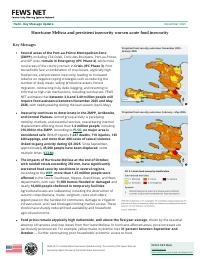
FEWS NET indique que plusieurs zones de la zone métropolitaine de Port-au-Prince (ZMPP) - Cité Soleil, Croix-des-Bouquets, Port-au-Prince et les sites de déplacés - restent en Urgence (Phase 4 de l'IPC), tandis que la plupart des zones rurales restent en Crise (Phase 3 de l'IPC). Face à la combinaison de pertes agricoles, de prix alimentaires atypiquement élevés et d'insécurité persistante, les ménages pauvres recourent de plus en plus à des stratégies négatives : réduction des repas, vente d'actifs productifs, migration forcée, endettement risqué, mendicité et échanges sexuels de survie.
FEWS NET estime que 3,0-3,49 millions de personnes auront besoin d'aide alimentaire entre novembre 2025 et mai 2026, avec un pic pendant la soudure d'avril-mai. L'insécurité continue de se détériorer dans la ZMPP, l'Artibonite et le Plateau Central, aucun corridor majeur n'étant considéré comme sûr (PLSO) ; le BINUH a rapporté 1 247 morts, 710 blessés, 145 enlèvements et plus de 400 cas de violences sexuelles liés aux gangs au T3 2025, et environ 45 000 personnes déplacées depuis septembre. L'ouragan Melissa, avec des pluies dépassant 250 mm, a affecté plus de 1,25 million de personnes dans le Sud, le Sud-Est, les Nippes, la Grand'Anse et l'Ouest, avec plus de 11 900 maisons inondées ou endommagées et près de 16 000 personnes hébergées ; les cultures d'automne (banane, maïs, sorgho, racines et tubercules, pois Congo) ont été détruites dans les communes les plus touchées.
Le maïs jaune à Jérémie a augmenté de 31% entre septembre et octobre. L'aide alimentaire d'urgence reste très inférieure aux besoins : sur 360 000 personnes identifiées par le PAM pour une assistance immédiate, seules 12 700 (3,5%) ont été atteintes lors des premières distributions, et le Plan de réponse humanitaire de 908 millions de dollars n'est financé qu'à 21%.
Texte Intégral du Document
Texte extrait du document original pour l'indexation.
Hurricane Melissa and persistent insecurity worsen acute food insecurity
Key Messages
Haiti - Key Message Update November 2025
Several areas of the Port-au-Prince Metropolitan Zone
(ZMPP), including Cité Soleil, Croix-des-Bouquets, Port-au-Prince,
and IDP sites, remain in Emergency (IPC Phase 4), while most
rural areas of the country remain in Crisis (IPC Phase 3). Poor
households face a combination of crop losses, atypically high
food prices, and persistent insecurity, leading to increased
reliance on negative coping strategies such as reducing the
number of daily meals, selling productive assets, forced
migration, contracting risky debt, begging, and resorting to
informal or high-risk mechanisms, including survival sex. FEWS
NET estimates that between 3.0 and 3.49 million people will
require food assistance between November 2025 and May
2026, with needs peaking during the lean season (April–May).
Insecurity continues to deteriorate in the ZMPP, Artibonite,
and Central Plateau. Armed group activity is paralyzing
mobility, markets, and essential services, exacerbating internal
displacement affecting more than 1.4 million people, including
210,000 in the ZMPP. According to PLSO, no major area is
considered safe. BINUH reports 1,247 deaths, 710 injuries, 145
kidnappings, and more than 400 cases of sexual violence
linked to gang activity during Q3 2025. Since September,
approximately 45,000 people have been displaced, some
multiple times (CCCM).
The impacts of Hurricane Melissa at the end of October,
with rainfall totals exceeding 250 mm, have significantly
worsened food security conditions in several regions.
According to the WFP, more than 1.25 million people were
affected in the South, Southeast, Nippes, Grand’Anse, and West
departments, with over 11,900 homes flooded or damaged and
nearly 16,000 people sheltered in temporary facilities.
Agricultural losses are substantial, including the destruction of
autumn crops (banana, maize, sorghum, roots and tubers,
pigeon peas) in the hardest-hit communes, damage to irrigation
infrastructure, and road blockages limiting market access. These
shocks have sharply reduced food availability and household
agricultural income.
Food prices remain atypically high nationwide, well above the five-year average, driven by the seasonal
absence of harvests and crop losses from Hurricane Melissa. In hurricane-affected areas, price increases are
particularly pronounced. For example, yellow maize in Jérémie rose 31 percent between September and
October — further constraining poor households’ economic access to food.
FEWS NET is a United States Government-funded activity. The content of this report does not
necessarily reflect the view of the United States Government.
FEWS NET Haiti
haiti@fews.net
fews.net/latin-america-and-caribbean/haiti
Recommended citation: FEWS NET. Haiti Key Message Update November 2025: Hurricane Melissa and persistent insecurity
worsen acute food insecurity, 2025.
Key Message Update
This Key Message Update provides a high-level analysis of current acute food insecurity conditions and any changes to FEWS NET's latest projection of acute food insecurity outcomes
in the specified geography. Learn more here.
Despite significant scale up in areas affected by Hurricane Melissa, emergency food assistance remains
far below needs. Of the 360,000 people identified by WFP as requiring immediate assistance, only 12,700
(3.5 percent) were reached during initial distributions. A second phase aims to assist about 190,000 people, but
implementation depends on security, logistics, and funding. According to OCHA, the Humanitarian Response
Plan for Haiti, estimated at $908 million, is only 21 percent funded.
*
FEWS NET's classifications are IPC-compatible. IPC-compatible analysis follows key IPC protocols but does not necessarily reflect the consensus of national food security partners. As of IPC
3.0, the IPC no longer assesses the impact of food assistance on classification and thus no longer maps the (!). However, FEWS NET continues to produce food security maps inclusive of the
(!) as well as maps compatible with IPC 3.0/3.1, which include the mapping of food security assistance bags. FEWS NET and the IPC use different methods to estimate the total Population in
Need of humanitarian food assistance and assess the risk of Famine. Learn more at www.fews.net/about.
Key Message Update November 2025
Famine Early Warning Systems Network
2