
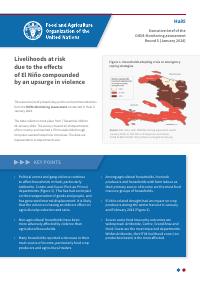
Haïti : Note de synthèse de l'évaluation DIEM-Suivi, Cycle 5 (janvier 2024)
Résumé — Cinquième cycle de l'enquête DIEM de la FAO auprès des ménages en Haïti, couvrant 1 974 ménages dans les dix départements par entretiens téléphoniques assistés par ordinateur entre le 7 décembre 2023 et le 20 janvier 2024. Les moyens d'existence sont de plus en plus menacés par les conditions sèches liées à El Niño combinées à une nouvelle recrudescence des troubles politiques et de la violence des gangs, en particulier dans l'Artibonite, le Centre et l'Ouest.
Constats Clés
- L'évaluation DIEM de janvier 2024 a couvert les dix départements et 1.974 ménages par entretiens téléphoniques réalisés du 7 décembre 2023 au 20 janvier 2024.
- Les troubles politiques et la violence des gangs continuaient d'affecter les ménages, surtout dans l'Artibonite, le Centre et l'Ouest, en perturbant le transport, en provoquant des déplacements et en affectant probablement de manière indirecte la production et les ventes agricoles.
- L'insécurité alimentaire aiguë sévère était généralisée, avec l'Artibonite, le Centre, la Grand'Anse et le Nord-Ouest comme départements les plus touchés et la zone de moyens d'existence HT04 du bassin rizicole comme zone la plus affectée dans l'Artibonite.
- Les conditions El Nino présentes depuis le milieu de 2023 ont entraîné des pluies inférieures à la moyenne dans la majeure partie du pays, et le manque d'eau d'irrigation a touché 46 pour cent des producteurs agricoles.
- Les ménages producteurs exposés à la violence ont signalé plus de difficultés de production que ceux non exposés, 81 pour cent contre 75 pour cent, et plus de difficultés de vente, 60 pour cent contre 44 pour cent.
- Les ménages vivant surtout du travail agricole faisaient face à l'insécurité alimentaire la plus sévère et près de la moitié n'avaient participé à aucune activité agricole pendant l'année précédente.
Texte Intégral du Document
Texte extrait du document original pour l'indexation.
Haiti
Executive brief of the
DIEM-Monitoring assessment
Round 5 (January 2024)
Livelihoods at risk
due to the effects
of El Niño compounded
by an upsurge in violence
Figure 1. Households adopting crisis or emergency
coping strategies
This executive brief presents key points and recommendations
from the DIEM-Monitoring assessment conducted in Haiti in
January 2024.
The data collection took place from 7 December 2023 to
20 January 2024. The survey covered all 10 departments
of the country and reached 1 974 households through
computer‑assisted telephone interviews. The data are
representative at department level.
Source: FAO. 2024. Haiti: DIEM-Monitoring assessment results
(January 2024). In: FAO Data in Emergencies Hub. Rome.
[Cited 13 March 2024]. https://data-in-emergencies.fao.org
KEY POINTS
• Political unrest and gang violence continue
to affect households in Haiti, particularly
Artibonite, Centre and Ouest (Port‑au‑Prince)
departments (Figure 3). This has had an impact
on the transportation of goods and people, and
has generated internal displacement. It is likely
that the violence is having an indirect effect on
agricultural production and sales.
• Among agricultural households, livestock
producers and households with farm labour as
their primary source of income are the most food
insecure groups of households.
• Non-agricultural households have been
more adversely affected by violence than
agricultural households.
• Severe acute food insecurity outcomes are
widespread. Artibonite, Centre, Grand’Anse and
Nord-Ouest are the most impacted departments.
Within Artibonite, the HT04 livelihood zone (rice
production basin) is the most affected.
• Many households reported a decrease in their
main source of income, particularly food crop
producers and agricultural traders.
• El Niño related drought had an impact on crop
producers during the winter harvest in January
and February 2024 (Figure 2).
Analytical overview for agricultural
households
Figure 2. Normalized Difference Vegetation Index
Anomaly, January 2024
El Niño‑related drought present before upsurge
in violence
• El Niño conditions have been present since the middle
of 2023, inducing below-average rainfall across most
of the country. The lack of irrigation water affected
46 percent of crop producers and had an impact on
the winter harvest.
Social unrest adding to El Niño effects on
agricultural livelihoods
• Crop‑producing households that were exposed to
violence faced more production difficulties (81 percent)
than those who were not (75 percent), and more sales
difficulties (60 percent) than those who were not (44
percent). The data show a correlation between livestock
sales difficulties and violence. The departments of
Artibonite, Centre, Grand’Anse and Nord-Ouest are
among those most affected by food insecurity.
•
Source: FAO. 2024. GIEWS Earth Observation. Haiti. In: FAO,
1 January 2024. Rome. [Cited 15 March 2024]. https://www.fao.
org/giews/earthobservation/country/index.jsp?code=HTI
This is most pronounced for poultry and caprine
producers compared to cattle owners. Small owners
were more affected than producers with a larger
herd size. Similarly, households only producing
crops with no livestock‑related income were worse
off than households with crops and livestock. This
could indicate that households that produce crops
and own animals have a higher coping capacity than
households who only own animals or crops.
In the context of severe acute food insecurity,
households are engaging in coping strategies that are
harmful for their livelihoods – decreasing non‑food
expenses and selling productive assets (Figure 1).
In addition, households that only own animals and do
not produce crops, are particularly affected by severe
food insecurity, according to the household hunger
scale (HHS).
•
Figure 3. Households reporting violence in
Artibonite, Centre and Ouest departments
Source: FAO. 2024. Haiti: DIEM-Monitoring assessment results
(December 2022, July 2023, January 2024). In: FAO Data in
Emergencies Hub. Rome. [Cited 13 March 2024].
https://data-in-emergencies.fao.org
2
The data indicate that violence is correlated with
increased hunger, which is in line with the latest
Integrated Food Security Phase Classification (IPC)
update released on 22 March 2024.
Agricultural labour particularly affected
• Households with farm labour as main income are
facing the most severe food insecurity and engaging in
more harmful coping strategies than other agricultural
livelihoods. Almost half of the households, who live
mainly from agricultural labour, did not engage in
any agricultural activity over the last year. These
households declared being affected by drought and
floods more frequently than the other households –
and were affected by a decrease in production driven
by drought – exhibiting the highest HHS scores.
Action points
•
In addition to emergency support needed to cover
immediate needs, support must be provided for
the upcoming printemps (spring) growing season to
increase sources of income for many food‑insecure
households – including farm workers – and increase
food availability for the future.
•
Any disengagement in agricultural activities decreases
local food availability in the future and increases the
dependence on imports. Long-term support to grain
production basins could potentially improve coping
capacity at the local level.
Support to agricultural livelihoods would likely create
more and better income opportunities for these
households. It is crucial to support the upcoming
printemps (spring) growing season by securing the
availability of seeds and fertilizer, with a focus on areas
with maize production, and lower levels of insecurity
for replanting in case of drought or floods early in
the season.
•
Many households are in immediate need of cash or
coupons to access food to save lives and protect
livelihoods, particularly in Artibonite, Centre,
Grand’Anse and Nord-Ouest departments.
Supporting local trade from local production would
increase the level of local food autonomy and
decrease the reliance on imported food that has to
circulate through Port-au-Prince.
FAO. 2024. Haiti: Executive brief of the DIEM-Monitoring assessment,
round 5 (January 2024). Livelihoods at risk due to the effects of El Niño
compounded by an upsurge in violence. Rome. https://doi.org/10.4060/
cd0293en
The boundaries and names shown and the designations used on the map
in this information product do not imply the expression of any opinion
whatsoever on the part of FAO concerning the legal status of any country,
territory, city or area or of its authorities, or concerning the delimitation of
its frontiers and boundaries. Dashed lines on the map represent approximate
border lines for which there may not yet be full agreement.
Some rights reserved. This work is available
under a CC BY-NC-SA 3.0 IGO licence
FAO Representation in Haiti
FAO-HT@fao.org
www.fao.org/haiti | @FAOHaiti
Port-au-Prince, Haiti
Office of Emergencies and Resilience
Data-in-emergencies@fao.org
data-in-emergencies.fao.org | @FAOEmergencies
Rome, Italy
Food and Agriculture Organization
of the United Nations
© FAO, 2024
CD0293EN/1/04.24
•
•
Comment citer
Organisation des Nations Unies pour l'alimentation et l'agriculture (FAO), Haïti : Note de synthèse de l'évaluation DIEM-Suivi, Cycle 5 (janvier 2024), https://reliefweb.int/attachments/87cec12d-1efe-49c2-ab9d-7e5a1b20670f/cd0293en.pdf