Texte Intégral du Document
Texte extrait du document original pour l'indexation.
1
Haiti: Tropical Storm Melissa | Grand-Sud
Situation Report | 26 October 2025
The thirteenth tropical storm of the season, named
Melissa, is currently moving through the Caribbean Sea and
expected to intensify rapidly into a major hurricane by
Sunday, posing serious flood risks. Haitian authorities have
placed the Sud and Grand-Anse departments under red
alert, while Nippes, South-East, and West departments
remain on amber alert. These mostly rural areas, whose
populations depend primarily on agriculture, are already
affected: persistent rains, strong winds, and adverse sea
conditions have damaged crops and the environment,
disrupted routes, increasing the risk of food insecurity. The
table below presents early findings from field
observations and information gathered from key
informants for the period 21–25 October 2025.
Department Observed phenomena Agricultural impacts
Nippes
Moderate intermittent rains;
localized landslides (Anse à Veau,
locality of Fleury, mainly at Morne
Pio). Swollen rivers. Adverse sea
conditions at Miragoâne.
§ Bean harvests from the summer campaign in humid mountain
zones (Plaisance and Baradères) compromised (premature
sprouting, rotting).
§ Flood risk in key areas of agricultural production.
§ No livestock losses reported at this stage.
Sud
Moderate intermittent rains and
winds. Swollen rivers. Adverse sea
conditions reported in Aquin,
Cavaillon, and Côteaux, calmer
conditions elsewhere.
§ Bean harvests from the summer campaign in humid mountain
zones (Camp-Perrin, Maniche and Les Anglais) compromised
(premature sprouting, rotting).
§ Avocado trees uprooted.
§ Interruption of, and delays, in the winter campaign preparation.
§ No livestock losses reported at this stage.
§ Flooded roads, limited field access.
Sud-Est
Persistent light to moderate rains
and winds. Adverse sea
conditions.
§ 15 ha of maize confirmed destroyed (Mapou, Belle-Anse).
§ Losses in pigeon pea and bean at the flowering stage.
§ Avocado trees uprooted in mountainous areas (Corail Lamothe).
§ Fishing infrastructure damaged in Jacmel.
§ Livestock losses reported (under assessment).
Grand-
Anse
Light to moderate rains, heavy at
Beaumont. Sustained winds.
Adverse sea conditions at Les
Irois, Anse d’Hainault, and Dame-
Marie.
§ No major agricultural losses reported at this stage.
§ Localized flooding at Anse d’Hainault.
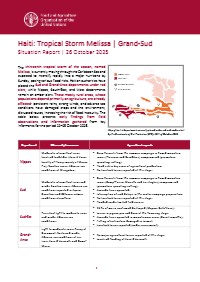
Map of Haiti's departments currently placed under red and amber alert
by the Directorate of Civil Protection (DPC), 26th of October 2025.
Ouest
Sud-Est Sud
.
Red alert
Amber alert
Cyclone warning
Rain warning
Grand-Anse
Sud
Nippes Ouest
Sud-Est
2
Across at-risk areas, current weather conditions already
undermine ongoing agricultural activities linked to the
summer campaign, disrupting preparations for the upcoming
winter campaign, and threatening rural households’ incomes
and food security. Maritime activities, such as fishing along the
southern coast, are fully suspended due to hazardous sea
conditions.
According to the October 2025 Integrated Food Security Phase
Classification (IPC) analysis, the four southern departments
threatened by the hurricane were already facing a Crisis level of
food insecurity (Phase 3), with some areas at risk of slipping
into Emergency (Phase 4). Over 1.4 million people in these
departments are in IPC Phase 3, including more than 350 000
in Emergency (Phase 4). Road and market disruptions could
rapidly raise staple food prices, restrict movement, and limit
farmers’ access to fields. As these areas are largely home to
agriculture-dependent households, the hurricane poses a high
risk of livelihood collapse unless swift action is taken to
restore productivity.
Preliminary on-the-ground analyses already indicate the need
to implement an emergency response aimed at protecting
and restoring heavily compromised livelihoods and
production. This response will focus on two axes:
• Rehabilitation of key rural infrastructure, notably clearing
field tracks and repairing destroyed or damaged structures
(under assessment);
• Distribution of agricultural inputs and vouchers for seeds
and fishing equipment, to enable the immediate resumption
of productive activities after the tropical storm’s passage.
Currently, FAO, together with the Ministry of Agriculture,
Natural Resources and Rural Development (MARNDR), is
assessing contingency stocks available in the Grand-Sud and the possibility of repurposing already planned
distributions to respond to the emergency. FAO has pre-positioned 1 000 emergency food production kits in
Port-au-Prince and is assessing their mobilization to the Grand-Sud.
FAO, with MARNDR, continues to monitor the evolving impact on agriculture, fisheries, livestock, and the
environment, with rapid assessments underway to quantify the extent of the damage to the sector. A
comprehensive field analysis, including collecting quantitative data through household surveys, is essential to
guide subsequent interventions.
Sources:
§ Directorate of Civil Protection (DPC), October 2025.
§ Integrated Food Security Phase Classification (IPC), October 2025.
§ Disaggregated estimates of the Haitian population in 2024, Haitian Institute of
Statistics and Informatics.
§ Information from direct exchanges with key informants and representatives of
local communities.
FAO Representation in Haiti
FAO-HT@fao.org
Food and Agriculture Organization of the United
Nations | © FAO, 2025
Plantain plantation in Haiti’s Sud Department,
damaged by the severe winds caused by tropical
storm Melissa.
Coastline of Haiti’s Sud Department, flooded and
strewn with debris following the passage of tropical
storm Melissa. Fishing activities are suspended.