
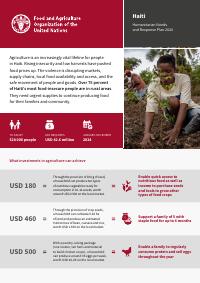
Haïti : Plan de réponse aux besoins humanitaires 2024 (chapitre FAO)
Résumé — Chapitre FAO du Plan de réponse aux besoins humanitaires 2024 pour Haïti, sollicitant 42,6 millions de dollars pour venir en aide à 528 000 personnes de janvier à décembre 2024. Il présente l'agriculture comme une bouée de sauvetage de plus en plus vitale alors que l'insécurité croissante, les faibles récoltes et les marchés perturbés font grimper les prix alimentaires, plus de 75 pour cent des personnes les plus en insécurité alimentaire vivant en zone rurale.
Texte Intégral du Document
Texte extrait du document original pour l'indexation.
Haiti
Humanitarian Needs
and Response Plan 2024
Agriculture is an increasingly vital lifeline for people
in Haiti. Rising insecurity and low harvests have pushed
food prices up. The violence is disrupting markets,
supply chains, local food availability and access, and the
safe movement of people and goods. Over 75 percent
of Haiti’s most food-insecure people are in rural areas.
They need urgent supplies to continue producing food
for their families and community.
528 000 people
FAO REQUIRES
USD 42.6 million
JANUARY–DECEMBER
2024
©FAO
TO ASSIST
What investments in agriculture can achieve
USD 180
Through the provision of 100 g of seed,
a household can produce ten types
of nutritious vegetables ready for
consumption in 10-12 weeks, worth
around USD 2 500 on the local market.
Enable quick access to
nutritious food as well as
income to purchase seeds
and tools to grow other
types of food crops
USD 460
Through the provision of crop seeds,
a household can cultivate 0.24 ha
of land and produce an estimated
0.66 tonnes of bean, cassava and rice,
worth USD 1 350 on the local market.
Support a family of 5 with
staple food for up to 6 months
USD 500
With a poultry-raising package
(one rooster, ten hens and material
to build chicken coops), a household
can produce around 35 eggs per week,
worth USD 20‑25 on the local market.
Enable a family to regularly
consume protein and sell eggs
throughout the year
Projected acute food insecurity situation (March–June 2024)
North Atlantic Ocea n
Nord-Ouest
Integrated Food Security
Phase Classification (IPC)
1 – Minimal
Nord
Nord-Est
2 – Stressed
3 – Crisis
Artibonite
4 – Emergency
5 – Famine
Centre
Grande-Anse
Ouest
Nippes
Sud
Not analysed
Ouest
Ca ribbea n S ea
T H E D O M IN ICAN
R EP U B L IC
Sud-Est
0
50 km
Urgency of humanitarian agricultural assistance
Haiti remains one of nine countries in the world facing the risk of famine
and one of five countries with more than 10 percent of the population in
Emergency (IPC Phase 4). Indeed, the number of Haitians in Emergency
(IPC Phase 4) has steadily increased over the past four years, despite a slight
decrease in 2023, with 620 000 people projected to experience high levels
of acute food insecurity in March–June 2024 if appropriate assistance is
not provided.
The humanitarian situation in the country has sharply deteriorated due to
overlapping crises, namely linked to intensified violence perpetrated by
armed groups, record‑high inflation, climate shocks and epidemics such
as cholera. Gang violence continues to have a detrimental effect on the
population’s food security, with an increase in kidnappings, armed attacks
and sexual violence. This has resulted in major internal displacement and
the disruption of markets and of the movement of people and goods,
including agricultural products.
The delay of the rainy season and rainfall deficits affected the outcome
of the 2023 spring season – typically representing half of the national
agricultural production – while heavy rains in mid-November triggered
severe flooding damaging crops, homes and infrastructure. This has led to
local agricultural production deficits and market supply chain dysfunction
that maintain food prices high, hindering availability of and access to
food. In 2023, agricultural production has decreased by around 39 percent
for maize, 34 percent for rice and 22 percent for sorghum compared with
the five‑year average.
Boosting vulnerable farming families’ agricultural and livestock production
will increase their self-reliance and strengthen their resilience against
future shocks.
Source: IPC. 2023. Haiti: Integrated Food Security Phase Classification
Snapshot, August 2023–June 2024. Port-au-Prince, Haiti. https://
www.ipcinfo.org/fileadmin/user_upload/ipcinfo/docs/IPC_Haiti_
AcuteFoodInsec_Aug2023_June2024_Snapshot_English.pdf
Drivers of food insecurity
Gang violence
Internal displacement
Inflation
Socio-political unrest
Climatic shocks
Key facts
Country population: 11.8 million
4.43 million people likely to
experience high levels of acute food
insecurity (IPC Phase 3 or above)
115 600 children suffer from
severe acute malnutrition, a
30% increase compared with 2022
64 400 suspected cases
of cholera (September 2023)
200 000 internally displaced
people, of whom 93% due
to gang violence
USD 9.10 out of 100
in humanitarian assistance to food
sectors went to support agriculture
and livelihoods (2016–2022)
In 2023, FAO reached about 18 500 households (92 500 people)
through emergency agricultural support. For example,
8 140 households benefited from eight distribution campaigns
enabling them to produce a total of 398 tonnes of cereals,
vegetables and tubers; 18 Farmer Field Schools were set up
and 420 people were trained on good agricultural practices for
improved production; 5 000 households received 5 000 small
ruminants and 10 500 poultry; and 6 500 households received a
total of 6 000 tools for market-gardening.
Under the overall lead of the Coordination nationale de la sécurité
alimentaire, the Food and Agriculture Organization of the United Nations
(FAO), as co-lead of the Food Security Sector in Haiti together with the
World Food Programme, works closely with 92 local and international
partners, including the IPC Global Support Unit, to ensure a needs-based,
coordinated and effective response.
©FAO
Coordination
FAO priorities
10 kg of bean seed, 5 kg
of rice seed and 300 cassava
cuttings
Improve staple
food and vegetable
production
Protect livestock
assets and restore
production
Cost per
household
(USD)
460
Number of
beneficiary
households
55 600
Total cost
(USD)
25 576 000
100 g of certified vegetable
seed (aubergine, cabbage,
carrot, chili, leek, okra,
onion, pepper, spinach and
tomato), tools (watering can,
machete, etc.) and 50 kg of
fertilizers
180
25 000
4 500 000
Provision of goats
500
15 000
7 500 000
Provision of poultry and
material for building
chicken coops
500
10 000
REQUIRED CITATION
FAO. 2024. Haiti: Humanitarian Needs and Response Plan 2024. Rome. https://doi.org/10.4060/cc9501en
The boundaries and names shown and the designations used on the map(s) in this information product do not
imply the expression of any opinion whatsoever on the part of FAO concerning the legal status of any country,
territory, city or area or of its authorities, or concerning the delimitation of its frontiers and boundaries. Dashed
lines on maps represent approximate border lines for which there may not yet be full agreement.
Some rights reserved. This work is available
under a CC BY-NC-SA 3.0 IGO licence
Funds needed by
Planned
implementation
period
Main/spring season:
February
February–March
Summer season:
June
July–September
Autumn season:
August
September–January
Year-round
Year-round
March
April–December
5 000 000
Contact
FAO Representation in Haiti
FAO-HT@fao.org | fao.org/haiti
Port-au-Prince, Haiti
FAO Office of Emergencies and Resilience
OER-Director@fao.org | fao.org/emergencies
Rome, Italy
Food and Agriculture Organization
of the United Nations
©FAO, 2024
CC9501EN/1/02.24
Type of assistance to
be provided/content of
assistance package
Priority
Comment citer
Organisation des Nations Unies pour l'alimentation et l'agriculture (FAO), Haïti : Plan de réponse aux besoins humanitaires 2024 (chapitre FAO), https://reliefweb.int/attachments/876afd0f-47e7-4470-b047-70da248daed7/cc9501en-2.pdf