
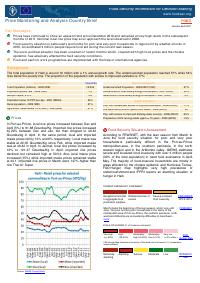
Note de suivi et d'analyse des prix par pays : Haïti, janvier-avril 2011
Résumé — Note de suivi des prix pour Haïti, financée par l'Union européenne et préparée par la FAO dans le cadre du programme Food Security Information for Decision Making, couvrant janvier-avril 2011. Elle signale que les prix alimentaires ont poursuivi leur tendance haussière depuis décembre 2010, le prix nominal du riz local se rapprochant des niveaux de 2008, dans un contexte aggravé par l'incertitude socio-politique et l'épidémie de choléra.
Constats Clés
- La note de suivi des prix de janvier-avril 2011 indique que les prix ont continué à augmenter depuis décembre 2010 et sont restés très élevés au début de 2011, les prix nominaux du riz local approchant les niveaux de 2008.
- La note estime que 3 millions de personnes avaient besoin d'aide alimentaire pendant la période de soudure, avec des ménages pauvres et très pauvres particulièrement touchés dans les zones affectées par les chocs climatiques.
- À Port-au-Prince, les prix du riz local ont augmenté de 5 pour cent de décembre à avril pour atteindre 91,88 gourdes par kg, tandis que les prix du riz importé ont augmenté de 20 pour cent de décembre à janvier avant de retomber à 40,42 gourdes par kg en avril.
- À Jacmel, les prix du riz local ont augmenté de 10 pour cent pour atteindre 121,27 gourdes par kg en avril, tandis que le riz importé restait élevé à 50,54 gourdes par kg.
- La section bilan alimentaire indique que la production agricole de 2010 a souffert du séisme, de l'ouragan Tomas et de l'épidémie de choléra, et que les récoltes de riz de l'Artibonite et du Sud-Ouest attendues en avril-mai devaient être inférieures de 20 à 30 pour cent à la moyenne.
- La production totale était de 502.000 tonnes, soit 9 pour cent sous la production de 2009 et 8 pour cent sous la moyenne, tandis que les besoins d'importations 2010-2011 étaient estimés à 636.000 tonnes.
Texte Intégral du Document
Texte extrait du document original pour l'indexation.
Food Security Information for Decision Making
www.foodsec.org
European Union
Price Monitoring and Analysis Country Brief
Haiti
January-April 2011
Key Messages
Prices have continued to show an upward trend since December 2010 and remained at very high levels in the subsequent
months of 2011. Nominal local rice price may soon approach the level observed in 2008.
Food security situation is particularly worrisome for poor and very poor households in regions hit by weather shocks in
2010. An estimated 3 million people require food aid during the current lean season.
The socio-political situation has been uncertain in recent months which, coupled with high food prices and the cholera
epidemic, has adversely affected the food security conditions.
Food and cash for work programmes are implemented with the help of international agencies.
Background
The total population of Haiti is around 10 million with a 1% annual growth rate. The undernourished population reached 57% while 54%
lives below the poverty line. The proportion of the population with access to improved sanitation is 17%.
Economic Indicators
Total Population (millions) - 2009 (WB)
View Data
10.033
Food Consumption
Undernourished Population - 2005/2007 (FAO)
57%
Population growth rate - 2009 (WB)
1%
Cereal share in total dietary energy consumption - 2007 (FAO)
46%
GNI per capita, $ PPP
n.a.
Meat share in total dietary energy consumption - 2007 (FAO)
4%
Population below 1$ PPP per day - 2001 (MDGI)
54%
Rural population - 2009 (WB)
51%
Agriculture, value added (% of GDP) - 2003 (WB)
27%
Prices
In Port-au-Prince, local rice prices increased between Dec and
April (5%) to 91.88 Gourdes/Kg. Imported rice prices increased
by 20% between Dec and Jan, but then dropped to 40.42
Gourdes/kg in April. In the same period, local and imported
maize prices fell by 12% and 6% respectively. Local maize was
stable at 22.05 Gourdes/Kg since Feb, while imported maize
was at 40.42 in April. In Jacmel, local rice prices increased by
10% to 121.27 Gourdes/Kg in April; imported rice prices
declined, but remained high at 50.54. Also local maize price
increased (15%) while imported maize prices remained stable
at 44.1. Imported rice prices in March were 147% higher than
rice Thai A1 Super.
Health Indicators
Pop. with sustainable access to improved sanitation - 2008 (WHO)
17%
Life expectancy at birth (years) both sexes - 2008 (WHO)
62
Pop. with access to improved drinking water sources - 2008 (WHO)
63%
Prevalence of HIV among adults aged >= 15 years - 2009 (WHO)
1.9%
Food Security Situation Assessment
According to FEWSNET, with the lean season from March to
June, the food security situation for poor and very poor
households is particularly difficult in the Port-au-Prince
metropolitan area, in the southern peninsula, in the north
western region and in the Artibonite valley. GIEWS estimates
severe and localized food insecurity with over 3 million people
(30% of the total population) in need food assistance in AprilMay. The majority of food-insecure households are mostly in
areas affected by the cholera epidemic and Hurricane Tomas.
FAO Hunger map highlights very high prevalence of
undernourishment and IFPRI reports an alarming situation of
hunger in Haiti.
CURRENT EMERGENCY ASSESMENT
Exceptional shortfall Widespread lack of
in aggregate food
access
production supplies
Severe localized
food insecurity
FAO/GIEWS
CPFS 2010
March marks the beginning of the lean season, which runs until
FEWSNET
June. The poor and very poor households in the slums of the
metropolitan area of Port-au-Prince, the southern peninsula, northwest and Artibonite are encountering difficulties to meet basic ...
more
SCALE OF HUNGER (% of Undernourishment)
Very high
(>= 35%)
High
(25-34%)
Moderately
Moderately
high (15-24%) low (5-14%)
Very low
FAO
(< 5% under.) Hunger Map
FAO Hunger Map classifies all countries of the world into five based on % of population
undernourished.
Extremely
alarming
Source: GIEWS Country Briefs
Alarming
Serious
Moderate
Low
IFPRI/2010
GHI
Food Security Information for Decision Making
www.foodsec.org
European Union
Haiti
Vegetation Condition
Food Balance Sheet
At the beginning of the rainy season, a very contrasted situation
is observed ranging from very poor to very good conditions with
some concerns in the provinces of Ouest, Nord-Ouest and NordEst. The general indicator of vegetation condition provided
below is the relative difference between the NDVI for April 2011
and the average of the last 10 years, calculated on the
agricultural zones derived from the GLOBCOVER 2005
database (ESA).
Crop production in 2010 suffered from the earthquake
devastation and from Hurricane Tomas. Moreover the cholera
outbreak had extremely affected labour force. Rice harvest in
Artibonite and the southwest, due in April-May, is expected to
be some 20-30% below average. Total production was at
502,000T,9% below 2009 output and 8% below average.
Imports requirements are put at 636,000 MT for the 2010/11
marketing year (June/July), almost the same level of 2009/10.
Source: GIEWS Country Briefs
Source: JRC MARS – FoodSec
Government Policies
Crop phase in the reference period
Sowing
Beans - Maize - Rice
Growing
Beans - Maize
Harvesting
Beans - Sorghum
Natural Disasters, Drought and Conflicts
The country underwent presidential and legislative elections in
March. Mr Martelly, the new president, will take office by midMay. The international community raised concern over
allegations of fraud in final results of legislative elections. The
president has asked for an independent verification of
legitimacy.
Refugees and IDPs
Total in the country
Total outside the country
2007
2008
Consumer and market oriented
measures
n.a.
Producer oriented measures
Stabilize oil prices
Trade policy measures
n.a.
Safety net (increased or introduced)
Food and cash work programmes
2009
2
3
23
32539
35737
36015
Source: UNHCR Statistical Online Population Database, United Nations High Commissioner for
Refugees (UNHCR), Data extracted on 01/12/2010.
Disaster Type (last year)
Due to the uncertain political situation, the Government’s ability
to undertake agricultural and food security measures is
undermined; however 2.5 million Gourdes from the current
fiscal year were allocated to stabilize oil prices in order to
support transport costs. Meanwhile the population is assisted
by international agencies through cash and food for work
programmes.
Different sources
Current events to watch (Click to see the full report)
No News Found
For more information, contact: Information-for-action@fao.org
Website: www.foodsec.org
Date
Location
Alert
Earthquake
2010-11-12
Ouest
Province
1/3
Powered By the GIEWS Workstation
Earthquake
2010-09-21
Ouest
1/3
The Programme on Linking Information and Decision Making to Improve Food Security is funded by
the European Union and implemented by the Food and Agriculture Organization of the United Nations.
Flood
2010-11-05
Western Haiti
1/3
Source: Global Disaster Alert and Coordination System - 3 = 1000 or more people killed or 800000
or more people displaced. 2 = 100 or more people killed or 80000 or more displaced.
Comment citer
Union européenne; Organisation des Nations Unies pour l'alimentation et l'agriculture (FAO), Note de suivi et d'analyse des prix par pays : Haïti, janvier-avril 2011, https://reliefweb.int/attachments/97c0dc03-1e5c-3872-9e2d-0d8be4b82ee0/Full_Report.pdf